
Our readers keep the lights on and my morning glass full of iced black tea. As an Amazon Associate, I earn from qualifying purchases.
Specs are compiled from manufacturer listings and verified buyer reviews and can change over time — please confirm the key details on the product page before buying.
You pull a deep vacuum on a mini-split, service a car’s AC, or stabilize wood. The right two-stage pump decides if you finish the job in minutes or fight a leak all afternoon. A single-stage pump leaves moisture behind. A two-stage (dual-stage) pump crushes the vacuum deep enough — below 50 microns — to boil that moisture out before it freezes in the lines. This guide compares seven real 2-stage pumps, from mid-range workhorses to a pro-level Fieldpiece, so you know which one earns a spot on your bench.
The pump’s ultimate vacuum depth — the lowest pressure it can reach, measured in microns — is the single number that tells you how dry and clean your system will be. Skip a weak pump and you leave moisture, acid, and performance-killing non-condensables (gases that do not condense at normal temperatures) in the lines. Ready to find your best 2 stage vacuum pump? Let’s get into it.
Our Picks at a Glance


How To Choose The Best 2 Stage Vacuum Pump
A two-stage vacuum pump uses two sets of rotors and vanes in series (one after the other) to pull a much deeper vacuum than a single-stage pump can reach. That depth — measured in microns (a unit of absolute pressure; 1 micron = 0.001 mmHg) — determines how thoroughly you remove moisture and contaminants from an AC or refrigeration system. Here are the three specs that separate a reliable pump from one that lets you down mid-job.
Ultimate Vacuum (Micron Rating)
The ultimate vacuum is the lowest pressure the pump can achieve at its inlet. A pump rated for 1.5 microns (0.2 Pa) can boil water at a much lower temperature, pulling moisture out of refrigerant oil and preventing acid formation. By contrast, a pump that only reaches 20 or 50 microns may leave enough moisture to freeze in the expansion valve (the part that controls refrigerant flow). For residential HVAC work, a pump that pulls below 15 microns is ideal. For automotive AC, anything under 50 microns is usually fine.
Motor Power & CFM (Flow Rate)
CFM (cubic feet per minute) measures how fast the pump moves air. A 5 CFM pump is the standard for most home and shop AC work — it evacuates a typical car system or mini-split in under 10 minutes. A 9 CFM pump, powered by a 3/4 HP motor, cuts that time roughly in half. That matters when you work on a large split system or do multiple evacs in a day. But bigger CFM also means more heat, so check the duty cycle: most pumps are rated for continuous 2-hour operation before they need a cooldown.
Refrigerant Compatibility & Safety (A2L / Sparkless)
Newer mildly flammable (A2L) refrigerants like R32 and R1234yf require a pump with a sparkless motor and an ignition-proof ON/OFF switch. If you plan to service modern equipment, look for a pump explicitly labeled “A2L-compatible” with a mechanically isolated switch. Pumps without this rating are safe for R22, R134a, and R410a, but you cannot legally use them on A2L systems in many jurisdictions.
Quick Comparison
| Model | Best For | Ultimate Vacuum | Flow Rate | Motor Power | Amazon |
|---|---|---|---|---|---|
| VIVOHOME 5 CFM (VH321)★ Best Overall | All-around HVAC & auto | 0.3 Pa (~2.2 microns) | 5 CFM | 1/2 HP | Amazon |
| Kozyvacu TA500Budget Champion | Budget-friendly prosumer | 50 microns | 5 CFM | 1/2 HP | Amazon |
| VEVOR 5 CFM | Long-run resin degassing | 20 microns | 5 CFM | 1/2 HP | Amazon |
| Orion Motor Tech (Gray A2L) | A2L / flammable refrigerants | 1.5 microns | 5 CFM | 1/2 HP | Amazon |
| VIVOHOME A2L (VH1397) | Sparkless operation + 15 micron depth | 0.2 Pa (15 microns) | 5 CFM | 1/2 HP | Amazon |
| Orion Motor Tech 9 CFM | Large systems / fast evacs | 1.5 microns | 9 CFM | 3/4 HP | Amazon |
| Fieldpiece VP87 | Pro daily driver / travel | — | 8 CFM | 3/4 HP | Amazon |
In‑Depth Reviews
1. VIVOHOME 110V 1/2 HP 5 CFM Dual Stage Rotary Vane HVAC Air Vacuum Pump
Our pick — over 4★ from 900+ verified ratings; the strongest balance of quality and price.
Quiet, pulls deep, and comes at a price that beats most 2-stage pumps on the shelf.
This VIVOHOME lives in that balance where a pro-grade spec meets a home-shop budget. You get a 1/2 HP motor that spins at 2880 r/min (rotations per minute), driving the dual-stage vanes down to an ultimate vacuum of 0.3 Pa (roughly 2.2 microns) — deep enough to boil moisture out of refrigerant oil before it damages the compressor. The manufacturer claims it reaches that vacuum in about three minutes, so you are not waiting around for the needle to drop.
Buyers report that with quality vacuum-rated hoses, this pump can pull well below its rated spec: one owner measured “10 micron” on a simple test setup. That is a real-world result, not marketing. The pump is compatible with R134a, R12, R22, R502, and R410a (with a 5/16-inch adapter) — so it covers the legacy refrigerants most home mechanics still deal with. It also runs at roughly 65 dB, which is noticeably quieter than the 70 dB rated on the Orion Motor Tech gray pump (a roughly 8% noise gap). The built-in motor current protection shuts things down if it overloads, and the 304 stainless steel coarse filter keeps contaminants out of the pump chamber. The catch: some owners mention a stutter on cold starts, where the pump hesitates like a car failing to turn over before it catches. If you work in an unheated garage, let the pump warm up at room temperature before loading it.
Why it works
- 0.3 Pa ultimate vacuum — deep enough for residential and auto AC work
- 65 dB operation is noticeably quieter than the 70 dB Orion Motor Tech (gray) pump
- Includes both 1/4-inch SAE and 1/2-inch Acme fittings for flexible connections
- Oil sight window and bottom drain make maintenance simple
The trade-offs
- Occasional hesitation on cold starts reported by some users
- Integrated breaker can trip if the pump struggles to start after sitting
Reach for it if: you want the deepest vacuum for the dollar in a pump that runs cool and quiet for home HVAC or auto AC work.
Look elsewhere if: you need a sparkless motor for A2L refrigerants — this VIVOHOME is not A2L-rated.
2. Dual-Stage HVAC Vacuum Pump, 5.0 CFM (Kozyvacu TA500)
A no-frills two-stage pump that gives the DIY crowd real evacuation power without the premium price.
The Kozyvacu TA500 hits a 50 micron ultimate vacuum and a 5.0 CFM flow rate — numbers that put it in the middle of the pack on paper, but buyers consistently report better results. One owner measured “37 microns on short hose test.” That is a strong real-world pull, and it comes from the same 1/2 HP rotary vane (a rotating vane-style pumping mechanism) design found in pumps costing more.
The TA500 runs on 110V/60Hz, so it plugs into a standard household outlet without any adapter. The inlet ports are 1/4-inch flare and 1/2-inch male, covering the most common AC service hoses. The build is workable but has an honest flaw: customers note that the plastic base feels brittle and one unit arrived defective, losing vacuum after warming up. Buyers also report that with high-quality aftermarket oil like Inland 19 ULTRA, the pump pulls down to 3 microns directly on an MKS901p gauge — showing the pump’s core is solid even if the case feels budget-tier. The 380 ml oil capacity holds 15% more oil than the VEVOR 5 CFM pump.
What works
- 380 ml oil capacity — holds 15% more oil than the VEVOR 5 CFM pump
- Buyers confirm pulls below 50 microns with good oil and short hoses
- Versatile use: HVAC, freeze dryer, resin degassing, vacuum packaging
What doesn’t
- Plastic base reported to crack under stress
- No check valve — oil can backflow if the pump stops under vacuum
Smart pick for: DIYers and prosumers who run a pump 2-3 times a year and want the best bang for their dollar.
skip it if: you need a sparkless motor for A2L refrigerants, or want a metal chassis for daily commercial use.
3. VEVOR 5 CFM 2 Stage Rotary Vane Vacuum Pump 1/2 HP

A heat-sinked pump engineered for runs beyond two hours without cooking itself.
You get a 5 CFM pump built for long sessions: a T-shaped heat sink and a dedicated cooling fan help the pure copper motor shed heat during resin degassing or wood stabilization. The manufacturer claims it runs continuously for “over 2 hours” — a spec most other pumps do not even risk stating. The ultimate vacuum is 20 microns, which is adequate for HVAC and auto work but falls short of the 1.5 micron pumps in this list (a 13.3x gap compared to the Orion Motor Tech gray pump). The oil capacity is 330 ml, and the pump runs on 120V/60 Hz.
The user-friendly touches are real: an anti-backflow inlet with a check valve and ball valve switch prevents oil from creeping back into your system, and the oil fume discharge filter element cuts down smoke and noise. The ergonomic handle has a rubber-clad iron structure that makes the 20.5-pound unit (roughly 10% heavier than the VIVOHOME 5 CFM’s 18.7 pounds) easier to carry. But the VEVOR has a documented reliability issue: one reviewer noted it “failed on second use; locks up and shuts off.” Another owner who uses it for vacuum casting reports 80 successful casts with regular oil changes, so the problem is not universal — but if you want a pump you never worry about, the VIVOHOME or Orion options inspire more confidence.
Built to last
- Dedicated cooling fan and T-shaped heat sink for extended run times
- Anti-backflow check valve prevents oil contamination of your system
- Compatible with R32 and R1234yf (A2L) refrigerants
Risk factor
- Multiple reports of pump locking up on second use
- 20 micron rating is far shallower than the 1.5 micron Orion Motor Tech pumps
Grab it for: resin degassing or wood stabilization where continuous run time and heat management matter more than absolute micron depth.
Pass on it if: reliability is your top concern — the QC variance is real.
4. Orion Motor Tech Vacuum Pump 5 CFM Gray | 2 Stage A2L

A sparkless, ignition-proof pump that pulls down to 1.5 microns — the gold standard for modern A2L systems.
This is the pump to buy if you work with R32, R1234yf, or other mildly flammable refrigerants. The motor is intentionally sparkless (no sparks generated inside), with an ignition-proof ON/OFF switch, so there is no arc risk when you pull a vacuum on a system that may have residual gas. And it does not sacrifice depth for safety: the manufacturer rates it at 1.5 microns (0.2 Pa) — the same deep vacuum target as the much larger 9 CFM Orion Motor Tech pump, and far deeper than the VEVOR’s 20 micron limit (a 13.3x gap). The 3450 rpm motor delivers 5 CFM, which is on par with the VIVOHOME and Kozyvacu pumps, but the 14.9 fl. oz. oil tank means fewer refills during long jobs.
The pump runs at or below 70 dB, which buyers describe as “super quiet” — one novice AC owner wrote he “was able to draw down my mini split to 120 microns pretty fast” after nitrogen pressure testing. The oil mist-free cap on the combined oil fill/exhaust port keeps the workbench cleaner. It runs on 120V, while some competing dual-stage pumps use 110V (a roughly 9% voltage difference). The catch: at 22.5 pounds, this is the heaviest pump in the 5 CFM tier — 3.8 pounds heavier than the VIVOHOME and 2 pounds heavier than the VEVOR. That weight comes from the reinforced bottom and sturdy motor housing, but if you are carrying it up a ladder all day, the Fieldpiece VP87 (8 CFM at a lighter build) may be a smarter investment.
Safety + depth
- Sparkless motor and ignition-proof switch — required for A2L refrigerants
- 1.5 micron ultimate vacuum — 13.3x deeper than the VEVOR’s 20 microns
- Oil mist-free cap reduces cleanup and protects the workspace
Weight penalty
- 22.5 pounds — noticeably heavier than most 5 CFM competitors
- 70 dB noise level is roughly 8% louder than the 65 dB VIVOHOME
Best for: HVAC pros and serious DIYers who need a safe, deep-pulling pump for modern A2L systems and do not mind the extra heft.
Consider the Fieldpiece VP87 instead if: your budget stretches further and you need a lighter, faster pump for daily commercial use.
5. VIVOHOME 1/2 HP 5 CFM 2 Stage A2L HVAC Vacuum Pump (VH1397)

An A2L-compatible VIVOHOME that carries the same 1/2 HP motor with a sparkless twist.
If you liked the standard VIVOHOME pick but need A2L compliance, this is the same family with an explosion-proof motor. The pump draws down to 15 microns (0.2 Pa) with a 5 CFM flow rate — slightly shallower on paper than the 1.5 micron Orion Motor Tech gray pump, but reviewers point out real-world numbers that close the gap. One buyer wrote that the pump “pulled a 12K minisplit to 134 microns in less than 5 minutes.” That is a fast, effective evacuation for a mid-size residential unit. The pump comes with two bottles of oil (330 ml and 230 ml), so you have a fill and a spare right from the start.
Like the original VIVOHOME, this version uses a thermally protected motor with a T-shaped heat fin and mesh vent design to keep internal temps down during extended pulls. The intake filter prevents dust ingress, and the exhaust fitting separates oil mist from the exhaust gas. The 20.1-pound weight is roughly in line with the VEVOR and slightly heavier than the original VIVOHOME (18.7 pounds), but the ergonomic handle and rubber base make it stable on a workbench. The main difference from the standard VIVOHOME is the sparkless motor, which allows it to handle R32, R1234yf, and R454B alongside the usual R134a and R410a. If you do not need that A2L rating, save some money and get the original VIVOHOME (product 1) for the same 1/2 HP performance.
Safe and fast
- Sparkless motor certified for A2L refrigerants (R32, R1234yf, R454B)
- Shoppers say pulling a 12K mini-split to 134 microns in under 5 minutes
- Two bottles of vacuum oil included (330 ml + 230 ml)
Niche overlap
- 15 micron rating is not as deep as the 1.5 micron Orion Motor Tech gray pump
- If you don’t need A2L, the standard VIVOHOME (product 1) gives similar performance for less
Choose it for: A2L-compliant evacuation with a trusted brand and fast pull-down on residential split systems.
Stick with the original VIVOHOME if: you only work with R22, R134a, and R410a — no need to pay extra for the sparkless motor.
6. Orion Motor Tech 2 Stage Vacuum Pump, 9 CFM 3/4 HP
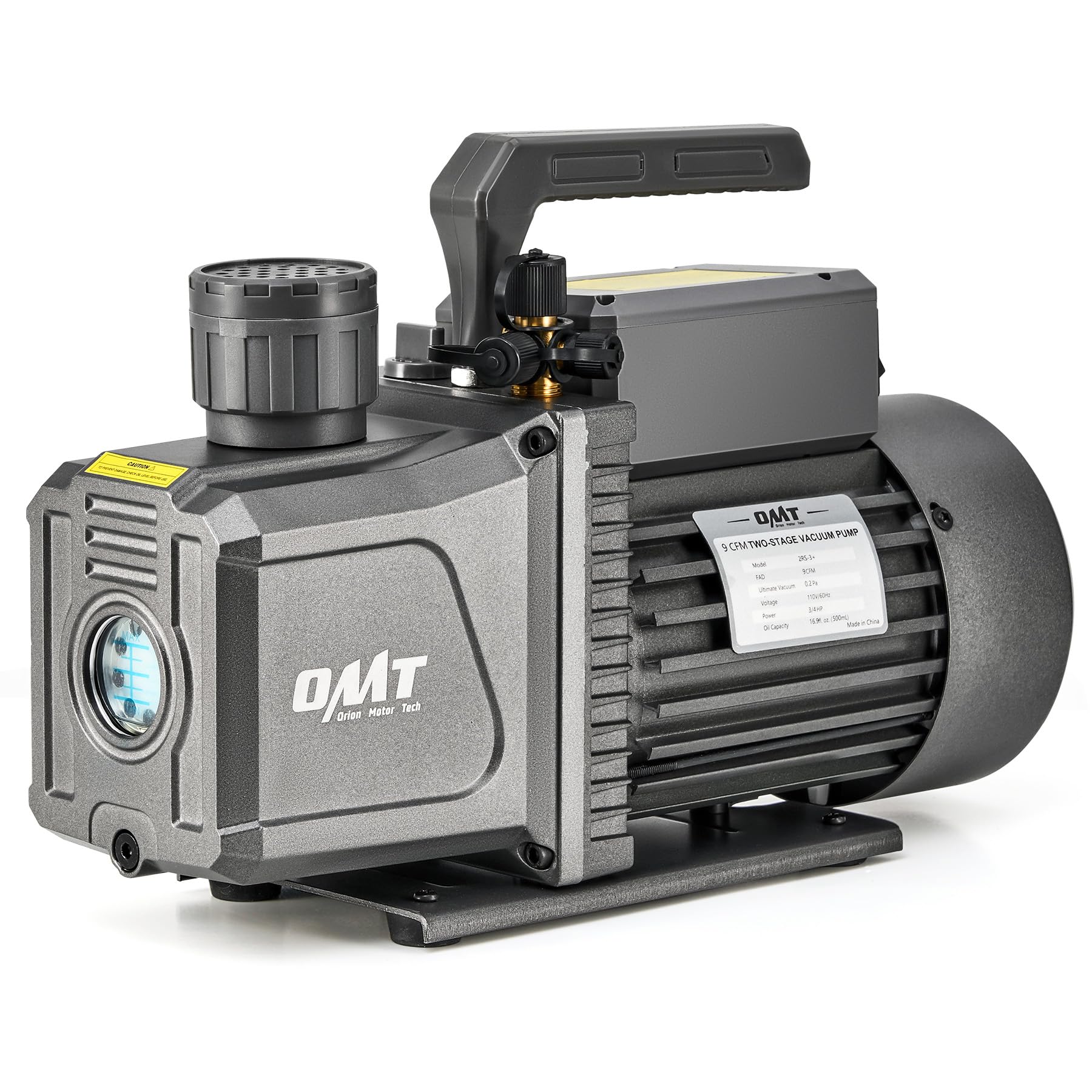
A 3/4 HP, 9 CFM beast that hits 1.5 microns fast enough to make large system evacs feel quick.
At 9 CFM, this Orion Motor Tech pump moves nearly twice the air of the 5 CFM pumps above — and it makes a real difference on large split systems, walk-in coolers, or any job where you would otherwise wait 20 minutes for the needle to drop. The 3/4 HP copper motor is paired with a direct coupling to the pump head, which improves power transfer and keeps noise below 70 dB. It shares the same 1.5 micron ultimate vacuum as the 5 CFM Orion Motor Tech gray pump, so the depth is identical; you just get there faster. The 12.8 fl. oz. oil reservoir includes a sight glass and scale so you can check levels mid-job without guessing.
Buyers are enthusiastic. One owner used it for an 8+ hour continuous pull on a BMW G30 evaporator replacement — the pump ran the whole time without overheating and got the AC “ice-cold.” Another buyer hit 4 microns on the pump alone and 50 microns through a manifold in one minute. The pump runs on 110V and draws 558 watts. The catch: durability reports are mixed. One buyer’s pump lost capacity after about 120 run hours over two months of daily use, even with proper oil changes. That is a niche but real risk if you are running a pump every workday. The port caps are also plastic — some buyers recommend replacing them with metal fittings for longevity.
Speed demon
- 9 CFM flow rate cuts evac time roughly in half compared to 5 CFM pumps
- 1.5 micron ultimate vacuum — professional-grade depth
- Detachable power cable prevents wire damage during transport
Longevity question
- One buyer mentioned pump failure after ~120 run hours
- Plastic port caps; metal replacements recommended for daily use
Grab it for: fast evacuations on large residential and light commercial systems where every minute saved is money earned.
Pass if you are a daily pro: the Fieldpiece VP87 below has a stronger reliability record for continuous use.
7. Fieldpiece VP87 Vacuum Pump – 8 CFM, 3/4 HP DC Motor

The pro’s choice: a lightweight 8 CFM pump with a rapid oil-change system that keeps you moving between jobs.
Fieldpiece designed the VP87 around one problem every HVAC tech knows: oil changes are the most tedious part of pump maintenance. The RunQuick Oil Management System lets you swap oil in seconds — drain, refill, and go — without tilting the pump or making a mess. It comes with two 8 oz bottles of oil, so you are ready for the first change right away. The 3/4 HP DC motor drives 8 CFM, putting it close to the 9 CFM Orion Motor Tech in speed while running on a more energy-efficient DC platform. The dual-stage design is A2L-compatible, and the pump itself is noticeably lighter and more compact than the 26-pound Orion 9 CFM unit — a real advantage when you are carrying it up a ladder or between buildings.
Buyers who do “a lot of refrigeration work” call it “very reliable” — one flew with the pump across the US multiple times with zero issues. Reviews consistently mention quiet operation and a durable build that feels solid in the hand. The catch is the price: it sits at the far premium end of this list, and for a hobbyist or part-time DIYer, the VIVOHOME or Orion Motor Tech pumps deliver similar functional performance at a fraction of the cost. The VP87 is for the pro who needs a pump that survives daily abuse and does not waste time on maintenance.
Pro-level convenience
- RunQuick oil change — drains and refills in seconds
- Lightweight and compact for a 3/4 HP pump, easy to fly with or carry on ladders
- Buyers report flawless reliability on frequent and long-duration pulls
Price premium
- Significant cost premium over the 5 CFM and 9 CFM Orion Motor Tech pumps
- 8 CFM is slightly slower than the 9 CFM Orion; the difference is small for most jobs
Worth it if: you work as a full-time HVAC professional and need a pump you can service in seconds and trust to run all day, every day.
pass on it if: you are a DIYer — the VIVOHOME or Orion Motor Tech 5 CFM will handle your annual evacs without the premium spend.
Understanding the Specs
Microns — The Real Depth Check
Microns measure absolute pressure (one micron = 0.001 mm Hg). The lower the number, the deeper the vacuum. A pump rated for 1.5 microns pulls far more moisture out of a system than one rated for 50 microns. For comparison: at 1.5 microns, water boils at roughly -80°F, so any moisture trapped in the refrigerant oil vaporizes and gets pulled out. For residential HVAC, target a pump that hits 15 microns or below. For auto AC, 50 microns is usually enough, but deeper is always better for preventing freeze-ups later.
CFM — The Speed Factor
Cubic feet per minute (CFM) tells you how fast the pump moves air. A 5 CFM pump is the standard for home and shop use — it evacuates a typical 1.5-ton mini-split or a car AC system in 5 to 10 minutes. A 9 CFM pump cuts that time roughly in half, which is valuable on large split systems or when you are doing multiple evacs in a single service call. The trade-off is that higher CFM pumps are heavier (more motor and vane surface) and typically cost more. If you mostly work on small residential units, 5 CFM is plenty. If you regularly pull on 3+ ton systems, step up to 8 or 9 CFM to save time.