
Our readers keep the lights on and my morning glass full of iced black tea. As an Amazon Associate, I earn from qualifying purchases.
Specs are compiled from manufacturer listings and verified buyer reviews and can change over time — please confirm the key details on the product page before buying.
Most people who buy a 2-stroke bicycle engine kit run into the same wall: the motor is fine, but the chain, carburetor, or clutch lets go before the first month is out. The kits that survive break-in ship an upgraded chain tensioner, an 8mm mounting stud, and a tunable carburetor; the rest fail in the first month. That is what this list sorts out — real engine size, real hardware, and what actually holds up on the road.
I’m Min — the founder and writer behind Gadgets Feed. This guide is built by comparing the manufacturers’ published specifications and the patterns across verified customer reviews, so you get each pick’s real strengths and trade-offs instead of marketing spin.
Every option here has real weaknesses worth knowing before you buy. Some kits need a new spark plug on day one, others need a better chain and clutch before you trust them at speed, and one is honest about being a 66cc engine sold as a 100. Each kit below has a documented weak point — a stock spark plug, a thin chain, a fussy carburetor — so pick the one you can fix yourself. This guide covers the 2 stroke bicycle engine kit options buyers actually finish building and keep.
Quick Picks
- 100cc Bicycle Engine Kit, 2 Stroke Bike Motor — Best Overall
- Sange 2 Stroke Pedal Cycle Petrol Gas Motor — Rider Favorite
- Sange 2 Stroke Pedal Cycle Petrol Gas Motor — Custom Builder’s Pick
- 2 Stroke 100cc Bicycle Motorized Gasoline — Best Instructions
- DNYSYSJ 100cc 2-Stroke Bicycle Engine Kit — Built for Big Riders
- 80cc 2 Stroke Bicycle Engine Motor Gas — Best for Small Frames
- IMAYCC Bike Motor Kit 80cc Motorized Bike Kit 2 — Most Reviewed
- 110cc 2-Stroke Bicycle Gasoline Engine Motor — Most Displacement
- IMAYCC Bike Motor Kit 100cc Motorized Bike Kit — Best Torque
How To Choose The Best 2 Stroke Bicycle Engine Kit
A bike engine kit arrives as an engine, fuel tank, sprocket, chain, and loose bolts that must line up with a frame the manufacturer has never measured. You are getting an engine, a fuel tank, a sprocket, a chain, and a bag of bolts that all have to line up with a bicycle frame the manufacturer has never seen. Kits with an 8mm mounting stud, an upgraded chain tensioner, and a printed assembly guide are the ones that finish the build.
Engine displacement — what the number actually tells you
An “80cc” kit and a “100cc” kit are usually closer in real cylinder size than the names suggest, and several reviews here confirm exactly that: buyers opened a “100cc” kit and measured a 66cc engine inside. Treat the label as a rough category, not a measurement. The displacement spec that matters is bore and stroke, and only a few listings in this guide print it. A kit that publishes its bore and stroke in millimeters is a kit that expects you to check.
Frame fitment is the real gatekeeper
Nearly every kit here fits 26-inch and 28-inch bikes, and most need a V-frame with clearance between the bottom bracket and the top bar. The IMAYCC kits call for 10 inches or more of that vertical space on a 26-inch bike. Measure that gap before you order anything — it is cheaper than shipping a kit back.
Hardware quality decides whether the kit lasts two weeks or two years
Chains snap, clutch cables fray, fuel filters fail, and carburetor bolts rattle loose across this category. Kits with an upgraded chain tensioner, an 8mm mounting stud (versus a 6mm), or a tunable carburetor buy you real durability headroom. Budget kits often need another round of parts before they are trustworthy.
Quick Comparison
| Model | Best For | Engine | Top Speed | Weight | Amazon |
|---|---|---|---|---|---|
| 100cc Bicycle Engine Kit (Frederimo) | First-time builders on a budget | 100cc 2-stroke, air-cooled | — | 10.84 kg package | Amazon |
| Sange 2 Stroke Pedal Cycle (80cc Black) | Hobbyists who enjoy a puzzle | 80cc 2-stroke, air-cooled | 45 km/h | 24.2 lb | Amazon |
| Sange 2 Stroke Pedal Cycle (100cc Black) | Customizers chasing top speed | 100cc 2-stroke, air-cooled | 50 km/h | — | Amazon |
| 2 Stroke 100cc Bicycle Motorized (H-YEEU Black) | Riders who want easy instructions | 100cc 2-stroke, air-cooled | 55 km/h | — | Amazon |
| DNYSYSJ 100cc 2-Stroke Bicycle Engine Kit | Heavier riders and big frames | 100cc 2-stroke, air-cooled | — | — | Amazon |
| H-YEEU 80cc 2 Stroke (Red) | Smaller riders and tight frames | 80cc 2-stroke, air-cooled | 38 km/h | 24.7 lb | Amazon |
| IMAYCC Bike Motor Kit 80cc Silver | Riders who want a proven seller | 80cc 2-stroke, air-cooled | — | — | Amazon |
| 110cc 2-Stroke Bicycle Gasoline (Silver) | Long-haul riders chasing cc | 110cc 2-stroke, air-cooled | — | 25.9 lb | Amazon |
| IMAYCC Bike Motor Kit 100cc Black | Torque-hungry riders and hills | 100cc 2-stroke, air-cooled | 50 km/h | 26.4 lb | Amazon |
In‑Depth Reviews
1. 100cc Bicycle Engine Kit, 2 Stroke Bike Motor Kit Petrol Gas Motor Conversion Kit Air-Cooling Motorized Bicycle Kit Super Fuel-efficient Modified Full Set 36

The lowest-cost complete 100cc kit for a 26–28″ bike you already own.
Your defining spec is the 100cc air-cooled two-stroke cylinder, paired with mounting hardware for 26-to-28-inch wheel frames. That covers most adult bikes you could pull out of the garage. The kit arrives as a full set — engine, tank, sprocket assembly, hardware — and the air-cooling design handles the temperature load without a radiator or water pump to service. Aluminium, steel, and plastic make up the build, and the whole package lands at 10.84 kg, so it is a substantial box to move before you even open it.
Assembly is where this one asks for patience, and every review confirms it. The printed instructions are thin on detail, but the work itself is not unusual once you have watched a couple of YouTube guides on this style of conversion. The engine fires up easily and holds a steady idle once the wiring and clutch cable are set correctly. What matters most post-install is the fuel mix — this kit wants a proper break-in oil-and-gas ratio, and skipping that is how people end up with a rough-running motor. A few buyers had units that were delivered and then stolen before they could even test them, which says nothing about the engine but a lot about where you leave the box.
The real catch is the carburetor on some units. It arrives needing a breather adjustment before it will run cleanly, and if you don’t catch that, you get a motor that refuses to fire. The 4:1-style quality-and-reliability pattern in the reviews is genuinely mixed — some riders are delighted from the start, others hit a build issue. That mismatch is not a defect pattern so much as a variance pattern, and it is typical here for a kit this inexpensive.
complete 100cc kit
- Complete 100cc air-cooled two-stroke kit with tank and hardware, ready to mount on a standard 26–28″ frame.
- Light enough at 10.84 kg package weight that you can lift it onto a bench alone and have it mounted in an afternoon.
- Engine starts and idles smoothly when the wiring, clutch, and break-in mixture are set correctly.
vibration at speed
- Instructions are minimal — plan on a YouTube walkthrough before you start.
- Carburetor on some units needs a breather adjustment before the engine will run.
- Fit quality varies kit to kit; the mounting hardware is the most common friction point.
first-time builders: you want a complete, affordable first kit for a 26–28″ bike and you are comfortable following a YouTube build.
quiet commuters: you need turnkey assembly or you plan to ride hard from the start.
2. Sange 2 Stroke Pedal Cycle Petrol Gas Motor Conversion Kit Air Cooling Motorized Engine Kit for Motorized Bike (80cc Black)

An 80cc kit for riders who enjoy the build — mounting the rear sprocket is the hardest step.
The 80cc single-cylinder air-cooled engine tops out at 45 km/h, and the whole rig weighs 24.2 pounds on the scale. It fits most 26-inch and 28-inch bikes — mountain, road, cruiser — and the ignition runs on a capacitor discharge system rather than points, which means fewer moving parts to foul. Fuel consumption lands around 3 liters per 100 kilometres, so a small tank stretches a good while between fill-ups.
What wins people over is the sheer fun factor. Getting the back wheel mounted is described as the hardest part of the whole job, and owners who enjoy that puzzle report the engine running smooth, the clutch giving a clean start every time, and immediate plans for a second build. If you are the kind of person who loves a mechanical challenge, this is the kit that rewards you for it. If you are not, mechanical skill is mandatory — this asks for drilling, some angle-grinding, and real troubleshooting before it runs.
The honest limitation is the accessory furniture around the engine. The throttle grip is glued on cheaply, the carburetor can be fussy straight from the start, and the kit does not include zip ties. Buyers report spending extra on upgrades to make the whole setup trustworthy over bumps. An occasional unit also arrives with a broken motor, so inspect everything before you bolt it on — Sange has been slow to respond to a few of those complaints, and the return label experience is inconsistent.
budget tinkerers: you want a fun, mechanically engaging project and you are comfortable upgrading the grips, carb, and cable work yourself.
premium seekers: you want a bolt-and-ride kit or you don’t enjoy troubleshooting fuel and clutch behaviour.
3. Sange 2 Stroke Pedal Cycle Petrol Gas Motor Conversion Kit Air Cooling Motorized Engine Kit for Motorized Bike (100cc,Black)

The kit that reads like a 100 and rides like a stockier motor.
What this 100cc air-cooled single-cylinder kit gives you is headroom: a 50 km/h rated top speed and the same 3-liters-per-100-kilometres fuel appetite as its smaller Sange sibling. It fits the usual 26-inch and 28-inch mountain, road, and cruiser frames, and ships with the engine, fuel tank, muffler, and hardware needed to complete the swap. The capacitor discharge ignition keeps the starting process clean and repeatable.
Owners who sprocket-swap this kit tend to love it. One rider paired a 32-tooth rear sprocket and hit 40 mph, dropped to a 28-tooth and reached 43, and even saw 52 mph tucked behind a vehicle before worrying about over-revving. Budget a few hours of tuning and expect that kind of response with the right gearing and pipe. The build quality earns real fans too — one owner called it the best motor kit they’d bought and singled out the included bullet head and speed carb clone as quality surprises.
Where this Sange asks for honesty is durability. Chain breaks almost immediately on some units, the thin clutch cable on others fails by the third ride, and a whole cohort of buyers received an engine that stopped working within the first week. That is a genuine mixed-reliability pattern, not a one-off. The clutch lever also feels loose enough on some kits that a rider reported almost crashing because it wouldn’t hold — a fair warning to check and tighten before your first proper ride. The displacement label is also a soft promise — reviewers measuring the “100cc” found closer to 66cc in the real cylinder.
DIY mechanics: riders who plan to sprocket-swap and upgrade the chain, clutch lever, and cable as part of the build and want a base with proven top-end potential.
plug-and-play fans: you want a stock kit to work reliably from the start or reliability-matters-most for your commute.
4. 2 Stroke 100cc Bicycle Motorized Gasoline Engine Motor Kit (Black)
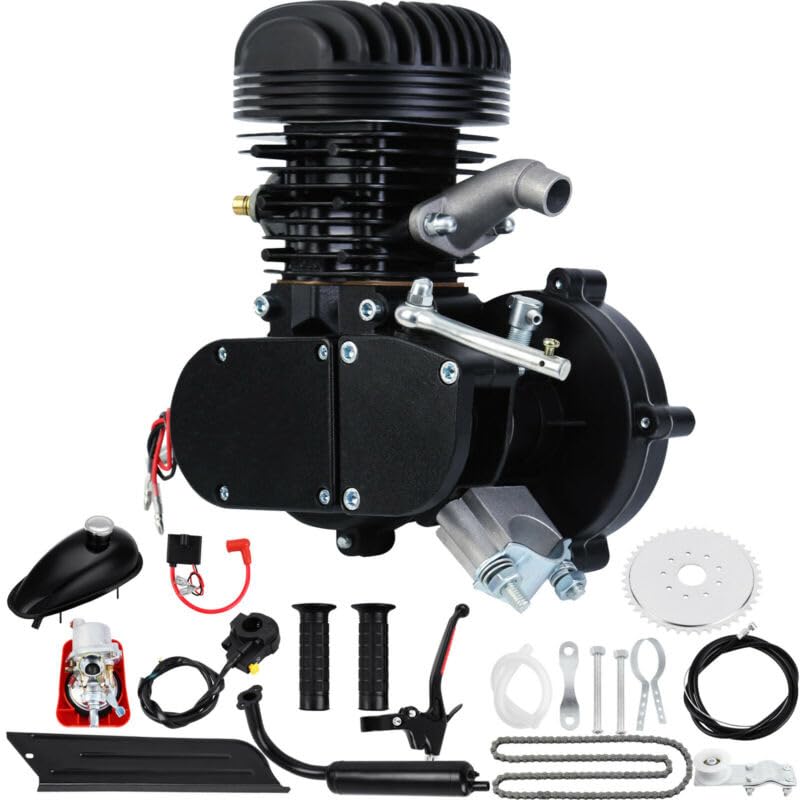
The rare kit whose manual is actually worth reading before you start.
Here is what buyers keep repeating about this H-YEEU 100cc air-cooled two-stroke: the instructions are genuinely good. Detailed assembly steps are included, along with all the required hardware, and the ignition runs on capacitor discharge with electronic spark — the same reliable pattern the rest of the category uses. The engine is rated for 55 km/h top speed and sips 2.5 liters per 100 km, making it one of the more fuel-stingy kits in this guide.
The build is set up for mountain bikes and paved roads, with rear derailleur configuration, twist-grip shifting, and rim brakes as the intended match. That set of specs tells you H-YEEU expected this to go on a fairly ordinary adult mountain bike, not a custom chopper. Owners who followed the manual closely report straightforward installation, everything in the box matching the listing, and the bike moving properly once it is buttoned up.
The catch lives in the carburetor. Multiple buyers had to rebuild it before the engine would run at all, and one reported the clutch wouldn’t properly disengage or engage again. That said, if you get a unit with a clean carb, this thing fires up fast — one owner reported 55 mph cruising on a properly set motor, another put 5 miles on in the first day. The engine also requires a careful 18:1 gasoline-to-oil break-in mix and lubricant oil before every start. Skip that ritual and cylinder scoring becomes a real risk.
100cc gasoline engine: The seller’s biggest investment is clearly the printed guide, which is why this kit suits first-time builders better than most of the lineup. Pictures are clear, wiring is spelled out, and the parts bag matches the list.
manual quality: Carburetor fussiness on delivery is the biggest complaint. Confirm the carb is factory-clean and don’t skip the 18:1 break-in ratio if you want the motor to last.
hands-on riders: anyone who values an assembly manual they can actually follow and doesn’t want to watch three hours of video before starting.
non-wrenchers: riders unwilling to rebuild a stubborn carburetor or check the clutch for proper throw.
5. DNYSYSJ 100cc 2-Stroke Bicycle Engine Kit – Gas/Petrol Motorized Bike Conversion Kit for 26″/28″ Bikes

A 50mm bore, 397-pound-rated kit that stops tipping the scales against heavier riders.
The DNYSYSJ answers a specific problem: heavier riders, bigger frames. It uses a 50mm bore single-piece cylinder and head, and the entire kit is rated to carry a maximum recommended weight of 397 pounds. Fuel economy is quoted at 150 miles per gallon, and the recommended break-in mix is 8 ounces of two-stroke oil per gallon of gas. The kit runs a 44-tooth sprocket, a red speed carburetor, and an upgraded CDI — the ignition box that converts the magnetic signal from the flywheel into a spark.
The mounting hardware is where this kit outperforms pricier rivals. It uses 8mm engine mount studs where the category standard is 6mm, which the listing points out makes the mounts twice as strong and twice as secure. That matters when you are putting out more torque than the average 66-to-80cc kit, and it is a real reason to pick this kit over the cheap options below. Buyers also give very high marks to the seller’s customer service — response time is fast, they resolve damaged-parts issues, and they help when the fit isn’t right for a specific bike.
The honest limitation is that this kit expects a builder. The instructions are poorly structured, and buyers consistently end up leaning on YouTube guides. Several owners mention upgrading the sprocket, chain tensioner, clutch lever, and the mounting gasket before the kit runs the way they want. It also ships with a stock spark plug that some riders swap out on day one. None of that makes it a bad kit — it makes it a kit for someone who likes the build as much as the ride.
custom builders: you weigh above the average rider, you want proven mounting strength, and you value responsive seller support when something arrives wrong.
stock purists: you want a quiet, bolt-on project — this kit needs the gasket, sprocket, and clutch upgrades to reach its potential.
6. 80cc 2 Stroke Bicycle Engine Motor Gas Motorized Bike Motor Kit(Red)

A compact 5-horsepower 80cc that squeezes into tighter frame space.
This H-YEEU 80cc air-cooled engine is rated for 5 horsepower at 6000 rpm, running a 47mm by 40mm bore-and-stroke cylinder. It tops out around 38 km/h and burns 2.5 liters per 100 km — the lowest fuel appetites here. Fitment is the other half of its appeal: it likes 26-inch and 28-inch bikes with V-frames that have 9 to 11 inches of clearance between the bottom bracket and the top bar, and frame tubes measuring 25 to 29mm. If your bike is on the small side, the numbers tell you directly whether it will fit.
You will need basic hand tools and about 2 to 3 hours for the install, and the kit wants a small pour of lubricant into the air cylinder before the first start. The included kit list is comprehensive — sprocket clamp assembly, exhaust muffler, push-button clutch, heavy-duty chain, bearing chain tensioner, carburetor, CD ignition coil, kill switch on the throttle, chain guard, spark plug, mounting brackets, gaskets — everything you would need for a complete build in a single box. The 18:1 break-in ratio applies here too, along with a lubricant addition before every cold start.
The honest trade-off is fitment and initial quality control. One buyer could not even assemble the chain with the original parts; another found spray paint inside the cylinder and a locked-up engine on arrival. Most problem deliveries get resolved with the seller once they are flagged, but you should not expect this kit to be a perfect fit in your frame — expect to make a light adjustment and check the internals before first start.
80cc strong spec: 5 horsepower at 6000 rpm in an 80cc package is a solid number for this displacement, and the 38 km/h rating keeps it honest as a commuter-speed kit rather than a highway build.
fit not guaranteed: the 9-to-11-inch frame clearance and 25-to-29mm tube spec rule out some bikes entirely, so measure first. Inspect the cylinder for spray paint or factory debris before you mount anything.
spec chasers: riders with compact 26-inch or 28-inch V-frames who want a lower-displacement engine that still has real horsepower behind it.
easy installers: you ride a frame with less than 9 inches of bottom-bracket clearance or you expect the kit to arrive ready to bolt on without inspection.
7. IMAYCC Bike Motor Kit 80cc Motorized Bike Kit 2 Stroke Gas Bicycle Engine Conversion Kit Fit for 26-28″ Bikes Silver
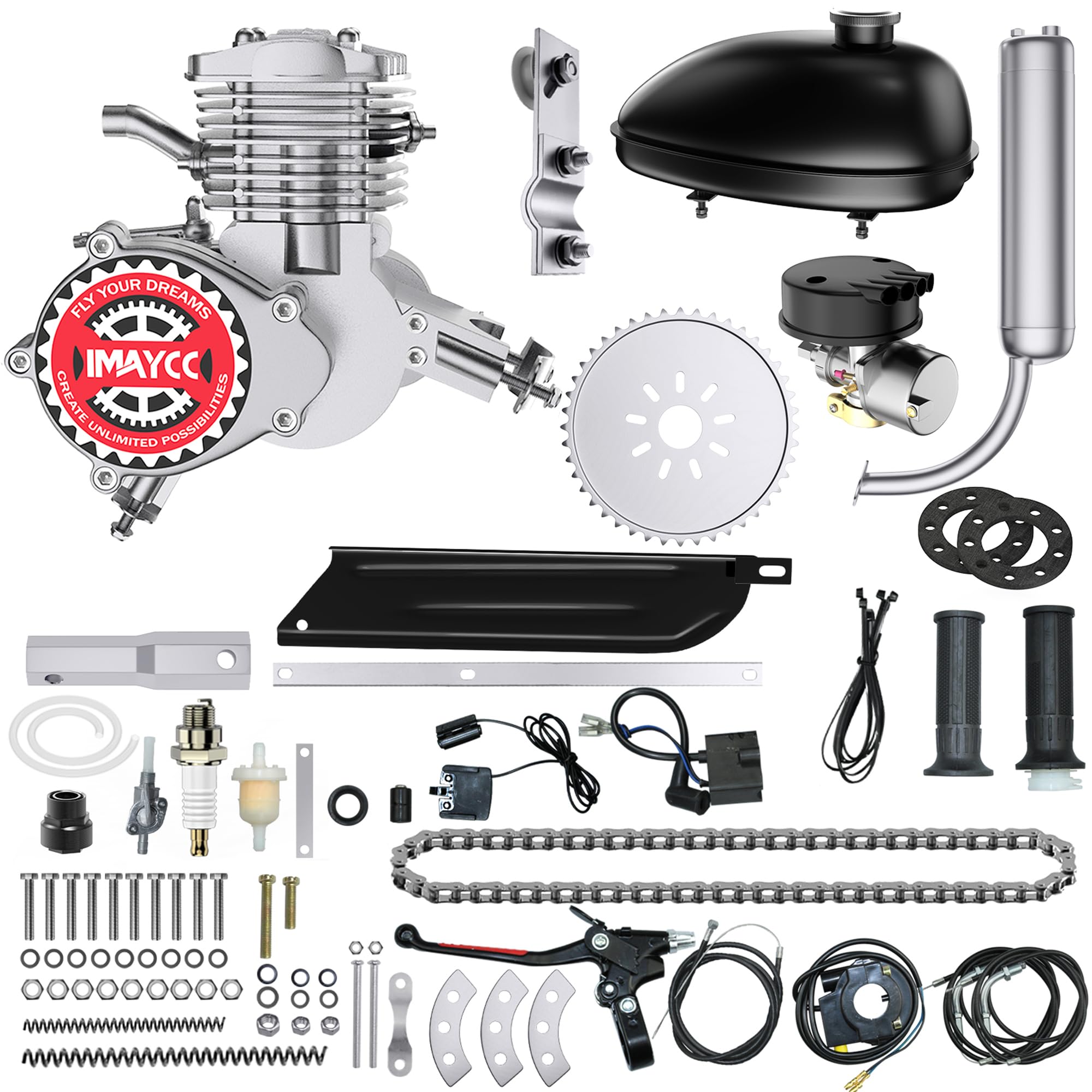
The safest long-term bet — the crowd has clearly done the testing for you.
The headline spec is the 2.1 kW single-cylinder air-cooled two-stroke, rated at 5000 rpm with a 44-tooth sprocket, a 110-knot chain, and 36 spokes — a standard hardware sheet that gives you a proven starting point. You also get a 2.5-litre black teardrop fuel tank and a starting method that uses the foot pedal rather than a pull cord. Ignition runs on CDI, so no points to adjust. Expect 2 to 4 hours of installation and fine-tuning, with IMAYCC explicitly telling you to watch their YouTube guide before starting if it is your first kit.
The reason to trust this kit more than its siblings is simple: it has more real-world owner feedback behind it than any other product in this guide. That volume is the whole point of buying a 2-stroke bike kit — you want to know what actually goes wrong over months, not just what looks good on a listing page. What customers note most is that the motor runs strong once dialed in, and that owners routinely come back for a second kit after their first one survives a proper break-in. The engine responds well to a slow, patient beak-in with a rising oil ratio — one reviewer who has been through four kits recommends starting at 30:1 for the first three tanks, then stepping up to 40:1.
The recurring catch is the small consumables around the engine. The stock spark plug fails quickly, the fuel filter dies within days, and the 110-link chain is often too long and needs a chain breaker to shorten. A weak clutch that demands pedal-first starts is another standard owner fix. None of that is a dealbreaker — but budget an afternoon of upgrades before you call the bike finished.
IMAYCC 80cc kit
- The 2.1 kW / 5000 rpm 80cc single is a proven powerplant with real long-term ownership behind it.
- IMAYCC customer support is responsive and the seller backs the kit through the YouTube installation path.
- Genuinely easy to mod — the ecosystem of upgrades for this chassis is the broadest here.
fixes needed
- Swap the spark plug and fuel filter on day one; the stock parts fail quickly.
- The 110-link chain usually needs shortening with a breaker.
- Clutch wants pedal-first starts; the engagement rod can wear fast on hard use.
near-top pickers: you want the widest real-world track record in the category and you’re comfortable with a small upgrade punch list.
faultless expecters: you want a two-hour install with zero follow-up tinkering — this kit rewards the rider who enjoys a follow-on parts list.
8. 110cc 2-Stroke Bicycle Gasoline Engine Motor Kit Motorized (Sliver)
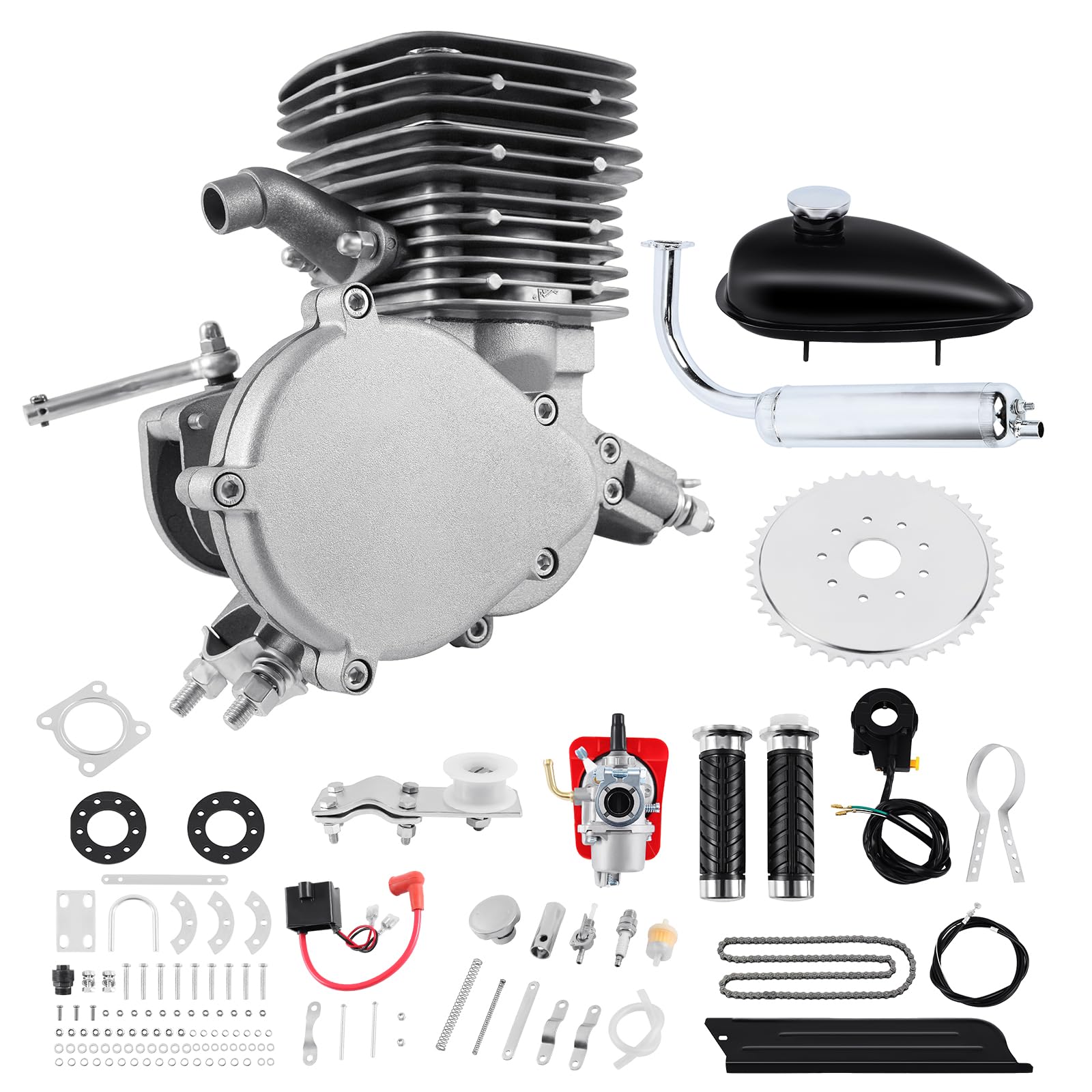
The biggest cylinder on the list — 110cc and 5.5-to-6.5 horsepower of engine.
Here is the displacement leader. Bore and stroke come in at 52mm by 40.2mm, and H-YEEU rates this kit for up to 3.8 kW at 6000 rpm — roughly 5.5 to 6.5 horsepower. The fuel economy quoted is 150 miles per gallon. It ships with an iron cylinder sleeve, weighs 25.9 pounds, and fits most 26-inch and 28-inch mountain, road, and cruiser bikes on mount terrain ranging from paved roads to unpaved trails. Like the sibling H-YEEU 80cc kit, it wants an 18:1 gas-to-oil break-in mix and a splash of lubricant oil before each cold start.
The iron sleeve is the interesting spec here. Iron is used in place of chrome plating to line the cylinder bore, and some buyers treat that as a downside on wear. A long-term owner who installed it that way came away impressed — reporting the engine running smooth at high rpm with no ticks or knocks, even after months of use. The gear-reduction crossover bearings are called out as the weak spot in that configuration, but the underlying engine has held up. Another rider logged over 100 miles with every start firing on the first try, calling it fantastic even at speed.
What you should be prepared for is tune-out variability. One owner found the 110cc wouldn’t push past 17 mph on their setup, another couldn’t get it started at all and found the internals seemed backward. A third reported a slow fuel leak from the tank on an otherwise clean build. These are not universal problems — the displacement and design are sound — but they show why inspecting the delivery and breaking in slowly is not optional. If you want the biggest bore in the category, this is the pick; just don’t skip the fine-tuning.
power seekers: you want the largest displacement engine available here and you’re okay dialing in carburetion, braking, and starting tolerances yourself.
lightweight lovers: your frame is on the smaller end of the 26–28″ wheel range or you want a plug-and-ride experience with minimal setup.
9. IMAYCC Bike Motor Kit 100cc Motorized Bike Kit 2 Stroke Gas Bicycle Engine Conversion Kit Fit for 26-28″ Bikes Black

The bigger sibling to the most-reviewed IMAYCC — an extra 20cc and a lower redline.
Compared to the 80cc IMAYCC above, this 100cc version moves 2 kW at 6500 rpm instead of 2.1 kW at 5000, and it carries a 3-litre fuel tank rather than 2.5. The hardware sheet is otherwise the same shared family of parts: 44-tooth sprocket, 110-knot chain, 36 spokes, CDI ignition, foot-pedal start, and fitment for 26–28″ V-frame bikes with at least 10 inches of clearance between the bottom bracket and top bar. The recommended cruise is 35 to 40 km/h with a 50 km/h cap, drinking 2.5 litres per 100 km.
Owners who finish the build come away with a real respect for the motor. Physically its torque is the standout — one experienced rider who tried several brands called this one “way more torque” and “a better engine overall.” Another described the sound as phenomenal and the pull as instant once the kit was properly installed. The kit ships with the tools needed for assembly, which is unusual at this price and saves a hardware store trip. Expect 2 to 4 hours if you are following the guide and a weekend if you are learning on the fly.
The recurring issues cluster around the small stuff: the chain can snap under load, the fuel filter is fragile, the carburetor bolt comes loose in use, and several reviewers point out the clutch only lasting a couple of months before it needs attention. This is not a plug-and-play box — it wants thread locker on every bolt, a proper 20:1 to 32:1 break-in sequence, and a sprocket upgrade if you ride a coaster-brake rear hub. Do those things and this is one of the strongest picks in its class for the money.
IMAYCC 100cc wins
- 2 kW at 6500 rpm delivers more usable low-end pull than the smaller 80cc sibling.
- Tools included — you can finish the build without a mid-project hardware run.
- Proven chassis family: the same 44-tooth sprocket, CDI, and frame fitment the IMAYCC 80cc line uses.
watch-outs
- Stock chain stretches and snaps for some riders; replace with a heavier unit or add a tensioner.
- Carburetor bolt and exhaust nuts want thread locker and frequent re-torque.
- Clutch wear is a known long-term item — some owners see it wear within a couple of months of regular riding.
performance buyers: you want real torque, the tools to install it, and you plan to do the break-in and bolt-locker maintenance a high-torque build needs.
smaller engine fans: your frame has less than 10 inches of clearance or you want to avoid lugging a heavier 26.4-pound engine around.
Understanding the Specs
Engine Displacement and Real Power
Displacement is the label on the box; real power is what gets to the rear wheel. Buyers in this category quickly learn the two are not the same. A “100cc” kit can ship with a 66cc cylinder by owner measurement, and an “80cc” can move a bike faster than a “100cc” if the gearing favours it. Look for two numbers when you can find them: rated power output (quoted in kilowatts or horsepower per rpm) and bore-and-stroke in millimetres. A kit that prints both is a kit built by someone who expects you to check the numbers, not just the label.
Break-In Ratio and Fuel Economy
Two-stroke engines need oil mixed into the fuel to keep the cylinder and piston lubricated. The ratio matters: too lean and the cylinder scorches, too rich and the spark plug fouls. The kits in this guide quote ratios from 16:1 to 20:1 on break-in, then step out to 32:1 or 40:1 once the engine is seated. After break-in, you can expect around 2.5 to 3 litres per 100 kilometres of fuel use on the smaller engines, and the 150-mile-per-gallon figures on a couple of the kits reflect that same math. Never start one of these cold without adding the oil — the manufacturer of more than one kit in this list calls that out explicitly.
FAQ
Will a 2-stroke bicycle engine kit fit my bike?
How hard is a 2-stroke bike engine kit to install?
What gas-and-oil mix should I use for the break-in period?
How fast will an 80cc or 100cc bike engine kit actually go?
Will a 2-stroke engine kit run with the muffler removed?
Do these kits ship with everything needed for assembly?
How long does the clutch and chain typically last on a 2-stroke bike kit?
Which is better for me, an 80cc or a 100cc 2-stroke kit?
Is a 2-stroke bicycle engine kit legal to ride on the road?
Do these kits come with a throttle and kill switch?
Can I put a 2-stroke bike engine kit on a cruiser or beach cruiser?
Final Thoughts: The Verdict
The strongest 2-stroke bicycle engine kit on this list is the 100cc Frederimo kit — it delivers the complete package at entry-level pricing and gets first-time builders on the road without a big outlay. If you want the biggest long-term track record and a broader upgrade path, grab the IMAYCC 80cc. And for pure torque and hill pull, the IMAYCC 100cc is the one to reach for — its 2 kW at 6500 rpm rating and included tool set make it the peppiest build in this group once the break-in is done properly.
If you have never assembled a 2-stroke kit before, the honest advice is to start with the manual-friendly H-YEEU 100cc, watch a full YouTube installation video for your chosen kit, buy a spare spark plug and fuel filter up front, and treat the break-in mixture as seriously as the engine itself. Do those three things and almost any kit here will run for a long time.
How We Picked
We do not accept paid placement. Every pick is matched to a real buyer and a real use-case; we do not hands-on test units.
Sources & Methodology
Specifications: manufacturer listings and product documentation. Review insights: verified customer reviews, as of September 2026. Pricing: not shown on this page (it changes often); check the current price via the retailer link.
As an Amazon Associate, Gadgets Feed earns from qualifying purchases. This does not affect which products we feature.