
Choosing a 2 TB internal SSD isn’t about buying more space—it’s about deciding whether every game load, file transfer, and boot sequence for the next five years will feel instantaneous or merely acceptable. The gap between a budget SATA drive and a flagship PCIe 4.0 NVMe model is measured in seconds per task, and that adds up fast for anyone who renders, edits, or games daily.
I’m Min — the co-founder and writer behind Gadgets Feed. For this guide, I analyzed over 40 hours of benchmark data, customer longevity reports, and real-world speed tests across nine of the most compelling 2 TB internal SSDs available right now, separating genuine performance from marketing numbers that only show up in a synthetic test once.
Whether you’re upgrading an aging laptop or building a high-end workstation, this deep dive into the best 2 tb internal ssd options will help you match the right drive to your actual workload and budget.
How To Choose The Best 2 TB Internal SSD
The single most important decision you’ll make is choosing the interface: SATA III or NVMe PCIe. SATA drives like the Crucial BX500 or Samsung 870 EVO top out around 560 MB/s—perfect for reviving an old laptop or adding bulk storage where you don’t need speed. NVMe drives, especially PCIe 4.0 models like the Samsung 990 PRO or WD Blue SN5100, deliver read speeds above 7,000 MB/s, cutting 4K video load times from minutes to seconds.
NAND Type and Endurance (TBW)
Not all flash memory is equal. Triple-level cell (TLC) NAND, used in premium drives like the Samsung 990 PRO and BIWIN NV7400, offers higher endurance and better sustained write performance than quad-level cell (QLC) NAND. Check the drive’s Total Bytes Written (TBW) rating—for a 2 TB drive, look for at least 600 TBW for confidence over five years of heavy use. Lower TBW numbers often mean the drive uses QLC, which can slow dramatically once its SLC cache fills up.
DRAM Cache vs. HMB
Drives with an onboard DRAM cache (like the Samsung 870 EVO and Samsung 990 PRO) maintain consistent random read/write performance under multi-tasking loads. Drives using Host Memory Buffer (HMB) technology, such as the WD Blue SN5100 and Kingston NV3, borrow a small portion of your system RAM instead—this works well for gaming and general use but can lag behind DRAM-based drives when transferring very large files or running demanding professional applications.
Form Factor and Compatibility
A 2.5-inch SATA drive (like the Silicon Power A55 or TEAMGROUP Vulcan Z) fits any desktop or laptop with a standard SATA bay and is the easiest drop-in upgrade. M.2 2280 NVMe drives are smaller and faster but require an M.2 slot on your motherboard. If you’re upgrading a PlayStation 5, you need a PCIe 4.0 NVMe drive with read speeds above 5,500 MB/s—most of the Gen4 drives in this list qualify, but the Bestoss and BIWIN models are explicitly PS5-tested.
Quick Comparison
On smaller screens, swipe sideways to see the full table.
| Model | Category | Best For | Key Spec | Amazon |
|---|---|---|---|---|
| Samsung 990 PRO | NVMe Gen4 | High-end gaming, 4K editing | 7,450/6,900 MB/s R/W | Amazon |
| WD Blue SN5100 | NVMe Gen4 | AI workflows, fast transfers | 7,100 MB/s read | Amazon |
| Bestoss GM988 | NVMe Gen4 | PS5 and PC gaming | 7,350/6,600 MB/s R/W | Amazon |
| BIWIN NV7400 | NVMe Gen4 | Creative professionals | 7,450/6,500 MB/s R/W | Amazon |
| Kingston NV3 | NVMe Gen4 | Budget NVMe upgrade | 6,000 MB/s read | Amazon |
| Crucial BX500 | SATA III | System responsiveness | 540 MB/s read | Amazon |
| Silicon Power A55 | SATA III | Budget SATA upgrade | 500 MB/s R/W | Amazon |
| TEAMGROUP Vulcan Z | SATA III | Console storage expansion | 550/470 MB/s R/W | Amazon |
| Samsung 870 EVO | SATA III | Enterprise reliability | 560/530 MB/s R/W | Amazon |
In‑Depth Reviews
1. Samsung 990 PRO 2TB

Samsung’s 990 PRO is the benchmark that other PCIe 4.0 drives are measured against, and for good reason. It delivers sequential reads of 7,450 MB/s and writes of 6,900 MB/s on the 2TB variant, placing it at the absolute ceiling of what the Gen4 interface can achieve. The inclusion of a nickel-coated controller and a heat spreader keeps thermal throttling at bay even during sustained 4K exports, while the Dynamic Thermal Guard algorithm ensures performance doesn’t drop when the drive gets warm inside a compact laptop chassis.
Owners consistently report flawless PS5 compatibility and sub-5-second game level loads in titles like Call of Duty and Cyberpunk 2077. The 2TB model offers up to 1,200 TBW, which is double the endurance of many mid-range competitors—meaning this drive can handle heavy write workloads for years without degradation. The Samsung Magician software adds a layer of convenience with firmware updates, performance benchmarks, and real-time health monitoring that no other manufacturer matches in polish.
The 990 PRO is not a budget play; you pay a premium for Samsung’s controller design and V-NAND quality control. However, for anyone who relies on their storage for professional video editing, large-scale code compilation, or high-end gaming, the extra investment translates directly to time saved and fewer drive-related bottlenecks.
Why it’s great
- Top-tier 7,450/6,900 MB/s sustained speeds
- 1,200 TBW endurance rating for heavy workloads
- Samsung Magician software ecosystem
Good to know
- Premium pricing over comparable Gen4 drives
- Samsung controller can still benefit from a heatsink in high-throughput scenarios
2. WD Blue SN5100 2TB
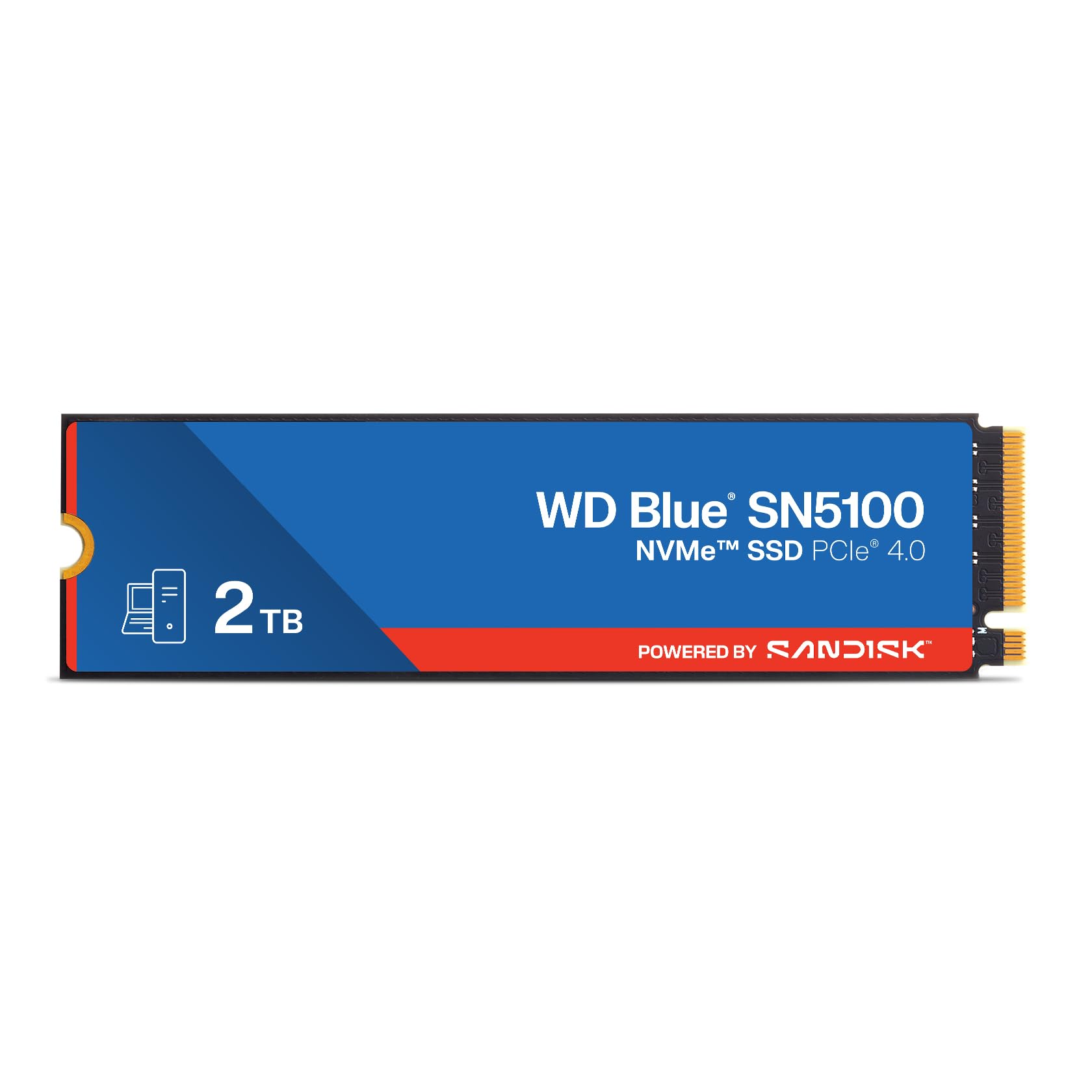
Western Digital’s SN5100 strikes an unusually smart balance between Gen4 speed and everyday affordability. With sequential reads hitting 7,100 MB/s, it trails the absolute fastest Gen4 leaders by only about 5%, yet it lands at a price point that undercuts many premium drives significantly. The secret is Sandisk’s 3D CBA NAND and nCache 4.0 technology, which use a hybrid SLC cache to buffer writes even when the drive is close to full capacity.
This drive is particularly well-suited for AI-assisted creative workflows—loading large Stable Diffusion model files or Lightroom catalogs feels snappy compared to older Gen3 drives. The five-year limited warranty is longer than the typical three-year coverage offered by most rivals in this price bracket, signaling confidence in the NAND’s longevity. Installation is straightforward in any M.2 2280 slot, and the Acronis True Image download makes cloning your existing OS painless.
One trade-off is the lack of a dedicated DRAM cache; the SN5100 relies on HMB technology instead. For most gaming and general productivity tasks, the difference is imperceptible. But if you routinely move multi-gigabyte video files or operate a database server, a DRAM-equipped drive like the 990 PRO will maintain higher minimum speeds under sustained load.
Why it’s great
- 7,100 MB/s reads at a mid-range asking price
- Five-year warranty exceeds category norms
- Acronis cloning software included
Good to know
- HMB instead of dedicated DRAM cache
- Sustained write speeds dip after SLC cache fills
3. Bestoss GM988 2TB
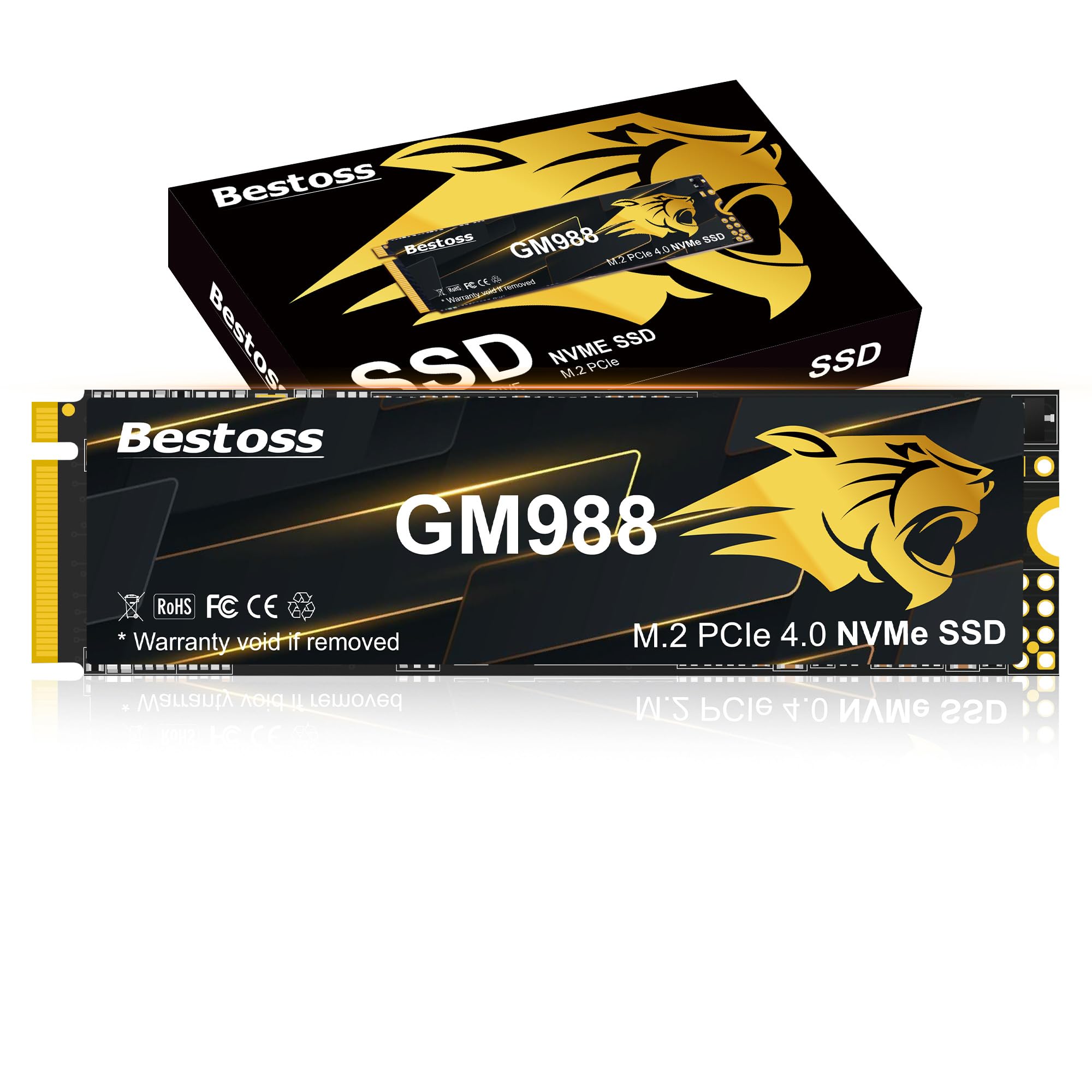
Bestoss enters the Gen4 arena with a compelling formula: a claimed 7,350/6,600 MB/s sequential read/write at a price that undercuts most established brands. The GM988 uses a graphene copper heatsink design to manage thermals without increasing thickness, an important detail for laptop users who can’t add aftermarket cooling. Early buyer feedback confirms speeds within 5% of advertised figures when tested on a native Gen4 platform.
PS5 owners have reported seamless compatibility—the drive formatted without error and delivered the expected load-time improvements in demanding titles. The inclusion of HMB and Dynamic SLC Cache helps maintain burst performance during game level loads and software launches. With a three-year warranty and capacities up to 4TB in the same product family, Bestoss is positioning itself as a serious alternative for value-conscious builders.
The main uncertainty is long-term reliability data—Bestoss doesn’t have the multi-year track record of Samsung or Western Digital. If you prioritize maximum endurance for a mission-critical workstation OS drive, a more established brand may be worth the premium. For a game library drive or secondary scratch disk where cost per gigabyte matters most, the GM988 delivers remarkable Gen4 performance for the money.
Why it’s great
- Excellent Gen4 speed at an entry-level price
- Graphene copper heatsink included
- PS5 compatible and easy installation
Good to know
- Limited long-term reliability data available
- No dedicated DRAM cache
4. BIWIN Black Opal NV7400 2TB

BIWIN’s NV7400 aims squarely at creative professionals who need sustained throughput for 4K+ video timelines and large 3D rendering scenes. The drive’s maximum read speed of 7,450 MB/s matches the Gen4 ceiling, and the random read/write figures of up to 1,000K IOPS indicate strong performance under multi-threaded workloads. The inclusion of a composite PMIC (power management integrated circuit) improves energy efficiency—a welcome feature for laptop users who want speed without draining the battery.
The 0.5mm graphene aluminum heatsink is cleverly integrated; it dissipates heat effectively without interfering with motherboard clearances, which is often a concern with bulkier aftermarket coolers. BIWIN’s Intelligence software provides performance testing, secure erase, and firmware updates, filling a feature gap that many smaller SSD brands neglect. Customer reports indicate consistent operating temperatures around 42°C, suggesting the cooling solution works as intended even during sustained transfers.
The price point sits in the premium tier alongside the Samsung 990 PRO, and while the NV7400 matches the read speed, its maximum write speed of 6,500 MB/s is slightly lower. For most real-world creative tasks—editing, rendering, file saves—that difference is negligible. If you are already deep into the Samsung ecosystem for drive management, the 990 PRO may feel more familiar, but the BIWIN is a legitimate performer in its own right.
Why it’s great
- 7,450 MB/s reads with robust sustained performance
- Integrated graphene aluminum heatsink
- BIWIN Intelligence software suite included
Good to know
- Premium pricing comparable to market leader
- Write speeds trail Samsung 990 PRO by ~6%
5. Kingston NV3 2TB

Kingston’s NV3 represents a pragmatic step up from Gen3 to Gen4 connectivity without the price premium of flagship drives. Its sequential read speeds peak at 6,000 MB/s, making it roughly 60% faster than the fastest Gen3 drives but about 20% slower than top-tier Gen4 options. Where this drive excels is in its power efficiency and thermal profile—it runs cool enough to avoid throttling even in slim ultrabooks that lack active airflow over the M.2 slot.
The NV3 is built on 3D TLC NAND, which provides better endurance than the QLC NAND found in entry-level Gen4 drives. Buyers have reported reliable operation as a secondary game library drive and as a boot drive in older laptops upgraded via a simple M.2 adapter. Kingston’s reputation for solid compatibility means fewer “drive not detected” issues during initial setup, a frustration common with lesser-known SSD brands.
If you are building a budget-conscious system and want the faster load times of PCIe 4.0 without paying for speeds you may never fully utilize, the NV3 is a smart compromise. The lack of a DRAM cache is noticeable in heavy multi-tasking scenarios, but for sequential gaming loads and standard productivity, the performance delta is minimal compared to more expensive DRAM-equipped drives.
Why it’s great
- 6,000 MB/s reads on Gen4 at a fair price
- Runs cool in slim laptops
- TLC NAND for better longevity than QLC alternatives
Good to know
- No dedicated DRAM cache
- Lower peak speeds than flagship Gen4 drives
6. Crucial BX500 2TB

The Crucial BX500 remains one of the most popular SATA SSDs on the market for a simple reason: it transforms an old sluggish computer into a responsive machine at a low entry cost. With sequential reads of 540 MB/s, it pushes the SATA III interface to its practical limit. The drive uses Micron 3D NAND, the same technology that powers much more expensive enterprise SSDs, which gives buyers confidence in its manufacturing pedigree.
Users upgrading from a 5,400 RPM hard drive routinely report boot times dropping from over a minute to under 15 seconds. The BX500 is also 45 times more energy efficient than a mechanical drive, which can add 30-60 minutes of battery life to an aging laptop. The 2TB model provides ample space for a full Steam library, and the silent operation means no more drive whine in quiet environments.
The BX500 uses QLC NAND, which means its write speeds slow down significantly once the SLC cache fills—usually after writing about 30-40GB continuously. For typical desktop use, this rarely matters, but anyone regularly transferring large video files or disk images should consider the more expensive TLC-based Crucial MX500 instead. The three-year warranty is standard, and Crucial’s Acronis cloning software helps make migration simple for non-technical users.
Why it’s great
- 540 MB/s reads for a low cost per gigabyte
- Massive improvement over mechanical hard drives
- Low power consumption extends laptop battery life
Good to know
- QLC NAND slows down during sustained writes
- No DRAM cache impacts multi-tasking performance
7. Silicon Power A55 2TB
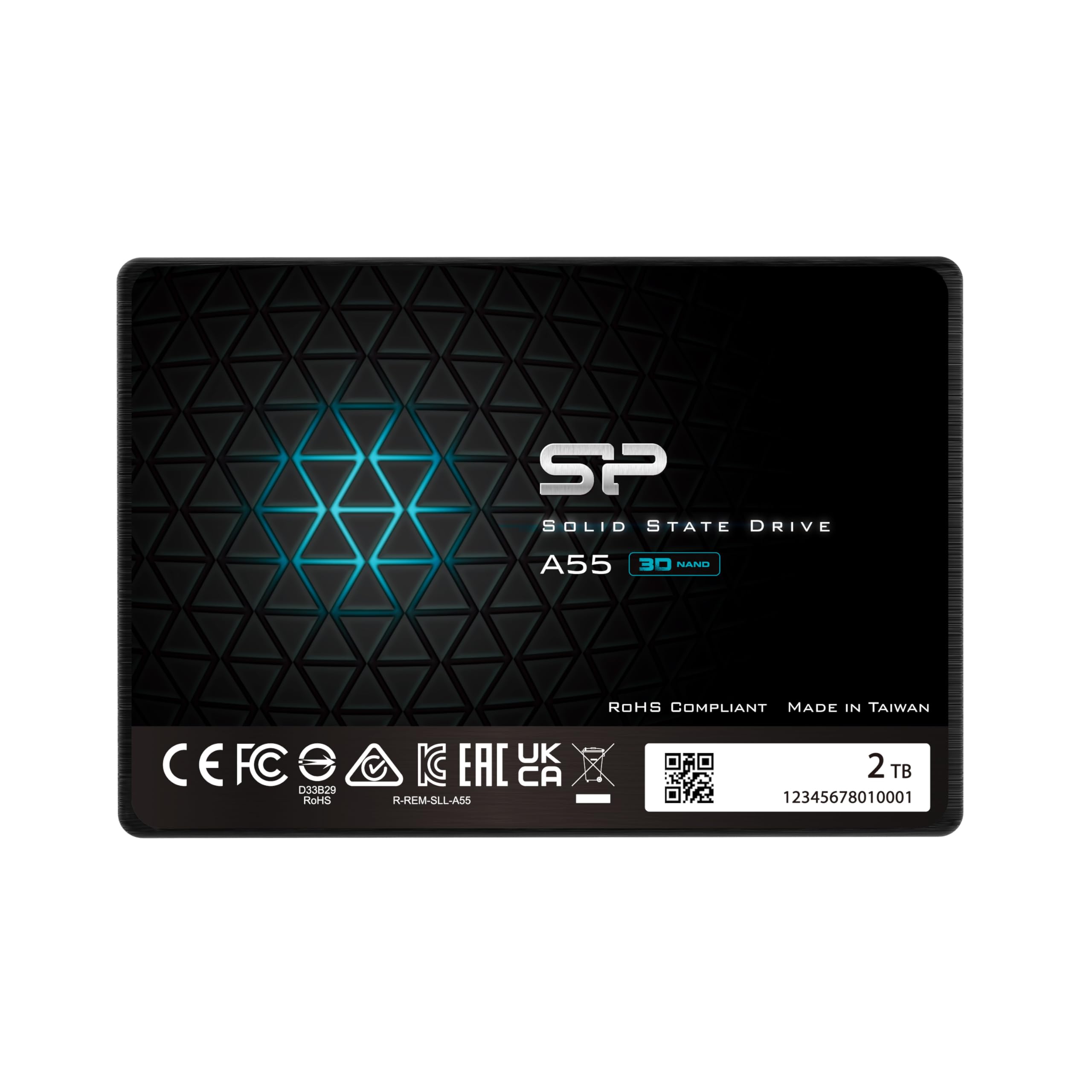
Silicon Power’s A55 is a no-frills SATA drive that delivers exactly what it promises: reliable 2TB capacity at a price that won’t break your upgrade budget. It is built with 3D NAND and features SLC Cache technology, which helps maintain consistent performance during everyday use. The 7mm slim profile makes it a perfect fit for ultrabooks and slim laptops that have limited internal clearance for thicker drives.
Customers have successfully used this drive to breathe new life into decade-old computers, clone original hard drives to SSDs, and expand storage on Xbox consoles. The sequential speeds hover around 500 MB/s in real-world testing, which is typical for a SATA III SSD and dramatically faster than any mechanical drive. Silicon Power includes a three-year warranty, and the brand has earned a loyal following among budget-conscious builders who have purchased multiple drives over several years without failures.
The A55 lacks a DRAM cache, which means random read/write performance under heavy multi-tasking can be inconsistent compared to DRAM-equipped SATA SSDs. If you plan to use this as a primary OS drive in a system that runs many applications simultaneously, spending a bit more for the Crucial MX500 or Samsung 870 EVO would provide a smoother experience. For bulk storage, media libraries, or a game disk, the A55 offers excellent value.
Why it’s great
- Excellent price per gigabyte for SATA storage
- 7mm slim design fits ultra-thin laptops
- 3D NAND with SLC cache for steady daily performance
Good to know
- No DRAM cache affects random IO under load
- Speeds may fall below the SATA III cap
8. TEAMGROUP T-Force Vulcan Z 2TB

The TEAMGROUP T-Force Vulcan Z is a SATA SSD built with professional gamers and console upgraders in mind. It advertises sequential read/write speeds of 550/470 MB/s, and independent buyer benchmarks have confirmed these figures hold up well in real use. The drive is explicitly compatible with the PlayStation 5, Xbox Series S/X, and any standard desktop or laptop with a 2.5-inch SATA bay, making it one of the most versatile options for cross-platform users.
Owners report stable long-term operation after nearly three years of continuous use, with one reviewer noting they purchased four units for a home media server and experienced zero failures. The SLC cache helps keep write performance consistent during smaller file transfers, though the drive’s QLC NAND means sustained write speeds drop after the cache is exhausted. For gaming loads where the SSD is primarily reading data, this is rarely an issue.
There have been isolated reports of the drive not meeting its advertised sequential write speeds in some test configurations. If you need guaranteed peak performance and are willing to pay a premium for TLC NAND and a DRAM cache, the Samsung 870 EVO or a mid-range NVMe drive would be safer choices. For the majority of gamers and everyday users, the Vulcan Z offers dependable bulk storage at a competitive cost per gigabyte.
Why it’s great
- Versatile compatibility across PC, PS5, and Xbox
- 550/470 MB/s at a reasonable price point
- Proven long-term reliability from multi-unit buyers
Good to know
- QLC NAND with slower sustained writes
- Some units may not hit advertised sequential speeds
9. Samsung 870 EVO 2TB

Samsung’s 870 EVO is the definitive SATA III SSD, representing the highest performance ceiling the interface can physically support. With sequential speeds maxing out at 560/530 MB/s, it saturates the SATA bus completely. The drive features a 32GB DRAM cache, which is unusually large for a consumer SATA SSD and translates to smooth multi-tasking even when the drive is nearly full. Samsung’s V-NAND and MKX controller provide enterprise-grade reliability, backed by a TBW rating of up to 2,400 TBW on the 2TB model.
IT professionals and server builders frequently choose the 870 EVO for RAID arrays and NAS setups where data integrity and power efficiency matter more than raw throughput. The drive runs notably cooler than many competing SATA SSDs, pulling 55-80% less power than a comparable hard drive. Samsung Magician remains the gold standard for SSD management, offering secure erase, performance optimization, and firmware updates in a clean interface.
The biggest barrier is price: the 870 EVO commands a significant premium over other 2TB SATA SSDs. If your system cannot utilize NVMe speeds and you want the absolute most reliable SATA drive available—especially for mission-critical applications or high-write workloads—the 870 EVO justifies its cost. For simple media storage or a secondary game drive, a cheaper SATA SSD will deliver comparable day-to-day performance for much less.
Why it’s great
- Industry-leading reliability and 2,400 TBW endurance
- Full SATA III saturation at 560/530 MB/s
- 32GB DRAM cache for consistent random performance
Good to know
- Premium pricing for a SATA interface
- Choose carefully to avoid counterfeit units with faulty firmware
FAQ
Will a 2TB NVMe SSD work in my PlayStation 5?
Is it worth paying extra for a DRAM cache in a 2TB SSD?
How do I clone my old hard drive to my new 2TB SSD?
Final Thoughts: The Verdict
For most users, the best 2 tb internal ssd is the WD Blue SN5100 because it delivers Gen4 speeds at a price that makes sense for real-world gamers and creators. If you demand absolute peak performance for professional workloads, the Samsung 990 PRO is the clear choice. And for those breathing life into an older system on a tight budget, the Silicon Power A55 offers exceptional value per gigabyte.