
Our readers keep the lights on and my morning glass full of iced black tea. As an Amazon Associate, I earn from qualifying purchases.
Specs are compiled from manufacturer listings and verified buyer reviews and can change over time — please confirm the key details on the product page before buying.
You bought component speakers, wired them in, and something still sounds wrong. The tweeters hiss and spit, the door woofers sound muddy, and turning it up just makes both problems louder. A 2-way audio crossover is the little box that fixes that — it splits the music signal so highs only reach the tweeters and lows only reach the woofers, instead of each driver trying to play the whole song.
I’m Min — the founder and writer behind Gadgets Feed. This guide is built by comparing the manufacturers’ published specifications and the patterns across verified customer reviews, so you get each pick’s real strengths and trade-offs instead of marketing spin.
What separates a crossover that genuinely cleans up your sound from one that quietly strangles it is the crossover frequency, the slope, and the tweeter attenuation switch — the three numbers nobody prints on the box. This breakdown of the 2 way audio crossover market covers those three specs pick by pick.
Our Picks at a Glance


How To Choose The Best 2 Way Audio Crossover
A crossover is a tiny component with an outsized job: it decides which frequencies each speaker is allowed to play. Get the specs wrong and you will hear it instantly — harsh tweeters, thin bass, or drivers that cut out the moment you turn the volume up. Here is what actually matters before you buy.
Crossover frequency has to match your drivers
The crossover frequency is the handoff point where the signal splits between your tweeter and your woofer. A crossover set at 3.5 kHz sends everything above that to the tweeter and everything below to the woofer. If you run a small tweeter with a crossover point that is too low, it strains on loud passages. If the point is too high, you get an audible gap in the midrange where neither driver fills in. Match the point to what your tweeter can safely handle.
Slope decides how sharp the cutoff is
The slope tells you how aggressively frequencies get rolled off past the crossover point, measured in decibels per octave (dB/oct). A 6 dB/oct slope is gentle — frequencies fade out slowly past the point. A 12 dB/oct or 18 dB/oct slope is steeper — each driver is pushed out of the range it should not play much faster. Steeper slopes protect tweeters better at high volume, but they also demand more from the components inside the crossover.
Tweeter attenuation keeps the highs in check
Tweeter attenuation is a switch that lets you turn the tweeter down by a set amount — usually -3 dB or -6 dB — so it stops overpowering the woofer. This is among the most underrated features on a passive crossover. If your tweeters sound bright or harsh against your door speakers, having a -3 or -6 dB switch lets you tame them without swapping parts. A crossover with only +3/+6 dB boosts is far less useful, because you rarely want more treble.
Passive vs electronic crossovers
A passive crossover sits between the amplifier and the speakers, runs off the amp’s own power, and needs no separate supply — that is the type most car audio buyers want. An electronic crossover (also called active) sits before the amplifier, needs its own 12V power feed, and lets you dial frequencies and gains from the unit itself. Choose passive for a simple drop-in upgrade behind your door panel; choose electronic if you are building a system with separate amps for mains and subs and want adjustable points.
Impedance and power handling
Impedance is the electrical load your speakers present to the amplifier, measured in ohms. A crossover built for 4 ohm systems needs to see 4 ohm speakers, and one built for 8 ohm works with 8 ohm drivers. Miss this and the crossover can strangle the volume or send the wrong signal. Power handling matters too: a stated 300W max rating does not mean you can hammer it with 300W continuously — look at the RMS figure and match it to your real amplifier output.
Quick Comparison
| Model | Best For | Crossover Frequency | Power Handling | Impedance | Amazon |
|---|---|---|---|---|---|
| DS18 PRO-CFX★ Best Overall | Car tweeters and mids | — | 300W RMS | — | Amazon |
| dbx 223xsPremium Pick | Pro PA and studio rigs | Adjustable, 80–90Hz seen | — | — | Amazon |
| Pyle PLXR2BMost Versatile | Adjustable electronic setups | Adjustable, 100Hz LPF seen | — | — | Amazon |
| HiQltyla WEAH 5003B | Budget car and home builds | 2,800Hz / 3,200Hz | 150W rated / 200W max | 4–8 ohm | Amazon |
| AUDIOTEK CX2 | Dedicated car audio upgrades | 3,500Hz | 300W max | 4 ohm | Amazon |
| Audiopipe CRX-203 | First-time car installs | 3,390–20kHz tweeter | 150W RMS / 300W peak | — | Amazon |
| Dayton Audio XO2W-2.5K | Speaker rebuilds | 2,500Hz | — | 8 ohm | Amazon |
| Fydun Heat Dissipation | Simple car upgrades | — | 300W | — | Amazon |
| Dayton Audio XO2W-2K | Beginner speaker projects | 2,000Hz | — | 8 ohm | Amazon |
In‑Depth Reviews
1. DS18 PRO-CFX 2-Way Car Audio Passive Crossover
Our pick — over 4.5★ from 400+ verified ratings; the strongest balance of quality and price.
The tweeter-cut switch that finally lets your mids breathe instead of fighting the treble
Most passive crossovers give you a boost switch and call it adjustability. This one goes the other way, offering -0, -3, or -6 dB attenuation on the tweeter — the direction you actually want when your highs are screaming over your door speakers. That feature alone explains why it sits at the top of this list. What wins people over most is the build: the crossover is described repeatedly as well-made, and the sound quality and overall performance draw the next-biggest share of praise.
Power handling is generous at 300W RMS, which means one amplifier channel can feed a tweeter and a mid-range speaker without the crossover choking on loud material. The wiring is wired-only and the unit runs off your amp — no separate power feed, no tuning dials to learn. It measures 6.3″ x 3.5″ x 1.5″, so plan your mounting spot before you start cutting.
The honest trade-off is size. These are larger than a typical 2-way crossover, and that is the most consistent complaint buyers raise — they are chunky enough that near-speaker mounting is awkward for some installs. Mounting screws are not included either, so grab your own before the panel goes back on. If your amplifier channels are already set up and you want clean separation without adding another powered component, this is the one most owners reach for — the crowd favorite here, holding 4.6 stars across 400+ ratings.
What Buyers Keep Praising
- 300W RMS handling from a single amp channel feeds two drivers
- -0/-3/-6 dB tweeter attenuation, the rare direction that actually tames harsh highs
- Improves stereo image and tone separation without adding noise
- Solid metal-and-plastic construction that resists vibration
Before You Order
- Larger than a typical 2-way crossover — measure your mounting space first
- Ships without mounting screws
- It cleans up the signal between your amp and drivers, but it cannot fix a cheap tweeter or woofer.
Right fit for you: You are running DS18 or similar 2-way component drivers and want a -6 dB cut so the tweeters blend instead of dominate.
Look elsewhere if: You have almost no room behind the door panel — this box wants a spot near the amplifier, not beside the speaker.
2. dbx 223xs Stereo 2-Way, Mono 3-Way Crossover
Studio-grade signal splitting that lets your mains breathe while the subs do the heavy lifting
Where the DS18 is a drop-in car part, this is a rack-mounted pro crossover with XLR balanced ins and outs — the locking three-pin connectors used in live sound rigs. It runs as a stereo 2-way or a mono 3-way via a mode switch, and adds a low frequency summed subwoofer output plus a 40Hz high-pass filter on both channels. The x10 range switch on both channels gives you a wider sweep of crossover points to dial in.
Owners who have moved from running mains full-range to adding this between preamp and amp describe a system transformation, with one long-running buyer noting the speakers finally produce clean highs and mids while the subs carry the low bass. Another pair of active 12″ tops and twin 18″ subs sets its crossover at 80–90Hz and prefers dialing its own point and separate gain control over built-in crossovers. It is a genuinely respected piece of kit, and it holds 4.8 stars across 80+ ratings.
The catch is that it is a different animal entirely from the passive boxes on this list. It needs proper balanced wiring, its cost sits well above every other option here, and owners point out it requires a working understanding of how crossover frequencies interact — it will not hold your hand. For a K-speaker hi-fi rig or a four-top live band, that trade is worth it.
What stands out: XLR balanced connections, a low frequency summed subwoofer output, and a 40Hz high-pass filter on both channels — features you simply will not find on a passive car crossover.
The real cost of entry: This is a premium rack component, so factor in the balanced cables and a proper install. It also assumes you know your way around crossover points already.
Made for: Home stereo or live sound builds where you want precise control over where mains hand off to subwoofers.
Not the pick if: You want a passive box that wires straight off your car amp with no separate power or balanced runs.
3. Pyle 2-Way Electronic Car Audio Crossover Network
A dial-it-in active crossover that behaves as well in a home studio as it does in a door panel
This is the electronic half of the fence. It takes a 2 channel input and gives you 4 channel RCA outputs, with a low-pass slope of 18 dB/oct and a high-pass that switches between 6 dB or 18 dB/oct — so you choose how sharply the signal divides rather than accepting a fixed point. Separation is rated above 60dB and distortion runs at 0.05% THD at 1V output. There is a power LED indicator and a remote subwoofer control, plus a parallel input switch.
Buyers use it far beyond the car. One ran it in a bi-amped home stereo off a 12V wall adapter as a low-pass filter around 63Hz, another set it at a 100Hz low-pass to squeeze more bass from an isobaric sub, and a third used it to adapt a Ford Fusion’s factory Sony sound with adjustable tuning. What people value most is the flexibility — the gain control and the range of frequency and slope options together.
Two things to know before you buy. Owners point out the unit will not power on unless a small jumper links to the remote-on terminal — an easy fix but a surprise if you skip it. The manual also mislabels the Ground, Remote, and 12V terminals, so wire it carefully the first time rather than trusting the print. It measures 3.94″ x 6.18″ x 1.18″ and weighs about 1.32 lbs, easy to tuck under a seat or into a studio rack.
Where it shines: A genuinely adjustable electronic crossover that works in cars, home subs, and small studios — the 18 dB/oct low-pass and 6 or 18 dB/oct high-pass give you real control.
Where it needs care: The remote-on jumper catch and the mislabeled terminals in the manual will trip up a first-timer who does not read carefully.
Reach for it if: You want to set your own crossover point and slope and are comfortable feeding it 12V power from a supply or the car’s electrical system.
Skip past it if: You want a no-power, no-tuning passive drop-in behind your door panel.
4. Audiopipe CRX-203 300 Watts 2 Way Crossover

The high-grade polymer parts and gold terminals that make a first install painless
For the money, this pair packs in the bits that matter: gold-plated screw terminals so your wire grips without soldering, and high-grade polymer capacitors inside an enclosed ABS cabinet. It is rated 150 watts RMS and 300 watts peak, and the tweeter side runs a 3.39–20kHz crossover with the woofer handling 20–4.3kHz. For a first-time passive install, that combination is hard to argue with.
Performance is what pulls the most praise here — buyers describe the sound as clean and the setup as genuinely simple, with one running two 6x8s and two tweeters off a pair of channels from a 4-channel amp, and another cleaning up the rear stage of a Silverado with 6x9s on the low end and 4x6s on the high. Ease of installation and value for money both draw steady support, and the overall reliability is a common theme.
Two caveats worth repeating. First, the bass output splits opinion — some buyers want more low-end heft than these deliver, so if you are chasing heavy bass, set expectations accordingly. Second, a rare early failure has been reported, with a unit going quiet and then dying within a week — an outlier across hundreds of sales, but worth knowing it can happen. Mount with the included format and keep your amp’s output sane and most buyers never see it.
What Earns Its Keep
- Gold-plated screw terminals mean no soldering required
- 150W RMS / 300W peak with a 3.39–20kHz tweeter crossover
- Enclosed ABS cabinet keeps the components protected
- Strong reviews for installation ease and overall value
Keep In Mind
- Bass output is described as lighter than some buyers expect
- An occasional unit fails early on high-power setups
- Fixed crossover point, no tweeter attenuation switch
Your match if: You are installing your first set of component speakers and want an affordable passive pair that wires up without a soldering iron.
Might disappoint if: You want deep, punchy sub-bass from your door speakers or you need to dial the tweeter level up and down.
5. Dayton Audio XO2W-2.5K 2-Way Speaker Crossover 2,500 Hz

The 12 dB/octave Linkwitz-Riley board that brings tired old speakers back to life
Dayton built this one with a 12 dB/octave Linkwitz-Riley alignment — a specific crossover design that rolls the signal off smoothly and keeps the woofer and tweeter in phase. It uses 18 gauge inductors to keep DC resistance low, and the low-pass section accepts either 4 or 8 ohm woofers. The crossover point sits at 2,500 Hz. It holds 4.8 stars across a small but devoted pool of buyers, which says a lot for a niche speaker part.
The rebuild stories here are the reason to buy. Owners have popped these into 44-year-old JBL L40 10″ 2-ways and said the old crossovers suddenly sounded like AM radio by comparison. Another dropped one into a pair of Peavey 115TLS boxes that had gone muddy and reported they played like new speakers afterwards. A third swapped one into a classic Dynaco A10 and called the 12 dB/octave slope faster and more efficient than the original. Marked wiring connects easily, and it works in car audio builds too.
What you give up is convenience. These are larger boards than some buyers expect, and they are 8 ohm units — so if your speakers are 4 ohm, most of the low-pass section flexibility is wasted. They are also not plug-and-play car parts; they suit someone restoring or building speakers who is comfortable with a proper mounting bracket. For the price, that is a fair trade for how far these lift a well-worn pair.
The defining spec: A 12 dB/octave Linkwitz-Riley alignment with 18 gauge inductors, a 2,500 Hz point, and 4 or 8 ohm woofer support in the low-pass section.
The honest limit: It is an 8 ohm crossover that is large for its type, so measure your cabinet or door cavity before ordering and confirm your drivers’ impedance.
Choose it if: You are restoring vintage speakers or replacing the tired crossover inside a box and want a proper 12 dB/octave design.
Pass if: You need a compact passive crossover to tuck beside a car speaker, or you are running a 4 ohm setup.
6. Dayton Audio XO2W-2K 2-Way Speaker Crossover 2,000 Hz
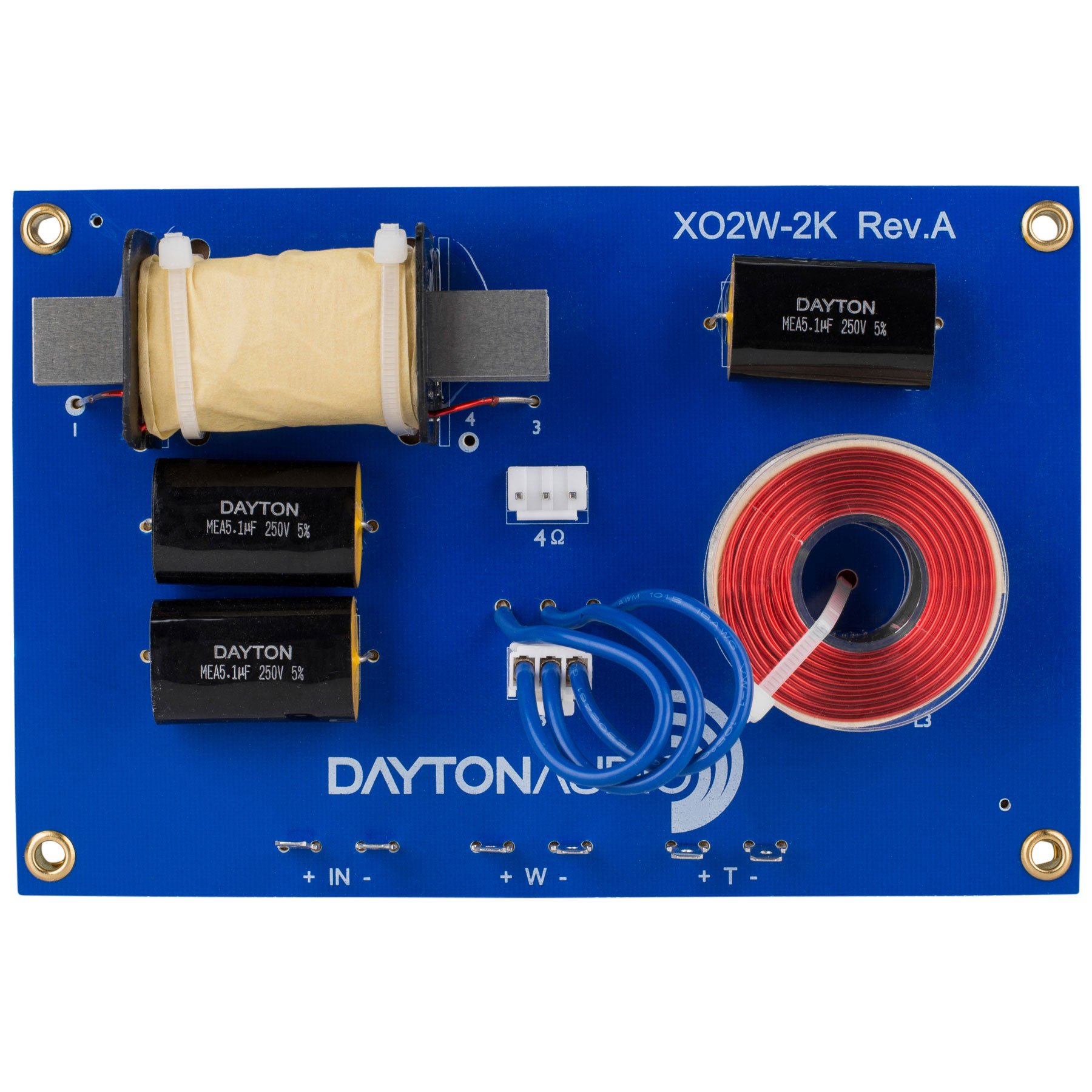
A hands-on starter board that teaches you speaker building without wrecking your setup
The XO2W-2K crosses over at 2,000 Hz, uses 18 gauge inductors to keep DC resistance low, and shares the same trick as its 2,500 Hz sibling — the low-pass section takes either 4 or 8 ohm woofers. Every component is glued or fastened down so nothing buzzes or rattles under vibration, and the blue PC board sits on a back plate for extra rigidity. Where the 2.5K version suits restoration, this one is more of a learning tool.
Beginners gravitate to it for exactly that reason. Owners describe using it as a starter crossover to test speaker projects before building final tuned versions, and one rebuilt a pair of bookshelf speakers running the woofer from a full-range signal using these. Report a garage pair that punches above its weight, or a Gem Sound GSP-15 speaker board that sounded better than the original and lasted three years in service.
The limitation is a known one and worth stating plainly: the design is a “cookbook” crossover, meaning it is a fixed general-purpose board rather than one tuned for your exact drivers. Experienced builders are honest that it is a starting point, not a final answer. One defective unit out of a two-pack has also been reported, so check both boards the day they arrive. If you want to learn before you spend on a custom crossover, this is your low-risk entry.
Why it earns its spot: A fixed 2,000 Hz point, 18 gauge inductors, and 4 or 8 ohm woofer support on a rigid blue PC board — a solid first crossover board for anyone experimenting with speaker builds.
Where it stops: It is a general-purpose board, not a design matched to your specific drivers, and quality control occasionally misses.
Good starting point if: You want to experiment with speaker building and try different driver combinations before committing to a tuned crossover.
Consider the 2.5K instead if: Your tweeter needs a higher crossover point or you are doing a proper restoration.
7. HiQltyla WEAH 5003B 2 Way Speaker Crossover

A screw-terminal box with a 3 dB switch that saves you from soldering and blown tweeters
Two useful details set this apart at its price. It uses convenient screw terminals — no welding, no soldering, just tighten and go — and it has a heat-dissipation shell in transparency coffee-colored ABS plastic with a dual-flow design. Rated power sits at 150W with a maximum tolerable 200W, it handles 4 to 8 ohm impedance, and it covers 45Hz–22kHz. The frequency division point is 2,800 Hz at the 0 dB switch setting and 3,200 Hz when switched to 3 dB.
The other reason buyers pick it is protection. With a treble protector on board, it limits power to keep your tweeters alive — the kind of feature owners credit with preventing speakers from blowing. That is the sort of thing you only appreciate after losing a tweeter the hard way. Inside you get 2x MKP fever-level audio capacitors and a polypropylene capacitor handling the treble filter, a metallized polyester film capacitor on the bass compensation side, plus bass and treble inductors and a ceramic resistor. One owner replaced a set of component-speaker crossovers that melted their plastic casing and reported these made those cheap speakers sound expensive.
Small footprint, quiet electronics, no drama — it measures 4.7 x 2.6 x 1.3 inches and weighs 14 ounces. The trade-off is that this is a straightforward passive box with a single 3 dB switch, so you will not get the ±6 dB range of the DS18 above or the adjustable points of an active unit. Sweep between 2,800 Hz and 3,200 Hz and that is your lot.
What you get for the money: Screw terminals, a 2,800 Hz / 3,200 Hz switch, 150W rated / 200W max handling, 4–8 ohm support, and a heat-dissipating coffee-tinted shell.
Know before you buy: The adjustability is limited to one 3 dB switch — fine for matching driver pairs, but not for fine-tuning a tweeter that runs hot.
Ideal for: A car front-stage or home boombox build where you want soldering-free installation and a bit of tweeter protection on a tight budget.
Not enough if: You need a wide tweeter cut or a tunable crossover point for a demanding component set.
8. AUDIOTEK CX2 2-Way 4 Ohm Passive Car Audio Crossover

A 3.5 kHz divider that lifts tired component setups without touching your head unit
If your car is running a component set with separate tweeters and woofers, this pair splits the signal at 3.5 kHz — highs to the tweeters, lows to the woofers — and each unit is rated for up to 300 watts maximum power. It is designed specifically for 4 ohm car audio configurations, with bracket mounting and an organized connection point between the amplifier output and your drivers. Swapping these in for the stock crossovers that came with a set of component speakers is the move most buyers make, and the extra power capacity is usually credited with the immediate jump in bass and treble.
The other common use is fixing what the factory left out. One owner added these alongside the tweeter crossovers that shipped with a set of high-powered door separates and reported every genre sounding cleaner for it. Another used them to upgrade a Kenwood setup, noting the low-pass and high-pass arrangement corrected phase shift and the 3.5 kHz point blended well while trimming the midrange.
Here is the catch, and it is worth taking seriously. At 150W RMS into 4 ohms with hard rock cranked, the tweeters can cut out and recover once you lower the volume — so the 300W max figure is optimistic for sustained high-power use. Several owners find that limiting. If your amp pushes serious continuous power into a 4 ohm load, run these within reason and treat the rating as a ceiling, not a target. For a normal component upgrade at sane volume, the imaging gain is real.
What You Gain
- Clean 3.5 kHz split between tweeters and woofers
- 300W max power rating per unit
- Bracket mounting keeps the install organised
- Immediate bass and treble improvement over tired stock crossovers
What to Watch
- Fixed 3.5 kHz point, no tweeter attenuation switch
- Tweeters can cut out under sustained high-volume rock
- Built for 4 ohm systems only
Made for: Drivers running 4 ohm component speakers who want to replace weak factory crossovers with a properly rated pair.
Look up the scale if: Your amp pushes continuous power well above what these handle at volume, or your tweeters need taming rather than dividing.
9. Fydun 300 Watts 2 Way Car Audio Crossover

A plug-in-and-tighten crossover that gets clean signal to doors and dash tweeters
What buyers like most here is that it just works and feels well made — build quality is the quality owners point to first, with sound quality and value close behind. The design leans on a bass inductor and magnet to shore up sagging bass, and the solderless plug-in sockets let you connect the corresponding line and simply tighten it. There is an overcurrent safeguard on board to protect your gear, and the high-gloss double-layer ABS housing is built to shed heat.
The real-world results are the clearest endorsement. One owner ran it for two months feeding door speakers and dash tweeters off two front amp channels, and found the 6x9s no longer bottom out and the dash speakers stay free of pop and crackle when the volume climbs. Another paired it with a stock radio and Hertz K165 speakers with a straightforward install, and a third used it in a portable speaker build, describing the wiring as no harder than hooking up a single speaker.
The trade-off is that it is a fixed passive box with no adjustable crossover point or tweeter attenuation — the specs list no frequency figures, so you accept it as-is. There is also an owner who wrote in Spanish that it works but seemed unimpressed; a mild note, not a pattern of failure. Weighs 12.7 ounces and suits anyone who wants simple, solder-free car installs without tuning anxiety.
Where it earns its place: Solderless plug-in sockets, a bass inductor and magnet for low-end reinforcement, and an overcurrent safeguard in a heat-dissipating ABS shell rated for 300W.
The honest shortfall: No listed crossover frequency or attenuation adjustment, so you cannot tune it to specific drivers — what you buy is what you get.
Right choice if: You want a simple, well-made passive crossover for a car or portable build and value a no-fuss install over adjustability.
Not for you if: You need to dial in a specific crossover point or tame your tweeters with an attenuation switch.
Understanding the Specs
Crossover Frequency
This is the handoff point, usually written in Hz or kHz, where the signal stops going to one driver and starts going to the other. On a 3.5 kHz crossover, everything above that goes to the tweeter and everything below goes to the woofer. Pick a point that matches what your tweeter can handle — set it too low and the tweeter strains on loud material, set it too high and you lose the midrange connection. Models here span 2,000 Hz to 3,500 Hz, and a couple of the active units let you dial the point yourself.
Slope and Attenuation
The slope, measured in dB per octave, tells you how sharply frequencies roll off past the crossover point — 6 dB/oct is gentle, 18 dB/oct is steep and protects tweeters better at volume. Attenuation is the tweeter’s volume switch, letting you cut the highs by -3 or -6 dB so they sit level with the woofer. A -3/-6 dB cut is more useful than a +3/+6 dB boost, because most installs need the tweeter tamed, not pushed.
FAQ
What does a 2 way audio crossover actually do?
Will a 4 ohm crossover work with my 8 ohm speakers?
What is the difference between a passive and an electronic crossover?
Why do my tweeters cut out when I turn the volume up?
Does a lower crossover frequency protect my tweeter better?
Can I use a car audio crossover in a home speaker build?
What does the -3 dB tweeter switch do on a crossover?
How do I install a passive car crossover?
Is a 300W crossover the same as a 150W crossover in real use?
Do I need a crossover with balanced XLR connections?
Final Thoughts: The Verdict
For most buyers, the 2 way audio crossover to beat is the DS18 PRO-CFX, because its -0/-3/-6 dB tweeter attenuation and 300W RMS handling let you tame harsh highs and feed two drivers from one amp channel — the two things that separate a genuinely blended system from a loud one. If your priority is a tunable active crossover that works in cars, home subs, and studios, grab the Pyle PLXR2B. And if you are restoring old speakers and want a proper 12 dB/octave design, the Dayton Audio XO2W-2.5K is the one to reach for.
The budget picks earn their keep too — the Audiopipe CRX-203 has the gold-plated screw terminals and dash-friendly format for a first install, and the HiQltyla WEAH 5003B brings its own 3 dB tweeter switch and heat-dissipating shell to the cheap end of the market. Whichever you pick, match the crossover frequency and impedance to your drivers and treat the max power rating as a ceiling, not a target. Wire it once, correctly, and your tweeters and woofers stop fighting each other.
How We Picked
We do not accept paid placement. Every pick is matched to a real buyer and a real use-case; we do not hands-on test units.
Sources & Methodology
Specifications: manufacturer listings and product documentation. Review insights: verified customer reviews, as of September 2026. Pricing: not shown on this page (it changes often); check the current price via the retailer link.
As an Amazon Associate, Gadgets Feed earns from qualifying purchases. This does not affect which products we feature.