
Our readers keep the lights on and my morning glass full of iced black tea. As an Amazon Associate, I earn from qualifying purchases.
Specs are compiled from manufacturer listings and verified buyer reviews and can change over time — please confirm the key details on the product page before buying.
You don’t need a license to get started with a 2-way handheld radio, but you do need one that won’t cut out halfway through a hike or a job site shift. The real difference between a good radio and a frustrating one depends on three things: battery life that actually matches the spec, a tough enough build to survive a drop onto concrete, and a frequency range that matches how you plan to use it. This guide cuts through the marketing jargon to land on the models that real owners rely on day in and day out.
I’m Min — the founder and writer behind Gadgets Feed. This guide is built by comparing the manufacturers’ published specifications and the patterns across verified customer reviews, so you get each pick’s real strengths and trade-offs instead of marketing spin.
if you need something for a job site, emergency preparedness, or a family camping trip, this breakdown of the best on the market right now makes picking the right 2-way handheld radio simple, honest, and actually useful.
Our Picks at a Glance


How To Choose The Best 2-Way Handheld Radio
A radio’s real-world performance depends on how it handles your specific environment. A long-range spec printed on the box means nothing in a hilly forest or a steel-frame building. Here are the specific factors that actually separate a useful radio from a frustrating one.
Frequency Band and Licensing
This is the single most common point of confusion. FRS (Family Radio Service) radios require no license and work right from the start, but they are limited to 2 watts of power (0.5 watts on some channels) and fixed antennas. They are perfect for families and light recreational use. GMRS (General Mobile Radio Service) radios offer higher power, up to 5 or even 8 watts, and repeater capability for much better range, but you need an FCC license (which is easy to get and covers your whole family). Ham radios (like the Baofeng UV-5R models) are the most powerful and flexible, but you must pass a test to get a ham license to transmit legally. Pick the band that matches your willingness to get licensed; a 10-watt ham radio is illegal to use on FRS or GMRS channels.
Battery Life and Charging
A “48-hour battery” spec is typically standby time, not active talk time. Look for the battery capacity in mAh — a 2500mAh pack will last significantly longer than a 1500mAh pack in real-world use. USB-C charging has become a must-have for convenience, letting you top up from a power bank, laptop, or car charger. If you are buying a multi-pack for a crew or family, the 18-20 hour average life models are the balance; anything below 1500mAh may struggle to last a full shift or day of active use.
Durability and Weather Resistance
If your radio is hitting the ground, getting rained on, or living in a dusty environment, an IP rating is non-negotiable. IP67 means it is dust-tight and can survive submersion in one meter of water for 30 minutes — a real difference-maker on a job site or river trip. A MIL-STD-810H certification means the radio has passed military standard tests for drops, vibration, and temperature extremes. A radio without these ratings may still be fine for casual indoor use, but plan on replacing it sooner in rough conditions.
Quick Comparison
| Model | Best For | Battery (mAh) | Channels | Band | Amazon |
|---|---|---|---|---|---|
| Retevis RB48★ Best Overall | Family / Hiking | 2000 | 22 FRS | FRS | Amazon |
| Baofeng UV-5RBest Value | Entry Ham | 1800 | 128 | VHF/UHF | Amazon |
| Baofeng GM-15 ProPremium GMRS | Off-Road / Work | 1500 | 250 | GMRS | Amazon |
| Baofeng 5RM | Ham / Prepper | 2500 | 999 | VHF/UHF | Amazon |
| Pxton 999S | Budget GMRS | 1500 | 38 | GMRS | Amazon |
| Baofeng UV-5G Plus | GMRS Enthusiast | 2500 | 999 | GMRS | Amazon |
| JUCJET H888S | Large Crews | 1500 | 16 | UHF | Amazon |
| Radtel RT-950 PRO | Ham Enthusiast | 2200 | 960 | VHF/UHF | Amazon |
| SAMCOM FPCN30A | Job Site / Business | 1500 | 20 | UHF | Amazon |
In‑Depth Reviews
1. Retevis RB48 FRS Walkie Talkies
Our pick — over 4.5★ from 750+ verified ratings; the strongest balance of quality and price.
The every-person radio that survives drops and rain without a license.
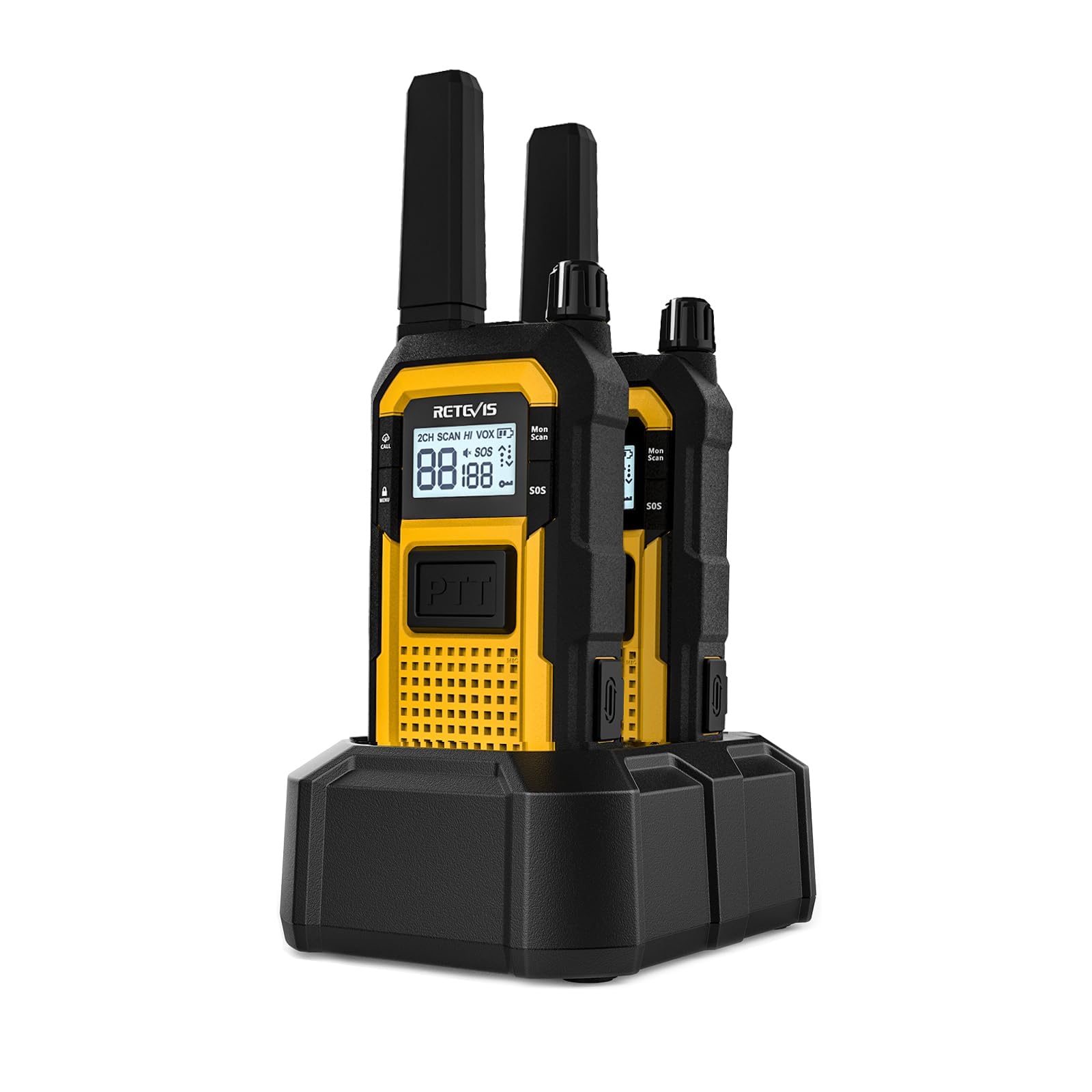
The Retevis RB48 is the rare radio that is both tough enough for heavy outdoor use and simple enough for a family to hand to kids. It carries an IP67 waterproof and dustproof rating, meaning it survives a dunk in a meter of water and blocks out fine dust that would kill lesser units. The build is tested against MIL-STD-810H, so it shrugs off drops from two meters — owners confirm the rugged housing with a giant PTT button feels genuinely sturdy. Users report it fits in a hoodie pocket and still punches clear audio at almost two miles apart even through city obstructions.
On the power side, the included 2000mAh battery delivers up to 18 hours of life, which the consensus audience describes as lasting all day into the next morning from a single charge. Recharging is flexible via USB-C or the included charging dock. The RB48 transmits on FRS bands (license-free) with a range rated for up to 300,000 square feet or 25 floors. While the front-panel LCD is yellow and highly visible, the radio is best for users who want a durable, go-anywhere unit without needing a license. Its main limitation is the lower legal power of FRS, so range in dense woods may be shorter than that of GMRS or ham models.
Real-world standout: The combination of IP67 waterproofing and a mil-spec drop rating at this price point is class-leading — it is the radio you take when you expect the conditions to be rough.
The honest limit: The 2000mAh battery provides all-day runtime, but users wanting the absolute longest stretch between charges may prefer the Baofeng 5RM’s 48-hour average or larger 2500mAh pack.
Reach for this if: You want a license-free, waterproof, rugged radio that works from the start for hiking, family trips, or emergency kits.
Look elsewhere if: You need the highest possible range for deep wilderness or want to access GMRS repeaters — those require a higher-power model with a license.
2. Baofeng UV-5R Two Way Radio (2-Pack)
The legendary ham starter that packs more punch than its price suggests.
The Baofeng UV-5R is the classic entry point into ham radio for a reason — it is extremely affordable for a 2-pack, yet it delivers solid audio, a talking range of up to 5 kilometers, and up to 128 memory channels with dual-band display and standby. It works across VHF (144-148MHz) and UHF (420-450MHz) bands, which means it can scan a broad spectrum of frequencies. Build quality is reliably good, with users praising clear sound even at a distance and all-day battery life with the included 1800mAh battery.
The main caveat that real owners point out is that this is not a grab-and-go radio. It requires manual programming or a Chirp-compatible cable to set up channels, and the interface can be confusing for new users. But once programmed, the UV-5R gives you communication that competes with radios costing several times more. The included earpieces are the one universally pointed-out weak spot; they work but sound mediocre. For the price of a good dinner, you own a capable ham radio that is also popular for prepper kits, hiking groups, and production teams.
Why owners love it: The sheer value — you get a dual-band, 128-channel ham radio in a 2-pack for a budget price, supporting features like VOX, an LED flashlight, and emergency alarm.
The setup hurdle: This radio does not work from the start; owners consistently note you must program it first, and the menu system takes time to learn.
Your best pick if: You are entering the ham radio hobby or already have a license and want an inexpensive backup rig that performs well.
Not the one if: You need a license-free, immediate-use radio for a family hike or casual event — look at the Retevis RB48 instead.
3. Baofeng GM-15 Pro 8W Walkie Talkie (2-Pack)
A powerful GMRS 2-pack with real repeater reach for serious outdoor use.
The Baofeng GM-15 Pro brings 8 watts of power to the GMRS band, doubling the standard 5 watts you see on most licenseable radios. This extra power translates to real-world range — buyers report transmitting 4 miles in an urban area on high power and reaching repeaters from miles away with a mag-mount antenna. It comes with 250 memory channels, including 30 default GMRS channels for out-of-box use, and supports up to 24 customizable repeater channels. The radio includes NOAA weather scanning across 11 channels, a built-in LED flashlight, VOX hands-free operation, and dual charging via USB-C or the included charger.
Build quality gets strong praise from the buying community, with the green housing having a rugged feel and good ergonomics. The included earpieces are noted as being a weak point with poor audio, so you may want to upgrade those. Programming is easy via the front panel or PC software (Radioddity GM-30 software works), and the 1500mAh battery provides an estimated 24 hours of life. The crowd favorite aspect is the radio’s ability to work with repeaters for extended range — far beyond what a simple FRS radio can manage.
Where it excels: The 8-watt power and GMRS repeater capability mean you can communicate over many miles in open or suburban terrain, far beyond entry-level radios.
A fair trade-off: The 1500mAh battery is smaller than the UV-5G Plus’s 2500mAh pack, so heavy users may need to charge more often during a long day.
Grab this for: Jeep trails, hunting trips, or any situation where you need to push a signal several miles without a repeater.
Consider another if: You want the absolute longest runtime — the UV-5G Plus’s 2500mAh battery gives you more headroom before needing a charge.
4. Baofeng 5RM 10W Handheld Radio
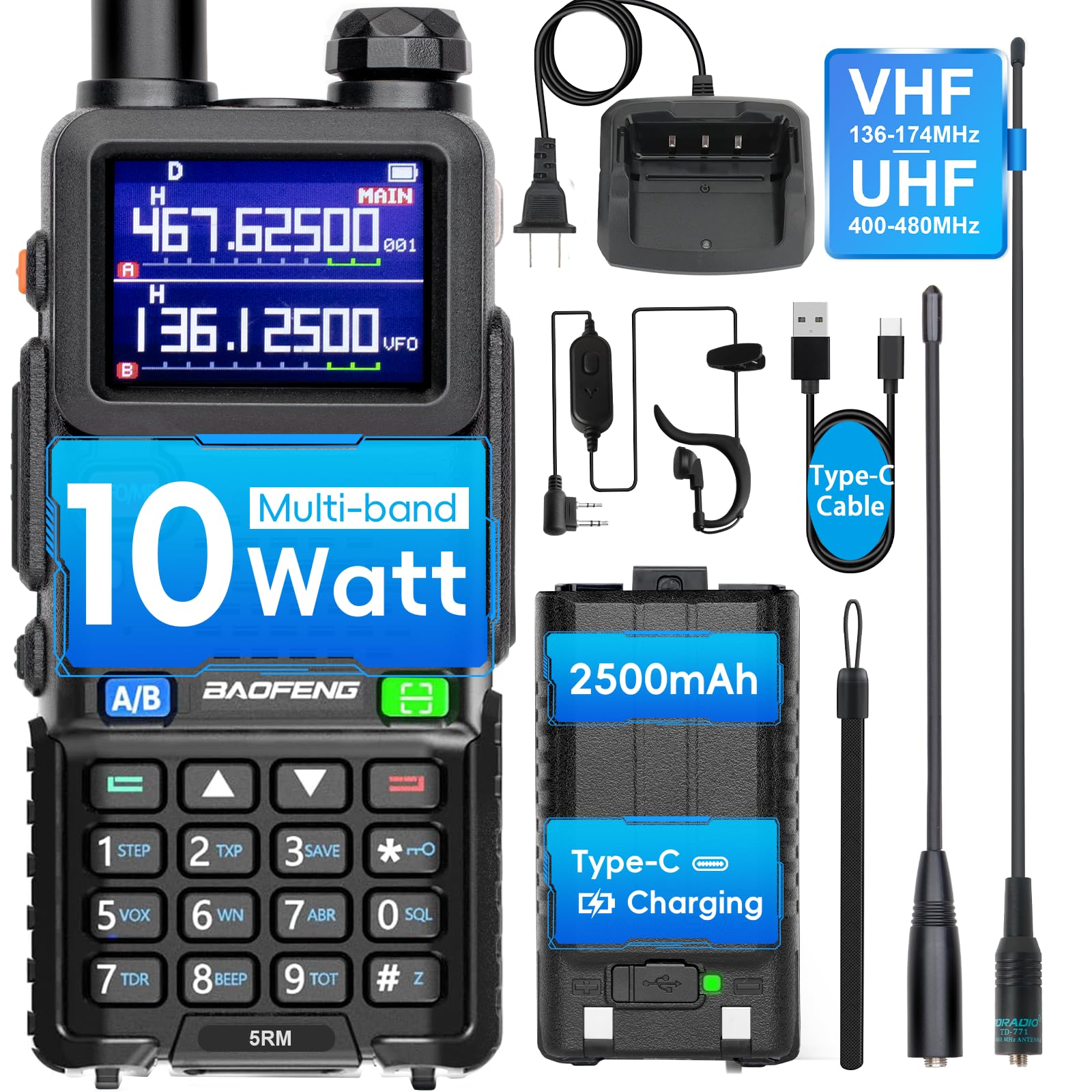
The full-featured 10W ham that charges via USB-C and runs for two days.
The Baofeng 5RM is the upgraded successor to the UV-5R line, and it closes almost every gap the classic model had. The headline figure is 10 watts of transmit power — the highest in this roundup — with measured output of roughly 8 watts being called “accurate frequency” by owners. It can reach repeaters 4-10 miles away, according to those who have tested it. The 2500mAh battery is massive for a handheld, providing an average life of 48 hours, and it charges through a Type-C port on the battery itself, which means you can power it from a portable bank, laptop, or car charger.
The 5RM also upgrades to a 1.77-inch TFT color screen and supports 999 memory channels, frequency copying between units via the keypad, a built-in scrambler, an FM radio receiver, and emergency alarm functions. Owners praise its sturdy construction and clear communication with minimal static. The only downsides found in the data are that the color screen can be hard to see in direct sunlight (a common issue with color screens) and that the menu complexity may be confusing for first-time ham users. The radio requires a ham license to transmit legally but can be used as a scanner by anyone.
What wins people over: The 2500mAh battery and USB-C charging mean you can leave for a weekend trip and never worry about power — it beats the 2000mAh Retevis by a clear margin for endurance.
The one thing to know: The red-on-blue menu text is tough to read in bright sun; some owners recommend programming it in the shade or using Chirp software on a PC.
Your radio if: You already have or plan to get a ham license and want the maximum power and battery life from a portable radio.
skip it if: You want a license-free, instant-use radio — the FRS or GMRS models above are simpler for non-licensees.
5. Baofeng UV-5G Plus GMRS Handheld Radio

A GMRS-specialized handheld with a bright screen and 969 customizable channels.
The UV-5G Plus takes everything Baofeng learned from the 5RM and applies it to the GMRS band. It is an upgraded version of their UV-5G, increasing the battery from 1500mAh to 2500mAh with a USB-C port and swapping the old display for a larger 1.9-inch color screen. It offers 969 fully customizable channels, with channels 1-30 pre-programmed for GMRS use right from the start. The radio supports a talking range of up to 7 miles, includes a NOAA receiver and scanner, and can scan weather and FM stations.
Owners give this radio high marks for its sound quality — the top-praised aspect — and its reliability for emergency preparedness. It is described as sturdy and easy to set up for GMRS use, though some note the screen’s red-on-blue color scheme is tough to read in bright sunlight, much like the 5RM. An FCC license is required to transmit on GMRS frequencies. The radio’s dedicated GMRS focus means it is less flexible than a ham dual-bander, but for those who want a modern, high-capacity GMRS radio, it is a very strong pick.
Where it shines: The 969 channels and 2500mAh battery make it the most future-proof GMRS handheld for someone who likes to program and customize their channels.
The main caveat: The 1.9-inch color screen is excellent indoors but washes out in direct sunlight, making field programming difficult on a bright day.
Best for: GMRS enthusiasts who want a modern, programmable radio with excellent battery life and a vivid display for indoor or shaded use.
Not for: Users who need a license-free radio or who plan to do most of their operation in full sun — the Retevis RB48’s simpler screen is easier to read in those conditions.
6. JUCJET H888S Walkie Talkies (4 Pack)

A big crew’s budget partner with surprisingly clear range through walls.
When you need four units for a wedding coordination team, a warehouse crew, or a family of active campers, the JUCJET H888S 4-pack is the obvious choice. Each unit offers up to 2 watts of UHF power with a line-of-sight range of up to 5 miles, reducing to less in congested areas. The 16 preset channels are dial-selectable by turning the knob, so there is no programming required — everyone just tunes to the same channel and talks. The radios include a built-in LED flashlight and a VOX hands-free function.
Owners consistently call these a great value for the price. The 1500mAh battery in each radio supports a claimed maximum standby of 96 hours, with real-world use reported as lasting through a full work shift or a day of event coordination. The audio is rated as clear, with one owner reporting it works perfectly through an entire building and even through 2-foot-thick brick and cement walls. The included earpieces are single-earbud style with a built-in microphone and PTT button. The main trade-off is the lower 2-watt power compared to the 5-10 watt models elsewhere, and range in heavy obstructions will be short — this is a connectivity solution for a moderate area, not for backcountry miles.
Why the 4-pack works: Getting four functional, rechargeable radios with earpieces and charging stations for this price beats buying separate single units.
The honest limit: Range is about 3.11 miles at best and drops quickly with walls; use confirmed by owners in cruise ships, stadiums, and large buildings rather than open wilderness.
Pick these if: You need four radios for a team on a budget — weddings, school events, warehouse teams, or family groups will find them more than capable.
Skip if: You need to reach a mile or more through dense terrain, or you want a waterproof radio for heavy rain — this one lacks an IP rating.
7. Pxton 999S GMRS Walkie Talkies (2 Pack)

An affordable GMRS pack with weather alerts for outdoor preparedness.
The Pxton 999S brings GMRS capability to a budget-friendly 2-pack with the added bonus of NOAA weather scanning across 10 channels, giving you real-time warnings about incoming severe conditions. The radio has 38 channels with 260 privacy codes, IP54 splash and dust resistance, and a built-in LED flashlight. It is built from PC/ABS plastic, which owners find holds up well to drops and general outdoor use. The 1500mAh battery is rated for up to 18 hours of typical use, with a standby time of 5-7 days under light conditions. Charging is flexible — you can use the included dock or a USB port (power bank, laptop, or car).
Functionality is a mixed area in the review data: some owners mention excellent results, with one noting clear communication through a 3-story reinforced concrete building and out to 3-4 km without line-of-sight. Others find the range limited, and a few have had batteries fail within a year. The general consensus among the buying community is that the 999S is good value for the money, with solid build quality and sound clarity. The key limitation is that it is a GMRS radio requiring an FCC license, and some users found the NOAA activation trick (hold the minus key while powering on) poorly documented.
The standout bonus: NOAA weather receiver on a budget GMRS radio means you stay informed about approaching storms without needing a separate device.
The biggest caution: Battery life and overall functionality get mixed reports — some owners get a full day, while others report battery failure within a year.
Take these if: You want a GMRS radio with NOAA weather scanning at a low price and are comfortable obtaining an FCC license for transmit use.
Think twice if: You need a guaranteed long-term investment — the mixed long-term reliability reports suggest spending a little more on the UV-5G Plus or GM-15 Pro for more consistent durability.
8. Radtel RT-950 PRO Ham Radio

The tinkerer’s dream with GPS tracking and a full-color spectrum analyzer.
The Radtel RT-950 PRO is an ambitious radio for the serious ham who wants a “shack-in-a-box” handheld. It delivers up to 10 watts of output power on VHF/UHF, plus 27MHz TX/RX at 3-4 watts for the CB-like 11-meter band. Its broad receiver covers AM, FM, CB, shortwave, and even LSB/USB modes. The standout features are integrated GPS with APRS for real-time position sharing with other APRS users, a built-in spectrum analyzer for monitoring nearby frequency activity, and Bluetooth app programming via your smartphone. The full-color display is described by owners as excellent and the UI as intuitive, making it one of the more modern-looking handhelds on the market.
The 2200mAh battery charges via USB-C or the included desktop charger. The radio has 960 memory channels and supports firmware updates that have added shortwave and longwave reception. However, the review data shows this is not a simple grab-and-go radio. Many owners note a steep learning curve with a complex interface, and the keypad programming can be frustrating. One owner reported that the programming cable was not recognized on five different PCs, and the Bluetooth app was clunky. It is also not CHIRP compatible, so you are locked into Radtel’s own software. For the experienced ham who loves reading manuals, this radio offers features no other handheld here matches.
What makes it unique: The combination of GPS, APRS, and a spectrum analyzer in a handheld radio is class-leading at this price — it is a communications tool and a hobbyist exploration device in one.
Who should think twice: The interface complexity and software compatibility issues make it a poor choice for someone who just wants a reliable radio without hours of setup.
Your radio if: You are a licensed ham who enjoys advanced features like APRS, spectrum analysis, and shortwave listening, and you have the patience for firmware updates and programming.
Not for: Any user who wants a quick-start radio for work, family, or emergency prep — the simpler Baofeng models or the Retevis RB48 are far easier to use.
9. SAMCOM FPCN30A Professional Two Way Radio (2 Pack)

The job-site specialist with instant group calling across teams.
The SAMCOM FPCN30A is built for professional environments — construction sites, warehouses, stadium events, and production crews. Its defining feature is Instant Group Call, which lets you broadcast an announcement across all teams even if they are on different channels. This is a genuine safety tool for site-wide alerts. The radio transmits at 5 watts high power on UHF bands (406.1-470MHz) with 20 UHF channels to split teams — for example, “Crane Ops” on channel 4 and “Foundation” on channel 7. It is a rugged unit with a large, clear LCD display, a durable belt clip, and an IP-rated level of dust and drop protection.
The 1500mAh rechargeable battery delivers 12+ hours of standby and up to 8+ hours of continuous use, which owners confirm is enough for a full shift including overtime. The included K-Type earpieces work well. The radio can also be programmed for specific needs via PC software. One consistent note from professional users is that the radio is not pre-programmed to standard channels from the start — you need a separate USB cable to program it. However, once set up, it is praised for its reliable performance in loud environments and for features like a lock function to prevent accidental channel changes. It requires an appropriate FCC license for business use.
The job-site advantage: The exclusive Group Call function means a supervisor can reach every team instantly on channel 12 without needing to know everyone’s frequency.
The setup requirement: It needs initial PC programming to map your specific channels, and it does not work with standard FRS frequencies, so a buyer needs to plan for that step.
Best for: Professional use where you need to keep different teams on separate channels but still broadcast a site-wide message — construction, security, and event staff.
Not the best for: Casual outdoor or family use — the other picks in this guide are simpler to set up and cheaper for non-business applications.
Understanding the Specs
Battery Capacity (mAh) and Real-World Life
The battery rating in mAh tells you how much energy a radio’s battery pack holds — a higher number generally means longer runtime. A 2500mAh battery, like the one in the Baofeng 5RM, gives you about two days of average use according to owners, while a 2000mAh pack (like the Retevis RB48) lasts through a full day plus a morning. But no spec can predict exact talk time, because heavy transmitting drains the battery much faster than receiving or standby. Look for the “Battery Average Life” figure, but know that your real-world mileage will vary based on how much you transmit.
Power Output (Watts) and Licensing
The wattage rating (5W, 8W, 10W) is the maximum transmit power of the radio. More power can mean better range, but it is capped by law depending on the service. FRS radios are limited to 2 watts, requiring no license. GMRS radios can go up to 5 watts (and in some cases 8), but need an FCC license. Ham radios can use up to 10 watts or more, but require a technician-class license or higher. A 10-watt radio on ham frequencies can reach a repeater many miles away, but if you are unlicensed, stick to a license-free FRS model to stay legal.
FAQ
Do I need a license to use a 2-way handheld radio?
What is the real range of a 2-way handheld radio in the woods or city?
What is the difference between FRS, GMRS, and Ham radio?
Can two different brands of 2-way radios talk to each other?
How long does a 1500mAh battery last compared to a 2500mAh one?
What does IP67 mean for a walkie talkie?
What is CTCSS and DCS privacy codes?
Can I charge a 2-way radio from a power bank?
What is the NOAA weather alert feature?
Is a 10-watt radio always better than a 5-watt one?
Final Thoughts: The Verdict
For the majority of shoppers, the 2-way handheld radio winner is the Retevis RB48 because it combines license-free FRS operation, true IP67 waterproofing, and a MIL-STD-810H drop rating in a package that requires no programming. If you want the highest talk power and longest battery life for ham radio, grab the Baofeng 5RM. And for serious GMRS use with repeater capability, the Baofeng GM-15 Pro is the one to reach for.
How We Picked
We do not accept paid placement. Every pick is matched to a real buyer and a real use-case; we do not hands-on test units.
Sources & Methodology
Specifications: manufacturer listings and product documentation. Review insights: verified customer reviews, as of July 2026. Pricing: not shown on this page (it changes often); check the current price via the retailer link.
As an Amazon Associate, Gadgets Feed earns from qualifying purchases. This does not affect which products we feature.