
Our readers keep the lights on and my morning glass full of iced black tea. As an Amazon Associate, I earn from qualifying purchases.
Specs are compiled from manufacturer listings and verified buyer reviews and can change over time — please confirm the key details on the product page before buying.
Picking a two-way radio system used to be simple: you grabbed a pair, pushed the button, and talked. Today the shelves are full of confusing claims about miles of range and days of battery life, and the gap between the marketing and what actually happens on a trail or a job site is huge. This guide cuts through that noise by comparing the published specifications and the real patterns in verified customer feedback, so you can choose the set that actually fits how you’ll use it.
I’m Min — the founder and writer behind Gadgets Feed. This guide is built by comparing the manufacturers’ published specifications and the patterns across verified customer reviews, so you get each pick’s real strengths and trade-offs instead of marketing spin.
We break down the best 2 Way Radio System options by durability, battery life, and true range, so you can match a set to your exact needs.
Our Picks at a Glance
How To Choose The Best 2 Way Radio System
The hardest part of buying a radio system isn’t the button — it’s matching the hardware to the terrain you’ll actually be in. Open fields and flat roads behave nothing like dense woods or concrete buildings, and your choice of frequency band and power decides how well your voice gets through. Figure out the environment first, then the price and features become much easier to sort.
Frequency Band and License: FRS vs GMRS vs UHF
You’ll see three main categories as you shop. FRS radios are license-free right from the start, with lower power limits — the NXGKET and the Cobra both fall here for casual family use. GMRS radios like the Rocky Talkie can push more power and reach much further, but they require a license from the FCC to transmit legally. Then there are UHF business radios like the SAMCOM FPCN30A, which are built for professional job sites and usually need a license tied to a business. The license isn’t a huge hurdle — it’s a simple application and fee — but it’s a step you need to know about before you buy.
Battery Chemistry and Standby Time
Not all batteries are created equal. A radio’s “average battery life” number can be wildly different depending on whether it’s rated for continuous talking or long stretches of standby. Look for the battery capacity in mAh (milliamp-hours) — the higher the number, the more juice in the tank. The Retevis RB48 carries a 2000mAh cell while the RT68H runs a 1200mAh battery, which explains a large chunk of the runtime difference. If you plan to leave radios on for a full shift or a multi-day camping trip, prioritize the bigger capacity and the standby-time spec over everything else.
Durability and Weather Protection
You will use a radio more if you are not scared of dropping it. The IP67 rating (a standard that means the radio is fully sealed against dust and can be submerged in a meter of water) is on the Retevis RB48 and Gaswei G1Pro+, and the Rocky Talkie is waterproof to the same depth. If you only use a radio in fair weather at a park, a splash-resistant IPx4 rating (meaning it handles light rain, not submersion) like the one on the Motorola T475 is plenty. Match the toughness to your actual lifestyle, and do not pay for a military drop-test you will never trigger.
Quick Comparison
| Model | Best For | Battery Capacity | Band / License | Waterproof Rating | Amazon |
|---|---|---|---|---|---|
| Retevis RB48★ Best Overall | Rugged outdoor use | 2000mAh | FRS (License-free) | IP67 | Amazon |
| Retevis RT68HBest Value | Budget-friendly work | 1200mAh | FRS (License-free) | Splash-proof | Amazon |
| NXGKET 4-PackMost Versatile | Family groups | 1800mAh | FRS (License-free) | — | Amazon |
| Cobra ACXT390 | Budget casual use | 6 AA (included) | GMRS | — | Amazon |
| Midd Kacy MK108 | Road trips | 1800mAh | GMRS | Waterproof | Amazon |
| Gaswei G1Pro+ | Waterproof outdoors | 1800mAh | FRS (License-free) | IP67 | Amazon |
| Motorola T475 | Easy family use | NiMH 800mAh | FRS (License-free) | IPx4 | Amazon |
| SAMCOM FPCN30A | Job site teams | 1500mAh | UHF (License req.) | — | Amazon |
| Rocky Talkie Expedition | Serious backcountry | 1800mAh | GMRS (License req.) | IP67 | Amazon |
In‑Depth Reviews
1. Retevis RB48 FRS Walkie Talkies
Our pick — 4.5★ from 800+ verified ratings; the strongest balance of quality and price.
The license-free set engineered to shrug off drops, dust, and a dunk in the lake.
Few radios bring this much toughness without a permit. The RB48 meets MIL-STD-810H for drops, vibration, heat, and cold, plus an IP67 rating against water and fine 0.1μm dust. It survived 1,000 two-meter drops in testing, so you can toss it in a gear bag without worry.
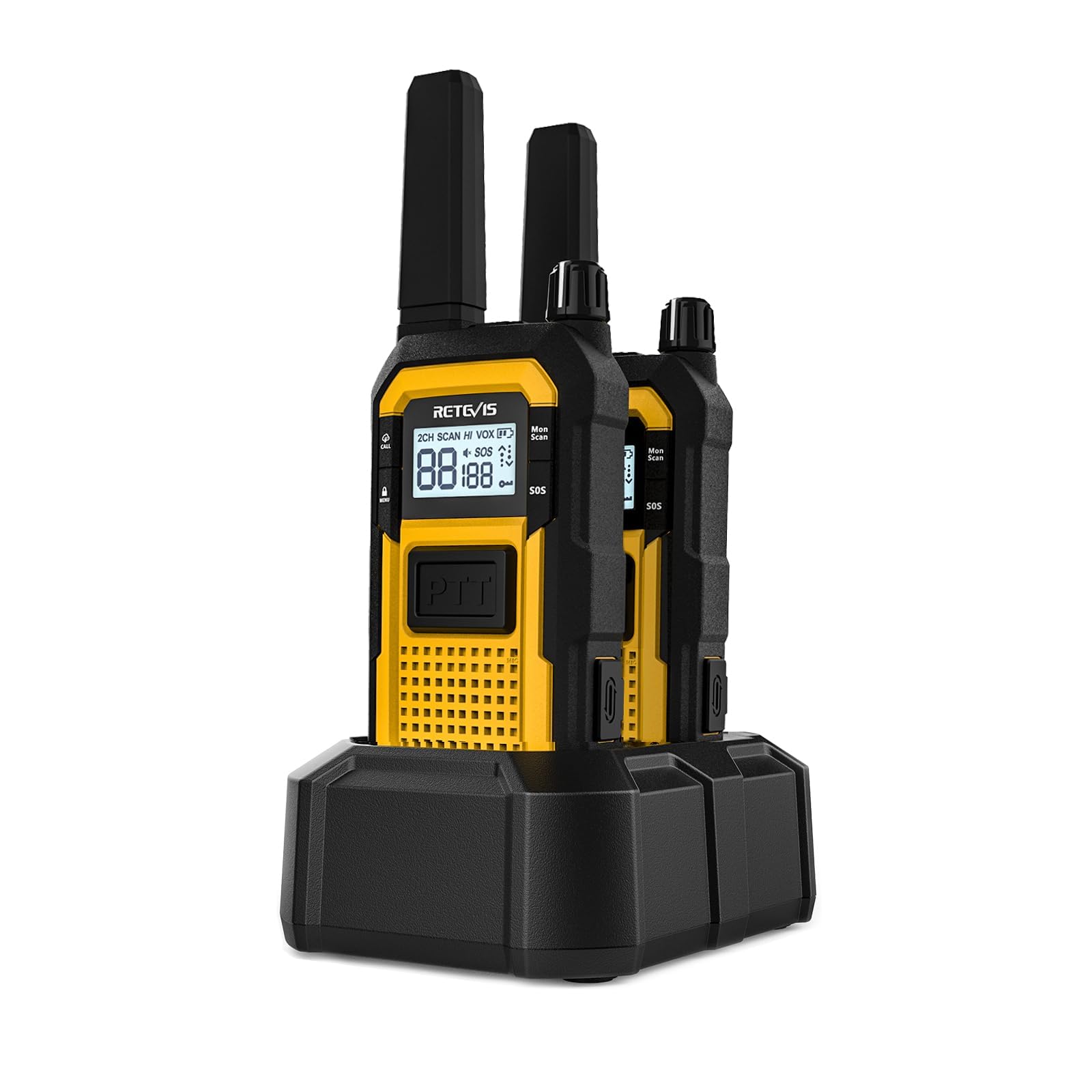
That armor wraps around a 2000mAh battery that delivers up to 20 hours of life between charges, plus the flexibility of USB-C charging or a drop-in charge station. The bright yellow shell also makes it easy to spot in the brush — a small detail that matters when you set it down on a trail. The dual PTT buttons and silicone covers mean you can still work it with gloves on or in a downpour.
What wins people over is the overall quality — the thing everyone raves about is how solid it feels versus radios that cost more. Buyers report it outperforms work-issued Motorola units and holds a full day of use on a single charge, with clear sound and excellent reception. The chemistry is simple: this is the set you grab when the conditions are the worst.
What the Armor Gets You
- MIL-STD-810H tested for harsh environments
- IP67 sealed against dust and submersion
- 2000mAh battery with USB-C and dock charging
Notable Trade-offs
- The pre-set CTCSS/DCS tones can feel limiting to power users
- 15 dB of audible noise rating is modest for loud job sites
Reach for this if: you need a radio that survives being dropped, rained on, and left in a dusty truck bed.
Think twice if: you want deep channel-programming flexibility — you’d miss the manual control.
2. Retevis RT68H Walkie Talkies
An affordable workhorse with a hidden LED display and a battery that outlasts a full shift.
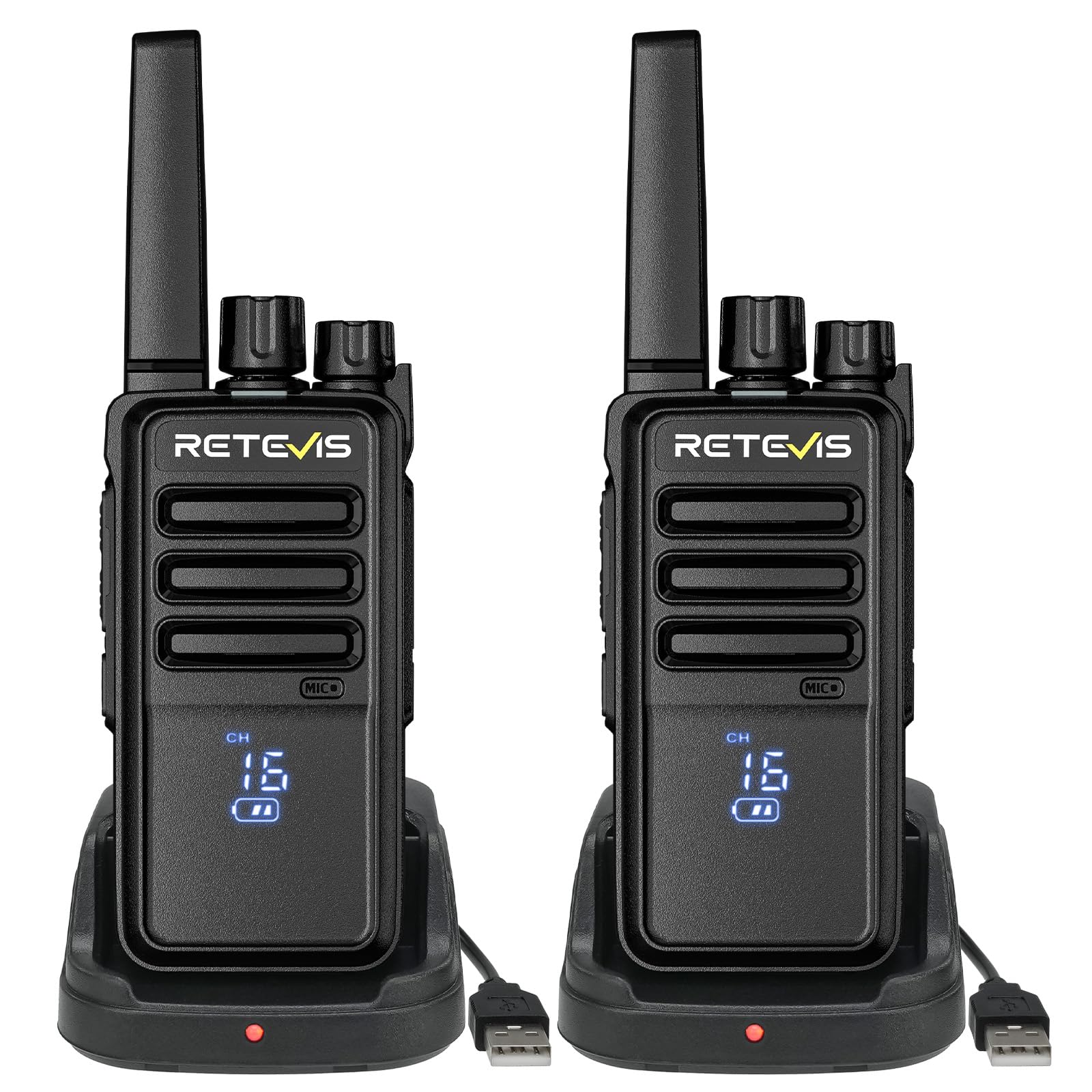
The RT68H proves you don’t need to spend big for dependable daily communication. It runs on a 1200mAh lithium battery rated for 10 to 15 hours of continuous use — enough for a whole workday — and recharges through a standard USB-C port or the included desktop cradle. That’s a 67% smaller battery than the RB48 above, but for a typical shift it rarely matters.
Its hidden LED display is a clever touch, showing channel and power info without relying on a voice broadcast, which is handy on noisy factory floors. The body is made from sturdy ABS plastic, rated shockproof, drop-proof, and splash-proof, and the 0-9 squelch function filters background noise so voices stay crisp in a team setting. The keypad lock prevents accidental channel changes during use.
Owners mention these are reliable across a church campus footprint and through indoor building ranges of up to a mile, with crisp sound and no mid-transmission cutouts. The recurring note is the value — durable FRS radios with good price-to-performance, with one caveat about compatibility with other Retevis models being mixed. It’s the sensible pick for a team that needs dependable comms without the premium price tag.
The Bottom Line: This is the radio you buy when you need rugged, reliable team communication and want to stretch the budget. The USB-C charging is a genuine modern convenience that many pricier sets lack.
3. NXGKET Walkie Talkies 4-Pack
A colorful four-pack that keeps cruises, campsites, and caravans talking for days on end.
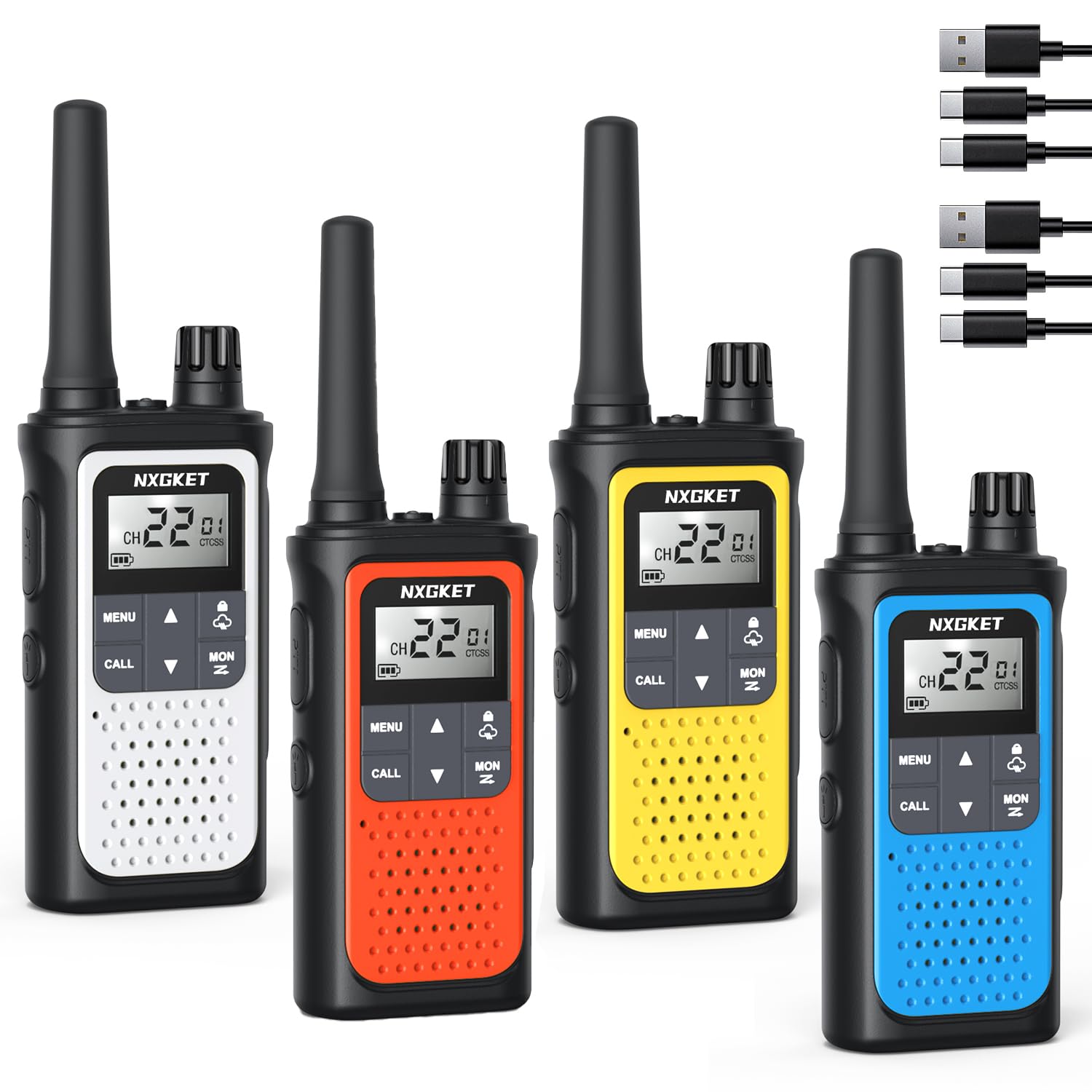
This is the set that fixes the classic family problem: you need more than two radios, and you need them to last the whole trip. The NXGKET includes four color-coded units—blue, yellow, white, and orange—each with an 1800mAh battery rated for 96 hours of average life. Customers note the charge genuinely holds for three days of use, which is the standout feature here.
You might see range claims up to 5 miles, but honest feedback says it works reliably within a 1-mile area — enough for a cruise ship, a large yard, or a convoy of two cars. With 22 channels and 121 privacy codes, you get 2,662 combinations, so you can usually find a clear channel. It also scans 10 NOAA weather channels (National Oceanic and Atmospheric Administration, for live weather alerts) and adds a 9-level VOX mode (voice-activated transmission, so you can talk hands-free).
What makes it special is the versatility for all ages. The clear LCD, large buttons, and simple interface make it easy for older family members to use, and the bright colors make each radio easy to identify. The main trade-off is the mixed range feedback — while some report great reception up to two miles, others say it’s not even a mile, so treat the “5 miles” claim as a best-case scenario and plan accordingly.
Why a Four-Pack Works
- 96-hour average battery life for multi-day trips
- 4 color-coded units keep everyone’s radio identifiable
- Charges all units via 2-in-1 USB-C cables
The Honest Caveat
- Range is consistently shorter than the 5-mile claim in hilly or wooded terrain
- Some duplication of charging cables needed if you want all four topped up at once
Grab this for: family trips and group activities where having four radios and a battery that lasts for days beats everything else.
Skip if: you need long-distance mountain-to-mountain range — this one’s strength is endurance, not extreme distance.
4. Cobra ACXT390 Walkie Talkies

A lightweight classic with AA batteries that’s ready when you need it, no charging dock required.
There’s something appealing about a radio that runs on the six AA NiMH batteries included in the box — it never needs a dedicated charging dock, and spares are easy to pack. The Cobra ACXT390 is compact and lightweight at 3.8 ounces, making it a natural companion for camping, hunting, and event coordination. The 22 channels and 121 privacy codes keep your conversations away from other groups nearby.
The five selectable call tones help you distinguish who’s calling, and the channel scan feature automatically finds active transmissions. VOX hands-free mode lets you transmit just by speaking, which is handy when your hands are full of gear or a fishing rod. For its size, the strong shell is built to withstand harsh conditions, and it gives you 24/7 access to NOAA weather channels.
Owners find it delivers solid quality and battery life — one reviewer noted a charge lasting longer than 10 hours at work, and another loved using it for a high school fashion show event. The reliability and range do get mixed feedback, with some finding clear communication over long distances and others noting it fades beyond two miles. As a light-duty, grab-and-go set, it fits its role well.
Final Read: This is a no-fuss, entry-level GMRS radio for people who want simplicity and portability. The AA battery design is its defining advantage — you’ll never be stuck searching for a wall outlet.
5. Midd Kacy MK108 Walkie Talkies
GMRS power with a battery rated for days, built for convoy-style road trips and farm work.
If your family regularly travels in two vehicles, this set replaces endless phone calls with the fun of “10-4 good buddy.” The Midd Kacy MK108 runs on GMRS frequencies (a licensed US band) with 60 channels, and its 1800mAh battery is rated for 120 hours—reviewers point out a full cross-country trip with two bars left. It supports four power-saving modes, so you can stretch that runtime even further.
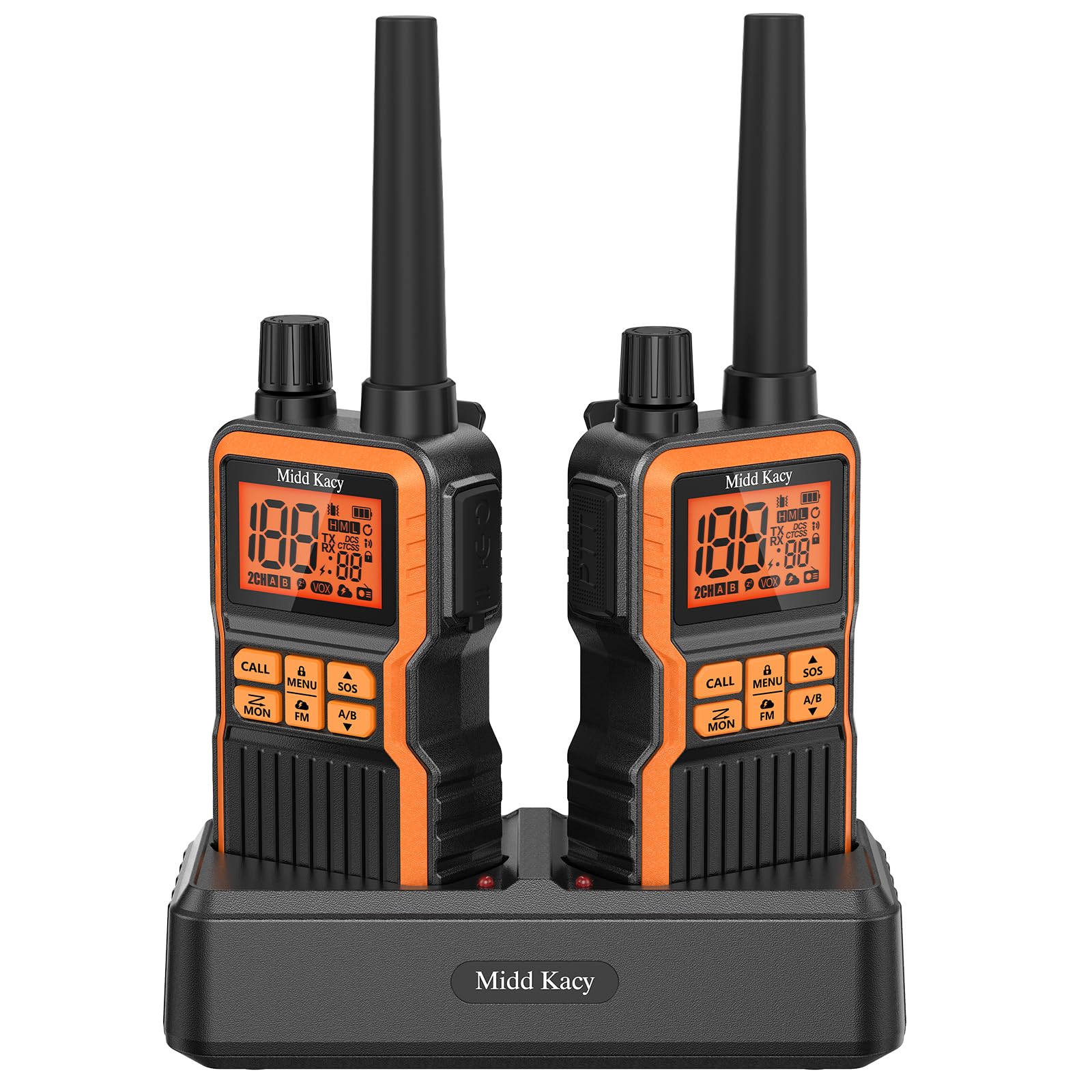
This is a rugged radio too, with waterproof, anti-drop, and dustproof construction and a strong shell for harsh conditions. The bold orange backlit LCD screen stays readable at night, and the 24/7 NOAA weather channels keep you informed of changing conditions. You also get SOS, FM radio, a stopwatch, and 10 call tone settings, plus a 2.5mm headset jack for private listening.
The battery life is the headline here — the thing that wins people over is how it lasts the whole way and then some. It works well with little static between vehicles on the highway, though the mixed feedback on range means you should expect about a football field’s distance before audio gets unintelligible in cars. For multi-day trips and farm use where charging opportunities are rare, this endurance is the real value.
Built for the Long Haul
- 120-hour average battery rating for multi-day trips
- 60 GMRS channels with 4 power-saving modes
- Included desktop charger and case
Where It Falls Short
- Range between moving vehicles is limited to a short distance
- Requires a GMRS license to transmit legally
Best for: families who do long road trips and want radios that survive the journey without a charge.
Look elsewhere if: you need to communicate across miles of open terrain — this one shines on endurance, not extreme distance.
6. Gaswei G1Pro+ IP67 Walkie Talkies
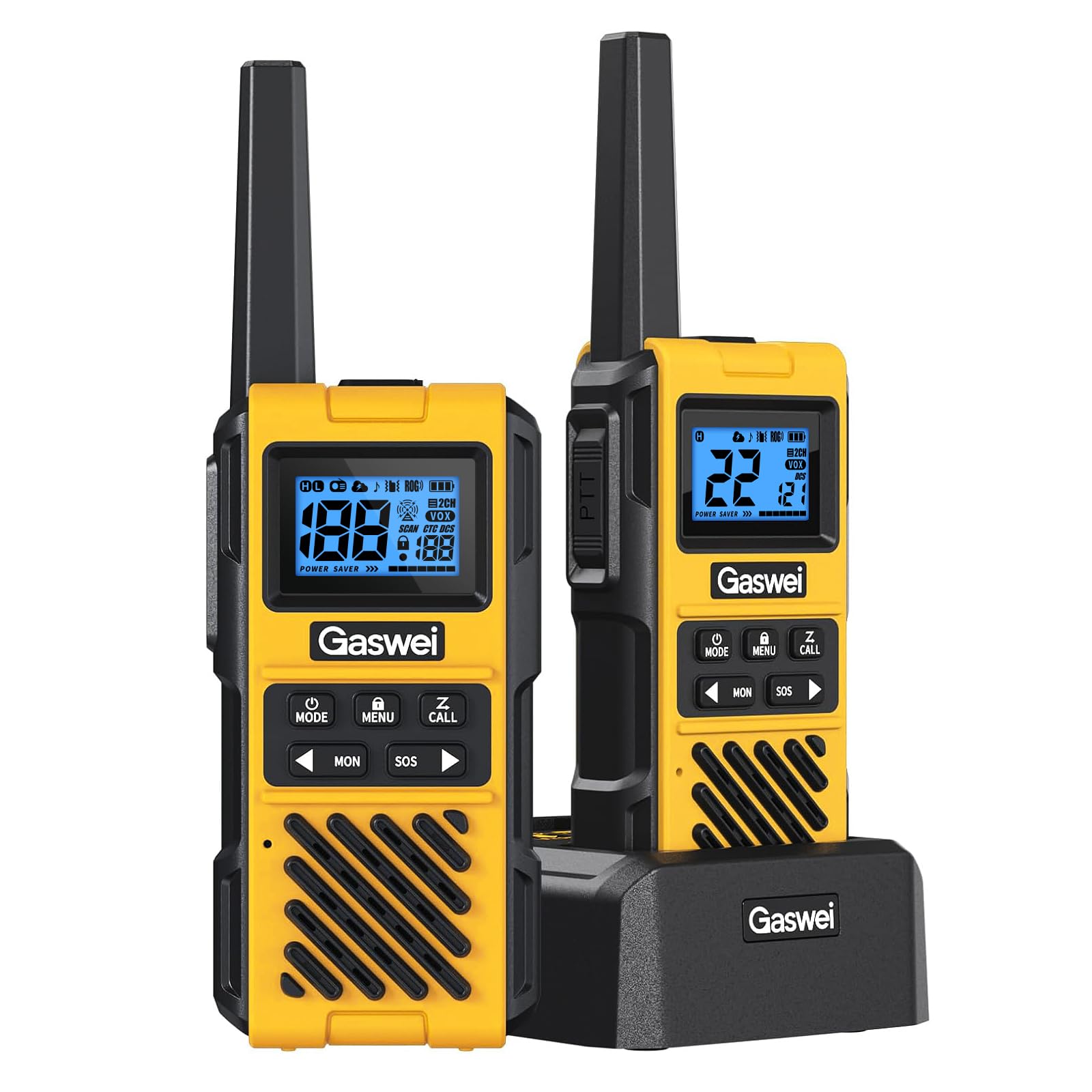
A waterproof, license-free set with a rugged grip that’s ready for rain-slicked trails.
For outdoor enthusiasts who don’t want to deal with GMRS licensing, the Gaswei G1Pro+ brings professional-grade protection in a simple FRS package. Its IP67 rating means it’s fully sealed against dust and can survive being submerged in up to a meter of water, and the shock-resistant construction handles 2-meter drops. A built-in anti-slip grip keeps it in your hand when conditions get wet.
It operates license-free from the start across 22 FRS channels and 121 CTCSS privacy codes — that’s up to 2,684 combinations to block unwanted conversations. The 1800mAh lithium battery delivers up to 24 hours of continuous use and 100 hours in standby, built for long stretches. You also get FM radio, VOX hands-free operation, SOS and vibration alerts, and 10 NOAA weather channels.
Shoppers say these perform much better than a set of Motorola radios they’d purchased, with batteries that last an amazingly long time and audio quality and range described as good. It’s been used to connect family members across Yosemite where cell service was spotty. The durability gets mixed feedback in the reviews, so treat the ruggedness as a solid bonus rather than an absolute guarantee.
Where It Wins: The IP67 seal plus 100-hour standby is a rare combo in the license-free category, making it a strong pick for kayakers, hikers, and anyone who fears the rain. It’s priced as a mid-range option with features that feel premium.
7. Motorola Solutions Talkabout T475
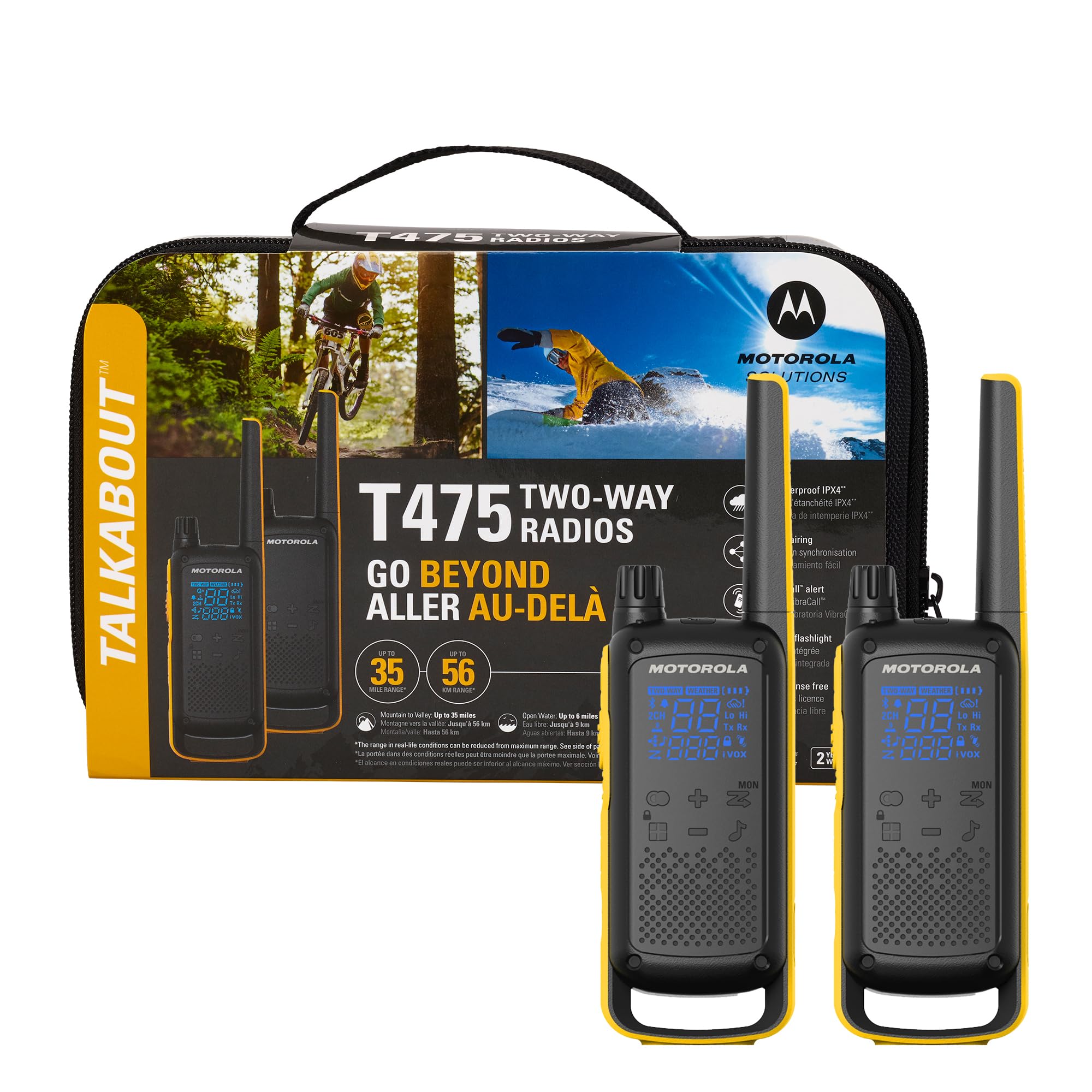
A trusted name with 2,662 channel combinations, a built-in flashlight, and easy pairing for the whole family.
The Motorola name carries weight, and the T475 backs it up with a package designed for easy family use. It comes with 22 channels and 121 privacy codes, totaling 2,662 combinations, plus weather-proof IPx4 protection that handles light rain and splashes. The included NiMH 800mAh batteries deliver up to 12 hours of life, and the dual-power design means you can swap in two AA batteries as a backup.
What sets this apart is the thoughtful extras. A built-in flashlight is always ready when you need to find something in the dark, and the VibraCall alert vibrates the radio so you never miss an incoming call in a noisy environment. It also includes NOAA Weather Radio and Alerts, plus a lanyard, earpiece, belt clip, and 16 personalized stickers to help each family member identify their radio. Easy pairing gets you talking in seconds.
The quality and ease of use win people over instantly, but the range and reliability do receive mixed feedback — some report good range while others say it struggles beyond a couple of hundred feet in certain conditions. One buyer mentioned an excellent 3.9-mile range on low power with wind cancellation, so results vary with terrain. For casual family use in parks, events, or around the neighborhood, this simplicity is the appeal.
The Family-Friendly Extras
- VibraCall vibration alert for noisy environments
- Built-in flashlight on each radio
- 16 stickers included for easy identification
Be Aware
- Range is inconsistent based on terrain and obstacles
- 800mAh battery capacity is smaller than many competitors
Choose this for: a household that values brand reliability and simple, out-of-the-box communication.
Pass if: you need guaranteed long-distance range or all-day heavy-duty use — the small battery and inconsistent range are limiting.
8. SAMCOM FPCN30A Business Radios

The 5-watt site radio that punches through concrete walls and keeps whole crews on one channel.
When communication is critical to a job site, the SAMCOM FPCN30A earns its place. Its 5 watts of UHF power reaches 3-5 miles in open areas and covers over 300,000 square feet indoors, pushing through concrete, steel, and basements. It’s built for heavy-duty work in construction, warehouses, and industrial environments, shrugging off dust, bumps, and drops.
The standout feature is Instant Group Call — a single button broadcast that reaches multiple teams even when they’re on different channels. That’s perfect for site-wide announcements or safety alerts. The 20 UHF channels let you split crews cleanly: “Crane Ops” on channel 4, “Foundation” on channel 7, “Site Office” on channel 12, keeping conversations from stepping on each other. The 1500mAh battery is rated for 21 hours of average life.
One honest caveat: this is a professional radio that requires a license, and buyers report it comes not pre-programmed to standard channels — you’ll need a separate USB cable to reprogram frequencies. The built quality, clear long-range audio, and the Group Call feature earn consistent praise, with flawless performance reported at loud stadium events. The battery life gets mixed feedback, with occasional reports of issues charging, so test your charging setup early.
Why Crews Need It
- 5 watts of power for deep building penetration
- One-key Group Call across all channels
- 20 UHF channels for clear crew separation
Setup Reality
- Requires a USB cable to reprogram channels to your needs
- Professional license required for legal use
Built for: construction managers and warehouse teams who need reliable, penetrating coverage across a large site.
Not for: casual family users — the programming requirement and licensing make it a professional tool, not a toy.
9. Rocky Talkie Expedition 5 Watt
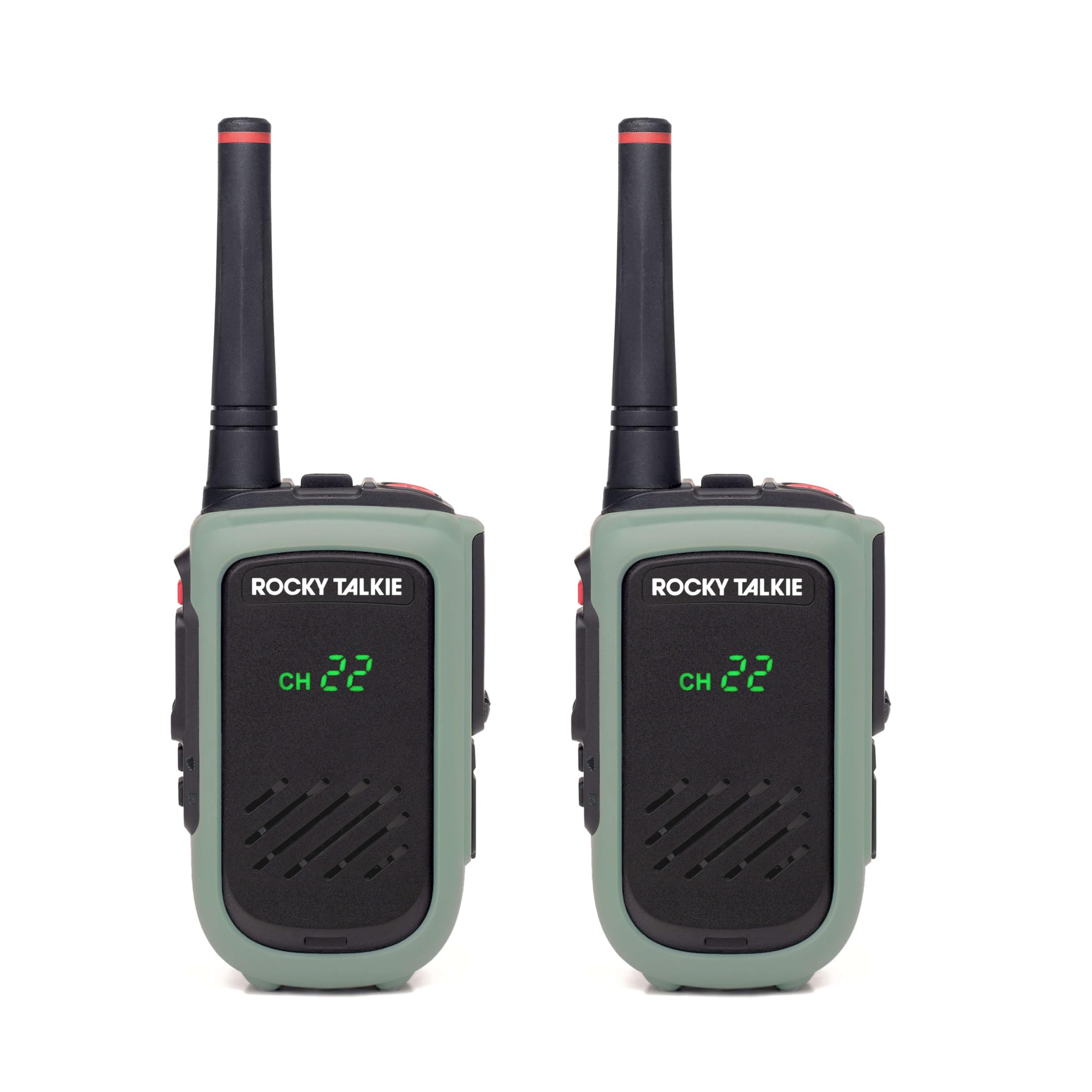
The max-power GMRS radio with a 5-day battery, built for the harshest backcountry conditions.
This is the radio that serious outdoor adventurers reach for when communication is a safety tool, not a convenience. The Rocky Talkie Expedition delivers the maximum 5 watts for GMRS, with a max range over 35 miles—though 2 to 8 miles is typical in backcountry. It open up 8 repeater channels to extend your range further, and the removable antenna lets you swap in a longer one for even more reach.
The battery is the defining feature: a specialized 1800mAh cell achieves an average of 5 days on a single charge, even in frigid conditions, and it’s user-replaceable. The IP67 rating means it’s waterproof to 1 meter of submersion, and the shatterproof screen adds another layer of protection. It also gives you access to 11 weather channels with NOAA alerts, plus dual-channel monitoring and transmitting.
Owners describe this as the most rugged, highest-quality walkie talkie they have experienced, with exceptional range in terrain that defeats cheaper sets — one report notes 2.4 miles through a dam area with 300 feet of elevation change. The customer service stands out, with weak batteries replaced free and spare parts sent proactively. The value gets mixed feedback only because of the higher price, but for those who need reliable backcountry comms, it is worth the money.
The Expedition Difference
- 5 days of average battery life in cold conditions
- 5-watt max power with 8 repeater channels
- User-replaceable batteries and USB-C charging
What You Pay For
- Premium price reflects the rugged build and support
- Requires a GMRS license to transmit legally
Worth it for: mountaineers, backcountry skiers, and off-road groups who need a radio they can trust when cell service disappears.
skip it if: your needs are limited to a park or a local event — the premium features won’t get used.
Understanding the Specs
Battery Capacity (mAh)
This is the number that tells you how long your radio can keep running between charges. A 2000mAh battery, like the one in the Retevis RB48, will generally last longer than a 1200mAh cell found in the RT68H. But the real-world runtime also depends on how much you transmit, your volume level, and whether you’re using high or low power. For multi-day trips, look for the “average battery life” rating in hours and add a generous buffer for your actual usage patterns.
Frequency Band and Licensing
The three main bands — FRS, GMRS, and UHF — dictate both your range and your legal obligations. FRS radios like the NXGKET are license-free and perfect for casual family use. GMRS radios like the Rocky Talkie and Midd Kacy push more power for longer range but require a simple FCC license. UHF business radios like the SAMCOM FPCN30A are built for professional use and typically need a business license. Always check which band a radio uses before buying, so you’re not accidentally transmitting illegally.
FAQ
Do I need a license to use a two-way radio?
Will these radios work through buildings and trees?
How long do the batteries actually last?
Can I use different brands of radios together?
What is the difference between IP67 and IPx4 waterproofing?
How far can a 5-watt radio really reach?
What is NOAA weather alert and why does it matter?
Is it better to buy a 2-pack or a 4-pack?
Final Thoughts: The Verdict
For the majority of shoppers, the 2 way radio system winner is the Retevis RB48 because it bundles MIL-STD-810H military durability, IP67 waterproofing, and a 2000mAh battery into a license-free package that’s ready for any adventure. If you want a budget-friendly workhorse for team communication, the Retevis RT68H delivers dependable performance with USB-C charging. And for serious backcountry expeditions where communication is a safety tool, the Rocky Talkie Expedition is the one to reach for.
How We Picked
We do not accept paid placement. Every pick is matched to a real buyer and a real use-case; we do not hands-on test units.
Sources & Methodology
Specifications: manufacturer listings and product documentation. Review insights: verified customer reviews, as of August 2026. Pricing: not shown on this page (it changes often); check the current price via the retailer link.
As an Amazon Associate, Gadgets Feed earns from qualifying purchases. This does not affect which products we feature.