
Our readers keep the lights on and my morning glass full of iced black tea. As an Amazon Associate, I earn from qualifying purchases.
Specs are compiled from manufacturer listings and verified buyer reviews and can change over time — please confirm the key details on the product page before buying.
The real trick is finding one that delivers industrial-grade steel removal, smooth variable-speed control, and enough mass to stay planted — without wrecking your budget. These three VEVOR and JLD machines cut through that noise, each aimed at a different shop size and skill level.
I’m Min — the founder and writer behind Gadgets Feed. This guide is built by comparing the manufacturers’ published specifications and the patterns across verified customer reviews, so you get each pick’s real strengths and trade-offs instead of marketing spin.
You want a grinder that removes steel fast without stalling, keeps your belts running at the right speed for every job, and stays solid on your bench. The best 2 x 72 belt grinder for you depends on motor power, build heft, and whether you are okay with a little assembly tinkering.
Our Picks at a Glance

How To Choose The Best 2 X 72 Belt Grinder
Look for a grinder that removes steel fast, tracks straight, and stays planted under pressure. Three specs separate the keepers from the compromises.
Motor Power and the Drive System
Motor power determines how aggressively you can push steel into the belt without stalling. A 1.5 kW to 2.2 kW motor (roughly 2 to 3 HP) gives you enough force for knife bevels and heavy stock removal without stalling. A variable-frequency drive (VFD) lets you dial belt speed from a crawl for sharpening to full speed for rough grinding. — an electronic controller that lets you adjust the belt speed from a crawl for fine sharpening up to a fast clip for rough grinding. It also protects the motor from the heat buildup that kills fixed-speed units.
Build Weight and Frame Rigidity
Heavier frames absorb vibration and keep the grinder planted under load. A machine that tips the scales around 170 to 200 pounds sits rock-solid when you bear down, translating every watt into cutting power instead of vibration. Thin sheet-metal frames shake, cause chatter marks on your workpiece, and wear out bearings faster. Look for a frame that is welded steel plate — thick enough that you cannot flex it with your hands.
Belt Tracking, Tooling, and Convenience
Good belt tracking keeps the abrasive centred on the platen and contact wheel without constant adjustment. The best grinders offer a simple adjustment knob and tracking that holds true under load. Also check what grinding heads come in the box: a flat platen for straight bevels, a large contact wheel for hollow grinds, and an arc rest for curved work. Quick-change belt mechanisms save you ten minutes every grit swap.
Quick Comparison
| Model | Best For | Motor Power | Max Speed | Weight | Amazon |
|---|---|---|---|---|---|
| VEVOR 2×72 Belt Grinder★ Best Overall | Balanced all-rounder | 1500 W / 2 HP | 2900 rpm | 110.7 lb | Amazon |
| JLD 2×72 Belt Grinder | Heavy stock removal | 2.2 kW | 3000 rpm | 187 lb | Amazon |
| VEVOR 2×82 Belt Grinder | Budget shop upgrade | 1500 W / 2 HP | 2800 rpm | 172 lb | Amazon |
In‑Depth Reviews
1. VEVOR 72 x 2-Inch Belt Grinder Sander
Our pick — over 4★ from 60+ verified ratings; the strongest balance of quality and price.
A 1500 W variable-speed grinder that delivers where it counts at a handsome discount.
The VEVOR 2×72 lands in the middle of the range with a 1500 W pure copper motor that spins at 2900 rpm, while the 2×82 VEVOR model below runs at 2800 rpm, so you get a touch more speed for hogging off metal. The machine includes three grinding moulds — circular, arc, and flat — plus three sanding belts at 100, 180, and 240 grit so you can start grinding right out of the crate. The welded steel frame and thickened base keep the 110.7-pound chassis stable during use.
Quality is the aspect owners mention most, with the machine described as well-made for the price point. One builder noted it “does clean hollow grinds” easily, and the tracking adjustment is easy to dial in. The VFD lets you ramp the belt speed up or down smoothly, which is critical when you switch from rough stock removal to a delicate edge finish. The plug-and-play electrical setup is straightforward — the unit comes ready for 110V with no transformer needed.
The recurring electrical gotcha is that this grinder will trip a GFCI outlet every time you start it up. Multiple owners confirm the same experience: the high inrush current on a GFCI circuit causes nuisance tripping. You need a standard non-GFCI outlet or a dedicated circuit. A few owners also mention the electronics enclosure feels cheap and the instructions are hard to follow. The trade-off is performance per dollar — this is the most affordable true 2×72 VFD grinder in the comparison.
What makes it a value winner
- 1500 W motor with VFD gives smooth variable speed at a budget-friendly price
- Three grinding moulds and three belts included — grind right away
- Welded steel frame and 110.7 lb weight keep it steady for most shop work
- Runs on standard 110V without a step-up transformer
The small catches
- Will trip GFCI outlets at startup — needs a standard non-GFCI circuit
- Electronics enclosure is plastic and some question its long-term durability
- Instructions are hard to follow; expect to figure out some assembly on your own
Best if you want: a solid VFD grinder without paying premium-tier money. For general metalworking, knife profiling, and deburring, this 1500 W machine punches above its cost.
Skip if you: only have GFCI outlets in your shop and cannot add a standard circuit. Also skip if you expect industrial-grade electronics packaging.
2. JLD 2 x 72-82 Belt Grinder Sander
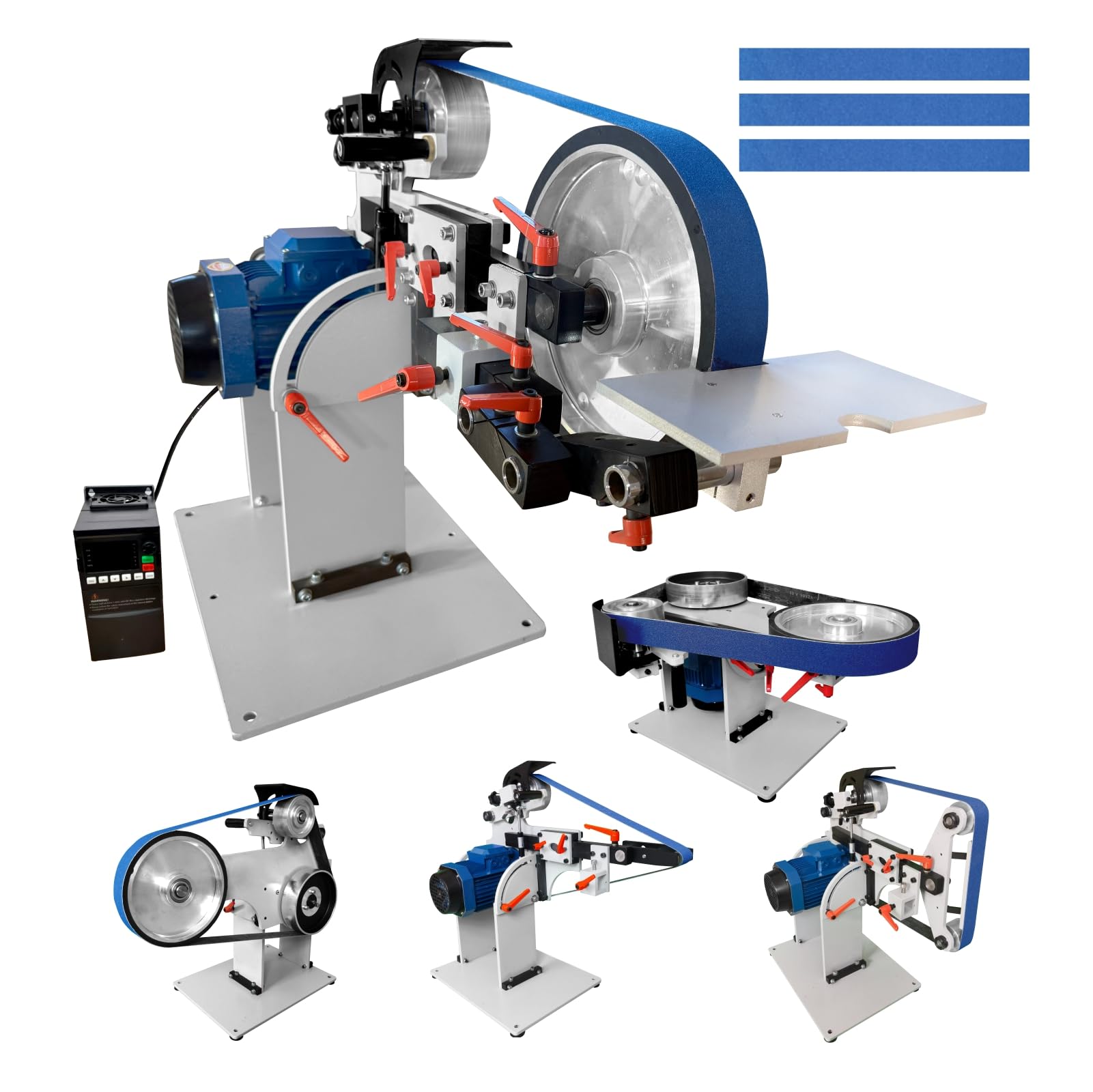
This 187-pound beast chews through half-inch rebar like it is butter.
What wins people over here is raw, unfiltered muscle. The 2.2 kW motor spins a 2 x 72 belt at up to 3000 rpm, and buyers report that it devours thick steel at only 65% power. The variable-frequency drive (a speed controller that lets you dial in anything from a slow sharpen to a fast rough-grind) gives you fine control for bevels without overheating the edge — something a fixed-speed grinder simply cannot do.
Build quality is the loudest talking point. The frame is thick plate steel welded at every joint, and at 187 pounds this machine sits planted without bolting it down. Owners describe it as “built like a tank” and note that vibration is so low you forget the motor is running. The included zirconia corundum belts (60, 100, and 180 grit) cover the whole workflow from heavy material removal down to finishing. It also supports vertical and horizontal orientations, so you can switch between standing up for long blades and laying flat for detail work.
The honest trade-off is the instruction manual. Several owners say the setup guide is poorly written — worth a look at the CW-100 VFD PDFs online instead. The white paint on the work-table arms may need a quick sand to slide freely. And at 187 pounds (the heaviest in this lineup, at 187 pounds versus the VEVOR 2×82’s 172 pounds), you absolutely need a helper or a lift gate to get it onto your bench.
Where it dominates
- 2.2 kW motor and 3000 rpm top speed outpaces the other picks for stock removal
- Thick plate-steel frame and 187 lb mass kill vibration and chatter
- VFD gives infinite speed adjustment — silent at low rpm for sharpening
- Quick belt swaps with an auto-catch pin save time between grits
Where it asks patience
- Manual is nearly useless — expect to rely on YouTube and third-party VFD guides
- Work-table arm paint may need sanding to fit properly
- Very heavy — 187 lbs means you need help moving it into position
Reach for this if: you are a bladesmith or metalworker who needs to remove serious material fast without the grinder walking across the floor. The motor power and build rigidity beat the 1500 W VEVOR units hands-down.
Think twice if: you want plug-and-play from the start. Expect to spend an evening figuring out the VFD programming on your own.
3. VEVOR 1500W 2HP Belt Sander Grinder, 2″ x 82″
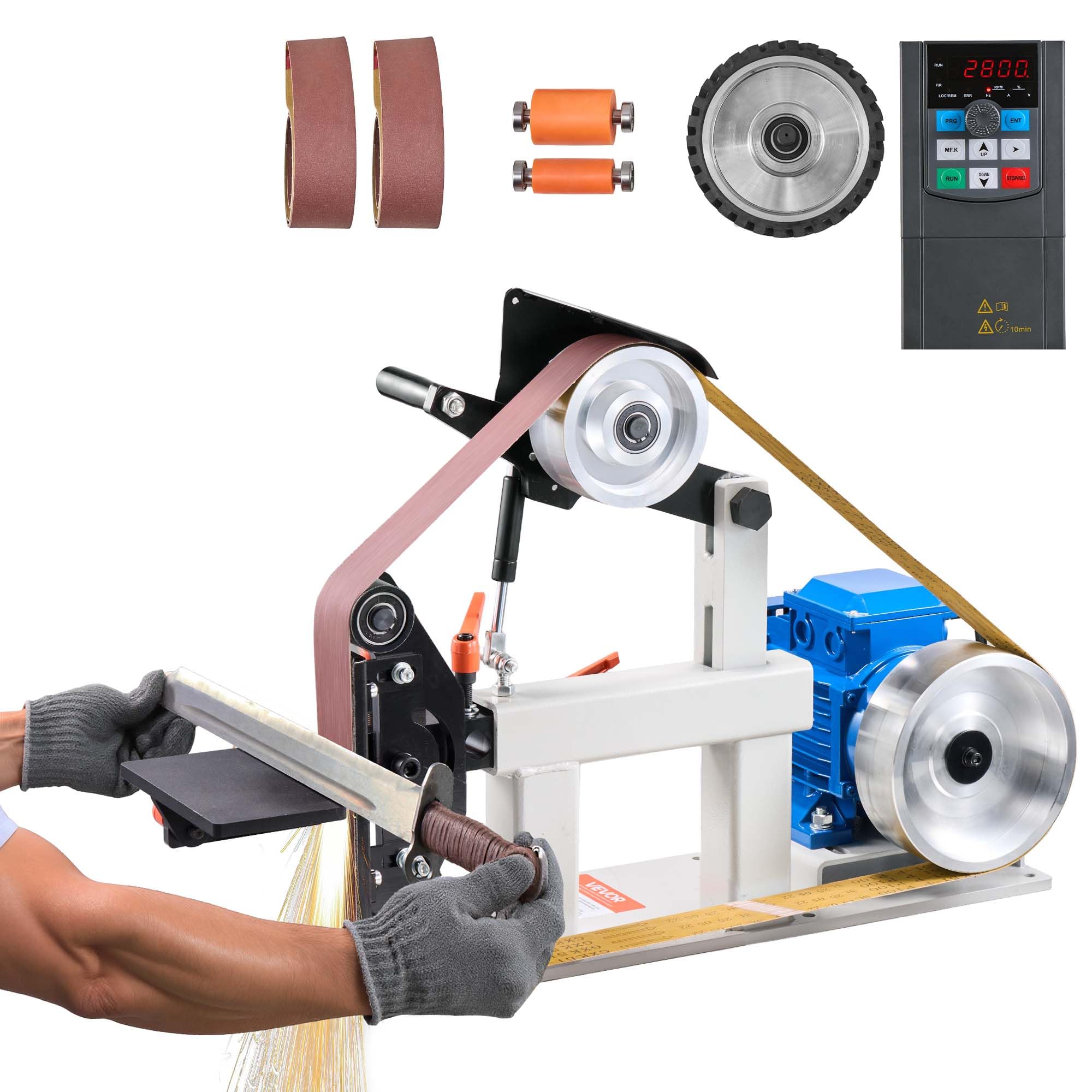
An affordable entry point to a large-format grinder — with the caveat that belts are not standard 2×72.
This VEVOR model uses a 2-inch by 82-inch belt, which is nominally longer than the standard 2×72 format. The 1500 W motor runs at 2800 rpm, while the 2×72 VEVOR above runs at 2900 rpm, but the real difference is the belt size. Several owners note that you will need a modification to run standard 2×72 belts — something to factor in if you already own a stack of 72-inch abrasive belts. The all-steel frame weighs 172 pounds, giving it solid heft that reduces vibration.
The included frequency converter lets you run the machine on single-phase household power while giving the motor three-phase performance. Setup is described as straightforward, with one owner noting they were up and running quickly after crated delivery. The build quality is the most-praised aspect, with the frame welded at all joints.
The foremost operational advice across reviews is the same GFCI issue — do not plug this into a GFCI outlet, as the inrush current trips it. A few owners received units damaged in shipping, and replacement support from VEVOR was inconsistent. The 82-inch belt format means you have a more limited selection of aftermarket belts compared to the ubiquitous 2×72 standard. If you are okay sourcing 82-inch belts or doing a simple modification, the heavy 172-pound frame gives you stability at a lower entry price.
Its best traits
- 172-pound all-steel frame provides excellent vibration dampening for the price
- Includes flat platen, 12-inch contact wheel, and two smaller wheels — versatile tooling
- Frequency converter lets you run on 110V single-phase with three-phase motor benefits
- Owners describe it as an affordable alternative to + grinders
What to plan for
- Uses 82-inch belts instead of standard 2×72 — modification needed for 72-inch belts
- GFCI outlet tripping at startup is a consistent complaint across buyers
- Instructions are in Japanese only; no multilingual programming guide included
Best for the budget-minded shop: that wants a heavy base and does not mind the 82-inch belt format. The steel frame is a genuine upgrade over flimsy grinders at similar cost.
Not for you if: you already own a collection of 72-inch belts and have no interest in modifying the machine. Also not ideal if GFCI outlets are your only available power.
Understanding the Specs
Motor Power and VFD
Horsepower (HP) and kilowatts (kW) tell you how much material the grinder can remove without stalling. A 1500 W motor is about 2 HP, enough for most knife work and deburring. A 2.2 kW motor is closer to 3 HP and chews through thicker steel faster. The variable-frequency drive (VFD) is a speed controller that converts your single-phase household power into three-phase power for the motor. It also lets you dial the belt speed from a crawl (great for sharpening without burning the edge) up to full speed for hogging off steel. Without a VFD, a grinder runs at one fixed speed, which limits what you can accomplish.
Weight and Frame Construction
A belt grinder’s weight is its best stabiliser. A machine in the 170-to-200 pound range sits planted under heavy pressure, reducing vibration and chatter marks on your workpiece. The frame should be welded steel plate — not thin sheet metal bolted together. Thicker steel absorbs motor vibration and keeps the belt tracking straight under load. A lighter machine (under 120 pounds) may walk across the floor or shake noticeably when you bear down.
FAQ
Can I use standard 2×72 belts on a grinder that says 2×82?
Why does my belt grinder trip the GFCI outlet every time I start it?
What does a VFD do for a belt grinder?
How much weight do I need in a belt grinder to reduce vibration?
Can I run a 2 HP belt grinder on a standard 110V household outlet?
What is the difference between a flat platen, contact wheel, and arc grinding?
How do I keep the belt tracking centred during a grinding pass?
Is a belt grinder worth it for a hobby knife maker?
What grit progression should I use for knife making?
Will a 2×72 belt grinder work for wood and plastic, or only metal?
Final Thoughts: The Verdict
If you want one dependable pick, the best 2 x 72 belt grinder winner is the JLD 2×72 because its 2.2 kW motor and 187-pound frame give it the most aggressive stock removal and the smoothest cut of the three. If you want a capable VFD grinder at a lower cost, the VEVOR 2×72 delivers 1500 W of variable speed in a well-built package — just skip the GFCI outlet. And for the heaviest base at the most accessible price, the VEVOR 2×82 offers 172 pounds of steel, provided you are comfortable sourcing longer belts or doing a small modification. The crowd favourite across over 120 combined ratings points to the VEVOR 2×72 as the value champion; the JLD takes performance honours if your budget stretches a little further.
How We Picked
We do not accept paid placement. Every pick is matched to a real buyer and a real use-case; we do not hands-on test units.
Sources & Methodology
Specifications: manufacturer listings and product documentation. Review insights: verified customer reviews, as of July 2026. Pricing: not shown on this page (it changes often); check the current price via the retailer link.
As an Amazon Associate, Gadgets Feed earns from qualifying purchases. This does not affect which products we feature.