
Our readers keep the lights on and my morning glass full of iced black tea. As an Amazon Associate, I earn from qualifying purchases.
Specs are compiled from manufacturer listings and verified buyer reviews and can change over time — please confirm the key details on the product page before buying.
A fast 20-amp (20A) charger can top off a deeply drained battery before dinner, but it also needs to be gentle enough not to cook your expensive AGM (Absorbent Glass Mat) or LiFePO4 (Lithium Iron Phosphate) battery overnight. The best options deliver real speed without forcing you to watch the process. This guide breaks down seven specific models so you find the one that matches your battery size and your budget.
I’m Min — the founder and writer behind Gadgets Feed. This guide is built by comparing the manufacturers’ published specifications and the patterns across verified customer reviews, so you get each pick’s real strengths and trade-offs instead of marketing spin.
Whether you are maintaining a classic car over winter or reviving a deep-cycle marine battery, finding the right 20 amp lead acid battery charger is about matching the right charging modes and safety features to your specific battery type.
Our Picks at a Glance
How To Choose The Best 20 Amp Lead Acid Battery Charger
Picking a 20-amp charger is a straightforward decision once you know the three things that matter most for your battery’s health and lifespan. You are looking for a charger that matches your battery’s chemistry, delivers the right current, and includes safeguards against common mistakes.
Battery Chemistry Compatibility
Not all chargers work with all battery types. If you have a standard flooded lead-acid battery, most chargers will handle it. But if you have an AGM (Absorbent Glass Mat) or a Gel battery, you need a charger with a specific mode for those chemistries. Many modern chargers also support LiFePO4 (Lithium Iron Phosphate) batteries, which require a different voltage curve. Check the charger’s listed compatibility before buying — hooking a lithium-only profile to an old lead-acid battery can undercharge it.
Multi-Stage Charging
A good 20-amp charger does not just slam power into your battery until it is full. It uses a multi-stage process — typically 7 to 10 stages — that starts with a bulk charge, then absorbs at a lower current, and finally floats at a maintenance voltage. This prevents overcharging and keeps your battery at peak health for longer. Without this, you risk boiling off the electrolyte in a flooded battery or damaging an AGM.
Safety Protections
Look for protections that handle real-world mistakes. Reverse polarity protection saves you if you accidentally clamp the leads backward. Spark-proof circuitry prevents a dangerous spark. Overcharge and over-temperature protection will shut the charger down if something goes wrong. These are not nice-to-haves; they are the difference between a tool you trust and one you watch nervously.
Quick Comparison
| Model | Best For | Charging Stages | Weight | Dimensions (DxWxH) | Amazon |
|---|---|---|---|---|---|
| BROODAY 20A★ Best Overall | Best Overall | 10-Stage | — | 10″ x 5″ x 9″ | Amazon |
| HTRC 20ATop Performer | Top Performer | 9-Stage | — | 3.5″ x 6.1″ x 1.9″ | Amazon |
| YHCHKJ 20A | Premium Pick | 3-Level Smart | 1.23 lbs | 7.63″ x 2.66″ x 6.71″ | Amazon |
| Hiyiton 20A | Versatile Choice | Smart Auto | — | 3.5″ x 6.3″ x 2″ | Amazon |
| Huiaipaic 20A | Best Value | Automatic | 1020 g (2.25 lbs) | 6.5″ x 7.56″ x 4.02″ | Amazon |
| RCGCBC 20A | Budget Champion | 9-Stage | — | 7.5″ x 2.5″ x 6.6″ | Amazon |
| VEVOR 20A | Compact Pick | 7-Level | 1.8 lbs | 6.5″ x 3.8″ x 2.2″ | Amazon |
In‑Depth Reviews
1. BROODAY Auto Battery Charger 20A
Our pick — over 4★ from 700+ verified ratings; the strongest balance of quality and price.
Six current settings let you safely charge a tiny 5Ah motorcycle battery or a 200Ah deep-cycle RV battery from the same unit.
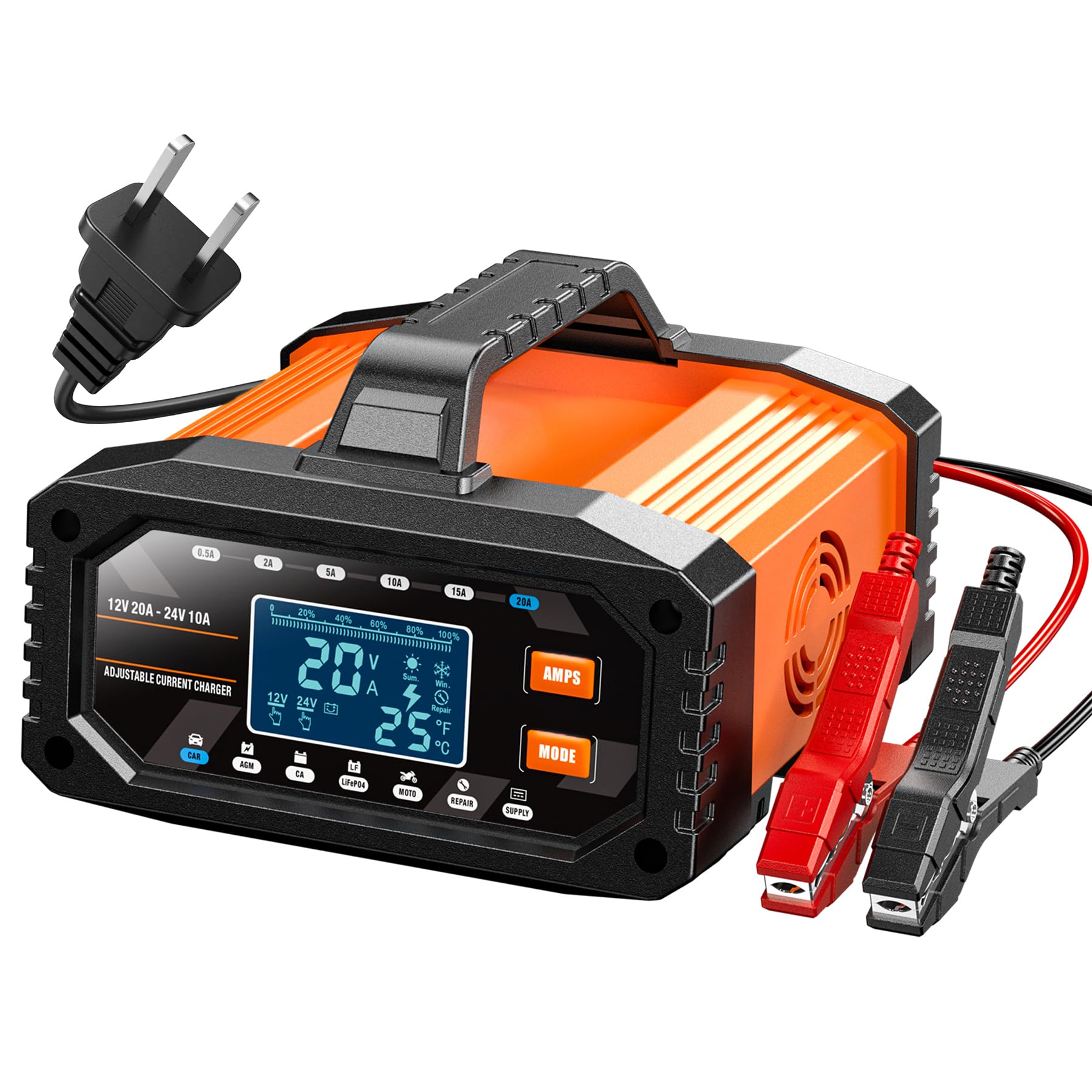
This BROODAY unit stands out because you are not stuck with one speed. You choose from six current levels — 0.5A, 2A, 5A, 10A, 15A, or 20A for 12V batteries — which means it can slowly nurse a motorcycle battery back to health or blast a deep-cycle RV battery at full 20A. The 10-stage charging process (bulk, absorption, float, and more) ensures you do not overcharge, so the battery stays healthy for its full lifespan. It works with LiFePO4, lead-acid, AGM, GEL, EFB, SLA, and flooded batteries, giving you broad coverage for cars, trucks, boats, and lawn mowers.
Unlike the smaller Huiaipaic unit (which measures 6.5″D x 7.56″W x 4.02″H), this charger takes up more bench space at 10″D x 5″W x 9″H — a 54% deeper footprint. But the trade-off is a large, high-contrast LCD screen that shows voltage, current, internal temperature in °F/°C, active mode (Summer/Winter), and fault alerts. One reviewer noted that it “charged it fully in about 3 hours” for a 24V LiFePO4 battery, which underscores the real-world speed of the 20A output. It also features 0V activation technology, meaning it can attempt to revive a battery that has dropped to zero volts — a trick most standard chargers simply refuse to attempt. The unit comes with a 3-year manufacturer warranty and CE, FCC, and ROHS certifications for safety.
Who it fits: Anyone who owns multiple battery types — from a tiny lawn tractor battery to a large truck battery — and wants one charger that can safely handle all of them at the right current.
One thing to note: The bulkier footprint (10 inches deep) means it stays on a garage shelf rather than fitting in a glovebox. If space is tight, a more compact unit may suit you better.
Reach for this if: you own batteries of various sizes and chemistries and want a single charger with micro-adjustable current that you can trust for years.
Look elsewhere if: portability and ultra-compact storage are your main priorities — this is a bench tool, not a road-trip accessory.
2. HTRC 20A Smart Battery Charger
At 3.5 inches deep, this is roughly the size of a thick paperback — much easier to stow than the 10-inch-deep BROODAY.
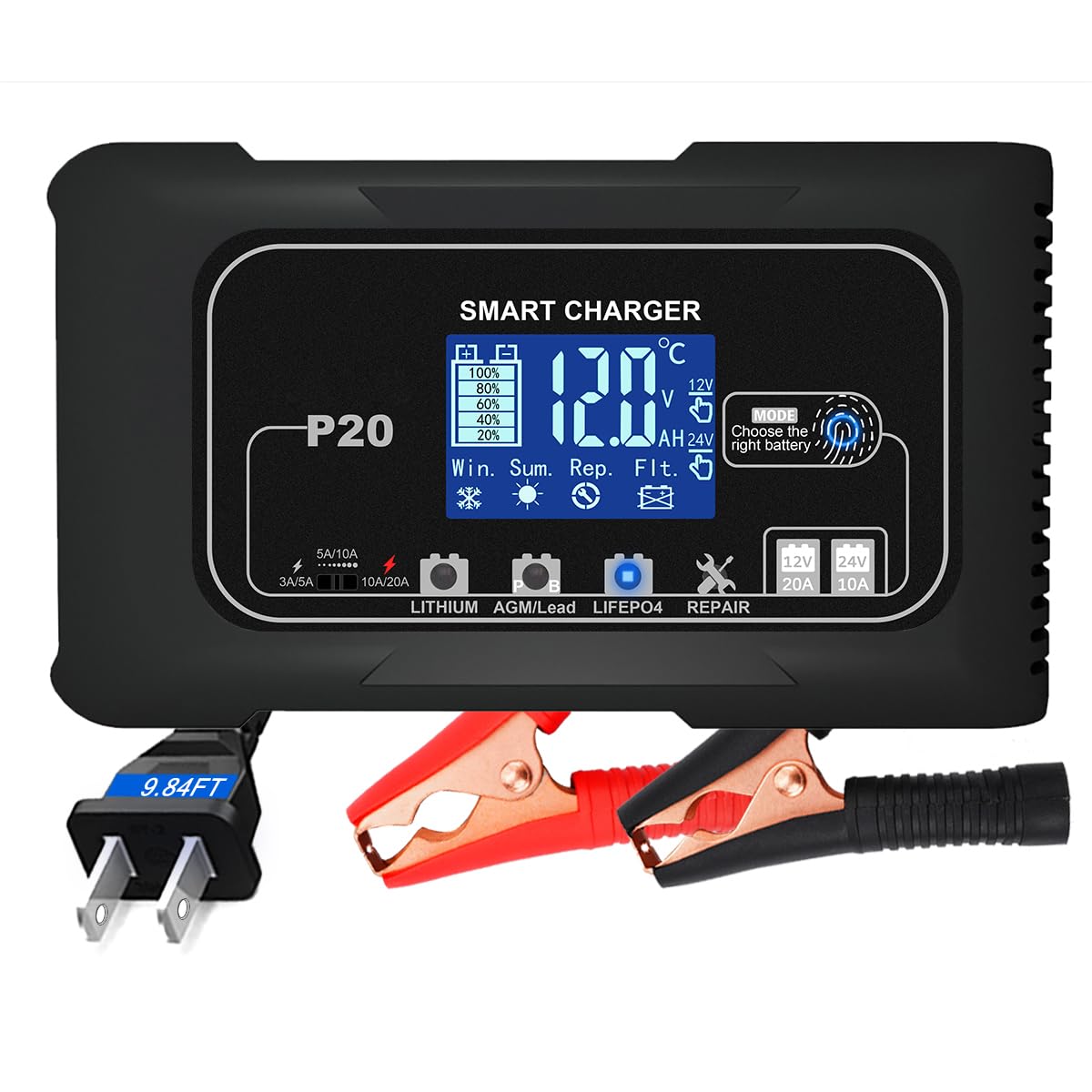
If bench space is precious, this HTRC charger is a standout. Its dimensions are just 3.5″D x 6.1″W x 1.9″H — roughly the size of a thick paperback. That is much more compact than the BROODAY above. It automatically recognizes whether you have a 12V or 24V battery, so there is no guesswork. The 9-stage charging process covers detection, desulfurization, bulk charge, absorption, trickle charge, and more. It supports lead-acid (AGM, Calcium, GEL, MF, EFB, SLA, VRLA, WET), lithium, and LiFePO4 batteries, with adjustable current in three levels — 5A, 10A, or 20A for 12V, and 3A, 5A, or 10A for 24V.
Buyers report it works great for “charging/maintaining car, motorcycle, lawn equipment batteries” and note it “revived an old battery.” The LCD screen displays voltage, current, charging temperature, and battery status. It automatically switches between summer and winter modes to compensate for ambient temperature — a feature that extends battery life in extreme climates. Repair mode can attempt to restore old, weak, and idle batteries, though the manufacturer notes it cannot activate a completely depleted battery. The lowest starting voltage is 2V. It is certified CE, FCC, and UL, and comes with a 2-year warranty.
What stands out
- Ultra-compact form factor — one of the smallest 20A chargers available
- Auto-senses 12V vs 24V and summer vs winter modes
- Wide compatibility including LiFePO4 and all lead-acid subtypes
What to consider
- Repair mode cannot revive a completely dead battery (below 2V)
- Connectors were reported by one buyer as “slightly different from listing” but still functional
Best for: someone who wants a powerful charger that fits in a small toolbox or travel kit and prefers the convenience of automatic voltage detection.
skip it if: you need a charger that can force-start a truly dead battery below 2V — this unit has a minimum 2V starting threshold.
3. YHCHKJ 20A Smart Car Battery Charger
At just 1.23 pounds, this is 45% lighter than the 2.25-pound Huiaipaic, and it comes with a 5-year warranty.
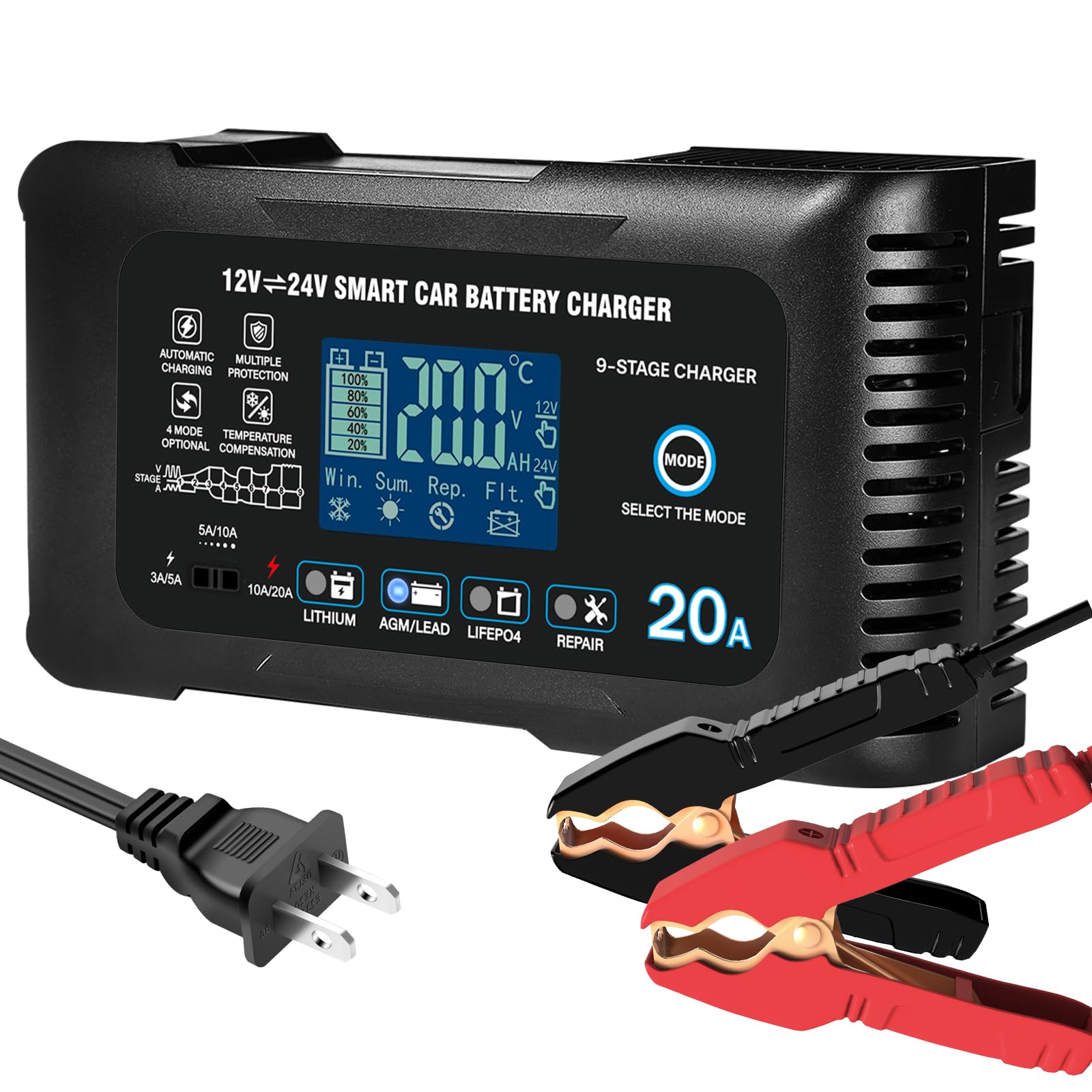
At just 1.23 pounds, this YHCHKJ charger is featherlight compared to the 1020-gram Huiaipaic unit. It delivers 20A max for 12V batteries and supports three current levels — 5A, 10A, and 20A for 12V, and 3A, 5A, and 10A for 24V. It is designed for LiFePO4, lithium, and lead-acid batteries (AGM, Gel, SLA). One buyer mentioned that its repair mode “revived 2- and 5-year-old deep-cycle marine batteries to full capacity,” which speaks directly to the pulse repair technology. It also has a dedicated summer and winter battery manager that adjusts charging based on temperature.
The large LCD display shows voltage, current, internal temperature, charging percentage, and active mode. Safety protections include reverse polarity, overcurrent, overcharge, short circuit, and a cooling system. The unit is UL certified and backed by a 5-year, 24/7 after-sales service guarantee — the longest warranty in this roundup. The minimum starting voltage is 2V, and it has a forced-powerful mode for over-discharged 24V batteries that are misrecognized as 12V. One buyer called it “compact, lightweight” and “reliable and user-friendly,” while another noted that charging a deeply drained battery “takes all day” at lower amps.
Strongest selling point: The combination of a 5-year warranty and UL certification at this price tier is tough to top, making it a low-risk purchase for someone who wants long-term support.
One honest catch: At low currents, the charging speed is modest — a reviewer mentioned a drained battery taking “all day,” so this is not a rapid top-off for a critically dead battery.
Go with this if: you want a light, portable charger with the longest warranty available and UL safety certification.
Think again if: you routinely need to charge a deeply depleted battery quickly — the charger prioritizes safety over raw speed at lower amp settings.
4. Hiyiton 20A Smart Battery Charger

Automatic detection of 12V and 24V means no fumbling with buttons — just clamp and walk away.
This Hiyiton charger is built for the person who wants to hook up and walk away. It automatically senses whether you have a 12V or 24V battery and adjusts the charging current accordingly. The 12V 20Amp and 24V 10Amp output is powered by a UL-certified circuit. It supports lithium, LiFePO4, and all common lead-acid types (AGM, GEL, EFB, MF, Flooded, VRLA, SLA, wet). The charger includes a cooling fan that allows it to operate in a temperature range of 14°F to 104°F, making it suitable for unheated garages in winter.
The LCD screen displays mode, voltage, and current. Safety protections cover short circuit, over current, over voltage, low voltage, electrostatic spark, and reverse polarity. It also features summer and winter modes that automatically adjust temperature compensation. The package includes a 9.8-foot power cord, cable clips, and two junction boxes. One owner reported it “charged a LiFePo battery and two lead acid batteries… all were charged fully and quickly.” Another mentioned that the charger voltage for a 12V 200Ah LiFePO4 battery “never exceeded 14V” even though the battery required 14.4V, though it still showed FULL after 4 hours.
Why it works
- Fully automatic voltage and current detection — truly set-and-forget
- Wide operating temperature range (14°F-104°F) with cooling fan
- UL certified with comprehensive safety protections
Where it may fall short
- Some LiFePO4 users reported a slightly lower charge voltage than expected (14V vs 14.4V)
- Not a jump starter — cannot revive a completely dead battery
Ideal for: the casual user who wants maximum convenience — clamp it, plug it, and let the charger handle the rest.
Not ideal for: LiFePO4 battery owners who need a guaranteed 14.6V full charge — you may want to verify voltage with a multimeter.
5. Huiaipaic 20-Amp Car Battery Charger
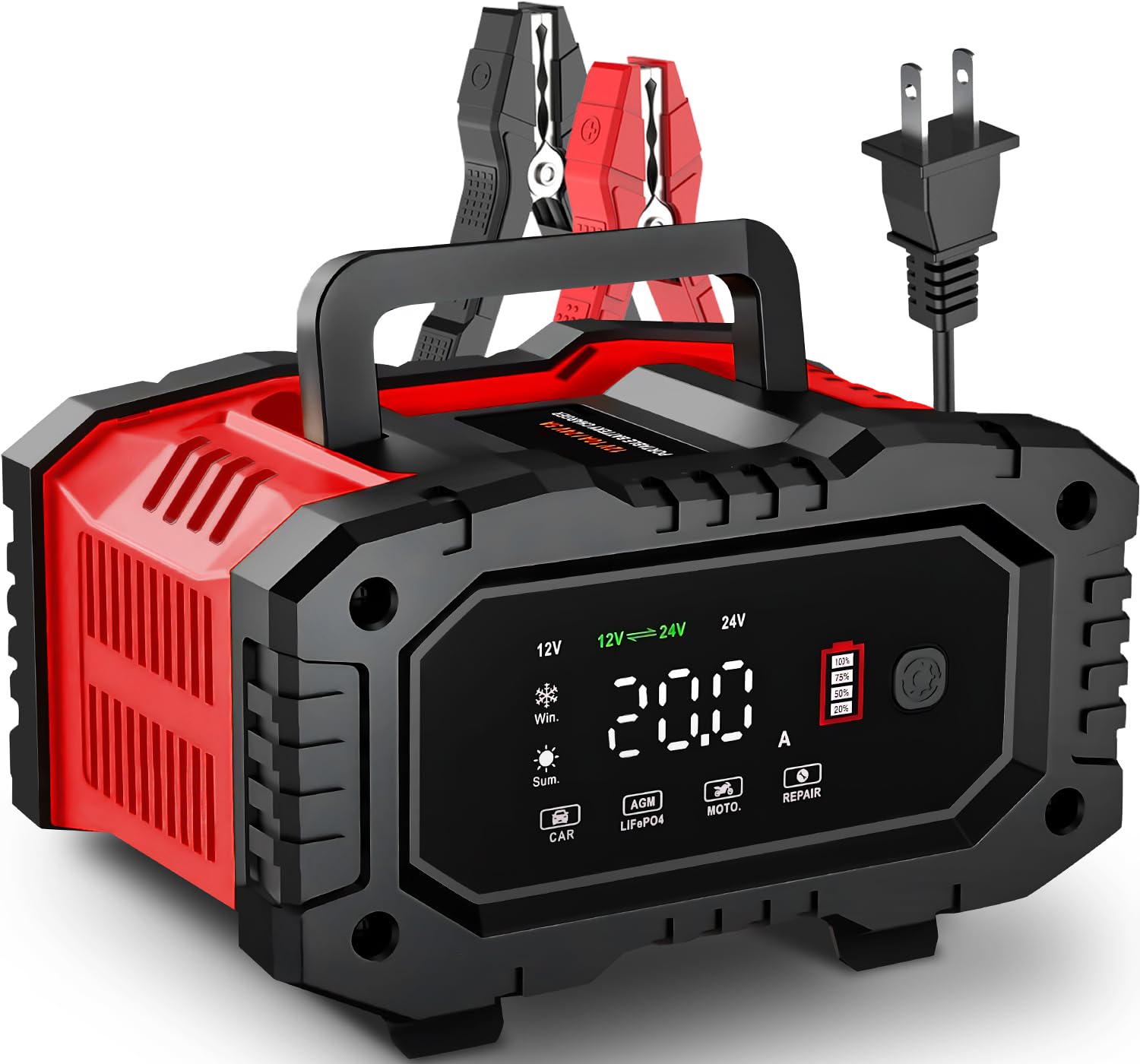
The only charger here with a built-in clip organizer and foldable handle — you wrap the cord and snap the clips to the sides for a tidy setup.
This Huiaipaic charger packs a lot of function into a compact 6.5″D x 7.56″W x 4.02″H frame. It operates as a charger, maintainer, trickle charger, and desulfator in one unit. It delivers 12V/20A and 24V/10A output from a 300W power supply. Owners mention it is “very compact and lightweight (~2 lbs)” and that “output up to 18A, averages 6A” for home use, making it a realistic pick for casual users rather than a professional garage. The pulse repair technology uses high-frequency and low-frequency signals to desulfate old or idle lead-acid batteries, though it cannot repair a seriously damaged battery.
The large LCD screen shows voltage, current, power percentage, temperature, and summer/winter modes. The standout design feature is a clip organizer and foldable handle on the back — you wrap the cords around the body and clip the alligator clips to the sides, keeping everything tidy. It supports battery capacities from 6Ah to 200Ah and works with LiFePO4 and all lead-acid types (SLA, WET, MF, FLOODED, GEL, VRLA, AGM, EFB, Calcium). It comes with CE, FCC, ROHS, UKCA, and UL certifications and a 24-month warranty.
Where it shines: The integrated cable management and foldable handle make it the most storage-friendly charger here, plus the desulfator function can extend the life of aging batteries.
Where it compromises: Real-world output averages around 6A rather than a sustained 20A, so it is better suited for overnight charging than a quick top-off.
Pick this for: a reliable everyday charger for home use that keeps your garage organized and can desulfate old batteries as a bonus.
Pass on this if: you need sustained 20A output for quickly charging large commercial batteries — this unit’s practical average is lower.
6. RCGCBC 0-20A Battery Charger
A memory function saves your last settings — so you do not have to reconfigure the current and battery type every time you use it.
The RCGCBC charger keeps things simple and affordable. It charges all 12V and 24V lithium, LiFePO4, and lead-acid (AGM, Gel, SLA) batteries with a max current of 20A. The 9-stage process includes pulse repair to maintain battery health. A one-touch start button makes operation straightforward, and the large LCD screen shows voltage, current, mode, temperature in °F/°C, charging percentage, and summer/winter mode. A convenient memory function remembers your last settings so you do not have to reconfigure every time.
The unit is built with an ABS flame-retardant shell and offers non-sparking circuitry, reverse polarity protection, overcharge, overvoltage, and overtemperature protection. Customers note it is “easy setup, clear display, solid build” and “reliable for multiple batteries.” One user specifically noted it is a “reliable charger for my RV battery” with a 20A max current for a 100Ah LiFePO4 battery. The one significant caveat: one reviewer received a unit wired for a European (EU) plug rather than a US standard plug, so it is worth inspecting the package upon arrival. The manufacturer offers permanent after-sales service and a 3-year warranty.
Best features
- Memory function saves your preferred current and battery type settings
- Permanent after-sales service and 3-year warranty at a budget price
- Comprehensive display with temperature readouts
Watch out for
- One verified review reported receiving a unit with an EU-style plug instead of a US plug
- Minimum starting voltage is 2V — it cannot jump-start a completely dead battery
Perfect for: the budget-conscious buyer who wants a fully featured 20A charger with strong after-sales support and does not mind checking the plug type on delivery.
Not for: anyone who needs a charger immediately for a critical job and cannot risk a plug mismatch — double-check the unit upon arrival.
7. VEVOR Smart Battery Charger, 20-Amp

A dedicated “Supply Mode” can charge batteries as low as 1V — something most chargers with a 2V minimum simply cannot do.
The VEVOR charger is the only unit in this lineup with a dedicated “Supply Mode” that can charge batteries with voltages as low as 1V — a notable advantage over chargers with a 2V minimum. It handles lead-acid batteries at 6V, 12V, and 24V, plus lithium and LiFePO4 at 12V and 24V. The four selectable modes — Charging, Maintain, Desulfation, and Supply — cover the full battery lifecycle. The 3.6-inch LCD screen displays working mode, charging voltage, current, and power percentage, with independent buttons for easy navigation.
It is compact at 6.5″D x 3.8″W x 2.2″H and weighs just 1.8 pounds. Safety features include over-current, short-circuit, reverse polarity, overheat, and over-voltage protection, plus thermal compensation that adjusts current and voltage for more stable charging. One reviewer used it “to keep my RV lithium batteries charged” and noted it “works good” though it “doesn’t have all the features for cell balancing that some higher cost chargers have.” Another buyer successfully recovered several dead batteries using the desulfation mode. The package includes two copper wire terminals, a 9.8-foot figure-eight tail plug, and battery clamps. It is certified UL, CE, and FCC.
Why it stands out: The supply mode charging down to 1V is a rare feature at this price — most chargers stop at 2V, making this the best pick for reviving deeply depleted batteries.
A fair limitation: The charger lacks advanced cell balancing for LiFePO4 packs, so it is more of a general-purpose tool than a dedicated lithium management system.
Choose this if: you often encounter batteries that have been sitting dead for months and need a charger that can force-feed them back to life from as low as 1V.
pass on it if: you need a dedicated lithium battery management system with per-cell balancing — this is a general-purpose charger, not a BMS.
Understanding the Specs
Charging Stages
A multi-stage charging process — 7, 9, or 10 stages — is what prevents your battery from overcharging. The stages start with a bulk charge (where the charger pushes maximum current), then switch to absorption (reducing current as the battery nears full), and finally float mode (holding the battery at a safe maintenance voltage). Without this, you risk damaging the battery by overcharging it. More stages generally mean more precise control, but a 7-stage charger is perfectly fine for most home users.
Pulse Repair / Desulfation
Sulfation is the buildup of lead sulfate crystals on the battery plates that happens when a lead-acid battery sits unused for a long time. A charger with pulse repair sends high-frequency electrical pulses to break down these crystals, restoring some lost capacity. This feature can extend the usable life of an aging battery, but it cannot repair a battery with physical damage like a shorted cell. It is a maintenance tool, not a miracle cure.
Current Adjustment (0.5A-20A)
Being able to dial in the charging current is important for matching the charger to the battery size. A small motorcycle battery (say, 5Ah) should be charged at 0.5A to 2A to avoid overheating, while a large deep-cycle battery (100Ah+) can safely handle the full 20A. A fixed-current 20A charger would damage a small battery, so adjustable current gives you the flexibility to charge anything from a lawn tractor to a truck.
Safety Certifications (UL, CE, FCC, ROHS)
These marks mean the charger has passed independent testing for electrical safety, electromagnetic interference, and environmental standards. UL (Underwriters Laboratories) is the most recognized in North America. A charger with UL certification has been tested for fire and shock hazards. CE and FCC cover European and U.S. emissions standards. ROHS means the product is free of certain hazardous materials. Stick with chargers that carry at least one of these marks.
FAQ
Can I use a 20-amp charger on a small motorcycle battery?
Will a 20-amp lead acid charger work on a LiFePO4 battery?
How long does it take to charge a 100Ah battery with a 20-amp charger?
What does pulse repair mode actually do?
Can I leave a 20-amp charger connected to my battery indefinitely?
What is the difference between a trickle charger and a battery maintainer?
Does a 20-amp charger need a special power outlet?
Why does my charger say it outputs 20 amps but only pushes 6 amps on my battery?
Can a 20-amp charger revive a completely dead battery (0V)?
Final Thoughts: The Verdict
Across the board, the 20 amp lead acid battery charger winner is the BROODAY Auto Battery Charger 20A because it offers six adjustable current levels (0.5A to 20A), a thorough 10-stage charging process, and broad compatibility with lead-acid and LiFePO4 batteries at a strong value. If you want the most compact form factor that auto-detects 12V and 24V, grab the HTRC 20A Smart Battery Charger. And for the longest warranty and lightest weight, the standout is the YHCHKJ 20A Smart Car Battery Charger with its 5-year coverage.
How We Picked
We do not accept paid placement. Every pick is matched to a real buyer and a real use-case; we do not hands-on test units.
Sources & Methodology
Specifications: manufacturer listings and product documentation. Review insights: verified customer reviews, as of July 2026. Pricing: not shown on this page (it changes often); check the current price via the retailer link.
As an Amazon Associate, Gadgets Feed earns from qualifying purchases. This does not affect which products we feature.