
Our readers keep the lights on and my morning glass full of iced black tea. As an Amazon Associate, I earn from qualifying purchases.
Specs are compiled from manufacturer listings and verified buyer reviews and can change over time — please confirm the key details on the product page before buying.
Running a big generator or a fleet of machines on a 4-gallon tank means you are a slave to the refill cycle — stopping work every few hours to lug tiny jugs back and forth. The real fix is a large stationary tank or a wheeled caddy that holds enough fuel for a full day of operation, not just a few hours. This guide breaks down a 20-gallon fuel cell for permanent mounting and a 15-gallon wheeled caddy for portable work, so you can match the right storage style to your refueling habits.
I’m Min — the founder and writer behind Gadgets Feed. This guide is built by comparing the manufacturers’ published specifications and the patterns across verified customer reviews, so you get each pick’s real strengths and trade-offs instead of marketing spin.
Note upfront: this list uses flexible matching for a true 20-gallon capacity, so one pick lands at 15 gallons but serves the same bulk-fuel purpose. Here are the best 20-gallon gas can options that genuinely solve the refueling grind — 20 gallon gas can.
Our Picks at a Glance
How To Choose The Best 20 Gallon Gas Can
Before you buy, decide where the tank will live. A fixed aluminum cell belongs inside a truck bed, a trailer, or next to a stationary generator, while a wheeled caddy rolls around a shop, garage, or yard. That one choice determines if you need a permanent mount or a portable cart.
Fixed tank vs. rolling caddy
A fixed fuel cell is a flat, rectangular tank you mount once and plumb into a machine. It saves you from refilling a small built-in tank, but it does not move. A rolling caddy carries its own pump and hose, so it works across multiple machines and can be pushed to wherever the job is, though it is noticeably heavier when full.
Fuel compatibility and fittings
Not every tank accepts every fuel. Check what the hoses and fittings tolerate; some rubber lines are fine for diesel and racing gas but react badly to ethanol blends. Also note the inlet and outlet fitting sizes (such as AN10) if you plan to connect it to an existing fuel system, and verify the tank works with your engine type before mounting anything.
Quick Comparison
| Model | Best For | Capacity | Mobility | Fuel Delivery | Amazon |
|---|---|---|---|---|---|
| EVIL ENERGY Fuel Cell Tank | Permanent generator or vehicle installation | 20 gallons | Fixed mount | Inlet/outlet fittings (AN10) | Amazon |
| TUFFIOM Fuel Gas Caddy | Portable refueling across machines | 15 gallons | Wheels with brakes | Manual pump with 10-ft hose | Amazon |
In‑Depth Reviews
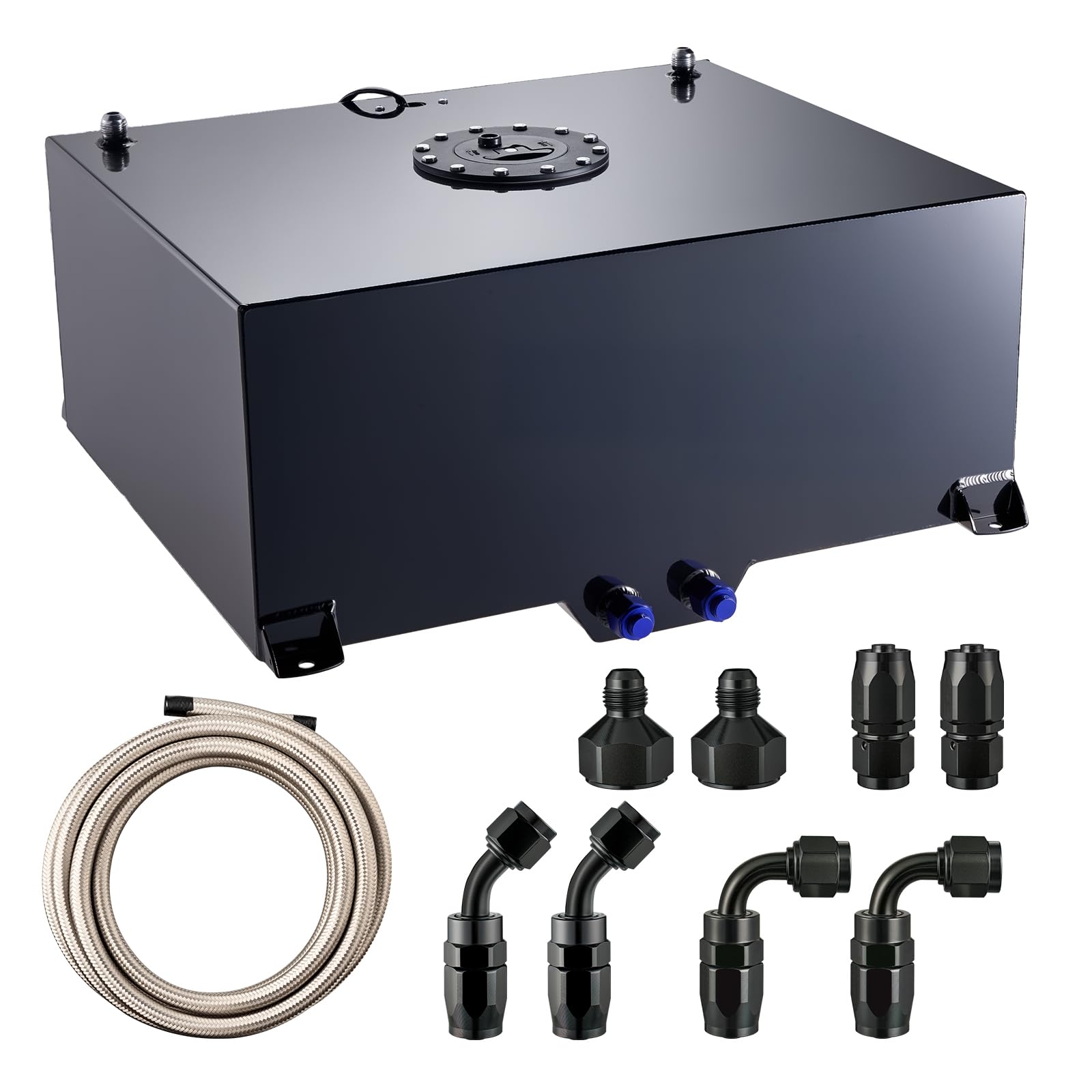
1. EVIL ENERGY 20 Gallon Fuel Cell Tank Aluminum with Level Sender 6AN
The permanent-install tank that stretches generator runtime from hours to nearly a full day.
The standout story here is pure math on runtime. Buyers report wiring this tank into a diesel generator that came with a 4-gallon factory tank capable of only 8 hours of running; with the 20-gallon cell installed, they get almost a full day before a refill is needed. That is what wins people over — the end of constant babysitting for any machine with a tiny built-in reservoir.
This is a true fuel cell for mounting, which is why it leans premium. The 1060-H24 aluminum alloy body keeps the structure rigid while the built-in anti-slosh foam (internal material that calms fuel movement and helps prevent flashback explosions) smooths fuel delivery. The 3–90 ohm level sensor sends a live fuel reading to your gauge, and the package arrives with a 6AN 12FT stainless steel CPE fuel line plus a full set of 0, 45, and 90-degree swivel fittings so you can route the line around tight spaces.
The catch is compatibility. The maker notes the CPE fuel line is not suitable for E85 gasoline, methanol, or ethanol, so this cell is best matched with diesel, biodiesel, gasoline, racing gas, oil, and water. The fuel cell measures 24 x 20 x 10 inches, so measure your mounting space first, and the inlet/outlet fitting is AN10. An occasional unit arrives with a bent mounting flange from shipping, so inspect the box on delivery.
What Owners Can’t Stop Praising
- Quadruples generator runtime — a 4-gallon, 8-hour setup becomes a near-24-hour one.
- Everything works from the start, including the level sender.
- Feels very well made, with good fit and finish for a permanent install.
The Honest Trade-Offs
- Not suitable for E85, methanol, or ethanol with the included CPE lines — check your fuel first.
- Fixed tank, so it is for mounting, not for rolling around a yard.
- Shipping can sometimes bend a mounting flange; inspect your unit.
The right call for: anyone mounting a large reserve tank to a generator, race rig, or diesel machine that suffers from a tiny stock tank.
Think twice if: you need to move fuel between vehicles — this one bolts down and stays put.
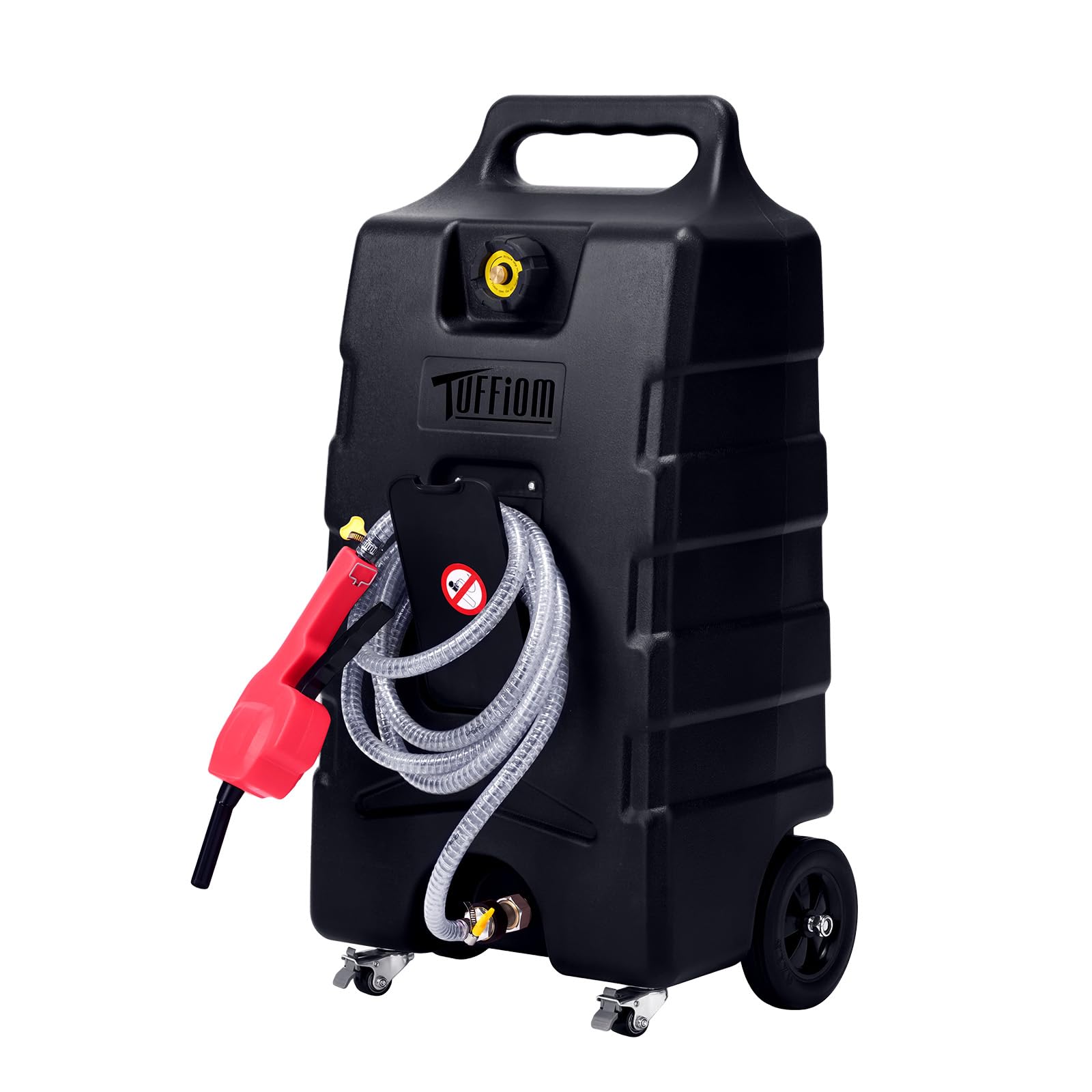
2. TUFFIOM 15 Gallon Fuel Gas Caddy w/Wheels & Manual Transfer Pump
The roll-anywhere caddy that beats 5-gallon jugs with faster, spill-free transfers.
What wins people over on this one is the pump — owners specifically single out pump operation more than any other feature. The hand pump moves fuel through a 10-foot automotive-grade, kink-free rubber hose, and the dual brass shut-off valves (one at the tank, one at the hose) allow a clean disconnect without fuel spilling everywhere. The verdict from those who live with it: it outpaces 5-gallon jugs for speed, avoids the mess, and even doubles as an effective siphon for emergencies.
At 15 gallons, this is the flexible match in this guide, holding 33% more capacity than a typical bulky 5-gallon setup — honestly, a significant jump — while staying portable. The high-strength HDPE body (a tough, lightweight plastic) keeps the weight down when empty, and the solid wheels roll over rough terrain while caster wheels with brakes hold the caddy steady when you are pumping. An adjustable exhaust valve works with the pump to prime the system and prevent leaks.
There is one recurring gripe worth knowing: a few units arrive with factory debris inside that can seize the soft aluminum pump rotor, so a quick clean before first use is a smart habit. Owners who hit this note that the caddy is heavy when full — 15 gallons of fuel is real weight to push — and some wish it had an electric pump instead of a manual one. The bright spot: owners mention it stays reliable even after 2 years of abuse.
The Things That Hold Up
- The pump gets the most praise — smooth, leak-free transfer with full control.
- Dual brass shut-off valves mean no mess when you disconnect the hose.
- Wheels with brakes roll over varied terrain and stay put mid-pump.
- Reported reliable after 2 years and able to withstand real abuse.
Where It Gets Heavy
- Some units ship with internal debris that can seize the pump — clean it before use.
- Very heavy when full, so rolling uphill is a workout.
- Manual pump only; owners wish it came electric.
Reach for this if: you refuel multiple machines — mowers, tractors, boats, generators — and want one mobile tank instead of a stack of jugs.
Look elsewhere if: you need a fixed huge-capacity install with a level sender, since this is a portable cart, not a mountable cell.
Understanding the Specs
Capacity and Weight
Capacity is the headline number, but weight is the real-world catch. A 20-gallon cell holds roughly four times what a standard 5-gallon jug carries, which is exactly why it kills the refill cycle. But fuel is heavy — a 15-gallon caddy full of fuel is a genuine push, not a carry. Match the capacity to how often you can bear moving the tank, not just how big your engine is.
Fuel Delivery System
How fuel leaves the tank matters as much as how much it holds. A fixed cell uses inlet and outlet fittings (like AN10) that plumb straight into a machine’s fuel system, while a portable caddy uses a manual pump and a long hose. Check the pump type and hose length — a 10-foot hose reaches machines parked further away, while a pump with a shut-off valve keeps disconnects clean and safe.
FAQ
Can I use a 20-gallon fuel cell for diesel and gasoline interchangeably?
Will a 15-gallon caddy replace a 20-gallon fuel cell?
How heavy is a 15-gallon fuel caddy when it’s full?
Do I need to prepare a fuel caddy before first use?
What is the level sender in the EVIL ENERGY fuel cell for?
Can the EVIL ENERGY fuel cell fit in my truck or trailer?
How does a manual pump caddy compare to an electric pump?
Is the anti-slosh foam in the fuel cell important?
What fittings come with the EVIL ENERGY fuel cell kit?
Will a 20-gallon cell work for a racing or performance build?
Final Thoughts: The Verdict
The 20-gallon EVIL ENERGY fuel cell is the 20 gallon gas can winner because it is the only true 20-gallon option here, and its real-world payoff is enormous — one install stretches generator runtime from 8 hours to nearly a full day. If you need a portable solution that works across a whole fleet of machines, the TUFFIOM 15-gallon caddy is the value pick, thanks to its praised pump and 2-year reliability. And if you want to know before you buy which one the crowd gravitates toward, the caddy’s 400+ owner base gives it the broadest real-world validation.
How We Picked
We do not accept paid placement. Every pick is matched to a real buyer and a real use-case; we do not hands-on test units.
Sources & Methodology
Specifications: manufacturer listings and product documentation. Review insights: verified customer reviews, as of August 2026. Pricing: not shown on this page (it changes often); check the current price via the retailer link.
As an Amazon Associate, Gadgets Feed earns from qualifying purchases. This does not affect which products we feature.