
Our readers keep the lights on and my morning glass full of iced black tea. As an Amazon Associate, I earn from qualifying purchases.
Specs are compiled from manufacturer listings and verified buyer reviews and can change over time — please confirm the key details on the product page before buying.
The biggest surprise for most buyers shopping for a small tank water heater is that “20 gallon” rarely means exactly 20 gallons. Several of the best sellers in this class actually hold 18 gallons, and that 2-gallon difference changes how you plan your showers, laundry, and kitchen use. This guide sorts through the top compact electric tanks that fit tight spaces, deliver reliable hot water, and plug into a standard 120-volt outlet so you don’t need a costly electrician to rewire your home.
I’m Min — the founder and writer behind Gadgets Feed. This guide is built by comparing the manufacturers’ published specifications and the patterns across verified customer reviews, so you get each pick’s real strengths and trade-offs instead of marketing spin.
You need hot water fast after a shower or a load of laundry, and the 20 gallon water heater you pick depends on three things: voltage, wattage, and how quickly it reheats. A 120-volt model with a 1500W element is fine for light use, but a 240-volt unit with a 3800W element cuts your wait time dramatically.
Our Picks at a Glance


How To Choose The Best 20 Gallon Water Heater
Before you pick one, you need to match three things: your available voltage, how many people use hot water in a row, and the physical space you have. Most of these compact tanks are designed for point-of-use duty — one bathroom, a kitchen, a workshop sink — not for a whole family of five taking back-to-back showers.
Voltage: The Plug That Decides Everything
Your wall outlet dictates your choices more than any other spec. A standard home outlet delivers 120 volts, which these compact tanks use with either a 1500W or 1650W element. The catch is recovery time: after you drain the tank, a 120-volt unit takes a while to reheat all 18 gallons. A 240-volt model needs a dedicated circuit and an electrician, but it heats water roughly two and a half times faster because its element pulls far more wattage.
Wattage: How Fast You Get Hot Water Back
Wattage tells you how quickly the element converts electricity into heat. A 1500W element is the entry-level standard, and a 3800W element cuts your wait dramatically. If you take one shower and then need hot water for dishes 20 minutes later, the higher wattage unit keeps up; the low-wattage one might leave you waiting.
Safety and Longevity Features
Look for an anode rod, a sacrificial metal rod inside the tank that attracts corrosion so the steel shell lasts longer. A temperature and pressure (T&P) relief valve is a critical safety device that releases pressure if the tank gets too hot. A porcelain enamel or glass-lined tank resists rust far better than bare steel, so check the inner lining before you commit.
Quick Comparison
| Model | Best For | Capacity | Heat Output | Voltage | Amazon |
|---|---|---|---|---|---|
| GE 18 Gal Plug and Play★ Best Overall | Easiest 120V install | 45 L (≈18 gal) | 140 °F | 120V | Amazon |
| GE 18 Gal Lowboy 240VFast Recovery | Fast recovery, tight height | 18 gallons | 3800 watts | 240V | Amazon |
| CAMPLUX 18 Gal ME200B | Budget-friendly 120V value | 18 gallons | 1500 watts | 120V | Amazon |
| ThermoMate 18 Gal KQ20A | Compact booster with long heat retention | 18 gallons | 1500 watts | 120V | Amazon |
| Reliance 20 Gal | True 20-gal mobile/manufactured homes | 20 gallons | 1650 watts | 120V | Amazon |
In‑Depth Reviews
1. GE Appliances 18 Gallon Versatile Plug and Play Water Heater
Our pick — 4.5★ from 400+ verified ratings; the strongest balance of quality and price.
The 120-volt plug-and-play that replaced a 30-gallon tank and won over a whole house.
This GE unit is the crowd favorite in the compact class, holding 45 liters (about 18 gallons) of hot water and drawing from a standard 120-volt supply. That means you can install it yourself with existing plumbing using the 3/4-inch NPT connections — no electrician, no new circuit. It fits kitchens, bathrooms, laundry rooms, cabins, RVs, garages, and sheds, so placement is rarely a problem.
The defining trick here is that it works as a standalone unit or inline with another water heater. If your master bath sits far from your main tank and the pipe run loses heat, this acts as a booster that delivers hot water fast at the far end of the house. Owners who swapped a 30-gallon Rheem for this one report the water runs hotter and stays hot longer, which is strong praise for a tank two-thirds the size.
Build quality leans on a stainless steel heating element that resists rust and corrosion, plus an anode rod that extends the tank’s life by fighting corrosion from the inside. The adjustable thermostat lets you tune the water temperature to your liking, and the 8-year tank and parts warranty backs it up for the long haul. The recurring trade-off is that heating performance reads mixed in the review data: plenty of owners get piping-hot water, but a minority report only warm output — usually a sign the thermostat needs raising.
Why owners stick with it
- Plugs into a normal 120V outlet — true DIY install
- Dual use as a standalone tank or inline booster for long pipe runs
- Stainless steel element and anode rod fight corrosion
- 8-year tank and parts warranty
The honest fit note
- Recovery is slow on 120V — back-to-back long showers can outrun it
- Some owners find the factory “no scald” temp setting too mild and need to adjust up
Reach for this if: you want the least-friction install possible and need one small tank to serve a bathroom, cabin, or workshop.
Look elsewhere if: your household stacks three or four showers in a row — the 120V element simply cannot reheat 18 gallons fast enough.
2. GE Appliances 18 Gallon Lowboy Electric Water Heater 240V
The low-profile 240-volt unit that brings 3800 watts of recovery speed to tight ceiling spaces.
This is the pick for anyone with a height problem. Its lowboy design sits short — 19.25 inches deep and under 26 inches tall — so it slips into crawl spaces, mechanical rooms, and under stairs where a tall tank simply will not fit. It is rated to supply a household of one to two people, which makes it a natural fit for a small condo or a couple’s cabin.
The key spec here is the 3.8kW (3800-watt) element, which is 2.5x more heating power than the 1500W elements on the 120-volt options in this guide. You notice the difference right after you drain the tank: water returns to temperature much sooner, so a second shower or a load of laundry is not a long wait. The inlet tube (a pipe that brings cold water in at the bottom) replenishes from the bottom, so you draw out more of the hot water you paid to heat.
That power demands a 240-volt circuit, so budget for an electrician if you do not already have one. Buyers report the wiring info is thin — the unit connects with two hots and a ground, with no neutral wire, which a confident DIYer handled but a novice should not attempt. Six months of real use shows no hot water shortage for kitchen, bath, and laundry as long as they are not all running at once, and normal showers are fine. The trade-off: long showers are risky on an 18-gallon tank, no matter how fast it reheats.
Wiring reality check: This is a hardwired 240-volt appliance, not a plug-in — if you are not comfortable with two hots and a ground and no neutral, call a pro before you start.
The capacity math: One to two people get dependable hot water, but back-to-back marathon showers will exhaust the tank; the fast element just shortens the refill wait.
Who it serves best: a couple in a small home or condo who wants faster recovery than any 120-volt tank can offer and has the 240V circuit to feed it.
Who should hold off: anyone without an existing 240V outlet near the install spot — the electrician cost changes the value proposition.
3. CAMPLUX 18 Gallon Electric Water Heater 120V 1500W

The 120-volt value champion with 24-hour insulation that keeps your hot water waiting all day.
CAMPLUX built this 18-gallon tank around the two things small-space owners care about most: energy waste and wait time. It ships with 24-hour insulation, so the water you heated this morning stays hot into the evening without the element cycling on and off all day. The built-in thermostat adjusts between 91°F and 150°F, and the UL Listed safety package includes an ASME, ANSI, and CSA-approved T&P relief valve to keep pressure in a safe range.
That porcelain enamel coating resists corrosion and abrasion, and The maker backs it with a 3-5 year damage-free lifespan, 2-year parts, and 3-year leak-free after-sales coverage..
The 1500W submerged heating tube claims 98% heat recovery efficiency., and owners confirm the speed is the selling point — setups in garage bathrooms and heated pole barns get quick hot water with no waiting. It runs on 120V AC hardwired with 3/4-inch NPT water connections, a 15-amp recommended breaker, and handles up to 150 PSI. The recurring gripe in the review data is leakage on a minority of units, and the 24-hour insulation means the tank holds heat at the cost of a slightly larger footprint.
What wins people over
- 24-hour insulation minimizes heat loss and energy waste
- Triple-layer enameled tank resists rust and abrasion
- UL Listed safety with T&P relief valve included
- 2-year parts plus 3-year leak-free after-sales coverage
What to watch
- A minority of units report leakage — inspect the fittings on arrival
- 120V 1500W means slow recovery after you drain the tank
Best for: budget-minded owners who want a dependable 120-volt tank for a cabin, camper, or single bathroom and plan to leave it running.
Think twice if: you need fast reheat for consecutive showers — the 1500W element will test your patience.
4. ThermoMate 18 Gallon Tank Water Heater 120V 1500W
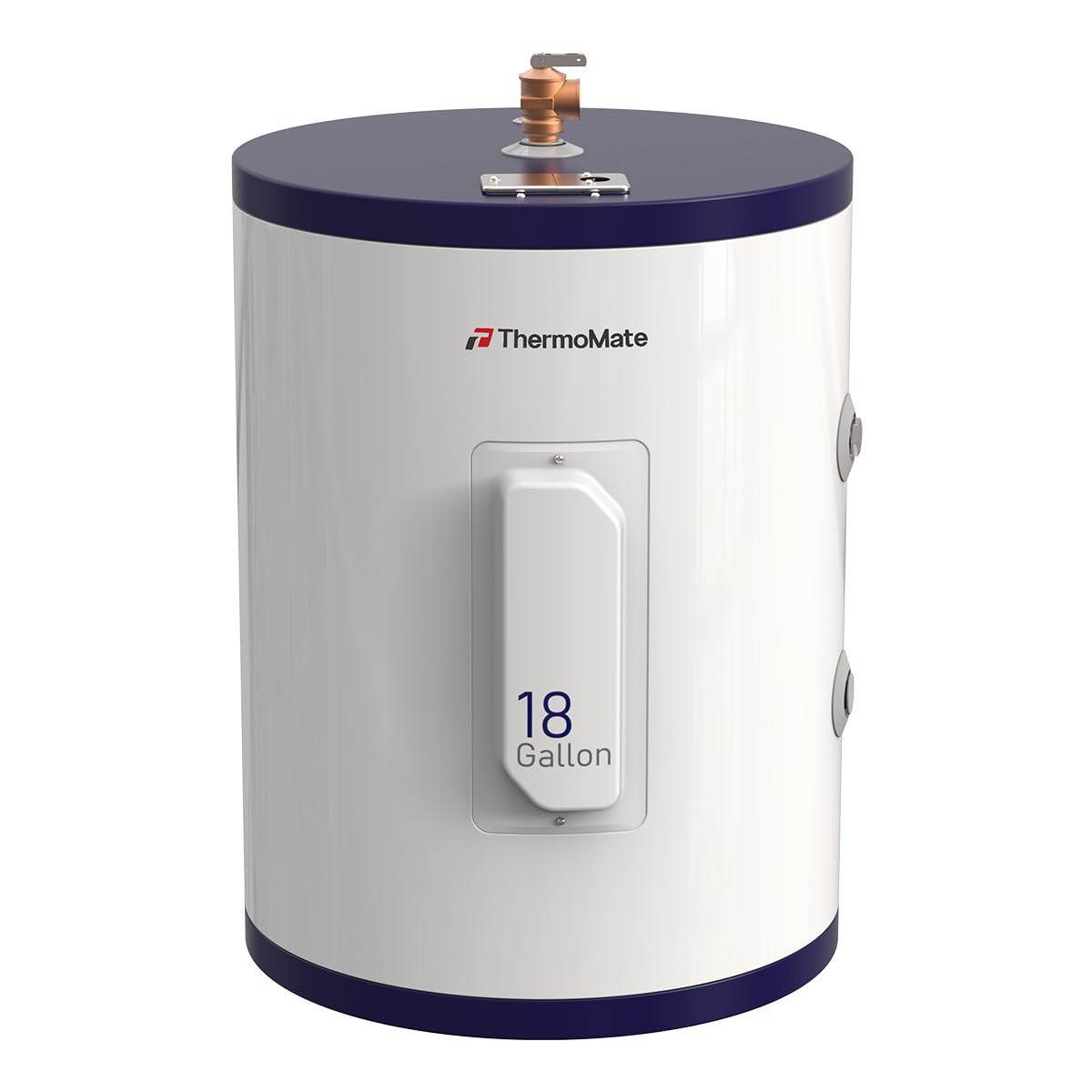
A 25.5-inch low-profile tank with an INCOLOY-800 element built to outlast copper.
ThermoMate sizes this 18-gallon tank for the tightest spots — 19.25 inches wide and 25.75 inches tall — and drops it to just 25.5 inches of profile height for under-sink and under-counter installs. It runs on 120 volts hardwired with a 1500W element and a 15-amp breaker, and delivers a flow rate of 4 GPM, enough for a 20-to-25-minute shower at factory settings.
The engineering highlight is the INCOLOY-800 heating element. This alloy resists corrosion better than copper at high temperatures, which translates to a longer element life and steadier energy use over time. The inner tank gets a porcelain enamel glass coating that stands up to high heat and rust, and the UL Listed package includes an ASME, ANSI, and CSA-approved T&P valve plus high-temperature limit protection.
Buyers consistently praise the nearly instant hot water delivery and long heat retention. One reviewer noted a foot-paddle switch to the same outlet as a dishwasher and disposer to prevent overloading the circuit, and it works reliably. The honest mixed note: heat retention is strong, but some report the temperature does not distribute evenly through the whole tank. Value opinions split between “best bang for the buck” and those who found it underwhelming, so set your expectations around a 120V booster, not a whole-house workhorse.
The standout trade: You pay a little more than other 120-volt tanks for the INCOLOY element and enamel lining, which buy long-term durability over raw heating speed.
Who this fits: The independent booster role — placed inline with a larger main tank to kill the wait at a distant sink or shower.
Grab it when: you value a corrosion-proof element and low-profile fit, and you are wiring it in as a booster rather than a primary heater.
Pass if: you expect even, rapid heating of the full 18 gallons — this unit excels at steady heat, not fast recovery.
5. Reliance 20 Gallon Electric Water Heater

The genuine 20-gallon tank that mobile home owners rely on, running on a standard 120-volt circuit.
If you truly need a full 20 gallons, this Reliance is the only pick in the guide that hits that exact capacity mark. It carries a 1650W element on 120 volts, which is slightly more pull than the 1500W units, and it is explicitly rated to meet manufactured home standards — the reason it keeps showing up in older trailers, mobile homes, and Skoolie bus conversions.
The real-world record here is unusually strong for a niche appliance. Owners mention 15-minute showers with a 1-GPM head and still have hot water left., and The model typically lasts about 10 years in rental properties, longer with annual sludge draining.. That longevity track record is the reason landlords keep buying it as a replacement.
The honest caveats are arrival quality and wiring. Some units arrive with dents and a broken drain valve, and one owner needed a plumber to replace a bad relief valve on install — so inspect carefully on delivery. And because it is a 120V tank, recovery after a full drain is slow; owners manage by spacing out showers rather than stacking them. At 68 pounds it is also noticeably heavier than the 56-pound CAMPLUX, so plan your install help accordingly.
Why it endures
- True 20-gallon capacity — the exact size many trailers require
- Runs on standard 120V, meeting manufactured home standards
- Documented 10-year lifespan in rental use.
- Handles 15-minute showers without running out.
Arrival caveat
- Some units arrive with dents or a broken drain valve — check immediately
- Slow 120V recovery after draining the full tank
Choose this if: you need a verified 20-gallon tank for a manufactured home, trailer, or bus conversion and want a proven 10-year track record.
Look past it if: you want a compact low-profile shape — this is a full-size tank, and at 68 pounds it is the heaviest option here.
Understanding the Specs
Voltage and Wattage
Voltage is the electrical pressure your wall outlet provides — 120V is the standard home plug, while 240V is a dedicated circuit used by high-power appliances. Wattage is how fast the element converts that electricity into heat: a 1500W element heats slowly and gently, while a 3800W element recovers the tank’s heat roughly two and a half times faster. If you have a 120V outlet and no plans to rewire, you are locked into the slower 1500W-to-1650W range.
Capacity vs. Recovery
Capacity is how many gallons the tank holds at once — 18 to 20 gallons in this class. Recovery is how quickly the element reheats that water after you drain it. A bigger tank or a higher-wattage element each buy you more usable hot water, but they solve different problems: tank size matters for how many showers you can stack, while wattage matters for how soon you can take the next one.
FAQ
How long can I shower with an 18 or 20 gallon water heater?
Can a 20 gallon water heater run on a standard 120V outlet?
What is the difference between 120V and 240V water heaters?
Does an 18 gallon tank count as a 20 gallon water heater?
What does the anode rod do in a water heater?
What is a T&P relief valve and why is it important?
Can I install a compact water heater myself?
How long does a small electric water heater last?
Which is better for a tiny house or cabin: 120V or 240V?
Why does my water heater only produce warm water, not hot?
Final Thoughts: The Verdict
For most buyers, the 20 gallon water heater winner is the GE 18 Gallon Plug and Play because it pairs the easiest 120V install with a dual role as a standalone tank or inline booster. If you want faster recovery and have a 240V circuit, grab the GE Lowboy with its 3800W element. And for a genuine 20-gallon tank that meets manufactured home standards, the Reliance is the one to reach for.
How We Picked
We do not accept paid placement. Every pick is matched to a real buyer and a real use-case; we do not hands-on test units.
Sources & Methodology
Specifications: manufacturer listings and product documentation. Review insights: verified customer reviews, as of August 2026. Pricing: not shown on this page (it changes often); check the current price via the retailer link.
As an Amazon Associate, Gadgets Feed earns from qualifying purchases. This does not affect which products we feature.