
Our readers keep the lights on and my morning glass full of iced black tea. As an Amazon Associate, I earn from qualifying purchases.
Specs are compiled from manufacturer listings and verified buyer reviews and can change over time — please confirm the key details on the product page before buying.
Picking the right 20 gauge wire is really about one question: does your project need wire that flexes, or wire that holds its shape? Stranded wire bends and twists around tight corners, which suits RC models, drones, car audio and anything that moves. Solid core wire stays where you bend it, which is exactly what you want on a breadboard or inside a circuit board. Get that one call right and the rest of the shopping list falls into place fast.
I’m Min — the founder and writer behind Gadgets Feed. This guide is built by comparing the manufacturers’ published specifications and the patterns across verified customer reviews, so you get each pick’s real strengths and trade-offs instead of marketing spin.
You are picking between silicone-jacketed and PVC-jacketed spools, and between stranded and solid conductors. Nearly every pick here runs at 600 volts with a tinned copper core, so your choice often depends on jacket feel, color count and how much wire you need. This breakdown of the 20 gauge wire options covers who each spool genuinely suits.
Our Picks at a Glance

How To Choose The Best 20 Gauge Wire
Twenty gauge wire — written as 20 AWG — is a thin, light-duty conductor. Makers size wire by the American Wire Gauge scale, where a smaller number means a thicker wire. That makes 20 AWG a good fit for signals and light current: speaker runs, LED strips, RC battery leads, guitar rewiring, radio antenna radials and breadboard jumpers.
Stranded versus solid core
Stranded wire is built from many thin copper threads bundled inside one jacket. That construction is what lets it bend and flex, so it survives vibration in cars, boats and drones. Solid core is a single stiff conductor. It stays in the shape you bend it into, which is why it drops cleanly into breadboard holes and circuit board pads.
Silicone versus PVC insulation
Silicone jackets stay soft even in cold and resist high heat, which suits tight routing and soldering work. PVC jackets resist oils, acids and moisture, and they tend to hold a tidier coil. Neither is automatically better — match the jacket to the environment the wire lives in.
The specs worth checking before you buy
Look at three numbers. Volt rating tells you how much electrical pressure the insulation can take. Current rating in amps tells you how much load the copper can carry. Strand count and strand thickness tell you how flexible the wire feels in your hand. A tinned copper core means the strands carry a thin tin coating that fights corrosion and helps solder flow.
Quick Comparison
| Model | Best For | Length | Voltage | Core | Amazon |
|---|---|---|---|---|---|
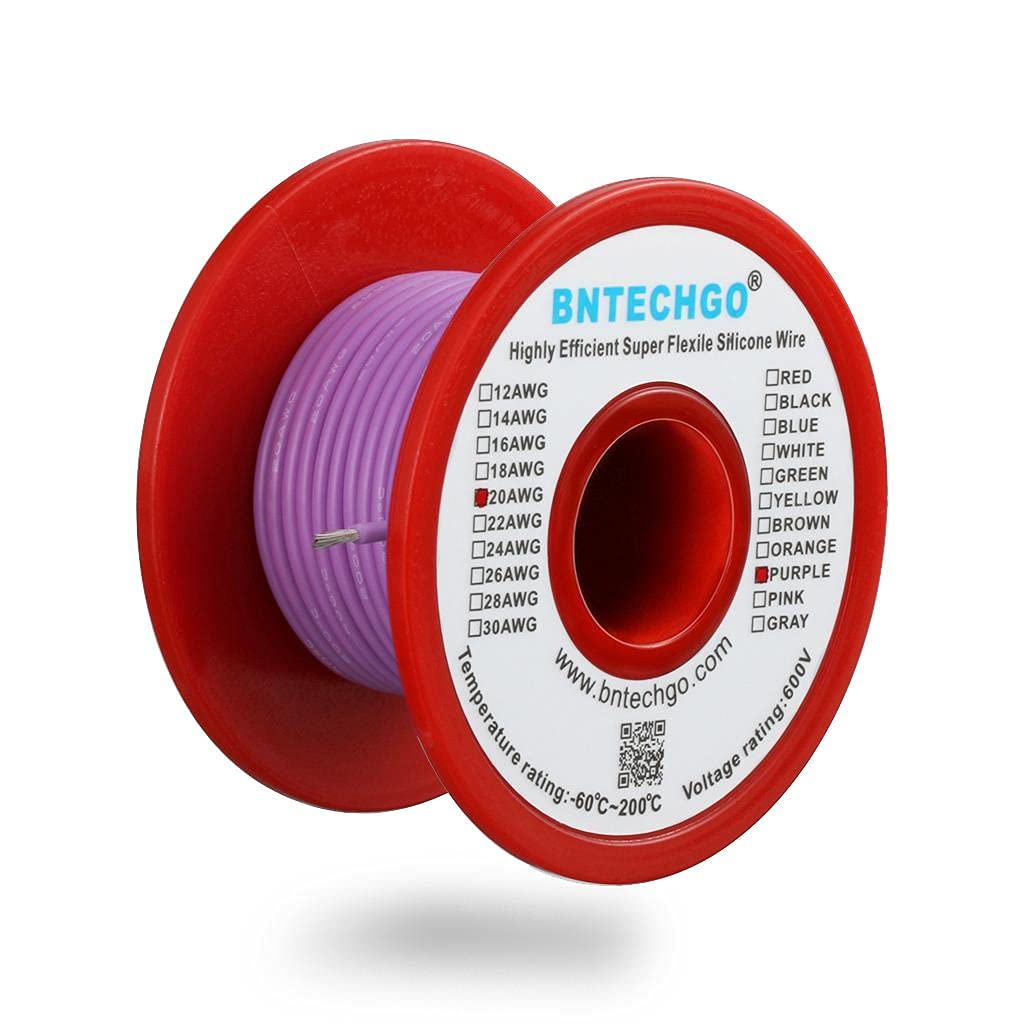
| BNTECHGO 20 Gauge Silicone Wire Purple 50ft★ Best Overall | Flexible silicone hook-up | 50 ft | 600 V | 100 strands, 0.08 mm tinned copper | Amazon |
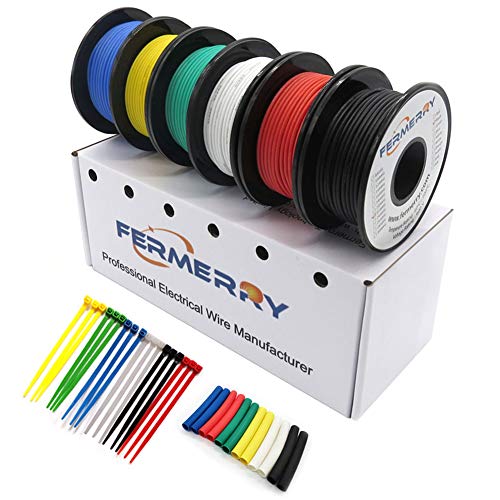
| Fermerry 20 AWG Stranded Wire Spool 10ft Each 6 ColorsBest Value | Color-coded small projects | 60 ft (6 colors x 10 ft) | 600 V | 100 strands, 0.08 mm tinned copper | Amazon |
| Haerkn 20awg Silicone Cable Kit 7 Colors 23ft EachMost Color Options | Wide color range | 161 ft (7 colors x 23 ft) | 600 V | 100 strands, 0.08 mm tinned copper | Amazon |
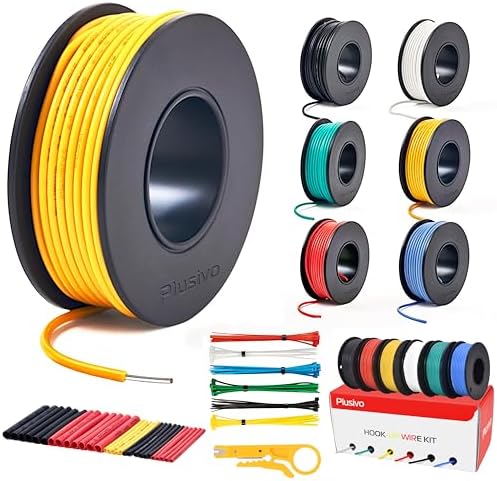
| Plusivo 20 AWG Solid Core Wire Kit, 6 Colors | Breadboard prototyping | 138 ft (6 colors x 23 ft) | 600 V | Single-strand tinned copper | Amazon |
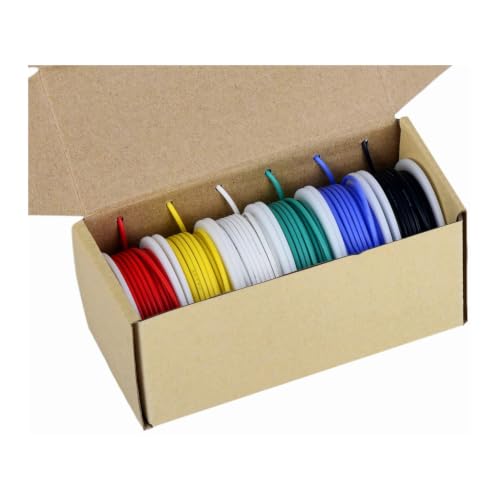
| TUOFENG 20 AWG Silicone Wire Kit, 6 Colors | RC and test leads | 138 ft (6 colors x 23 ft) | 600 V | 100 strands, 0.08 mm tinned copper | Amazon |
| TUOFENG 20 AWG Solid Wire Kit, 6 Colors | Fixed point-to-point wiring | 157.8 ft (6 colors x 26.3 ft) | 300 V | Single-strand tinned copper | Amazon |
| GS Power 20 AWG Wire 100ft OFC Copper Speaker Wire | Car audio and 12V runs | 200 ft total (100 ft red + 100 ft black) | 12 V low voltage DC | 10 strands, 0.25 mm per conductor | Amazon |
| NAOEVO 20 Gauge Wire 2 Conductor 100FT | Automotive and marine runs | 100 ft | 600 V | 26 strands, 0.24 mm tinned copper | Amazon |
In‑Depth Reviews
1. BNTECHGO 20 Gauge Silicone Wire Purple 50ft Stranded Tinned Copper Wire
Our pick — over 4.5★ from 800+ verified ratings; the strongest balance of quality and price.
A 100-strand silicone spool that bends like rope and solders fast
Start with the conductor, because this is where the BNTECHGO separates itself. Inside the silicone jacket sit 100 strands of 0.08 mm tinned copper, a very fine build for a 20 gauge wire. Fine strands are what give wire its drape — this spool loops and turns almost like rope instead of fighting you. The tin coating on those strands does two jobs: it blocks corrosion over time, and it makes the copper grab solder quickly.
The silicone jacket is the second reason people reach for this color. It shrugs off heat up to 200°C and stays usable down to -60°C, so it holds up at both ends of the temperature scale. It is rated at 600 volts and measures 1.8 mm across the outside — slim enough to feed through tight holes and grommets. You get 50 feet on one spool for a single-color run.
What wins people over is the build quality, followed closely by flexibility and easy handling. The most telling owner story is a radio hobbyist who laid this wire out as ground plane radials and reported it behaves better than plastic-coated wire that tangles and refuses to straighten. Another note that keeps coming up: a buyer wiring eight three-wire sensor inputs found it easy to strip and tin, and crimped it into spade lugs without a fuss. There is one honest catch worth understanding, and it is baked into the stretchy jacket rather than a defect — wire this soft will not push into terminals the way stiffer wire does, so it suits hobby and non-critical builds over high-safety industrial use.
What earns it the top spot
- 100 fine 0.08 mm tinned copper strands give it real flexibility
- 600 V rating with a -60°C to 200°C silicone jacket
- 0.08 mm tinned strands resist corrosion and take solder easily
- 50 feet on a single spool in a bold purple that is easy to trace
Where it asks more from you
- Too soft for fittings that need a stiff wire to push into place
- One color only, so tracing multiple signal paths means improvising
Compared with the Fermerry spools below, this one spool gives you 50 ft against Fermerry’s 10 ft per color — though Fermerry hands you six colors to this spool’s one. So the choice is really volume in a single color versus a rainbow in smaller runs.
Pick it for: single-line runs, radio radials, 3D printer cable chains and any job where the wire has to survive constant bending.
Look past it for: breadboards or terminal blocks that need a rigid wire to hold its own shape.
2. Fermerry 20 AWG Stranded Wire Spool 10ft Each 6 Colors
Six 10 ft color-coded spools plus 18 pieces of heat shrink tubing
Here is the number that sets this kit apart: it carries a 10 A current rating, and the Haerkn kit further down is rated at 5 A. If your circuit runs a heavier load, that headroom matters before anything else does. The box opens to six 10-foot spools — black, red, blue, white, green and yellow — so sixty feet of color-coded wire sits ready for whatever you are building.
Inside each spool is the same fine construction: 100 strands of 0.08 mm tinned copper, an 1.8 mm outside diameter and a 600 volt rating. The silicone sheath takes heat up to 200°C, so it does not mind a hot soldering iron passing nearby. Fermerry also throws in 18 pieces of 2.4 mm heat shrink tubing and 18 wire ties, three of each color, which saves a second order.
The finishing touch that keeps buyers coming back is how easy this wire is to solder. Guitars get rewired, small toys get repaired and model harnesses get rebuilt, and the six colors turn tracing a fault into a simple color-match. The fit note worth knowing: the silicone sleeve runs a touch chunky on thin gauges, so if a snug fit inside a tiny connector is critical, measure first. Durability draws a split verdict — some owners find it very strong while others describe it as only adequate, which points to light-duty use rather than constant flexing.
Where the value sits: you are getting six colors, a set of heat shrink tubes, and cable ties together in one box rather than sourcing each separately.
Buy it when: you want a starter kit with every common color and a few extras in the box.
Pass if: your job needs one long continuous run rather than short six-color lengths.
3. 20awg Silicone Electrical Wire Cable Kit 7 Colors 23ft Each Spool
Seven 23 ft spools, each with a velcro-style strap to stop the tangle
Long runs in plenty of colors is this kit’s whole pitch. You get seven spools — black, red, yellow, green, blue, white and brown — each holding 23 feet, for 161 feet in the box. That is a lot of hook-up wire to keep on the bench without reordering mid-project. Each conductor is again built from 100 strands of 0.08 mm tinned copper, rated 5.0 A, with the jacket good from -60°C up to 200°C at 600 volts.
The detail owners keep praising is the little velcro-style strap on each spool. It wraps the wire so a soft, springy silicone coil does not unravel into a bird’s nest between jobs — a small thing that saves real annoyance. The supplier describes the conductor as high-purity oxygen-free copper with a tin plating, which is why it strips, bends and solders so willingly.
What the review page keeps circling back to is how simple this wire is to work with. It takes solder without complaint, the insulation does not shrink or scorch under the iron, and the color range makes matching wires to a diagram straightforward, which is why DC projects, guitar rewires and LED runs show up again and again. One honest note: the gauge itself divides opinion — most find it spot-on while a handful wonder if a given spool runs a touch light, so confirm against your wire stripper’s markings when it lands.
Standout wins
- Seven colors and 23 ft per spool — 161 ft all in
- Velcro-style strap keeps each soft spool tidy
- Takes solder cleanly with insulation that resists scorch
- 5.0 A rating at 600 volts for light-duty circuits
Worth weighing first
- The 5.0 A rating is on the lower side, so heavy loads want a sturdier gauge
- Gauge runs lighter than some buyers expect — check it on arrival
Right pick if: color-coding a busy project is your priority and you want long lengths in every shade.
Think twice if: the circuit pulls serious current or you need rock-solid gauge consistency for a precision build.
4. Plusivo 20 AWG Solid Core Wire Kit, 6 Colors, Pre-Tinned
Single-strand wire that drops into breadboard holes and stays put
If you are building on a breadboard, solid core is the wire that makes the work painless. This kit gives you six 23-foot spools — 138 feet total — in black, red, yellow, green, blue and white, all pre-tinned so the ends solder without fuss. Because the conductor is a single strand, it slides into breadboard holes and through plated through-holes on a circuit board without the fraying you get from stranded ends.
The jacket here is PVC, not silicone, and that changes the feel in a useful way. PVC holds a coil more tidily and resists acids, oils, alkalies and moisture, plus it takes abrasion well — good traits for a bench that sees spills and rough handling. The bundle is rated 600 volts. The kit also ships with a heat shrink tube set, a mini wire stripper and colored cable ties, so you are not hunting for tools mid-build.
The organizational side of this kit is what tends to impress. Everything lives in a color-coded dispensing box that keeps the spools lined up and feeds out one color at a time, so a bench never turns into a snarl of loose wire. A buyer who needed five extra feet to finish a ceiling-fan harness found this kit spliced in the missing length cleanly when no local store stocked it. The honest trade-off is right in the name: solid wire is stiffer than stranded, so it will not flex and absorb vibration the way silicone wire does, and it is not the pick for anything that moves.
The tidy-bench factor: the dispensing box, stripper and heat shrink turn this into a self-contained kit rather than loose rolls.
Reach for this if: breadboards, protoboards and fixed point-to-point wiring are your world.
Look elsewhere if: your wire will flex, vibrate or need to thread through moving parts.
5. TUOFENG 20 AWG Silicone Wire Kit, 6 Colors, 138 ft, Stranded Tinned Copper
100-strand silicone wire built to snake through tight RC and test-lead routes
Stranded silicone wire is the go-to for anything that moves, and this six-color kit is aimed squarely at that job. Each spool holds 23 feet — 138 feet in total — in red, black, white, blue, green and yellow, so you can color-code positives, grounds and signal lines without a label maker. Every conductor carries 100 strands of 0.08 mm tinned copper, giving it the bend needed to route through tight channels and around motors.
The jacket works a wide temperature window, listed from -60°C up to +200°C at a 600 volt nominal rating, and the 5 A figure suits light current like battery leads, LED projects and DC motors. The supplier lists it for model aircraft, cars and ship models, battery and motor hookups, plus car lighting and ballast connections — a clear sign this is hobby-grade wire built for movement rather than a fixed install.
Buyers keep noting two things: it is easy to strip, and it crimps well. A grandparent who picked spools up for a grandson’s 3D printer reported the wire worked well for the money, while other owners have used it for model railroads and LED strip runs. The one real limitation to plan around: this wire is extremely flexible, and on an automotive run through a snug waterproof connector, that softness can work against you — it bends instead of threading straight, so a stiffer wire is the better tool when you need to push a terminated end through a narrow plug.
Why hobbyists like it
- 138 ft across six colors for organized multi-wire builds
- 100-strand tinned copper strips, crimps and solders cleanly
- -60°C to +200°C silicone jacket at 600 V
The honest caveat
- So flexible it can be hard to feed through snug connectors that need a stiff wire
- 5 A rating keeps it to light-duty circuits, not heavy loads
Suits you if: RC models, test leads and flexible electronics are on your bench.
Not for: jobs that need wire to push through a tight plug without bending.
6. TUOFENG 20 AWG Solid Wire Kit, 6 Colors, Tinned Copper, 26.3 ft Each
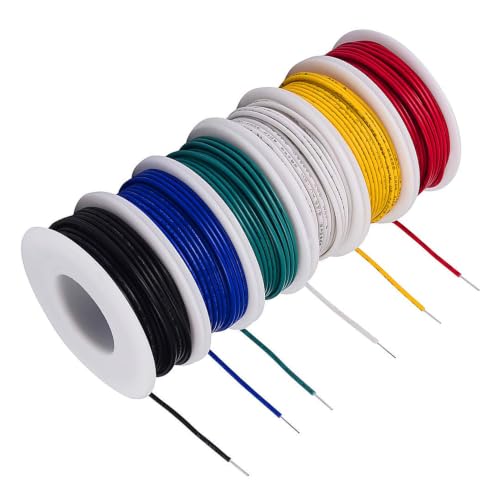
26.3 ft solid-core spools that hold their bend on fixed runs
Where this kit differs from the Plusivo above is length per color. Each of the six spools carries 26.3 feet, so you get 157.8 feet total in black, blue, green, white, yellow and red — a little more wire per shade than the 23-foot spools elsewhere. That matters when a single fixed run inside a control panel runs long and you would rather not splice.
The conductor is a single solid strand of tinned copper, and the point of that build is simple: it keeps the bend you put in it. On a breadboard or a circuit board, wire that stays put is wire that does not spring out of a hole mid-test. The PVC jacket here is listed at 300 volts and rated from -40°C to +80°C, which is a narrower window than the silicone kits, so plan for ordinary indoor conditions rather than engine bays or hot enclosures.
Owners describe this wire as sturdy and easy to strip, with the solid core holding shape far better than soft stranded wire on a breadboard. The six colors make tracing a circuit or splicing an alarm line a quick job, and the spools arrive in a pull-through box so each color feeds out on its own. The clear limit is the number you just read — 300 volts and an 80°C ceiling means this is indoor electronics wire, not a candidate for automotive or high-heat work.
Shape retention is the selling point: a solid conductor that stays where you bend it keeps breadboard and control-panel runs orderly.
Choose it for: breadboards, prototype circuits and control panels where the wire must hold its formed route.
Skip it for: automotive, marine or any high-temperature install that calls for a wider rating.
7. GS Power 20 AWG Wire 100ft – OFC Copper Automotive Speaker Wire Spool
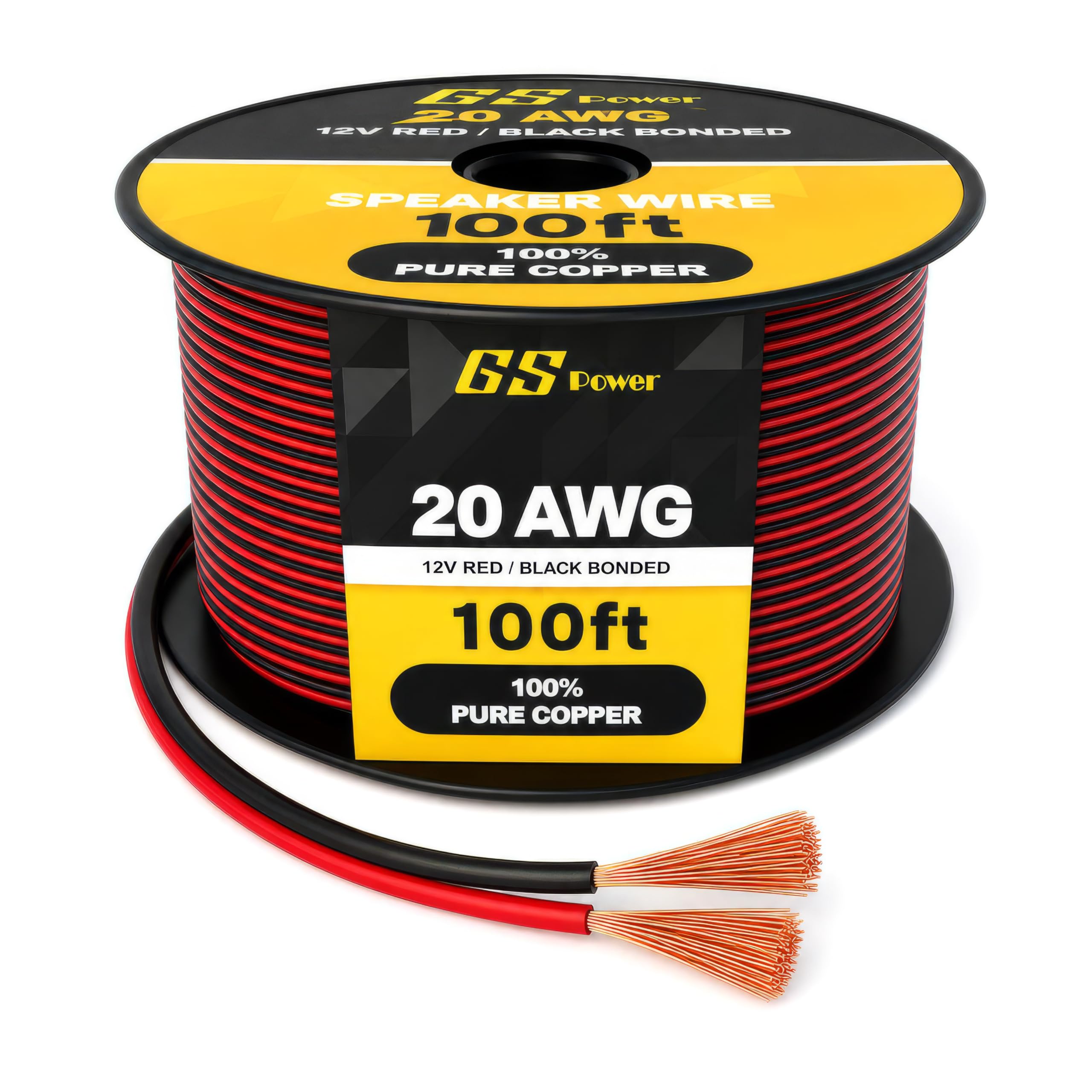
A bonded red-and-black OFC pair for speaker runs and 12V power
The construction here is what earns the price: 99.99% oxygen-free copper, not copper-clad aluminum, which the maker says keeps resistance low over long runs. Each conductor holds 10 strands of 0.25 mm copper, a build that flexes enough to tuck behind dashboards and through door panels without kinking. The spool hands you a bonded red and black pair totaling 200 feet — 100 feet red plus 100 feet black — that splits apart when you need single runs.
The black/red pair is the quiet convenience. Keeping polarity fixed on the spool means you are never guessing which line is positive once you are under a dash with limited light. The GPT PVC jacket resists oil and gas, is rated from -40°F to +176°F, and is RoHS compliant, so it stands up to engine bays, trailer frames and marine spots. It is rated for 12V low-voltage DC only, which is the correct ceiling for car audio, LED runs and light-duty 12V circuits.
The strength of OFC copper is easy to see on a bench: 10 strands of 0.25 mm copper with a jacket that holds up to soldering heat. Buyers have replaced 30-year-old speaker wire on a restored boombox and reported it performing well, while another slipped it under carpet and around baseboards without any loss of tone. One thing to plan around: this 10-strand OFC build holds its bends rather than draping like fine silicone wire, so if you need maximum flexibility, a 100-strand spool is the easier choice.
What stands out
- 99.99% oxygen-free copper, not copper-clad aluminum
- 200 ft of bonded red and black pair for polarity-kept runs
- GPT PVC jacket rated -40°F to +176°F and RoHS compliant
- 10 strands of 0.25 mm copper for dash-and-panel routing
The trade-offs
- Holds bends instead of draping soft — less flexible than fine-strand silicone
- 12V low-voltage DC only, so it is not a fit for AC mains work
A match for: car audio, trailer wiring, landscape lighting and 12V LED runs.
Not for: jobs needing the draping softness of fine-strand silicone wire.
8. NAOEVO 20 Gauge Wire 2 Conductor, 20 Gauge Automotive Wire 12V Cable, 100FT
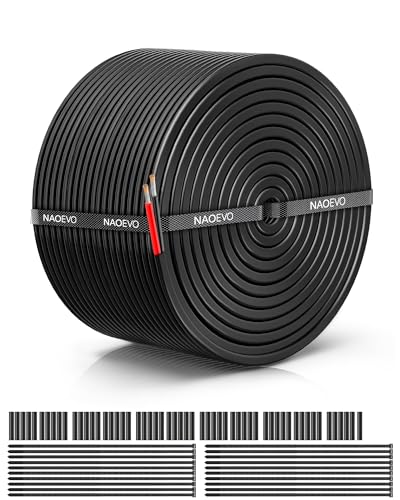
The weather-sealed two-conductor run built for mud, water and rough trails
This is the outdoor pick, and the IP68 rating is the reason. That number means the wire is sealed against dust and against being submerged in water, which is exactly what a marine or off-road build needs. Inside each circuit sit 26 strands of 0.24 mm tinned copper with a 2.5 mm jacket, and the whole run carries a 600 volt rating — so it handles 5V, 12V and 24V systems as easily as higher-voltage DC.
The two-conductor layout does the heavy lifting for you. Both conductors are bonded into one jacket, so a single pull threads both lines at once instead of fishing two separate runs through a frame. The PVC insulation resists chemicals and oxidation, the working range covers -22°F up to 221°F, and the flame-retardant grade is VW-1. NAOEVO also packs in 56 heat-shrink tubes and 20 cable ties, so the finishing supplies come in the box.
What owners lean on is toughness. One buyer ran this on an off-road side-by-side with the wire sitting in mud and water and reported it still held up. In a 24-volt LED strip install, a buyer found the sheathing tough, the flexibility good for fishing and forming, and the gauge correct when checked against crimping. The honest trade-off is that thick jacket — it is too chunky for standard clear crimp connectors, so you will want screw terminals instead, and the jacket itself feels thin to some buyers while others call the coating durable.
Sealed for the elements: IP68 protection plus a VW-1 flame rating means this run is built to sit in mud, splash and weather.
Made for: automotive, marine and outdoor low-voltage runs that face water and grime.
Handle differently if: you planned to use standard clear crimp connectors — a thicker jacket wants screw terminals.
Understanding the Specs
Strand count and strand size
The strand count tells you how many individual copper threads make up the conductor. More, thinner strands make wire more flexible, which is the number to watch if the wire will bend or vibrate. A 20 AWG hook-up wire with 100 strands of 0.08 mm behaves like soft rope, while a build with 10 strands of 0.25 mm is stiffer and holds its shape. Solid-core wire is a single strand, so it is the stiffest of all and stays where you bend it — the reason it drops cleanly into breadboard holes.
Voltage, current and temperature ratings
The volt rating is the electrical pressure the insulation can take — most hook-up kits here run at 600 V, while 12V automotive and low-voltage cable is meant for far lower circuits. The current rating in amps tells you how much load the copper can carry, and it ranges from 5 A on some silicone kits up to 10 A on others, so match it to your circuit. The temperature range covers the jacket, from as low as -60°C up to +200°C on silicone insulation and narrower windows on PVC. Tinned copper means the strands carry a thin tin coating that resists corrosion and helps solder flow.
FAQ
Is 20 gauge wire thick enough for car speakers?
What does 20 AWG actually mean compared with 18 or 22 gauge?
Should I choose stranded or solid core 20 gauge wire?
What is tinned copper wire and why does it matter?
Can 20 gauge silicone wire handle the heat of soldering?
How much current can 20 gauge wire carry?
Will 20 gauge wire work through a breadboard?
What is the difference between silicone and PVC insulation?
Is 20 gauge wire waterproof enough for outdoor use?
Which colors do I need for a typical project?
Final Thoughts: The Verdict
For most jobs, the 20 Gauge Wire pick to start with is the BNTECHGO 20 Gauge Silicone Wire Purple 50ft — 100 fine tinned-copper strands, a 600 V rating, and a silicone jacket that bends without fighting back. It carries the strongest buyer reputation here, with 4.8 stars across 800+ ratings. If you need a rainbow of colors in the box, grab the Haerkn seven-color kit; for breadboards and fixed boards, the Plusivo solid core kit is the one to reach for; and for car audio or 12V runs, the GS Power OFC speaker wire earns its place.
How We Picked
We do not accept paid placement. Every pick is matched to a real buyer and a real use-case; we do not hands-on test units.
Sources & Methodology
Specifications: manufacturer listings and product documentation. Review insights: verified customer reviews, as of September 2026. Pricing: not shown on this page (it changes often); check the current price via the retailer link.
As an Amazon Associate, Gadgets Feed earns from qualifying purchases. This does not affect which products we feature.