
Our readers keep the lights on and my morning glass full of iced black tea. As an Amazon Associate, I earn from qualifying purchases.
Specs are compiled from manufacturer listings and verified buyer reviews and can change over time — please confirm the key details on the product page before buying.
You want big prints and room to crop without bogging down your computer with huge files—that is why a 20-megapixel (20MP) sensor (the part that captures the image) hits a balance. But the 20MP number alone does not tell you how fast the camera focuses, how far the zoom reaches, or whether the lens is sharp. Those real-world factors—autofocus speed, zoom range, stabilization, and lens quality—separate the keepers from the duds. This guide shows which of today’s 20MP cameras actually deliver the shots you are after.
I’m Min — the founder and writer behind Gadgets Feed. This guide is built by comparing the manufacturers’ published specifications and the patterns across verified customer reviews, so you get each pick’s real strengths and trade-offs instead of marketing spin.
Whether you’re stepping up from a phone or looking for a versatile travel companion, you’ll find a clear winner for your needs among the best 20 megapixel camera options reviewed here with specs you can actually use.
Quick Picks
- OM SYSTEM Olympus E-M10 Mark IV Black – 20MP Micro Four Thirds — Best Overall
- Canon PowerShot SX740 HS – 20.3MP, 40x Optical Zoom, 4K UHD — Superzoom Premium
- Sony RX100 VII – 20.1MP 1.0-Type Stacked CMOS — Pocket Powerhouse
- Minolta Pro Shot 20MP – 67x Optical Zoom, Full 1080p HD — Zoom Value Leader
- Kodak PIXPRO Astro Zoom AZ425 – 20MP Digital Camera Bundle — Budget Zoom Bundle
How To Choose The Best 20 Megapixel Camera
Not every camera with a 20MP sensor is built for the same job. A wildlife shooter needs massive zoom and fast autofocus; a travel vlogger needs 4K video and a pocket-friendly body; a beginner needs simple controls and a forgiving learning curve. Three specs separate the winners from the pack.
Optical Zoom vs. Digital Zoom
Optical zoom uses glass lenses to physically magnify the image, so you keep full resolution at every zoom level. Digital zoom simply crops and enlarges the pixels, which destroys detail. When you see “67x” or “40x” on a compact camera, that number always refers to the optical reach—the single most important spec if you shoot distant subjects like birds, sports, or airshows.
Autofocus Points and Speed
Autofocus points are tiny sensors on the camera’s image sensor that lock onto your subject. More points (493 or 425) mean the camera can track a moving subject across the entire frame without losing focus. Fewer points (3) limit focus to the center area—fine for static landscapes but frustrating for kids or pets on the move. For action, never settle for less than hybrid or phase-detection AF.
Image Stabilization
Camera shake at telephoto zoom or in dim light ruins more photos than any other mistake. In-body stabilization (sensor-shift) steadies the sensor itself, working with any lens you mount. Lens-based stabilization lives in the zoom lens—equally effective but tied to that specific lens. A camera with 4.5 stops of compensation lets you shoot handheld at shutter speeds that would otherwise blur without a tripod.
Quick Comparison
On smaller screens, swipe sideways to see the full table.
| Model | Best For | Optical Zoom | Autofocus Points | Video Resolution | Amazon |
|---|---|---|---|---|---|
| OM SYSTEM E-M10 Mark IV | Enthusiast Interchangeable Lens | 3x (kit lens) | 121 | 4K DCI 2160p | Amazon |
| Canon PowerShot SX740 HS | Superzoom Travel | 40x | Hybrid | 4K UHD | Amazon |
| Sony RX100 VII | Premium Pocket Zoom | 8.3x (24-200mm) | 425 | 4K | Amazon |
| Minolta Pro Shot 20MP | Extreme Telephoto Value | 67x | 493 | 1080p Full HD | Amazon |
| Kodak PIXPRO Astro Zoom AZ425 | Budget Zoom Bundle | — | 3 | HD | Amazon |
In‑Depth Reviews
1. OM SYSTEM Olympus E-M10 Mark IV Black – 20MP Micro Four Thirds

The compact mirrorless that swaps lenses and still slips into a jacket pocket.
Reach for this camera when your phone is not enough but you refuse to carry a bulky DSLR. The 20MP Live MOS sensor (a type of image sensor) paired with the kit’s M.Zuiko 14-42mm f/3.5-5.6 EZ lens (a compact zoom lens) delivers image quality that, as buyers report, “looks incredible on laptop.” You can pop off the kit lens and mount any Micro Four Thirds (a standard lens mount system) glass—a path to grow your skills without buying a whole new camera body.
The standout feature is the in-body 5-axis image stabilization that compensates for 4.5 shutter speed stops. Owners mention that it allows “quick autofocus, effective image stabilization (1-second handheld exposures),” meaning you can shoot in dim churches or evening street scenes without a tripod. The flip-down monitor triggers a dedicated selfie mode—handy for vloggers—and the 16 Art Filters include an Instant Film option for a retro look straight out of camera.
At 12-bit depth, this camera holds richer color and tonal data than the 8-bit Kodak below, giving you more latitude to edit shadows and highlights. The trade-off is the 3x optical zoom of the kit lens—nothing like the 67x of the Minolta—so you will need to physically walk closer or buy a telephoto lens.
Hands‑down winner for upgraders: The E-M10 Mark IV merges a grow‑into‑it interchangeable system with smartphone‑beating image quality in a lightweight body—ideal for learning manual controls without frustration.
A real limitation: No USB‑C charging, and the wireless app connection is slow—buy a spare battery and a card reader for fast transfers.
Reach for this if: You want a mirrorless camera you can grow with, value in-body stabilization, and plan to swap lenses down the road.
Look elsewhere if: You need extreme zoom reach (over 10x) or shoot fast action—the 121 contrast‑detection points are solid but not as sticky as phase‑detection systems.
2. Canon PowerShot SX740 HS – 20.3MP, 40x Optical Zoom, 4K UHD
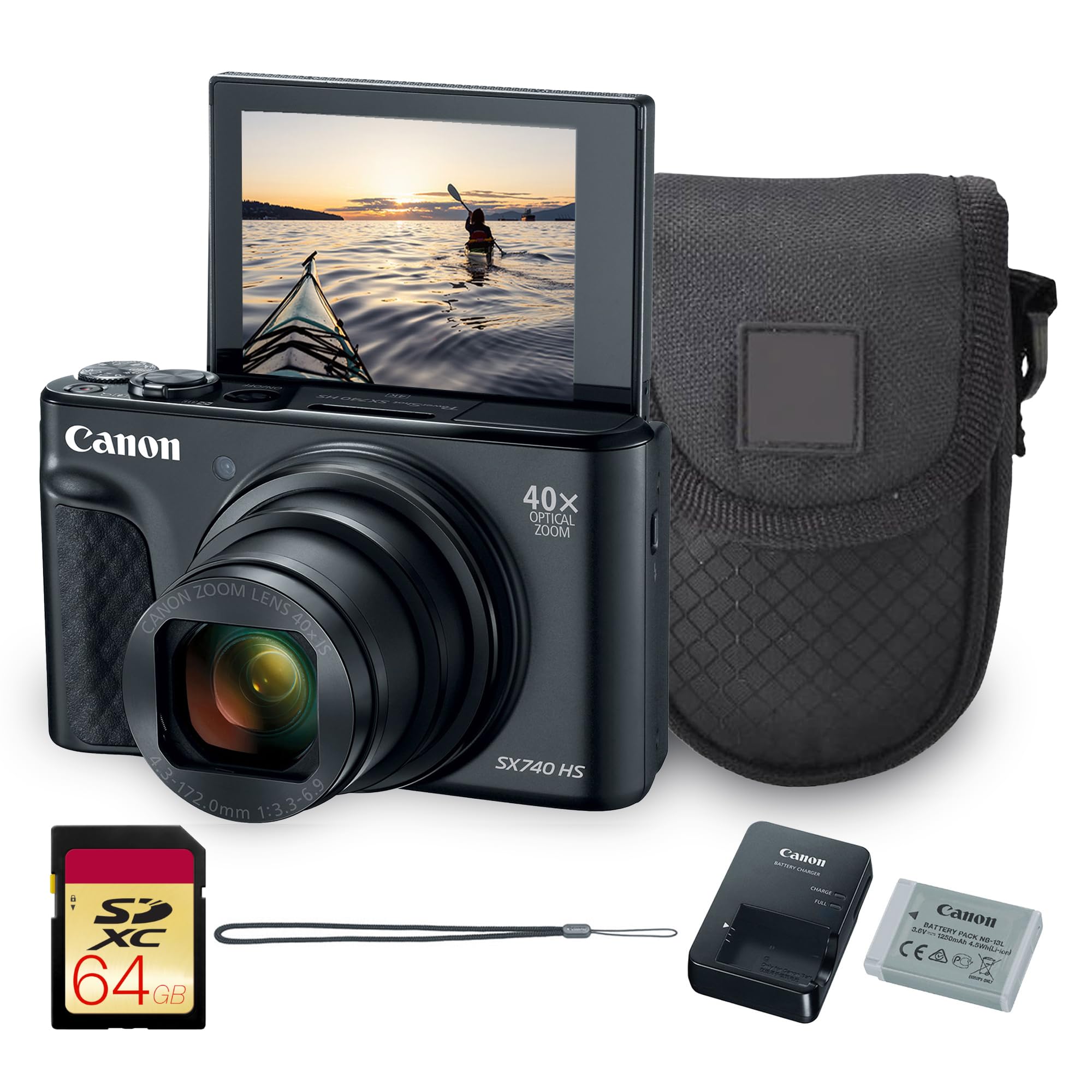
The pocket superzoom with 4K video that outruns your phone’s reach.
This Canon packs a 40x optical zoom lens (24-960mm equivalent) into a body small enough for any bag—meaning you can shoot a wide-angle landscape and then, without moving a step, capture a distant hawk in the same frame. The 20.3MP CMOS sensor with DIGIC 8 processing keeps noise low indoors, and the 16:9 aspect ratio is optimized for widescreen display and video.
Battery life is the real headline here: customers note “long battery life (5-day trip without recharge),” an exceptional claim for a compact zoom camera. The built-in 5-axis image stabilization smooths handheld 4K UHD footage so you can skip the gimbal for casual vlogging. The flip screen tilts upward for selfies, and Wi-Fi plus Bluetooth let you push photos straight to your phone.
One catch worth noting—some units are international models that cannot be registered for Canon USA warranty. Verify the seller’s listing before checkout. Also keep in mind that the 8-bit depth is less forgiving in heavy edits than the 12-bit OM SYSTEM files.
Perfect for the all‑in‑one traveler: No lens swaps, no charger needed for days—just a 40x reach and 4K video in a jacket pocket.
Check before buying: Confirm your unit is North American stock; international units work identically but lack US warranty support.
Grab this for: Travelers and wildlife beginners who want one compact camera that goes from wide to telephoto without changing glass.
Pass if: You need interchangeable lenses, raw 12‑bit editing headroom, or a weather‑sealed body for heavy rain.
3. Sony RX100 VII – 20.1MP 1.0-Type Stacked CMOS
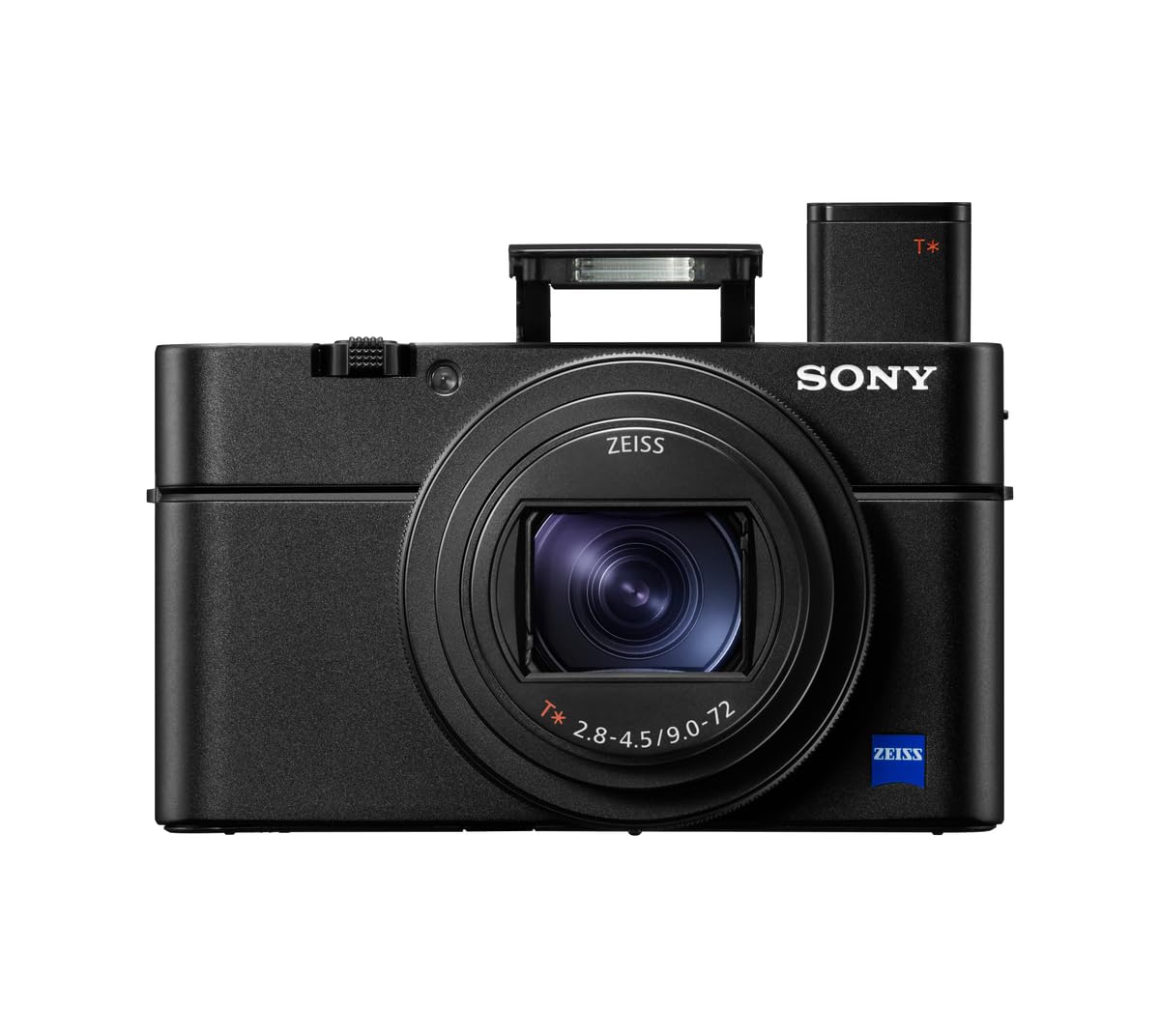
The pocket rocket that brings pro autofocus and 4K with a microphone jack.
Sony crammed 425 phase-detection autofocus points (plus 425 contrast points) into this 1-inch sensor compact—the same AF system found in much larger Sony cameras. That means the RX100 VII locks onto and tracks a subject’s eye (human or animal) across the entire frame at up to 20 fps with zero blackout. The Zeiss Vario-Sonnar T* 24-200mm F2.8-4.5 lens covers everything from group shots to tight portraits.
For video shooters, the microphone jack is the deciding spec: you can plug in an external lavalier or shotgun mic for clean audio without a separate recorder. Active mode image stabilization steadies 4K footage while you walk. Reviewers point out “the pictures I took in low light came out amazing,” and the pop-up electronic viewfinder gives you a bright eye-level view even in harsh sunlight.
The compromises are real: the body is almost too small, with buyers noting the power and shutter buttons are “too close causing accidental shut-offs.” There is no weather sealing, and the menu system is dense. At 8.3x optical zoom, it cannot reach distant subjects like the Minolta’s 67x or Canon’s 40x.
Why videographers love it
- External mic jack for clean audio
- Active mode stabilization smooths walking footage
- Real-time Eye AF for humans (stills and movies) and animals (stills)
- Pop-up EVF for bright sunlight shooting
Things to know
- Buttons are crowded—power button too close to shutter
- Slippery metal finish; an aftermarket grip helps
- No weather sealing
- 8.3x zoom max—not for distant wildlife
Ideal for: Travel vloggers and hybrid shooters who need pro‑level autofocus and external audio in a truly pocketable body.
Not for: Wildlife photographers needing >10x zoom, or anyone who hates fiddly small buttons.
4. Minolta Pro Shot 20MP – 67x Optical Zoom, Full 1080p HD

The 67x zoom that brings distant birds and planes into frame without the price tag.
This Minolta packs a jaw-dropping 67x optical zoom versus the Canon’s 40x, making it the undisputed king of extreme telephoto at this price tier. The 493 autofocus points versus the Kodak’s 3 points mean tracking a flying bird across the frame is genuinely possible. The 3-inch articulating LCD screen flips out and rotates, letting you shoot over crowds or from low angles without lying on the ground.
Shoppers say the “excellent optical zoom for outdoor/distant subjects (bird, air show)” and call it “superior to Pixel 7 phone for zoom.” The 12-bit depth (a measure of color and tonal information per pixel) captures more tonal information than 8-bit competitors, so you can recover more shadow detail in editing software. Smart scene modes handle face, smile, and blink detection automatically, and built-in Wi-Fi lets you transfer shots to your phone.
The honest trade-offs: 1080p at 30fps (no 4K), and the menu system is reportedly “confusing, non-intuitive.” A few buyers experienced quality-control issues with card readers and batteries. For indoor snapshots, your phone will be faster and more reliable.
Why zoom shooters pick it
- 67x optical zoom—more than any other pick here
- 493 hybrid AF points track distant subjects
- 12-bit raw files for editing flexibility
- Articulating screen for odd angles
Honest downsides
- 1080p video only—no 4K
- Menu is confusing; manual required
- Quality control: some units arrive defective
- Battery drain: one reviewer noted 15-min battery life
Reach for this if: You shoot distant wildlife, airshows, or sports on a budget and need maximum optical reach for the money.
Skip if: You need 4K video, simple menus, or consistent quality assurance from the start.
5. Kodak PIXPRO Astro Zoom AZ425 – 20MP Digital Camera Bundle

The affordable bundle that hands beginners a whole kit in one box.
This Kodak bundle includes the camera, a 32GB SD card, a camera case, and a rechargeable battery with charger—everything a first-time buyer needs to start shooting immediately. The 20MP sensor with optical image stabilization delivers crisp, clear close-ups and HD video. The 3-inch LCD gives you a clear view for framing, and auto scene modes handle the settings for you.
Buyers report it works “great for real estate photos” and find it “easy to use, quality zoom for distant objects.” The 4:3 aspect ratio is classic for printing, and the built-in flash helps in dim rooms. The extra battery included in the bundle is 960 mAh versus the camera’s 1100 mAh, as one reviewer helpfully noted—still useful as a backup even if it runs out a bit sooner.
The hard limit here is the 3 autofocus points versus the Minolta’s 493, so tracking a moving child or pet across the frame will be frustrating. The 8-bit depth also means less editing headroom in post-production. For static subjects in good light, it works fine; for action, look higher up the list.
Starting‑point simplicity: Great for kids, real estate agents, or casual users who want a dedicated camera without learning manual controls.
The catch: With only 3 autofocus points and 8‑bit files, you will outgrow this camera quickly if you start shooting moving subjects or editing raws.
Best if: You want a complete starter kit with minimal learning curve for static subjects like products, real estate, or family portraits.
Not for: Action photography, raw editing, or anyone who needs fast autofocus tracking.
Understanding the Specs
Optical Zoom Range
Measured as a multiplier (e.g., 40x, 67x), this tells you how many times closer the lens can make a distant subject appear compared to its widest setting. A 40x lens can bring a faraway bird to fill the frame; a 3x kit lens requires you to walk close. For travel and wildlife, more zoom is better—but it adds bulk and often reduces low-light performance.
Autofocus Points & Type
Autofocus points are the spots on the sensor where the camera measures focus. More points (493 or 425) allow the camera to track a moving subject across the entire frame. Fewer points (3) restrict focus to the center area. Hybrid and phase-detection systems are faster and more reliable than basic contrast detection for action shots.
Bit Depth
Bit depth determines how many millions of colors each pixel can record. A 12-bit file holds 68.7 billion colors; an 8-bit file holds only 16.7 million. More bits give you smoother gradients and more room to lift shadows or recover highlights in editing without banding or noise.
In-Body vs. Lens Stabilization
In-body image stabilization (IBIS) moves the sensor to counteract shake, working with any lens you mount. Lens-based stabilization lives inside a specific zoom lens and moves glass elements. Both reduce blur from hand shake, but IBIS is more flexible because it stays active when you swap lenses.
FAQ
Is a 20 megapixel camera enough for printing large photos?
Does more optical zoom mean worse image quality?
Can I use a 20MP camera for professional work?
What does a 4:3 vs 16:9 aspect ratio mean for my photos?
How many autofocus points do I really need?
Can I use the OM SYSTEM E-M10 Mark IV for video?
What is the difference between a point-and-shoot and a mirrorless camera?
Does the Sony RX100 VII have a mic input for external microphones?
Will a 20MP camera be better than my smartphone?
Which 20MP camera has the best battery life?
Final Thoughts: The Verdict
For the majority of shoppers, the best 20 megapixel camera winner is the OM SYSTEM Olympus E-M10 Mark IV because it pairs a versatile interchangeable lens system with exceptional in-body stabilization (which steadies the shot without a tripod), all in a compact body that fits a jacket pocket. If you want extreme optical reach without buying extra lenses, grab the Canon PowerShot SX740 HS—its 40x zoom and 4K video make it the ultimate travel companion. And for the videographer who refuses to compromise on audio or autofocus, the standout is the Sony RX100 VII with its mic input and 425-point phase-detection AF (autofocus that tracks subjects quickly).
How We Picked
We do not accept paid placement, and we did not hands-on test every unit. Instead, we match each pick to a real buyer and use-case by comparing the manufacturers’ published specifications against the patterns in verified customer reviews — so you get each pick’s real strengths and trade-offs instead of marketing copy.
Sources & Methodology
Specifications: manufacturer listings and product documentation. Review insights: verified customer reviews, as of July 2026. Pricing: not shown on this page (it changes often); check the current price via the retailer link.
As an Amazon Associate, Gadgets Feed earns from qualifying purchases. This does not affect which products we feature.
Product prices and availability are accurate as of the date/time indicated and are subject to change. Any price and availability information displayed on Amazon at the time of purchase will apply to the purchase of this product. As an Amazon Associate I earn from qualifying purchases.
CERTAIN CONTENT THAT APPEARS ON THIS SITE COMES FROM AMAZON. THIS CONTENT IS PROVIDED "AS IS" AND IS SUBJECT TO CHANGE OR REMOVAL AT ANY TIME.
Amazon and the Amazon logo are trademarks of Amazon.com, Inc. or its affiliates.