
Our readers keep the lights on and my morning glass full of iced black tea. As an Amazon Associate, I earn from qualifying purchases.
Specs are compiled from manufacturer listings and verified buyer reviews and can change over time — please confirm the key details on the product page before buying.
When you want to heat a good-sized home or a large workshop without running your furnace non-stop, the right pellet stove can shrink your heating bill. The catch is that not every model actually warms 2,000 square feet reliably, especially once the temperature drops below freezing. This guide covers five stoves that have the heat output (measured in BTUs) and the pellet hopper capacity to handle that space, and it shows you the real trade-offs of each one.
I’m Min — the founder and writer behind Gadgets Feed. This guide is built by comparing the manufacturers’ published specifications and the patterns across verified customer reviews, so you get each pick’s real strengths and trade-offs instead of marketing spin.
You need a 2000 sq ft pellet stove that balances a large-enough hopper (so you do not refill it at 2 AM) with a heat output that keeps the cold away when you need it most.
Our Picks at a Glance


How To Choose The Best 2000 Sq Ft Pellet Stove
Picking a pellet stove for a 2,000-square-foot space is different from picking one for a small cabin. You need enough heat output (measured in BTUs) to overcome heat loss through walls and windows, and you need a hopper big enough that you are not refilling it every few hours. Here are the three specs that matter most.
BTU Output — The Real Measure of Heating Power
To heat 2,000 square feet, a stove typically needs at least 30,000 British Thermal Units (BTUs — a unit that measures how much heat the stove produces per hour). If your home has poor insulation or large windows, look for a stove closer to 40,000 BTUs so it can keep you warm even on the coldest days.
Hopper Capacity — How Long You Can Walk Away
The hopper holds the wood pellets that feed the fire. A 60-pound hopper might last about 24 hours on a low burn setting, while a 130-pound hopper can push you past two days without a refill. Your choice depends on whether you are okay filling it every morning or want to load it up and forget it for a weekend.
Electrical vs. Non-Electric Operation
Most pellet stoves use electricity to run the auger motor (which moves pellets into the fire), blower fan (which pushes hot air into the room), and ignition system. If the power goes out, so does your heat. A non-electric model uses a natural gravity-feed system (pellets drop by gravity, no motor) and passive draft (airflow without a fan), so it works during a blackout — but it is harder to dial in the exact temperature and may produce more smoke on startup.
Quick Comparison
| Model | Best For | BTU Output | Hopper Capacity | Item Weight | Amazon |
|---|---|---|---|---|---|
| US Stove GW1949 Wiseway★ Best Overall | Off-grid / Power outages | 40,000 BTUs | 60 lbs | 131 lbs | Amazon |
| PelPro PP70Premium Pick | Highest heat output in its class | 42,500 BTUs | 70 lbs | 199 lbs | Amazon |
| Cleveland Iron Works Medium PS60W | Smart home connectivity | 30,124 BTUs | 60 lbs | 182.98 lbs | Amazon |
| Cleveland Iron Works Bayfront PSBF66W | Large open floor plans | 30,173 BTUs | 66 lbs | 224.9 lbs | Amazon |
| Canyon Lodge Large C130W | Maximum runtime between refills | 29,501 BTUs | 130 lbs | 209.44 lbs | Amazon |
In‑Depth Reviews
1. US Stove GW1949 Wiseway Non-Electric Pellet Stove
The one stove that keeps you warm when the whole neighborhood goes dark.
This is the only stove on this list that runs without any electricity, using a natural gravity-feed system (pellets drop by weight instead of an auger motor) and passive draft (airflow without a blower fan) rather than a powered motor and fan. That means you get silent operation and zero dependency on the power grid, so it is a smart pick if you live somewhere with frequent winter power outages. It puts out 40,000 BTUs to heat up to 2,000 square feet, and its 60-pound hopper lasts up to 30 hours on a low burn.
The trade-off is that it is not as set-and-forget as an electric model. Buyers report that it smokes heavily on the first start (you will want to run it outside to burn off the manufacturing oils), and one reviewer in Northern Maine said it could not keep a 600-square-foot space above 68°F when the temperature dropped below zero. On the flip side, another buyer noted it heats a 2,500-square-foot addition with two box fans assisting the airflow. At 131 pounds, it is noticeably lighter than the Cleveland Iron Works Bayfront (which weighs 224.9 pounds), so moving it into place is easier solo.
You will need to tweak the burn cage gaps and clean the fly ash from the secondary plate regularly to keep the draft working right. But if your top priority is having heat when the power is out, no other stove here offers that confidence — and that is why it earns the Best Overall spot over the higher-BTU PelPro PP70.
Why this stands out
- Natural gravity feed system means zero electricity needed
- 40,000 BTUs matches or beats most electric models in this size range
- 60-lb hopper delivers up to 30 hours of burn time on low
The real drawbacks
- Smokes heavily on the first startup; requires outdoor burn-off
- Performance drops sharply in sub-zero weather according to some cold-climate buyers
- Gravity feed is less precise than an auger system; needs regular draft adjustments
Reach for this if: you live in a region with frequent power outages and you want a heat source that keeps working when the grid goes down.
Look elsewhere if: you need a stove that can hold a steady temperature in extreme cold (below 0°F) without auxiliary fans.
2. PelPro PP70 Pellet Stove for Home Heating – 70 lb Hopper, 42,500 BTU
The biggest BTU punch in this lineup, built to push heat through older drafty homes.
With 42,500 BTUs, the PelPro PP70 delivers about 44% more heat output than the Canyon Lodge Large (29,501 BTUs). That makes it the most powerful stove in this roundup, with enough heat to keep even a drafty 2,000-square-foot home comfortable. It is EPA-certified at 88.5% efficiency, meaning less of your pellet fuel turns into wasted exhaust. The 70-pound hopper holds roughly two days’ worth of fuel, and the easy-to-use dial control gives you 10 variable heat settings to fine-tune the temperature without fumbling through a digital menu.
The 300W auto-igniter gets the fire going at the push of a button. The fresh air kit is included, so you can install it in a mobile home, garage, or shop without worrying about fresh-air intake. It is 22 inches deep and 22 inches wide, making it more compact than the Cleveland Iron Works Medium (which is 26.02 inches deep), so it fits in tighter floor plans. However, customer reviews are mixed: some owners mention the stove works flawlessly supplementing heat pumps in a barn for three winters, while others describe frequent auger jams (pellets getting stuck in the feed screw), heavy smoking on start and stop, and a thermostat that only functions between high and low settings.
If you need raw heating power in a compact footprint and you are comfortable working through minor adjustments, this stove delivers the highest BTU-per-square-inch ratio in the group.
Raw heat, clear limits: The PP70 leads every other pick on pure BTU output, but buyer experiences are split — some call it amazing while others report significant daily maintenance.
This one is for: the buyer who needs maximum heat output in a compact stove and is willing to spend time on daily cleaning and potential troubleshooting.
Not for: anyone who wants a hands-off, reliable heater straight from the start with no learning curve.
3. Cleveland Iron Works Medium Pellet Stove – 60lb Hopper
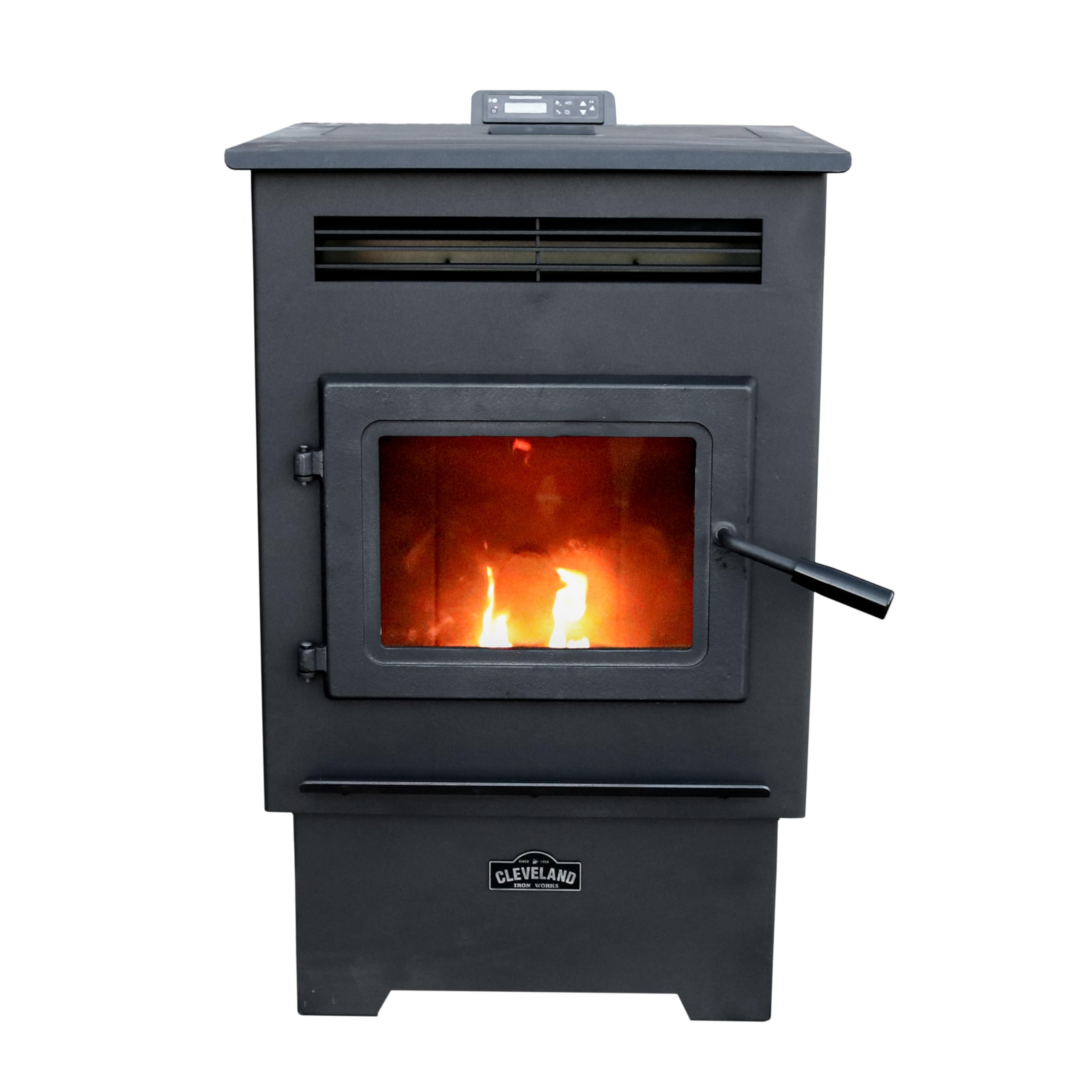
A cast-iron stove you can control from your phone, with real-world burn data to back it up.
This is the only stove in the list with built-in WiFi smart-home technology, so you can adjust the temperature and lighting from a smartphone app without walking across the room. It heats 1,500 to 2,200 square feet with 30,124 BTUs from a 60-pound hopper — and customers note that one bag of pellets lasts 20-26 hours on a low burn setting, or 3-4 days with intermittent use. That runtime is similar to what you would expect from a 60-pound hopper, but it falls short of the Canyon Lodge’s 130-pound hopper (which gives you about 2.2 times longer between refills).
At 182.98 pounds, it is noticeably lighter than the Cleveland Iron Works Bayfront (224.9 pounds), but it is still a heavy chunk of cast iron that two people will want to carry. One buyer who has used it for three winters in a 1,000-square-foot solar home says it burns on low all night and only needs to be cleaned daily. Another reviewer had a serious mechanical failure after one year — the control panel went dark and left them without heat in January. The manufacturer customer service has been praised by some for overnighting replacement parts and criticized by others for being unresponsive.
The programmable thermostat is the standout feature here, letting you set a schedule so the stove ramps up before you wake up and backs off while you are asleep.
What makes it unique
- Built-in WiFi for app-based temperature and lighting control
- Reviewers point out 20-26 hours of burn on low with a single 40-lb bag of pellets
- Programmable thermostat lets you set heating schedules
What to watch for
- Some shoppers say control panel failure and auger bolt issues after the first year
- Customer service reputation is inconsistent based on reviewer accounts
- Manual is vague in spots, especially for first-time pellet stove owners
Reach for this if: you love smart-home convenience and want to control your stove’s temperature from anywhere in the house.
Look elsewhere if: you want a track record of zero mechanical issues or you prefer a simpler stove with fewer electronics that can fail.
4. Canyon Lodge Large Pellet Stove
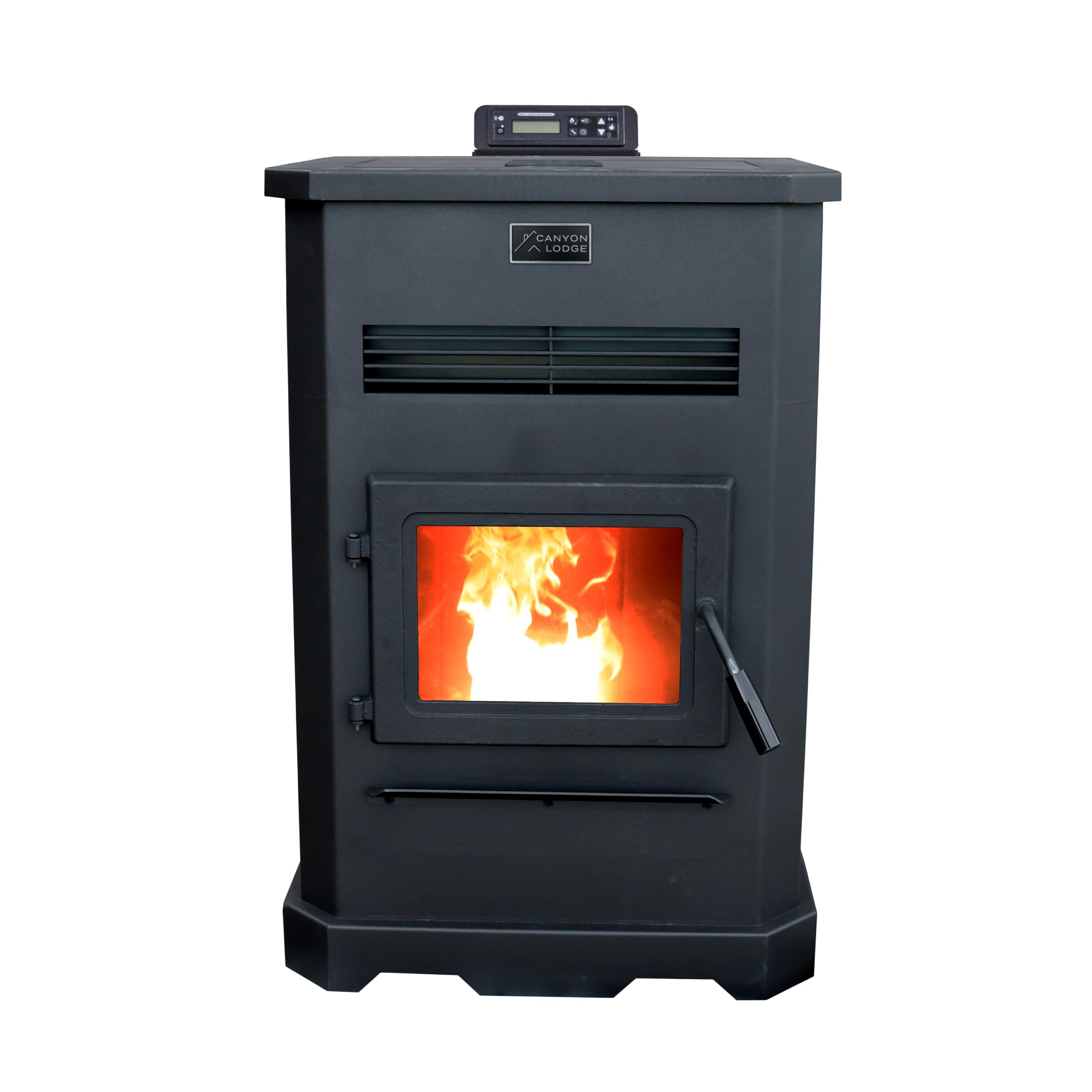
A 130-pound hopper that lets you go two full days without thinking about refueling.
If your main frustration is walking to the pellet bin at 2 AM to pour another bag into the hopper, the Canyon Lodge is the answer. Its 130-pound hopper is more than double the size of the 60-pound hopper on the Cleveland Iron Works Medium. That gives you the longest runtime of any stove here — one reviewer noted that while it does not quite hold the full 130 pounds, it will take three 40-pound bags, which is still enough to run for an estimated 48 hours or more on a low burn. The stove is rated to heat 2,000 to 3,000 square feet, and it puts out 29,501 BTUs — which is slightly less heat than the 30,124 BTUs of the Cleveland Iron Works Medium.
The Whisper Quiet Blower Technology (a fan designed to run quietly) makes a difference in a living room setting, and the large viewing glass with an air wash system (a stream of air that keeps soot off the window) keeps the glass clear longer so you can enjoy the fire view. It supports smart home technology and includes a fresh air kit, so it is mobile-home approved from the start. However, buyer experiences are sharply divided: one review calls the unit a “giant POS” that caught fire inside the stove, while another says it works great for heating their whole house from the basement and calls customer support “very good.” The app and remote control are described as “a bit wonky” by one owner, though they confirmed the stove functions as intended.
For the buyer who wants to load pellets as infrequently as possible and is willing to accept some electronic interface quirks, this stove has the biggest appetite of the bunch.
The big advantage
- 130-lb hopper — the largest in this roundup by a wide margin
- Whisper quiet blower keeps noise low in living spaces
- Air wash system keeps the glass cleaner for longer between wipes
Serious concerns
- Serious safety reports exist: one review describes a fire inside the stove
- App, remote, and user manual are all reported as clunky or unhelpful
- Hopper actually holds slightly less than the advertised 130 lbs according to one buyer
This is for: the person who values maximum time between refills above everything else and is comfortable with a stove that has a mixed safety reputation.
skip it if: you prioritize a spotless safety record and a polished app experience over sheer hopper capacity.
5. Cleveland Iron Works Bayfront Pellet Stove – 66lb Hopper

A solid cast-iron stove that swallows whole rooms with heat, but demands a daily cleaning habit.
The Bayfront is the largest stove in the Cleveland Iron Works lineup on this list, weighing 224.9 pounds and standing 30.43 inches tall. That is 93 pounds heavier than the US Stove Wiseway (131 pounds), so you need a sturdy hearth or floor. Buyers who switched from firewood to this pellet stove praise the quiet operation and the “crazy heat” it puts out. One owner in West Virginia reports using 40-60 pounds of pellets per day in a 1,650-square-foot home during a cold winter, buying 3 tons and having 2,400 pounds left by March.
The built-in WiFi and smart home technology is the same system as the Medium PS60W, and the app works well for scheduling on and off times. The biggest complaint across reviews is that the hopper door switch is easy to bend when loading pellets, which stops the auger from turning until the switch is fixed. Another buyer mentions that the glass smokes up quickly when running on a low setting, requiring a wipe-down every day. Daily cleaning is a recurring theme here: multiple owners confirm you need to clean the burn pot and glass daily to keep the stove running efficiently.
If you have a large open floor plan and you do not mind a few minutes of daily maintenance, this stove delivers the warmth and the smart controls that make pellet heating feel modern. For its cast-iron build and WiFi features, it is a good alternative to the Medium PS60W if you need to cover more square footage.
Solid heat, known quirks: The Bayfront puts out reliable heat for large spaces and the app-based scheduling is genuinely useful, but the daily glass cleaning and the fragile hopper-door switch are predictable annoyances.
This pick fits: the buyer with a big open floor plan who wants WiFi controls and is prepared for a daily 5-minute cleaning routine.
Not for: anyone looking for a low-maintenance stove that can go multiple days without attention, or those who want a lighter, more portable unit.
Understanding the Specs
BTU Output — What It Actually Means for You
BTU stands for British Thermal Unit, and it measures how much heat the stove produces per hour. A stove at 30,000 BTUs is fine for a well-insulated 2,000-square-foot home, but if you have single-pane windows or a drafty layout, you will want something closer to 40,000 BTUs to keep the space comfortable on the coldest days. This is the single most important number on the spec sheet.
Hopper Capacity — How Long Your Pellets Last
The hopper is the bin where you pour the wood pellets. A 60-pound hopper will typically burn for about 24 hours on the lowest setting, while a 130-pound hopper can go two full days without a refill. If you hate waking up to a cold house because the stove ran out of fuel at 4 AM, prioritize a larger hopper over a higher BTU rating.
Electric vs. Non-Electric — Do You Need Power to Stay Warm?
Most pellet stoves use electricity to move the auger (the screw that feeds pellets into the fire) and run the blower fan. That means if the power goes out, the stove shuts down. A non-electric gravity-feed stove like the US Stove Wiseway keeps burning without any electricity, but it is harder to control the burn rate and produces more smoke on startup.
Weight and Dimensions — Will It Fit and Can You Move It?
Pellet stoves are heavy. A 130-pound stove is manageable by one strong person, but a 225-pound cast-iron stove needs two people and a dolly. Measure your floor space and the doorway path before you buy — a stove that is 26 inches deep may not fit where a 22-inch stove would.
FAQ
Will a 30,000 BTU pellet stove actually heat 2,000 square feet?
How many bags of pellets will I burn in a typical winter?
Can I run a pellet stove without electricity?
How often do I need to clean a pellet stove?
Do pellet stoves work during a power outage?
Is a smart pellet stove with WiFi worth the extra cost?
What size vent pipe does a pellet stove need?
Can I install a pellet stove in a mobile home?
How long does a 60-pound hopper last compared to a 130-pound hopper?
Are pellet stoves safe to leave running overnight?
Final Thoughts: The Verdict
If you want one dependable pick, the 2000 sq ft pellet stove winner is the PelPro PP70 because its 42,500 BTU output gives you the most heat for your money in a compact frame, and the 70-pound hopper keeps you from refilling every night. If you want zero grid dependency, grab the US Stove GW1949 Wiseway for its gravity-feed non-electric operation. And for the largest hopper capacity, the standout is the Canyon Lodge Large with its 130-pound bin.
How We Picked
We do not accept paid placement. Every pick is matched to a real buyer and a real use-case; we do not hands-on test units.
Sources & Methodology
Specifications: manufacturer listings and product documentation. Review insights: verified customer reviews, as of July 2026. Pricing: not shown on this page (it changes often); check the current price via the retailer link.
As an Amazon Associate, Gadgets Feed earns from qualifying purchases. This does not affect which products we feature.