
Our readers keep the lights on and my morning glass full of iced black tea. As an Amazon Associate, I earn from qualifying purchases.
Specs are compiled from manufacturer listings and verified buyer reviews and can change over time — please confirm the key details on the product page before buying.
Before we dig in, one honest heads-up: this list uses flexible, human-like matching for power handling. That means not every pick is the exact 2000-watt number you searched; where the nearest same-type size and wattage serves the same purpose, we’ve included it so you can compare real options side by side.
I’m Min — the founder and writer behind Gadgets Feed. This guide is built by comparing the manufacturers’ published specifications and the patterns across verified customer reviews, so you get each pick’s real strengths and trade-offs instead of marketing spin.
You want a 12-inch sub that delivers serious bass without blowing up your trunk or your wallet, and we’ve matched the strongest candidates to the right amps, boxes, and budgets to make your choice simple. Here is the field of top-tier 2000 watt 12 inch subwoofer options, ranked for real-world performance.
Our Picks at a Glance


How To Choose The Best 2000 Watt 12 Inch Subwoofer
To get the bass you want, you need to match three things: your amp’s clean power, the box size you can fit, and how low you want the bass to go. Get these aligned and almost any sub on this list will reward you; mis-match them and even a great driver will sound weak or die early.
Read the RMS, not the peak
Peak wattage is the marketing number — a brief burst before failure. RMS is the power a sub can handle continuously, which is what you actually listen to. A sub rated 1000W RMS paired with an amp that delivers 1000W RMS is a healthy match. Overpower it badly and you risk cooking the voice coil; underpower it and you might clip the amp, which is what really damages speakers.
Match the impedance to your amp
Impedance (measured in ohms) determines how much current your amp pushes. Dual voice coil subs give you wiring flexibility: a dual 2-ohm sub can run at 1 ohm or 4 ohms, while a dual 4-ohm sub can run at 2 ohms or 8 ohms. Choose the configuration that lands in your amplifier’s stable range — most mono car amps are happiest at 1 or 2 ohms.
Respect the enclosure
A sub is only as good as its box. Sealed enclosures give tight, punchy bass; ported enclosures get louder and dig deeper but need precise internal volume and tuning. Check the manufacturer’s recommended cubic feet before you build or buy. Wrong box dimensions can make a fine sub sound muddy — or let the cone over-excurs and tear.
Quick Comparison
| Model | Best For | RMS Power | Voice Coil | Magnet | Amazon |
|---|---|---|---|---|---|
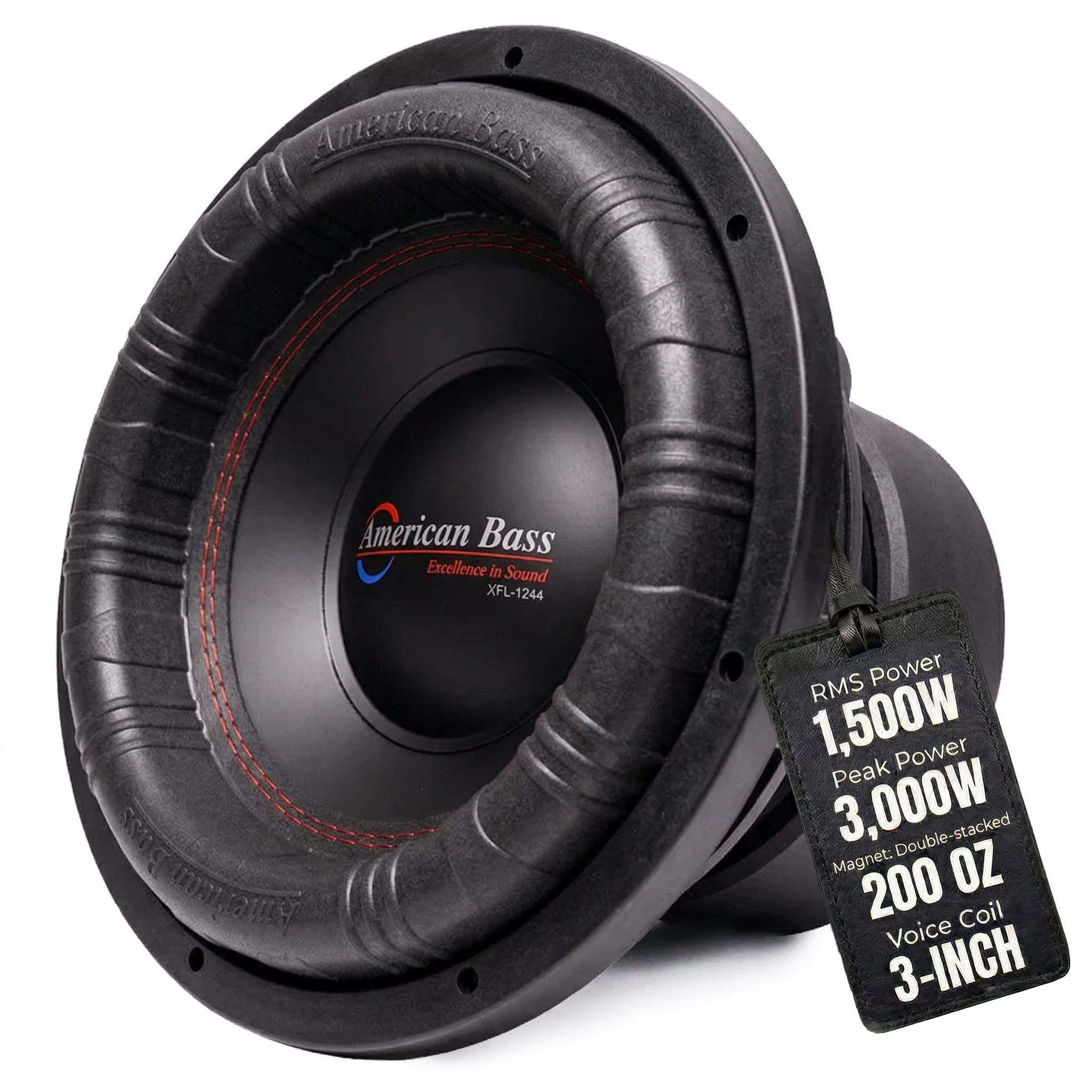
| American Bass XFL★ Best Overall | Maximum output | 1,500W | 3″ | 200 oz | Amazon |
| BOSS Phantom P126DVCBudget Champion | Budget value | 1,150W | 2″ | — | Amazon |
| Kenwood KFC-W3041Musical Pick | Hi-fi musicality | — | Single 4Ω | — | Amazon |
| Rockville W12K9D4 | Crowd favorite | 1,000W | 3″ | 190 oz | Amazon |
| Soundstream Tarantula | Low-tuned ported | 1,000W | 3″ | — | Amazon |
| H YANKA BSP-12-4 | Efficiency | 1,400W | 3″ | Dual Y35 | Amazon |
| Hifonics Brutus BRW12D2 | SPL builds | — | 3″ | Dual 70 oz | Amazon |
| CT Sounds STRATO-12-D2 | Balanced SQ + SPL | 1,250W | 3″ | 170 oz | Amazon |
| Rockville Destroyer 12D1 | Competition abuse | 2,000W | 3″ | 300 oz | Amazon |
In-Depth Reviews
1. American Bass XFL 12 Inch
Our pick — over 4.5★ from 300+ verified ratings; the strongest balance of quality and price.
The 1,500W RMS heavyweight with a 200 oz magnet that stays cool under pressure.
If your goal is sheer, chest-thumping output, this is the benchmark on the list. The massive 200 oz magnet leads the whole lineup, edging out the Rockville’s 190 oz, and it pairs with a durable 3-inch voice coil to move serious air without strain.
Owners consistently report deep, hard-hitting lows, with one running a pair on a 1,500W Precision Power amp at 2Ω and noting no heat or smell even after heavy use. The crowd consensus is clear: sound quality is what wins people over here, and it’s the single most-mentioned trait by a wide margin. Build quality and value-for-money also earn steady praise, confirming this is a sub you buy once and trust.
This is not a subtle speaker. It weighs about 36 lbs, and buyers describe the bass as audible a block away and strong enough to shake the car — one listener’s apartment complex felt it too. The honest trade-off is that it overpowers weaker mid-range speakers, and it is too much for a small car. You want a solid box, ideally around 2.2 to 2.5 cubic feet, and a real amplifier to feed it.
What wins people over
- Enormous 1,500W RMS headroom for peak output
- 200 oz magnet and 3″ voice coil built for abuse
- Owners praise the deep, clean low end
Know before you buy
- Roughly 36 lbs — needs a solid, well-built enclosure
- Bass can overpower smaller front speakers
- Not ideal for compact cars or weak amps
Reach for this if: you want the loudest, deepest option here and have the amp and box space to feed a 1,500W RMS driver.
Look elsewhere if: you are working with a small vehicle or a modest factory amplifier — this sub will demand more than that.
2. BOSS Audio Phantom P126DVC
The budget pick that delivers big sound for the price when fed a modest, clean signal.
This is the entry-level pick that punches well above its price tag. It handles 2,300W max and 1,150W RMS through a dual 4-ohm 2-inch copper voice coil, with an 84dB sensitivity and a 31 Hz resonant frequency. That sensitivity score sits just 1% below the Rockville W12K9D4’s 83dB — a hair more efficient, meaning it gets loud on less power.
What buyers love is the value: big sound for a fraction of the cost is the dominant theme across feedback. The catch is that sound quality gets genuinely mixed reviews, and durability is the most-discussed negative — a few units have blown out within a month of use. One buyer who pushed 500W RMS through it after a proper break-in still saw it fail, a reminder that this sub has a ceiling.
The smart play here is restraint. Owners say it performs best in a sealed box and poorly in ported enclosures, and that a moderate 6-hour break-in matters. If you feed it a clean, modest signal and resist the urge to max out the gain, you get a reliable budget thumper; if you chase huge wattage, you will likely be shopping again soon.
Best for: someone building a first system on a tight budget who will run a modest amp in a sealed box.
Who it is not for: bassheads who plan to push serious RMS — this one rewards a gentle hand.
3. Kenwood KFC-W3041
The audiophile 12-inch that delivers precise, musical bass over raw SPL.
Not every buyer wants to rattle windows. This Kenwood is the audiophile’s 12-inch, built around a multi-layer polypropylene cone with Kenwood’s X-Motif design and a Closed Yoke with Advanced Airflow Control — a thermal system using an aluminum bobbin that keeps the motor cool so the sound stays clean. It is rated at 2,000W maximum power with a single 4-ohm voice coil, a setup that matches perfectly with the KAC-D5101 amplifier.
The real story here is precision, not volume. Buyers report being able to “hear every little beat in the bass and absolutely feel it” — a level of musical detail the pure SPL subs on this list simply do not chase. It comes with a 13″ x 13″ x 6.125″ footprint, a 5-3/8 inch mounting height, and an 11-1/8 inch mounting hole, so it drops into most standard enclosures.
The trade-off: this is not a flex sub. It will not hit as hard as the American Bass XFL or the Rockville Destroyer in a max-output contest. Instead, it rewards listeners who want tight, accurate bass for daily listening and who came to Kenwood after watching cheaper subs fail. For that crowd, the review pages sum it up: “this was by far the best one to find.”
Choose this for: clean, musical bass in a home hi-fi or daily driver where accuracy beats sheer pressure.
Skip it for: competition SPL builds — this is a finesse driver, not a bruiser.
4. Rockville W12K9D4

The proven all-rounder that rattles trailers on a budget with 1,000W RMS.
This is the internet’s darling for a reason. It handles 4,000W peak, 2,000W program, and 1,000W RMS, with a dual 4-ohm 3-inch 4-layer voice coil wound with OFC wire. That 3-inch coil is 50% larger than the BOSS Phantom’s 2-inch, which translates directly into better heat handling and more abuse before distortion creeps in.
The build is genuinely heavy-duty: a double-stacked 190 oz magnet, cast aluminum basket, non-pressed paper cone, and Nomex spider. At 83dB sensitivity, it sits right next to the BOSS’s 84dB, so it is nearly as efficient while being far more sturdy. Buyers describe it as loud enough to rattle trailers, and many note it outperforms dual 12-inch setups from other brands.
Feedback is overwhelmingly positive on sound quality — the most-mentioned trait by a wide margin — and quality and value follow close behind. The recurring gripe is durability: a few units have blown after a month, and owners caution against over-powering it beyond roughly 600-700W RMS. Feed it a clean amp signal in a properly sized sealed or ported box and it will reward you for years.
Why it leads
- 3″ 4-layer voice coil with OFC wire for cool running
- Cast aluminum basket and 190 oz magnet — serious build
- Huge owner base praising sound quality and value
Watch the wattage
- Owners recommend keeping it around 600-700W RMS
- A few reported voice coil failures within a month
- Needs a proper box — ported or sealed
Best all-rounder: the safe recommendation for most buyers — proven, popular, and powerful enough to impress without demanding competition-level gear.
Just know: push much more than 700W RMS and you venture into risky territory.
5. Soundstream Tarantula

The 90s legacy brand that still digs deep in low-tuned ported boxes.
Soundstream built its reputation in the 90s, and this Tarantula shows the formula still works. It runs 2,000W peak and 1,000W RMS through a 3-inch 4-layer voice coil, with an overcompensating motor structure and a vented T-yoke designed to pull heat away from the coil during long sessions. The non-transfer spruce pulp cone and stitched surrounds are built to survive serious excursion.
Buyers who have had it for a year or more report clean, loud output that “hits low lows,” especially in a 2.5 cubic foot ported box tuned to 30Hz. That is the balance: this sub loves a well-tuned ported enclosure — the spec calls for an optimum 2.50ft3 ported volume — and rewards it with deep, musical bass that competes with far pricier brands.
The modest review count means the evidence base is smaller, but it is uniformly positive on sound quality and value. The one candid warning: one owner blew it by pushing extreme volume — “got so loud the speaker blew” — which is less a flaw and more a physics lesson. Respect the 1,000W RMS rating and this Tarantula will keep spinning.
Pick this for: deep, low-tuned ported builds where you want musicality and output in equal measure.
Be careful: over-driving it past RMS is the fast path to a dead cone.
6. H YANKA BSP-12-4

The budget bruiser with 88dB sensitivity for maximum output per watt.
Here is a sub that gets loud without needing a monster amp, thanks to an 88dB sensitivity — the highest on this list. That means it converts power into sound more efficiently than any competitor here, so a modest amplifier still produces serious volume. It carries 2,800W max and 1,400W RMS, powered by a 3-inch dual voice coil and dual Y35 magnets sized at 190 mm x 25 mm.
The engineering details are surprisingly thoughtful for the price. A precision-wound black aluminum voice coil, a dual-layer spider with red cloth reinforcement, and silver-plated 24-strand tinsel leads all point to a manufacturer that cares about reliability. The black aluminum basket is designed to aid heat dissipation, and the foam edge gets orange stitching for extra durability.
Buyers consistently describe it as musical and detailed — “tight and accurate” in the bass region — with solid quality and value for money earning equal praise. One owner runs it on a Skar RP 3500 amplifier at 1 ohm without issue, while another notes it outperforms a previous 10-inch sub even on a modest 600W amp. The single negative review mentions a unit that arrived sounding blown, which reads like a shipping casualty rather than a design flaw.
Why it stands out
- 88dB sensitivity — huge output on modest power
- 1,400W RMS is serious headroom for the price
- Thoughtful cooling and reinforced spider design
Keep in mind
- Smaller owner base, so less long-term data
- A rare unit may arrive with shipping damage
Reach for it if: your amp is modest but you still want deep, hard-hitting bass — this gets the most output per watt.
Think twice if: you need the proven track record of a bigger brand with thousands of reviews behind it.
7. Hifonics Brutus BRW12D2

The 90s SPL legend that still slams with dual 70 oz magnets.
Hifonics was the brand to beat in the golden era of car audio, and this Brutus 12-inch carries that legacy. It is rated at 2,000 watts with a dual 2-ohm configuration, built around a vented aluminum former holding a 3-inch voice coil. That vented design lets heat escape — less heat means less distortion and more reliable power handling on long listening sessions.
The motor assembly is the headline: dual 70 oz magnets in a vented high-energy design that boosts both power handling and SPL, wrapped in a heavy-gauge, powder-coated aluminum die-cast basket. A specialized dual poly cotton spider with double centering lets the woofer take more power with minimal distortion. Buyers who remember 90s Hifonics say this recaptures that quality, calling it “the best 12s I’ve ever had.”
Owner reports are glowing on bass quality — described as worth double the price — with one running two on a TXP 12000 amp all day without issues. The honest caveat: one unit blew within a month, and a buyer noted an old Kenwood box rattled because the dimensions were wrong. This sub needs a properly sized enclosure; cram it in the wrong box and you will not hear what it can do.
Pick this for: SPL-focused builds where you want legendary brand pedigree and dual 70 oz magnet authority.
Respect the box: the wrong enclosure will strangle it — measure before you mount.
8. CT Sounds STRATO-12-D2

The showpiece 12-inch that pairs stunning looks with accurate, deep bass.
CT Sounds built this 12-inch to be seen and heard. It runs 2,500W max and 1,250W RMS through a dual 2-ohm coil, with a 3-inch 4-layer high-temperature CCAW voice coil and a 170 oz triple-stacked Y35 grade ferrite magnet. That magnet structure is the second-largest on this list, trailing only the Rockville Destroyer’s 300 oz, and it powers a 4% carbon fiber reinforced cone with a competition mega foam surround.
The details are competition-minded: an advanced air cooling system, a signature chrome-plated low carbon iron bottom plate, dual round weaved copper tinsel leads, and 8-gauge push terminals. Buyers call the woofer “a work of art,” and one refuses to hide the white basket and chrome backplate. It is not just looks — owners describe it as “very accurate, deep bass, that isn’t boomy.”
The one thing every owner mentions: this sub needs a break-in period. The spider is stiff from the factory, and the voice coil may emit a burning smell early on — normal, not damage. Owners advise against maxing it out before break-in. In a 2.1 cubic foot ported enclosure tuned to 32Hz, powered by a 2,300W amp at 1 ohm, it delivers clean, punchy output that outshines brands like Rockford, Memphis, and Kicker in direct comparison.
What impresses
- 170 oz triple-stacked magnet for serious authority
- Accurate, non-boomy bass that still gets loud
- Stunning build quality with chrome and carbon details
Plan for it
- Stiff spider requires a patient break-in period
- Early burning smell is normal but can alarm new owners
Best for: the buyer who wants both sound quality and a showpiece — accurate bass in a gorgeous package.
Just remember: break it in gently before you lean on it.
9. Rockville Destroyer 12D1

The apex predator built for competition floors and 2,000W RMS abuse.
This is the heaviest hitter on the list, literally and figuratively. The Destroyer handles 8,000W peak, 4,000W program, and a full 2,000W RMS — compared to the Rockville W12K9D4’s 1,000W RMS and the highest continuous rating here. It is powered by triple-stacked 300 oz Y35 magnets and a 3-inch 4-layer black aluminum voice coil made in the USA, rated for 300-350 degrees C so it shrugs off heat that would kill lesser subs.
The design is pure competition: a cast aluminum basket that cuts weight while keeping strength, a tear-resistant Nomex spider, and a 30mm XMAX for massive excursion. It offers a dual 1-ohm impedance, which suits a 2,000W RMS amplifier looking for a direct 1-ohm load. Owners mention running it hard for 50-minute sessions with no voice coil smell or overheating — the thermal engineering is the star here.
Sound quality is the most-praised trait by a wide margin, with buyers calling it “best bang for the buck” and noting it outperforms pricier reconed subs. The honest risk: reliability gets mixed to negative mentions, and one owner destroyed it with a Taramps Big Boss 3 amp, a 3,000W+ monster. This sub needs a clean, well-matched 2,000W signal — overfeed it and even a Destroyer will fall.
Why it is the apex
- 2,000W RMS — the highest continuous rating on this list
- 300 oz magnet and USA-made 3″ voice coil
- 30mm XMAX for massive excursion and deep bass
Handle with care
- Dual 1-ohm demands a stable, quality amp
- Overpower it and even this sub can fail
- Heavy and built for serious installs, not casual ones
For serious competitors: if you have a clean 2,000W RMS amp and want the most output per dollar, this is the endgame.
Not for beginners: match it carefully or it will punish you — this is a tool for people who know their wattage.
Understanding the Specs
RMS vs Peak Power
RMS is the amount of power a sub can handle continuously — the number that actually matters for daily listening. Peak is the brief burst a sub can survive before failing; it is mostly a marketing figure. Match your amp’s RMS output to the sub’s RMS rating and you get clean, reliable bass. Overpower and you risk burning the voice coil; underpower and you risk clipping, which is equally deadly.
Voice Coil Size and Impedance
The voice coil is the motor that moves the cone, and a larger coil — 2-inch versus 3-inch — handles more heat and power before distorting. Impedance, measured in ohms, determines how your amp sees the load. Dual voice coil subs let you wire to different impedances: a dual 2-ohm can run at 1 or 4 ohms, a dual 4-ohm at 2 or 8 ohms. Pick the configuration that lands in your amp’s stable range.
Magnet Size and Sensitivity
The magnet drives the voice coil’s force. Bigger magnets, measured in ounces, generally mean more control and output — the 300 oz stack on the Rockville Destroyer versus the 170 oz on the CT Sounds. Sensitivity, measured in dB, tells you how efficiently a sub converts power into sound: 88dB is loud on modest power, while 83dB needs a stronger amp to reach the same volume.
Enclosure Compatibility
Every sub has an ideal box volume and type — sealed or ported. Sealed boxes give tight, punchy bass in a smaller footprint; ported boxes get louder and dig deeper but need precise internal volume and tuning frequency. Check the manufacturer’s recommended cubic feet before you build or buy. The wrong box makes a good sub sound muddy or lets the cone over-excurs and tear.
FAQ
What size amp do I need for a 2000 watt 12 inch subwoofer?
What is the difference between dual 2 ohm and dual 4 ohm voice coils?
Will a 2000 watt subwoofer work with my factory car stereo?
What size enclosure do I need for these subwoofers?
How do I break in a new subwoofer?
What causes a subwoofer to blow?
Is a 2000 watt subwoofer too loud for daily driving?
What is the difference between sealed and ported enclosures for bass?
Final Thoughts: The Verdict
For most people, the 2000 watt 12 inch subwoofer winner is the American Bass XFL because it delivers the most usable RMS power on the list — 1,500W — with a 200 oz magnet that owners trust to hit hard and stay cool. If you want proven popularity and a more forgiving price, grab the Rockville W12K9D4, the crowd favorite with 833 ratings behind it. And for the true competitor chasing maximum output and heat tolerance, the Rockville Destroyer 12D1 is the one to reach for with a clean 2,000W RMS amp. The read across the whole market is simple: the crowd has overwhelmingly voted with its wallet on the Rockville W12K9D4 as the safest all-round bet, but the American Bass XFL holds the higher continuous-rating crown for those who want maximum headroom.
How We Picked
We do not accept paid placement. Every pick is matched to a real buyer and a real use-case; we do not hands-on test units.
Sources & Methodology
Specifications: manufacturer listings and product documentation. Review insights: verified customer reviews, as of August 2026. Pricing: not shown on this page (it changes often); check the current price via the retailer link.
As an Amazon Associate, Gadgets Feed earns from qualifying purchases. This does not affect which products we feature.