
Our readers keep the lights on and my morning glass full of iced black tea. As an Amazon Associate, I earn from qualifying purchases.
Specs are compiled from manufacturer listings and verified buyer reviews and can change over time — please confirm the key details on the product page before buying.
Most 2000-watt amps you see on a box are quoting a peak rating (the loudest burst the amp can hit for an instant), not the continuous power your speakers actually run on day to day. The MUSYSIC SYS-2000 takes the top spot here because it gives you a real 2-channel, rack-mountable layout (it bolts into a standard equipment rack) with XLR and 1/4-inch inputs (the two common pro-audio connectors), and its price sits in the friendly mid-range. The seven amps below are sorted by what they actually deliver — continuous power, input options, heat behavior, and how they hold up in a church sanctuary, a DJ rig, or a car trunk — so you can pick the right one without guessing.
I’m Min — the founder and writer behind Gadgets Feed. This guide is built by comparing the manufacturers’ published specifications and the patterns across verified customer reviews, so you get each pick’s real strengths and trade-offs instead of marketing spin.
One honest note before you scroll: this list uses flexible, human-like matching for the roughly 2000-watt power class. A pick may be a 2-channel amp rated nearer 1800W or nearer 2400W rather than the exact figure you typed in — the nearest same-type amp serves the same job. That is exactly why knowing your real continuous power need matters first, which is the heart of any smart 2000 watt 2 channel amp decision.
Our Picks at a Glance
How To Choose The Best 2000 Watt 2 Channel Amp
The wrong assumption almost every first-time buyer carries into this category is that a bigger printed watt number means a louder, better amp. It does not. Peak wattage is a brief, split-second ceiling the amp can touch before it distorts. What your speakers actually run on, day in and day out, is the RMS rating — the continuous power the amp can hold without breaking up. Learning to read the RMS number first, and the peak number second, is the single habit that separates a good purchase from a disappointing one.
Peak Watts vs RMS Watts: Read The Real Number
RMS stands for root-mean-square, which is simply the average continuous power an amp can deliver cleanly. Peak is the maximum momentary burst. A 2000W peak amp might carry only 600W to 1000W of true RMS, so always match your speakers to the RMS figure, not the big headline. If your speakers are rated near the amp’s RMS, you get clean, punchy sound. If you constantly run the amp near its peak ceiling, you invite distortion and heat.
Impedance: The Ohm Load That Reshapes Your Power
Impedance is the electrical resistance your speakers present, measured in ohms. Most 2-channel amps push more power into a 2-ohm load than a 4-ohm load, because lower resistance draws more current. A 2-ohm stable amp lets you wire multiple speakers or a subwoofer for more output, but it also runs hotter. Check that your speakers’ ohm rating falls inside the amp’s stable range before you buy.
Inputs, Modes, and Cooling
XLR and 1/4-inch TRS inputs are the pro-audio standard for mixers and DJ controllers, while RCA low-level inputs and high-level inputs suit car head units. Bridge mode combines both channels into one for a subwoofer. And cooling matters: a variable-speed fan keeps a rack amp alive during long sets, while a sealed Class D design runs cooler in a tight car space. Match these to where the amp will actually live.
Quick Comparison
| Model | Best For | Channels | Peak / RMS Power | Inputs | Amazon |
|---|---|---|---|---|---|
| MUSYSIC SYS-2000★ Best Overall | Home and pro installs | 2 | 2000W peak | XLR and 1/4-inch | Amazon |
| Pyle PTA1000BTMost Versatile | Bluetooth stereo streaming | 2 | 2000W peak / 1000W per channel stereo | TRS, XLR, Speakon | Amazon |
| Rockville RXD-T2 | Car and marine audio | 2 | 2400W peak / 1200W RMS | RCA and high-level | Amazon |
| Rockville Krypton-T2 | Big-bass car builds | 2 | 2800W peak / 700W RMS | High-level and RCA | Amazon |
| ORION CBA4500.2 | Constant high-power loads | 2 | 4500W peak / 600W RMS | Low-level RCA | Amazon |
| PRV Audio MDX2000.2 | Motorcycle and powersports | 2 | 2000W peak / 2x 1000W RMS at 2 ohm | RCA | Amazon |
| Rockville D14 | DJ and live sound rigs | 2 | 7000W peak / 2000W RMS | Combo XLR and 1/4-inch | Amazon |
In-Depth Reviews
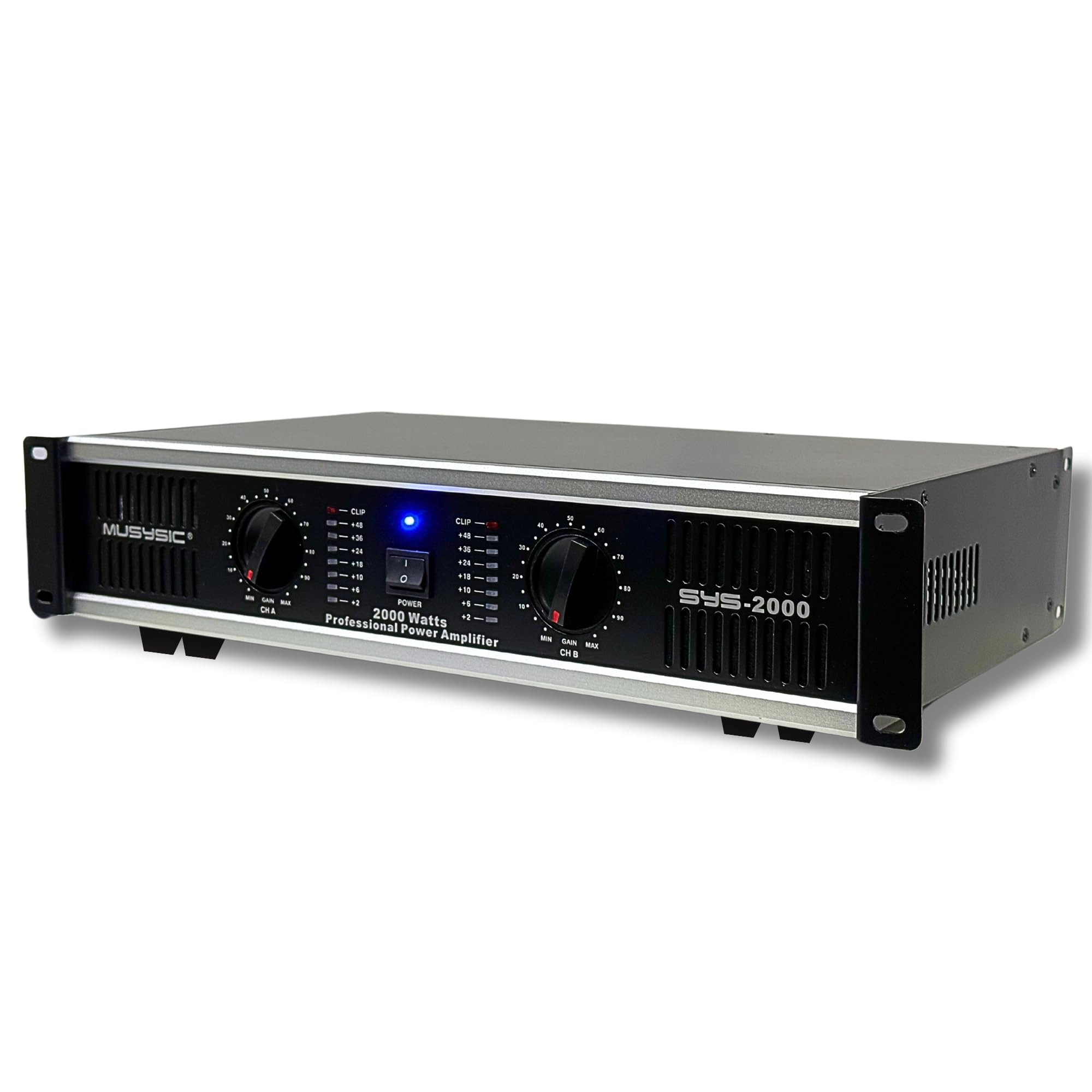
1. MUSYSIC SYS-2000 Power Amplifier 2000 Watts 2 Channel PA Amplifier
Our pick — 4.5★ from 350+ verified ratings; the strongest balance of quality and price.
The install amp that church techs and DJs keep reaching for — pro inputs, honest rack fit, real-world reliability.
The MUSYSIC SYS-2000 is a 2000W peak, 2-channel professional amplifier built into a 2U rack-mount chassis, which means it bolts straight into a standard pro-audio rack at a fixed height. It carries XLR inputs and 1/4-inch inputs, the two connector types mixers and DJ controllers actually output, so you can run it straight from a board without adapter clutter. Its ATR Technology is designed to respond fast to demanding bass transients, giving you a punchy low end instead of a muddy one.
What wins people over is the value angle. Owners say the SYS-2000 performs like a pricier amp, and one buyer reports it filling a 100+ seat church sanctuary with clear, crisp sound. Yes, it is rated 2000W, but staying within rated limits is the discipline buyers repeat: the amp rewards you for reading the manual and not pushing it to the max. The SYS-2000’s trick is its 0.77V input sensitivity, which lets it turn a weak mixer signal into loud, low-noise output.
Buyers report mixed feelings on fan noise: some praise the quiet fan, while others find the fans on the loud side — the difference usually depends on how close you sit to the rack. That is only a small slice of what people notice, though, and most of the conversation centers on the value and the sound quality.
What Earns Its Keep
- 2U rack chassis drops straight into a standard pro-audio cabinet with no adapter kit.
- XLR and 1/4-inch inputs match mixers, DJ controllers, and preamp gear directly.
- 0.77V input sensitivity boosts weak source signals into loud, low-noise output.
- 0.1% THD keeps distortion low even at high volume, so vocals stay clean.
Sized Caveat
- Fan noise is a mixed read — fine for a live room, less ideal in a near-silent studio.
- The 2000W figure is peak power, so plan around its continuous headroom, not the headline.
- At 13 pounds, it is a permanent fixture, not a grab-and-go rehearsal amp.
Best fit: Permanent PA, church, and DJ installs where XLR inputs and a rack-mount chassis earn their keep.
Think twice if: you need a portable unit or run sources that expect low-level RCA inputs.
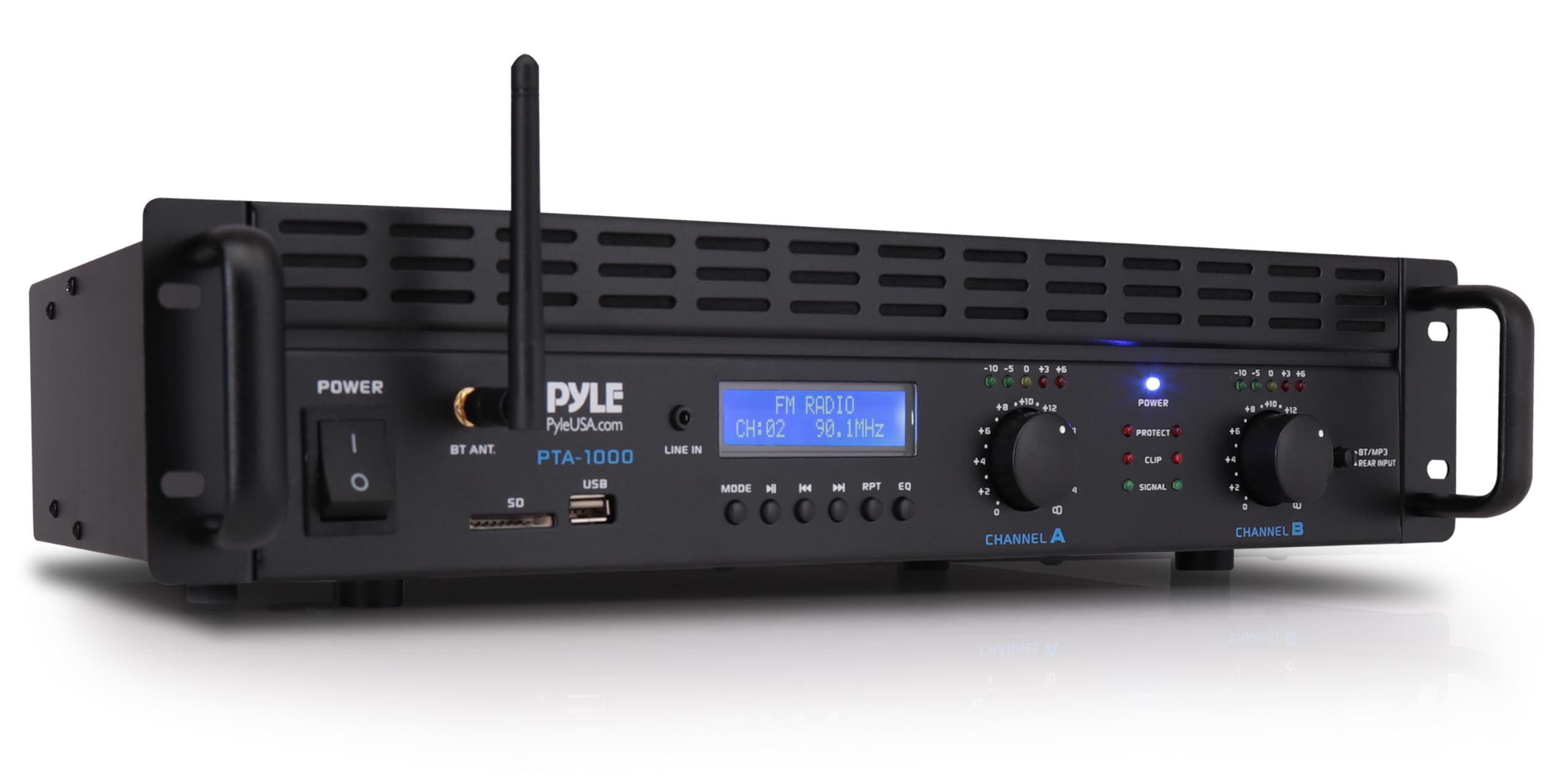
2. Pyle 2-Channel Rack Mount Power Amplifier with Bluetooth – 2000W Bridgeable PTA1000BT
A rack amp that streams straight from your phone — no mixer, no adapter, just Bluetooth to speakers.
For anyone who wants speakers armed without a full signal chain, the PTA1000BT is the flexible pick. It runs 2000W maximum power in bridged mode, or 1000W per channel in stereo, and it handles 4 to 8 ohm speaker loads. The real headline is the built-in Bluetooth chipset: it streams wirelessly from phones, tablets, and laptops, so you can run background music at a venue without a mixer in the chain. Around the back you get two 1/4-inch TRS jacks, two XLR jacks, three Speakon outputs, plus binding-post speaker terminals — enough connection types to cover almost any passive speaker you already own.
Owners find it quick to set up, and buyers running two tower speakers plus two mini speakers report more than enough power on tap. Its front panel carries an LCD screen and left/right channel level indicators with protect, clip, and signal LEDs, so you can watch exactly what the amp is doing in real time. The Bluetooth is the standout: it works reliably for most listeners, though the connection occasionally drops for a few. At roughly 7 pounds lighter than the MUSYSIC above, it is far easier to move between rooms.
The honest catch is consistency. A recurring theme in the reviews is that some units deliver clean, powerful sound while others develop a crackling noise or fade out over months — a small slice of an otherwise happy field, but a real one. If you want the safest long-term bet, treat this as a value pick and lean on it for stereo listening, not for driving cabinets near its limit. One buyer reports a unit that ran clean for seven months of light use, then went silent with the power still on.
The streaming edge: Bluetooth plus LCD metering makes this the easiest amp to run from a phone, and its Speakon outputs mean you skip loose wiring.
Where it asks for care: keep it well below the clipped ceiling and give it airflow — the crackle complaints cluster around hard use, not gentle stereo listening.
Reach for this if: you want Bluetooth wireless streaming and Speakon connectivity for a home or café speaker setup.
Look elsewhere if: you need a rugged, long-haul amp for high-load pro cabinets.
3. Rockville RXD-T2 Micro 2-Ch Class D Car Amplifier, 2400W Peak / 2x600W RMS

A compact car amp that runs cool for five seasons outdoors and still shakes the house.
The RXD-T2 does not lead with its wattage — it leads with verified output. This is a Dyno-certified Class D car amplifier rated at 2400W peak and 1200W RMS, with 600W x 2 channels at 2 ohms and 400W x 2 channels at 4 ohms. That continuous figure is the one that matters: 600 watts of real power per channel is enough to drive a serious subwoofer and keep the bass tight. Because it is a full marine-grade build, it resists moisture, saltwater, UV, vibration, and extreme temperatures, so the same amp that works in a car trunk also survives on a boat. Its 12dB/octave crossover, low pass and high pass filters from 50Hz to 250Hz, and 12dB bass EQ let you tune the sound precisely.
Owners run it hard and it takes it. One owner reports five seasons of outdoor use with the amp barely warming, and its Class D efficiency suits battery-powered systems. Bass is its language — buyers describe it pushing shallow-mount subs in a truck box and delivering raw output that punches well above its footprint. In the 2-ohm stable config, it handles multiple speakers without complaint.
What you should know: overheating turns up as a mixed note. Some owners mention it stays cool, while others find it runs warm under heavy loads — the same trade-off every high-output car amp carries. For most builds, proper mounting with airflow settles it. Compared to its sibling the Krypton-T2 below, this one leans toward continuous output the certified way, whereas the Krypton goes for a higher peak number. Pair it with a single 12-inch dual-voice-coil sub and it behaves.
Strong Points
- Dyno-certified 1200W RMS and 600W x 2 at 2 ohms — a continuous figure you can build a system around.
- Marine-grade build handles moisture, saltwater, UV, vibration, and temperature swings.
- 2-ohm stable with a 12dB/octave crossover and 12dB bass EQ for real tuning range.
- Compact footprint suits tight car and powersports installs.
Worth Noting
- Runs warmer under sustained high load — mount it with airflow clearance.
- RCA and high-level inputs only — it is a car amp, not a rack-mount PA.
Go for it if: you want a certified-power car or marine amp that endures heat and moisture without drama.
Pass on it if: your system lives in a rack and needs XLR connectors.
4. Rockville Krypton-T2 2 Channel Car Amplifier, 2800W Peak, 700W RMS

A Dyno-certified 2800W racket-maker with a built-in voltage display to watch your battery.
If you want hard-hitting sub-bass in your car, the Krypton-T2 is Rockville’s answer. It is a Dyno-certified 2-channel amp (Dyno-certified means an independent dyno test confirmed the output) rated 2800W peak and 700W RMS (RMS is the continuous power it can sustain), pushing 350W x 2 into 2 ohms, 215W x 2 into 4 ohms, or a full 700W x 1 when bridged (bridged means you combine both channels into one stronger channel). Where this unit stands apart from the RXD-T2 above is its layout: a built-in digital voltage display lets you watch the car’s electrical supply in real time, which is a genuine edge when you are pushing a subwoofer hard. Adjustable low pass of 50Hz to 250Hz (the range that feeds your sub), high pass from 60Hz to 1.2kHz (the range that feeds your speakers), and a 12dB bass boost give you room to shape the low end.
The Krypton-T2 uses Class A/B circuitry — a design known for clean, dynamic reproduction — with high-level inputs and auto-on so it can tap a factory head unit without adapters. One driver ran a single dual-voice-coil sub and reported cleaner, lower, cooler output than the two-sub setup it replaced. Another says it out-louded their previous lower-rated amp through Texas summer heat. It is built with protection circuitry, so it shuts down before it fully cooks.
The trade-off is real, though: this is a hot-running design by nature, and the recurring note is exactly that — under heavy load in hot climates, it can reach protection mode. Running it in winter, or with an added fan and mounted off a wooden spacer for airflow, keeps it well within its comfort zone. Compared with the RXD-T2’s certified power, this sibling leans on a spicier peak number and rewards careful installation. If you want to warm your cabin with bass and not your amp, give it breathing room.
The voltage display edge: watching your real-time supply on the amp itself is rare at this tier and helps you catch electrical strain before it hits a subwoofer.
The heat reality: Class A/B runs warmer than Class D, so mount it with airflow and do not run it near its limit in summer traffic.
Perfect for: drivers who want a tunable, certified-power amp with an on-board voltage readout for big-bass builds.
Not your amp if: you can only mount it in an enclosed, hot spot with no airflow.
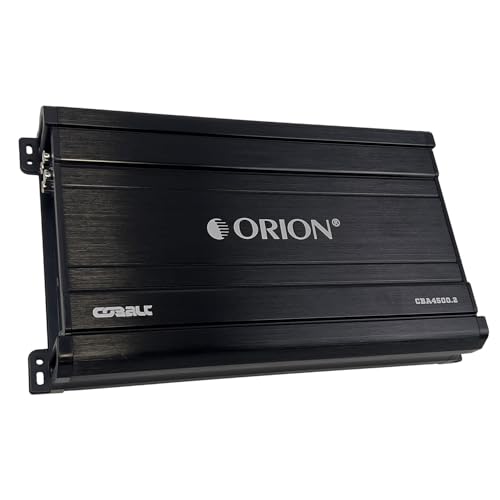
5. ORION CBA4500.2 Cobalt High Efficiency 2-Channel Class A/B Amp, 4500W
Built for speakers with a constant high-power appetite — the rated numbers tell only half the story.
The Orion Cobalt CBA4500.2 is a Class A/B amplifier designed to power car speakers with a continuous 2-ohm or 4-ohm load. Its real rating is the honest one: 300W RMS x 2 at 2 ohms and 125W RMS x 2 at 4 ohms, with a 4500W peak figure on the box. Its MOSFET power supply and low-level RCA inputs carry signals from a receiver to the amp, and the frequency response spans 10 to 30kHz. A low pass filter, high pass filter, bass boost, and 2-way protection circuitry round out the feature set, and it is FCC-specified and runs up to an 80 degree C operating temperature.
Where the Cobalt builds its reputation is on the 2-ohm side. The amp is engineered to hold a continuous low-impedance load without overheating or adding noise, which is exactly what constant-demand speakers need. Feed it a 2-ohm load and it delivers its full 300 watts per channel; drop it to 4 ohms and it settles to 125 watts per channel. The point is to match it to the right speakers, not to chase the peak number.
Here is the plainest caution on the list: the Cobalt asks a lot of you in the match. A recurring buyer note is that a poorly matched setup sends the amp into protection mode before it ever reaches its rating — which tracks with an amp that wants a specific 2-ohm load to sing. That is a fit issue, not a defect, but it is a real one. If you run it with the speakers it was designed for, it performs as it should; if you throw mismatched drivers at it, it will cut out.
Choose it if: your speakers present a steady 2-ohm or 4-ohm load and you want a Class A/B amp built to sit there without complaint.
skip it if: you want a forgiving amp that works with whatever speakers you happen to own.
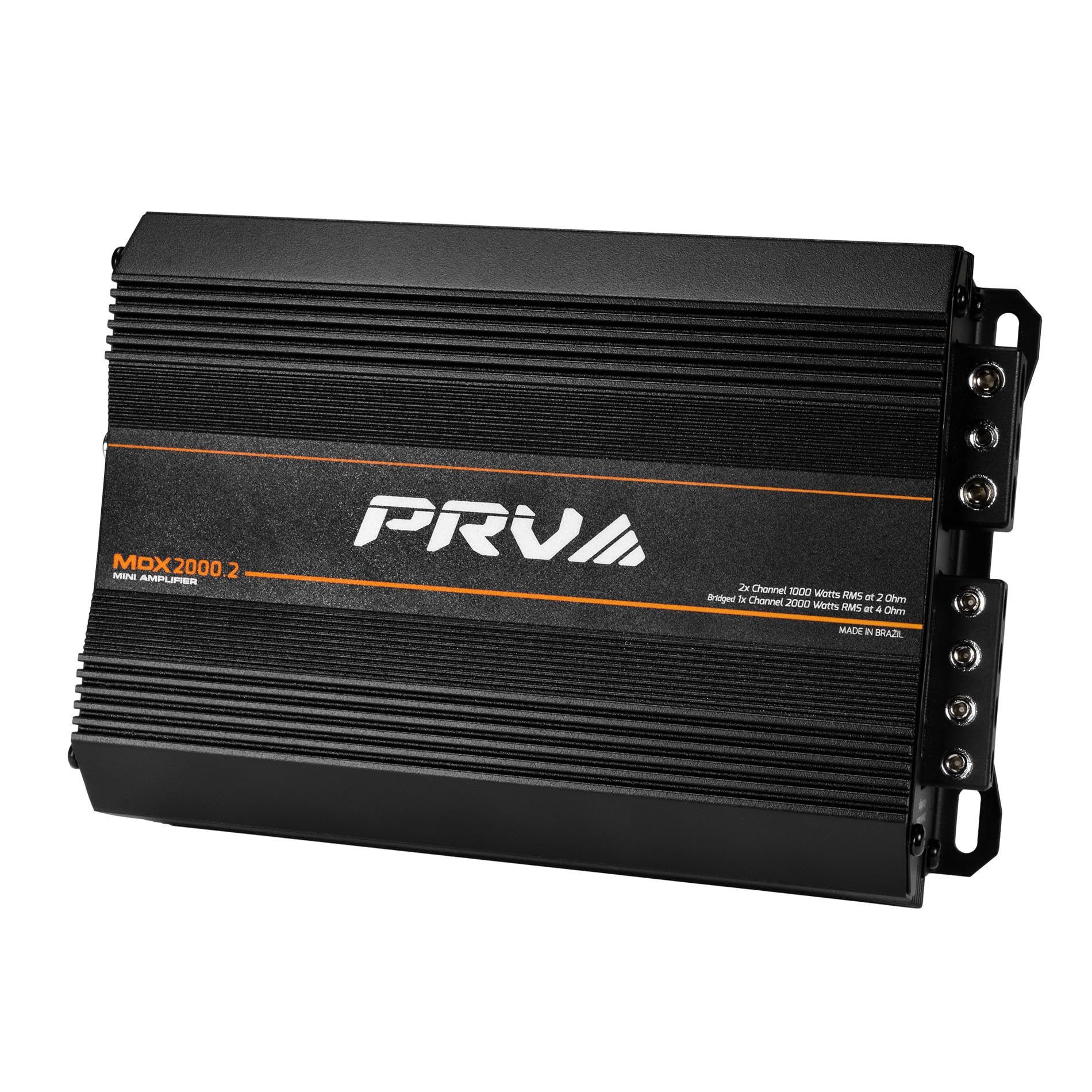
6. PRV Audio MDX2000.2 2 Ohm Mini 2 Channel Car Audio Amplifier, 2x 1000 Watts RMS at 2 Ohm
A pocket-sized true-RMS amp that turns a motorcycle fairing into a concert.
The MDX2000.2 earns its place on certified continuous power, not a peak number. It is a mini 2-channel car audio amplifier rated at 2 x 1000 watts true RMS at 2 ohms (RMS is the sustained power it can deliver), certified at full-range output — and it will deliver 1 x 2000 watts RMS into a 4-ohm load when bridged (bridged means both channels combine into one). That is the whole point: a small amp that puts genuine power behind your speakers. It uses Digital Class D Brazilian Technology (a switching amp design that runs cooler and more efficiently), which lets you wire multiple speakers and divide the power across channels. On a 2-ohm channel you can run 8x 8-ohm drivers or tweeters, four per channel in parallel.
The size is what makes this one special. The mini heavy-duty heatsink measures just 8.5 inches wide by 5.9 inches long and 2.6 inches tall, and weighs 4 pounds, so it slips into places a full-size car amp simply cannot go. That is why it is the pick of choice for motorcycle, ATV, and Slingshot builds. One rider fitted it to an Electra Glide Ultra with a factory head unit and aftermarket speakers and got “painful loud” results; another ran four 8-inch and four 6.5-inch speakers off it, with the built-in fans keeping heat down.
The catch to plan for is fitment — this is a specialist tool. It runs best with the right speaker match, and its RCA inputs mean it wants a proper source signal. If your install involves a factory head unit’s high-level output, you will want a line-level converter ahead of it. For the right project, though, nothing else at this footprint delivers the same continuous output.
what separates it
- 2 x 1000W true RMS at 2 ohms, with 1 x 2000W bridged at 4 ohms when you need one big channel.
- 4-pound, 2.6-inch-tall chassis fits motorcycle fairings and tight powersports spaces.
- Digital Class D design lets you run eight 8-ohm drivers, four per channel, in parallel.
- Built-in fans keep it cool in enclosed installs.
Before You Buy
- RCA inputs only — a factory high-level source needs a line converter.
- Mini footprint frees space but offers less surface area for heat shedding than a full-size body.
Made for: motorcycle, ATV, and powersports builds where a full-size amp will not fit but real RMS power will.
Not ideal for: rack-mounted home or PA systems that need XLR connectivity.
7. Rockville D14 2-Channel Class D Pro/DJ Rack Mount Power Amplifier

A 10-pound DJ amp with a true 2000W RMS rating — the closest thing here to the number you searched.
Inside live-sound and DJ circles, this is the pick that most closely matches a true 2000-watt 2-channel amp expectation. The D14 is a Class D pro amplifier rated 7000W peak and 2000W RMS, delivering 1000 watts x 2 at 4 ohms of continuous power for passive speakers and subwoofers. Its 10.14-pound weight and compact 1.5U rack-mount chassis mean you can carry it to a gig and rack it on arrival without breaking your back. Stereo, parallel, and bridged mono modes let it adapt to different setups, and a built-in limiter prevents distortion before it reaches your speakers.
The control set is where a working DJ feels the difference. Its LCD screen shows per-channel volume in decibels and the unit’s temperature, so you can keep an eye on heat mid-set. The crossover switch offers bypass, 80Hz, or 160Hz, letting you run full-range speakers or send only lows to a sub. Combo XLR/1/4-inch inputs, Speakon and binding-post outputs, plus short circuit, thermal, and DC overload protection round it out. Owners describe it as a lightweight system that is easier to move than the heavier options it replaces.
The honest read on the D14 is that its strength is its headroom. Buyers who back their gains off get clean, dynamic sound that plays loud for outdoor gigs; the loudest, most distorted edge of the dial is not where this amp is happy. Noise at low volume is a mixed note, and the fan is audible in a quiet studio but a non-issue on a live stage. This is a working amp, not a living-room nuisance.
Where it earns its keep: true 2000W RMS, per-channel dB metering, and a rack-mount chassis at barely 10 pounds makes it a live-gig workhorse.
The honest limit: the top of the dial is not the balance — run it with headroom (leave some power in reserve) and it stays clean and controlled.
Right choice for: DJs and live-sound operators who rack their gear and want genuine continuous power that travels light.
Wrong choice for: quiet home listening, where the fan and low-level noise become noticeable.
Understanding the Specs
Peak vs RMS Power
Peak power is the momentary ceiling an amp can hit before it distorts. RMS is the continuous power it can hold cleanly, and it is the number your speakers live on. When you see “2000W peak / 700W RMS,” build your system around the 700W. That way your speakers never run past the point where the amp starts breaking up, and your bass stays tight instead of muddy.
Impedance and Bridge Mode
Impedance is the ohm load your speakers present, and a lower load draws more power but runs hotter. Bridging combines both channels into one stronger channel for a subwoofer, doubling output while raising the minimum impedance the amp can safely handle. Check that both your speaker load and your bridged load sit inside the amp’s stable range before you wire anything up.
Input Connectors
XLR and 1/4-inch TRS inputs are the pro-audio standard and carry a balanced signal that resists interference over long cable runs. RCA low-level inputs and high-level inputs are common on car amps, connecting to a receiver or a factory head unit. Matching the input type to your source saves you adapter clutter and keeps the signal clean.
Cooling and Mounting
Class D amps run cooler and more efficiently than Class A/B designs, while Class A/B amps often add warmth and a live feel. Fans and heatsinks decide how long an amp survives a long set or a hot trunk. Give any amp airflow clearance, and mount it off surfaces where heat cannot build up underneath.
FAQ
How much RMS power do I actually need from a 2000W 2-channel amp?
What is the difference between 2-ohm and 4-ohm loads on these amps?
Can I bridge a 2-channel amp to power a single subwoofer?
Which inputs work with a DJ mixer instead of a car head unit?
Do these amps overheat during long playback?
Is a peak rating of 2000W the same as true 2000W output?
How do I keep a rack-mount amp cool in a crowded rig?
Which of these works best for a motorcycle or powersports build?
Can I run multiple speakers off one 2-ohm channel?
Final Thoughts: The Verdict
For most buyers chasing a 2000 watt 2 channel amp, the MUSYSIC SYS-2000 is the pick to start with — its rack-mount build, XLR and 1/4-inch inputs, and 0.77V input sensitivity (how much signal the amp needs to reach full output) make it a natural fit for permanent PA, church, and DJ installs where reliability and connector compatibility matter more than a printed peak number. If you need the closest thing to a true 2000W RMS figure, the Rockville D14 delivers 2000W RMS at just over 10 pounds, ideal for working DJs and live sound. And for a car or marine setup, the Rockville RXD-T2 pairs a certified 1200W RMS output with a marine-grade, heat-resistant build that keeps playing. Whoever you pick, run it with headroom, give it airflow, and match your speakers to the RMS figure — that is what separates a clean, lasting system from a disappointing one. The MUSYSIC backs that up with 4.5 stars across 300+ ratings.
How We Picked
We do not accept paid placement. Every pick is matched to a real buyer and a real use-case; we do not hands-on test units.
Sources & Methodology
Specifications: manufacturer listings and product documentation. Review insights: verified customer reviews, as of September 2026. Pricing: not shown on this page (it changes often); check the current price via the retailer link.
As an Amazon Associate, Gadgets Feed earns from qualifying purchases. This does not affect which products we feature.