
Choosing a 2000 watt power station means deciding how much of your daily life you can keep running when the grid goes dark or the campsite has no hookup. These aren’t phone chargers — they are silent, fume-free alternatives to gas generators that can keep a refrigerator cold, power a CPAP machine through the night, or run power tools on a job site miles from an outlet. The hard part isn’t finding one; it’s finding the one whose battery chemistry, recharge speed, and port selection actually match your specific load list.
I’m Min — the co-founder and writer behind Gadgets Feed. I’ve spent hundreds of hours analyzing inverter specs, cycle life ratings, and real-world runtime data across the current market to separate the genuine workhorses from the overhyped battery packs.
After comparing capacity, inverter quality, and charging flexibility across eleven models, this guide delivers a clear verdict on the best 2000 watt power station for home backup, off-grid living, and mobile power needs.
How To Choose The Best 2000 Watt Power Station
The 2000-watt class is a sweet spot — enough power to run most household appliances and tools, yet still portable enough to move. The key is balancing three core specs: usable capacity in watt-hours, the inverter’s continuous and surge wattage, and the battery chemistry that determines how many years the unit will last.
Battery Chemistry and Cycle Life
Lithium Iron Phosphate (LiFePO4) is the gold standard for this category. It delivers 3,000 to 6,000 full charge cycles before dropping to 80% capacity, which translates to 8 to 17 years of daily use. Older NMC (Nickel Manganese Cobalt) chemistries offer slightly higher energy density but degrade faster and carry higher thermal runaway risk. Every unit in this guide uses LiFePO4 — the only real question is cycle count.
Inverter Type and Surge Capability
A pure sine wave inverter is non-negotiable for sensitive electronics like laptops, medical devices, and variable-speed refrigerators. The steady 2000W continuous rating covers most needs, but the surge rating — typically 3000W to 4800W — determines whether your fridge’s compressor startup or a circular saw’s initial draw trips the unit. Look for “power lifting” or “X-Boost” modes that extend usable output for short bursts.
Recharge Speed and Input Flexibility
Fast AC recharge (0-80% in under 90 minutes) is a major quality-of-life advantage. Solar input wattage determines how quickly you can replenish off-grid. Top-tier units accept 800W to 2600W of solar, and some support hybrid AC+DC charging that cuts total recharge time in half. Dual charging is the single best feature for emergency preparedness.
Quick Comparison
On smaller screens, swipe sideways to see the full table.
| Model | Category | Best For | Key Spec | Amazon |
|---|---|---|---|---|
| BLUETTI AC200L | Mid-Range | Expandable Home Backup | 2048Wh, 2400W Out, 8192Wh Max | Amazon |
| EF ECOFLOW DELTA 3 Max | Mid-Range | Fast Recharge & App Control | 2048Wh, 3400W X-Boost | Amazon |
| BLUETTI Elite 200 V2 | Mid-Range | Longest Lifespan | 2074Wh, 6000+ Cycles | Amazon |
| Anker SOLIX F2000 | Mid-Range | Transportable Design | 2048Wh, 2400W Out | Amazon |
| Jackery Explorer 2000 v2 | Mid-Range | Lightest 2kWh Unit | 2042Wh, 39.5 lbs | Amazon |
| OUPES Mega 1 | Budget | Solar Kit Value | 1024Wh, 36 Min AC Fast Charge | Amazon |
| AFERIY P210 | Budget | Quiet Operation | 2048Wh, 2400W Out, < 30dB | Amazon |
| DABBSSON 2000L | Budget | Compact Build | 2048Wh, 41 lbs, Semi-Solid Cells | Amazon |
| GROWATT HELIOS 3600 | Premium | Whole-House Ready | 3600Wh, 7200W Parallel, 36kWh Max | Amazon |
| Jackery HomePower 3000 | Premium | Lightest 3kWh System | 3072Wh, 3600W Out, 59.5 lbs | Amazon |
| EF ECOFLOW DELTA Pro 3 | Premium | Ultimate Whole-Home | 4096Wh, 120/240V, 48kWh Expand | Amazon |
In‑Depth Reviews
1. BLUETTI AC200L Portable Power Station

The AC200L delivers 2400W continuous output with 3600W Power Lifting surge, making it one of the most capable units in the mid-range tier. BLUETTI’s proprietary 2400W AC input charges the 2048Wh LFP battery from 0-80% in just 45 minutes — a speed that rivals units costing significantly more. The 30A RV port is a rare find at this price level, enabling direct connection to an RV’s existing distribution panel without a bulky adapter.
Expansion is where this unit shines. You can connect up to four separate battery packs (B300K, B210, B300, or B230) to push total capacity to 8192Wh, which translates to over two days of running a full-size refrigerator, lights, and a modem. The <10ms UPS transfer keeps sensitive electronics online during grid flickers, and the 1200W solar input means a full recharge from four 300W panels in under two hours of direct sun.
At 61.4 pounds, it’s not a lightweight, but the compact 16.5-inch footprint and integrated handles make it manageable for rolling from garage to backyard. The audio feedback on button presses is a minor ergonomic annoyance, but the sheer versatility of ports — including a 48V/8A DC port for direct RV battery charging — cements this as the most well-rounded choice for buyers who want both home backup and RV capability from one unit.
Why it’s great
- 45-minute 0-80% AC recharge is among the fastest in its class
- Expandable to 8192Wh with multiple battery options
- Built-in 30A RV outlet eliminates external adapters
Good to know
- Heavier than some 2kWh competitors at 61.4 lbs
- Proprietary AC power cord may be hard to replace if lost
2. EF ECOFLOW DELTA Pro 3 Portable Power Station

The DELTA Pro 3 redefines what a portable power station can be by delivering native 120V and 240V split-phase output from a single unit — no parallel kit required. With a 4096Wh LFP battery and 4000W continuous output (6000W with X-Boost), this is the only unit in this guide that can run a 3-ton central air conditioner or a 1 HP well pump directly. The 2600W solar input across two ports enables a full recharge in under 2.5 hours with adequate panels.
Expandability is extreme: you can daisy-chain up to 48kWh of extra batteries, plus integrate the Smart Home Panel 2 for automatic whole-house transfer switch functionality. The IP65-rated battery pack with CTC (Cell-to-Chassis) design is automotive-grade, meaning it resists dust and water splashes better than any competing unit. X-Quiet technology keeps noise at 30 dB during light loads — quieter than a library.
The 115-pound weight is a genuine obstacle for single-person transport, though the integrated handle and dolly-compatible base mitigate it somewhat. Some users report the mobile app requires internet connectivity for certain settings, which is a concern during off-grid emergencies. For homeowners who need true whole-house backup without installing a massive standby generator, the DELTA Pro 3 is the undisputed champion.
Why it’s great
- Native 120/240V split-phase output runs heavy appliances
- IP65-rated battery pack for dust and water resistance
- Scalable to 48kWh for multi-day whole-home backup
Good to know
- Very heavy at 115 pounds, requires two people or a cart
- Some advanced settings require app connection
3. BLUETTI Elite 200 V2 Portable Power Station

The Elite 200 V2 packs 2074Wh and a 2600W inverter (3900W Power Lifting) into a footprint that is 40% smaller than the AC200L. BLUETTI achieved this density with CNAS-certified automotive-grade LFP cells rated for 6000+ cycles to 80% capacity — that’s a 17-year lifespan under daily use. The HyperWatt technology delivers 2600W continuous output, enough to run a microwave, coffee maker, and hair dryer simultaneously without hitting the inverter ceiling.
Standby power consumption is just 10W — three times lower than the category average — which means the battery lasts longer between charges when used as a UPS. The three charging modes (Turbo at 1800W, Standard at 1440W, Silent at 800W) let you trade speed for noise: Silent mode runs at 16-30 dB, quieter than a bedroom fan. Dual AC+DC charging fills the battery from 0-80% in 50 minutes.
The lack of a 30A RV port is a notable omission for RV users, and the 53.4-pound weight is middling for the capacity. Still, the combination of industry-leading cycle life, compact size, and sub-1-hour recharge makes the Elite 200 V2 the smartest long-term investment in the mid-range bracket.
Why it’s great
- 6000+ cycles provide up to 17 years of daily use
- 10W standby consumption minimizes wasted energy
- Silent charging mode at 16-30 dB for bedside use
Good to know
- No 30A RV outlet for direct RV connection
- Heavy for its size at 53.4 lbs
4. EF ECOFLOW Portable Power Station DELTA 3 Max
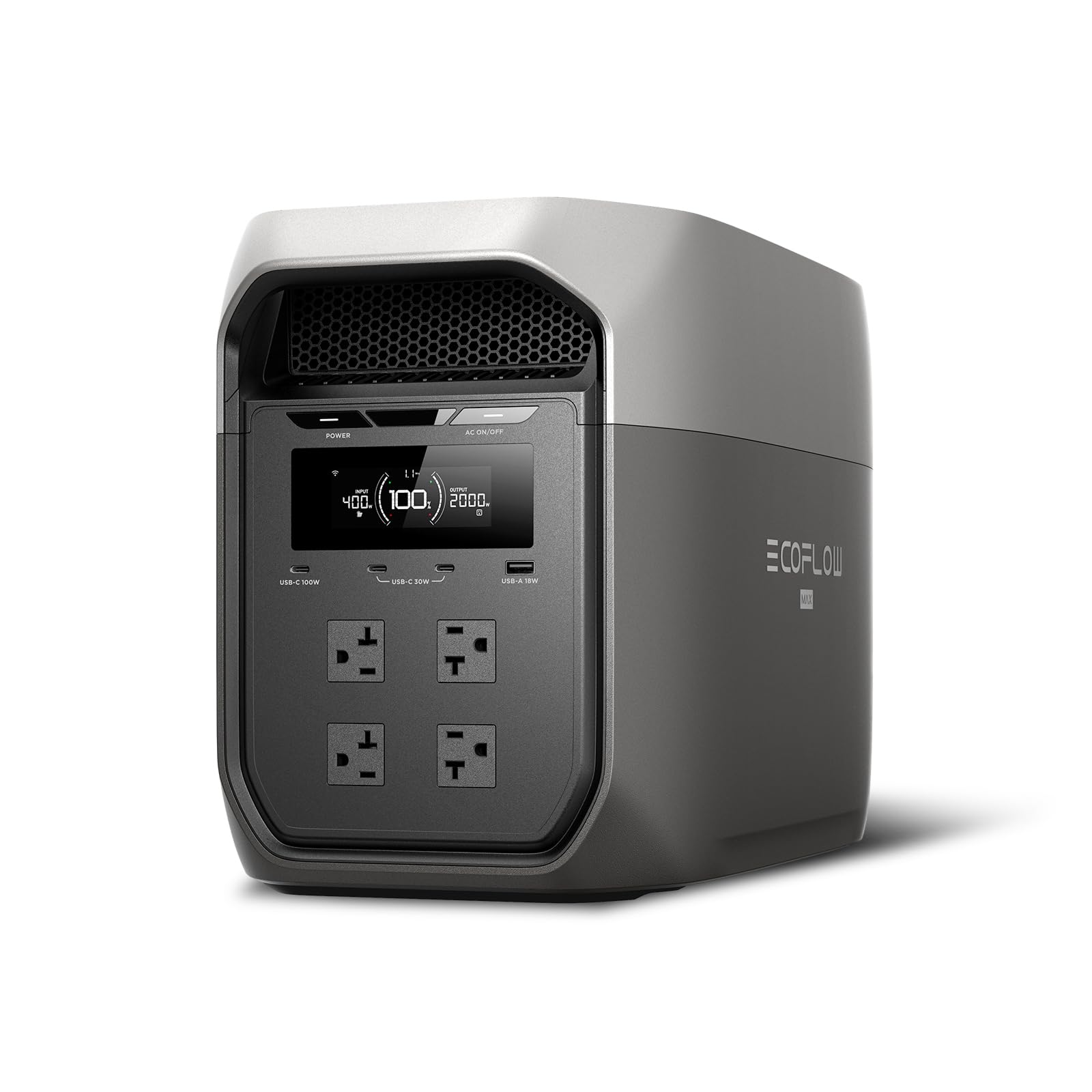
The DELTA 3 Max combines a 2048Wh LFP battery with EcoFlow’s X-Stream charging technology that refills 0-80% in just 1.13 hours. The 3400W X-Boost mode extends the continuous inverter headroom to cover 99% of household appliances, including high-draw items like a 1500W space heater while simultaneously charging a laptop and running a mini-fridge. The dual-handle design and 9.4-inch depth make it easier to carry than many 2kWh units despite its 19-inch height.
The <10ms UPS transfer time protects sensitive electronics like NAS drives and gaming PCs from the briefest grid interruption. Storm Guard mode in the app monitors weather alerts and automatically charges the battery to 100% before an anticipated outage — a proactive feature that competitors are only beginning to match. The XT60i solar input support enables faster charging from higher-voltage portable panels.
Button readability in low-light conditions is a minor complaint from users, and the lack of a 30A RV port limits its appeal for large RV setups. For urban homeowners and remote workers who prioritize fast recharge speed and seamless app integration over expandability, the DELTA 3 Max is the most polished all-in-one package.
Why it’s great
- 0-80% AC recharge in just 68 minutes
- 3400W X-Boost covers virtually all appliances
- Storm Guard proactively pre-charges before outages
Good to know
- Buttons are difficult to see in low light
- No direct 30A RV output port
5. Anker SOLIX F2000 Portable Power Station

The SOLIX F2000 (also sold as the PowerHouse 767) stands out for its InfiniPower technology, which blends GaN transistors with a long-life LFP battery rated for 3000+ cycles. The 2400W inverter handles most loads cleanly, and SurgePad allows high-wattage devices up to 3600W to start without tripping the system. The integrated telescoping handle and wheels make this one of the easiest 2kWh units to move — a major advantage for anyone who needs to roll the station from garage to campsite.
HyperFlash AC input delivers 0-80% charge in just 1.4 hours, putting it among the fastest in this tier. The 12-device port array includes an RV port, four AC outlets, three USB-C ports (two at 100W, one at 60W), and two car outlets. The 5-year full-device warranty exceeds the industry standard by two years, reflecting Anker’s confidence in the GaNPrime power architecture.
At 67.2 pounds, the F2000 is heavy but the wheel system compensates far better than any strap or handle on lighter units. Some users note that the UPS mode limits AC output to 1440W in bypass, which is an important caveat if you plan to run it as a whole-home UPS. For van-lifers and RVers who prioritize mobility without sacrificing capacity, this is the easiest unit to live with daily.
Why it’s great
- Wheels and handle make transport effortless
- HyperFlash charges 0-80% in 1.4 hours
- 5-year full-device warranty is best in class
Good to know
- Heavy at 67.2 pounds despite wheels
- UPS bypass limits output to 1440W
6. Jackery Explorer 2000 v2 Portable Power Station

The Explorer 2000 v2 is the lightest 2kWh power station on the market at just 39.5 pounds, thanks to Jackery’s CTB (Cell-to-Body) technology borrowed from EV manufacturing. This design integrates the battery cells directly into the structural frame, reducing weight by 41% and volume by 34% compared to typical 2kWh units. Despite the weight savings, the 2200W pure sine wave inverter and 2042Wh LFP battery provide genuine 2kWh-class runtime.
AC fast charging hits 0-80% in 66 minutes, and Emergency Super Charging mode (activated via app) achieves a full charge in 102 minutes. Silent Charging mode keeps noise below 30 dB while still delivering a full charge in 5 hours — ideal for overnight charging in a bedroom or RV. The <20ms UPS transfer is UL1778 certified, making it one of the few units with formal UPS certification for sensitive electronics.
The solar barrel ports are a slight weak point — users report the connectors flex inward when cables are inserted, which could lead to long-term wear. The lack of a 30A RV port and limited expandability (no extra battery support) are notable trade-offs for the size reduction. For solo campers, van dwellers, and apartment dwellers who need to carry their power station up stairs, the Explorer 2000 v2 is the most physically manageable 2kWh option available.
Why it’s great
- Lightest 2kWh unit at 39.5 lbs
- UL1778 certified UPS for sensitive electronics
- Silent Charging mode at <30 dB for overnight use
Good to know
- Solar barrel ports feel fragile when plugged in
- No expandability or 30A RV port
7. OUPES 2000W Solar Generator with Panels Included
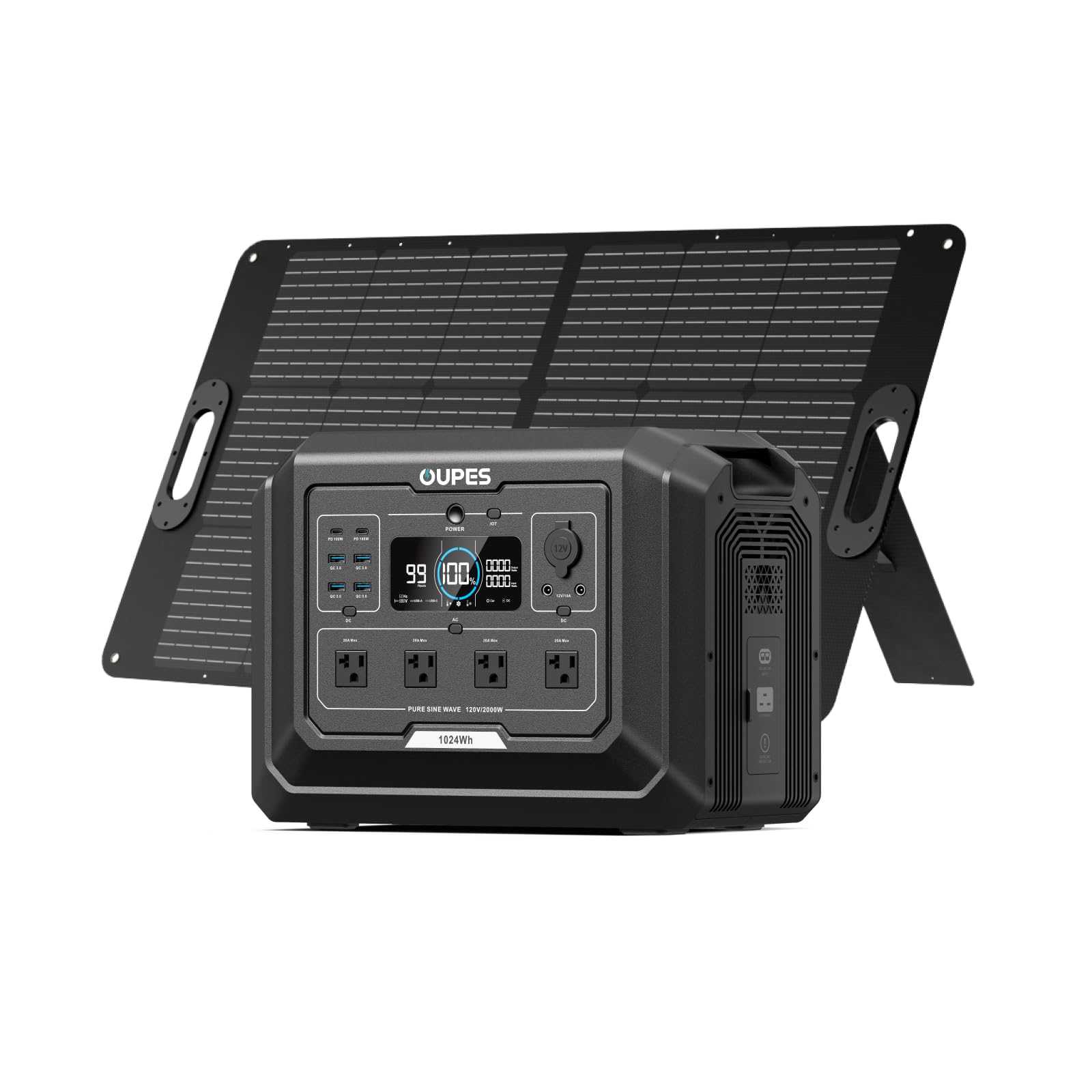
The OUPES Mega 1 enters the 2000W class with a 1024Wh battery that is smaller than the 2kWh competitors, but its 2000W pure sine wave inverter (4500W surge) matches the heavy-lifting capability of far larger units. The headline feature is the 36-minute 0-80% AC recharge time — the fastest in this entire guide — achieved through OUPES’s high-current charging architecture. The included 100W monocrystalline solar panel provides genuine out-of-box solar capability for campers who don’t want to make a second purchase.
The LFP battery is rated for 3500+ cycles to 80% capacity, which provides roughly 10 years of weekly usage. Capacity is expandable to 5120Wh by adding two B2 extra batteries, allowing the system to grow as needs evolve. The 13-port array includes dual 100W USB-C PD ports for laptop charging and four 120V AC outlets, plus an <20ms UPS mode for critical home backup.
At 27.8 pounds, this is the lightest unit in the guide by a wide margin, though the 1024Wh base capacity means it will run a refrigerator for roughly 8-10 hours versus 20+ hours from 2kWh units. The 100W included panel is adequate for trickle charging but slow for full replenishment — most users will want to add a larger panel later. For budget-conscious buyers who want 2000W output capability and are willing to trade runtime for portability and price, this is the most accessible entry point.
Why it’s great
- 36-minute 0-80% AC recharge is fastest in class
- Very lightweight at 27.8 lbs
- Includes 100W solar panel out of the box
Good to know
- Base 1024Wh capacity is half of 2kWh competitors
- Included 100W panel is slow for full recharge
8. AFERIY 2048Wh Portable Power Station P210

The AFERIY P210 delivers a full 2048Wh capacity with a 2400W inverter (4800W surge) in a package that produces just 16-30 dB during operation — quieter than a library or a whisper. The <10ms server-level UPS transfer is the fastest in this guide, making it ideal for sensitive medical equipment or NAS systems that cannot tolerate even a single cycle dropout. The 7-year extended warranty is industry-leading, covering the unit for two full years beyond most competitors.
The 16-port array includes six AC outlets, two USB-C (100W + 20W), two USB-A, two DC5521 ports, a car outlet, and a 300W XT60 port for fast solar or DC input. The AFERIY app provides real-time energy management and automation scheduling, allowing users to set charging windows during off-peak electricity rates. The pure sine wave inverter is used for both input and output, ensuring that the charging circuitry delivers cleaner power to the battery.
The 54-pound weight is average for this capacity, and the lack of a 30A RV port limits its use in large RVs without a separate adapter. A small number of users reported display issues after extended solar charging, though AFERIY’s responsive customer service resolved most cases quickly. For noise-sensitive environments like bedrooms, offices, and libraries, the P210 offers the quietest uninterrupted power experience in the 2kWh class.
Why it’s great
- Ultra-quiet 16-30 dB operation at normal loads
- <10ms UPS transfer is fastest in this guide
- 7-year extended warranty provides long-term peace of mind
Good to know
- No 30A RV outlet
- Some early units had display software issues
9. DABBSSON Portable Power Station 2000L
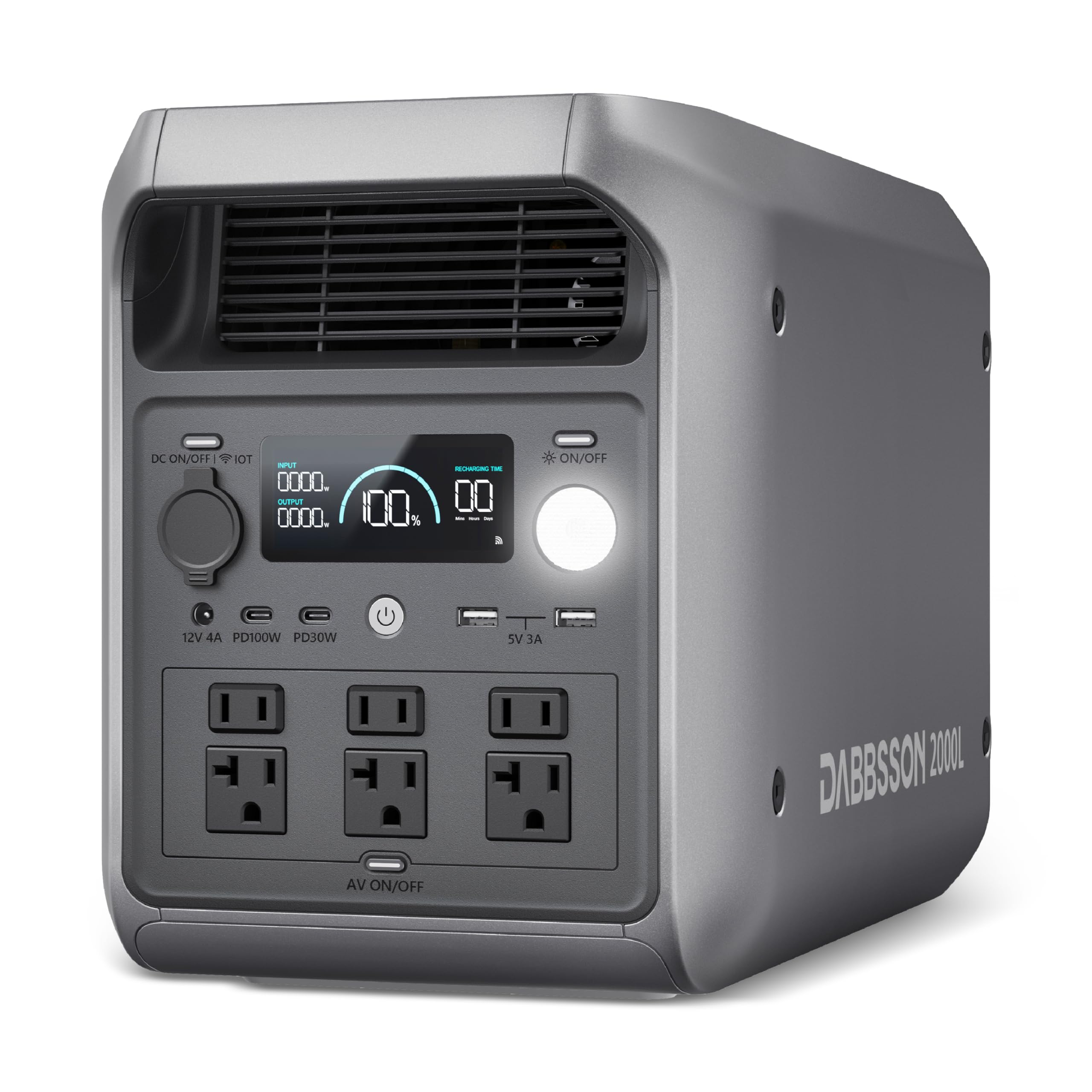
The DABBSSON 2000L uses advanced semi-solid state LiFePO4 cells that achieve 4000+ cycles to 80% capacity — a 25% improvement over standard LFP cells. The 2048Wh battery delivers 1.3x longer runtime per cycle than comparable units, according to DABBSSON’s internal testing, thanks to improved energy density and lower internal resistance. The 2200W inverter (3300W Power Boost) is paired with six AC outlets, making it one of the most outlet-rich stations in this class.
AC input charging at 2048W achieves a full recharge in just 1 hour, which is the fastest full charge time in the guide. The <10ms EPS transfer protects connected devices from power loss, and the UL94-V0 flame-retardant housing provides an extra layer of fire safety for indoor use. The Dabbsson App supports charging speed adjustment, schedule setting, and real-time monitoring via Wi-Fi and Bluetooth.
At 41 pounds, the 2000L is one of the lightest full-2kWh stations available, and its 11.2 x 18.3 x 8.9-inch footprint slides easily into tight spaces. Some users reported software issues with initial units that prevented full charge/discharge, though DABBSSON’s support team has been actively issuing firmware updates to address these. For buyers who prioritize runtime per cycle, fast recharge, and six AC outlets in a portable package, the 2000L is a compelling mid-range choice.
Why it’s great
- Semi-solid cell technology delivers 4000+ cycles
- Full recharge in 1 hour — fastest in this guide
- Only 41 lbs with 2048Wh capacity
Good to know
- Early units had software calibration issues
- Customer support responsiveness is inconsistent
10. GROWATT HELIOS 3600 Portable Power Station
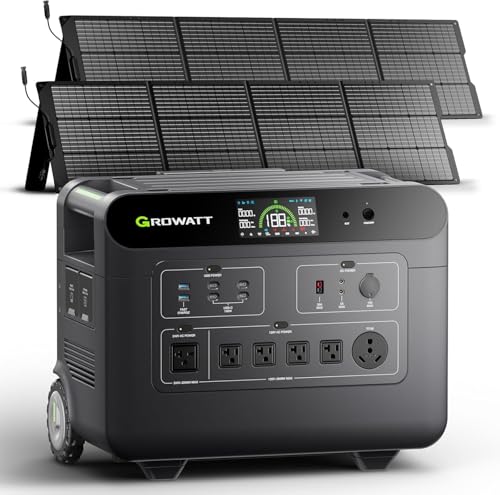
The HELIOS 3600 is built around a 3600Wh LFP battery and a 3600W continuous inverter (7200W surge when paired with a second unit for split-phase 240V). Growatt’s expertise in residential solar inverters is evident in the 99% MPPT efficiency — the highest solar conversion rate in this guide — which translates to faster off-grid charging than any competitor. The two included 200W solar panels provide immediate solar capability out of the box, and the 2000W maximum solar input enables a full recharge in roughly 2.5 hours under direct sun.
The <15ms EPS switch keeps critical loads running during outages, and the cold start technology allows operation at temperatures as low as -22°F, outclassing every other unit in this guide for winter and cold-climate use. Expandability is modular: you can parallel two units for 7200W 240V output or add expansion batteries to reach 36kWh — enough to power a typical home for 2-3 days without panel recharge.
The 149-pound weight with included panels is substantial, though the built-in handle and wheels improve manageability. The Bluetooth app has been reported as non-functional by some users, and the lack of a toggleable EPS mode means the unit always reserves some power for the transfer switch circuit. For homeowners in cold climates who need a solar-first system that can scale to whole-house backup, the HELIOS 3600 is the most technically capable option.
Why it’s great
- 99% MPPT efficiency maximizes solar harvest
- Operates reliably down to -22°F
- Expandable to 36kWh for whole-house backup
Good to know
- Very heavy at 149 pounds with panels
- Bluetooth app functionality is inconsistent
11. Jackery HomePower 3000 with 2X 200W Solar Panels
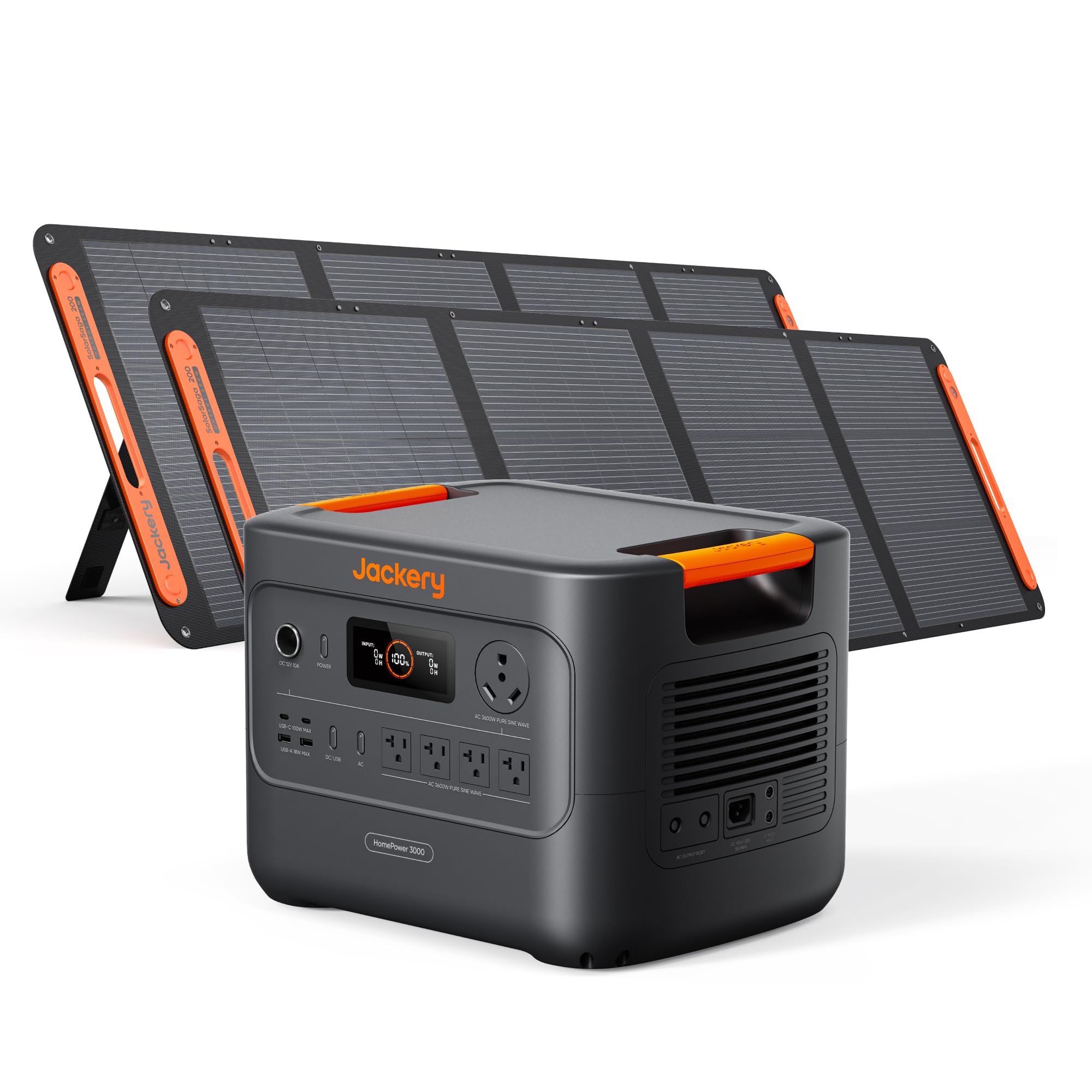
The HomePower 3000 is Jackery’s flagship home backup system, pairing a 3072Wh LFP battery with a 3600W inverter (7200W surge) and two 200W SolarSaga panels. At 59.5 pounds for the power station alone, it is the lightest 3kWh system on the market — 43% lighter than comparable 3kWh competitors — thanks to the same CTB technology found in the Explorer 2000 v2. The 7200W surge handles dual-appliance startup draws with ease, such as simultaneously starting a refrigerator compressor and a microwave turntable.
Hybrid AC+DC charging achieves a full recharge in 1.7 hours, while standalone AC charging takes 2.2 hours. The ChargeShield 2.0 AI algorithm adjusts charging current in real-time based on temperature and battery health, extending the LFP cells to 4000 cycles at 70% capacity retention. The built-in TT-30 RV port provides plug-and-play power for RVs, and the dual 100W USB-C PD ports charge two laptops simultaneously at full speed.
The <20ms UPS is UL certified, and the system can run a full-size refrigerator for 1-2 days while also powering lights, Wi-Fi, and a television. The lack of battery expandability is the most significant limitation — unlike the BLUETTI or GROWATT systems, you cannot add extra battery packs to increase runtime beyond the base 3072Wh. For homeowners who want one complete, ready-to-deploy system with solar panels included and don’t need future capacity upgrades, the HomePower 3000 delivers the best power-to-weight ratio in the premium tier.
Why it’s great
- Lightest 3kWh unit at 59.5 lbs
- Includes two 200W solar panels out of the box
- 7200W surge handles demanding startup loads
Good to know
- Battery capacity cannot be expanded
- Requires separate purchase of wheel kit
FAQ
Can a 2000 watt power station run a whole house?
What is the difference between LiFePO4 and NMC batteries in power stations?
How long does a 2000W power station take to charge from solar panels?
Final Thoughts: The Verdict
For most users, the best 2000 watt power station winner is the BLUETTI AC200L because it combines a full 2048Wh capacity with 2400W output, 45-minute fast charging, and expandability to 8192Wh at a price that undercuts premium-tier equivalents. If you prioritize absolute quiet and the fastest UPS transfer for sensitive electronics, grab the AFERIY P210. And for whole-home backup with 240V split-phase capability and 48kWh expandability, nothing beats the EF ECOFLOW DELTA Pro 3.