
Our readers keep the lights on and my morning glass full of iced black tea. As an Amazon Associate, I earn from qualifying purchases.
When the grid goes dark—whether from a hurricane, winter storm, or rolling blackout—a standard gas generator brings noise, fumes, and fuel logistics. A 2000Wh battery changes the game entirely: silent, emission-free, instantly available power for fridges, medical devices, and lights. But not all units deliver the same real-world runtime, recharge speed, or expandability.
I’m Min — the co-founder and writer behind Gadgets Feed. I’ve spent hundreds of hours analyzing battery chemistries, inverter topologies, charge controller specs, and real user feedback across dozens of portable power stations and server-rack batteries to separate marketing claims from genuine performance.
Whether you need emergency home backup, off-grid workshop power, or extended RV living, this guide cuts through the noise to find the right 2000wh battery for your specific energy needs.
How To Choose The Best 2000Wh Battery
Selecting the right 2000Wh-class battery involves balancing capacity, output power, recharge speed, and portability. Here are the four factors that matter most.
Chemistry and Cycle Life
LiFePO4 (LFP) is the gold standard today, offering 3,000 to 6,000 cycles before reaching 70-80% capacity retention. NMC cells pack more energy per pound but degrade faster under heavy cycling. For stationary backup or frequent use, LFP’s longer lifespan justifies the slight weight penalty. For ultralight camping, NMC may still appeal, but most serious units in this guide use LFP.
Inverter Output and Surge Capability
Continuous wattage determines what you can run 24/7. A 2000W inverter handles most refrigerators and space heaters, but large appliances like well pumps or air conditioners require 3000W+ of continuous output. Surge rating matters even more: motors can draw 3-5x their running wattage for a split second. Look for units with 6000W+ surge to avoid nuisance overload trips.
Recharge Speed
Fast AC recharging—under 2 hours from 0-100%—lets you top off between utility windows. Premium units like the EcoFlow Delta Pro 3 achieve 1800W AC input (0-80% in 50 minutes). Budget units may take 6-8 hours. If you rely on solar, high MPPT voltage (up to 150V) and amperage (up to 15A) dramatically shrink charging time in limited sun.
Expandability and UPS Features
Some stations allow daisy-chaining extra batteries to multiply capacity from 2kWh to 12kWh or more. This future-proofs your system if your needs grow. Also critical is a fast UPS mode (<20ms transfer) to keep computers and medical equipment running through brief flickers without rebooting.
Quick Comparison
On smaller screens, swipe sideways to see the full table.
| Model | Category | Best For | Key Spec | Amazon |
|---|---|---|---|---|
| EF ECOFLOW DELTA Pro 3 | Premium | Whole-home 240V backup | 4096Wh, 4000W output, 240V split-phase | $2,599.00$3,699.00Amazon |
| Anker SOLIX F3000 | Premium | 6000W pass-through charging | 3072Wh, 3600W output, expandable to 24kWh | $2,399.99Amazon |
| GROWATT HELIOS 3600 | Premium | Dual-unit 240V whole house | 3600Wh, 3600W output, 240V with parallel | $1,599.00$2,099.00Limited time dealAmazon |
| EF ECOFLOW Delta 3 Ultra | Premium | Silent operation at 25dB | 3072Wh, 3600W output, <10ms UPS | $1,399.00$1,699.00PrimeAmazon |
| Jackery HomePower 3000 | Mid-Range | Lightest 3kWh class at 59.5 lbs | 3072Wh, 3600W output, 59.5 lbs | $1,299.00Amazon |
| ABOK Ark3600 | Mid-Range | Budget 3840Wh expandable | 3840Wh, 3600W output, expandable to 11520Wh | $1,139.05$1,299.00Amazon |
| AFERIY 3840Wh | Mid-Range | Fast 1.5-hour AC recharge | 3840Wh, 3600W output, 1.5H charge | $1,169.00$1,299.00Amazon |
| Jackery Explorer 2000 v2 | Mid-Range | Lightest 2kWh with solar panels | 2042Wh, 2200W output, 39.5 lbs | $1,499.00Amazon |
| Anker SOLIX F2000 | Mid-Range | Wheeled transport and fast charge | 2048Wh, 2400W output, 0-80% in 1.4 hrs | $899.99$1,999.00Amazon |
| Generac GB2000 | Mid-Range | Brand trust and wireless charging | 2106Wh, 1600W output, 15W wireless pad | from $99.95Amazon |
| PECRON F3000LFP | Value | Highest capacity per dollar | 3072Wh, 3600W output, 1800W fast charge | $849.00Amazon |
| VPauexii 48V 400Ah Rack | Budget | 20.48kWh stationary solar storage | 20.48kWh, 48V, 6000+ cycles | $2,919.99Amazon |
| Vatrer 51.2V 100Ah (4-Pack) | Budget | 20.48kWh with free server rack | 20.48kWh, 51.2V, 5000+ cycles | $3,249.99Amazon |
In‑Depth Reviews
1. EF ECOFLOW DELTA Pro 3 Portable Power Station

The Delta Pro 3 stands alone as the only unit in this roundup that delivers native 120V/240V split-phase from a single chassis. With a 4096Wh LiFePO4 core, 4000W continuous output (6000W with X-Boost), and a 48kWh expandable ecosystem, it powers a 3-ton central AC or a 1 HP well pump without needing a second unit.
Its 1800W AC input (0-80% in 50 minutes) and 2600W solar input are class-leading. The IP65-rated CTC battery pack provides dust and splash resistance, while the 10ms UPS mode protects sensitive electronics. The EcoFlow app logs real-time stats and remote control, though some users report the app requires internet for certain charge limit changes.
At 115 pounds, it is heavy, but the integrated handle and wheeled base (sold separately or built into larger kits) make it manageable for garage-to-house moves. The lack of a dedicated 12V port is a minor annoyance for those wanting direct DC fridge operation.
Why it’s great
- True 240V split-phase from one unit
- Fastest AC recharge in class (0-80% in 50 min)
- Expandable to 48kWh
- IP65 battery protection
Good to know
- 115 lbs, no dedicated 12V port
- App requires internet for some settings
- High price point
2. Anker SOLIX F3000 with Expansion Battery
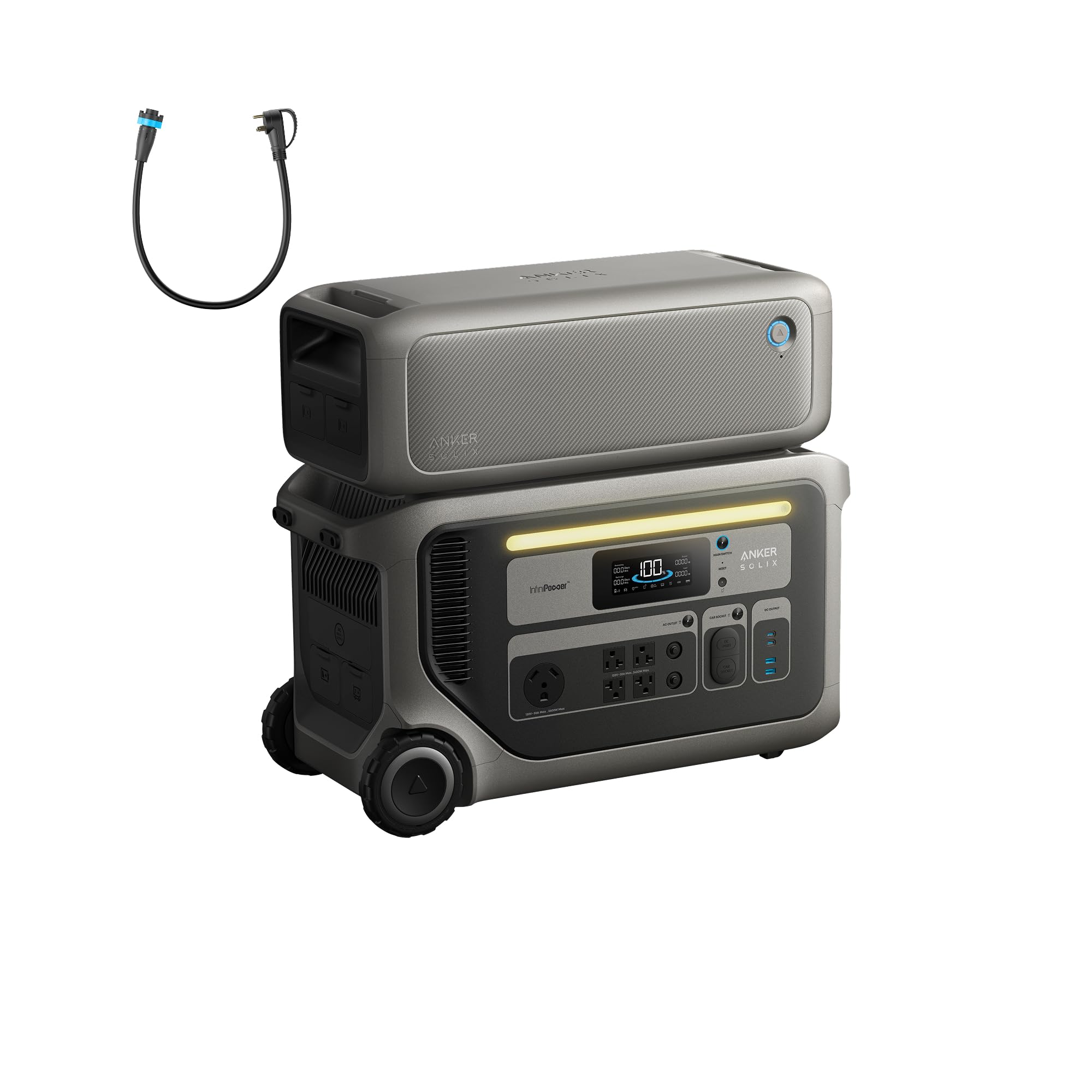
The F3000 comes as a bundle with one BP3000 expansion battery, giving you 6kWh out of the box—enough to run a 190W fridge for 42 hours. Its headline feature is 6000W of combined pass-through charging: you can plug a 120V gas generator and solar panels simultaneously without interrupting output to your loads.
Ultra-low idle consumption allows 125 hours of AC standby time—meaning the unit sips power when not actively supplying loads. Dual MPPT trackers (60V and 165V ports) accept a wide range of panel voltages. The 30A TT-30 RV outlet handles 13K BTU air conditioners easily, as reported by users.
Downsides include a retracting handle that feels slightly flimsy and a heavy overall package (~92 lbs with the expansion battery). The solar panels included in some bundles are bulky and difficult to deploy solo. The F3000 does not support 240V split-phase without pairing two units.
Why it’s great
- 6kWh starting capacity (bundle)
- 6000W pass-through charging
- 125-hour AC idle standby
- Dual MPPT solar inputs
Good to know
- ~92 lbs with expansion battery
- No 240V split-phase in one unit
- Solar panels are large and heavy
3. GROWATT HELIOS 3600 with 400W Solar Panel
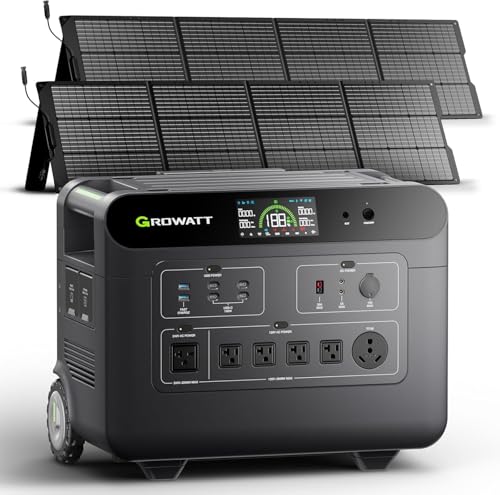
Growatt brings its residential solar inverter expertise into a portable package. The HELIOS 3600 delivers 3600Wh of LFP capacity with a 3600W inverter that can parallel two units for 7200W at 240V—enough for whole-house backup. A cold-start function keeps it operational down to -22°F, a rarity among portable stations.
The included 2×200W solar panels allow immediate solar charging out of the box, and the 2000W high-voltage MPPT input (99% efficiency) ensures fast replenishment. The app supports time-of-use scheduling to prioritize solar and cut electricity bills. User reports highlight reliable fridge runtime of 24–30 hours on a single charge.
At 149 pounds (with panels), it is the heaviest all-in-one kit. Bluetooth/Wi-Fi connectivity has been inconsistent for some users. The EPS mode runs continuously when plugged into a wall, which can trickle-drain if not managed via the app.
Why it’s great
- 240V split-phase via two-unit parallel
- Operates down to -22°F
- 2000W solar MPPT with 99% efficiency
- Includes two 200W solar panels
Good to know
- 149 lbs with solar panels
- Inconsistent Bluetooth/Wi-Fi
- EPS always on when plugged in
4. EF ECOFLOW Delta 3 Ultra with Transfer Switch
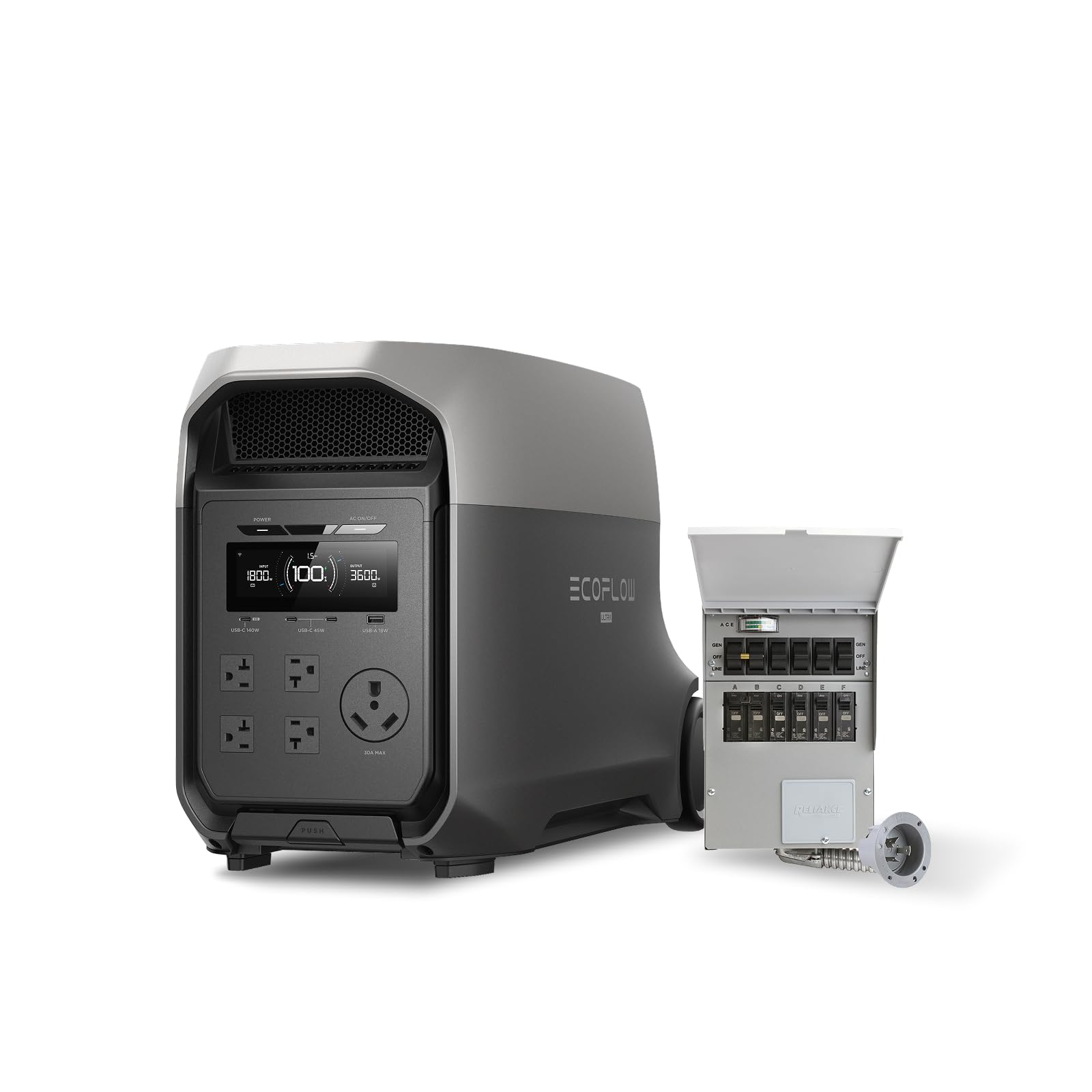
The Delta 3 Ultra uses X-Quiet 3.0 technology to achieve a near-silent 25dB under load—quieter than a library. This makes it ideal for overnight use in RVs or apartments where noise is a critical factor. It delivers 3600W continuous output (7200W surge) with a reliable 10ms UPS transfer.
Four input methods (AC, solar, car, smart generator) provide flexibility, and the included transfer switch enables hardwired home integration without a separate subpanel. The LiFePO4 cell structure is EV-grade, rated for 10 years of daily cycling. Users praise the build quality and quiet fan operation.
The 60V solar input limit (current limited) is lower than some competitors, which may restrict panel configurations. The unit ships in two boxes (station and transfer switch), which can cause confusion upon delivery.
Why it’s great
- 25dB whisper-quiet operation
- Included transfer switch for home integration
- 10-year battery lifespan
- 7200W surge capacity
Good to know
- 60V solar input limit
- Ships in two separate boxes
- Premium price
5. Jackery HomePower 3000
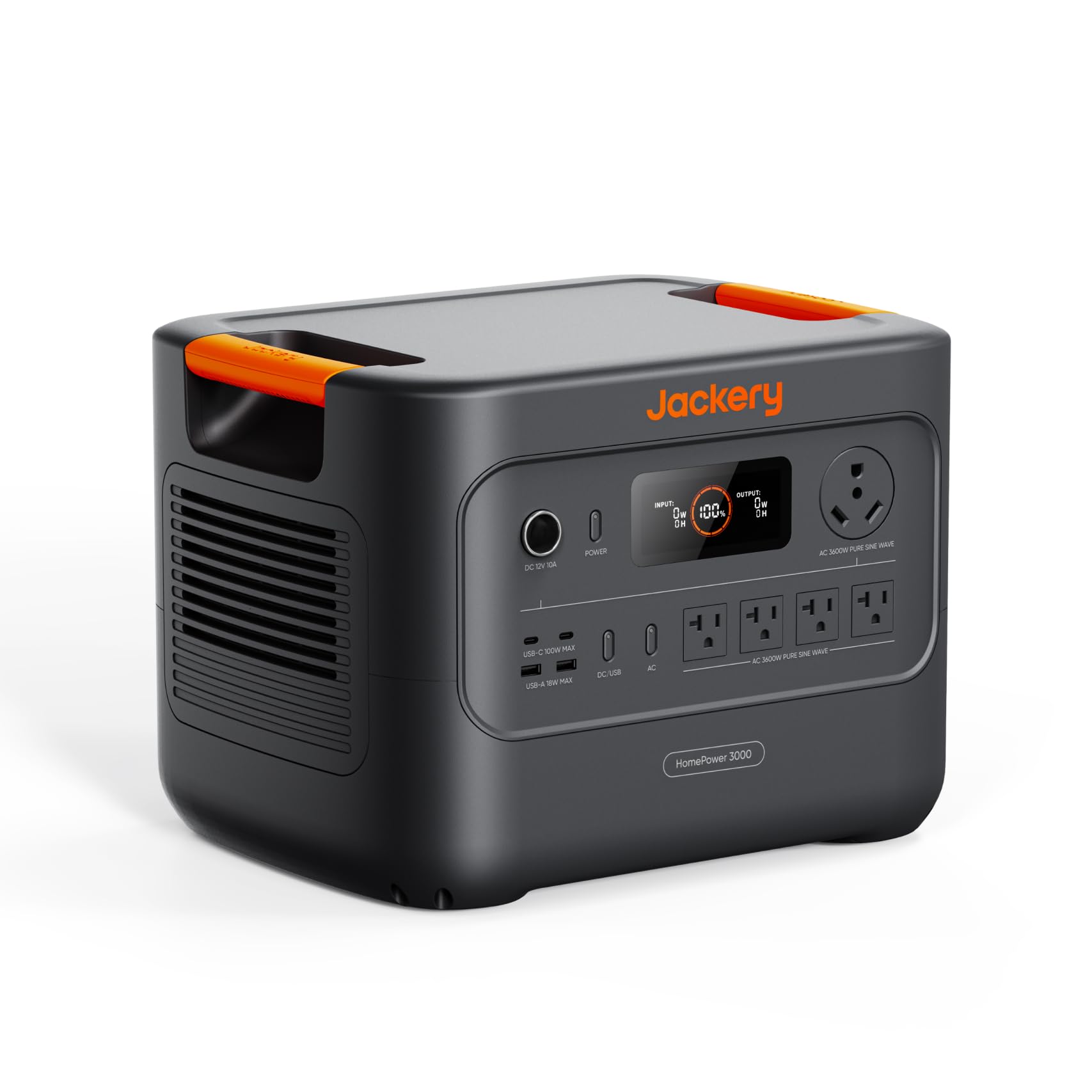
Jackery’s HomePower 3000 uses CTB (Cell-to-Body) technology to achieve an industry-leading weight of 59.5 pounds for a 3072Wh unit—43% lighter than similarly sized competitors. It delivers 3600W continuous output (7200W surge) and includes a TT-30 RV port for direct camper hookups.
ChargeShield 2.0 AI algorithms optimize charging speed and battery health, with hybrid AC+DC recharge reaching full in 1.7 hours. The LiFePO4 core is rated for 4000 cycles to 70% capacity. Users report dry camping 3+ days in a 30-foot travel trailer without air conditioning, running microwave, TV, and propane heater fans.
The 20ms UPS transfer meets UL1778 certification, but the warranty is only honored when purchased directly from Jackery—a critical caveat for Amazon buyers. The fan noise is noticeable (~60 dB) under heavy load.
Why it’s great
- 43% lighter than 3kWh class average (59.5 lbs)
- Hybrid AC+DC recharge in 1.7 hours
- 4000-cycle LFP battery
- Built-in TT-30 RV outlet
Good to know
- No warranty from Amazon purchases
- Fan noise ~60 dB under load
- 20ms UPS, not <10ms
6. ABOK Ark3600
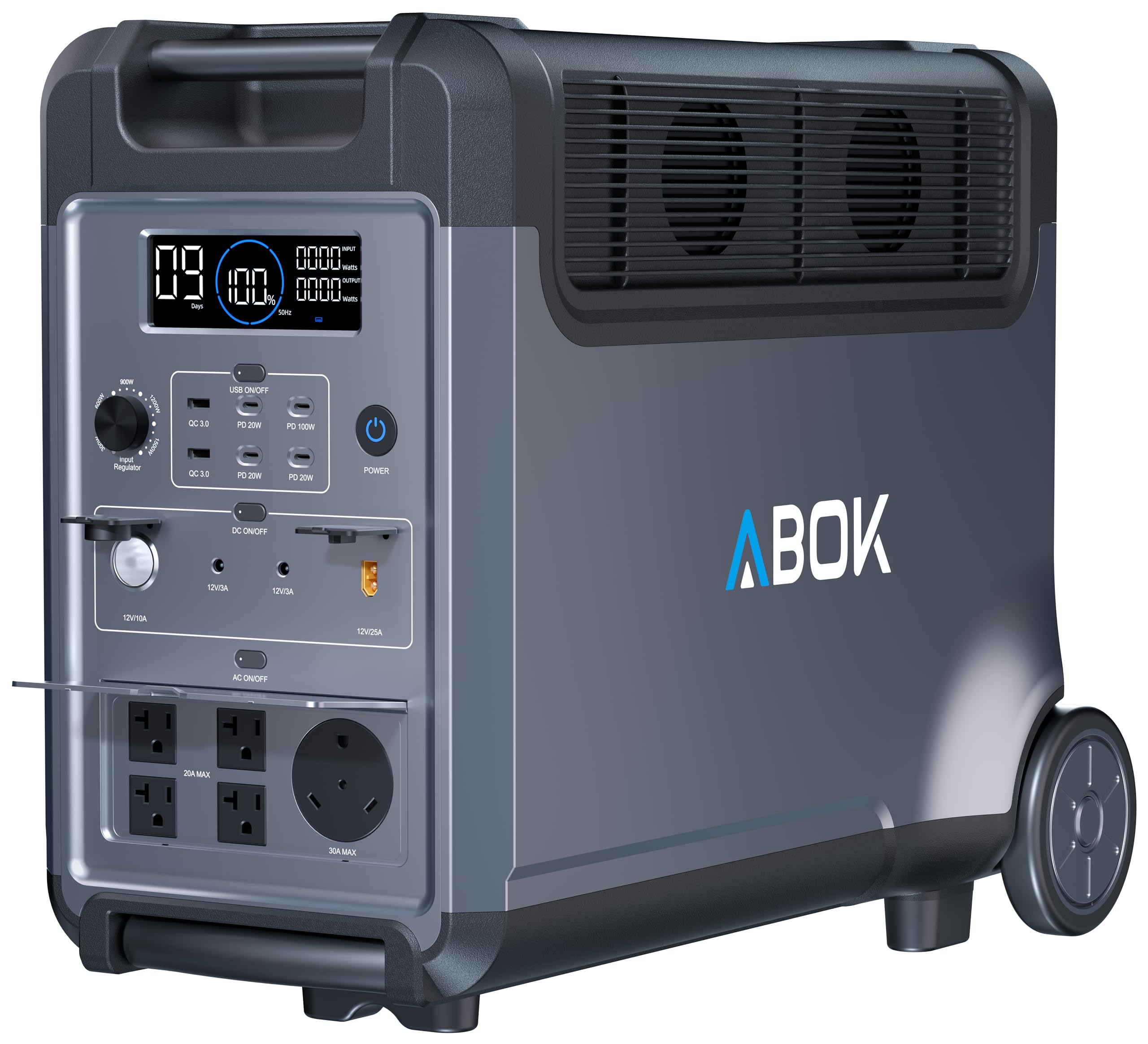
The Ark3600 packs a 3840Wh LFP battery with 3600W continuous output (4500W peak) and scales to 11520Wh via expansion packs. Its 15 output ports include a 30A AC outlet, three USB-C ports (one 100W PD), and an XT60 12V/25A output for high-current DC devices.
AC charging delivers a full charge in 3 hours, and combined AC+PV reduces that to 1.29 hours. The telescoping handle and durable wheels make the 92-pound unit easy to roll around. User reviews highlight its ability to simultaneously power a wet vacuum, heat gun, and SDS drill without tripping.
The Bluetooth app lacks solar/AC input split visibility, and the 120V-only output (no 240V) limits whole-house applications. Some units have shipped with cosmetic display issues, though customer support has been responsive in replacing them.
Why it’s great
- Large 3840Wh base capacity
- Expandable to 11520Wh
- 15 versatile ports including 30A AC
- Fast AC+PV charge (1.29 hours)
Good to know
- 120V only, no 240V output
- App lacks solar/AC split data
- Some cosmetic QC reports
7. AFERIY 3840Wh Portable Power Station

The AFERIY 3840Wh station combines a generous 3.8kWh capacity with one of the fastest AC-only recharge speeds in its class—a full 100% in just 1.5 hours. Its 3600W inverter (7200W peak) handles 99% of household appliances, and the <10ms UPS mode ensures seamless transitions for medical equipment or servers.
The unit ships with a pull handle, weighs 80.46 pounds, and offers 15 output ports. The smart app enables charging scheduling, light mode selection, and remote power-off. Users report reliable solar charging with 4×445W panels for off-grid RVs, keeping a fridge running continuously with intermittent fan and TV usage.
Some units arrived with non-functional displays out of the box, though customer support resolved these through replacement. The expansion capability to 11.5kWh works only with dedicated battery packs, not generic third-party batteries.
Why it’s great
- 1.5-hour AC full recharge
- 3840Wh base capacity
- <10ms UPS transfer
- 15 output ports
Good to know
- Display QC issues reported
- Proprietary expansion packs only
- 80.46 lbs, no wheels
8. Jackery Explorer 2000 v2 with 2x200W Solar Panels
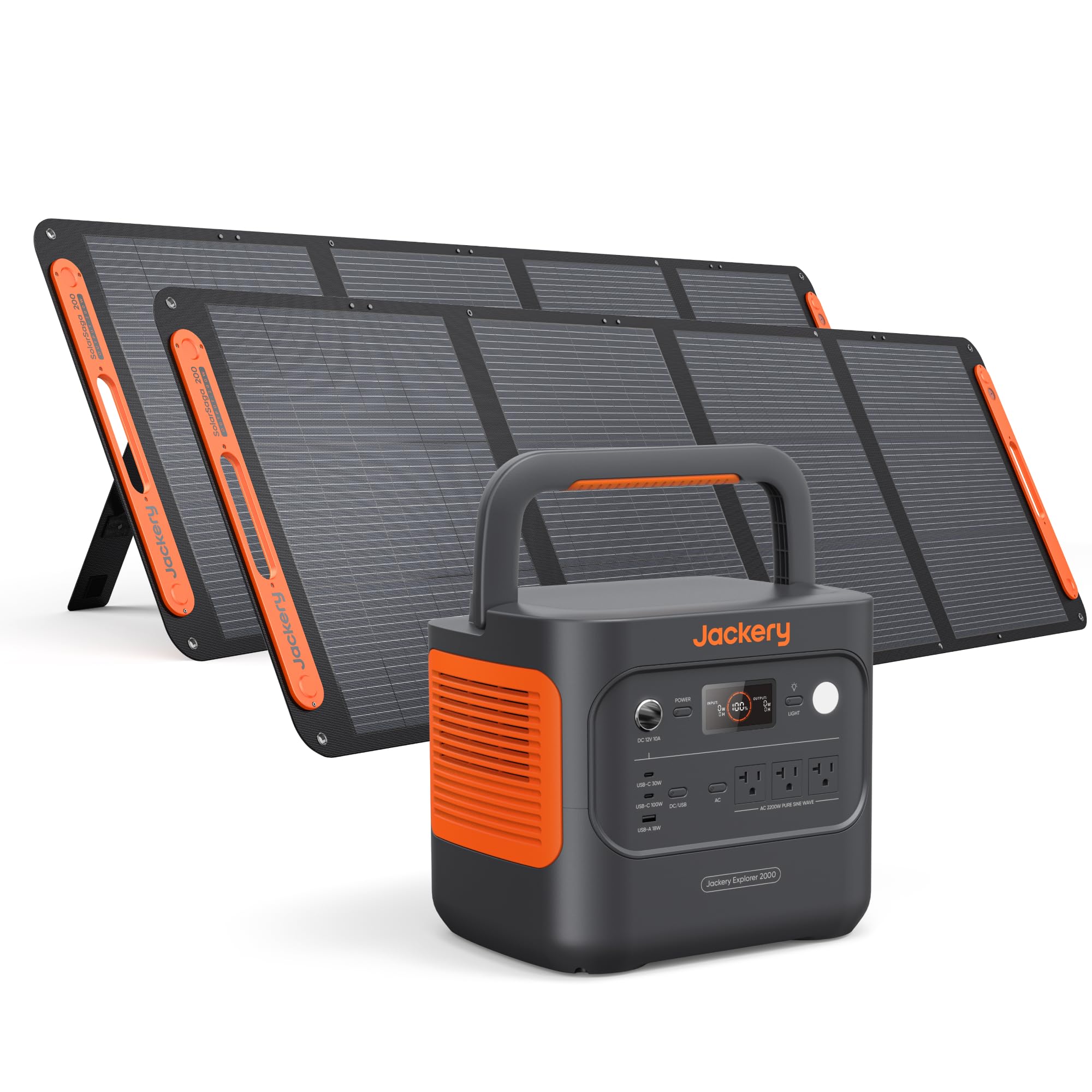
The Explorer 2000 v2 uses CTB technology to squeeze 2042Wh into a 39.5-pound chassis—41% lighter and 34% smaller than standard 2kWh LFP stations. Its 2200W inverter powers most essentials (TV, fridge, lights), and the two included 200W SolarSaga panels provide up to 400W of solar input in full sun.
AC charging hits 80% in 66 minutes, and the app-activated Emergency Super Charging mode completes a full charge in 102 minutes. Silent Charging mode keeps fan noise at 30dB, making it bedroom-friendly. Users report running a 5000 BTU window AC for 3.5 hours, draining to 45%.
The 20ms UPS is adequate for most devices but slower than premium units. The included solar panels use DC8020 connectors that require removing the L-shaped adapter before connection—a detail easily missed. Expansion requires a separate battery pack, not add-on via standard expansion ports.
Why it’s great
- 39.5 lbs—lightest in 2kWh class
- Includes two 200W solar panels
- 80% AC charge in 66 minutes
- Silent Charging mode at 30dB
Good to know
- 20ms UPS (not <10ms)
- Solar connector adapter required
- Proprietary expansion battery
9. Anker SOLIX F2000 (PowerHouse 767)

The SOLIX F2000 (PowerHouse 767) delivers 2048Wh with InfiniPower LiFePO4 cells rated for a decade of daily use. Its HyperFlash technology charges 0-80% in just 1.4 hours—one of the fastest in the 2kWh segment. The 2400W inverter supports SurgePad technology for 3600W peaks to handle motor startup loads.
Twelve ports (4 AC, 3 USB-C, 2 USB-A, 2 car outlets, RV port) cover most scenarios. The integrated wheels and telescoping handle make the 67-pound unit easy to roll, a major advantage over similar-capacity bricks. Users appreciate the quiet operation and clear display.
The UPS mode is limited to 1440W AC output regardless of the unit’s full 2400W capacity—a critical caveat for large loads. Monthly top-off charging is required for storage, and some users report confusing behavior when using it as a UPS for high-power servers.
Why it’s great
- 0-80% AC charge in 1.4 hours
- Integrated wheels for easy transport
- 10-year battery lifespan
- 3600W SurgePad peak power
Good to know
- UPS limited to 1440W output
- Requires monthly storage charge
- No 240V output
10. Generac GB2000 Portable Power Station

Generac, a household name in standby generators, brings its reliability to the portable market with the GB2000. It packs 2106Wh and a 1600W inverter (2106W peak)—modest power but sufficient for a refrigerator, lights, and mobile devices. The large 4.7-inch color display shows real-time battery level and estimated runtime.
A built-in 15W wireless charging pad eliminates cable clutter for Qi-compatible phones. Fast solar recharge reaches 80% in 3.3 hours from a wall outlet, or via solar, car, and generator inputs. Users in hurricane-prone Florida report powering a refrigerator and lights for 1-3 hours during storms, with one customer purchasing a second unit for redundancy.
Customer support experiences are polarized: some praise Generac’s responsiveness, while others report unresolved failures after short use. The 1600W continuous output is the lowest in this lineup, limiting heavy-load applications like space heaters or power tools.
Why it’s great
- Trusted Generac brand and service network
- Built-in 15W wireless charging pad
- Large 4.7-inch color display
- Fast 3.3-hour wall recharge
Good to know
- Only 1600W continuous output
- Mixed customer support reviews
- No expansion battery option
11. PECRON F3000LFP Portable Power Station
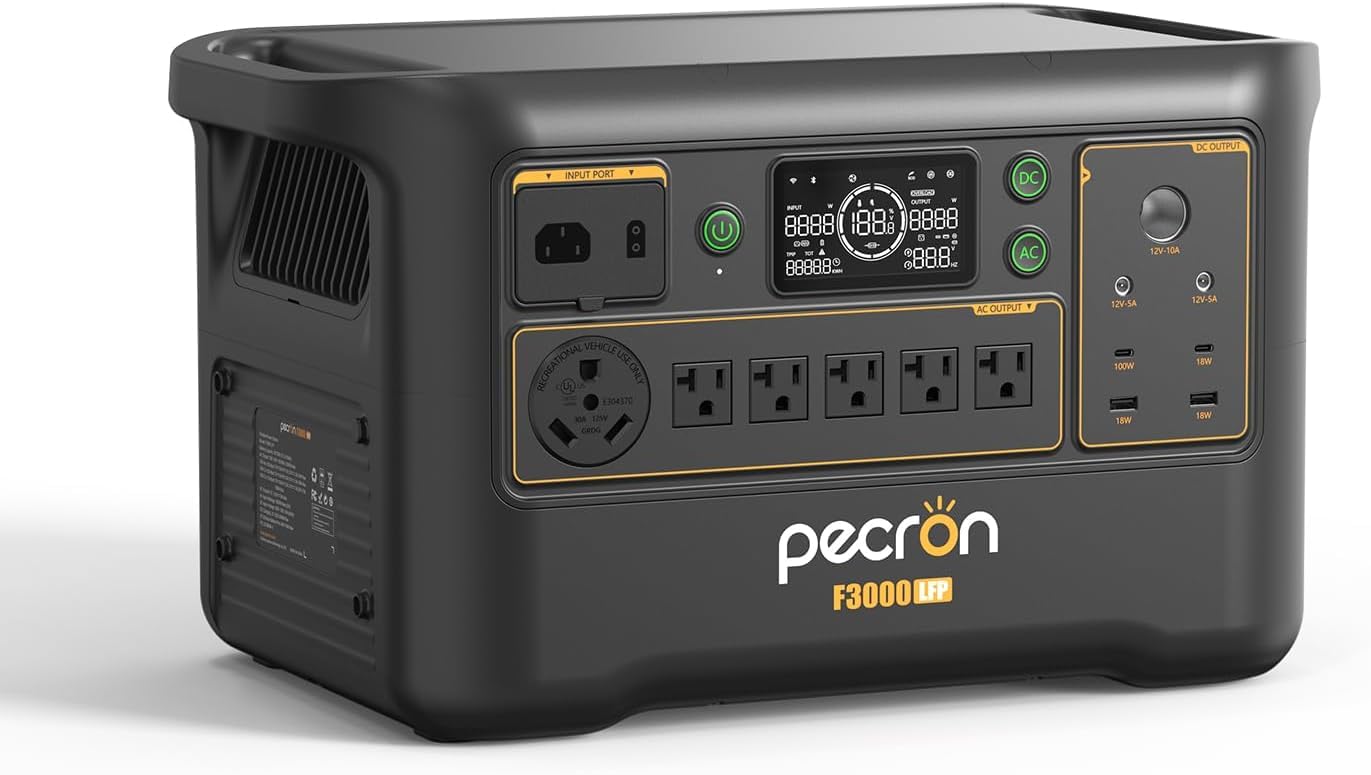
The PECRON F3000LFP delivers 3072Wh with a 3600W inverter at an aggressive price point—offering the best capacity-to-dollar ratio in this roundup. Its 1800W AC input recharges from 0-100% in just 2 hours, and triple charging (AC+solar+car) provides max flexibility. Thirteen ports include 6 AC outlets and 2 USB-C with 100W PD.
Users report excellent real-world performance: 30W idle draw, 420W+ solar input from a single 400W panel, and 1200Wh consumption running a fridge for 24 hours (versus 500Wh for some competitors). The 8-20ms UPS protects computers and medical devices during outages. After 5 months and 40+ outages, one user reports flawless operation.
The fan runs audibly during charging, and there is no solar-only charging mode (the unit draws a trickle from AC even when solar is connected). Expansion to 10752Wh requires a proprietary cable sold separately. Customer service has been responsive, but the brand lacks the long-term track record of Anker or Jackery.
Why it’s great
- Best 3072Wh capacity per dollar
- 1800W AC full charge in 2 hours
- 6 AC outlets—most in class
- Low 30W idle power draw
Good to know
- Fan noise during charging
- No solar-only AC bypass
- Expansion cable sold separately
12. VPauexii 48V 400Ah LiFePO4 Server Rack Battery
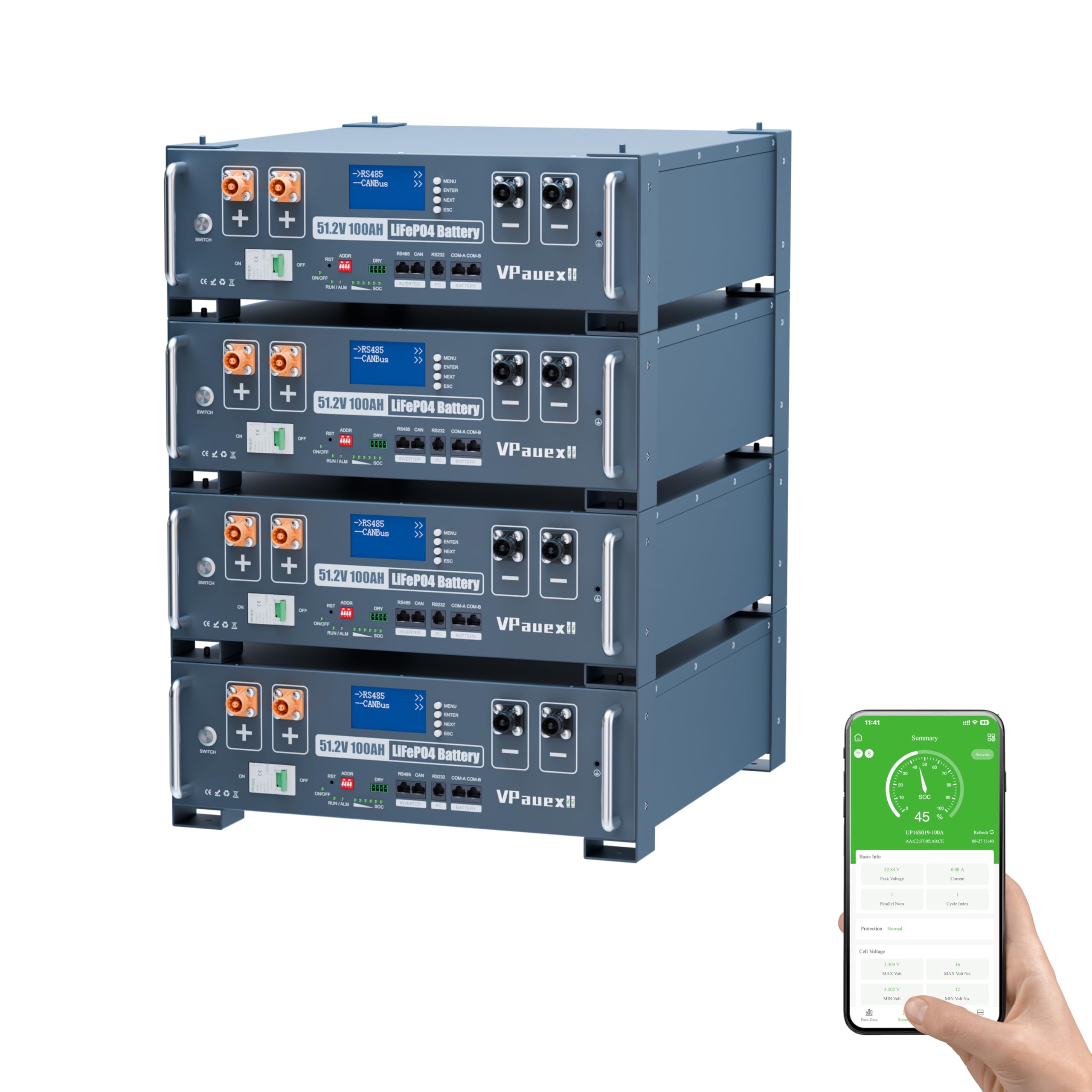
This is not a portable power station—it is a 48V server-rack battery designed for stationary solar storage. With 20.48kWh of LFP capacity and 6000+ cycle life, it replaces multiple lead-acid batteries in off-grid and whole-home setups. The built-in aerosol fire suppression activates automatically above 170°C.
Wi-Fi and Bluetooth enable remote monitoring, and the LCD display shows real-time voltage, current, and SOC. It communicates via CAN/RS485 with major inverters (EG4, Victron, Sol-Ark). Users report flawless integration with EG4 inverters and battery capacities testing above rated 100Ah per unit.
This system requires an external inverter—it cannot power AC appliances directly. The 3U rack mount kit is included, but the battery weighs 99 pounds, making solo handling difficult. If you need portable 120V power, this is not the right choice; if you want massive stationary storage, it offers exceptional value per kWh.
Why it’s great
- Massive 20.48kWh capacity
- 6000+ cycle LFP lifespan
- Built-in fire suppression system
- WiFi/Bluetooth app monitoring
Good to know
- Requires external inverter
- 99 lbs, rack-mount only
- Not portable
13. Vatrer 51.2V 100Ah LiFePO4 Battery (4-Pack)
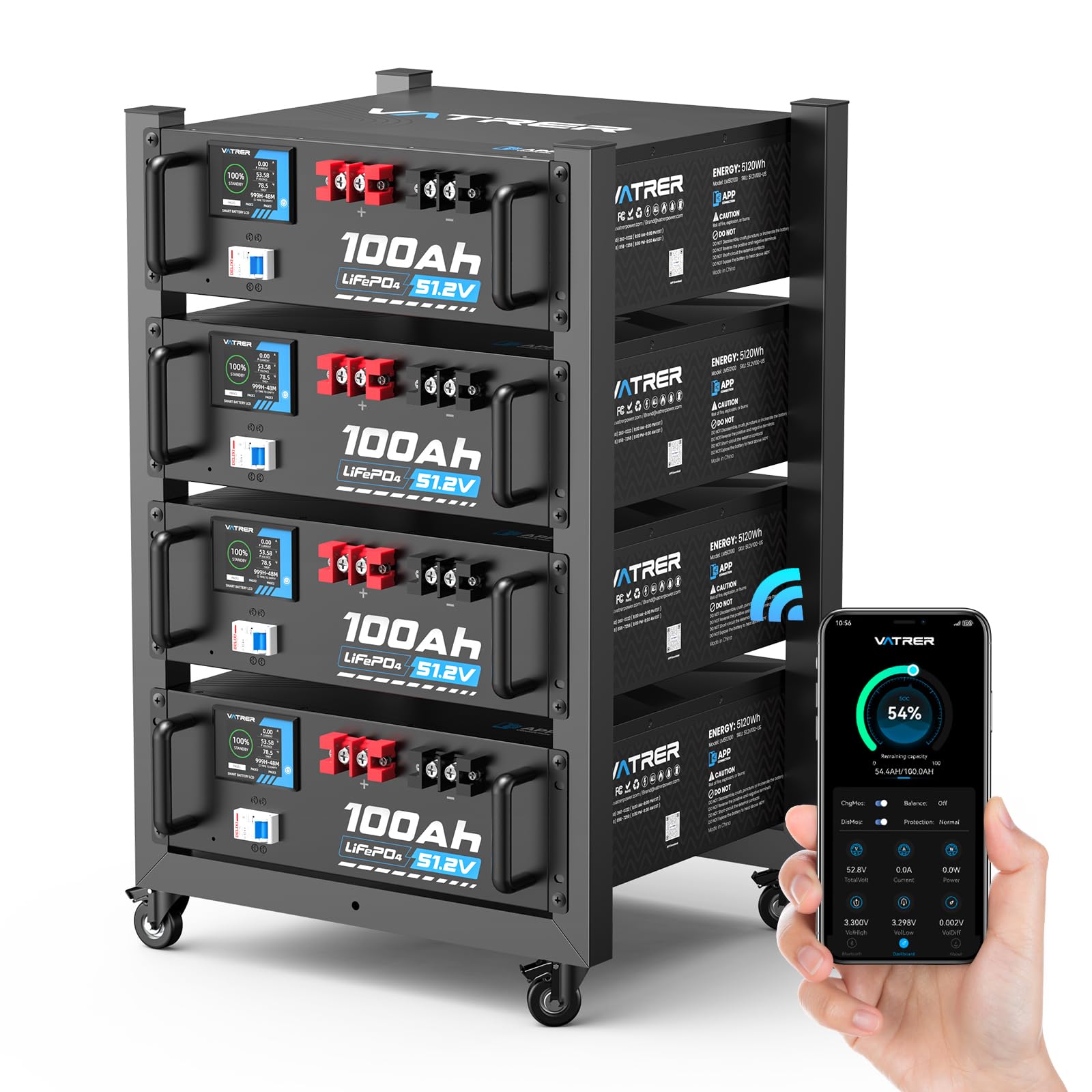
This 4-pack of Vatrer 51.2V 100Ah LFP batteries delivers 20.48kWh of storage and includes a free heavy-duty server rack with 360° swivel casters. Each battery features a touchscreen display, Bluetooth app monitoring, and a built-in 100A BMS with low-temp cutoff. Rated for 5000+ cycles, these are drop-in replacements for lead-acid in solar systems.
Testing confirms each unit delivers over 100Ah of usable capacity, with cell balance within 7mV. The dual positive and negative terminals help distribute current and reduce heat at high loads. Users report seamless operation with EG4-3000 inverters after minor bulk voltage adjustment to 56.0V for optimal cell balancing.
The terminal design on earlier units could not fit 2/0 or 4/0 cable lugs without modification, though newer models have corrected this. The touchscreen and app interface include some Chinese-language menus that require translation. As with the VPauexii, these are stationary batteries—you must provide your own inverter for AC power.
Why it’s great
- 20.48kWh total with free server rack
- Touchscreen display on each battery
- 5000+ cycle LFP lifespan
- Bluetooth app monitoring
Good to know
- Requires external inverter
- Terminal design issue (older units)
- App has Chinese menus
FAQ
What size inverter do I need for a 2000Wh battery?
Can I add solar panels to a 2000Wh battery after purchase?
How long does a 2000Wh battery run a refrigerator?
What is the difference between a portable power station and a server rack battery?
How often should I charge a 2000Wh battery for storage?
Final Thoughts: The Verdict
For most users, the 2000wh battery winner is the EF ECOFLOW DELTA Pro 3 because it is the only unit that delivers native 240V split-phase, class-leading recharge speed, and expandability to 48kWh—future-proofing your home backup for years. If you want a lighter, more portable option with integrated wheels, grab the Anker SOLIX F2000. And for maximum value per kWh in a stationary solar storage setup, nothing beats the Vatrer 51.2V 100Ah 4-Pack with its free rack and 5000+ cycle lifespan.
Product prices and availability are accurate as of the date/time indicated and are subject to change. Any price and availability information displayed on Amazon at the time of purchase will apply to the purchase of this product. As an Amazon Associate I earn from qualifying purchases.
CERTAIN CONTENT THAT APPEARS ON THIS SITE COMES FROM AMAZON. THIS CONTENT IS PROVIDED "AS IS" AND IS SUBJECT TO CHANGE OR REMOVAL AT ANY TIME.
Amazon and the Amazon logo are trademarks of Amazon.com, Inc. or its affiliates.