
A 200-watt solar panel sits in the sweet spot between portability and real-world power. It’s enough to keep a 12V fridge running, recharge a sizable power station in a few hours, or take the edge off your electric bill. But the number printed on the spec sheet rarely matches what you’ll actually see at the terminals; voltage, connector type, cell technology, and whether you buy a rigid rooftop panel or a foldable portable kit all dictate your final experience.
I’m Min — the co-founder and writer behind Gadgets Feed. I’ve spent countless hours comparing the internal cell architecture, real-world output data from verified buyers, and compatibility nuances between different power station brands to separate the panels that actually deliver their rated power from those that inflate their numbers.
This guide walks through the nine best models on the market right now, covering rigid bifacial powerhouses for vans and lightweight folding options for campsites, to help you pick the right 200w solar panel for your setup without wasting money on overrated specs.
How To Choose The Best 200W Solar Panel
Not all 200W panels are created equal. The real difference comes down to cell technology, intended installation, and the connector ecosystem you already own. Buy the wrong format and you’ll either never see 200W because your power station limits input wattage, or you’ll struggle to mount a portable panel on your roof. Here is what actually matters.
Type of Panel: Rigid vs Portable vs Bifacial
A rigid rooftop panel is built into an aluminum frame with tempered glass. It is weather-hardy but immobile; you mount it with Z-brackets and leave it. A portable folding panel uses flexible cells held in a fabric frame with kickstands. You deploy it at the campsite and store it in your trunk. A bifacial panel collects sunlight from both sides — the front from direct sun and the back from reflected ground/roof light. Rigid panels are best for permanent off-grid installations. Portable panels suit campers and emergency kits. Bifacial rigid panels give you 30% more potential output from the same footprint if you install them on a reflective surface.
Cell Efficiency and Busbar Count
Older solar panels use 9BB (9 busbar) P-Type cells that top out around 23% efficiency. The latest panels use 16BB or 18BB N-Type cells pushing past 25% efficiency. Higher efficiency means the same physical panel size produces more power in less sunlight. More busbars also reduce the risk of micro-cracks and hot spots. If you have limited roof space or frequently charge in overcast conditions, the premium for N-Type panels pays for itself within the first year of use.
Connector Compatibility with Your Power Station
Every portable power station has a maximum input voltage and a specific connector type — MC4, XT60, Anderson, or DC5521. A strong 200W folding panel will include a 3-in-1 or 5-in-1 adapter cable to match most brands (Jackery, EcoFlow, BLUETTI, Anker). But you must still check the open-circuit voltage (VOC) of the panel against your station’s max input voltage. A 57.6V panel connected to a station that only accepts 50V will either refuse to charge or damage the controller. Stick to panels that match your station’s voltage range to avoid compatibility headaches.
Quick Comparison
On smaller screens, swipe sideways to see the full table.
| Model | Category | Best For | Key Spec | Amazon |
|---|---|---|---|---|
| Anker SOLIX PS200 | Portable | Premium power station owners | 57.6V VOC / MC4 | Amazon |
| Renogy E.Flex 200W | Portable | Lightweight camp setup | 25% / 13.9 lbs | Amazon |
| RICH SOLAR 200W | Rigid | Permanent RV roof install | 18BB N-Type / 24 lbs | Amazon |
| Callsun 200W Bifacial | Rigid Bifacial | Maximizing output per panel | 30% bifacial gain | Amazon |
| BougeRV N-Type 16BB | Rigid | Compact van rooftop | 51.6 x 30.2 x 1.4 in | Amazon |
| ZOUPW 200W Portable | Portable | Direct USB-C device charging | PD 60W USB-C port | Amazon |
| SOKIOVOLA 200W | Portable | Entry-level camping | IP68 / 21 x 23 in folded | Amazon |
| SOLUPUP 200W | Portable | Broad power station support | 4 DC conversion ports | Amazon |
| HQST 200W Ultra-Light | Portable | Backpack portability | 11 lbs / IP67 | Amazon |
In‑Depth Reviews
1. Anker SOLIX PS200 Solar Panel

The Anker SOLIX PS200 stands apart because of its high open-circuit voltage of 57.6V, which pairs specifically with Anker’s own power stations but also works well with any MPPT controller that accepts up to 60V. That high-voltage architecture reduces current and cuts cable losses, meaning more of the panel’s rated 200W actually reaches your battery. The four kickstand angles (30°, 40°, 50°, 80°) allow precise sun tracking throughout the day, and the MC4 connector keeps energy transfer clean and stable.
At 20.35 pounds, this is not the lightest folding panel in its class, but the IP67 waterproof rating and ETFE coating give it an edge in durability for campers and emergency backup users who cannot baby their gear. Users report consistent output between 150W and 175W in full sun, with occasional bursts closer to 180W under optimal conditions. The inclusion of two 9.8-foot MC4 cables gives you flexibility to keep the panel in direct sun while your power station stays shaded.
The trade-off is that the connector ecosystem is MC4-only out of the box — Anker includes an MC4-to-XT60 dongle, but you may need additional adapters for Anderson or DC5521-based stations. Some buyers received units with missing cables, though Anker’s support generally resolves that quickly. If you already own an Anker SOLIX power station or you prefer MC4 workflow, this is the most polished 200W portable panel available.
Why it’s great
- High 57.6V VOC reduces line loss for efficient long-cable runs.
- IP67 rated with durable ETFE surface that handles rain and scratches.
- Four distinct kickstand angles for precise solar tracking.
Good to know
- Heavier than many competitors at 20.35 lbs.
- Limited to MC4 out of box; extra adapters needed for non-Anker stations.
- Some units reported with missing cables in the box.
2. Renogy 200W Portable Solar Panel (E.Flex)
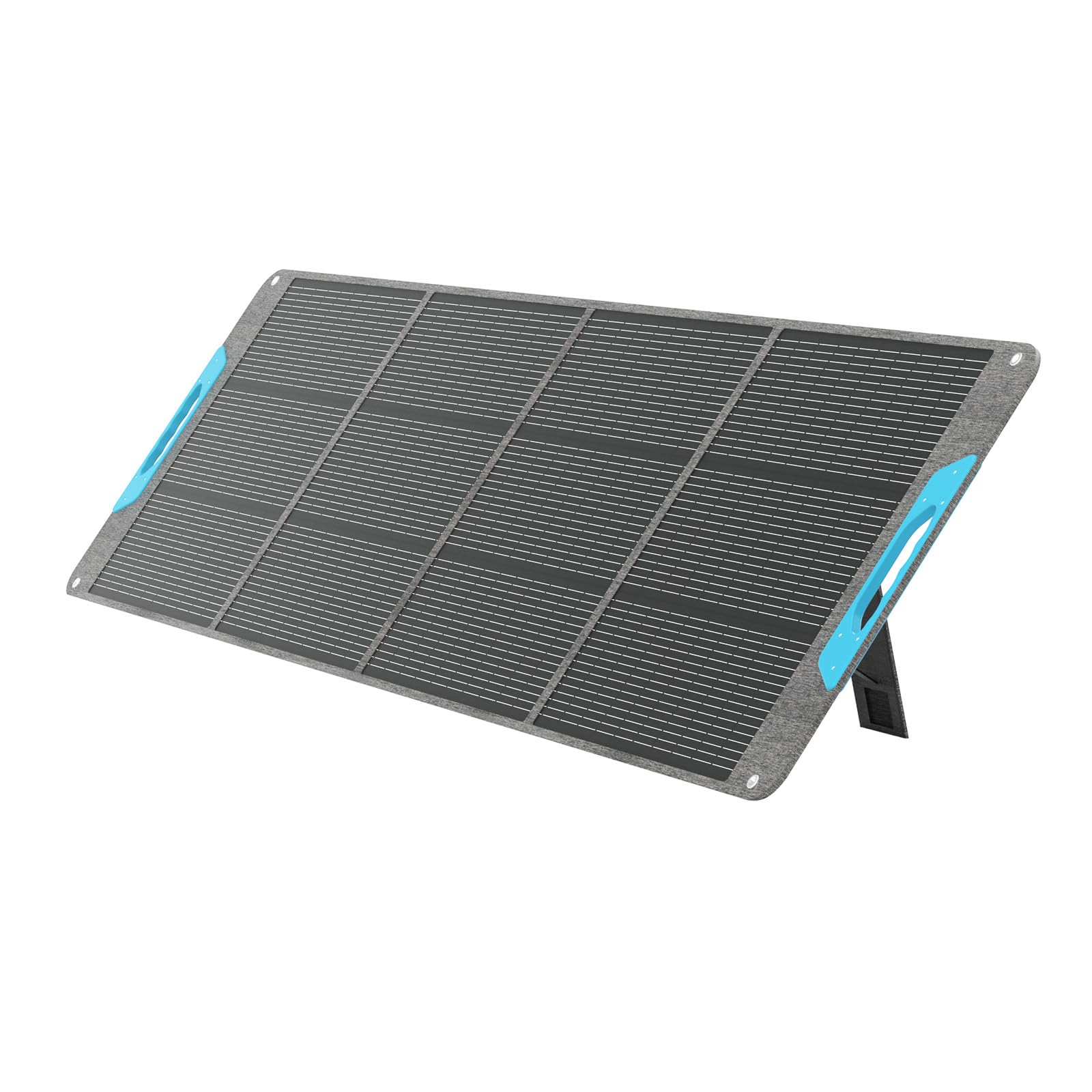
Renogy’s E.Flex 200W panel weighs only 13.9 pounds, making it one of the lightest foldable 200W panels on the market. The weight saving comes from its 16BB N-Type cell architecture and slimmed-down frame, yet it still delivers a claimed 25% efficiency. Users in Florida have reported seeing output that exceeds the rated 200W during peak sun when the panel is paired with an MPPT controller, which is rare behavior for portable panels.
The quadfold design folds down to 23.72 x 22.99 inches, roughly the size of a small backpack. A magnetic closure replaces the usual velcro or snap straps, which is more durable over repeated open-close cycles. The built-in USB ports include a 45W USB-C PD port and two USB-A ports, letting you charge smartphones, tablets, or a camera directly without a power station in the loop. The four kickstands have adjustable angles (40°, 50°, 60°) and a unique “small ear” design that stabilizes the panel against wind.
On the downside, several users mentioned that the plastic feet on the kickstands are clingy and make the initial unfolding experience slightly frustrating until you figure out the technique. The included carrying bag is functional but basic — you may want a padded case if you plan to transport it frequently. The UL 61730 certification gives peace of mind for electrical safety, but the IP65 rating means it can handle splashes but not submersion. For the weight-conscious camper who wants proven output, this is the best balance.
Why it’s great
- Only 13.9 lbs, lightest in its class for easy transport.
- Users report output exceeding 200W with MPPT control.
- Magnetic closure is more durable than velcro straps.
Good to know
- Kickstand feet can be sticky and annoying to separate at first.
- Carrying bag is fairly basic for the price range.
- Only IP65 rated — resists splashes but not full submersion.
3. Callsun 200W Bifacial Solar Panel

The Callsun 200W bifacial panel is a rigid panel with a transparent backsheet that captures reflected light from the ground, wall, or roof surface. This bifacial design can boost total power output by up to 30% over a standard opaque-back panel — verified by users who regularly see 420W from a single 200W-rated unit when mounted on a reflective surface. The N-Type 16BB cell architecture delivers 25% efficiency and superior low-light performance.
Measuring 51.3 x 30.3 x 1.4 inches and weighing 23.8 pounds, it is compact enough for Class B van roofs while still producing meaningful power. The TwinCell anti-shade design splits the panel into two independent halves, so if a tree branch shades one side, the other half keeps generating at full voltage. This is a huge advantage over conventional single-cell panels that can collapse to near-zero output when partially shaded. The low temperature coefficient of -0.3%/K also means it loses less power on hot summer roofs than typical panels.
The purchase is backed by a 10-year technical support and a 25-year performance commitment (84.5% output after 25 years). Some users noted that the bifacial gain depends heavily on surface reflectivity — you get the full 30% boost only on light-colored concrete or white membrane roofs, not on dark asphalt. The pre-drilled holes on the back make mounting straightforward, though you will need standard Z-brackets or rail mounts. For anyone with reflective mounting space, this panel delivers more per-watt value than any other rigid 200W panel.
Why it’s great
- Bifacial design adds up to 30% extra output on reflective surfaces.
- TwinCell technology maintains power output even when partially shaded.
- Low -0.3%/K temperature coefficient preserves power in summer heat.
Good to know
- Bifacial gain is only maximized on light-colored reflective surfaces.
- Rigid construction means it cannot be folded for transport.
- Requires separate mounting brackets and a charge controller.
4. RICH SOLAR 200 Watt 12 Volt Monocrystalline Solar Panel

Rich Solar has built a reputation for rugged rooftop panels, and this 200W 18BB N-Type model is their most refined offering yet. It generates a rated 10.9 amps and charges 12V batteries efficiently. Users have reported surviving 95+ mph storms with hail and debris while the panel remained unscratched, speaking to the build quality of the 1.3mm anodized aluminum frame and tempered glass. The panel’s anti-reflective coating improves low-angle light capture during winter mornings and evenings.
Installation is straightforward thanks to 14 pre-drilled holes that are compatible with standard Z-brackets, ground mounts, and tilt mounts. The 3-foot quick connect cables with MC4 connectors make wiring simple, whether in series or parallel. Real-world output from verified buyers shows a steady 180W to 190W in peak sun, with bursts over 200W on partly cloudy days due to the cloud-edge effect. Users running 1,000W arrays on their RVs confirm that these panels handle constant vibration, weather, and road debris without degradation.
The 25-year limited warranty on power output and 5-year material warranty are solid for this price tier, though the panel is heavier than some competitors at 24 pounds. The 12 AWG aluminum leads are slightly undersized compared to the copper leads found on premium panels, which introduces about 1.2W of loss per lead. For permanent roof mounting where weight is less of a concern, this is the most durable 200W rigid panel per dollar spent.
Why it’s great
- Proven durability — survived 95 mph storms with hail and debris.
- 14 pre-drilled holes make mounting flexible and quick.
- Consistent real-world output between 180W and 190W in peak sun.
Good to know
- 24 lbs is heavier than many competitors in this size class.
- Aluminum leads add a small power loss compared to copper.
- Not portable — designed for permanent rooftop installation only.
5. BougeRV 12V N-Type 16BB 200W Bifacial Solar Panel

BougeRV’s N-Type 200W panel is built for tight rooftop spaces. The 16BB cell design improves current collection and reduces covered area by 26% compared to standard 9BB panels, making it 51.6 x 30.2 x 1.4 inches — small enough to fit between roof vents and AC units on a Class B van. The transparent backsheet enables biracial gain of up to 30% extra output from ground or roof reflection, pushing real-world performance closer to 250W on bright surfaces.
The panel uses N-Type cells that have an 80% bifacial gain compared to 70% for P-Type cells, meaning the backside captures more of the reflected light. BougeRV claims a 30-year lifespan, five years longer than most standard panels, thanks to the lower degradation rate of N-Type cells. Installation is plug-and-play with pre-drilled holes on the back, and users report output of 197W on a patio table in direct sun, matching the rated spec closely.
One drawback is that the real-world output heavily depends on the mounting environment — if you install it on a dark-colored roof, you will not see the full bifacial benefit. The connector type is MC4, so you need to pair it with a charge controller before connecting to a 12V battery. For van lifers and boat owners with limited roof square footage, this panel offers the highest power density per inch of any rigid 200W panel reviewed here.
Why it’s great
- 26% smaller footprint than standard 9BB panels, ideal for small roofs.
- Bifacial with 80% rear-side gain for reflected light capture.
- 30-year lifespan with low N-Type degradation rate.
Good to know
- Bifacial gain is only significant on light-colored reflective surfaces.
- Requires an external charge controller for battery integration.
- Not portable — a dedicated rigid mount is necessary.
6. ZOUPW 200W Portable Solar Panel
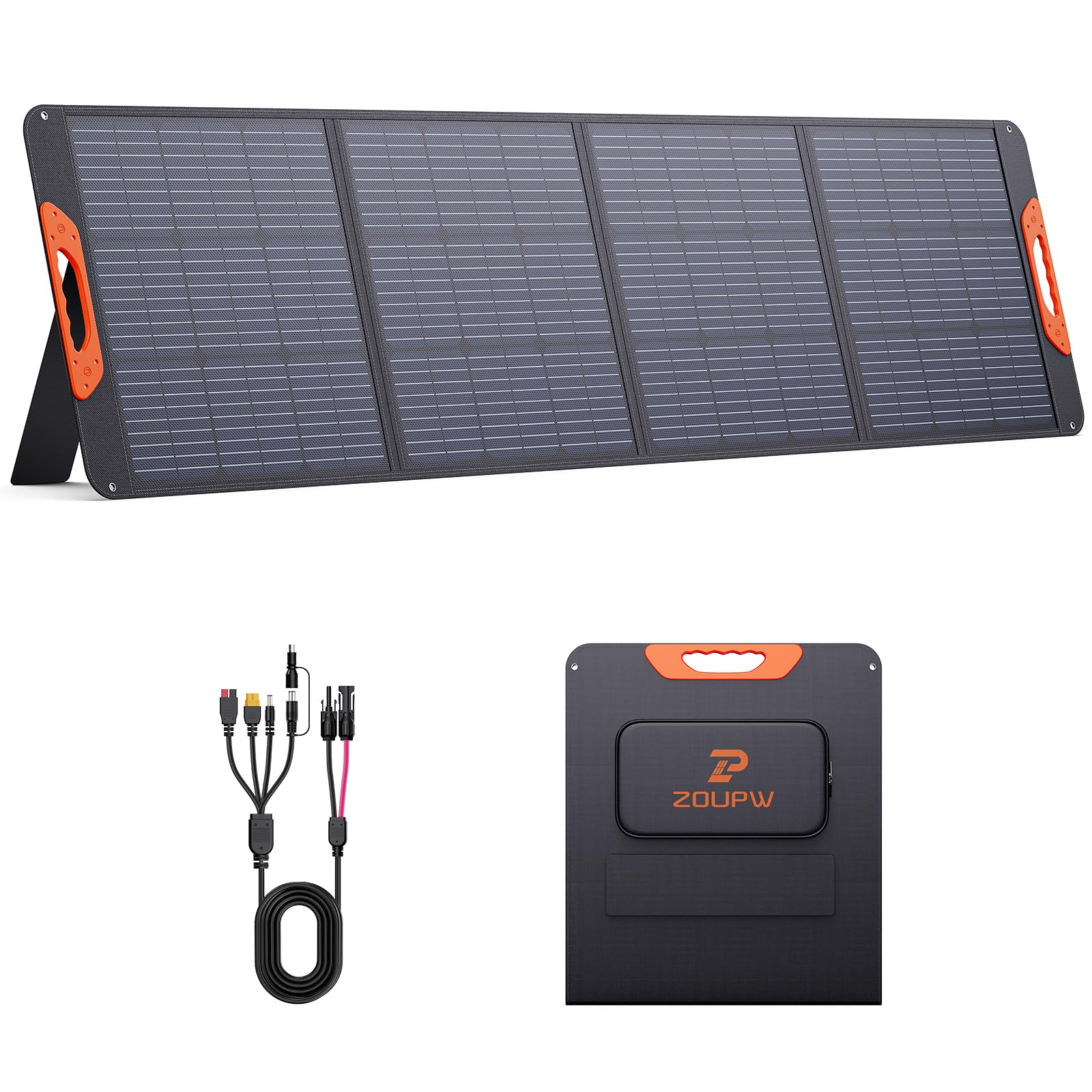
The ZOUPW 200W portable panel is distinguished by a built-in USB-C port that delivers 60W of Power Delivery — enough to charge a laptop directly from the panel without a power station in the middle. This is a rare feature at this price point; most folding panels cap USB-C output at 45W. The panel also includes USB-A QC3.0 and two standard USB-A ports, making it a self-contained charging hub for multiple devices simultaneously.
The 23.5% efficiency A+ monocrystalline cells are slightly behind the 25% N-Type leaders, but the IP67 waterproof rating and ETFE surface coating make it suitable for damp camping and marine environments where sudden splashes are routine. The four adjustable kickstands support a 45° angle that captures 25-30% more energy than flat-laying panels, and the magnetic handle and folded size of 25 x 21 inches make it manageable for one-person setup. Users report real-world output of 130W to 170W depending on sun angle and cloud cover.
The universal 5-in-1 adapter cable (XT60, Anderson, DC7909, DC8020, DC5521) means it works with almost every major power station brand out of the box. Some users experienced lower output than expected (around 130W) when connected to certain Jackery models, which may be due to the station’s internal input current limit rather than the panel itself. The 1.97-inch folded thickness is manageable for trunk storage, though at 19 pounds, it is on the heavier side for portable use.
Why it’s great
- Built-in 60W USB-C PD port charges laptops directly.
- IP67 waterproof with durable ETFE coating for wet environments.
- Universal 5-in-1 adapter cable covers all major power station brands.
Good to know
- At 19 lbs, heavier than the lightest portable panels.
- 23.5% efficiency lags behind the 25% N-Type competitors.
- Some users report only 130W with certain power station models.
7. SOKIOVOLA N-Type 16BB 200W Portable Solar Panel
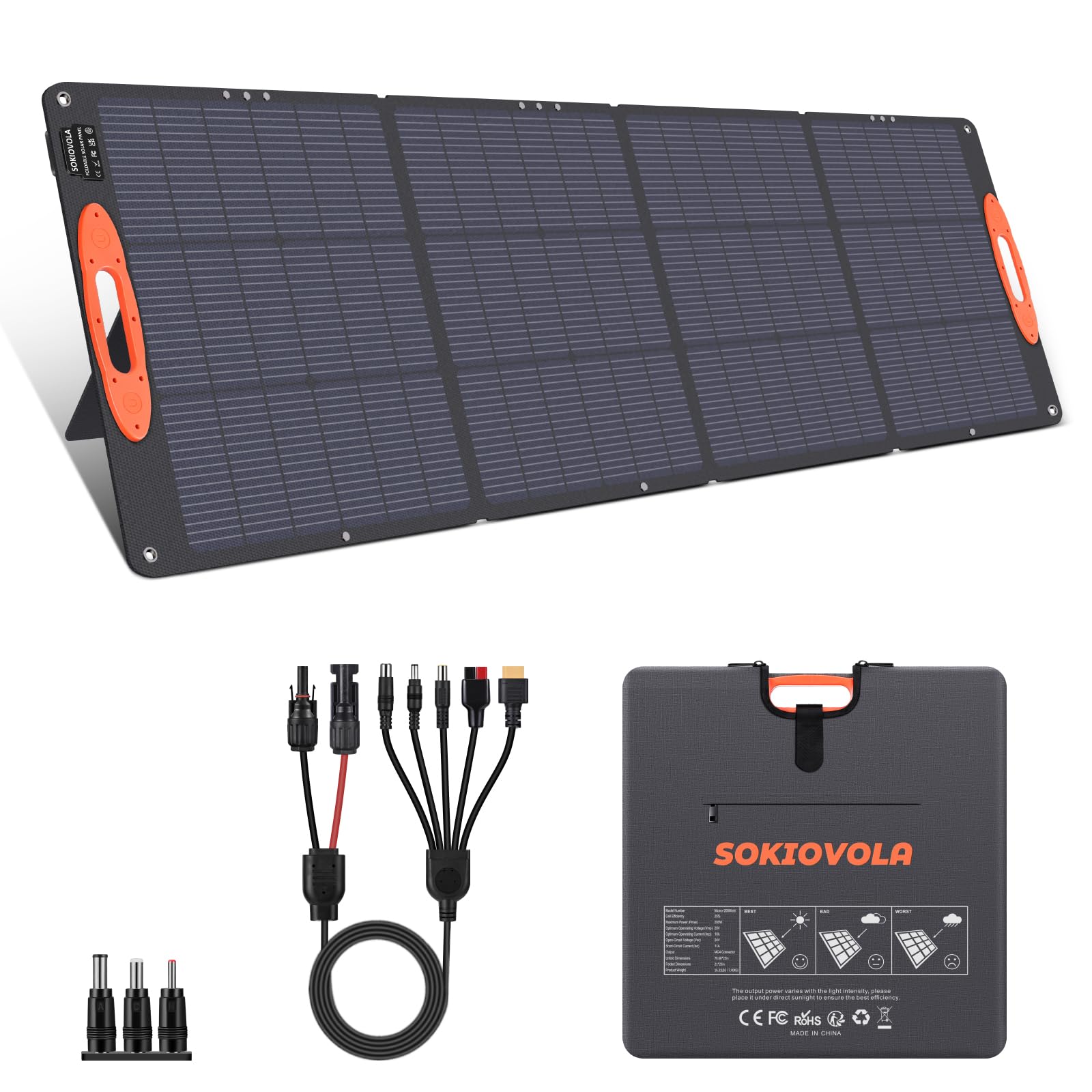
SOKIOVOLA packs N-Type 16BB cells into a folding panel that is IP68 waterproof — the highest water resistance rating on this list, allowing full submersion in up to 1 meter of water for 30 minutes. This makes it the go-to choice for kayak campers, beach setups, or anyone who expects their panel to get dunked. The 25% high-efficiency monocrystalline cells deliver real-world output around 170W to 180W in full sun, with 50W on overcast days.
The panel folds to a compact 21 x 23 inches and weighs 16.31 pounds — middle-of-the-pack for portable panels but still manageable. The package includes a 10.5-foot 5-in-1 solar extension cable with adapters for XT60, DC5521, DC7909, DC8020, and Anderson ports, ensuring compatibility with Jackery, EcoFlow, BLUETTI, Anker, and Goal Zero stations. A carrying bag and user manual round out the package, and the 12-month warranty with 30-day refund guarantee reduces purchase risk.
Some users noted that the panel fabric feels thinner than premium brands like Renogy or Anker, raising questions about long-term UV durability. The kickstand legs are adjustable but can be awkward to lock into position during initial setup. The included XT60 connector on some units failed after a few uses, though the main MC4 cable remained functional. For budget-conscious buyers who want N-Type efficiency and IP68 protection without paying the premium, this is a strong value pick.
Why it’s great
- IP68 rated — fully submersible, ideal for wet environments.
- N-Type 16BB cells provide 25% efficiency at a competitive price.
- 5-in-1 adapter cable covers the widest range of power stations.
Good to know
- Fabric feels thinner than premium competitors; UV durability is unknown.
- Kickstand adjustment can be finicky during setup.
- Included XT60 adapter reported to fail on some units.
8. SOLUPUP 200 Watt Portable Solar Panel
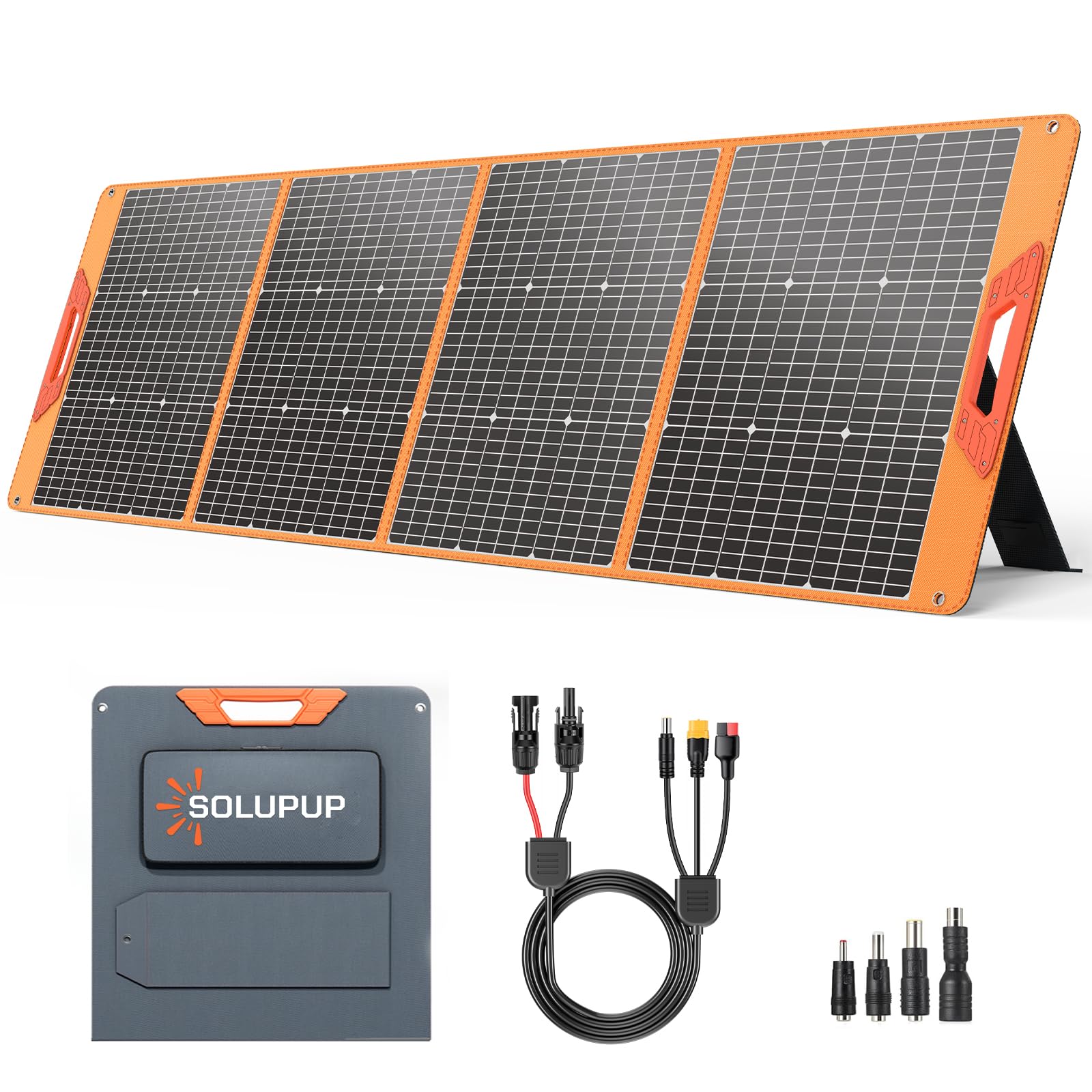
The SOLUPUP 200W panel is built around a power box that includes an MC4 adapter with 1 SAE, 2 USB-C, and 2 USB-A fast-charging ports, giving you the most simultaneous device-charging options of any panel on this list. This built-in power box means you can charge a tablet, phone, laptop, and a portable battery all at once without needing an external charge controller for low-power devices. The 24% monocrystalline cell efficiency is slightly behind the N-Type leaders but still competitive.
The panel folds to 24.4 x 20.8 x 1.9 inches and weighs 18.5 pounds — not the lightest, but the magnetic handle makes one-handed carry easy. Four adjustable kickstands hold the panel steady on uneven ground, and hanging holes allow wall-mounted use if you prefer not to deploy the stands. The IP66 rating means it can handle heavy rain and dust, making it suitable for extended camping trips. Users report real-world output from 180W to 192W in peak sun and 45W to 120W on overcast days.
The included adapter cables support MC4 to DC5521, Anderson, and XT60, covering about 98% of power stations on the market. One notable limitation is that the power box outputs 18V via the SAE port, which is designed for low-power device charging — you still need an MPPT charge controller to efficiently charge a 12V battery bank. Some users also found the initial setup of the four kickstands to be a bit floppy until the panel is positioned correctly. For campers who want a self-contained charging hub without extra dongles, this is a smart pick.
Why it’s great
- Integrated power box with 2 USB-C and 2 USB-A for multi-device charging.
- High real-world output up to 192W in full sun.
- IP66 rated for rain and dust resistance.
Good to know
- SAE port outputs 18V; an MPPT controller is needed for battery charging.
- Kickstand setup can be floppy until the panel is properly positioned.
- Heavier than the lightest portable panels at 18.5 lbs.
9. HQST 200W Ultra-Light Portable Solar Panel
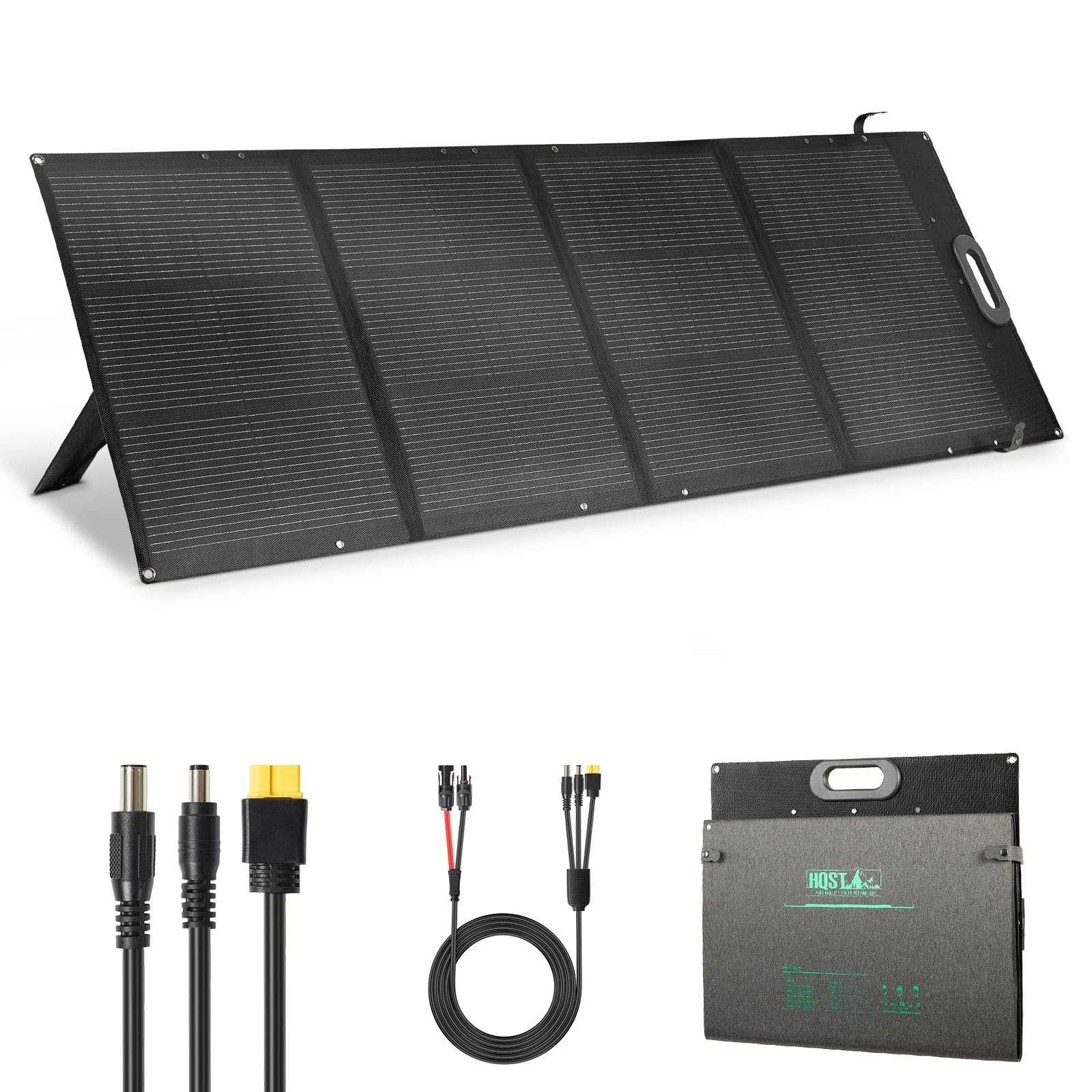
The HQST 200W Ultra-Light panel weighs just 11 pounds — a full 37% lighter than most other 200W portable panels. This weight savings comes from N-Type 16BB cells and a laminated construction that eliminates stitched seams where water can seep in. The 25% efficiency means you are not sacrificing power for portability: users report 180W to 190W output in peak sun with the optional MPPT controller, and the panel folds down to only 1.97 inches thick for trunk storage.
The panel includes two adjustable kickstands that support a 40° to 60° angle range, staying stable on uneven ground thanks to a rigid design that prevents the floppiness common in soft panels. The IP67 waterproof rating means it can handle rain and splashes without issue, and the PVDF-coated outer layer resists scratches and wear. The 4.9-foot 3-in-1 adapter cable supports XT60, DC7909, and DC5521 connectors for compatibility with Jackery, EcoFlow, BLUETTI, and Goal Zero stations. Users can also connect multiple panels in series or parallel for higher-voltage arrays.
The main trade-off is that the 4.9-foot cable is shorter than ideal for running the panel to a shaded power station, and the rigid fold design means the panel does not wrap around gear like some fully flexible alternatives. The 12-month limited warranty is shorter than the multi-year coverage from premium brands. For backpackers, motorcycle campers, or anyone who counts every pound in their pack, this is the lightest 200W panel that still delivers N-Type efficiency and solid daily output.
Why it’s great
- Only 11 lbs — 37% lighter than most 200W portable panels.
- 25% N-Type efficiency without added weight.
- IP67 waterproof with seam-free laminated construction.
Good to know
- Cable is only 4.9 ft — may be short for some setups.
- Rigid fold design does not wrap around gear.
- 12-month warranty is shorter than premium competitors.
FAQ
Can I use a 200W solar panel to charge a 100Ah battery in one day?
What is the difference between a 12V and 24V 200W solar panel?
Why does my 200W portable panel only produce 150W in full sun?
Can I connect multiple 200W panels together?
Do folding solar panels overheat when packed away?
Final Thoughts: The Verdict
For most users, the 200w solar panel winner is the Callsun 200W Bifacial because it delivers measurable extra output through bifacial gain and TwinCell anti-shade technology without inflating the price. If you need a lightweight portable panel for camping, grab the Renogy E.Flex 200W for its unbeatable 13.9-pound weight and consistent output. And for a rugged permanent rooftop install, nothing beats the RICH SOLAR 200W with its proven storm survivability and 25-year warranty.