
The era of the 20D Digital SLR represents a sweet spot in camera history where rugged magnesium-alloy bodies, dedicated phase-detection autofocus systems, and high-quality CCD sensors capable of clean images at ISO 1600 became accessible to serious enthusiasts without breaking the bank. These cameras were built to last, lacking the video features and live-view gimmicks of modern entry-level DSLRs, but delivering a tactile shooting experience that forces you to compose through the optical viewfinder and master exposure fundamentals.
I’m Min — the co-founder and writer behind Gadgets Feed. I’ve spent countless hours analyzing the technical specifications, build materials, and real-world performance metrics of classic and modern APS-C DSLRs to separate the genuine bargains from the overpriced nostalgia traps.
Whether you are a student building a kit on a strict budget or a seasoned photographer seeking a durable backup body, this guide covers the definitive best 20d digital slr options available today through a careful balance of sensor resolution, autofocus capability, burst rate, and lens ecosystem compatibility.
How To Choose The Best 20D Digital SLR
Choosing a DSLR from this era requires balancing sensor technology, build durability, and lens compatibility. While megapixel counts are lower by modern standards, the image quality from these CCD sensors is often preferred for their unique color science and lower noise profiles at base ISO. The most critical factor is the lens mount, as it determines every upgrade path for the next decade.
Sensor Resolution and ISO Performance
An 8.2-megapixel CCD sensor, like the one in the original Canon EOS 20D, produces clean 3504 x 2336 pixel files that print beautifully at 16 x 22 inches. The real differentiator is how each sensor handles ISO 1600 and 3200. Cameras like the Canon 30D and Sony A200 demonstrate that a well-tuned CCD with decent noise reduction algorithms can outperform higher-resolution sensors in dim conditions, making them ideal for event and indoor photography without flash.
Autofocus System and Burst Rate
A 9-point autofocus system with a central cross-type sensor, found in the Canon 20D and 30D, delivers reliable single-shot and AI Servo tracking for subjects moving at moderate speeds. For action sports or wildlife, the Nikon D7500’s 51-point AF system with 15 cross-type sensors and 8 fps continuous shooting represents a massive leap forward. For general use, a 5 fps burst rate is sufficient for capturing decisive moments without filling a memory card prematurely.
Build Quality and Weather Sealing
The magnesium-alloy chassis found on the Canon 20D, 30D, and 80D provides superior rigidity and durability compared to the polycarbonate bodies of entry-level models like the Rebel T7 or Nikon D3200. Weather sealing, present on the D7500 and 80D, adds splash and dust resistance that allows shooting in light rain or dusty environments. If you plan to shoot outdoors year-round, prioritize a sealed body with a metal lens mount.
Lens Ecosystem and Future Upgrades
The Canon EF/EF-S mount and Nikon F-mount offer the largest selection of used and new lenses on the market. A body like the Canon EOS 80D or Nikon D7500 grants access to decades of professional glass, including fast primes and telephoto zooms, without requiring an adapter. Budget-friendly bodies such as the Sony A200 use the Minolta A-mount, which has a smaller pool of lenses and slower autofocus motors, limiting long-term growth.
Quick Comparison
On smaller screens, swipe sideways to see the full table.
| Model | Category | Best For | Key Spec | Amazon |
|---|---|---|---|---|
| Canon EOS 80D | Premium | All-around enthusiast | 45-point all cross-type AF | Amazon |
| Nikon D7500 | Premium | Sports and wildlife | 51-point AF, 8 fps | Amazon |
| Canon EOS Rebel T7 (Renewed) | Mid-Range | Dual-lens kit value | 24.1MP, 75-300mm included | Amazon |
| Canon Rebel T7 Bundle | Mid-Range | Complete beginner setup | Wi-Fi, 24.1MP, bonus gear | Amazon |
| Nikon D3500 | Mid-Range | Travel and portability | Guide Mode, SnapBridge | Amazon |
| Nikon D3200 (Renewed) | Mid-Range | Entry-level value | 24.2MP, 1080p video | Amazon |
| Sony Alpha A200K | Budget | In-body stabilization | Super SteadyShot, 10.2MP | Amazon |
| Canon EOS 30D | Budget | Magnesium build bargain | 2.5-inch LCD, 5 fps | Amazon |
| Canon EOS 20D | Budget | Ultra-budget learning body | 8.2MP, magnesium chassis | Amazon |
In‑Depth Reviews
1. Canon Digital SLR Camera Body [EOS 80D] and EF-S 18-135mm f/3.5-5.6 Image Stabilization USM Lens

The Canon EOS 80D represents the peak of the APS-C DSLR refinement cycle, offering a 24.2-megapixel CMOS sensor with Dual Pixel CMOS AF that provides smooth, continuous autofocus in live view and video mode—a feature entirely absent from the older 20D and 30D bodies. The Intelligent Viewfinder displays AF points, a grid, and a horizontal electronic level, allowing you to compose without ever taking your eye from the finder. The 45-point all cross-type AF system locks onto subjects reliably even at EV -3, making it suitable for indoor events and nighttime street photography.
The included EF-S 18-135mm f/3.5-5.6 IS USM lens uses a Nano USM motor for fast, silent autofocus, which is essential for video recording where lens noise would ruin the audio track. The 3.2-inch vari-angle touchscreen with 1.04 million dots provides precise touch-to-focus control, while the 7 fps burst rate captures action sequences without lag. Battery life is exceptional, with the LP-E6N pack rated for 960 shots per CIPA standards, comfortably lasting a full wedding or sports event.
The weather-sealed magnesium-alloy body adds durability for outdoor shooting in light rain or dusty conditions, a significant upgrade over the polycarbonate Rebel series. The 80D also supports the EOS Utility Webcam Beta Software, turning it into a high-quality 1080p webcam for streaming or conferencing. With an audio monitoring jack and external microphone input, this camera serves as a hybrid workhorse for both photography and video production.
Why it’s great
- Dual Pixel CMOS AF enables smooth, continuous autofocus during live view and 1080p 60fps video recording
- 45-point all cross-type AF system with low-luminance performance down to EV -3
- Weather-sealed magnesium-alloy chassis provides superior durability over entry-level polycarbonate bodies
Good to know
- No 4K video recording; maximum video resolution is 1080p at 60fps
- The Power Zoom Adapter works only with the kit lens, limiting its utility
2. Nikon D7500 20.9MP DSLR Camera with AF-S DX NIKKOR 18-140mm f/3.5-5.6G ED VR Lens

The Nikon D7500 inherits the same 20.9-megapixel DX-format CMOS sensor and EXPEED 5 image processor found in the flagship D500, delivering class-leading image quality with an ISO range of 100-51,200 that remains clean well beyond ISO 6400. The 51-point AF system with 15 cross-type sensors and group-area AF provides fast, accurate tracking for birds in flight, motorsports, or unpredictable children’s sports. Burst shooting at 8 fps with deep buffer capacity ensures you capture the peak moment in every sequence.
The large 3.2-inch, 922K-dot tilting touchscreen LCD with touch-to-focus and full touch menu navigation allows quick setting changes without diving through menus. The 18-140mm f/3.5-5.6G ED VR kit lens offers a 27-210mm equivalent zoom range, making it versatile for landscapes, portraits, and telephoto compression. The Vibration Reduction provides up to 4 stops of stabilization, allowing sharp handheld shots at 1/15th of a second in good light.
This camera features 4K UHD 30fps and 1080p 60fps video with stereo sound, power aperture control, and auto ISO for video, plus a 4K time-lapse mode. The weather-sealed body is built to withstand splashes and dust, making it reliable for outdoor adventures in unpredictable weather. While the D7500 uses a single SD card slot and lacks a battery grip, its superior autofocus and high-ISO performance make it the best option for action-oriented shooters in this price bracket.
Why it’s great
- 51-point AF system with 15 cross-type sensors and group-area AF for reliable action tracking
- 4K UHD 30fps video with power aperture control and auto ISO
- Weather-resistant magnesium-alloy body with excellent ergonomics
Good to know
- Single SD card slot limits backup options for professional use
- Heavier body (~640g body only) compared to entry-level Nikon D3500
3. Black Canon EOS 2000D Rebel T7 DSLR Camera with EF S 18 55mm DC III and 75 300mm III Lenses (Renewed)

The Canon EOS 2000D, sold in this renewed kit with both an EF-S 18-55mm f/3.5-5.6 III and an EF 75-300mm f/4-5.6 III lens, offers the most complete starter setup for learning telephoto and wide-angle photography without buying additional glass. The 24.1-megapixel APS-C CMOS sensor captures detailed 6000 x 4000 pixel files that allow generous cropping for distant subjects like wildlife or sports. The 9-point AF system with a central cross-type sensor is adequate for stationary and slow-moving subjects, but struggles with fast action compared to the D7500’s 51-point system.
The 75-300mm lens provides a 120-480mm equivalent reach on the APS-C sensor, enabling frame-filling shots of birds, moon details, and distant architectural features. The Super Spectra Coating on the lens reduces flare and ghosting in backlit conditions. The renewed condition includes a 90-day warranty and original accessories, making it a safe entry point for photographers who want both a standard zoom and a telephoto lens in one box.
The 3.0-inch LCD with 920K dots offers decent playback and menu navigation, though it lacks touch sensitivity. The camera captures 1080p video at 30fps with monaural sound, which is adequate for casual clips but not serious filmmaking. The polycarbonate body keeps weight low at 475g body only, but the lack of weather sealing limits outdoor use in rain or dusty environments. For a budget-conscious learner who needs two focal ranges immediately, this kit delivers unbeatable value.
Why it’s great
- Includes both 18-55mm and 75-300mm zoom lenses for versatile focal coverage
- Renewed condition with 90-day warranty provides peace of mind for budget buyers
- Lightweight polycarbonate body at 475g is easy to carry all day
Good to know
- 9-point AF system lacks sensitivity for fast-moving subjects in low light
- No touchscreen, Wi-Fi, or 4K video; basic feature set even for an entry-level camera
4. Canon EOS Rebel T7 DSLR Camera Bundle with EF-S 18-55mm is II Lens | 24.1MP, Wi-Fi, USA Warranty
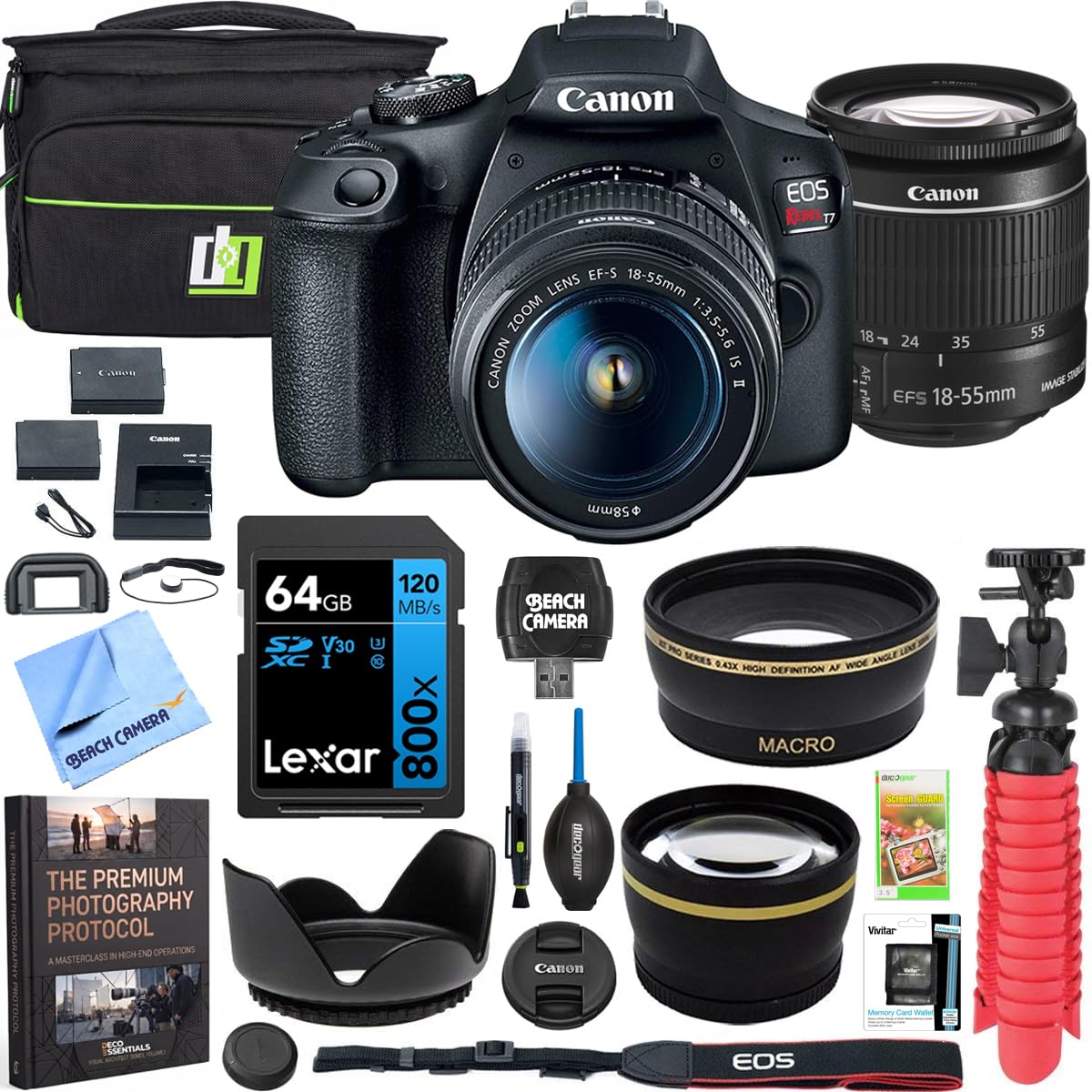
This Canon EOS Rebel T7 bundle is designed for the first-time DSLR buyer who wants everything in one shipment: the 24.1MP camera body, the EF-S 18-55mm f/3.5-5.6 IS II lens with optical image stabilization, a 58mm wide-angle and telephoto lens set, a replacement LP-E10 battery, a 64GB Lexar SDXC memory card, a 12-inch tabletop tripod, and cleaning tools. The 9-point AF system with AI Servo tracking provides adequate autofocus for portraits and landscapes, though it is not designed for fast sports.
The built-in Wi-Fi with NFC allows instant photo transfer to a smartphone for social media sharing, and the Canon Camera Connect app enables remote shooting from up to 16 feet away. The 3.0-inch LCD with 920K dots provides clear image review, but lacks vari-angle articulation. The optical viewfinder offers 95% frame coverage, which is standard for entry-level DSLRs. The 18-55mm IS II lens includes a 4-stop image stabilizer that reduces blur in handheld shots at shutter speeds as slow as 1/15th of a second.
The bundle includes a Deco Gear medium camera bag, which fits the body with the kit lens attached plus the extra accessories. The 60-inch tripod provides stable support for long exposures and group shots, while the cleaning kit includes a sensor brush, blower, and microfiber cloth. The included Deco Essentials photography ebook guides beginners through aperture, shutter speed, and ISO settings. While the battery drains quickly, reportedly lasting only about 8 shots on some units, the spare battery mitigates this issue for longer outings.
Why it’s great
- Comprehensive bundle includes extra lens, tripod, bag, memory card, and cleaning kit
- Built-in Wi-Fi and NFC enable quick photo sharing and remote camera control via smartphone
- 18-55mm IS II lens provides 4-stop optical image stabilization for sharper handheld shots
Good to know
- Reported battery life issues; the LP-E10 may need frequent recharging or replacement
- Included memory card may be a different brand than advertised; check contents upon arrival
5. Used Nikon D3500 DSLR with 18-55mm Lens, Black

The Nikon D3500 is the lightest and most beginner-friendly DSLR in this guide at 365g body only, making it ideal for travel photography where every gram counts. The 24.2-megapixel DX-format CMOS sensor lacks an optical low-pass filter, delivering sharper images with more fine detail compared to the Canon 20D’s 8.2MP CCD. The Guide Mode walks beginners through scene modes, exposure compensation, and white balance with on-screen instructions, effectively teaching manual control without overwhelming the user.
The 11-point AF system provides reliable single-shot autofocus for portraits and landscapes, but the lack of an AF motor in the D3500 body means you must use AF-S lenses with built-in motors for autofocus—older Nikon AF-D lenses will only work in manual focus. The 18-55mm f/3.5-5.6G VR kit lens includes Vibration Reduction for up to 3.5 stops of stabilization, allowing sharp handheld shots in low light. The SnapBridge Bluetooth connection automatically transfers 2MP photos to your smartphone, while full-resolution transfer is available via the Nikon app.
The 3.0-inch LCD with 921K dots provides clear playback but lacks touch functionality. The optical viewfinder offers 95% frame coverage with a 0.85x magnification. The D3500 captures 1080p video at 60fps with monaural sound, but lacks a microphone input, limiting audio quality for vlogging. The battery life is excellent at 1550 shots per CIPA rating, easily lasting a week of casual shooting. The used market offers substantial savings, but verify that the original charger and cable are included as some units arrive with incorrect accessories.
Why it’s great
- Guide Mode teaches manual exposure with on-screen instructions, ideal for absolute beginners
- Lightweight 365g body with 1550-shot battery life for extended travel shooting
- SnapBridge Bluetooth auto-transfers 2MP photos to smartphone for instant sharing
Good to know
- No AF motor in body; only AF-S lenses with built-in motors can autofocus
- Missing microphone input and vari-angle screen limit video and vlogging capability
6. Nikon D3200 24.2 MP CMOS Digital SLR with 18-55mm f/3.5-5.6 AF-S DX NIKKOR Zoom Lens (Renewed)
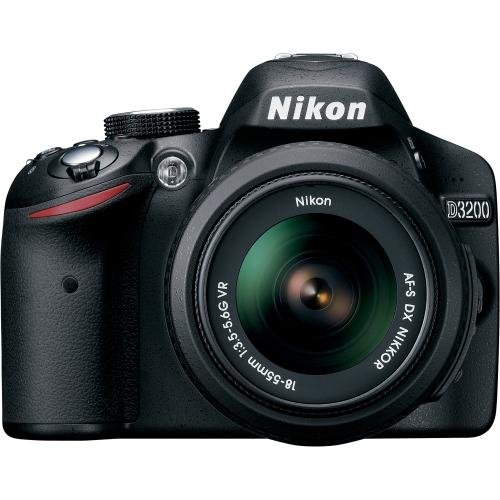
The Nikon D3200 was the first entry-level DSLR to pack 24.2 megapixels into an affordable body, and even a decade later, its sensor delivers excellent dynamic range and color depth at base ISO for large prints and cropping. The EXPEED 3 image processor enables smooth 1080p video at 30fps with full-time autofocus in live view, a feature that older CCD-based cameras like the 20D lack entirely. The 11-point AF system with a central cross-type sensor provides reliable focus for stationary and modestly moving subjects in good light.
The included 18-55mm f/3.5-5.6 AF-S DX VR II lens features Vibration Reduction that counteracts hand shake by up to 4 stops, allowing clean handheld shots at 1/10th of a second. The 3.0-inch LCD with 921K dots is sharp for playback and menu navigation, but lacks touch input. The Guide Mode, inherited from the D5100, walks beginners through aperture priority and shutter priority modes with on-screen tips, making the transition from auto to manual smooth. The D3200 also supports the WU-1a wireless mobile adapter for optional Wi-Fi connectivity.
The renewed condition offers a 90-day warranty and includes the original battery and charger, though some units may have minor cosmetic wear or an off-brand battery. The polycarbonate body with a textured grip is comfortable for extended shooting, though it lacks weather sealing. The absence of Wi-Fi (unless you buy the adapter) means you need a card reader or USB cable to transfer images. For photographers who prioritize sensor resolution and video capability over build quality, the D3200 delivers the best spec-per-dollar ratio among entry-level options.
Why it’s great
- 24.2MP CMOS sensor provides excellent dynamic range for large prints and cropping
- EXPEED 3 processor enables 1080p 30fps video with full-time live view autofocus
- Guide Mode teaches exposure control, great for first-time DSLR users
Good to know
- No built-in Wi-Fi; requires optional WU-1a adapter for wireless connectivity
- Plastic lens mount and body lack weather sealing, limiting use in harsh conditions
7. Sony Alpha A200K 10.2MP Digital SLR Camera Kit with Super SteadyShot Image Stabilization

The Sony Alpha A200K is the only camera in this guide with built-in sensor-shift image stabilization, which works with any mounted lens—making it possible to get sharp shots with vintage Minolta glass or inexpensive manual primes. The 10.2-megapixel APS-C CCD sensor produces images with distinctive color science that many photographers describe as more film-like than modern CMOS sensors, with particularly pleasing skin tones and red saturation. The Super SteadyShot system provides up to 3.5 stops of stabilization, compensating for hand shake at shutter speeds down to 1/15th of a second.
The kit includes an 18-70mm f/3.5-5.6 zoom lens, which provides a 27-105mm equivalent focal range suitable for everyday photography from landscapes to portraits. The 2.7-inch ClearPhoto LCD with 230K dots is adequate for image review but low-resolution compared to modern 3-inch screens. The Eye-Start AF system automatically activates autofocus when you bring the viewfinder to your eye, saving battery power. The 9-point AF system with central cross sensor is reliable for general use but suffers in low light compared to the Canon 20D’s system.
The A200K stores images on CompactFlash Type I/II and Memory Stick Pro Duo cards, which are slower and less common than the SD cards used by all other cameras in this guide. The body uses the Minolta A-mount, which has a smaller used lens market than Canon EF or Nikon F, limiting upgrade options. The included lithium-ion battery provides decent life for a full day of casual shooting, but the lack of a live view means you compose solely through the optical finder. For photographers who want in-body stabilization on a tight budget and appreciate CCD color, this is a unique option.
Why it’s great
- Built-in Super SteadyShot image stabilization works with any mounted lens, including vintage glass
- CCD sensor produces unique color science with pleasing skin tones and rich reds
- Eye-Start AF system activates autofocus when you raise the camera to your eye
Good to know
- Minolta A-mount lens ecosystem is smaller than Canon EF and Nikon F, limiting future upgrades
- Uses CompactFlash and Memory Stick Pro Duo cards instead of the more common SD format
8. Canon EOS 30D 8.2MP Digital SLR Camera (Body Only)

The Canon EOS 30D refines the 20D formula by adding a larger 2.5-inch LCD with 170-degree viewing angle, a spot metering mode, and improved 5 fps burst buffer that allows up to 30 JPEG frames before slowing down. The 8.2-megapixel CCD sensor is the same as the 20D, producing clean, detailed images up to ISO 1600 with noise that resembles film grain rather than digital artifacts. The magnesium-alloy chassis provides exceptional rigidity and durability, and the shutter is rated for 100,000 cycles, meaning a well-used copy still has years of life left.
The 9-point AF system uses a center cross-type sensor that is sensitive at f/2.8, making it compatible with fast primes like the 50mm f/1.8 for reliable low-light focus. The camera accepts all Canon EF and EF-S lenses, including modern STM and USM glass, giving it access to the largest lens ecosystem in the world. The 30D also features a customizable Picture Style system for black and white, landscape, and portrait presets, which reviewers have praised for excellent monochrome JPEGs with film-style options and filters.
The 30D lacks live view and video recording, forcing the photographer to rely entirely on the optical viewfinder for composition. CompactFlash cards are required, which are less convenient than SD cards. The body weighs 785g with battery, notably heavier than the Rebel T7’s 475g, but the solid feel and Japan-build quality justify the heft. For a photographer who values tactile feedback, a bombproof build, and CCD colors, the 30D is a compelling choice with significant savings over the 80D. Verify that the LCD functions correctly before purchase, as some units have reported display failures.
Why it’s great
- Magnesium-alloy chassis with 100,000-cycle shutter offers exceptional durability for the price
- Spot metering and customizable Picture Styles for excellent in-camera black and white JPEGs
- Accepts all Canon EF and EF-S lenses, providing access to a massive used lens market
Good to know
- No live view or video recording; optical viewfinder only for composition
- CompactFlash card slot requires older and slower media versus SD cards
9. Canon EOS 20D DSLR Camera (Body Only) (OLD MODEL)

The Canon EOS 20D is the camera that defined the enthusiast DSLR segment in 2004, and its 8.2-megapixel CCD sensor still produces images with a distinct analog character that modern CMOS cameras often lack. The magnesium-alloy body feels dense and premium in the hand, and the ergonomic grip provides a secure hold even with heavy telephoto lenses. The 5 fps burst mode captures 23 consecutive JPEG files in approximately 4.6 seconds, which was class-leading at launch and remains functional for moderate action photography today.
The 9-point AF system with a center cross-type sensor provides fast, accurate single-shot autofocus for portraits and landscapes, but the AI Servo tracking is primitive by modern standards, struggling with erratic movement. The camera accepts Canon EF and EF-S lenses, giving access to the entire Canon lens ecosystem from vintage FD-mount adapted glass to the latest RF lenses via adapter. The 20D produces very clean images at ISO 100-400, becomes grainy but usable at ISO 800, and retains detail at ISO 1600 with a character that many photographers prefer over the smoothed-out noise of modern sensors.
The 20D uses CompactFlash Type I and II cards, which are slower and less convenient to transfer than SD cards. The 1.8-inch LCD with 118K dots is tiny and low-resolution by today’s standards, useful only for basic histogram verification and composition review. The camera lacks any video capability, live view, or wireless connectivity. The shutter is rated for 50,000 cycles, but many surviving units have exceeded this without failure. For under , the 20D is the cheapest gateway into the Canon professional system, but verify that the data transfer function works and the correct charger is included before purchasing.
Why it’s great
- Ultra-low entry price for a magnesium-alloy body with access to the entire Canon EF/EF-S lens system
- CCD sensor produces distinctive analog-looking images with unique color science
- 5 fps burst rate remains functional for moderate action and event photography
Good to know
- 1.8-inch LCD with 118K dots is very small and low-resolution for image review
- No live view, video, or wireless connectivity; optical viewfinder and CompactFlash only
FAQ
Can I use modern Canon EF-S lenses on the Canon EOS 20D body?
Is the Nikon D3200 still a good camera for learning photography in 2025?
Does the Sony Alpha A200K work with modern SD memory cards?
What does the Canon EOS 80D offer that the 20D does not for video?
Final Thoughts: The Verdict
For most users, the best 20d digital slr winner is the Canon EOS 80D because it combines a 24.2MP sensor, 45-point all cross-type AF, and Dual Pixel CMOS AF for both photography and video in a weather-sealed magnesium body. If you want a lightweight travel camera with excellent battery life and built-in Bluetooth, grab the Nikon D3500. And for the most affordable entry into the Canon EF/EF-S ecosystem, nothing beats the Canon EOS 20D for its rugged build and unique CCD color science.