
A sustained power outage in a large home doesn’t just mean dim lights—it halts HVAC systems, well pumps, and critical medical equipment. A 20-kilowatt diesel-grade generator is the threshold where portable backup transforms into whole-home survival infrastructure, handling a 5-ton AC unit and a full kitchen load simultaneously without breaking a sweat.
I’m Min — the co-founder and writer behind Gadgets Feed. I’ve spent countless hours dissecting generator specifications, comparing engine displacements and wattage curves, and cross-referencing real-world owner feedback to separate marketing claims from actual performance in this demanding power class.
This guide isolates the genuine 20-kilowatt performers from the pretenders, analyzing fuel efficiency, transfer switch compatibility, and true surge capacity so you can confidently select the best 20kw diesel generator for your home or jobsite.
How To Choose The Best 20Kw Diesel Generator
A 20kW-class generator represents a serious investment in home protection. The difference between a satisfying purchase and a costly mistake often comes down to three critical factors: fuel type flexibility, engine build quality, and how the unit integrates with your home’s electrical panel. Below, we break down the specifications that separate mid-range workhorses from premium performers.
Engine Displacement and Construction
The heart of any generator in this class is its engine block. A 670cc to 999cc engine displacement range directly correlates with the sustained torque needed to handle heavy starting loads from HVAC compressors and well pumps. Look for cast-iron cylinder sleeves and OHV valve designs—these components dissipate heat more effectively and extend engine life significantly under continuous load. V-Twin configurations in the 700cc-plus range (like the Milwaukee Series or Westinghouse V-Twin) tend to idle more smoothly and produce less vibration than single-cylinder equivalents, which matters if the generator sits near living spaces.
Fuel Type: Tri-Fuel vs. Dual-Fuel vs. Dedicated
While diesel is the traditional choice for industrial-grade 20kW output, many modern generators in this power band now offer tri-fuel capability—running on gasoline, propane, or natural gas. Natural gas is ideal for whole-home backup because it eliminates fuel storage and refueling during multi-day outages, but it requires a dedicated gas line and a licensed plumber. Propane offers the longest shelf life of any fuel and burns cleanly, while gasoline delivers the highest peak wattage. For buyers seeking the ultimate flexibility, a tri-fuel unit like the Westinghouse 20027 or Champion 201161 provides redundancy that single-fuel generators cannot match.
Transfer Switch Readiness and Electrical Integration
A 20kW generator is useless if you cannot properly connect it to your home’s electrical system. The unit must have a heavy-duty 50A 120/240V outlet (NEMA 14-50R) or a 125A terminal block for hardwiring via a licensed electrician. Many premium models now include both a 50A outlet for portable interlock kits and a high-amp terminal block for permanent standby installation. Confirm that the generator’s neutral is floating (for portable use with an interlock) or can be bonded (for standalone operation) to match your setup. Units with built-in automatic transfer switch (ATS) pre-wiring, like the GENMAX GM10500iETC, simplify installation but require careful voltage matching.
THD (Total Harmonic Distortion) and CO Safety Systems
If you plan to power computers, phones, or modern variable-speed appliances, low Total Harmonic Distortion (THD) is essential. Inverter generators like the GENMAX GM10500iETC achieve THD below 3%, delivering clean power comparable to grid electricity. Open-frame conventional generators, by contrast, often sit at 6–12% THD, which can cause motor windings in refrigerators and furnaces to overheat over extended operation. Carbon monoxide (CO) auto-shutdown systems are now standard in premium models—look for CO Alert (DuroMax), CO-Shield (Champion), or COsense (Generac) certifications for automatic engine kill when CO accumulates beyond safe thresholds in enclosed or semi-enclosed spaces.
Quick Comparison
On smaller screens, swipe sideways to see the full table.
| Model | Category | Best For | Key Spec | Amazon |
|---|---|---|---|---|
| Westinghouse 28000 (B0CQN51MQB) | Tri-Fuel Premium | Whole-home standby with natural gas | 999cc V-Twin / 20,000W running (gas) | Amazon |
| Champion 201161 | Tri-Fuel Value | Whole-home + workshop on NG | 717cc V-Twin / 12,000W running (NG) | Amazon |
| GENMAX GM10500iETC | Inverter Tri-Fuel | Home backup with sensitive electronics | 458cc single / 8,500W running (gas) | Amazon |
| DuroMax XP15000HX (B0BDQQ7PHG) | Dual-Fuel Heavy | Whole-home + RV backup | 670cc OHV / 15,000W peak (gas) | Amazon |
| DuroMax XP15000HXT (B0BDQRQCC2) | Tri-Fuel DuroMax | Multi-fuel jobsite + home | 670cc OHV / 15,000W peak (gas) | Amazon |
| Westinghouse 28000 (B0C2JD7M8K) | Gasoline Premium | High-output pure gasoline backup | 999cc V-Twin / 20,000W running | Amazon |
| Generac GP15500EFI (7705) | EFI Gasoline | Long-duration gasoline home backup | 816cc EFI / 19,300W starting | Amazon |
| Honda EU7000iS | Inverter Premium | Quiet, clean power for critical loads | 389cc inverter / 7,000W running | Amazon |
| Generac Guardian 22kW (7043) | Standby Premium | Permanent whole-home automatic backup | 999cc G-Force / 22,000W running | Amazon |
In‑Depth Reviews
1. Westinghouse 28000 Peak Watt Tri-Fuel (B0CQN51MQB)
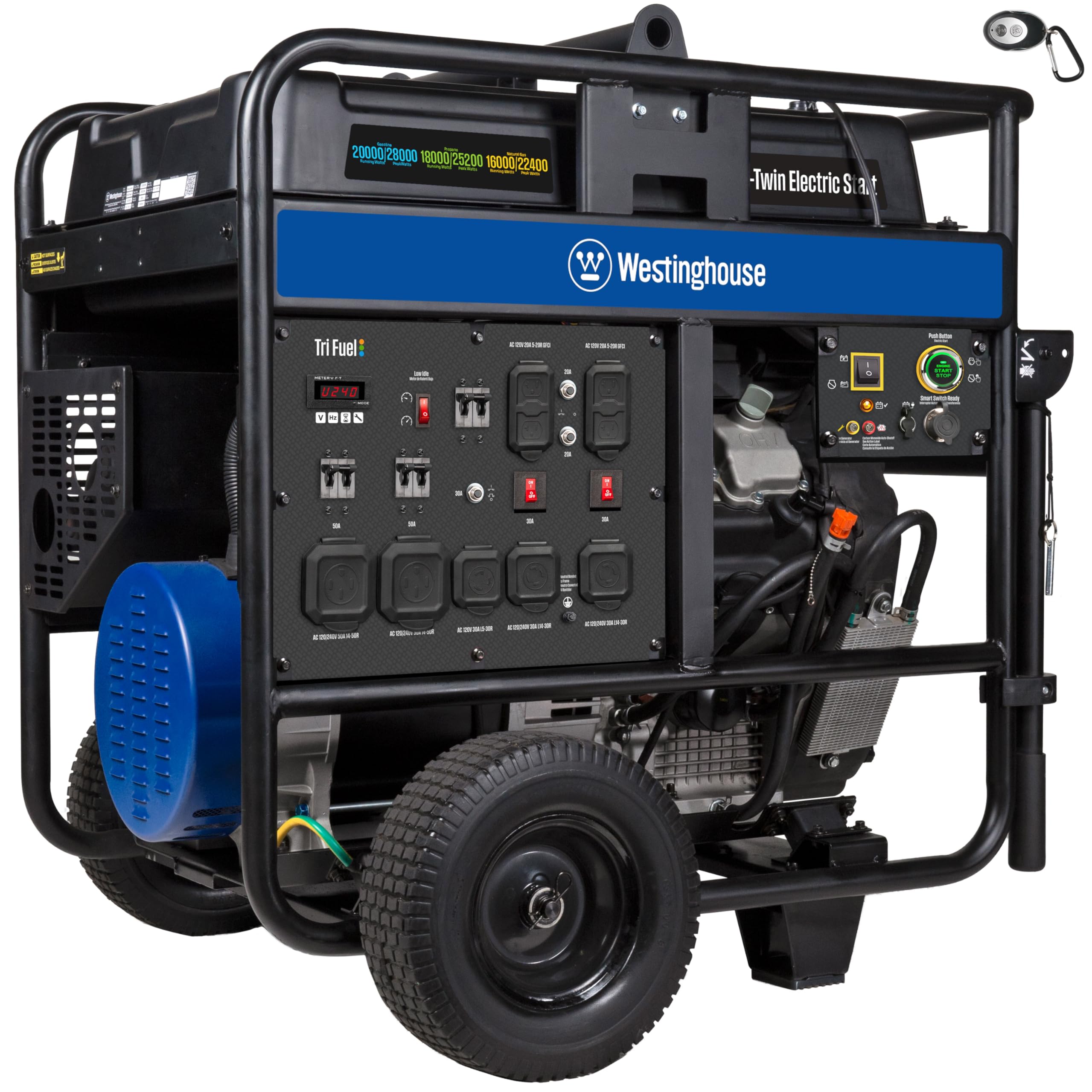
The Westinghouse 28000 Tri-Fuel sits at the top of the 20kW-class hierarchy for a straightforward reason: its 999cc V-Twin OHV engine with a cast-iron sleeve delivers 20,000 running watts on gasoline and 16,000 running watts on natural gas, backed by a 125A terminal block that allows a licensed electrician to hardwire it directly into your home panel—bypassing the current limitations of standard 50A outlets. This is the rare portable generator that genuinely behaves like a whole-house standby unit while remaining movable via never-flat wheels and foldable handles.
In real-world use, owners report powering 2,100–3,000-square-foot homes including central air conditioning (with a soft start), well pumps, electric dryers, and full kitchen loads simultaneously. The tri-fuel flexibility means you can run the unit on natural gas indefinitely during an extended outage, switch to propane for cleaner storage, or fall back to gasoline during extreme cold when gas line pressure drops. The Low THD engineering keeps modern electronics safe, and the CO auto-shutdown sensor adds a critical safety layer for outdoor semi-enclosed placement.
Assembly is straightforward—bolt on the wheels, attach the handle, connect the battery, and add oil—but the 557-pound dry weight demands a trailer hitch or a ramp for off-pallet movement. Some early units shipped with minor cosmetic issues (missing control panel bolts), but Westinghouse support has resolved those under warranty. The 17.2-gallon tank delivers up to 15 hours at 25% load, though full 20kW draw will burn through that fuel in roughly 8–10 hours, making natural gas the obvious choice for multi-day events.
Why it’s great
- 999cc V-Twin with cast-iron sleeve for extreme durability
- 125A terminal block for direct hardwire installation
- Tri-fuel (gas, propane, natural gas) with included hoses
- Low THD safe for sensitive electronics
Good to know
- Very heavy (557 lbs) requires planning for off-pallet movement
- Gasoline consumption is high under full load
- Some units have minor QC gaps like missing bolts
2. Champion Power Equipment 201161 15,000-Watt Tri-Fuel

Champion’s 201161 bridges the gap between true 20kW capacity and budget-friendly affordability with its Milwaukee Series 717cc V-Twin engine, delivering 15,000 starting watts and 12,000 running watts on gasoline, and still capable of powering a 3.5-ton central AC unit with a soft start on natural gas. The unit arrives with both natural gas and propane hoses included, eliminating the need for additional purchases—a rare convenience at this price point.
Real-world performance data from Hurricane Beryl survivors is compelling: owners ran the generator for 90+ continuous hours on natural gas, powering well pumps, refrigerators, freezers, window AC units, and partial HVAC loads. The Intelligauge display tracks voltage, hertz, and run-time hours, making maintenance scheduling transparent. The CO Shield carbon monoxide auto-shutdown system is sensitive—some users report false triggers after 1.5–2 hours of outdoor operation—but Champion has been responsive in replacing units damaged in shipping.
The 331-pound weight makes it one of the lighter units in this class, and the included wheel kit with folding handles simplifies positioning. The break-in procedure requires a 5-hour run at 50% load before the first oil change, a step many skip but one that directly impacts long-term engine health. The 3-year limited warranty and free lifetime technical support provide reassurance, though the CO sensor sensitivity and occasional shipping damage are the primary drawbacks to monitor.
Why it’s great
- 717cc V-Twin with cast-iron sleeve for reliable power
- Includes both NG and propane hoses out of the box
- Proven 90+ hour continuous performance in real emergencies
- Light enough (331 lbs) for manageable repositioning
Good to know
- CO Shield sensor may trigger prematurely in some conditions
- Must perform 5-hour break-in before full load
- Long-term parts can be slow to source
3. GENMAX GM10500iETC Tri-Fuel Inverter

The GENMAX GM10500iETC stands apart from the conventional open-frame crowd by packing inverter technology into a 10.5kW tri-fuel package, achieving Total Harmonic Distortion (THD) under 3%—clean enough to run sensitive electronics, computer servers, and modern variable-speed HVAC controls without risk of damage. Its 458cc 4-stroke engine produces 8,500 running watts on gasoline and 6,800 running watts on natural gas, making it ideal for homes where clean power for smart appliances is as critical as raw wattage.
Owner experiences highlight the unit’s remarkable quietness on natural gas—significantly lower than open-frame competitors—and the remote start key fob allows operation from inside the house during storm conditions. The 50A NEMA 14-50R outlet and voltage transfer switch simplify hookup to a home interlock kit, and the included ATS cable pre-wires the generator for automatic standby operation. Multiple protection systems—overload, thermal, overvoltage, undervoltage, overcurrent, short circuit, and overspeed—are embedded in the control board, providing industrial-grade safeguards.
The downsides are notable but manageable: the unit ships without a paper manual (available on request), and some owners received units with minor defects that required warranty return. The neutral is floating by default, requiring a separately sold bonding plug for standalone use. At lower output than the heavy hitters (8.5kW vs. 15–20kW), this generator is best suited for homes that do not need to run multiple HVAC systems simultaneously—but for those who prioritize power quality and fuel efficiency, it delivers unmatched value in its class.
Why it’s great
- Inverter technology delivers THD under 3% for sensitive electronics
- Tri-fuel (gas, propane, natural gas) with included hoses
- Remote start key fob and ATS pre-wire for convenience
- Multiple onboard protection systems for safety
Good to know
- Running watts lower than conventional 20kW units
- Neutral floating requires bonding plug for standalone use
- Some QC variance reported; check unit immediately on delivery
4. DuroMax XP15000HX Dual-Fuel
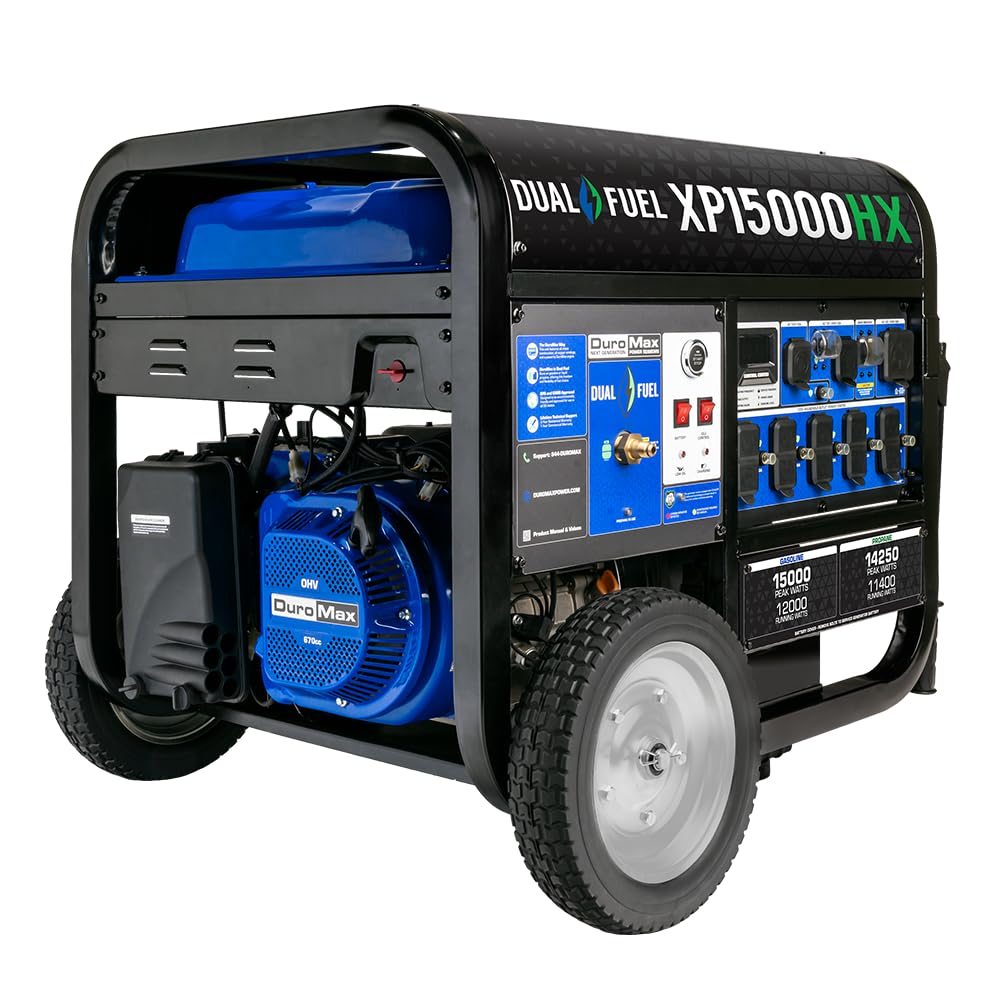
DuroMax’s XP15000HX delivers a no-nonsense 15,000 peak watts and 12,000 running watts on gasoline through its 670cc OHV engine, with all-copper windings designed to dissipate heat more effectively than aluminum-wound competitors—a feature that measurably extends the generator’s operational lifespan under sustained heavy loads. The dual-fuel configuration (gasoline and propane) provides fuel flexibility without the added complexity of a third fuel system.
The power panel is fully loaded: five GFCI 120V household outlets, a 120V 30A twist-lock, a 120/240V 30A twist-lock, and a heavy-duty 120/240V 50A outlet ready for transfer switch connection. The front-facing control panel with a digital multimeter displays voltage, frequency, total hours run, and maintenance interval warnings—all visible at a glance. The CO Alert system automatically shuts down the engine when harmful fumes are detected, adding a critical safety layer.
Owner feedback is generally positive, with praise for the unit’s ability to run heat pumps and whole-home loads without hiccups. However, the generator runs loud (typical for open-frame dual-fuel units), and some owners reported the unit arriving with no oil (standard for all DuroMax models—read the manual). A small number of catastrophic failures (fires reported in isolated cases) point to possible assembly or shipping damage issues, making a thorough pre-use inspection mandatory.
Why it’s great
- 100% copper windings for better heat dissipation
- Dual-fuel flexibility with front-facing fuel selector
- Digital multimeter with maintenance interval tracking
- CO Alert auto-shutdown for safety
Good to know
- Loud operation typical of open-frame designs
- Requires careful assembly and oil check before first start
- Isolated reports of manufacturing defects
5. DuroMax XP15000HXT Tri-Fuel
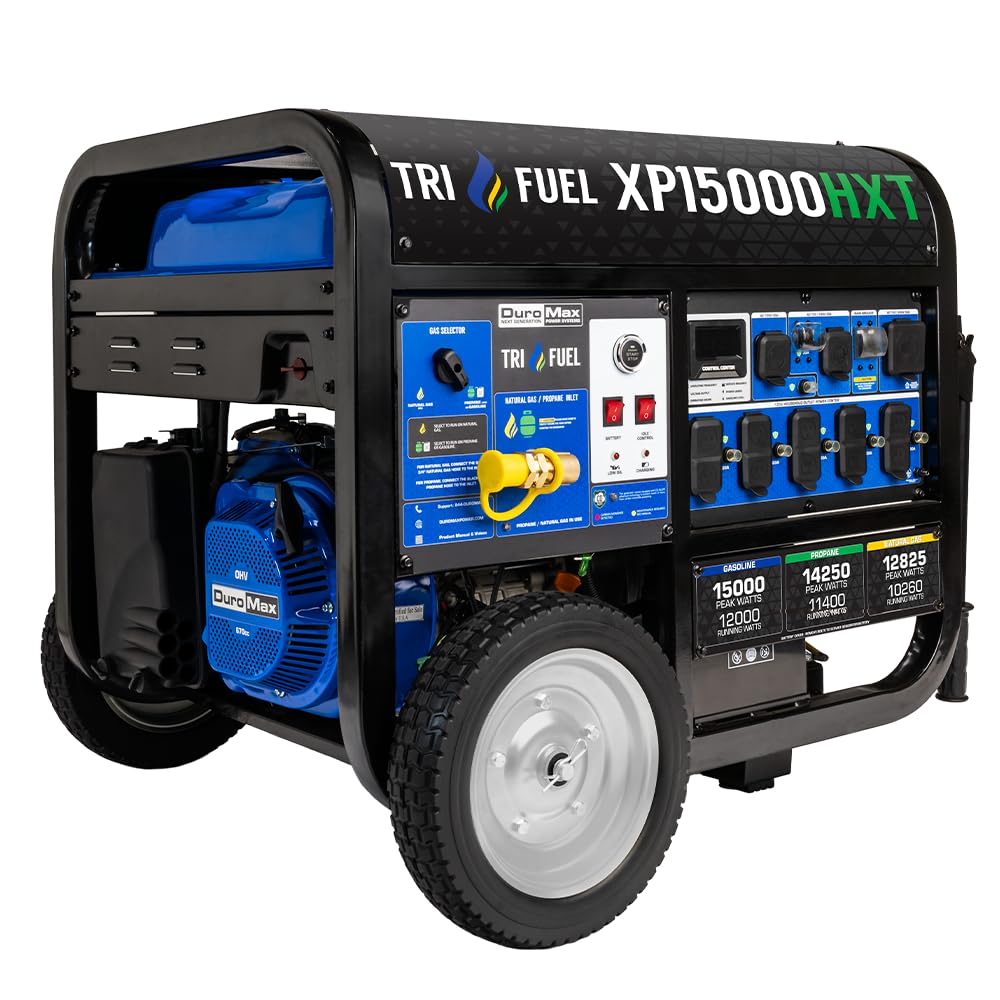
The DuroMax XP15000HXT is the tri-fuel sibling of the XP15000HX, adding natural gas capability to the same 670cc OHV engine platform while retaining the all-copper windings and remote start key fob. This unit outputs 15,000 peak watts on gasoline, 13,500 on propane, and approximately 12,000 on natural gas—enough to cover most large homes when connected to a 50A interlock kit.
The upgraded computer interface features a large LED display with a gas gauge, load gauge, voltage, frequency, and runtime readout. The included 15-foot natural gas hose (3/4-inch diameter) and propane regulator mean you can switch between all three fuels without buying additional adapters. Owners praise the unit as a “tank” for jobsite use, camping, and whole-home backup, noting that the remote start works reliably from 100+ feet away.
Notable downsides include a 50 Hz frequency rating on the spec sheet (though the unit outputs 60 Hz in practice—a labeling inconsistency that causes confusion), and a significant design revision between the HX and HXT models that changed the control board location, oil access, and exhaust routing, making it incompatible with some older mounting setups. A handful of owner reports mention breakers tripping under perceived load, suggesting possible manufacturing inconsistency in the voltage regulator.
Why it’s great
- Tri-fuel with included natural gas hose and propane regulator
- Remote start key fob for convenient operation
- 100% copper windings for longevity
- Large LED display with real-time load monitoring
Good to know
- Spec sheet confusion over 50 Hz vs. actual 60 Hz output
- Design revision may not fit previous mounting setups
- Some units have voltage regulation inconsistencies
6. Westinghouse 28000 Peak Watt (B0C2JD7M8K)

This gasoline-only version of Westinghouse’s 999cc V-Twin platform strips back the tri-fuel complexity to deliver the highest raw power density in the review: 28,000 peak watts and 20,000 running watts from a single fuel source, with a 17-gallon fuel tank providing up to 15 hours of runtime at 25% load. The cast-iron sleeve engine with automatic idle control reduces fuel consumption when demand is low, a feature missing from many competitors at this power level.
The outlet configuration is extensive: four GFCI 120V household outlets, two 50A 120/240V 14-50R outlets, two 30A 120/240V L14-30R outlets, and one 30A 120V L5-30R outlet—all with rubber covers. This makes the unit uniquely suited for simultaneously powering a house via interlock and running a separate workshop or RV feed. The remote start key fob and push-button electric start with auto choke simplify operation in bad weather.
At 541 pounds, this is one of the heaviest portable generators available, and owners confirm it requires 2–4 people or mechanical assistance to unload from a delivery truck. Noise levels are moderate for its class—audible but not overwhelming inside the house. The main risks are that Westinghouse warranty covers parts only (labor costs fall on the owner), and a small number of units have suffered complete failure after 1.5 years of light use, with customer support being slow to respond.
Why it’s great
- 999cc V-Twin with cast-iron sleeve for maximum durability
- 28,000 peak watts is among the highest in this class
- Multiple 50A outlets for dual-feed setups
- Automatic idle control for fuel savings at low loads
Good to know
- 541 lbs requires heavy lifting equipment
- Parts-only warranty; user pays labor costs
- Some units experience premature failure
7. Generac GP15500EFI (7705)
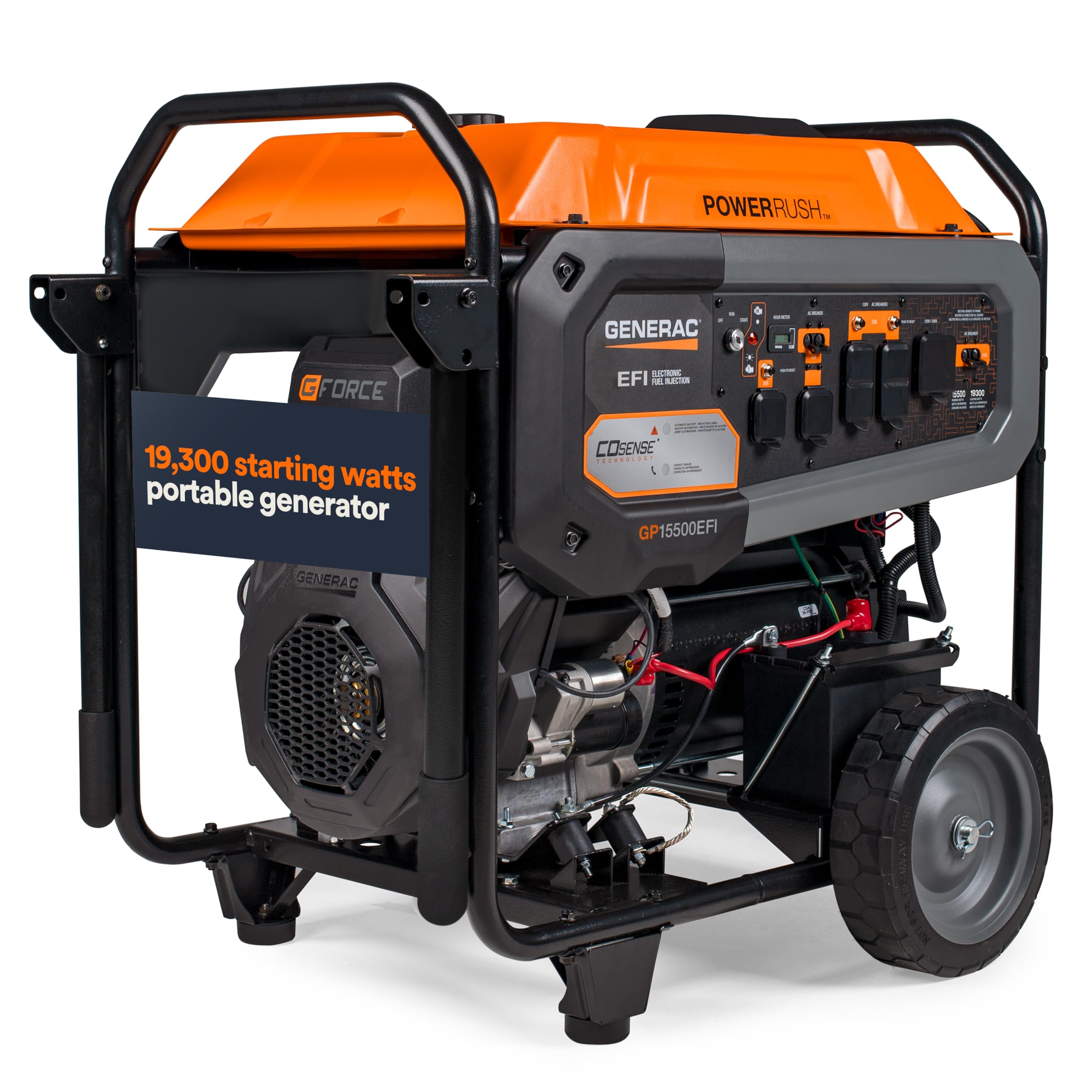
Generac’s GP15500EFI brings electronic fuel injection (EFI) to the 20kW-class portable generator segment, eliminating the carburetor’s susceptibility to stale fuel, altitude changes, and cold starts. The 816cc EFI engine delivers 19,300 starting watts and 15,500 running watts on gasoline, with the COsense technology continually monitoring carbon monoxide levels and automatically shutting down the engine before dangerous accumulation occurs.
The EFI system is the standout feature here: it self-adjusts fuel mixture based on temperature and load, which translates to easier starting in sub-freezing conditions and better fuel efficiency across the load curve. The large-capacity steel fuel tank includes a built-in gauge, and the rugged 1.25-inch steel-tube cradle with never-flat wheels is designed to survive repeated transport on rough job sites. Owners with 500+ hours of runtime on non-ethanol fuel report zero engine issues when adhering to early oil changes.
However, build quality perception is mixed. Some units arrive with missing wheel kit axles, and the spark plugs on some models were found gapped at 0.018 inches instead of the specified 0.030 inches, causing misfires under load. The warranty process through Generac’s dealer network varies by region—some owners received prompt replacements, while others faced long delays for simple parts. The EFI system, while beneficial, also introduces a computer module that is less field-serviceable than a carburetor for remote or off-grid users.
Why it’s great
- Electronic fuel injection for reliable cold starts and altitude compensation
- 816cc EFI engine with proven 500+ hour longevity on non-ethanol fuel
- COsense auto-shutdown for enhanced safety
- Rugged steel cradle designed for job site durability
Good to know
- Some units have missing wheel kit parts or incorrect spark plug gap
- EFI module is less field-serviceable than a carburetor
- Warranty support quality varies by region
8. Honda EU7000iS Inverter
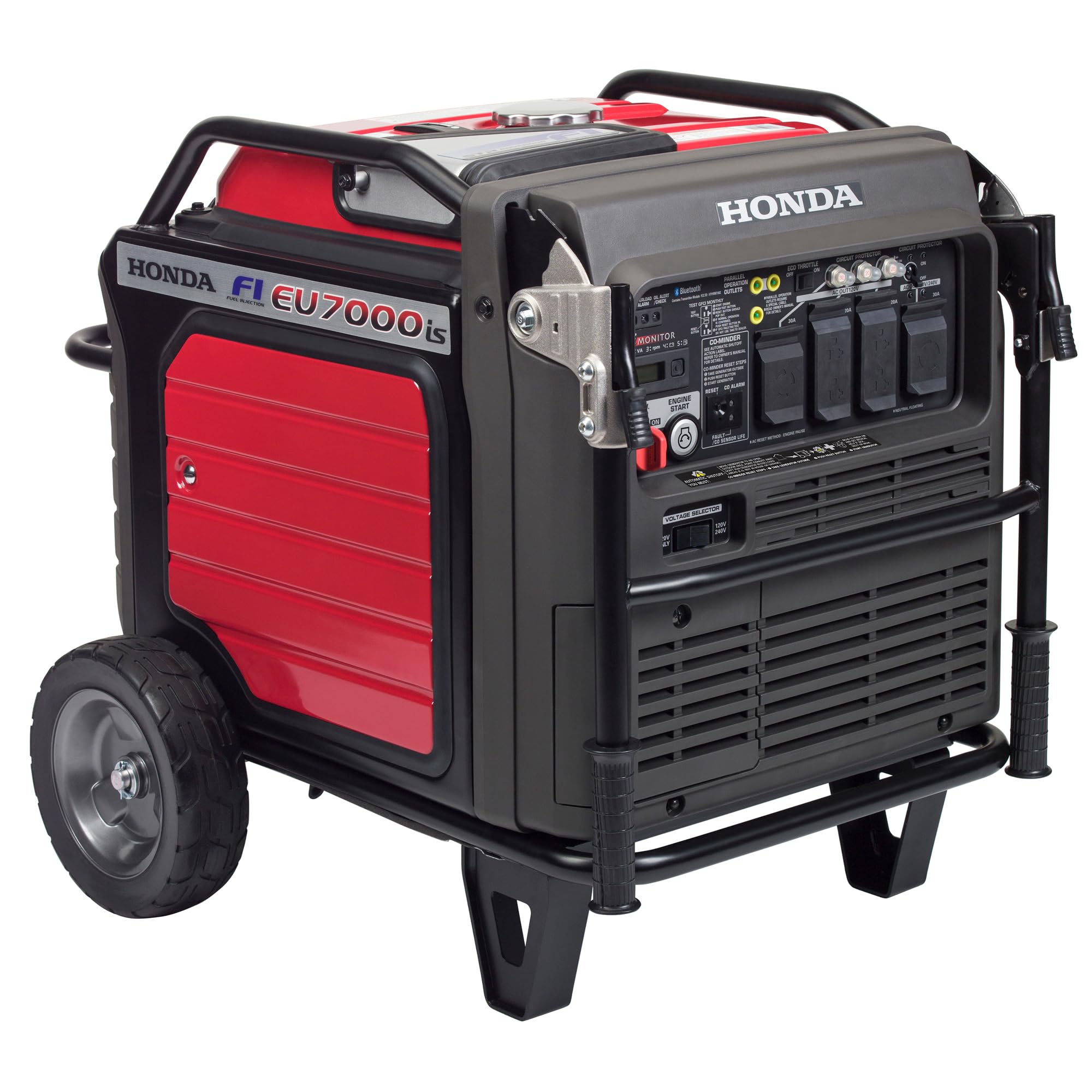
Honda’s EU7000iS redefines what a 7kW generator can do by combining advanced inverter technology with noise levels as low as 52 dBA—quieter than a normal conversation—making it the only unit in this guide that can power a home without disrupting neighborhood quiet hours or camping experiences. The 389cc engine delivers 7,000 running watts and 8,000 peak watts, with the Eco Throttle system adjusting engine speed to match load, achieving 6.4–16 hours of runtime on a single 5.1-gallon tank.
The parallel capability allows two EU7000iS units to combine for up to 14,000 running watts, competitive with many open-frame units while maintaining the whisper-quiet operation and clean sine-wave output that protects laptops, medical devices, and audio equipment. The My Generator smartphone app provides Bluetooth-based remote start/stop and maintenance reminders—a rare convenience in the generator world. The CO-MINDER system continuously monitors CO levels and shuts down the engine before unsafe thresholds are reached.
The trade-offs are significant for the price: 7kW is insufficient to run a whole 2,000+ square-foot home with HVAC without strict load management. Owners typically pair this unit with a Generlink or transfer switch and selectively power essential circuits (fridge, furnace blower, lights, well pump). At 263 pounds, it is the most maneuverable unit here, but the fuel tank is small, requiring refueling every 6–8 hours under moderate load. The price places it firmly in premium territory, justified by Honda’s legendary reliability and the quietest operation in its class.
Why it’s great
- 52–58 dBA noise level is the quietest in this comparison
- Inverter technology delivers clean sine-wave power for electronics
- Bluetooth app with remote start and maintenance reminders
- Lightweight (263 lbs) and highly portable
Good to know
- 7kW running watts insufficient for whole-home HVAC without load management
- Small fuel tank requires frequent refueling under load
- Premium price matches Honda’s build quality
9. Generac Guardian 22kW (7043) with 200A Transfer Switch
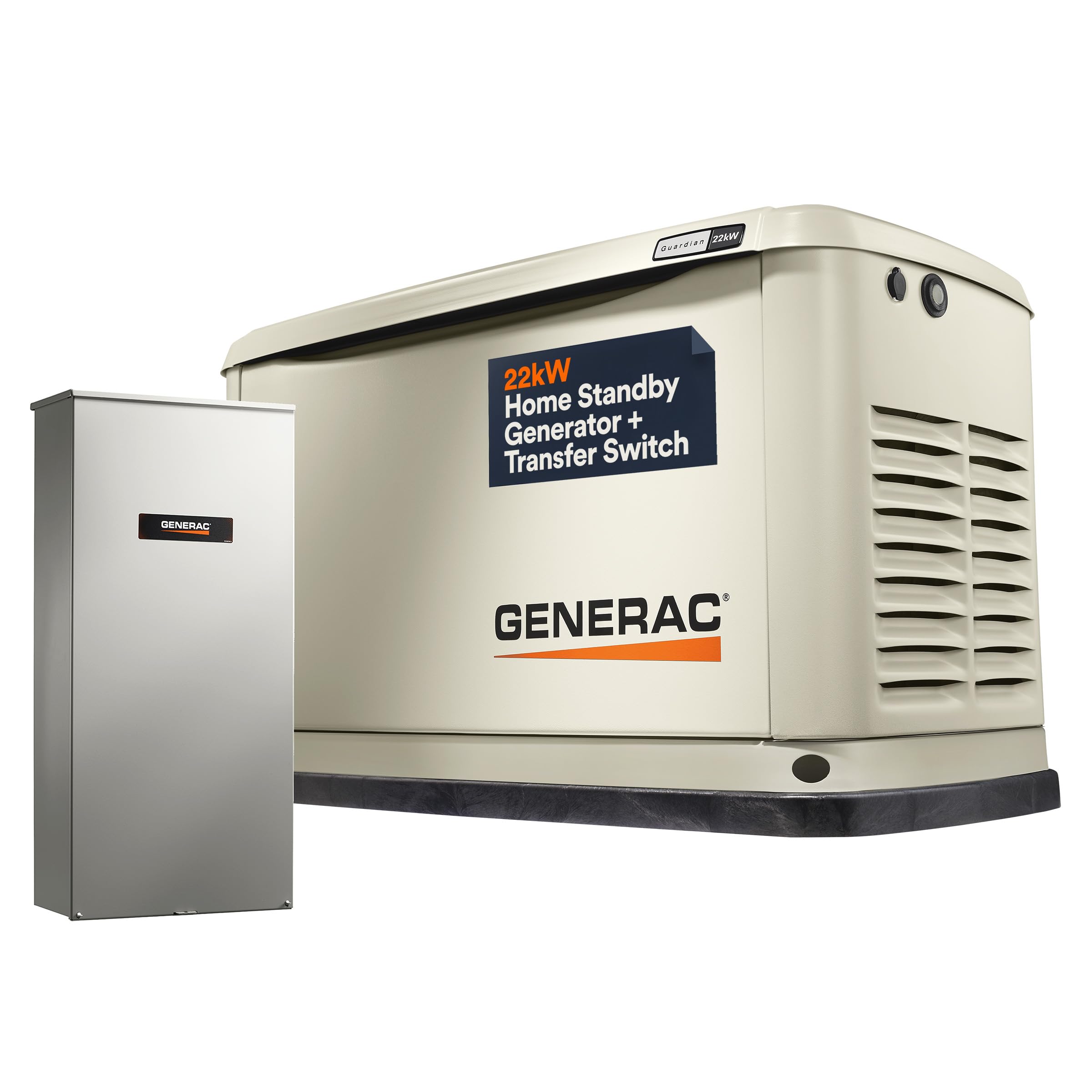
The Generac Guardian 22kW (7043) is the only true automatic standby generator in this lineup, and it occupies a different category entirely: it sits permanently outside your home, connected to your main electrical panel via a 200A NEMA 3R smart transfer switch, and automatically starts within seconds of a utility outage—no extension cords, no manual transfer, no refueling. The 999cc G-Force engine delivers 22,000 running watts on natural gas or propane, with True Power Technology maintaining under 5% total harmonic distortion.
The Mobile Link Wi-Fi connectivity provides remote monitoring via smartphone, providing real-time status updates, maintenance alerts, and exercise cycle logs. The generator self-exercises weekly to ensure readiness, running briefly under load to keep components lubricated and the battery charged. Owners who purchased through Amazon report prices significantly below local dealer quotes, even after paying a licensed electrician for professional installation. The 5-year limited warranty provides long-term confidence.
The downsides are a direct consequence of the automatic standby design: installation is not a DIY project—you need a licensed electrician and a natural gas or propane supply line. The onboard computer controls can be sensitive to power surges or EMP events, and the Generac mobile app now requires a annual subscription for full feature access. Some owners in remote areas without internet connectivity report difficulty with the Wi-Fi-dependent monitoring system. If you are looking for a portable generator you can take on trips or move between properties, this is not it—but for whole-home peace of mind, it is the ultimate solution.
Why it’s great
- Automatic start and transfer within seconds of outage
- 22,000 running watts covers entire home including HVAC
- 5-year limited warranty provides long-term confidence
- Wi-Fi remote monitoring with smartphone app
Good to know
- Professional installation required by licensed electrician and plumber
- Annual subscription () required for full app features
- Not portable—permanent installation only
FAQ
Do I need a soft start for my HVAC system when using a 20kW generator?
Can I run a 20kW tri-fuel generator on natural gas without a gas line modification?
What is the difference between a floating neutral and a bonded neutral generator?
How do I calculate the running wattage my home actually needs?
Can I leave a portable 20kW generator outside in the rain or snow?
Final Thoughts: The Verdict
For most users, the best 20kw diesel generator winner is the Westinghouse 28000 Tri-Fuel because its 999cc V-Twin engine delivers genuine whole-home power with natural gas flexibility and a 125A terminal block for hardwire installation—closing the gap between portable and standby without requiring permanent installation. If you want the cleanest power for sensitive electronics and quieter operation, grab the GENMAX GM10500iETC. And for permanent, hands-off whole-home backup, nothing beats the Generac Guardian 22kW with automatic transfer switch.