
An air-cooled V-twin idling in summer traffic pushes oil temps past 280°F — that is the moment a thin or unstable 20W50 shears down, losing film strength and leaving your camshafts and bearings exposed. Selecting the right 20W50 motor oil is about finding a lubricant with high shear stability, robust ZDDP levels, and resistance to thermal degradation that matches your specific engine platform.
I’m Min — the co-founder and writer behind Gadgets Feed. I’ve spent hundreds of hours analyzing oil additive packages, viscosity curves, and real-spectroscopy data to understand how different 20W50 formulations protect flat-tappet cams, wet clutches, and high-output pushrod engines under sustained thermal load.
This guide breaks down seven of the top contenders by their film strength, additive chemistry, and real-world performance. Read on to find the best 20w50 motor oil for your engine.
How To Choose The Best 20W50 Motor Oil
Selecting a 20W50 motor oil isn’t about picking the highest price tag. The real decision hinges on three pillars: the engine’s operating temperature profile, the presence of a wet clutch, and the camshaft type (flat-tappet vs. roller). A high-torque air-cooled motor demands a different additive package than a water-cooled cruiser. Here is how to match the oil to the machine.
Thermal Resistance and Shear Stability
Air-cooled V-twins and older inline-fours run significantly hotter than modern water-cooled engines. The oil’s viscosity must remain stable above 260°F to prevent the film from thinning out and losing load-bearing capacity. Look for formulations using Group IV PAO or Group V ester base stocks, which possess natural high-temperature stability. Synthetic blends with high shear stability indices resist permanent viscosity loss from the mechanical shearing that occurs in transmission and primary chaincases.
Additive Chemistry: ZDDP and Friction Modifiers
The anti-wear package, specifically zinc dialkyldithiophosphate (ZDDP), is critical for flat-tappet engines where the cam lobe slides across the lifter face. Low-ZDDP oils (below 1200 ppm) risk cam spalling. A premium 20W50 for older Harley-Davidson or British engines should contain at least 1400 ppm zinc. However, friction modifiers that reduce static friction can cause wet clutch slippage. A JASO MA or MA2 certification confirms the oil’s friction characteristics are compatible with a shared lubrication sump.
Base Stock and Additive Package Synergy
The base stock determines the oil’s resistance to oxidation and thermal breakdown. Conventional oils use Group I or II base stocks that oxidize faster under sustained heat. Full synthetics using PAO and ester blends offer longer service intervals and better deposit control. The additive package includes detergents to neutralize combustion acids, dispersants to suspend soot particles, and anti-foam agents to prevent aeration in the crankcase. The most expensive oils often pair a premium base stock with a robust additive dose.
Quick Comparison
On smaller screens, swipe sideways to see the full table.
| Model | Category | Best For | Key Spec | Amazon |
|---|---|---|---|---|
| Red Line 42504 | Full Synthetic | Milwaukee-Eight & Big Twins | 2200 ppm ZDDP, ester base | Check Price |
| Lucas Oil 10702 | Full Synthetic | Harley top-end noise reduction | 6-quart case, high zinc | Check Price |
| Royal Purple 06316 | Full Synthetic | High-temp film strength | Max-Cycle additive technology | Check Price |
| AMSOIL WV01RCA07923 | Full Synthetic | Combined sump protection | JASO MA/MA2 certified | Check Price |
| Liqui Moly 20064 | Synthetic Blend | Universal 4-stroke use | 4-liter jug, high shear stability | Check Price |
| Valvoline 798152 | Conventional | Budget-friendly seasonal changes | 6-qt case, anti-foam additives | Check Price |
| PENN GRADE 1 71196 | Synthetic Blend | Racing / high-hp engines | ZDDP for flat tappet | Check Price |
In‑Depth Reviews
1. Red Line 42504 20W50 Motorcycle Oil

Red Line 42504 uses a full-synthetic formulation with ester and PAO base stocks delivering 2200 ppm of ZDDP — among the highest zinc concentrations found in a retail 20W50. This makes it especially suited to Milwaukee-Eight, Twin Cam, and Evolution big twins where flat-tappet cam lobes require extreme pressure protection under sustained high spring loads and elevated oil temps.
The friction modifiers are specifically engineered for wet-clutch compatibility, earning JASO MA/MA2 certification. Users consistently report audible top-end noise reduction and smoother shifting. The ester base also offers superior ring seal and lower evaporation loss compared to conventional or Group III base stocks.
Red Line has been manufacturing since 1979 with a zero-compromise approach. The 42504 delivers measurable film strength that resists shearing even when oil temperatures climb beyond 250°F. For a high-output big twin, this is the benchmark.
Why it’s great
- Highest ZDDP at 2200 ppm protects flat-tappet cams
- Ester + PAO base resists thermal breakdown
- JASO MA/MA2 certified for wet clutches
Good to know
- Quart size only; bulk buyers need multiple units
- Premium price per quart reflects ester content
2. Lucas Oil 10702 High Performance Synthetic 20W-50

Lucas Oil 10702 is a full-synthetic 20W50 that has amassed a cult following within the Harley-Davidson community for its ability to quiet top-end rattle on Twin Cam and Milwaukee-Eight engines. The oil uses a high-zinc additive package that provides strong anti-wear protection for flat-tappet setups.
The synthetic base stock delivers consistent viscosity across a wide temperature range, resisting thermal thinning in air-cooled engines. Users report seeing good oil condition even after 5,000-mile intervals. The case of six quarts covers two full oil changes for most big twins, making the per-quart cost competitive for a synthetic.
Lucas Oil has been a staple in American motorsports since the 1980s. The 10702 is designed specifically for motorcycle applications where the engine, transmission, and primary chaincase share a common sump, requiring the correct friction profile to prevent clutch slip.
Why it’s great
- Notably reduces top-end engine rattle
- Full synthetic withstands air-cooled heat
- Convenient 6-quart case saves per-unit cost
Good to know
- Some users report faster shearing in extreme race conditions
- Not ideal for high-revving applications above 7,000 RPM
3. Royal Purple 06316 Max-Cycle 20W-50

Royal Purple Max-Cycle 20W-50 uses a full synthetic base stock combined with the company’s proprietary Synerlec additive technology. This formulation provides a tenacious film under extreme pressure, delivering greater wear protection on cold startup and sustained protection as oil temperatures rise. The additive package also includes rust and corrosion inhibitors.
Users switching from other synthetics frequently note smoother shifting and reduced valvetrain noise. The case of six quarts provides enough oil for two changes on most cruisers. The dark purple color visually confirms the additive presence. Oil analysis reports show low wear metals at 4,000–5,000 mile drain intervals.
Royal Purple’s Max-Cycle line was specifically developed for high-performance motorcycle engines with shared sumps. It is JASO MA/MA2 certified, meaning it will not interfere with wet clutch engagement. The oil also offers good oxidation stability, resisting sludge formation.
Why it’s great
- Synerlec additive tech improves film strength
- Low wear metals reported in used-oil analysis
- JASO MA/MA2 certified for wet clutches
Good to know
- Dark color makes visual level check harder
- Case of six can be heavy to pour from
4. AMSOIL WV01RCA07923 Full Synthetic 20W-50

AMSOIL has built a reputation for extending oil drain intervals through superior base stock technology. The WV01RCA07923 is a full-synthetic 20W50 designed for motorcycle engines, transmissions, and primary chaincases. It offers extreme-pressure protection for gears and chains while maintaining the correct static friction coefficient for wet clutches per JASO MA/MA2 standards.
The 1-gallon jug format is convenient for single changes on big twins without mixing multiple quarts. Users consistently report noticeable improvement in shift quality and a quieter engine tone. The oxidation resistance is excellent, making this oil suitable for bikes that sit in extended traffic or see sustained high-rev operation.
AMSOIL backs the oil with their WARRANTY SECURE guarantee, stating it will not void factory warranties. The high-temperature stability prevents viscosity loss even when oil temps exceed 250°F. The gallons are priced competitively compared to buying four individual quarts.
Why it’s great
- Exceptional oxidation resistance for extended drains
- 1-gallon jug simplifies refills
- Warranty backed by AMSOIL guarantee
Good to know
- Gallon jug requires careful measuring
- Premium cost per quart vs. blends
5. Liqui Moly 20064 Motorbike 4T 20W-50

Liqui Moly 20064 is a synthetic-blend 20W50 that punches above its tier in shear stability and cleaning capability. The German formulation uses a high-viscosity index base that resists thermal thinning, with a flash point of 230°C, which is very high for a blend. The additive package includes specialized detergents that prevent black sludge formation engines prone to carbon buildup.
The 4-liter jug is a smart value choice for riders who need exactly one change and have no interest in storing leftover oil. Multiple users in hot-climate states like Florida report that the oil holds its viscosity during prolonged summer rides without significant breakdown. It is mixable with other engine oils and suitable for wet clutches.
Liqui Moly has decades of reputation in European motorsports. The 20064 is universal-fit, compatible with most 4-stroke motorcycles, scooters, and ATVs. For riders who want German engineering at a mid-range price point, this is a strong candidate.
Why it’s great
- High flash point (230°C) resists burn-off
- Excellent cleaning prevents sludge
- 4-liter jug is a tidy single-change size
Good to know
- Not a full synthetic; lower ZDDP than Red Line
- Some users report higher oil consumption vs. full synthetics
6. Valvoline 798152 4-Stroke 20W-50 (Case of 6)
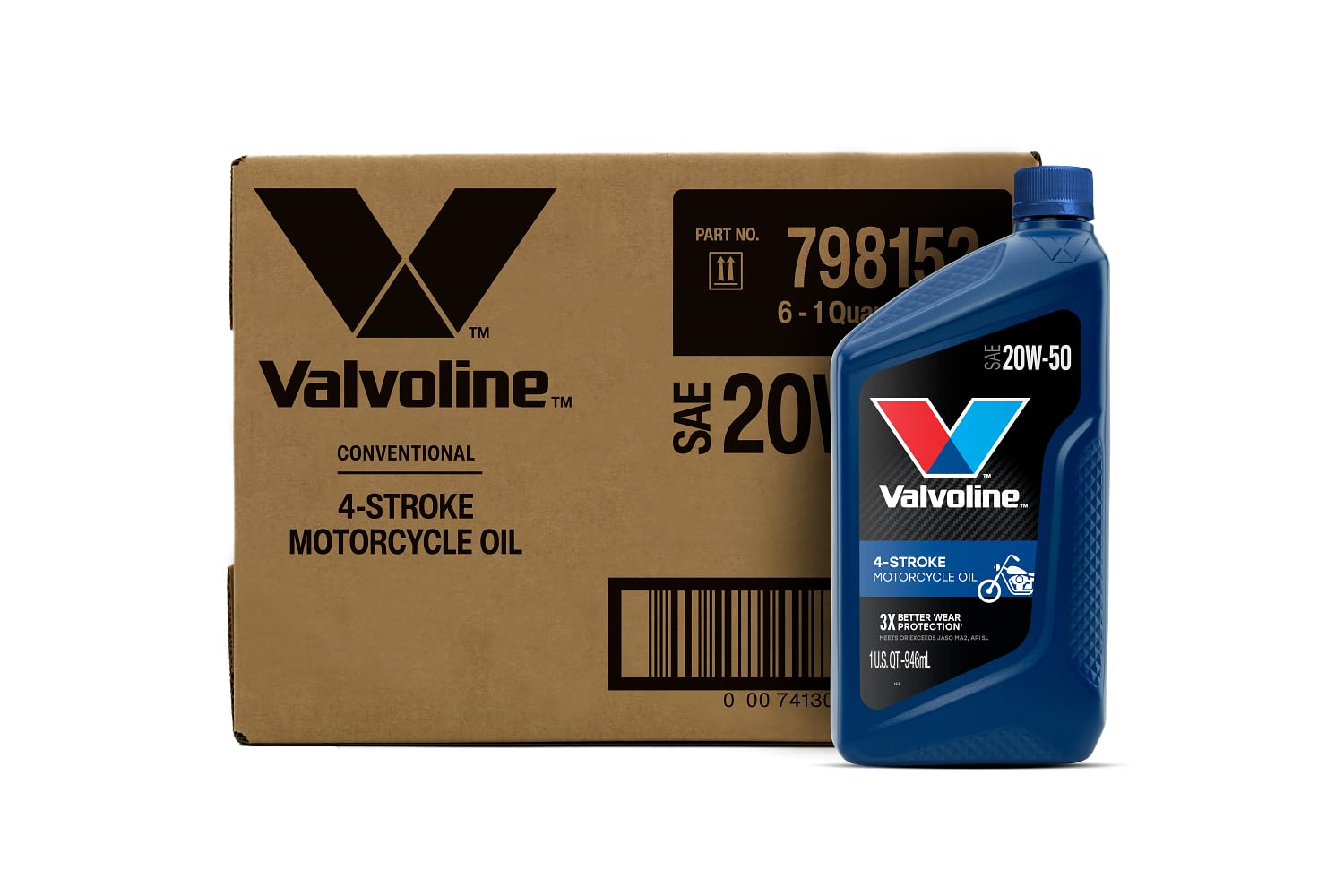
Valvoline 798152 is a conventional 20W50 that delivers dependable protection for those on a strict budget. It incorporates special cleaning agents and dispersants to prevent deposit formation, along with shear-stable viscosity improvers to resist oil film breakdown. Silicone additives prevent foaming, which is important for engines with high shear loads in the transmission and primary.
The case of six quarts covers approximately two oil changes on most metric cruisers and vintage bikes. Users report good longevity, with one review noting 40,000 hard miles on a 1988 Yamaha Radian with no engine issues. At this price point, the cost per quart is the lowest in the roundup.
Valvoline has been a trusted name in lubrication for over 150 years. While this conventional oil will need more frequent changes than synthetics, it provides adequate protection for low-to-moderate duty cycles and seasonal riders who change oil annually.
Why it’s great
- Lowest per-quart cost in the comparison
- Anti-foam and anti-corrosion additives present
- Case of 6 covers two changes
Good to know
- Conventional base shears faster under extreme heat
- Lower ZDDP content vs. premium synthetics
7. PENN GRADE 1 71196 Synthetic Blend 20W-50 (12-Pack)

PENN GRADE 1 71196 is a synthetic-blend high-performance oil formulated for highly stressed engines including racing and high-horsepower street motors. The additive package delivers high ZDDP levels specifically for flat-tappet engines, making it a favorite in the air-cooled Porsche and classic British car community where cam lobe protection is non-negotiable.
The 12-quart case provides exceptional value for multi-vehicle garages. The blend uses Pennsylvania-grade base stocks with select additive technologies for excellent shock load resistance. The oil also demonstrates strong anti-foaming and shear stability.
For riders or racers with high-horsepower engines, the PENN GRADE 1 delivers proven protection. It is a synthetic blend, not a full synthetic, so drain intervals should be shorter than a PAO-based oil, but the additive package is optimized for the conditions that destroy lesser oils.
Why it’s great
- High ZDDP for flat-tappet cam protection
- Excellent shock load and high-temp performance
- 12-quart case is a bulk value
Good to know
- Not a full synthetic; shorter drain recommended
- 12-pack takes up significant shelf space
FAQ
Can I use a car 20W50 oil in my motorcycle that calls for 20W50?
How often should I change a full synthetic 20W50 in an air-cooled V-twin?
Is higher ZDDP always better for a 20W50 oil?
Does 20W50 oil expire or go bad in the bottle?
Final Thoughts: The Verdict
For most riders, the best 20w50 motor oil winner is the Red Line 42504 because its 2200 ppm ZDDP concentration and ester base stock deliver the highest film strength and cam protection for flat-tappet engines under high heat. If you want top-end noise reduction and a proven track record in Harleys, grab the Lucas Oil 10702. And for a premium synthetic with excellent shear stability in a convenient gallon jug, nothing beats the AMSOIL WV01RCA07923.