
Our readers keep the lights on and my morning glass full of iced black tea. As an Amazon Associate, I earn from qualifying purchases.
You are drilling into hardened steel or stainless, and your bit just smokes, walks off-center, or snaps on the third hole. The 21/64 drill bit is a common, tough size that needs the right material and design to survive. This guide cuts through the confusion on HSS, cobalt, and carbide options so you grab the exact one your job needs.
I’m Min — the founder and writer behind Gadgets Feed. This guide is built by comparing the manufacturers’ published specifications and the patterns across verified customer reviews, so you get each pick’s real strengths and trade-offs instead of marketing spin.
The right choice depends on the metal you are cutting and how often you use it. This is your direct line to the 21/64 drill bit that will survive the steel, the stainless, and the stubborn bolts while staying affordable or your drill chuck.
Quick Picks
- Drill America DWDCO21/64P6 21/64″ Cobalt Drill Bit (Pack of 6) — Best Value
- Drill America 21/64″ Cobalt Heavy Duty Split Point Stub Drill Bit (Pack of 6), D/ASTCO Series — Top Performer
- 21/64″ inch HSS M35 Cobalt Twist Drill Bit, High Speed Steel, Pack of 5 — Budget Champion
- Drill America 21/64″ Solid Carbide Drill Bit, DMOD Series — Premium Pick
How To Choose The Best 21/64 Drill Bit
Three big decisions define a 21/64 drill bit: the material it is made from, the tip shape, and the length. Match these to the metal you are drilling.
Cobalt Steel vs. High-Speed Steel vs. Carbide
The bit material is everything. Standard HSS works fine for wood, plastic, and soft metals. For harder stuff like stainless steel, nickel alloys, or case-hardened bolts, you want at least M35 cobalt steel with 5% cobalt. Solid carbide is the toughest option, running faster and lasting much longer on the hardest materials, but it is brittle — you cannot let it wobble or jam in a hand drill.
Split Point and Cutting Angle
A split-point tip means the cutting edge goes all the way to the center, so the bit grabs the metal immediately without walking across the surface. A 135-degree cutting angle is common on split-point bits for steel; it creates a stronger cutting edge that resists chipping compared to the standard 118-degree point.
Stub vs. Jobber Length
Stub-length bits are shorter and stiffer, which reduces vibration and breakage when you are drilling into tough materials by hand or with a magnetic drill (magdrill). Standard jobber-length bits give you more reach for deeper holes but are less rigid.
Quick Comparison
On smaller screens, swipe sideways to see the full table.
| Model | Best For | Material | Pieces | Tip Angle | Amazon |
|---|---|---|---|---|---|
| DelitonGude M35 Cobalt | Multi-metal kit | HSS M35 Cobalt | 5 | 135° | $20.99Amazon |
| Drill America DWDCO | Stainless & nickel alloys | Cobalt | 6 | — | $31.94Amazon |
| Drill America D/ASTCO | Thick steel, magdrill work | Cobalt (Stub) | 6 | 135° | $23.80Amazon |
| Drill America DMOD | Hardened steel, broken bolts | Solid Carbide | 1 | — | $54.80Amazon |
In‑Depth Reviews
1. Drill America DWDCO21/64P6 21/64″ Cobalt Drill Bit (Pack of 6)

Six cobalt drills built for stainless and nickel without the premium price.
This six-pack is your daily driver for hard metals like stainless steel or nickel alloys, where standard HSS bits would burn up fast. The extra cobalt in the steel gives it better heat resistance so the edge stays sharper longer when cutting tough alloys. Buyers report it drills through 3/16″ steel cleanly, and one owner says it is their go-to for titanium and zirconium. The gold oxide coating is a thinner surface treatment than black oxide — it does not add much cutting performance, but it clearly identifies these as cobalt bits so you never grab the wrong one from the drawer.
Unlike the stub-length Drill America D/ASTCO below, these are standard jobber-length bits, so you get more reach for deeper holes. The two-flute spiral design pulls chips up and out of the cut, which keeps the hole from clogging. A reviewer noted that 10 out of 12 bits in their pack had a quality grind while two slipped by inspection — a reminder that even good production runs have variance, but the overall value at this price is hard to beat compared to buying single premium bits.
Why it’s great
- Six cobalt bits for less than the price of three singles from some brands
- Proven on stainless, titanium, and zirconium per buyer reports
- Round shank fits standard chucks and drill presses
Good to know
- Quality control can miss a grind flaw on a few bits
- Gold oxide coating offers similar performance to an uncoated tool
Best for: Shops that need a reliable six-pack of cobalt bits for regular stainless and alloy work.
Skip if: You need a stub-length bit for a magdrill or extreme rigidity on thick steel.
2. Drill America 21/64″ Cobalt Heavy Duty Split Point Stub Drill Bit (Pack of 6), D/ASTCO Series
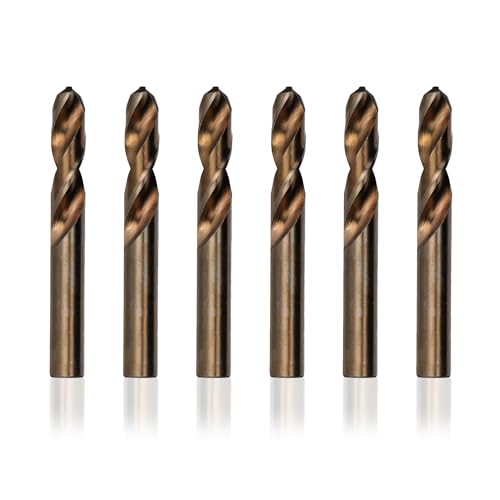
Six stub-length cobalt bits that shrug off thick steel holes.
When you are drilling through thick steel with a magnetic drill (magdrill), a standard-length bit can flex and break. These stub-length bits are shorter — the package dimensions are identical to the DWDCO pack at 6 x 4 x 2 inches, but the bit itself has less overhang, making it much stiffer. One buyer drilled four 7/8″ thick steel holes with a magdrill and lubricant and reported no dulling yet. The 135-degree split point grips the metal immediately and prevents walking, which matters when you are starting a hole on a slick steel surface.
Like the DWDCO series, these use cobalt steel with a gold oxide finish and two-flute chip evacuation. The big difference is the stub length and the 135-degree split point, which is not listed on the DWDCO spec sheet. A machine shop owner says these outlast regular high-speed drills two times over, especially in stainless. The catch, as one reviewer noted, is that the packaging gives no cobalt percentage or M35/M42 spec, so you are trusting the brand’s reputation over a published chemical standard.
The case for it: Stub length and 135-degree split point mean less vibration and no walking, even in thick, hard steel with a magdrill.
The downside: No published cobalt percentage or M35/M42 grade, so you are relying on Drill America’s construction quality.
Best for: Heavy steel drilling with a magnetic drill or where bit rigidity is critical.
Skip if: You need a longer reach for deep-hole drilling — standard jobber length is better for that.
3. 21/64″ inch HSS M35 Cobalt Twist Drill Bit, High Speed Steel, Pack of 5
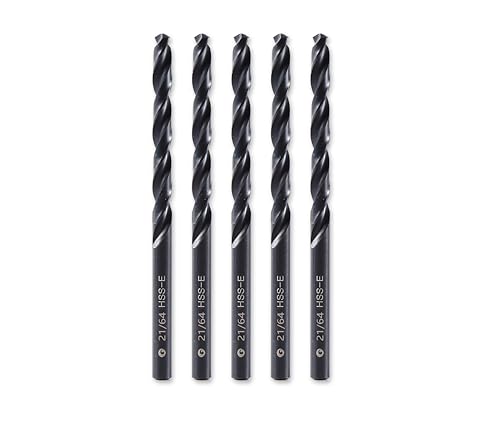
Five M35 cobalt bits that tackle hard metals on a DIY budget.
If you need a 21/64 bit for occasional work on steel, cast iron, or galvanized pipe, this five-pack gives you M35 high-speed steel with 5% cobalt at a very accessible price. The 135-degree split-point tip and spiral groove design help with self-centering and chip removal. Each bit has a total length of 115mm with a 75mm working length, giving you decent reach for standard hand-drill or drill-press jobs. Owners mention it drills multiple holes in stainless steel with cutting oil without issue, and the blades come sharp out of the box.
One buyer found the first bit drilled five holes in T-posts (80+ Rb hardness) before dulling, while the others lasted one to four holes with heavy effort — the seller offered a full refund, which is great support. This performance is a tier below the solid carbide DMOD, which cuts through hardened steel where even cobalt fails, but for the price of a five-pack, these are a smart choice for general metalwork. The full-grinding nitriding adds wear resistance that helps the edge survive tough alloys better than standard HSS.
The case for it: Five M35 cobalt bits with a 135-degree split point for a low price, proven on stainless and hard steel with cutting oil.
The trade-off: Expect 1-5 holes per bit in very hard material like T-posts — this is not carbide-level endurance.
Best for: DIYers and light-industrial users who need a few backup bits for mixed-metal drilling.
Skip if: You are drilling hardened steel or case-hardened bolts where a single carbide bit is the only safe bet.
4. Drill America 21/64″ Solid Carbide Drill Bit, DMOD Series
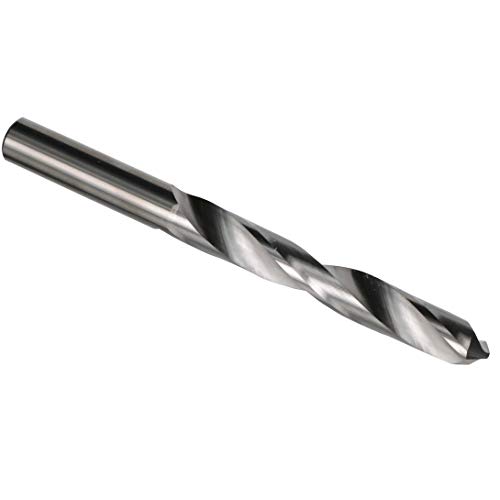
The single carbide bit that chews through hardened steel where everything else fails.
When you hit a case-hardened bolt or a piece of hardened steel that smokes every HSS and cobalt bit, this solid carbide bit is the last answer. One buyer broke several HSS and cobalt bits before switching to this carbide bit; it drilled through without issue. Another owner drilled 5-10 minutes into a broken bolt on a John Deere tractor to seat an extractor after a failed extractor kit. Solid carbide runs faster and lasts longer than cobalt, but it is more brittle — you need a rigid setup like a drill press or a very steady hand, and any wobble can snap it immediately.
This is an uncoated carbide tool with a round shank and two-flute design, manufactured to National Aerospace Standard 907. Unlike the five-pack of cobalt bits above, this is a single bit at a premium price, but buyers consistently say it pays for itself by saving a failed project. One reviewer snapped theirs within seconds despite using cutting fluid and low pressure, which is the risk of carbide — it is hard but not tough. If your project absolutely must not fail and you are drilling into the hardest metals, this is the bit to reach for.
Why it’s great
- Drills hardened steel and case-hardened bolts that destroy HSS and cobalt bits
- Manufactured to National Aerospace Standard 907 for precision
- Buyers confirm it saves projects where other bits failed
Good to know
- Brittle — can snap immediately if you wobble or apply too much pressure
- Single bit only, no backup, at a premium price point
Best for: One-shot drilling into hardened steel, broken bolts, and case-hardened parts where nothing else works.
Skip if: You are drilling soft metals or wood at a DIY pace — a cobalt multi-pack will serve you better and cost less.
Understanding the Specs
Cobalt Percentage and M35 / M42
Cobalt steel bits blend high-speed steel with cobalt, typically 5% (M35) or 8% (M42). More cobalt means better hot hardness — the edge stays sharp even when the bit gets hot from friction in stainless steel. M42 is tougher and more expensive; M35 is a very strong middle ground for most metalwork. If the bit does not list a percentage, it may still be good, but you get less assurance.
Split Point vs. Standard Point
A split-point tip has a secondary grind that creates a cutting edge all the way to the center, so the bit starts drilling exactly where you put it without skittering across the surface. This is critical on smooth steel or curved surfaces where a standard point would walk. Most quality 21/64 bits for metal use a 135-degree split point — the steeper angle reduces walking and creates a stronger cutting edge.
FAQ
Can I use a 21/64 cobalt drill bit in a hand drill?
What is the difference between M35 and M42 cobalt bits?
Will a solid carbide 21/64 bit work in a hand drill?
What does the 135-degree cutting angle mean for drilling?
Why is a split-point bit better for metal drilling?
How do I know if I need a stub-length or jobber-length bit?
Can a 21/64 bit drill through stainless steel?
What does the gold oxide finish on a drill bit do?
How many holes should a 21/64 cobalt bit drill in steel?
Can I use a 21/64 drill bit for wood or plastic?
Final Thoughts: The Verdict
For the majority of shoppers, the 21/64 drill bit winner is the Drill America DWDCO21/64P6 six-pack because it delivers proven cobalt performance on stainless and nickel alloys at a reasonable per-bit cost. If you need extreme rigidity for thick steel on a magdrill, grab the Drill America D/ASTCO stub-length six-pack. And for hardened steel and broken bolts where nothing else cuts it, the standout is the Drill America DMOD solid carbide bit.
How We Picked
We do not accept paid placement, and we did not hands-on test every unit. Instead, we match each pick to a real buyer and use-case by comparing the manufacturers’ published specifications against the patterns in verified customer reviews — so you get each pick’s real strengths and trade-offs instead of marketing copy.
Sources & Methodology
Specifications: manufacturer listings and product documentation. Review insights: verified customer reviews, as of July 2026. Pricing: not shown on this page (it changes often); check the current price via the retailer link.
As an Amazon Associate, Gadgets Feed earns from qualifying purchases. This does not affect which products we feature.
Product prices and availability are accurate as of the date/time indicated and are subject to change. Any price and availability information displayed on Amazon at the time of purchase will apply to the purchase of this product. As an Amazon Associate I earn from qualifying purchases.
CERTAIN CONTENT THAT APPEARS ON THIS SITE COMES FROM AMAZON. THIS CONTENT IS PROVIDED "AS IS" AND IS SUBJECT TO CHANGE OR REMOVAL AT ANY TIME.
Amazon and the Amazon logo are trademarks of Amazon.com, Inc. or its affiliates.