
Finding a reliable 21700 battery means navigating a sea of inflated capacity claims and generic cells that sag under load. The wrong choice leaves you with a flashlight that dims after ten minutes or a vape mod that hits weak. You need a cell that delivers its rated amp-hours without overheating or degrading after a few cycles.
I’m Min — the co-founder and writer behind Gadgets Feed. I’ve spent weeks cross-referencing datasheets, tearing through customer reviews for hidden failure patterns, and comparing real-world discharge curves to separate the honest cells from the overhyped ones.
This guide breaks down the top contenders for the best 21700 batteries on the market, focusing on genuine capacity, safe discharge rates, and consistent build quality.
How To Choose The Best 21700 Batteries
The 21700 format is larger than the classic 18650 and offers significantly more capacity and current capability, but not all cells are created equal. Many budget cells exaggerate their mAh rating and cannot sustain their claimed discharge current without dangerous temperature rise. Understanding three core specs will keep you safe and satisfied.
Real Capacity vs. Advertised Capacity
A genuine high-capacity 21700 typically delivers between 4800mAh and 5000mAh. Any cell advertising 6000mAh or more in this size is almost certainly lying — internal chemistry cannot fit that much energy in a standard 21700 can. Look for cells from reputable OEMs like Samsung, Molicel, or LG, or at minimum a seller who publishes independent discharge graphs.
Continuous Discharge Current (CDR)
This is the maximum safe current the cell can deliver continuously without overheating or degrading. A 15A CDR is common for high-capacity cells (around 5000mAh), while high-drain cells trade capacity for a 30A-35A CDR. Using a cell beyond its CDR risks venting or catastrophic failure — especially critical in high-power flashlights and vape mods.
Protected vs. Unprotected Cells
Protected cells add a tiny circuit board that shuts off the battery if voltage drops too low, current spikes, or a short circuit occurs. This makes them safer for beginners and devices without built-in protection, but the protection board adds length — typically 68mm vs. 65mm for an unprotected cell. Always measure your device’s battery tube before buying protected 21700s.
Quick Comparison
On smaller screens, swipe sideways to see the full table.
| Model | Category | Best For | Key Spec | Amazon |
|---|---|---|---|---|
| XTAR VC4SL Charger | Charger | Capacity testing & slow charging | 3A max per slot (USB-C) | Amazon |
| XTAR VC8 Charger | Charger | High-volume 8‑cell grading | 8 bays, grading mode (CH1-4) | Amazon |
| EdisonBright Fenix are-A2 | Charger | Portable 2‑bay with carry case | 1A per slot, LCD display | Amazon |
| SEVENKA R8 8‑Bay Charger | Charger | Multi‑bay budget charging | 8 slots, LCD readout | Amazon |
| BauerF 5.0 Ah Battery | Power Tool Battery | Bauer 20V tool system | 5.0Ah, 20V Lithium‑Ion | Amazon |
| Dlyfull M4S Charger | Charger | USB‑C powered universal charging | 2A max (slot 4 only) | Amazon |
| BWIETE X4 Charger | Charger | Budget 4‑bay revival charger | 4 independent channels | Amazon |
In‑Depth Reviews
1. XTAR VC4SL Charger

The XTAR VC4SL occupies a sweet spot as a premium charger that doubles as a capacity tester. Its four independent slots handle 21700 cells as well as 18650, 26650, and NiMH chemistries, and the LCD screen cycles through voltage, current, charge time, and mAh capacity. The built-in discharge function lets you verify a cell’s real capacity before you rely on it for a critical device — a feature most budget chargers omit entirely.
Charging current is user-selectable up to 3A on a single slot when using a quality QC3.0 adapter, which cuts charge time for a depleted 5000mAh 21700 to roughly two hours. The USB-C input is a welcome modern convenience, though the charger is picky about its power source — several reviews note it fails with weak wall warts or computer USB ports. XTAR’s customer service sent a free capable block to affected users, which suggests the company stands behind the product.
Real-world testing reported by owners shows the VC4SL’s capacity measurements are consistently within 200mAh of a reference-grade charger like the VC8, making it accurate enough for comparing cells. The trade-off is the lack of a dedicated storage mode and a slightly dim display that some find hard to read in daylight. For anyone who charges 21700s regularly and wants data, not just electrons, this charger justifies its price.
Why it’s great
- Discharge testing reveals true cell mAh
- 3A fast charging via USB‑C with QC3.0
- Compatible with 21700, 18650, 26650, and NiMH
Good to know
- Requires a high‑output power adapter
- No storage charge mode
- Display visibility could be better outdoors
2. XTAR VC8 Charger

The XTAR VC8 is the charger to buy when you manage a stable of 21700 cells — eight bays with independent charging channels let you top off an entire week’s rotation in one go. The left four bays include a grading mode that performs a full charge-discharge-charge cycle to map true capacity, while the right four bays offer fast charging up to 3A per slot. The bundled QC3.0 wall adapter means you get peak performance out of the box.
The real-world bottleneck is power distribution: the total input is capped at 18W, so when all eight bays are active, each slot sees only about 500mA. That makes the VC8 excellent for overnight charging but not for a quick turnaround. The grading cycle is also slow — expect eight-plus hours for a single 5000mAh cell — but the data it yields is invaluable for spotting counterfeit or overrated cells from unknown sellers.
Build quality feels solid, with a clear segmented LCD and spring-loaded slots that accommodate protected 21700 cells without force. A storage charge mode (3.7V target) on the left bays is a thoughtful addition for long-term cell preservation. The main frustration reported is that only four of the eight bays can grade, which feels like a missed opportunity. Still, for the price per bay, the VC8 is a workhorse.
Why it’s great
- Eight independent charging bays
- Grading mode catches fake capacity cells
- Includes QC3.0 fast charger
Good to know
- Only left four bays support grading
- Slow charge speed when all eight slots used
- 18W total limit splits across bays
3. EdisonBright Fenix are-A2

The EdisonBright are-A2 is a purpose-built two-bay charger bundled with a BBX5 battery carry case, making it the ideal travel companion for flashlight and vape enthusiasts who need to keep spare 21700s organized. The LCD screen displays voltage, charge current, and a running timer for each bay — useful data that most compact chargers omit. The 1A charge rate per slot is conservative but safe, and the charger automatically detects battery type, switching between Li-ion and NiMH profiles.
Owners consistently note that 21700 cells stay cool to the touch throughout the charging cycle, a good indicator of proper current regulation and thermal management. The spring-loaded contacts are firm enough to handle protected cells without slippage, and the reverse polarity protection adds peace of mind when loading batteries in dim conditions. The included plastic carry case fits two spare 21700s securely, though it’s basic and lacks foam padding.
The trade-off is speed: at 1A, a depleted 5000mAh 21700 takes roughly five hours to fully charge. That’s fine for overnight use but slower than the XTAR options. The barrel jack power input feels dated versus USB-C, and the bundled adapter is region-specific. For a grab-and-go kit that prioritizes safety and display feedback over raw speed, the are-A2 delivers a well-rounded package.
Why it’s great
- LCD shows voltage, current, and time
- 21700 cells stay cool during charge
- Bundled carry case is convenient
Good to know
- 1A charge rate is slow for large cells
- Barrel plug, not USB-C
- Only two bays limits throughput
4. SEVENKA R8 8‑Bay Charger
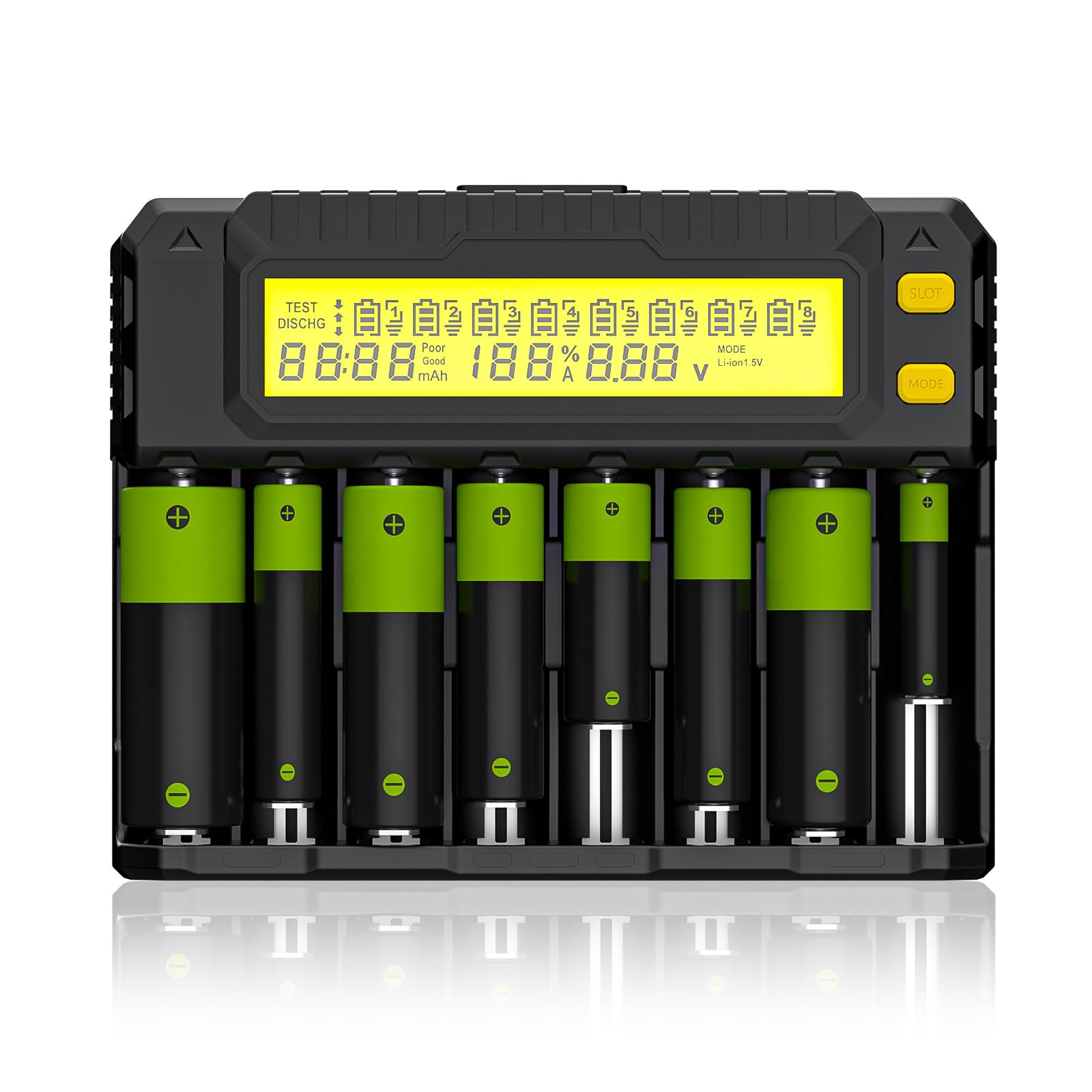
The SEVENKA R8 is an eight-bay charger that prioritizes volume over speed, making it a solid pick for users who maintain large battery collections and can plan charging around a slower cycle. The LCD panel displays voltage, charge current, elapsed time, battery type, and a percentage bar — impressive information density for a charger at this tier. The fire-retardant PC housing and temperature monitoring add a layer of safety that’s especially welcome when charging eight Li-ion cells simultaneously.
Charging current is adjustable between 0.25A, 0.5A, and 0.8A for lithium cells, though many reviews note that the actual speed at each slot is limited by the USB input source. Using a standard 5V/2A phone charger, a 5000mAh 21700 can take 12 to 24 hours to fill, which is usable only if you rotate batteries in advance. The NiMH charging speed is fixed at 0.5A, which is adequate for AA and AAA cells but not fast.
The build quality exceeds expectations for the price — the slots grip cells firmly and the LED indicators, while initially confusing, become intuitive after a few cycles. A few owners report the charger correctly revived old NiMH cells that proprietary chargers rejected. If your primary need is to charge many 21700s overnight on a tight budget, and you have the patience, the SEVENKA R8 works reliably.
Why it’s great
- Eight bays for high‑volume charging
- Fire‑retardant housing and over‑temp protection
- Affordable price for bay count
Good to know
- Very slow charge rate from USB input
- No capacity testing or grading mode
- LED display can be confusing at first
5. BauerF 5.0 Ah Battery (AODERTI)

This is a dedicated power tool battery built for the Bauer 20V system, not a loose 21700 cell for a flashlight or vape. The 5.0Ah capacity translates to genuine runtime gains over the standard 2.0Ah or 3.0Ah packs that ship with most Bauer tools. Users report it powers an air compressor for extended framing sessions and keeps a chainsaw running through multiple cuts without the voltage sag that smaller packs exhibit under load.
The battery uses lithium-ion chemistry and integrates overcharge and overdischarge protection directly into the pack’s circuit, so no external charger management is needed beyond the Bauer wall charger. The casing clips securely onto the tool base and includes a fuel-gauge LED indicator on the top face. At 5.0Ah, this is roughly the highest capacity available for the Bauer platform without moving to the bulky 8.0Ah option.
The caveat is compatibility: this pack only works with Bauer 20V tools and chargers. It is not a standard 21700 cell you can use in a flashlight or vape mod. If you already own Bauer equipment, this is a direct upgrade that doubles runtime. For general-purpose 21700 users, stick with loose cells and a quality charger. The AODERTI-branded pack is aftermarket, so while it works well initially, longevity reports are limited compared to OEM Bauer packs.
Why it’s great
- Doubles runtime versus 2.0Ah Bauer packs
- Maintains voltage under heavy tool load
- Built-in protection circuit
Good to know
- Only compatible with Bauer 20V tools
- Aftermarket brand, not OEM
- Not a standard 21700 cell for other uses
6. Dlyfull M4S 4‑Bay Charger

The Dlyfull M4S targets users who want one charger for every battery chemistry in their drawer, from 21700 and 18650 Li-ions down to NiMH AAA and even AAAA cells. The four independent slots each auto-detect the battery type and select the appropriate charge profile. The USB-C input is a standout feature at this price — it lets you power the charger from a laptop, power bank, or car adapter, which is invaluable for travel or off-grid charging.
The charging current is tiered: a single battery in slot 4 can draw up to 2A, two batteries share 1A each, and four batteries split 500mA per slot. That means charging four 21700s simultaneously will be slow, but the convenience of USB power and universal compatibility offsets the speed compromise for many owners. The charger also includes a 0V/low-voltage activation feature that can revive deeply discharged Li-ion cells that standard chargers reject as dead.
Build quality feels decent but not premium — the plastic shell is lightweight and the slot springs are stiffer than some competitors, making insertion and removal a bit fiddly. Several reviews praise its ability to handle 21700s that are longer due to protection circuits, which is a common pain point with cheaper chargers. For a grab-and-all charger that covers every battery size in a household, the Dlyfull M4S offers excellent versatility for the price.
Why it’s great
- USB‑C input works with power banks
- Revives over‑discharged Li-ion cells
- Fits protected 21700 cells easily
Good to know
- Slow charge rate with 4 batteries
- Stiff springs make battery loading tricky
- No LCD display — only LED indicators
7. BWIETE X4 4‑Bay Charger
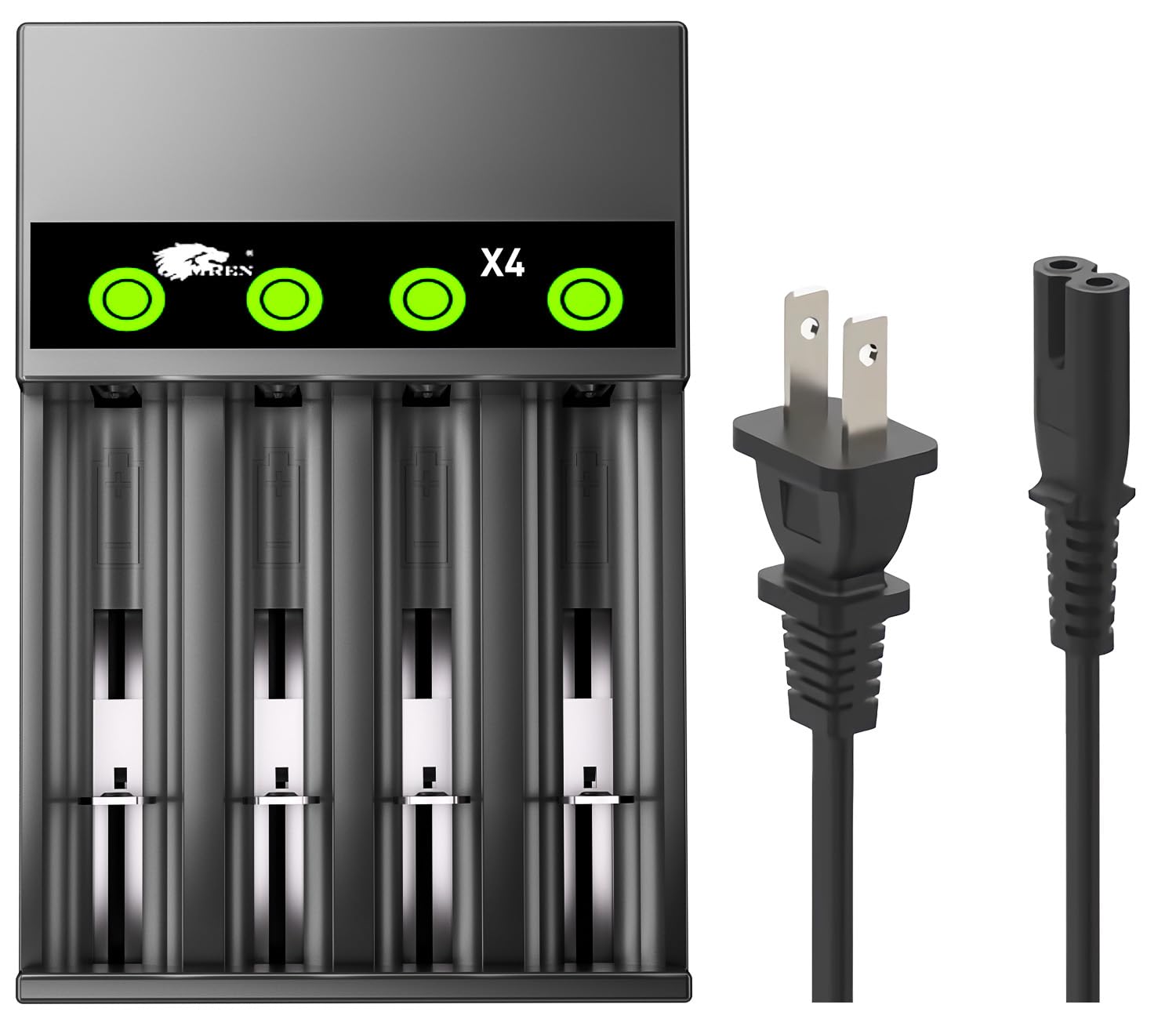
The BWIETE X4 is a no-frills four-bay charger that focuses on getting the job done cheaply. It automatically selects the optimum charge current for each slot and illuminates an independent LED for each bay — green when full, red when charging — so you can monitor status at a glance. The spring-loaded contacts accommodate flat-top and button-top 21700s, though protected cells with extra length may require a bit of wiggling.
A notable use case that emerges from reviews is battery revival: several owners report that the X4 can successfully charge NiMH AA cells that their name-brand Eneloop chargers rejected, as well as revive over-discharged 18650s. The low-voltage activation function seems to work reliably, which gives this budget charger a second life for neglected batteries. The charge current is not user-selectable, so speed is whatever the charger decides — typically around 500mA to 1A per slot depending on count.
The trade-offs are clear: no LCD display, no capacity testing, and a plastic housing that feels less substantial than mid-range options. A few reviews note that the included manual is poorly translated and some LED labels are confusing initially. If you need a simple, functional charger for occasional 21700 charging and don’t need data or fast turnaround, the BWIETE X4 works well for the price.
Why it’s great
- Revives old or deeply discharged batteries
- Four independent channels
- Low price point for basic needs
Good to know
- No display — only red/green LEDs
- Protected 21700 cells can be tight
- Auto‑current selection cannot be overridden
FAQ
Can I use a 21700 battery in any device designed for 18650?
What does it mean when a 21700 battery says “protected”?
Why do some 21700 batteries advertise 6000mAh or more?
Final Thoughts: The Verdict
For most users, the best 21700 batteries experience starts with a quality charger, and the XTAR VC4SL wins because it combines fast USB-C charging with accurate capacity testing — letting you verify cell health before every cycle. If you manage a large battery rotation and need to grade suspect cells, grab the XTAR VC8. And for a portable travel kit that keeps two cells organized and displays real-time data, nothing beats the EdisonBright Fenix are-A2.