
A power outage doesn’t announce itself. When the grid goes dark, the difference between a night of cold sandwiches and keeping your entire home running comes down to the 220 volt generator sitting in your garage. These machines aren’t just about wattage labels—they’re about real-world capability: starting a 13,500 BTU RV air conditioner on a 95-degree day, running a well pump through a three-day storm, or powering a food truck from dawn till closing. Choosing the wrong one means throwing money at a paperweight.
I’m Min — the co-founder and writer behind Gadgets Feed. This guide is the result of hundreds of hours spent cross-referencing customer-verified run-time data, outlet configurations, and long-term reliability reports across a wide price range to separate the workhorses from the weekend-only toys.
Whether you’re outfitting an RV, prepping for hurricane season, or running a mobile business, finding the right best 220 volt generator requires weighing real fuel flexibility against pure output and portability.
How To Choose The Best 220 Volt Generator
Selecting a generator in this class is a balancing act. Your choice hinges on four key variables: the type of fuel you want to store, whether you need clean sine-wave power for sensitive electronics, how much noise your neighbors (or campsite) will tolerate, and the physical reality of moving a 50-200 pound machine from storage to use.
Fuel: Gas, Propane, or Natural Gas
Dual-fuel models let you switch between gasoline and propane, giving you storage flexibility—propane doesn’t gum up carburetors over time. Tri-fuel options add a natural gas hookup, which is ideal for whole-house backup if you already have a gas line. Gasoline offers the highest peak wattage, but degrades after a few months in storage. An ethanol-free gasoline additive is cheap insurance for any gasoline-powered unit.
Wattage and Outlet Configuration
Pay attention to the surge vs. rated wattage split—the surge figure is what you need to start a motor (like a well pump or AC compressor). For 220V equipment, confirm the unit has an L14-30R (30-amp) or a 14-50R (50-amp) outlet. A 30-amp 240V outlet can handle around 7,200 continuous watts, while a 50-amp version supports up to 12,000 watts—critical for tying into a home transfer switch.
Inverter vs. Standard Alternator
Inverter generators produce power with less than 3% total harmonic distortion (THD), making them safe for laptops, TVs, and CPAP machines. Standard generators often exceed 5% THD, which can damage sensitive electronics. Inverters also adjust engine speed to match the load, cutting fuel consumption and noise dramatically at light loads—but they typically cost more per watt.
Portability and Noise
An open-frame 13,000-watt generator can weigh over 220 pounds. Wheel kits and telescoping handles turn a dead lift into a manageable roll. Noise ratings range from 59 dBA (conversation-level quiet) to over 70 dBA (sounds like a vacuum cleaner). If you’re camping or have close neighbors, prioritize a unit rated at 65 dBA or lower.
Quick Comparison
On smaller screens, swipe sideways to see the full table.
| Model | Category | Best For | Key Spec | Amazon |
|---|---|---|---|---|
| Westinghouse iGen8200TFc | Inverter | Whole-Home Backup | 8200W Peak / Tri-Fuel | Amazon |
| DuroMax XP13000HXT | Standard | Heavy Duty Whole Home | 13000W Peak / Tri-Fuel | Amazon |
| Westinghouse WGen | Standard | Whole House Backup | 12500W Peak / Dual-Fuel | Amazon |
| DuroStar DS13000MX | Standard | Heavy Load Backup | 13000W Peak / Dual-Fuel | Amazon |
| WEN DF680iX | Inverter | EV Charging / RV | 6800W Peak / Dual-Fuel | Amazon |
| PowerSmart PS5055C | Inverter | Transfer Switch Ready | 7000W Peak / 120/240V | Amazon |
| Champion 4500-Watt | Inverter | RV & Food Truck | 4500W Peak / 61 dBA | Amazon |
| AMERISUN AM5046C | Inverter | Camping / Light Home | 5000W Peak / CO Sensor | Amazon |
| Generac GP3300i | Inverter | Light Portable Backup | 3300W Peak / 59.5 lbs | Amazon |
| WEN 56360i | Inverter | Ultralight Camping | 3600W Peak / 46 lbs | Amazon |
| Pulsar PGD40ISCO | Inverter | Budget Camping | 4000W Peak / 47.3 lbs | Amazon |
In‑Depth Reviews
1. Westinghouse iGen8200TFc
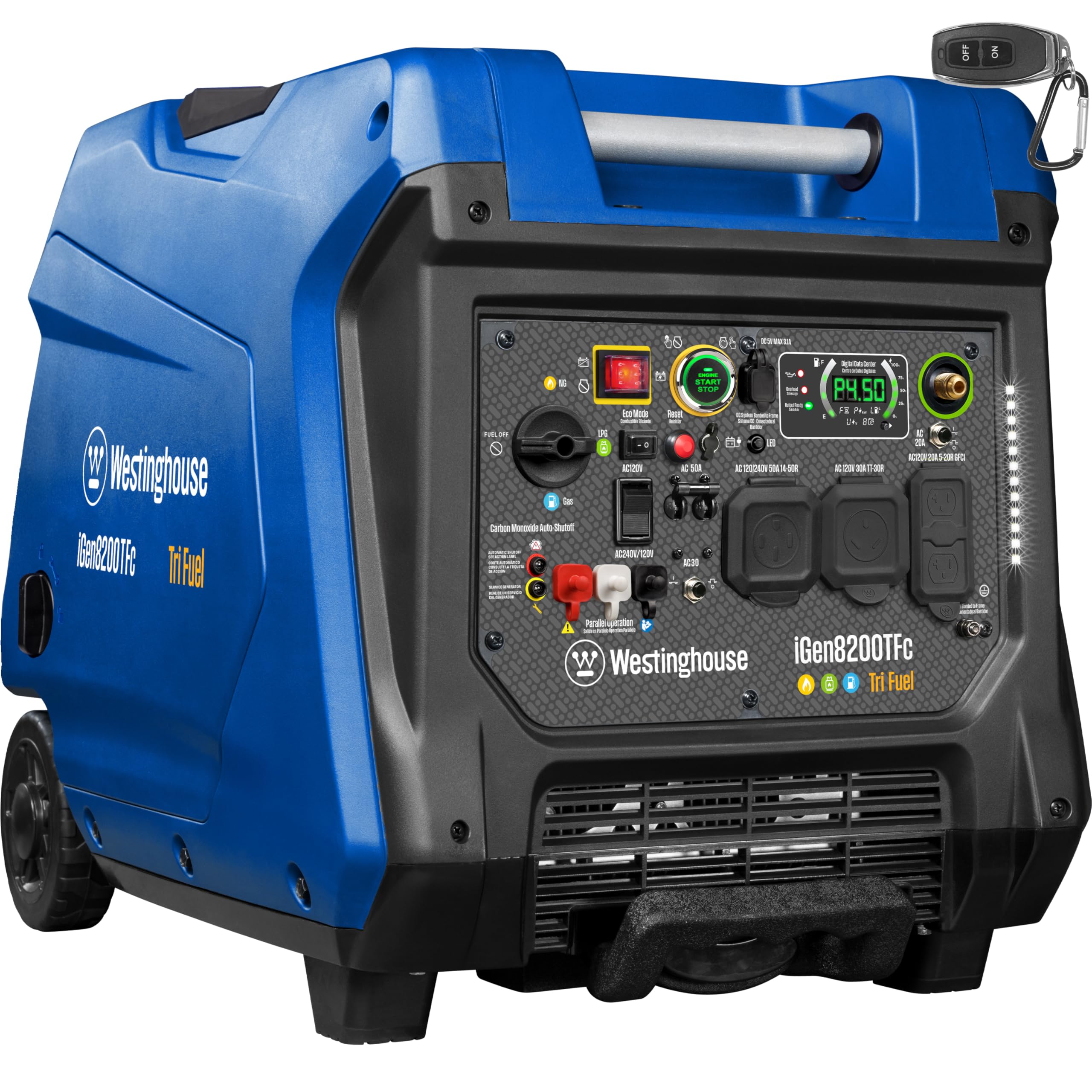
The iGen8200TFc is the rare generator that marries the fuel flexibility of a tri-fuel setup with the clean power and quiet operation of a fully enclosed inverter. On gasoline, it delivers 8,200 peak watts and 6,600 running watts—enough to handle a 50-amp transfer switch for a home’s critical loads. Switching to propane drops the peak to 7,380 watts, and natural gas yields 6,560 peak watts. The 298cc Westinghouse engine with a cast iron sleeve is built for longevity, and the CO sensor with automatic shutdown adds a critical safety layer.
At 60 dBA at 25% load, this unit is quiet enough for conversation nearby. The remote electric start with included key fob means you don’t have to fight a pull cord in the middle of a storm. The 14-50R 50A outlet is transfer-switch ready, and the integrated battery maintainer keeps the battery topped off during long storage periods. Tool-less access panels simplify oil changes and spark plug maintenance.
The 134.5-pound weight is manageable with the built-in wheel kit, though it’s heavier than smaller inverter models. Some users note that the break-in period requires attention to oil changes, and the 3.9-gallon tank on gasoline lasts up to 17 hours at 25% load—adequate for overnight runs. The tri-fuel capability and sub-3% THD make this the most versatile single solution for both home backup and recreational use.
Why it’s great
- Tri-fuel flexibility (gas, propane, natural gas) with easy fuel selector knob
- Quiet 60 dBA inverter with less than 3% THD for sensitive electronics
- Remote electric start with included key fob and built-in battery maintainer
Good to know
- 134.5 pounds is heavy for a portable; wheel kit is essential
- Gasoline runtime drops sharply above 50% load
2. DuroMax XP13000HXT
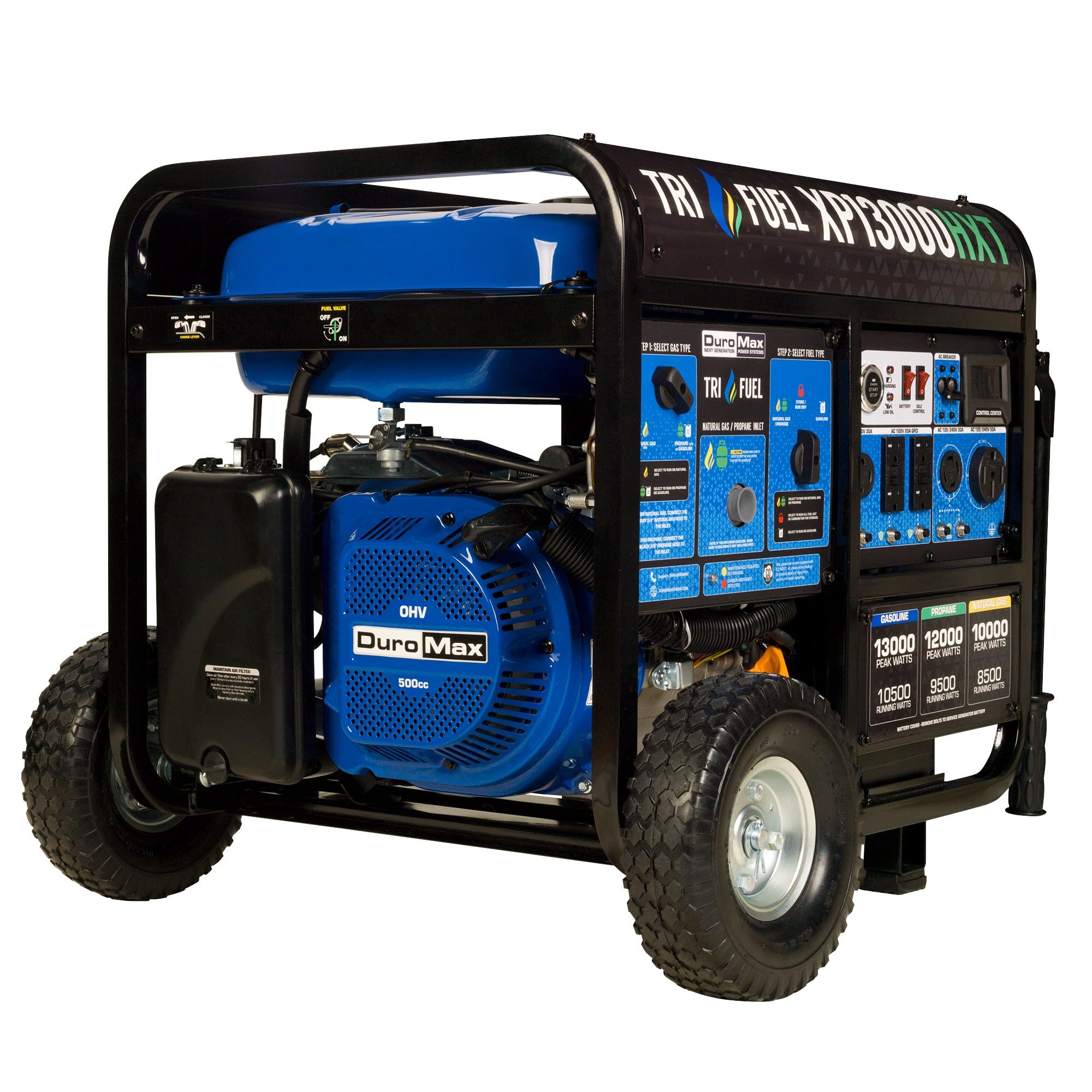
When whole-home backup means running a central AC, well pump, refrigerator, and lights simultaneously, the XP13000HXT delivers brute force. Its 500cc OHV engine pushes 13,000 peak watts and 10,500 running watts on gasoline, with slightly lower output on propane and natural gas. The push-button electric start and included remote start let you fire it up from inside the house, and the front-facing interface lets you switch between the three fuel types in seconds.
The 50-amp outlet is transfer-switch ready, and the CO Alert automatic shutdown protects against carbon monoxide buildup. The heavy-duty steel frame and 240-pound weight are not for casual camping trips—this is a stationary or wheeled unit best suited to a garage or shed. Users running it on natural gas report that a 3/4-inch gas line is recommended to feed the engine’s appetite.
Customer reports highlight that the battery may arrive discharged, so a trickle charger is a smart first purchase. The semi-loud 500cc engine is expected at this power level, but the trade-off is the ability to power a welding machine or run the entire house on a single tank of propane for days. For those who need maximum output with fuel choice, this is the heavy cannon in the lineup.
Why it’s great
- True tri-fuel operation (gas, propane, natural gas) with remote start
- 13,000 peak watts from a 500cc engine handles welders and whole-house loads
- Durable steel frame and included wheel kit for semi-portable use
Good to know
- Weighs 240 pounds; not a unit you move daily
- Not an inverter—THD is above 5%, not safe for sensitive electronics without a filter
3. Westinghouse 12500 Peak Watt Dual Fuel

The Westinghouse 12500-watt model is a proven workhorse for whole-house backup, offering 9,500 running watts on gasoline and 8,500 on propane. The 457cc engine with a cast iron sleeve delivers durability, and the remote start with key fob plus electric and recoil backup means you have three ways to get it running. The 6.6-gallon fuel tank provides up to 12 hours of runtime at 50% load.
Outlet configuration is robust: two GFCI 120V 20A receptacles, one L14-30R 30A 240V outlet, and one 14-50R 50A 240V outlet. This setup is transfer-switch ready and can also power an RV’s 50-amp service. The CO sensor with automatic shutdown and low-oil shutdown are included safety features. Assembly is minimal—attach the wheel kit and battery, add oil, and you’re running.
At 212 pounds, the included wheel kit makes it manageable on flat surfaces, but the open-frame design is loud—expect over 70 dBA at full load. Users at higher altitudes note a loss of efficiency above 2,000 feet, mitigated by a high-altitude jet kit. For a pure workhorse that starts every time and powers the whole house, this is a benchmark option in the sub- range.
Why it’s great
- Dual-fuel with remote start key fob and three-start options
- 50A and 30A 240V outlets for transfer switch and RV use
- 457cc cast iron sleeve engine built for long-term reliability
Good to know
- Open frame is loud; not suitable for quiet camping
- 212 pounds requires the included wheel kit for movement
4. DuroStar DS13000MX

The DuroStar DS13000MX brings 13,000 peak watts and a 500cc dual-fuel engine at a price that undercuts most competitors in this power class. It runs on gasoline or propane, with a push-button electric start and a remote control for convenient operation. The 50-amp outlet is transfer-switch ready, and the all-metal construction with a reinforced steel frame is designed to withstand harsh conditions.
Users report that it powers an entire home including a 1.5-ton AC unit, fridge, stove, microwave, and water heater without hesitation. The CO alert feature provides automatic shutdown if carbon monoxide levels become dangerous. Assembly requires attaching the wheel and handle kit, adding oil, and connecting the battery. The 220-pound weight is standard for this output class.
Some units arrive with minor shipping damage due to weight, but customer service generally resolves issues quickly. The engine is not an inverter, so it’s louder than enclosed inverter models and produces higher THD. For the price, it’s one of the most affordable ways to get true 240V whole-house backup power with dual-fuel flexibility.
Why it’s great
- Exceptional power-to-price ratio for whole-home 240V backup
- CO alert auto-shutdown for safety
- Remote start included for convenient operation
Good to know
- Open-frame design is loud; not suitable for quiet environments
- Not an inverter; use a power conditioner for sensitive electronics
5. WEN DF680iX

The WEN DF680iX stands out for its bonded-neutral 240V configuration specifically designed for low-power Level 2 EV charging. On gasoline, it produces 6,800 surge watts and 5,100 rated watts; on propane, those figures drop to 6,000 surge and 4,500 rated watts. The 224cc dual-fuel engine includes a fuel shutoff to run the carburetor dry before storage, extending engine life.
This inverter generator produces clean power safe for sensitive electronics, and the ECO mode reduces engine speed to match load, saving fuel and lowering noise. The control panel includes an L14-30R 120V/240V 30A receptacle, a TT-30R RV outlet, two three-prong 120V outlets, a 12V DC outlet, and two 5V USB ports. The telescoping handle and onboard wheels make the 99.2-pound unit easier to move than larger open-frame models.
Customers running fifth wheels report that it runs both AC units on propane without issue. The electric start is reliable, but some users note the 240V outlet is dedicated to that purpose and disables the 120V outlets when engaged. The tri-fuel capability is not present here—gasoline and propane only—but for those specifically needing a portable EV charger backup, this is a purpose-built solution.
Why it’s great
- Bonded-neutral 240V outlet designed for Level 2 EV charging
- Inverter technology with ECO mode for quiet, efficient operation
- Telescoping handle and wheels for improved portability
Good to know
- Dual-fuel only; no natural gas option
- 240V mode disables 120V outlets
6. PowerSmart PS5055C
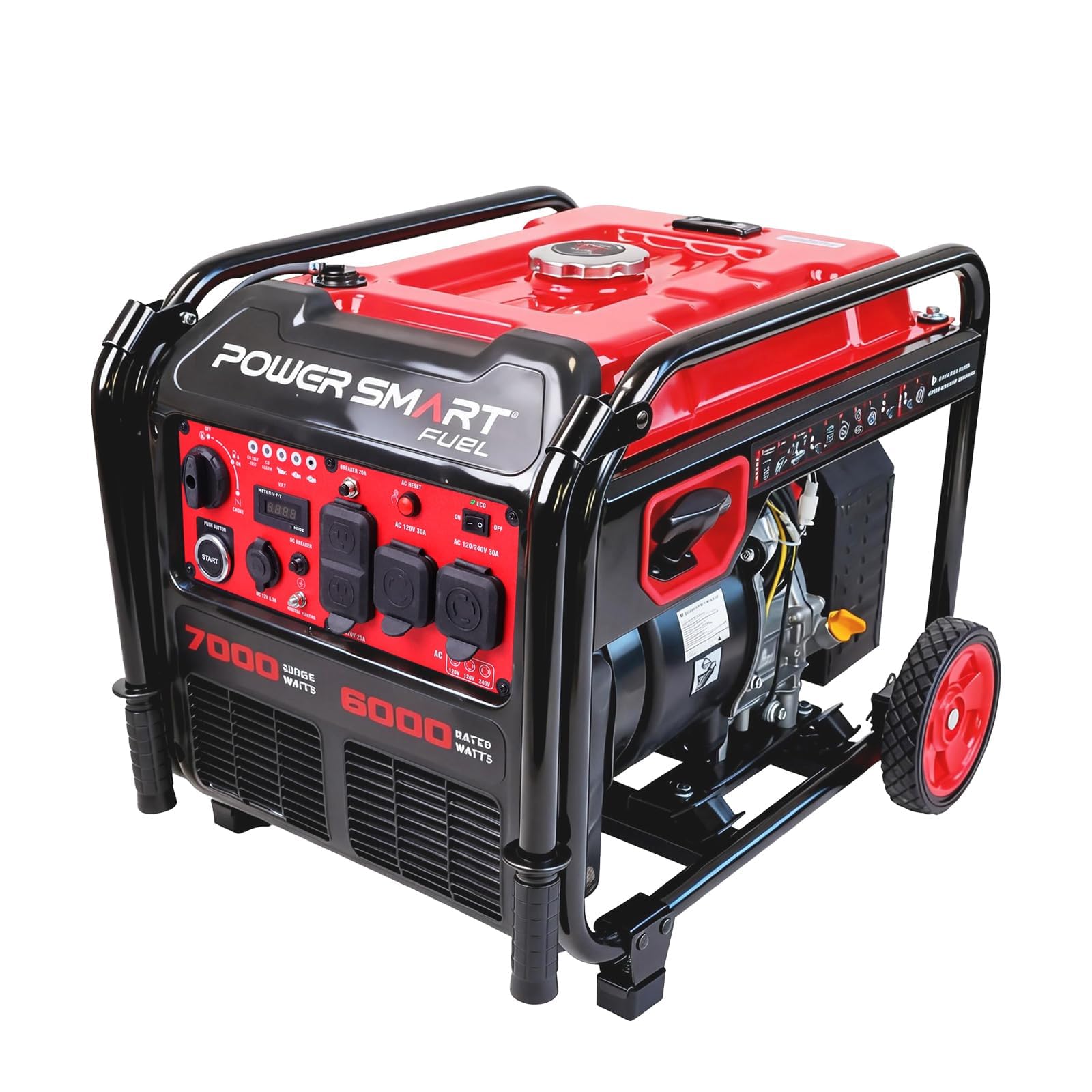
The PowerSmart PS5055C delivers 7,000 surge watts and 6,000 rated watts from a 322cc engine, with the advantage of clean sine-wave inverter power (less than 3% THD) at a price that undercuts many competitors in this power class. The open-frame design provides superior airflow for heavy loads, and the 120/240V selector makes it ready for transfer switch connection or 50-amp RV service.
The electric push-button start with battery is effortless, and the recoil backup is there if the battery dies. The 3.2-gallon fuel tank provides 6 hours of runtime at 50% load, which is on the shorter side for this class. The 70 dBA noise level at 23 feet is typical for an open-frame inverter but not as quiet as enclosed models. A warm-up period of 10 minutes before connecting high-wattage loads is recommended by the manufacturer.
Users running a 30-amp inlet box report it powers an entire house except for 240V appliances like dryers and water heaters. The 113.5-pound weight is manageable for two people, and the compact dimensions (25.9 x 19 x 19 inches) fit well in a truck bed. The low-oil shutdown and overload protection are welcome safety nets. For the power-to-price ratio, this is a strong contender for home backup.
Why it’s great
- Clean sine-wave inverter with less than 3% THD at a mid-range price
- Electric push-button start with recoil backup
- 120/240V selector for transfer switch or 50A RV use
Good to know
- 70 dBA noise level is louder than enclosed inverter generators
- Only 6-hour runtime at 50% load on the 3.2-gallon tank
7. Champion 4500-Watt Inverter

The Champion 4500-watt inverter generator has built a reputation among food truck owners and heavy RV users for surviving daily 12-hour shifts. With 4,500 starting watts and 3,500 running watts, it’s not the highest output on this list, but its 61 dBA noise rating makes it one of the quietest in its class. The 212cc engine runs for up to 14 hours on 2.3 gallons of gasoline at 25% load.
The Intelligauge display shows voltage, frequency, and operating hours, which helps with maintenance scheduling. The CO Shield carbon monoxide auto-shutoff system and the EZ Start Dial simplify startup. The clean power output (less than 3% THD) is safe for sensitive electronics, and the parallel-ready capability lets you link a second Champion inverter for double the output. The included 3-year warranty and lifetime technical support are above average for this price tier.
Real-world tests from RV owners running the generator 24/7 for nine days in desert conditions confirm its fuel efficiency and durability. The 92.2-pound weight with an integrated handle is manageable, though not as light as smaller inverter models. Some users note it’s slightly less quiet than a Honda EU3000 but consider the price difference worth the trade-off. This is a proven, reliable choice for daily commercial or heavy recreational use.
Why it’s great
- Proven durability in daily food truck and heavy RV use
- Very quiet at 61 dBA with extended 14-hour runtime
- CO Shield auto-shutoff and 3-year warranty
Good to know
- 92.2 pounds is heavier than smaller inverter models
- No 240V output; 120V only
8. AMERISUN AM5046C
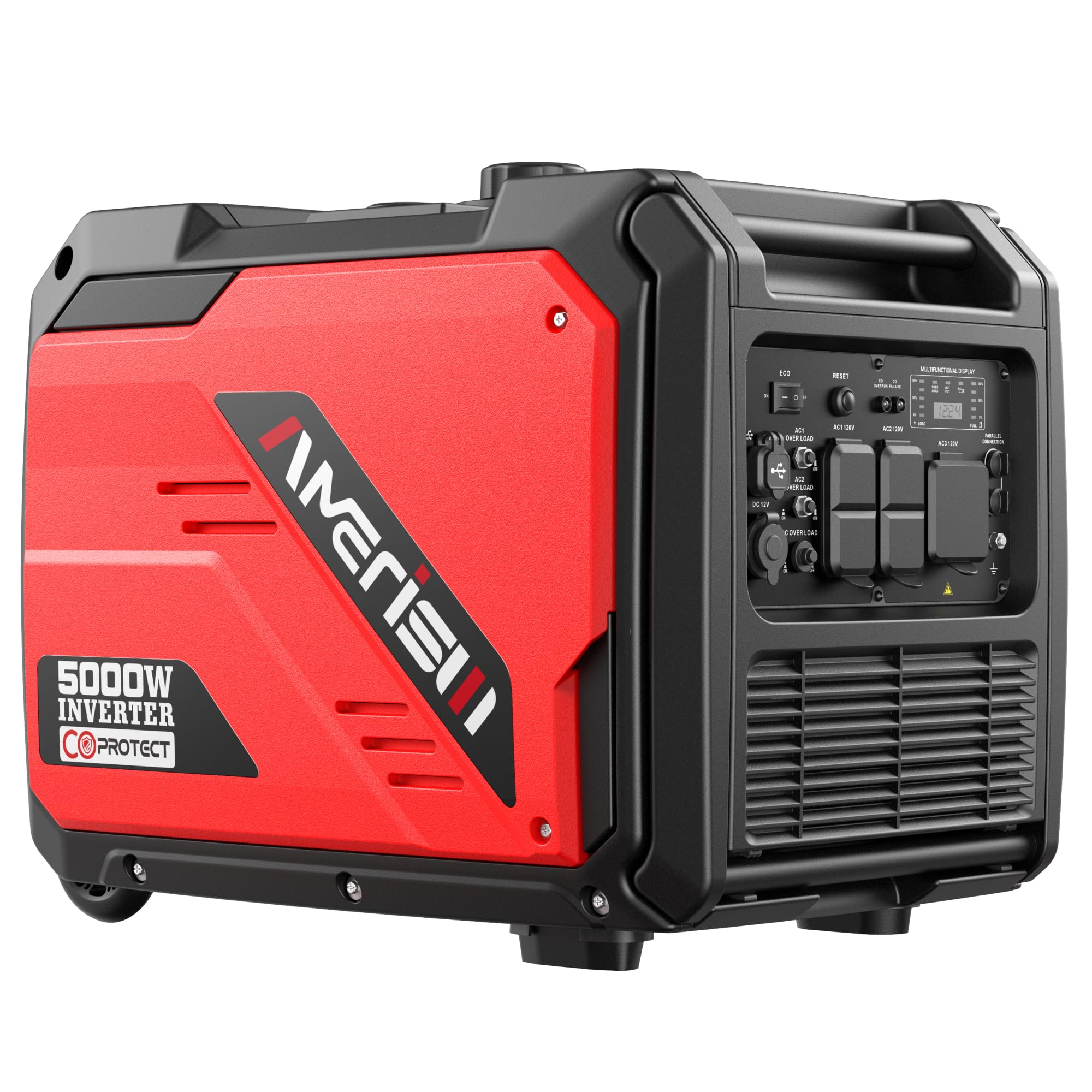
The AMERISUN AM5046C offers 5,000 peak watts from a 223cc engine at a price that’s competitive for a mid-range inverter. The CO sensor technology provides real-time detection of carbon monoxide and includes a CO failure light for additional safety. The 3.43-gallon fuel tank delivers up to 10 hours of runtime at 50% load, which is solid for this wattage class.
The outlet panel includes four 120V 20A outlets, one 120V 30A RV outlet, two 5V USB ports, and a 12V car port. The unit is parallel ready, allowing connection to another 5,000-watt inverter generator for double the output. The wheel kit and carrying handle make it reasonably portable for camping or home backup. EPA and CARB compliance ensures it’s legal for sale in all 50 states.
Users report it runs a 13,500 BTU RV mini-split air conditioner for 8-12 hours per tank of fuel, and powers a fridge, TV, and lights simultaneously without surge issues. Some customers note that initial startup can require many pulls until the engine breaks in. At 70 dBA, it’s not as whisper-quiet as premium inverter models, but the value proposition is strong for a 5,000-watt inverter with safety features.
Why it’s great
- Dual CO sensor system with real-time detection and failure light
- Good runtime of 10 hours at 50% load on 3.43 gallons
- Parallel ready for doubled output with a second unit
Good to know
- 70 dBA is louder than premium inverter models
- Initial break-in period can require multiple pull-starts
9. Generac GP3300i

The Generac GP3300i is a lightweight, fully enclosed inverter generator that prioritizes portability and quiet operation. With PowerRush Advance Technology, it offers over 50% more starting capacity than its 3,300 peak watts suggest—meaning it can handle motor-driven appliances that would stall a standard generator of this size. The 439cc engine may seem oversized for the output, but Generac uses it to extend engine life and reduce strain.
The TruePower Technology delivers less than 3% THD, making it safe for sensitive electronics. The Economy Mode automatically adjusts engine speed to reduce fuel consumption and noise. The LED indicators for low oil and overload are clear and useful, and the COsense Technology adds automatic shutdown protection. Two USB ports and parallel-ready capability round out the feature set. The 59.5-pound weight makes it one of the most portable options in the premium tier.
User reports are mixed on long-term reliability. Some owners report over 1,000 hours of use, while others experienced failures around 500 hours and found replacement parts difficult to source. The unit’s performance at altitude is noticeably reduced—at 5,000 feet, the effective running wattage drops to around 2,500 watts. For those who need a lightweight, quiet generator for weekend camping or short-term outages, this is a solid choice, but heavy users may want to look at more serviceable options.
Why it’s great
- Extremely lightweight at 59.5 pounds for easy portability
- PowerRush Advance Technology provides 50% more starting capacity
- Quiet operation with Economy Mode for fuel savings
Good to know
- Long-term reliability reports are inconsistent past 500 hours
- Power output drops significantly at higher altitudes
10. WEN 56360i

The WEN 56360i is one of the lightest inverter generators in its power class at just 46 pounds. The 149cc engine produces 3,600 surge watts and 2,900 rated watts, which is enough for a 13,000 BTU RV air conditioner, a small refrigerator, lights, and electronics simultaneously. The fuel shutoff feature runs the carburetor dry before shutdown, preventing gum buildup during storage.
The outlet panel includes two three-prong 120V receptacles, one TT-30R RV receptacle, one 12V DC outlet, and two 5V USB ports. The clean power output makes it safe for sensitive electronics. The three-year warranty is above average for this price tier. At 46 pounds, it’s easy to lift into a truck bed or carry to a campsite, though the lack of wheels means you’ll carry it everywhere.
Users consistently praise its quiet operation and easy pull-start—typically one or two pulls even in cold weather. The compact size fits under camper bunks, saving storage space. The runtime of roughly 4 hours on a tank with the AC running is adequate for overnight use but requires refueling for longer stretches. For those on a tight budget who need a lightweight, reliable RV or camping inverter generator, this is a top pick.
Why it’s great
- Ultralight at 46 pounds for easy carrying
- Inverter technology with clean power for sensitive electronics
- Fuel shutoff extends engine life during storage
Good to know
- No 240V output; 120V only
- 4-hour runtime on a tank with heavy loads requires regular refueling
11. Pulsar PGD40ISCO

The Pulsar PGD40ISCO offers 4,000 peak watts and 3,200 rated watts from a 145cc engine, all in a 47.3-pound package that can be carried with one hand. The 1-gallon fuel tank provides 4 hours of runtime at half load, which is on the shorter side but acceptable for intermittent use. The super-quiet operation at 59 dBA makes it one of the quietest generators on this list—conversation-friendly.
Automatic voltage regulation keeps power stable for sensitive electronics, and the parallel-ready capability lets you combine two units for more output. The included components are minimal—just the generator itself—so you’ll need to purchase a funnel and oil separately. The white color is unusual and helps with visibility in low-light conditions. The 18.9 x 11.4 x 17.3-inch dimensions make it very compact for storage.
Users with 13,500 BTU RV air conditioners confirm it handles the load when paired with a soft start. The 59 dBA noise level is genuinely quiet for this wattage class. Some long-term users report fuel cap vapor-locking in hot conditions, requiring a slight crack of the cap to relieve pressure. For a budget-friendly, lightweight, and quiet inverter generator that provides 240V capability (note: this is a 120V-only unit based on specs, but customers confirm it runs 240V RV AC units via the TT-30R outlet), it’s a strong entry point.
Why it’s great
- Extremely quiet at 59 dBA for its power output
- Very lightweight at 47.3 pounds for one-hand carry
- Parallel ready for doubled output
Good to know
- Only 4-hour runtime at half load on the 1-gallon tank
- Some units experience fuel cap vapor lock in high heat
FAQ
Can a 220 volt generator run my whole house?
What’s the difference between a standard generator and an inverter generator for 220V use?
How do I connect a 220 volt generator to my home’s electrical panel?
Why do some 220 volt generators have bonded neutrals and others don’t?
Final Thoughts: The Verdict
For most users, the best 220 volt generator winner is the Westinghouse iGen8200TFc because it combines tri-fuel flexibility, inverter-quiet operation at 60 dBA, and enough 240V power (8,200 peak watts) to run a home transfer switch or charge an EV. If you need a whole-home workhorse with maximum output, grab the DuroMax XP13000HXT for its tri-fuel 13,000-watt capacity and remote start. And for a lightweight, budget-friendly RV or camping companion, nothing beats the WEN 56360i at just 46 pounds with clean inverter power.