
Our readers keep the lights on and my morning glass full of iced black tea. As an Amazon Associate, I earn from qualifying purchases.
Specs are compiled from manufacturer listings and verified buyer reviews and can change over time — please confirm the key details on the product page before buying.
You never wait for a tank to refill and reheat again. A 220 volt tankless water heater heats water only when you turn the tap, so you get endless hot showers and free up closet space. The catch is the electrical demand: each unit needs a dedicated 240V circuit, a 40-amp or 50-amp double-pole breaker, and 8 AWG or 6 AWG copper wire installed by a licensed electrician. Below, nine models are compared by wattage, flow rate, and real owner experiences, so you can match the right one to your home before calling the electrician.
I’m Min — the founder and writer behind Gadgets Feed. This guide is built by comparing the manufacturers’ published specifications and the patterns across verified customer reviews, so you get each pick’s real strengths and trade-offs instead of marketing spin.
If you are ready to ditch the tank, you need to see the best 220 volt tankless water heater options that actually deliver consistent hot water for your whole household without tripping breakers.
Our Picks at a Glance


How To Choose The Best 220 Volt Tankless Water Heater
Choosing an electric tankless water heater depends on three questions: how much hot water you need at once, how cold your incoming water is in winter, and how much electrical capacity your home has. Get any of these wrong, and you face lukewarm showers or a breaker that pops every morning. Here is how to think through each one before you buy.
Match the kW to your climate and household size
The wattage — measured in kilowatts (kW) — is the engine size of a tankless heater. A higher kW unit can raise the water temperature more at a higher flow rate. In warmer climates with warmer incoming groundwater, an 11kW or 14kW unit can often handle a whole small home. In cold northern winters, the incoming water is much colder, so you will need a 24kW or 36kW model to keep a shower hot while the dishwasher runs. If you only need to heat one sink or one shower in a tiny space, a compact 8kW point-of-use unit can be the most efficient choice.
Understand the flow rate (GPM)
Flow rate, measured in gallons per minute (GPM), tells you how much hot water the unit can produce at a given temperature rise. A single modern shower head uses about 1.5 to 2 GPM. If the spec says the unit delivers 2.3 GPM at a certain temperature rise, that is roughly one strong shower. To run two showers at once, you will want a unit rated at 4.3 GPM or higher. Remember that the rated GPM always drops as the incoming water gets colder, because the heater has to work harder to raise the temperature.
Check your electrical panel first
Skipping this step is the most expensive mistake you can make. Every 240V tankless heater needs a dedicated double-pole breaker and a thick copper wire run straight from your panel. A small 8kW unit needs a 40-amp breaker, while a 24kW unit may need two or three separate 40-amp breakers. Your home’s main service panel must have enough spare capacity — a 100-amp panel is often too small for a whole-house unit, while 200-amp service is the common recommendation. If you are unsure, ask an electrician to do a load calculation before you order anything.
Quick Comparison
| Model | Best For | Heat Output | Flow Rate | Max Temp | Amazon |
|---|---|---|---|---|---|
| TNKLS WTRHTR11.8KW TITAN★ Best Overall | Proven long-term reliability | 11.8 KW | — | — | Amazon |
| ThermoMate 8kWBest Value | Point-of-use / 2 faucets | 8000 watts | 1.56 GPM | 131 °F | Amazon |
| SIVUATEK 14kWTop Performer | Single bathroom + small space | 14 kW | 2.3 gpm | 110 °F | Amazon |
| Rheem RTEX-11 | Multiple fixtures, digital temp | 11 KW | 2.68 gpm | 140 °F | Amazon |
| Ranein 18kW | 2-3 outlets at once | 18 KW | 4.3 gpm | 140 °F | Amazon |
| Ecosmart ECO 24 | High quality whole-house | 24 KW | 5.8 gpm | — | Amazon |
| Rheem RTEX-24 | Whole-house, strong flow | 24 KW | 5.9 gpm | — | Amazon |
| Stiebel Eltron Tempra 24 Trend | Quiet, whole-house reliability | 24 KW | — | 140 °F | Amazon |
| Stiebel Eltron Tempra 36 Plus | Largest homes, cold climates | 36 KW | 1.5 gpm | 140 °F | Amazon |
In-Depth Reviews
1. TNKLS WTRHTR11.8KW TITAN
Our pick — over 4.5★ from 300+ verified ratings; the strongest balance of quality and price.
This 20-year tankless proves electric on-demand heat can outlast a full house renovation.
The Titan earns the top spot not for flash, but for longevity. Buyers report replacing one with an identical unit after nearly 20 years of service — “This is a replacement for one that lasted almost 20 years” is a recurring theme in the review pages, with the same owners noting the swap took about 15 minutes because the connections were already in place. Such a proven track record is rare among newer, untested competitors.
This unit delivers 11.8 kW of heat output at 99.5% efficiency, making it ideal for a small home or a mobile home rather than a large family estate. It is tiny — only 2.5″W x 7″H — so it vanishes onto a wall next to your panel. Reliability is the most-discussed and most-praised aspect by a wide margin, with 31 owners singling it out. The trade-off is the electricity bill: a busy family of six reports it keeps up, but the bill runs high.
This is a UL-compliant, ETL lead-free certified unit from a brand with 29 years in the business. It ships with a patented design assembly and a 5-year EU spare part availability window. The cream color is a slightly old-school look, but on a utility room wall, nobody will notice.
What wins people over
- Proven 20-year lifespan in real homes
- 99.5% efficiency rating
- 15-minute swap for returning buyers
The honest trade-offs
- 11.8 kW is for smaller homes, not whole-house winter duty
- Owners note a noticeable electric bill increase
Reach for this if: you want the safest, most proven bet in the category and you live in a smaller space or moderate climate.
Look elsewhere if: you need to run multiple showers in a cold northern winter — the 11.8 kW heat output will struggle to keep up.
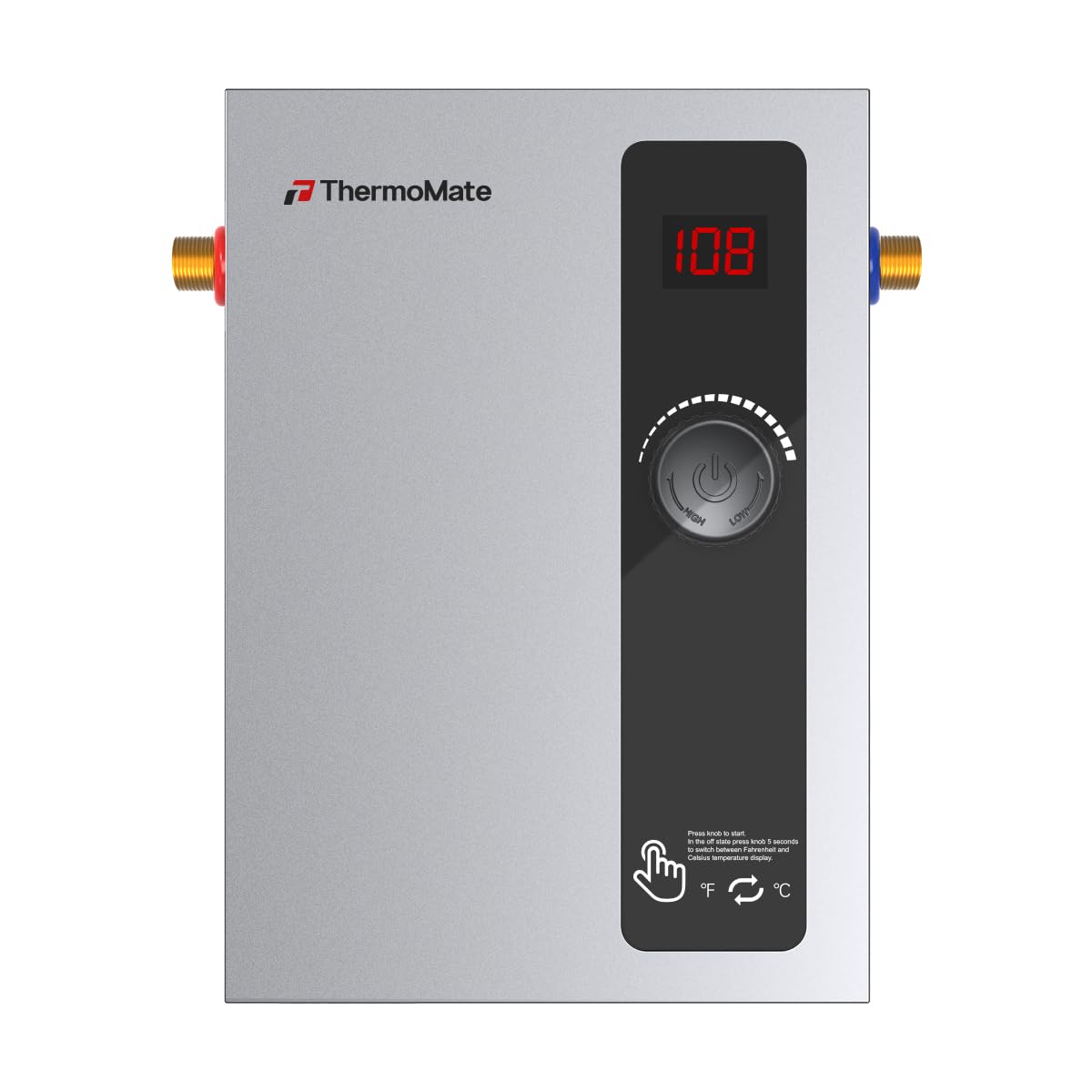
2. ThermoMate 8kW at 240 Volt
A compact point-of-use unit built to serve two faucets without eating your whole panel capacity.
The ThermoMate 8kW is the budget champion for a very specific job: instant hot water at a sink, an en-suite bathroom, or a wet bar. It pushes 1.56 GPM at a 35°F rise and tops out at a toasty 131 °F. It is designed for up to 2 faucets, which makes it the smart play when you do not need whole-house capacity. It is also the lightest unit here at 9.9 pounds, and at 8.58″W x 12.2″H it tucks neatly under a cabinet or beside a vanity.
The standout engineering is the cast aluminum heating chamber. Because the heating element is separated from the water lines, the maker says it prevents leaks and scale buildup on the element, which is the classic failure point on electric heaters. Owners credit this design and the easy install more than anything else — installation and performance are the two most-praised aspects by count. One owner shared a dramatic bill win, reporting an 18kW unit cut the electric bill from to in a single month, though that reference is to a larger model in the same family.
It is an ETL-certified unit with overheating protection, auto-stop when no water is detected, and leakage protection. The electrical side is simple: 8kW at 240V, 33.3A nominal current, requiring a 40-amp double-pole breaker and 8 AWG wires. Note the reviews — for code compliance you will want an electrician to run the dedicated circuits and cut-off boxes.
Smart sizing: It only heats water on demand, so it can cut water heating costs by up to 60% compared to a tank., but the real win here is the space it frees and the 131 °F ceiling for washing up.
The fit: this is the wrong tool for a whole family home — 1.56 GPM is one faucet at a time. For a guest bathroom or kitchen island, it is close to ideal.
3. SIVUATEK 14kW Tankless Water Heater
A shoebox-sized 14kW unit with a touchscreen that delivers 110 °F water in seconds.
The SIVUATEK V7B-140B is proof that a 240V tankless unit can be genuinely smart without being huge. It is compact as a shoebox, with a user-friendly digital display and touch control panel for setting your exact temperature. The 14kW heating system delivers 110 °F hot water in seconds, which owners confirm — the review pages note it takes less than 10 seconds to produce unlimited hot water. It is ETL-listed and qualifies for UL, adding confidence.
The performance is the most-praised aspect, with over 30 owners highlighting it. One owner said the unit heats a full home from the basement with water “plenty hot even on the second floor.” This unit beats the ThermoMate on flow, offering 2.3 gpm, and it beats the Titan on raw heat output at 14 kW. The 98% energy efficiency is a touch lower than the Titan’s 99.5%, but the real-world difference is negligible.
The most honest review in the data — that if you plan to use more than one faucet at a time, you should step up to the V7B-240B model for more heat output. The 14kW max temp is 110 °F, which is noticeably lower than many competitors; the ThermoMate hits 131 °F and the Rheem RTEX-11 reaches 140 °F. This is a single-user or single-bathroom unit at heart.
The smart features
- Digital touch panel with clear, real-time status updates
- Adjusts power based on flow rate and temp setting
- Standard 1/2″ NPT connections for basic DIY install
Know before you buy
- 110 °F max temperature is lower than rivals
- Temperature drops if you open a second faucet
Grab it for: a single person or couple wanting a high-tech, space-saving upgrade for one bathroom.
Think twice if: you have hard water — one owner noted the unit developed a problem after 4 months, though the company sent a replacement promptly.
4. Rheem RTEX-11 11kW

The multi-fixture Rheem with true 1-degree digital temperature control for a small home.
Rheem is the most recognized name in water heating, and the RTEX-11 justifies that reputation with its digital thermostatic controls. You can set the temperature in 1-degree increments anywhere from 80°F to 140°F, which is the widest, most precise range in this comparison. That precision is the thing owners praise most — reliability tops the aspect counts at 57 mentions, and the digital display is called out as very helpful by long-time Rheem owners replacing older versions.
The 11kW heat output delivers up to 2.68 GPM, enough for multiple fixtures in a small home. It is 90% smaller than a traditional tank heater, and critically, it requires no venting, so installation is simpler than a gas tankless. The efficiency is rated at 99.8%, the highest figure in this lineup alongside the EcoSmart and the 24kW Rheem. The wiring spec is clear: 240V single-phase, one 50-amp double-pole breaker, and #8 AWG copper conductors with a recommended minimum 100-amp service panel.
The honest caveat is durability. While many owners mention “flawless performance for years,” a notable share mention temperature fluctuations between scalding and cool, and some report failures. At 8.25″W x 12.63″H and just 3.2 kg, it is one of the lighter units here, making wall mounting easy. The 5-year leak and 1-year parts warranty offers some protection, but the mixed long-term feedback is worth weighing against the Titan’s proven 20-year track record.
Precision at a price: this gives you the best temperature control in the category — 80°F to 140°F in 1-degree steps — which is a genuine comfort win for picky households.
The balance: for a smaller home with a single shower, this is a fantastic digital upgrade. For a large family, the 11kW output and the mixed reliability reports suggest you look at the 24kW Rheem instead.
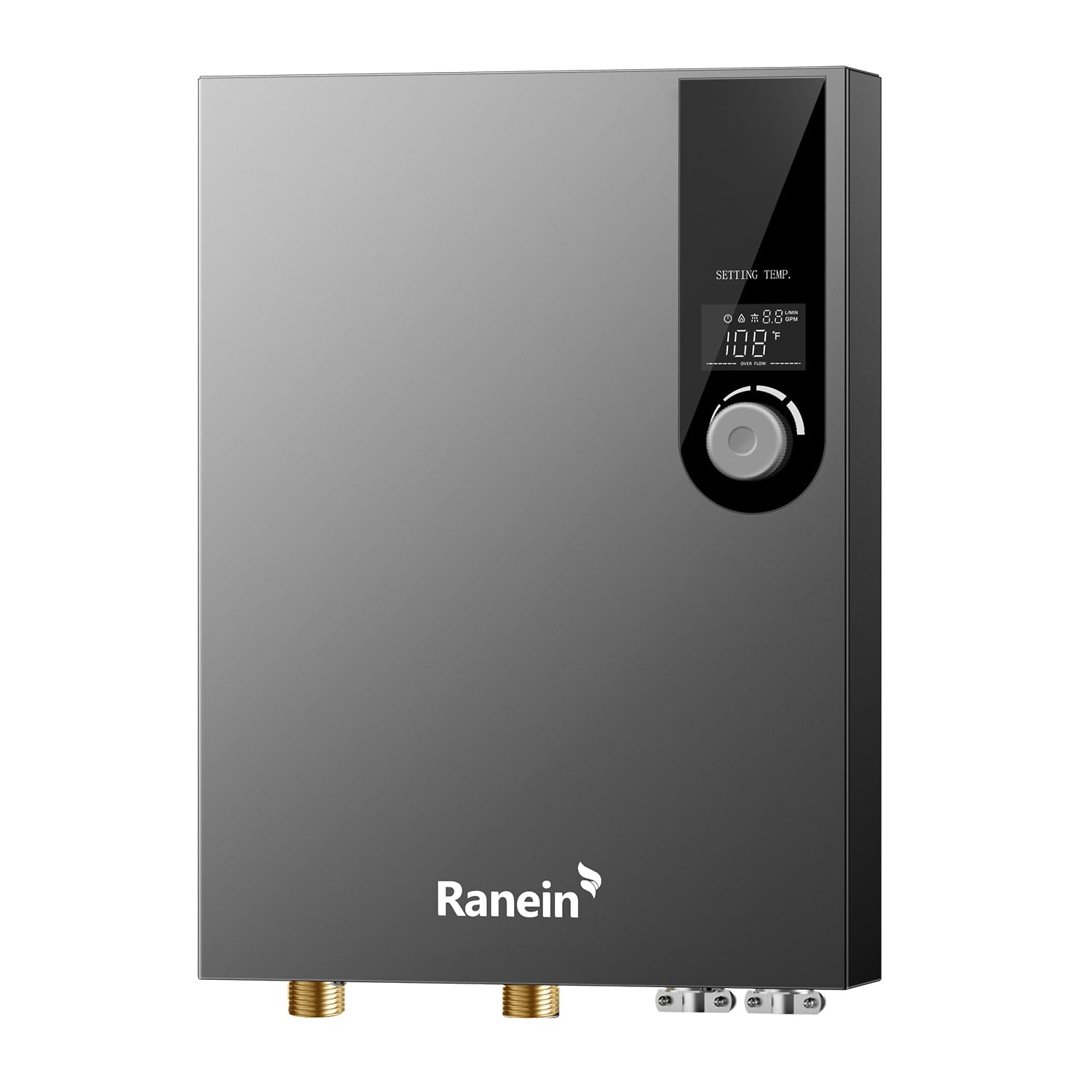
5. Ranein 18kW Whole House
An 18kW workhorse that keeps two outlets going at once with stainless steel elements.
The Ranein RE18K is the bridge between small apartment units and the premium 24kW behemoths. At 18 kW with a 99% thermal efficiency rating, it supports 2-3 household water outlets simultaneously, making it a true whole-house option for modest homes. The max flow rate of 4.3 GPM is a massive step up from the 2.3 gpm of the SIVUATEK, meaning you can run a shower and a sink without the temperature collapsing — a capability owners confirm, with one noting you can shower for an hour and never run out of hot water.
It is the most feature-complete unit in the mid-range. The precise temperature control allows adjustments from 86°F to 131°F in 1°F increments via an intuitive control knob and LED display. It is CSA certified to meet U.S. and Canadian safety standards, with leakage protection, overheat protection, drop-tested durability, and a moisture-resistant design. The stainless steel heating elements are designed to reduce scale buildup for a longer service life.
The electrical demand is the reality check. This 18kW unit requires 2 dedicated 240V circuits, each with its own 40-amp double-pole breaker and 8 AWG cable. That is a heavier ask than the 8kW or 14kW units, and one owner reported random breaker trips despite a proper installation — a reminder that panel capacity and wiring quality matter more here. At 13.8″W x 18.7″H and 7.9 kg, it is compact given its output.
What it does well
- 4.3 GPM supports 2-3 outlets at once
- 1°F temperature increments from 86°F to 131°F
- Stainless steel elements resist scale
The electrical reality
- Requires 2 dedicated 240V circuits with 40A breakers
- A few customers note breaker trips; warranty service can be slow
Best fit: a small to mid-size home that wants to run a shower and kitchen sink at the same time without paying for 24kW of capacity.
Not for: anyone with a maxed-out 100-amp panel — this needs two full circuits and real service capacity.
6. Ecosmart ECO 24 24kW

The made-in-USA 24kW unit that earns the “quality” label from more owners than any spec sheet could.
The EcoSmart ECO 24 is the most positively reviewed premium unit in this lineup, with quality as the dominant recurring theme in owner feedback. The patented self-modulating technology is the star — it monitors water temperature and flow to adjust power usage in real time, which owners say delivers excellent temperature stability with no fluctuation, even running a shower and washer simultaneously. It is manufactured in the United States.
At 24 kW with a 5.8 gpm flow rate, this is a serious whole-house option. Owners confirm it handles a 2-bath, 3-person household comfortably on an 80-amp supply. The 99.8% energy efficiency rating matches the best in class, and the digital output temperature display keeps you informed. The sleek white design measures 17″W x 17″H with a 3.5-inch depth, and at 14.3 pounds it is over 3 pounds lighter than the 24kW Rheem, making it easier to wall-mount solo.
The real downside is installation cost, not the unit’s performance. It requires a high-amp electrical setup — one owner ran 3x40A circuits for a DIY install, while another flagged that the electrician’s fee was the expensive part. The energy bill is a genuine mixed bag: some reviewers point out it “dropped my electric bill,” while others note it uses more power than expected. The lifetime warranty on electronics, exchanger, and element is the strongest in this comparison, though it only covers the cost of the heater, not labor.
The quality leader: no other unit here has quality as its most-praised aspect the way the ECO 24 does — this is the one owners recommend for consistent, stable output.
The catch: the upfront electrical work is the real cost. If your panel requires a full service upgrade, the bill for the electrician can rival the price of the heater itself.
7. Rheem RTEX-24 24kW

The highest-flow Rheem — 5.9 GPM — built to satisfy two showers and a hot laundry load together.
The Rheem RTEX-24 is the most popular 24kW unit in this list by owner count, and it earns that with the highest flow rate here at 5.9 GPM. This is the spec that matters for real households: it handles 2 showers plus hot laundry simultaneously, with owners in Florida noting only a 2-4°F drop at the farthest shower. The self-modulating power control adjusts output to demand, and the ON/OFF dial with digital temperature display keeps things simple.
Performance is the most-praised aspect by a huge margin, with 87 owners highlighting it, and installation is the second-most-praised at 40. One owner reported hot water in 22.93 seconds with a 2-4°F drop at the farthest shower, while handling 2 showers and hot laundry. The efficiency rating is 99.8%, and the unit weighs in at 17.8 pounds with a 17.63″W x 18.25″H footprint. At 3.5 inches deep, it is a slim profile against the wall.
This unit replaces the RTEX-11 in the lineup, and the flow difference is dramatic — 5.9 GPM vs 2.68 GPM is more than double, making the RTEX-24 the clear choice for anyone who found a smaller unit underwhelming. The electrical requirement is significant: shoppers say it needs 3x40A breakers and 9×8-gauge wires, with a 200-amp service panel recommended. One owner paid for electrician installation. Durability is mixed — some units last over six years, while a few fail within three months or arrive with a broken control module.
Why it leads on flow
- 5.9 GPM handles 2 showers + laundry at once
- 22.93-second heat-up reported in real use
- Digital display with adjustable temperature
Before you commit
- Needs 3x40A breakers and a 200-amp panel
- Occasional quality-control issues on arrival
Choose this if: you have a 200-amp panel and want maximum simultaneous flow for a busy family.
Compare first if: your panel is older or smaller — the EcoSmart offers similar output for a simpler install, while this Rheem demands serious electrical work.
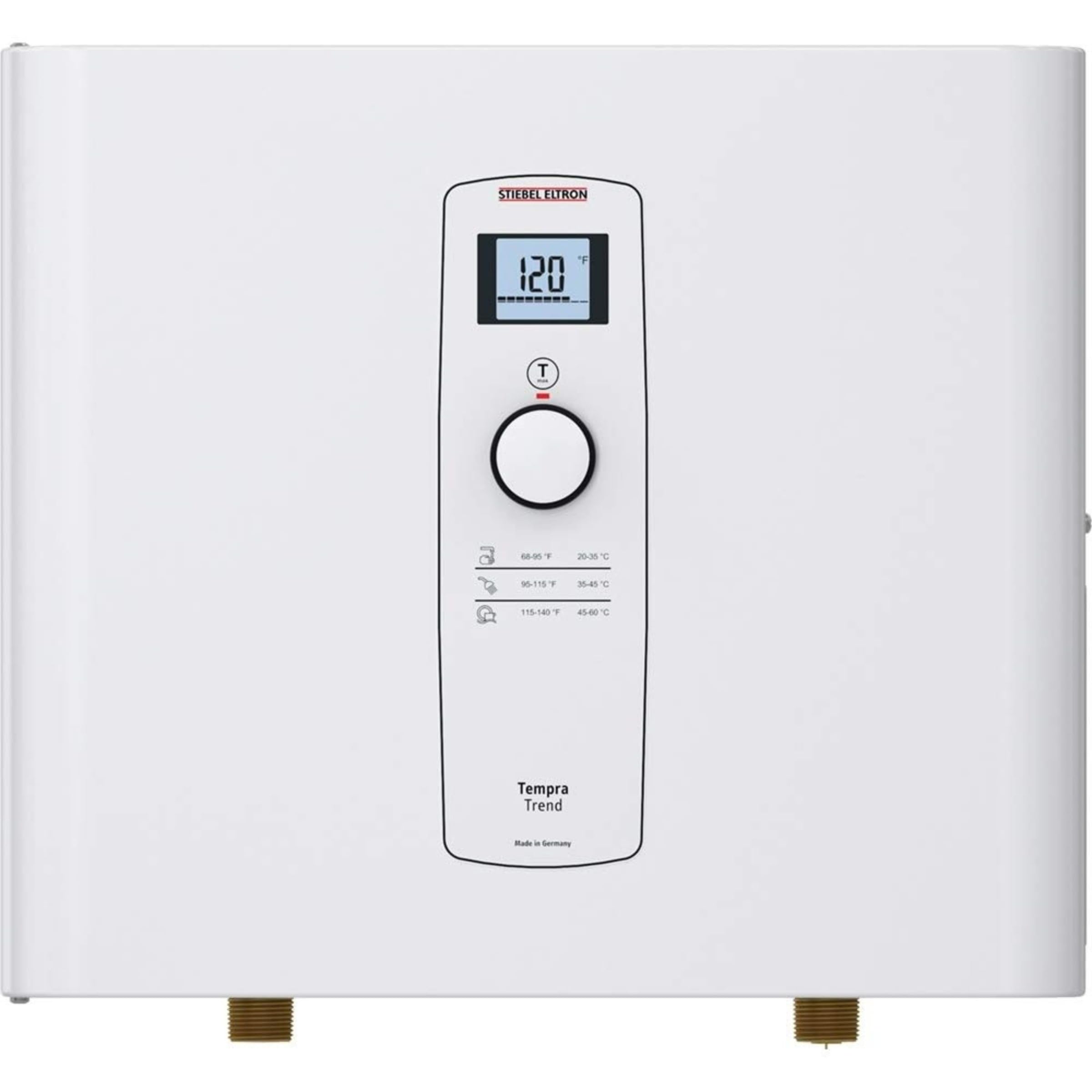
8. Stiebel Eltron Tempra 24 Trend
German-engineered 24kW heat with silent operation and a solid copper core.
The Stiebel Eltron Tempra 24 Trend is the premium pick for those who value engineering pedigree. The interior solid copper heating system is the standout spec — copper transfers heat more efficiently than the steel or aluminum chambers used elsewhere, which is why Stiebel Eltron backs it with a 7-year leakage and 3-year parts warranty, the most generous coverage here. It is also noise-free in operation, with a single electronic switch activating the heater.
This 24kW model offers an output temperature range of 68° to 140°F, and buyers report it produces enough hot water for showers while heating instantly. The effectiveness and water temperature are the two most-praised aspects. The digital temperature display is easy to read, and the auto-modulation saves energy by adjusting output to demand. At 16.63″W x 14.5″H and 16.1 pounds, it is the most compact 24kW unit in this comparison.
The trade-off is the electrical service requirement — it needs a minimum recommended 150A service, and owners note it requires 2 circuits, often needing both an electrician and a plumber for the install. The flow limiter is a clever feature that maintains constant temperature for high-flow appliances. However, the review count is smaller than the Rheem or EcoSmart, and one owner reported a frustrating warranty experience after the unit failed at 13 months. The power bill, though, trended positive, with one owner seeing a 10% drop.
The engineering case: solid copper internals, silent running, and a 7-year leak warranty make this the least likely to fail quietly in the night.
The premium cost: you pay more for the brand and build, and the 150A service minimum means it is not for older panels.
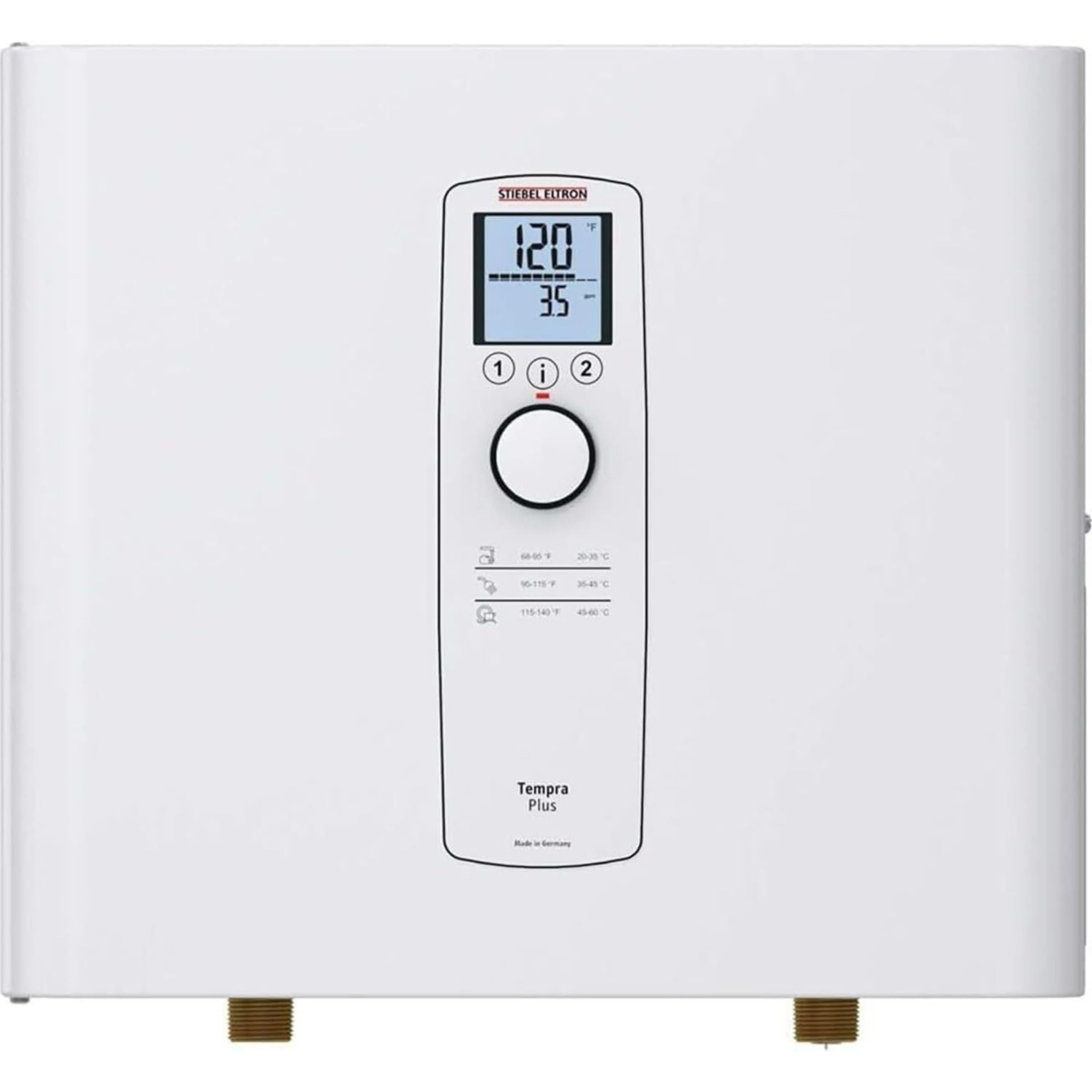
9. Stiebel Eltron Tempra 36 Plus
The 36kW flagship for the biggest homes and the coldest winters — copper elements, German engineering.
The Tempra 36 Plus is the most powerful unit in this comparison at 36 kW, designed for large homes with demanding hot water needs simultaneously. Owners mention it still heats water perfectly after a year in service on a 3/2.5-bath home. This is the unit to choose when nothing else can keep up with a big family in a cold climate. It is German-made with copper elements, and owners who researched the engineering call it the best available.
The digital display makes temperature and flow adjustment easy, and the quality is the most-praised aspect by a wide margin. One owner switched from a 75-gallon tank and saw 100°+ hot water arrive in 1-2 minutes versus 5-7 minutes for the old tank. The killer feature here is raw capacity — where the 24kW units run two showers, the 36kW Plus handles a full house with a margin to spare.
The reality check is the massive electrical appetite. This unit requires 3 double circuits with 50-amp breakers each, which is a serious infrastructure investment. The install is expensive — one owner noted three wire runs from a panel 40 feet away cost nearly as much as the heater. The flow spec of 1.5 gpm is the lowest here, which under cold groundwater conditions limits simultaneous output. And the energy consumption is the honest weakness: pulling 10-15 kW during a shower, one owner saw a higher electric bill despite solar panels, and reported inconsistent temperature swings between hot and cold.
The capacity king
- 36 kW heat output handles a 2.5-bath home with ease
- German-made with copper elements for longevity
- Digital display for precise temp and flow control
The commitment
- Needs 3 double 50A circuits — a real electrical upgrade
- High energy draw; some owners see big bills
- 1.5 gpm flow is low for the wattage
The right owner: a large family in a cold climate with a beefy 200A+ electrical panel and a budget for professional installation.
Step down if: your home is smaller or your winters are mild — a 24kW unit like the EcoSmart or Rheem delivers most of the benefit for a fraction of the electrical cost.
Understanding the Specs
Heat Output (kW)
The kilowatt rating is the total heating power available. Higher kW means the unit can raise cold water to a hot temperature at a higher flow rate. An 8kW unit is fine for one sink, an 11-14kW unit handles a small home, and a 24-36kW unit is for whole-house, simultaneous use. The max temperature tells you how hot the water can get — 131 °F to 140 °F is the common ceiling for comfortable, safe showers.
Flow Rate (GPM)
Gallons per minute is how much hot water the unit outputs at a given temperature rise. The higher the GPM, the more fixtures you can run at once. A 1.56 GPM unit serves one faucet, a 4.3 GPM unit serves 2-3 outlets, and a 5.9 GPM unit can run two showers plus a washer. This number always drops in winter when incoming water is colder.
FAQ
What size breaker do I need for a 240V tankless water heater?
Can I install a 220 volt tankless water heater myself?
Will a tankless water heater save me money on my electric bill?
How many showers can a 24kW tankless water heater run at once?
Why does my tankless heater run out of hot water?
What is the difference between 220V and 240V tankless heaters?
How long does an electric tankless water heater last?
Do tankless water heaters need a 200 amp electrical panel?
Final Thoughts: The Verdict
For most buyers, the best 220 volt tankless water heater overall is the Titan 11.8kW because of its class-leading 20-year reliability record and 99.5% efficiency. If you want the best whole-house flow at a premium price, grab the EcoSmart ECO 24, which owners praise for quality and stable temperature. And for a small, budget-friendly point-of-use solution, the ThermoMate 8kW is the one to reach for. Whichever you choose, verify your electrical panel capacity before you order — that is the single step that separates a smooth upgrade from an expensive surprise.
How We Picked
We do not accept paid placement. Every pick is matched to a real buyer and a real use-case; we do not hands-on test units.
Sources & Methodology
Specifications: manufacturer listings and product documentation. Review insights: verified customer reviews, as of August 2026. Pricing: not shown on this page (it changes often); check the current price via the retailer link.
As an Amazon Associate, Gadgets Feed earns from qualifying purchases. This does not affect which products we feature.