
Our readers keep the lights on and my morning glass full of iced black tea. As an Amazon Associate, I earn from qualifying purchases.
Specs are compiled from manufacturer listings and verified buyer reviews and can change over time — please confirm the key details on the product page before buying.
A 220V power station isn’t a giant phone charger — it’s a quiet, indoor-safe replacement for a gas generator that can run your well pump, dryer, or even a 5-ton AC. The models here all deliver true 120V/240V split-phase output, which is the difference between keeping your lights on and actually running your whole house.
I’m Min — the founder and writer behind Gadgets Feed. This guide is built by comparing the manufacturers’ published specifications and the patterns across verified customer reviews, so you get each pick’s real strengths and trade-offs instead of marketing spin.
If you need serious whole-home backup without fuel fumes, this breakdown of the best 220v power station options reveals which units truly handle 240V appliances and which ones riders regret.
Our Picks at a Glance

How To Choose The Best 220V Power Station
Choosing a 220V power station means matching its output and capacity to the specific appliances you refuse to live without during an outage. The two numbers that matter most are continuous wattage (does it have the muscle to start your pump or AC?) and watt-hours (how long will that muscle last?).
Continuous vs. Surge Wattage
Motors in well pumps and refrigerators draw a big burst of power for a split second when they start, then settle into a lower continuous draw. A station’s surge wattage covers that initial kick, while the continuous rating is what it sustains. If your dryer needs 5,400W to run, you want a unit rated at 6,000W continuous so the surge headroom is there too.
Battery Chemistry: LFP Is the Standard
All the serious 220V units use lithium iron phosphate (LFP) cells, which tolerate far more charge cycles than older lithium-ion packs. The practical payoff is lifespan measured in years — several of these stations are rated for roughly a decade of daily use, which justifies the higher upfront cost for a device meant to sit ready for emergencies.
Expandability and Recharging Speed
Think about whether the base capacity is enough or if you’ll want add-on batteries later; the best stations let you stack extra packs when your needs grow. Recharge speed also varies wildly — some refill from a wall outlet in under two hours, while others take most of a day, which changes how you use them during multi-day outages.
Quick Comparison
| Model | Best For | Capacity | AC Output | Weight | Amazon |
|---|---|---|---|---|---|
| Jackery HomePower 3600 Plus★ Best Overall | Balanced whole-home backup | 3584Wh (exp. 21kWh) | 3600W (7200W parallel) | 77.2 lbs | Amazon |
| OSCAL PowerMax 6000Fastest Recharge | Fast solar charging | 3600Wh | 6000W (9000W surge) | 100.3 lbs (45.5kg) | Amazon |
| PECRON F5000LFP | High-power 240V appliances | 5120Wh (exp. 35.8kWh) | 7200W | 123.9 lbs | Amazon |
| Anker SOLIX F3800 | Trusted brand, EV charging | 3.84kWh (exp. 26.9kWh) | 6000W (12000W max) | 132.3 lbs | Amazon |
| EcoFlow DELTA Pro 3 | Silent, expandable, EV-ready | 4096Wh (exp. 48kWh) | 4000W (12000W scalable) | 115 lbs | Amazon |
| Jackery Solar Generator 5000 Plus | Longest expandable runtime | 5040Wh (exp. 60kWh) | 7200W (14400W surge) | 134.5 lbs | Amazon |
In‑Depth Reviews
1. Jackery HomePower 3600 Plus
Our pick — over 4.5★ from 150+ verified ratings; the strongest balance of quality and price.
The rolling powerhouse that refills fast and rolls right where you need it.
You get serious power without sacrificing portability with the HomePower 3600 Plus. It delivers 3600W of AC output (jumping to 7200W when you pair two in parallel) from a 3584Wh LFP battery (a lithium iron phosphate pack that lasts longer than standard lithium-ion). The dual-voltage support means you can feed both 120V and 240V appliances — enough to run pumps, heaters, and dryers with ease.
Recharging is where this unit stands out: buyers report it climbing from 28% to 100% in under two hours, and the spec sheet backs that pace with a 0–100% full charge in just 2 hours via hybrid AC+DC. That speed matters when a storm is rolling in and you need a full tank fast. At 77.2 pounds, it’s still a heavy lift, but the luggage-style wheels and telescopic handle make rolling it from kitchen to garage feel easy.
The build quality is the thing that wins people over — it’s the most-praised trait in the owner community, and riders note it feels sturdier than comparable brands. The LFP cells are heat-tested at 302 °F and rated for 6,000 cycles with a 10-year lifespan.
What It Does Best
- Charges 0–100% in 2 hours via hybrid AC+DC
- Dual voltage (120V & 240V in parallel) for big appliances
- Wheels and telescopic handle make 77.2 lbs easy to move
- LFP cells rated for 6,000 cycles and a 10-year lifespan
Trade-Offs to Know
- Base 3584Wh means heavy users may want the expansion battery
- Requires a second unit in parallel to hit 7200W output
The Balanced Choice: If you want one station that recharges fast, rolls easily, and runs your fridge, freezer, and work-from-home gear through an outage, this is the one to start with.
Plan Ahead: At 77.2 lbs you won’t be carrying it up stairs; the wheels handle flat ground, so think about where it lives.
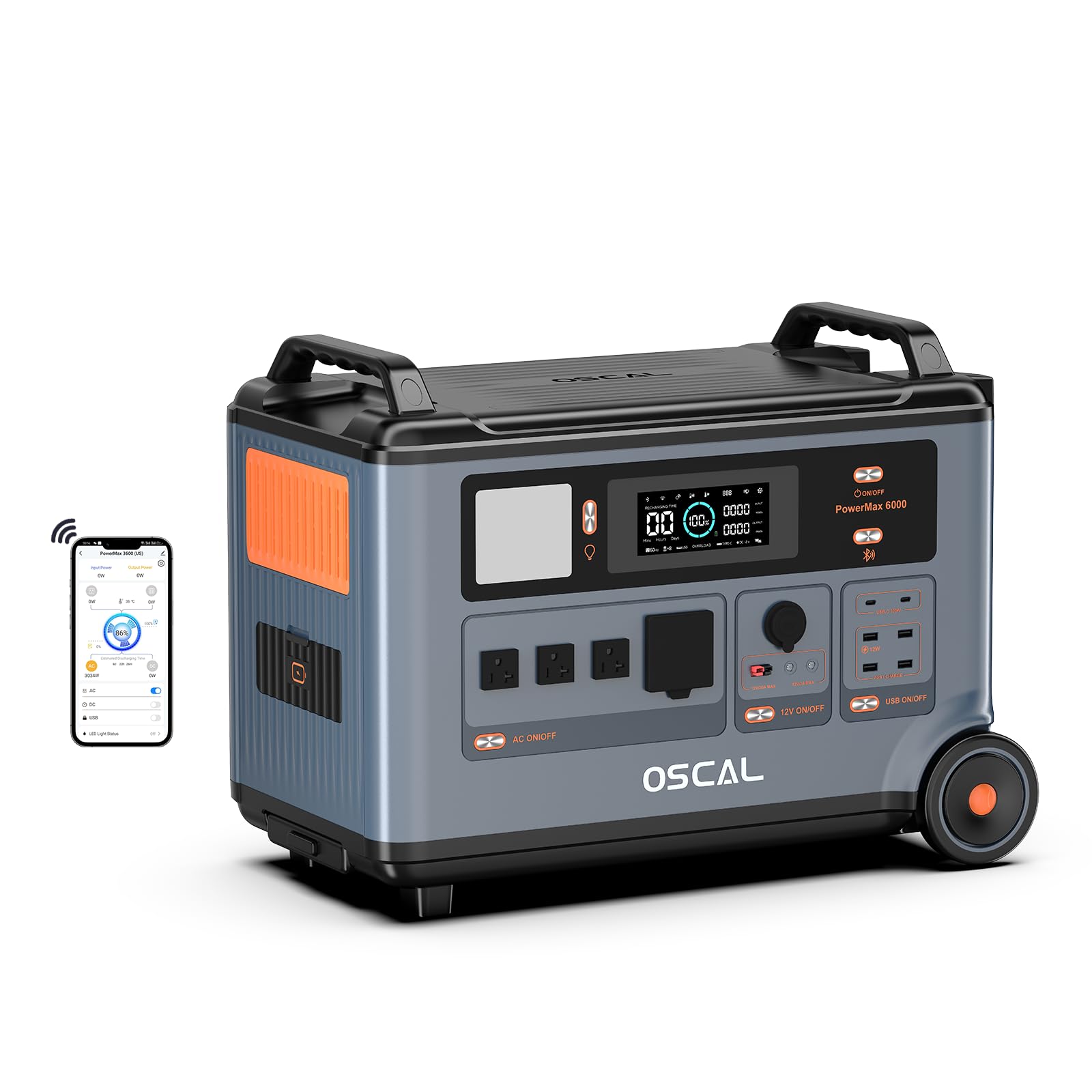
2. OSCAL PowerMax 6000
The 240V unit that fills its tank faster than any rival here.
If you hate waiting for a recharge, the OSCAL PowerMax 6000 is your pick. It accepts 2200W of AC input and up to 2400W of solar input, which gets this 3600Wh station from 0% to 100% in just 1.44 hours with solar and 1.96 hours from a wall outlet — faster than most rivals in this class.
Output is equally brawny. The 6000W continuous rating (with a 9000W surge) feeds four AC outlets on a 120/240V split-phase system, and the 5–8 ms EPS switchover means network gear and other sensitive electronics don’t blink when the grid drops. The LFP battery is rated for 3,500 charge cycles, backed by a 5-year warranty and a claimed 25-year service life.
Owner feedback is straightforward: the build feels solid and quiet, and the clear display earns praise. The recurring gripe, owners mention, is solar connectivity — the unit arrived configured to accept one panel at a time, which frustrated owners who bought the three-panel bundle. As one buyer put it: “Why would you sell a power generator with 3 solar panels without a way to use three solar panels?”
Why It Stands Out
- 0–100% solar charge in 1.44 hours at 2400W input
- 6000W continuous / 9000W surge output
- 5–8 ms EPS switchover for uninterrupted power
- Smart App control for monitoring and remote commands
Watch For
- Solar panel connectivity is limited to one panel at a time as shipped
- At 45.5 kg (100.3 lbs), plan for a permanent home spot
If Speed Is Everything: This is the station for solar owners who hate waiting — it recharges faster than anything else on this list.
Read the Fine Print: Check how your solar panel bundle connects before buying; the multi-panel limitation is the most common complaint.
3. PECRON F5000LFP
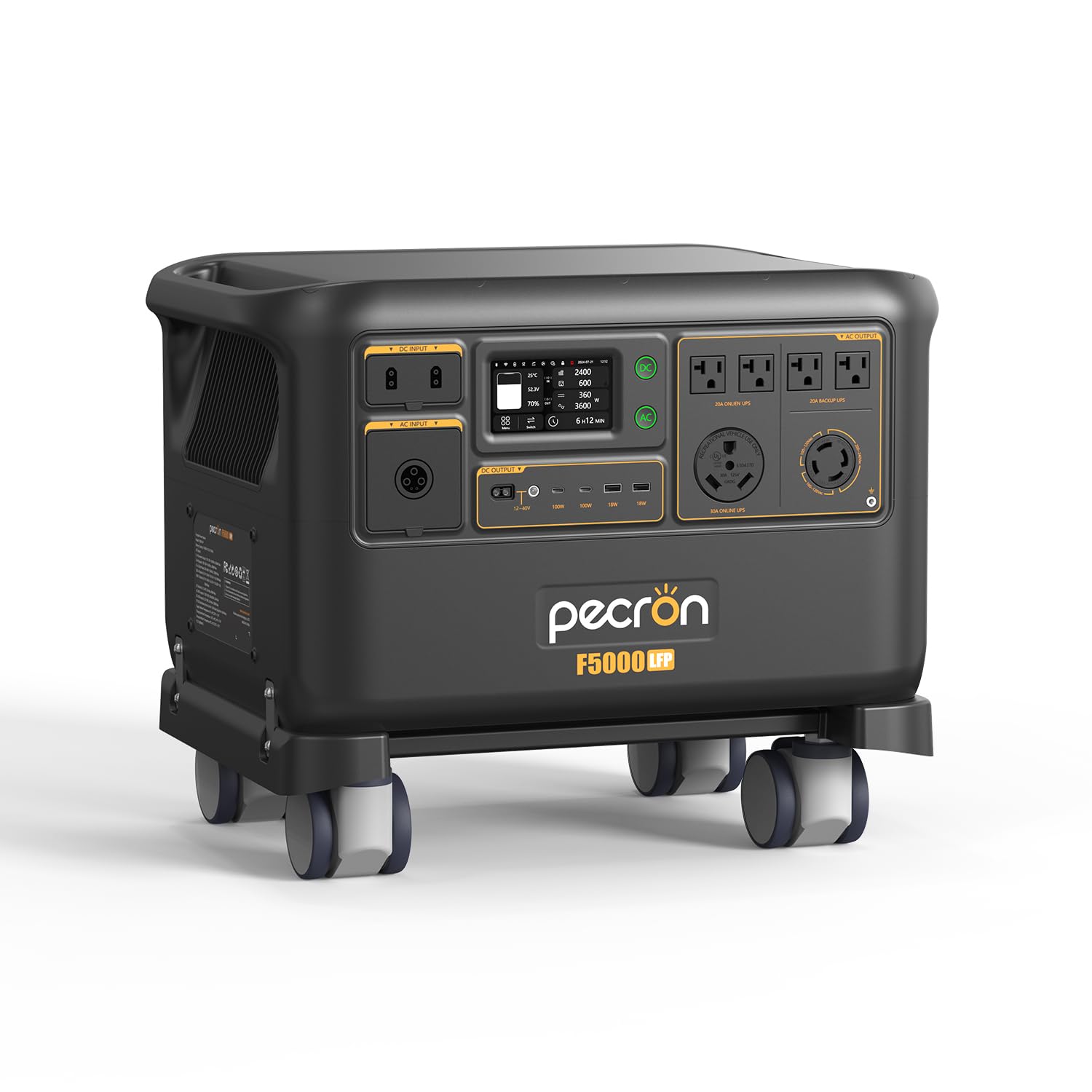
A 7200W bruiser built for dryers, heaters, and water pumps.
The PECRON F5000LFP sets the high-water mark for raw muscle, beating the Jackery HomePower 3600 Plus on both fronts — it carries 5120Wh of capacity against 3584Wh, and pushes 7200W of AC output versus 3600W. That’s a 43% capacity edge and a full 2.0x output advantage, which translates into running high-draw appliances like dryers, heaters, and water pumps without breaking a sweat.
It’s also a serious UPS. The two 20A and one 30A outlets deliver 0ms online UPS switching, meaning Wi-Fi routers, aquariums, CPAP machines, and data-center gear never lose power for even a blink. With 6 AC and 6 DC outputs, the 12–40V adjustable 5525 port and XT-60 port let you tailor voltage for different laptop and vacuum models, while two 18W USB-A ports and one 100W USB-C handle phones and computers.
The 100-pound-plus weight class is real here at 123.9 pounds, but the detachable cart turns it from a dead lift into a roll. Solar enthusiasts get 6400W of total input across two ports (25A per port), and the smart app lets you schedule charging to dodge peak-rate electricity. Owner reports of reliability are split — the unit impresses when it works, but a small number had solar charging failures within the first week, so treat the warranty as a must-check.
Pure Power: This is the pick when you need 7200W of continuous 240V output and a stout 5120Wh base — it out-muscles every other station here on paper.
Hear This: The 30dB low-noise mode keeps CPAP users sleeping soundly, but the weight means you’ll want the detachable cart set up from day one.
Choose It For: Garage or utility-room duty where a dryer, water heater, and pump all need simultaneous 240V power.
Think Twice If: You want a device you can casually move between rooms — at 123.9 lbs, this one stays put.
4. Anker SOLIX F3800

Anker’s build quality and a NEMA 14-50 port that charges your EV directly.
The Anker SOLIX F3800 is the most-reviewed 220V station here, and the consensus is clear: it’s an impressive, easy-to-use backup system. The 6,000W AC output covers a full home’s needs, and its 120V/240V dual-voltage capability means your dryer works — no more settling for only 120V in an outage. The 3.84kWh base expands to 26.9kWh with up to six add-on battery packs, and stacking a second F3800 doubles output to 12,000W.
What truly separates it is the NEMA 14-50 port (the same outlet your electric car charger uses), which lets you plug your EV directly into the station at 6,000W — no grounding accessories or special cables required. It also powers RVs through NEMA 14-50 or L14-30 ports, making it a dual-duty solution for home backup and road trips. The Anker app adds Wi-Fi and Bluetooth control, letting you monitor all power sources and set the unit to save you money on your bill.
Owner experiences with solar charging are mixed — some see full sun performance, others report the 400W solar panel delivering only about 218W even in midday Texas sun. The smart temperature system and impact-resistant design support Anker’s 5-year warranty and claimed 10-year lifespan. If you want a brand with deep support and an EV-friendly port, this is the most proven pick.
The Standout Features
- NEMA 14-50 port charges your EV at 6,000W
- 120V/240V output runs dryers and other big appliances
- Expandable to 26.9kWh with up to 6 battery packs
- Wi-Fi/Bluetooth app control for monitoring everything
Consider This
- Solar charging maxes lower than expected for some owners
- At 132.3 lbs, it’s the heaviest unit on this list
The Brand-Name Buy: If you want the most proven track record, a 5-year warranty, and a station that can charge your EV, the F3800 is the safest premium bet.
Reality Check: Solar performance varies with panel pairing — don’t expect the full rated wattage on overcast days.
5. EF ECOFLOW DELTA Pro 3

A near-silent 30 dB hum that protects your servers with a 10 ms UPS switch.
The EcoFlow DELTA Pro 3 quietly does it all — literally. Its X-Quiet technology keeps operation at a hum as low as 30 dB, so it can sit beside your bed or server rack without disturbing a thing. That silence pairs with a 10 ms switch-over capability, meaning NAS systems, servers, and entertainment devices get uninterrupted power the instant the grid fails — faster than most rivals can even react.
Inside is a 4096Wh LFP battery (expandable to 48kWh) with a 4000W output that scales to 12,000W with extra units. That’s enough to spin a 3-ton central AC or a 1 HP water pump, and the 120V/240V support means 240V appliances work from a single unit. It recharges 80% in just 50 minutes from a wall outlet, and the 2600W solar input (across two ports) gives off-grid owners a solid renewable path.
The IP65-rated CTC battery pack adds water and dust resistance, and the automotive-grade LFP cells back a 5-year warranty. Owners praise the power delivery and the smooth-rolling wheels, with one noting the design “looks stealthy like a Porsche.” The trade-off: at 115 pounds, it’s hefty, and a few customers note the battery drains faster than expected under continuous heavy load — one said it didn’t last beyond 4 hours pulling serious wattage.
Whisper-Quiet Power: For home offices, server closets, and bedrooms, the 30 dB hum and 10 ms UPS make the DELTA Pro 3 the most considerate station here.
Know the Limits: Heavy continuous draws will drain the 4096Wh base faster than the bigger-capacity units, so plan your load list.
Best For: Tech-heavy homes where silent, instant backup for electronics matters more than raw capacity.
Reconsider If: You need to run a dryer and well pump simultaneously for hours — the 4096Wh base is better paired with the expansion battery.
6. Jackery Solar Generator 5000 Plus
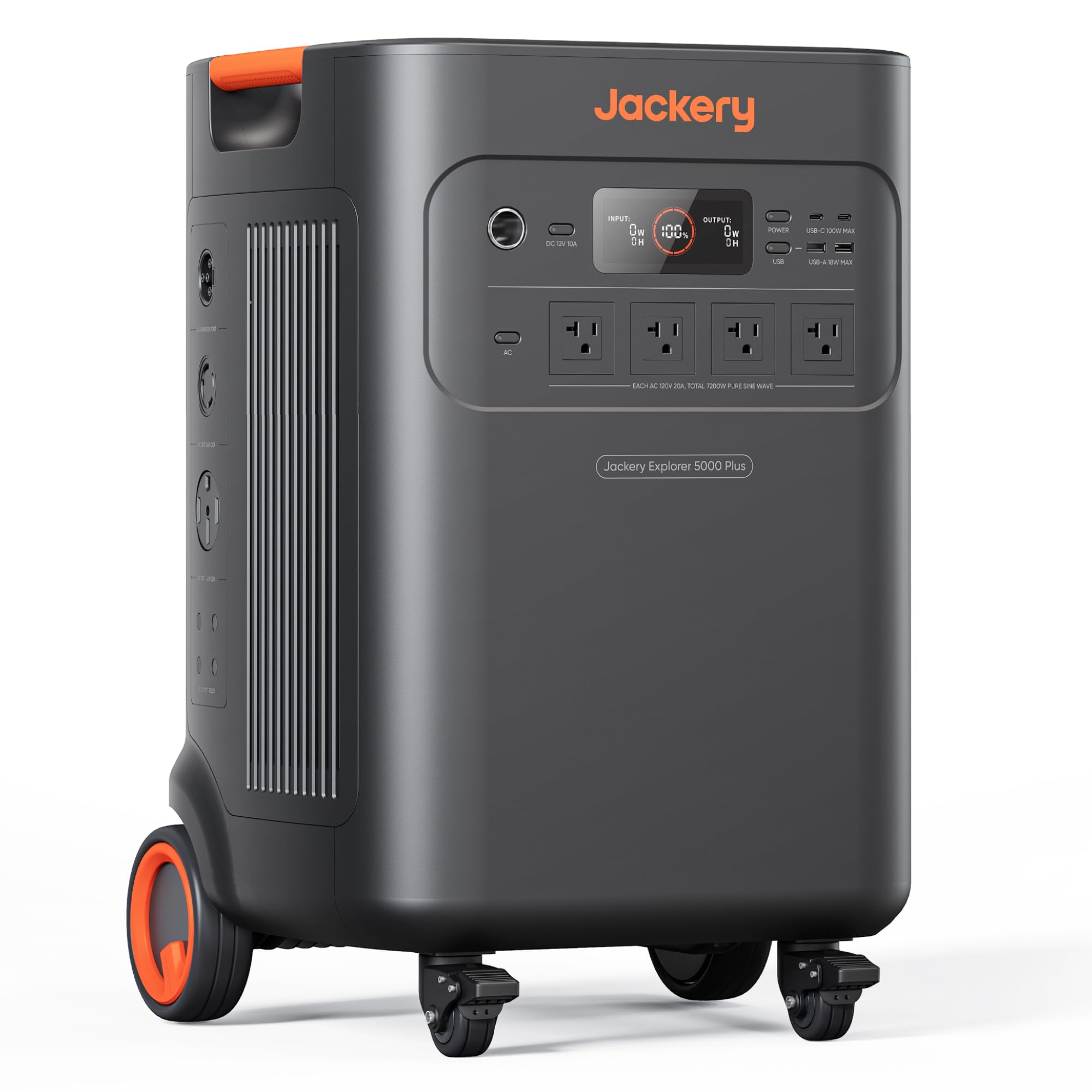
The longest-lasting backup here — expandable to 60kWh for two-week outages.
The Jackery Solar Generator 5000 Plus is the endurance champion of this list. With a 5040Wh base capacity that expands all the way to 60kWh, it’s the station designed for extended outages, not just overnight hiccups. The 7200W rated output (14,400W surge) handles a 5-ton AC or a water heater, and 120V/240V support covers everything in a typical home.
What makes it special for solar owners is the charging flexibility: it works with both high- and low-voltage panels and can refill in about 2 hours with up to 4000W of input. Pair it with the Jackery 60A Smart Transfer Switch and you can protect up to 12 circuits at 120V or 6 at 240V, routing power to the circuits that matter most during a blackout.
The LFP cells and ChargeShield 2.0 technology rate the battery for up to 11 years of daily use. Owners praise the solid build and quiet operation — one mobile welder specifically chose it because it runs quietly indoors when gas generators can’t. The honest caveat: a few reviewers point out the battery losing over 30% daily in standby, so if you let it sit for weeks, keep an eye on the charge level. The Wi-Fi connection also drains battery, so switching it off when not needed helps.
Why It’s the Endurance King
- 5040Wh base expands to 60kWh — the most on this list
- 4000W solar input refills in about 2 hours
- 7200W rated / 14,400W surge handles 5-ton AC
- LFP cells rated for up to 11 years of daily use
The Honest Trade-Offs
- Standby drain can exceed 30% daily for some owners
- At 134.5 lbs, it’s the heaviest station in this lineup
For the Long Haul: If your region faces multi-day or multi-week outages, the 60kWh expansion ceiling makes this the station you’ll never outgrow.
Manage Standby: Turn off the Wi-Fi when not in use — it’s a known drain on the battery between outages.
Understanding the Specs
Watt-Hours (Wh) vs. Watts
Watt-hours measure total energy stored — the “size of the tank.” Watts measure how fast that energy can flow out at any moment. A 3600Wh station with a 3600W output can run a 3600W dryer for about one hour, or a 360W fridge for roughly ten hours. Bigger Wh means longer runtime; bigger W means you can run heavier appliances.
120V/240V Dual Voltage
Most portable stations only output 120V, which tops out around 1,800W per outlet. A 240V-capable unit uses split-phase output to deliver the higher voltage that dryers, well pumps, water heaters, and EV chargers need. If an appliance is hardwired for 240V, a standard 120V station simply can’t run it — dual voltage is the difference between lights-on and laundry-done.
UPS Switchover Time
When the grid fails, a station with UPS (uninterruptible power supply) mode instantly swaps to battery power. Switchover is measured in milliseconds — the PECRON delivers 0ms, the EcoFlow and OSCAL around 5–10 ms. For computers, servers, and medical equipment, a fast switchover prevents reboot loops and data loss. For lights and fridges, even a slower switch is fine.
LFP Battery Chemistry
Lithium iron phosphate (LFP) cells are the gold standard for power stations because they handle thousands of charge-discharge cycles before degrading. Older lithium-ion packs might last 500–1,000 cycles; LFP units are rated for 3,500–6,000 cycles. That translates to a 10-year-plus lifespan, which justifies the premium price for a device meant to sit ready for emergencies.
FAQ
What appliances can a 220V power station actually run?
How long will a 3584Wh station power my fridge and freezer?
Can I charge a 220V power station with solar panels?
What is the difference between rated power and surge power?
Can these power stations charge my electric vehicle?
How heavy are these 220V power stations?
Will a 220V power station work for RV camping?
How long do the batteries last before needing replacement?
Can these stations power my whole house during an outage?
Is a 220V power station safer than a gas generator indoors?
Final Thoughts: The Verdict
For the majority of shoppers, the 220v power station winner is the Jackery HomePower 3600 Plus because it pairs fast 2-hour recharging with genuine 240V output and rolling portability. If you want maximum raw power for dryers and pumps, grab the PECRON F5000LFP with its 7200W output. And for the longest expandable runtime up to 60kWh, the Jackery Solar Generator 5000 Plus is the one to reach for. Whichever you choose, you’re getting a quiet, indoor-safe backup that a gas generator simply can’t match.
How We Picked
We do not accept paid placement. Every pick is matched to a real buyer and a real use-case; we do not hands-on test units.
Sources & Methodology
Specifications: manufacturer listings and product documentation. Review insights: verified customer reviews, as of August 2026. Pricing: not shown on this page (it changes often); check the current price via the retailer link.
As an Amazon Associate, Gadgets Feed earns from qualifying purchases. This does not affect which products we feature.