
Our readers keep the lights on and my morning glass full of iced black tea. As an Amazon Associate, I earn from qualifying purchases.
Specs are compiled from manufacturer listings and verified buyer reviews and can change over time — please confirm the key details on the product page before buying.
A power outage that shuts down your well pump, your fridge, and your furnace doesn’t have to mean dragging a noisy, smelly gas generator out of the shed. A 220V solar generator is the clean, quiet way to keep your whole house running without the fumes or the hassle of refueling. The trick is picking one with enough muscle for your 240V appliances—your well pump, your dryer, your air conditioner—and a battery that lasts through the night.
I’m Min — the founder and writer behind Gadgets Feed. This guide is built by comparing the manufacturers’ published specifications and the patterns across verified customer reviews, so you get each pick’s real strengths and trade-offs instead of marketing spin.
You need a generator that powers both 120V and 240V appliances from one unit. The best 220v solar generator gives you split-phase output (two 120V legs that combine for 240V), a LiFePO4 battery (a long-lasting lithium-iron-phosphate battery that lasts thousands of charge cycles), and room to add more battery capacity later.
Quick Picks
- OUPES Guardian 6000 Portable Power Station — Best Overall
- Anker SOLIX F3800 Portable Power Station — Power Beast
- EF ECOFLOW DELTA Pro 3 Portable Power Station — Quiet Performer
- Jackery HomePower 3600 Plus Portable Power Station — Lightweight Champ
- OSCAL PowerMax 6000 Solar Generator — Speed Demon
How To Choose The Best 220V Solar Generator
Choosing a 220V solar generator means looking past the headline wattage and checking the specs that actually determine whether it will run your specific appliances. Here is what matters most.
Output Wattage and Split-Phase 120V/240V
The generator’s continuous output wattage tells you the maximum power it can supply steadily. Split-phase voltage is the key: a 120V/240V output lets you run standard 120V household outlets alongside heavy 240V appliances like a well pump or a central AC. Without split-phase, you are stuck at 120V and cannot power those larger loads.
Battery Chemistry and Lifespan
LiFePO4 batteries deliver 3,500–6,000 charge cycles and a 10+ year service life. They typically handle 3,500 to 6,000 charge cycles before degrading and offer a service life of 10+ years. Older lithium-ion or lead-acid batteries wear out much faster, so
Solar Input and Recharge Speed
A higher solar input (measured in watts) means faster recharging. Look for a generator that supports at least 1000W of solar input if you plan to rely on panels for daily recharging, and consider units that combine AC wall charging and solar to refill in under two hours.
Quick Comparison
| Model | Best For | Capacity (Wh) | Continuous Output (W) | Weight (lbs) | Amazon |
|---|---|---|---|---|---|
| OUPES Guardian 6000 | Whole-Home Backup | 4608 | 6000 | 111 | Amazon |
| Anker SOLIX F3800 | Massive Output | 3840 | 6000 | 132.3 | Amazon |
| EcoFlow DELTA Pro 3 | Quiet Operation | 4096 | 4000 | 115 | Amazon |
| Jackery HomePower 3600 Plus | Lightweight Portability | 3584 | 3600 | 77.16 | Amazon |
| OSCAL PowerMax 6000 | Fast Recharge Speed | 3600 | 6000 | 100.3 | Amazon |
In‑Depth Reviews
1. OUPES Guardian 6000 Portable Power Station
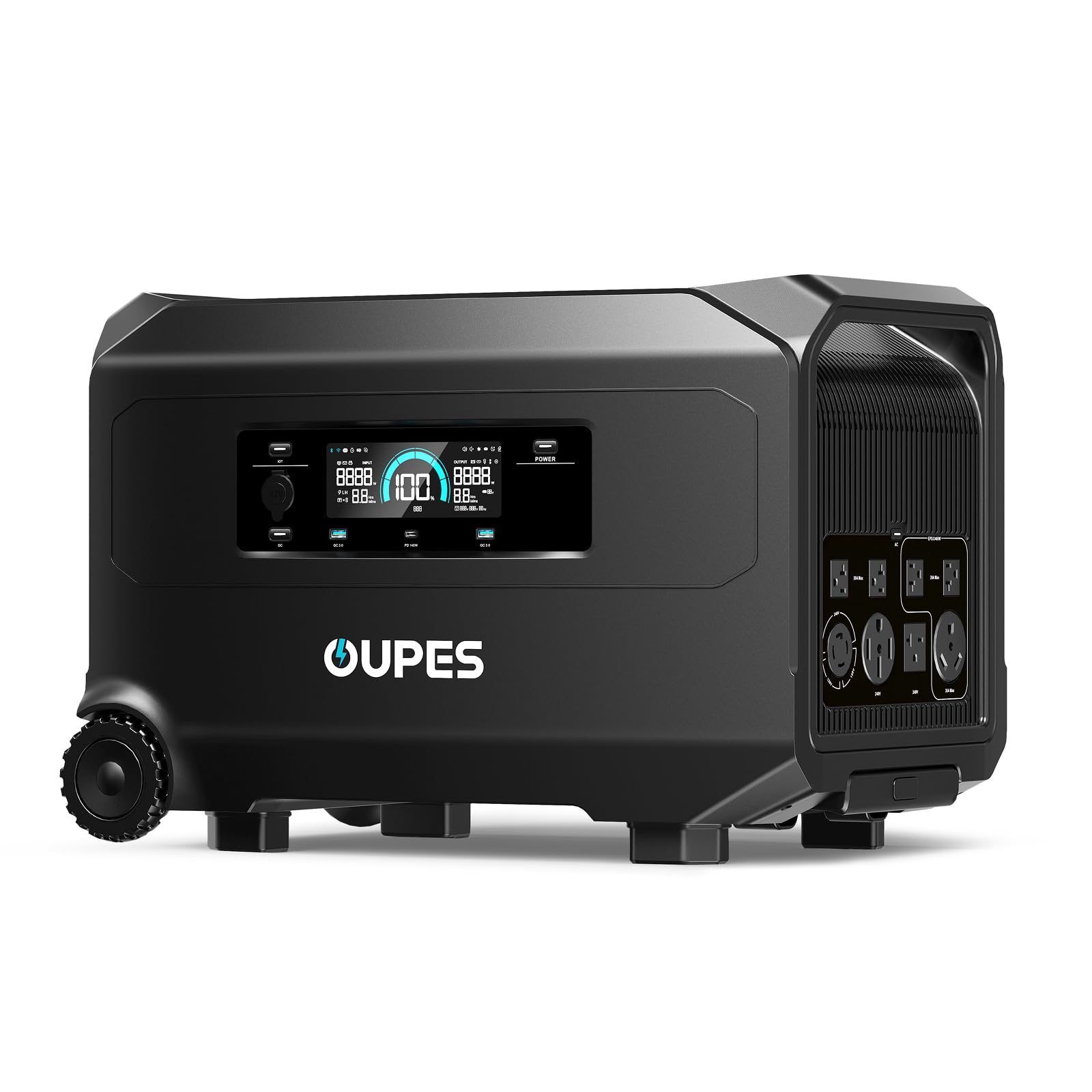
The powerhouse that hooks into your home panel without an electrician.
This generator delivers 6000W of continuous output at both 120V and 240V, making it one of the few units that can power a whole home straight from the start. With a 4608Wh battery—at 4608Wh, versus the Jackery HomePower 3600 Plus’s 3584Wh—it runs lights, a fridge, and a coffee maker for a full 24 hours while still showing 80% battery, according to buyers. The 11 output ports include a NEMA 14-50R and L14-30R, so you can plug in your RV or a transfer switch immediately.
Recharging is unusually fast: the OUPES refills from empty in just 64 minutes when you combine a 240V AC wall outlet and solar panels. One reviewer notes it charges from a standard 120V outlet in 3+ hours, so the speedy recharge requires the right setup. At 111 pounds, it is not light, but the built-in handle and wheels make it rollable from garage to backyard.
The expandability is a major advantage here—start at 4608Wh and scale up to 41,472Wh with optional battery packs. The LiFePO4 cells are rated for 4000+ cycles, which translates to over 10 years of daily use. One buyer highlights the OUPES app for remote monitoring and control, though another notes the firmware cannot be updated through the app yet, which is a minor oversight on a flagship device.
Why It Wins
- 6000W continuous split-phase 120V/240V output powers well pumps and dryers
- 4608Wh capacity expandable to 41,472Wh for multi-day outages
- Recharges in 64 minutes using combined 240V AC and solar inputs
The Trade-offs
- Heavy at 111 pounds, though wheels help with mobility
- Firmware cannot be updated through the app currently
- 120V AC charging takes 3+ hours without a 240V source
Who it works for: This is the one you want if you need whole-home backup power that connects to your existing transfer switch without an electrician.
The catch: The 64-minute recharge requires a 240V outlet—you will not hit that speed from a standard wall socket.
2. Anker SOLIX F3800 Portable Power Station

The 132-pound beast that charges your EV and runs your whole house.
If raw power capacity is your priority, the F3800 delivers 6000W of AC output through its NEMA 14-50 port, enough to run a dryer or charge an electric vehicle directly—no special grounding adapter needed. Its 3840Wh battery is built with EV-class LiFePO4 cells and can be expanded to 26.9kWh with up to six extra battery packs. Add another F3800 and you reach 12,000W of combined output, which one buyer says is enough to power their home for two weeks.
Buyers praise the fast AC recharge: a warm unit charges completely in under two hours. One reviewer noted: “If you’re charging a warm unit with AC power, it will charge completely in under two hours, assuming you have not limited the AC power for charging via the app.” The Anker app lets you monitor and control everything via Wi-Fi or Bluetooth. However, a few users note the MPPT solar controllers (maximum power point tracking controllers that tune solar panel output) are tune for Anker’s own panels, so reaching the full 2400W solar input takes careful panel wiring.
At 132.3 pounds, the F3800 is the heaviest generator on this list—at 132.3 pounds, compared to the Jackery HomePower 3600 Plus at 77.16 pounds—so you will appreciate the telescoping handle and locking wheels. The 5-year warranty and 10-year lifespan make it a long-term investment. One reviewer mentions the cold-weather charging limit: the BMS restricts charging current when the battery is below 50°F, which can be a problem in winter unless you warm it up first.
What Stands Out
- 6000W AC output with NEMA 14-50 port for direct EV charging
- Expandable to 26.9kWh for two-week backup capability
- Charges from AC in under two hours when warm
What Holds Back
- Heaviest pick at 132.3 pounds, tough to move without help
- BMS limits charging below 50°F, reducing cold-weather usability
- Solar MPPT tune for Anker panels; harder to reach full solar input with third-party panels
Your best bet if: You need the highest single-unit output to charge an EV or run a large home and can handle the heavy weight.
One real trade-off: The cold-weather charging restriction means it is less effective in freezing garages without pre-warming.
3. EF ECOFLOW DELTA Pro 3 Portable Power Station

The whisper-quiet backup that switches on in 10 milliseconds.
The DELTA Pro 3 runs at just 30 dB—quieter than your refrigerator humming in the next room—so you can keep it indoors without the drone of a gas engine. Its 4096Wh LiFePO4 battery delivers 4000W of continuous output at 120V/240V split phase, enough to start a 3-ton central AC or a 1 HP water pump. With X-Boost, it handles surges up to 6000W, and you can pair two units for 12,000W total.
One of the best features here is the ultra-fast 10 ms switch-over when the grid goes down, so your NAS server, router, and sump pump never notice the interruption. Buyers report the unit recharges from a gas generator in about 2 hours per day and handles a 240V well pump without issues. The built-in neutral-ground bonding is toggleable through the app, which some buyers love for RV and transfer switch setups.
Interestingly, at 115 pounds, the DELTA Pro 3 is lighter than the Anker SOLIX F3800 (115 lbs vs. 132.3 lbs) despite offering a slightly larger battery. It also charges via solar at up to 2600W across two ports—higher than the OSCAL’s 2400W solar input. However, one frustrated reviewer points out the EcoFlow app requires an internet connection to change settings during an outage, which makes real off-grid control difficult without a data connection.
Its Strongest Suit
- Ultra-quiet 30 dB operation for indoor use without noise
- 10 ms UPS switch-over for sensitive electronics
- 4096Wh LiFePO4 battery expandable to 48kWh
Watch For
- App requires internet for off-grid control—potentially limiting in remote areas
- No built-in 12V DC port (most competitors include one)
- At 115 pounds, still heavy despite being lighter than the Anker
Pick this if: Quiet operation and instant power switching are more important than the highest wattage output.
The limitation to know: Without internet access, you cannot change charging settings through the app during an outage.
4. Jackery HomePower 3600 Plus Portable Power Station

The lightest 3.6kWh unit you can roll around with one hand.
At only 77.16 pounds, the Jackery HomePower 3600 Plus is significantly lighter than the OUPES Guardian 6000 (111 pounds) and the Anker SOLIX F3800 (132.3 pounds), making it the most portable option among the high-capacity generators. The built-in telescopic handle and luggage-style wheels let you roll it from kitchen to garage without breaking a sweat. Despite the lighter weight, it still delivers 3600W of continuous output and supports dual voltage (120V/240V) when you pair two units in parallel.
Owners mention impressive real-world performance: one reviewer ran a fridge, phones, a coffee maker, a lamp, a CPAP machine, and a fan for 26 hours and still had 89% power remaining. The 3584Wh LiFePO4 battery delivers 6,000 charge cycles for a 10-year lifespan., and uses high-temp resistant ceramic membrane cells tested at 302°F to prevent thermal runaway. You can recharge from 0-100% in just 2 hours using hybrid AC+DC charging, or 4 hours with solar panels alone.
Where it falls short compared to the bigger units is raw output: 3600W continuous is enough for most appliances but will not handle a central AC or a large well pump by itself. The expandability goes up to 21kWh per unit or 43kWh with multiple units, which is helpful but means buying additional full generators rather than just extra battery packs—a costlier path.
Why You Want It
- Lightest in class at 77.16 pounds with built-in wheels and handle
- 6,000 cycles and 10-year lifespan from LiFePO4 cells
- Charges in 2 hours via hybrid AC+DC input
Its Limits
- 3600W output is lower than the 6000W competitors; cannot power large single-unit 240V loads
- Expanding capacity requires buying another full generator, not just a battery pack
- Dual voltage requires two units in parallel—no single-box 240V
Reach for this if: Portability matters most—you need to move the generator between home, RV, and campsite regularly.
Look elsewhere if: You need to power a 240V well pump or central AC from a single unit; you will need the higher output of the OUPES or Anker.
5. OSCAL PowerMax 6000 Solar Generator
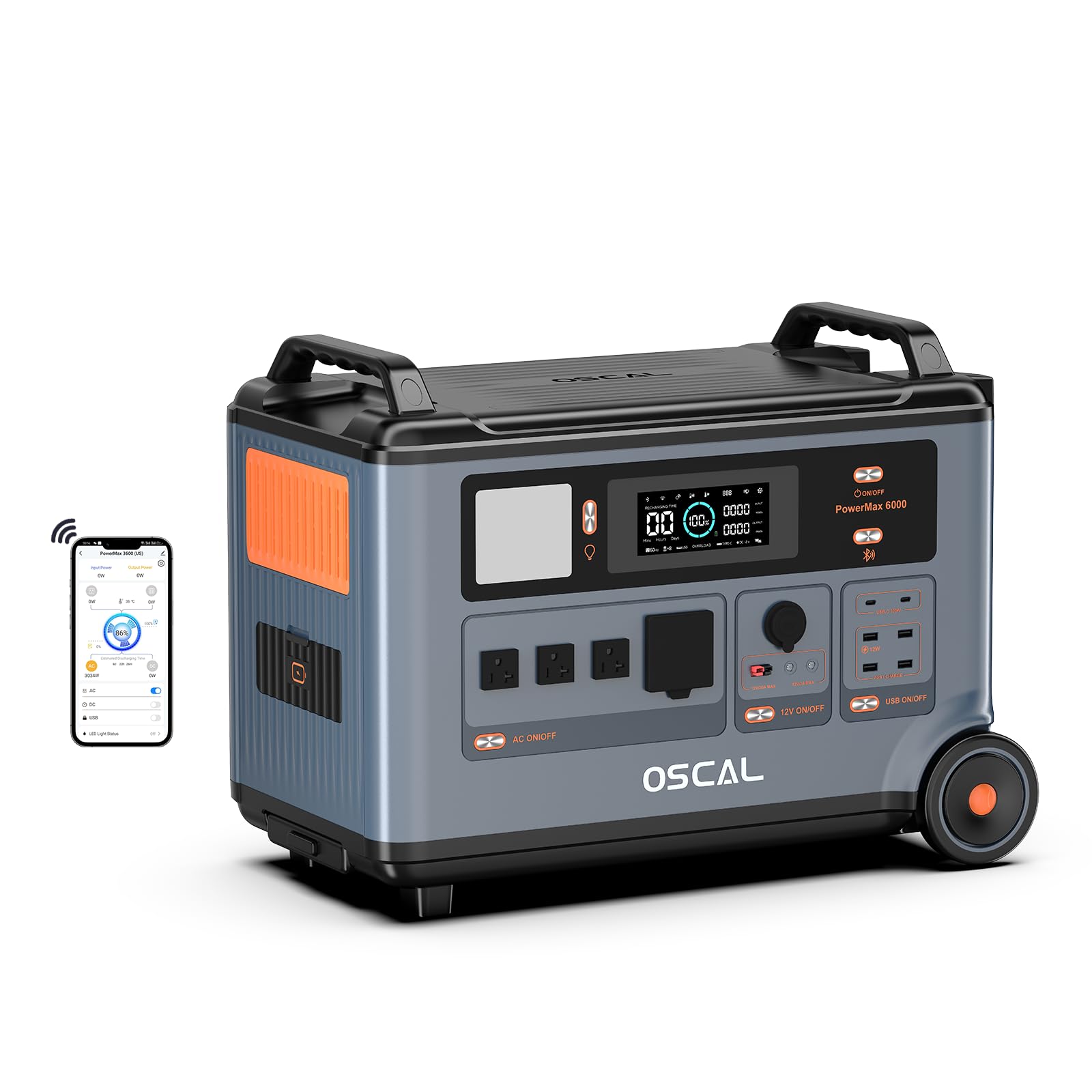
Full recharge in under two hours—faster than most competitors.
The OSCAL PowerMax 6000 uses a 2200W bi-directional inverter that lets it recharge from 0% to 100% in just 1.96 hours via a standard AC wall outlet. That is notably faster than the OUPES Guardian 6000’s 64-minute recharge, which requires a 240V outlet, and much faster than the Jackery’s 2.5-hour AC-only charge. The 3600Wh LiFePO4 battery also supports 2400W of solar input, so you can top off from panels in about 1.44 hours on a good sun day.
With 6000W of continuous output (9000W surge) and 120V/240V dual voltage, this generator can handle heavy loads like a well pump or a dryer. The EPS switch-over happens in just 5-8 milliseconds, keeping your electronics running without a hiccup. Customers note it is quiet in operation, powers a travel trailer’s appliances easily, and has a durable build with a handle and wheels for rolling around.
There are a couple of trade-offs: the capacity sits at 3600Wh—smaller than the OUPES’s 4608Wh or the Anker’s 3840Wh—so you will get less runtime on a single charge. One reviewer mentions the unit only allows one solar panel connection at a time, which limits solar charging speed unless you buy an additional combiner box. The 5-year warranty is solid, but the brand (ECOGREAT) is less established than Anker or Jackery, which may matter for long-term support.
Fastest Recharge
- Recharges from 0-100% in 1.96 hours via AC input
- 6000W continuous output with split-phase 120V/240V
- 5-8 ms EPS switch-over for uninterrupted power
What To Weigh
- 3600Wh capacity is lower than several competitors in this class
- Single solar panel input limits solar charging speed
- Brand is newer and less proven than Anker or Jackery
Your move if: You want the absolute fastest recharge time and a 6000W output in a relatively compact package.
The trade-off to know: The smaller battery means you will run out of power sooner than with the OUPES or Anker on extended outages.
Understanding the Specs
Output Wattage and Split-Phase Voltage
The split-phase 120V/240V feature is what allows a single unit to power both standard household outlets and heavy 240V appliances like well pumps or dryers—without it, you are stuck at 120V. A 6000W unit can handle a well pump plus lights and a fridge, while a 3600W unit manages kitchen essentials and electronics but will struggle with high-draw appliances.
Battery Capacity and Chemistry
Capacity is measured in watt-hours (Wh), which tells you how much energy the battery can store. A 3600Wh unit running a 600W fridge will last about 6 hours; a 4608Wh unit lasts about 8 hours on the same load. LiFePO4 (lithium iron phosphate) chemistry is the standard for new generators because it handles 3,500-6,000 charge cycles before degrading, giving you 10+ years of daily use. Older lithium-ion or lead-acid batteries wear out in 500-1000 cycles, so always choose LiFePO4.
FAQ
What does 220V solar generator mean?
Can a 220V solar generator power a whole house?
How long does a 220V solar generator last on a full charge?
Can I charge a 220V solar generator with regular solar panels?
What is the difference between LiFePO4 and lithium-ion batteries?
How fast can a 220V solar generator recharge from solar panels?
Do I need a transfer switch for a 220V solar generator?
Can I run a well pump with a 220V solar generator?
What is EPS or UPS switch-over time in a solar generator?
How heavy are 220V solar generators?
Final Thoughts: The Verdict
For the majority of shoppers, the best 220v solar generator winner is the OUPES Guardian 6000 because it delivers the highest output (6000W continuous) and the largest battery (4608Wh) at a balanced price point, plus it connects directly to a home transfer switch without extra gear. If you want ultra-fast recharge speed and compact dimensions, grab the OSCAL PowerMax 6000. And for quiet operation with a proven brand, the EcoFlow DELTA Pro 3 runs at just 30 dB in standby mode.
How We Picked
We do not accept paid placement. Every pick is matched to a real buyer and a real use-case; we do not hands-on test units.
Sources & Methodology
Specifications: manufacturer listings and product documentation. Review insights: verified customer reviews, as of July 2026. Pricing: not shown on this page (it changes often); check the current price via the retailer link.
As an Amazon Associate, Gadgets Feed earns from qualifying purchases. This does not affect which products we feature.
Related Guides
Product prices and availability are accurate as of the date/time indicated and are subject to change. Any price and availability information displayed on Amazon at the time of purchase will apply to the purchase of this product. As an Amazon Associate I earn from qualifying purchases.
CERTAIN CONTENT THAT APPEARS ON THIS SITE COMES FROM AMAZON. THIS CONTENT IS PROVIDED "AS IS" AND IS SUBJECT TO CHANGE OR REMOVAL AT ANY TIME.
Amazon and the Amazon logo are trademarks of Amazon.com, Inc. or its affiliates.