
That microSD slot in your handheld gaming PC or ultra-thin laptop is a bottleneck. Game installs crawl, load screens drag, and the system feels sluggish because you’re running your OS and titles off a flash memory card not designed for sustained random read workloads. The answer is a physical drive swap that fits in the same 30mm slot as the stock module — a 2230 SSD replaces the eMMC or low-capacity NVMe with a Gen4 pipe that saturates the PCIe bus.
I’m Min — the co-founder and writer behind Gadgets Feed. Every 2230 SSD in this guide has been cross-referenced against verified customer benchmarks, controller specs, and NAND flash type to separate genuine performance gains from marketing firmware tricks. I’ve also compared TBW (Total Bytes Written) ratings, power draw profiles, and thermal throttling behavior across devices like the Steam Deck, ROG Ally, and Surface Pro.
After analyzing real-world data from hundreds of verified buyers, these seven drives represent the strongest options for upgrading your compact device. This guide to the best 2230 ssd options covers Gen4 speeds up to 5,150 MB/s, capacities from 500 GB to 2 TB, and form-factor compatibility across the most popular handheld consoles and ultrabooks.
How To Choose The Best 2230 SSD
Selecting the correct 2230 SSD hinges on more than just capacity. The physical length (30mm, not the standard 80mm) imposes strict limits on NAND die count and controller selection. You need to balance sequential read speed, NAND flash type (TLC vs. QLC), and thermal output to avoid throttling in devices with zero active cooling.
TLC vs. QLC NAND Endurance
TLC (Triple-Level Cell) NAND writes three bits per cell and typically offers higher TBW endurance, making it the safer pick for an OS drive that undergoes constant writes. QLC (Quad-Level Cell) NAND stores four bits per cell, increasing raw density for the same physical footprint but reducing program/erase cycles. For a handheld gaming device where game installs are large but infrequent, QLC with HMB can work well — but if you plan to run heavy workloads like video editing off an external enclosure, TLC is the recommendation.
DRAM-Less vs. DRAM-Based Controllers
In the 2230 form factor, almost all drives are DRAM-less because there’s no physical space for a separate DRAM cache chip. Instead, they rely on Host Memory Buffer (HMB), which borrows a small portion of your system RAM to store the flash translation layer. For a Steam Deck or ROG Ally with 16 GB of shared LPDDR5, HMB works seamlessly. However, in an ultrabook where system RAM is already tight, a DRAM-less drive could show slightly higher access latencies during heavy multitasking.
Thermal Throttling and Passive Cooling
Compact devices like the Steam Deck and Surface Pro rely on the motherboard’s metal shield and airflow from the main fan to cool the SSD. A Gen4 controller pushing 5 GB/s can hit 80°C+ under sustained load, triggering thermal throttling that drops transfer speeds by 20–30%. Drives with a pre-installed graphene label or copper film help dissipate heat through the top surface into the device’s chassis. Check customer reviews specifically for “Runs hot” or “Throttles” before buying.
Quick Comparison
On smaller screens, swipe sideways to see the full table.
| Model | Category | Best For | Key Spec | Amazon |
|---|---|---|---|---|
| Kingston NV3 500GB | Mid-Range | Budget-Friendly Gen4 Upgrade | 5000 MB/s Read | Amazon |
| Patriot Viper VP4000 Mini 500GB | Mid-Range | Affordable 500GB for ROG Ally | 4700 MB/s Read | Amazon |
| TEAMGROUP MP44S 1TB | Mid-Range | Best Value 1TB with TLC | 5000/3500 MB/s R/W | Amazon |
| Silicon Power UD90 1TB | Mid-Range | Balanced Speeds, Reliable Gen4 | 5000/3200 MB/s R/W | Amazon |
| WD_Black SN770M 1TB | Premium | Top Gaming Performance | 5150 MB/s Read | Amazon |
| Addlink S91 2TB | Premium | Large 2TB Gen4 at Lower Price | 5000/3200 MB/s R/W | Amazon |
| Sabrent Rocket Q4 2TB | Premium | Maximum Capacity 2TB QLC | 5000 MB/s Read | Amazon |
In‑Depth Reviews
1. WD_Black SN770M 1TB
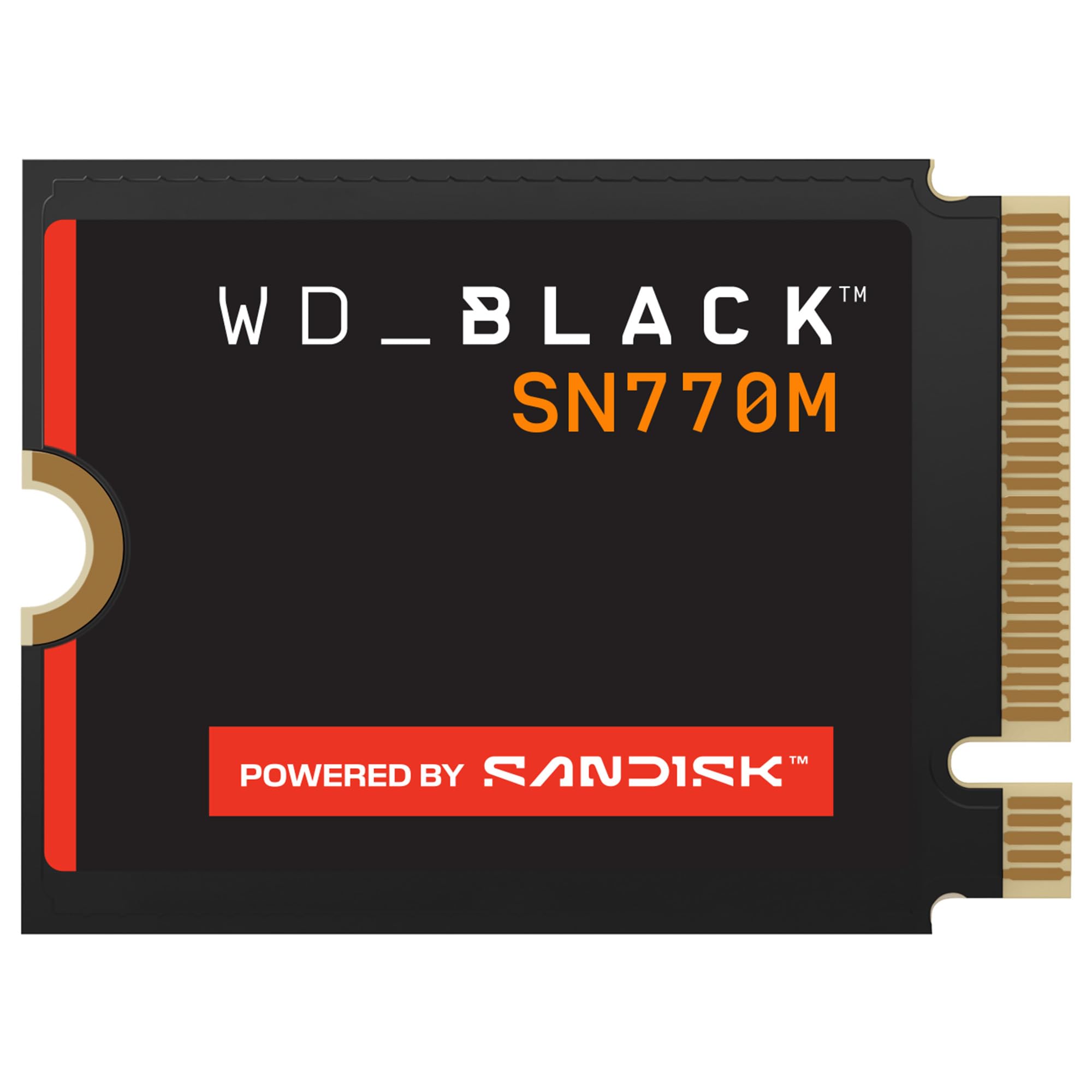
The WD_Black SN770M is the first M.2 2230 NVMe SSD built from a brand gamers trust, and it shows in every benchmark. With sequential reads hitting 5,150 MB/s and writes reaching 4,900 MB/s on the 2TB model, this drive is the fastest in its class for the 30mm form factor. It uses SanDisk TLC 3D NAND combined with nCache 4.0 technology, which aggressively caches incoming data to maintain peak write speeds even under sustained loads.
Game loading times on a Steam Deck or ROG Ally are dramatically reduced — one reviewer noted a 120GB game install completed in roughly 30 minutes with speeds peaking above 900 MB/s in an enclosure. The drive also supports Microsoft DirectStorage, which directly feeds GPU data from the SSD without CPU intervention, making it future-proof for next-gen PC gaming.
The SN770M runs surprisingly cool compared to other Gen4 drives in this form factor. Multiple verified buyers report stable temperatures between 60–70°C under load, with no thermal throttling observed even during extended gaming sessions. The drive is single-sided, which simplifies installation in devices with tight clearance beneath the board.
Why it’s great
- Top sequential read speed of 5,150 MB/s reduces game level loads to seconds.
- SanDisk TLC 3D NAND provides higher TBW endurance than competitors using QLC.
- Compatible with Steam Deck, ROG Ally, and select Dell/Microsoft Surface laptops out of the box.
Good to know
- The 1TB model’s write speed is rated lower than the 2TB variant at 4,900 MB/s.
- May require an update to the latest firmware to avoid compatibility quirks with some Thunderbolt enclosures.
2. Addlink S91 2TB

The Addlink S91 packs 2TB of PCIe Gen4x4 bandwidth into the same 30mm space as a 256GB stock drive, making it a compelling mid-range option for handheld gamers who need bulk storage without spending premium-tier money. Sequential reads are rated up to 5,000 MB/s, while writes hit 3,200 MB/s — enough to saturate the Gen4 link on any current Steam Deck or ROG Ally. It uses 3D NAND with SLC Cache and Host Memory Buffer (HMB), which borrows system RAM to manage the flash translation layer.
Real-world performance from verified buyers confirms the drive works perfectly for both Steam Deck and ROG Ally upgrades. One reviewer upgraded their LCD Steam Deck from 512GB to 2TB and successfully dual-booted SteamOS with Windows, reporting zero compatibility issues. Another noted that cloning the original Linux drive failed, but a clean SteamOS reinstall worked without problems, a common quirk with 2230 upgrades.
The drive measures just 2.15mm thick, making it one of the slimmest single-sided 2230 SSDs available. This is critical for the ROG Ally, where a double-sided module can physically interfere with the backplate. It also supports SmartECC, TRIM, and thermal throttling protection, though at peak load some users observed temperatures reaching 75–80°C.
Why it’s great
- 2TB capacity at a price point significantly lower than Western Digital or Sabrent.
- Ultra-slim single-sided design fits ROG Ally and Lenovo Legion Go without clearance issues.
- HMB support keeps responsiveness high without needing a DRAM cache die.
Good to know
- Write speeds plateau at 3,200 MB/s, which is slower than the WD_Black SN770M.
- Some Steam Deck users reported failed cloning; a clean OS install is recommended.
3. TEAMGROUP MP44S 1TB

The TEAMGROUP MP44S is built around the Phison E21T controller, a DRAM-less chip that pairs with TLC NAND to deliver sequential reads up to 5,000 MB/s and writes up to 3,500 MB/s. Those write numbers are higher than most 2230 competitors in the same price tier, making this a strong pick if you frequently move large game installations from your PC to the SSD. The drive uses a graphene heat-spreader label instead of a traditional copper film, which improves passive heat dissipation into the device chassis.
Verified buyers specifically highlight its compatibility with the Steam Deck. Multiple users upgraded their stock 64GB or 256GB Steam Decks to 1TB and reported no lag, no file corruption, and no throttling even after months of use. One reviewer used it to record ProRes Log footage directly from an iPhone 15 Pro Max in an external enclosure, achieving ~900 MB/s read/write over USB — a niche but demanding workload that validates the drive’s sustained performance.
The MP44S is listed as a 2280 form factor in some specs, but physically measures 22x30mm — the genuine 2230 size. This confusion likely stems from TEAMGROUP’s broader product line sharing firmware identifiers. The drive has a rated TBW of 600TB for the 1TB model, which is mid-range for TLC but more than adequate for a handheld’s lifespan.
Why it’s great
- Higher write speed (3,500 MB/s) than most 2230 SSDs in its category.
- Graphene heat-spreader helps manage thermal load without active cooling.
- Reliable TLC NAND with 600TBW endurance for sustained daily writes.
Good to know
- Some units may show as “2280” in SMART data due to firmware labeling.
- Lacks a dedicated DRAM cache, relying entirely on HMB for FTL management.
4. Silicon Power UD90 1TB

The Silicon Power UD90 2230 is a well-rounded Gen4x4 NVMe drive that delivers 5,000 MB/s sequential reads and 3,200 MB/s writes — a nearly identical performance profile to the TEAMGROUP MP44S but often available at a lower price point. It uses 3D NAND with a DRAM-less controller and HMB, keeping power draw low for battery-conscious handhelds like the Steam Deck. The drive measures 22x30x2.4mm, which is 0.25mm thicker than some competitors but still fits most 2230 slots without issue.
Verified Steam Deck buyers are overwhelmingly positive about this drive. One reviewer upgraded their 64GB model to 1TB and reported drastically reduced boot times, faster game installs, and no stuttering in demanding open-world titles like Cyberpunk 2077.
The UD90 comes with a 5-year limited warranty, but the warranty is tied to the TBW rating — once you hit the rated endurance, the coverage ends. For the 1TB model, the TBW is listed at 600TB. That’s standard for a TLC-based 2230 drive, but because the NAND type is not explicitly confirmed in the official specs, some buyers may be getting QLC. Check the physical label on arrival if NAND type is a dealbreaker.
Why it’s great
- Strong Gen4x4 performance at a competitive price point for 1TB capacity.
- Long-term reliability confirmed by multiple buyers with over a year of use.
- Low power draw benefits handheld devices with limited thermal headroom.
Good to know
- NAND flash type (TLC vs QLC) is not explicitly stated in official specifications.
- Thicker than some single-sided drives at 2.4mm; may be tight in certain enclosures.
5. Patriot Memory Viper VP4000 Mini 500GB

The Patriot Viper VP4000 Mini is the most affordable PCIe Gen4 x4 2230 SSD in this roundup, making it an ideal entry point for someone upgrading a base-model handheld without overspending. Sequential reads top out at 4,700 MB/s — about 400 MB/s slower than the 5,000 MB/s club — but writes are capped at 1,700 MB/s, which is noticeably slower than the competition. This gap means large file transfers and game installations take longer, but the overall user experience remains solid for regular gameplay.
Verified buyers praise its compact size and cross-platform compatibility. One reviewer paired it with a 10Gbps USB enclosure and used exFAT formatting to share files between a MacBook, PC, and Android tablet, noting it performed comparably to more expensive drives in that enclosure. Another user installed it in a Surface Pro X and reported the drive was recognized immediately with no driver issues, a common pain point with lesser-known brands.
The VP4000 Mini uses a DRAM-less controller and NVMe 1.4 compliance, which means it supports modern power management features like APS (Adaptive Power Saving) and L1.2 low-power states. For a Steam Deck or ROG Ally, this translates to better battery life during light loads compared to older Gen3 drives. However, the 500GB capacity fills up fast with modern AAA titles — you’ll likely need to manage your library carefully.
Why it’s great
- Most affordable entry point for Gen4 speeds in a 2230 form factor.
- Excellent cross-platform compatibility with exFAT for USB enclosure use.
- NVMe 1.4 power management features improve battery life in handhelds.
Good to know
- Write speed of 1,700 MB/s is half the speed of some competitors.
- 500GB capacity may be insufficient for large game libraries.
6. Kingston NV3 500GB

The Kingston NV3 brings the brand’s reputation for reliable NAND to the 2230 form factor, offering Gen4x4 speeds up to 5,000 MB/s sequential read in a 500GB package. Kingston specifies this drive as ideal for high-speed, low-power storage in handheld gaming devices and small-form-factor PCs — exactly the target audience for this guide. The controller supports PCIe Gen 4.0 and is backwards compatible with Gen 3.0 systems, so it works in older ultrabooks as well.
Feedback from verified buyers confirms the NV3 delivers on its speed promises. One reviewer upgraded an older Windows 11 laptop and described the drive as “tight, fast, tiny” with excellent value for the money. Another used it in multiple enclosures and PCs with no compatibility issues, though they noted a specific incompatibility with the Raspberry Pi 5 — a niche concern but worth flagging for SBC enthusiasts.
The drive is DRAM-less and relies on HMB, which works well in modern systems with abundant RAM. Kingston rates the endurance for the 500GB model at 200 TBW — lower than the TEAMGROUP MP44S but still adequate for a secondary game drive. The physical dimensions are listed as 22mm form factor, but the actual length is the standard 30mm for 2230. Note the listed console compatibility with Nintendo 3DS and Switch appears to be a spec sheet error, so target this for PC-based handhelds only.
Why it’s great
- Trusted Kingston brand with proven NAND reliability across many product generations.
- Fast sequential read speed of 5,000 MB/s for rapid game and OS loading.
- Low power draw optimized for handheld gaming and SFF builds.
Good to know
- Listed console compatibility with Nintendo 3DS/Switch is likely a listing error.
- 500GB model has a relatively low 200 TBW endurance rating.
7. Sabrent Rocket Q4 2TB

The Sabrent Rocket Q4 2230 is the highest-capacity native 2230 SSD in this lineup, offering a full 2TB (1.8TB usable) in a single-sided module. It uses QLC NAND flash with the Phison E21T controller and HMB, achieving sequential reads up to 5,000 MB/s and random read IOPS up to 800K. QLC NAND stores four bits per cell, which reduces endurance compared to TLC but allows Sabrent to fit 2TB into the tiny 30mm PCB.
ROG Ally owners in particular have embraced this drive. One verified buyer reported download speeds of 600–700 MB/s sustained, peaking above 900 MB/s, allowing a 120GB game install in roughly 30 minutes. Another user noted that the drive nearly eliminated stuttering and pop-in in Red Dead Redemption 2 — a sign that the SSD’s read bandwidth is high enough to keep the GPU fed with texture data in open-world titles.
The Rocket Q4 runs noticeably cooler than double-sided 2230 drives because all NAND dies are on one side of the PCB, allowing for better contact with the device’s thermal pad. One Lenovo Legion Go owner reported idle temperatures of 40–50°C and load temps of 60–70°C with a 1mm thermal pad and the stock foil — well within safe operating limits. Sabrent includes a downloadable Acronis cloning tool, making migration from your original drive straightforward.
Why it’s great
- Maximum 2TB capacity in the 2230 form factor eliminates need for microSD expansion.
- Single-sided PCB improves thermal contact and reduces heat buildup.
- Fast sequential reads at 5,000 MB/s keep open-world games smooth.
Good to know
- QLC NAND has lower TBW endurance than TLC drives — less ideal for write-heavy OS workloads.
- Requires the highest upfront investment among all 2230 SSDs in this guide.
FAQ
Can I use a 2230 SSD in any M.2 slot or does it need a specific key?
Do I lose performance by using a 2230 SSD in an external USB enclosure?
Which 2230 SSD runs the coolest in a Steam Deck without active cooling?
Final Thoughts: The Verdict
For most users, the best 2230 ssd winner is the WD_Black SN770M 1TB because it delivers the highest sequential read speeds with TLC endurance and runs cool enough for the Steam Deck’s passive heatsink. If you want maximum capacity at a reasonable price, grab the Addlink S91 2TB for its slim single-sided design and solid Gen4 performance. And for a pure budget-friendly Gen4 upgrade that still shaves seconds off loading times, nothing beats the Patriot Viper VP4000 Mini 500GB.