
Drilling a 23/32-inch hole without the bit skating across your workpiece can feel like a battle against physics. The wrong choice leaves you with an egg-shaped hole, a broken bit, or a skinned knuckle. The 23/32 size sits in an awkward zone — large enough to generate serious torque, but uncommon enough that material quality and tip geometry make or break the job.
I’m Min — the co-founder and writer behind Gadgets Feed. I’ve spent hundreds of hours cross-referencing M35 cobalt compositions, 118° versus 135° split-point debates, and reduced-shank tolerances to separate the bits that hold an edge from those that fold under pressure.
Whether you are boring through hardened steel, cast iron, or layered stainless, you need a bit that self-centers and stays sharp. This guide delivers the definitive breakdown to find the absolute best 23/32 drill bit for your specific cutting task.
How To Choose The Best 23/32 Drill Bit
A 23/32-inch bit demands a sharp look at three factors: material composition, point geometry, and shank type. The diameter creates significant rotational stress that lower-grade bits cannot sustain.
Material: HSS vs. M35 Cobalt
Standard high-speed steel (HSS) bits handle wood, plastic, and mild steel at moderate speeds. M35 cobalt steel, with its 5% cobalt content, retains hardness at high temperatures, letting you drill stainless steel, titanium, and hardened alloys without rapid edge breakdown. For 23/32 specifically, heat buildup is aggressive — M35 is the safer bet for ferrous metals.
Point Geometry: 118° vs. 135° Split Point
A 118° point works for soft materials where walking is less of a concern. The 135° split-point design creates a self-centering action that reduces thrust force and virtually eliminates bit walk on curved or irregular surfaces. At 23/32, that walking prevention saves you from recutting an oversized hole.
Shank Type: Reduced vs. Straight
Most standard drill chucks max out at 1/2-inch capacity. A 23/32 bit with a reduced shank (1/2-inch diameter with three flats) fits those chucks without needing an adapter. Straight-shank bits require a larger chuck or a drill press with a 5/8-inch or 3/4-inch capacity. If your drill is a standard 3/8 or 1/2-inch unit, you must choose a reduced-shank variant.
Quick Comparison
On smaller screens, swipe sideways to see the full table.
| Model | Category | Best For | Key Spec | Amazon |
|---|---|---|---|---|
| NordWolf M35 Cobalt Stubby | Premium | Impact driver & tight spaces | M35 cobalt / 135° split | Amazon |
| Drill America D/A3F23/32 | Premium | General purpose steel drilling | HSS / 118° / 3-flat shank | Amazon |
| MAXTOOL Silver & Deming | Premium | Deep hole drilling in metal | M2 HSS / black oxide | Amazon |
| Meccion M35 Cobalt | Mid-Range | High-temp stainless steel jobs | M35 cobalt / 135° pilot | Amazon |
| Drill America KFD3F Contractor | Mid-Range | Self-centering on steel | M1 HSS / 135° split | Amazon |
| uxcell M35 Cobalt Jobber | Budget-Friendly | Stainless steel and brass | M35 cobalt / 135° point | Amazon |
| HARFINGTON 4241 HSS | Budget-Friendly | Soft metals, wood, PVC | 4241 HSS / 118° split | Amazon |
In‑Depth Reviews
1. NordWolf 23/32″ M35 Cobalt Stubby Drill Bit
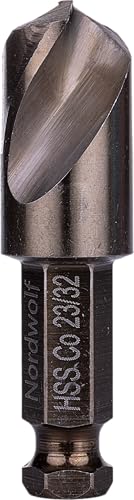
The NordWolf stubby redefines what a 23/32 drill bit can do in an impact driver. Its 7/16-inch hex shank locks into quick-change chucks and impact drivers without slipping — a rare feature at this diameter. The M35 cobalt alloy with a 135° split point delivers aggressive self-centering that eliminates walking on stainless steel exhaust pipes and round steel vent pipe.
At only 2.36 inches overall length with a 1-inch cutting flute, this bit excels in tight engine compartments and between stud bays where a standard 6-inch jobber bit simply will not fit. One user drilled multiple holes in 1/8-inch stainless without dulling, and a mechanic used it to extract a broken oxygen sensor from an exhaust manifold with precision.
One critical review noted rapid dulling when drilling out a bolt, even with cutting oil. This suggests the stubby geometry generates intense localized heat during heavy bolt-extraction use. For typical metal fabrication and stainless steel work, however, the build consistency and hex-shank compatibility place it at the top of the class.
Why it’s great
- Hex shank fits impact drivers and standard chucks
- M35 cobalt holds edge on stainless and hardened metals
- Stubby length reaches confined spaces 6-inch bits cannot
Good to know
- Short flute limits chip clearance in deep holes
- Some users report rapid dulling during bolt extraction
2. Drill America D/A3F23/32 23/32″ HSS Reduced Shank
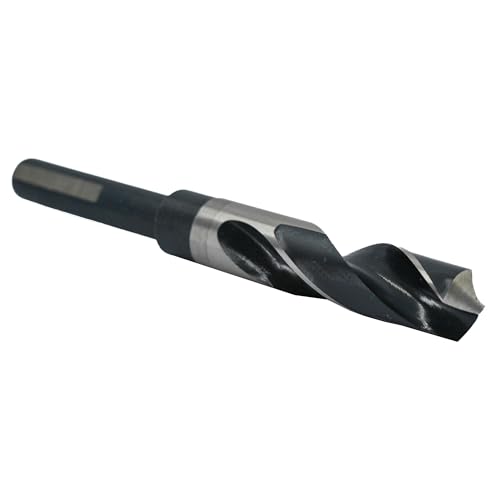
The Drill America D/A3F series is a USA-made workhorse with a 118° point angle and black oxide finish tuned for low-to-medium tensile strength materials. Users report drilling ten holes in front rotors for 5/8-inch press-in wheel studs without cutting fluid, and the tenth cut matched the first. The 3-flat reduced shank locks into a 1/2-inch chuck with zero play, reducing chatter at the bit start.
The black oxide treatment creates micro-pockets that hold cutting fluid near the cutting edge, which is critical when enlarging holes in iron or steel. One user drilled 10 holes in rotors dry with no performance drop — a testament to the surface treatment’s lubricity.
The 118° point lacks the aggressive self-centering of a 135° split, so drilling on curved steel requires a center punch. For aluminum and general-purpose steel work, this bit delivers repeatable accuracy and edge retention that justifies the premium positioning.
Why it’s great
- USA-made HSS with consistent hardness
- Black oxide coating improves lubricant retention
- Excellent performance on rotor-grade steel
Good to know
- 118° point walks more than 135° split-point on curved surfaces
- Not optimized for stainless or hardened alloys
3. MAXTOOL 23/32″ Silver and Deming HSS M2

The MAXTOOL Silver and Deming bit uses M2 high-speed steel — a step above generic HSS in hardness and heat resistance — with a black oxide finish and 6-inch overall length. The reduced shank drops to 1/2-inch, fitting standard chucks while the 3-inch flute length clears chips efficiently during deep drilling. One user drilled through a 2-inch solid steel bar on a drill press with perfect results, noting the bit cost one-third of competitor pricing.
Another user bored three holes in 0.3-inch hardened 4140 steel at 470 RPM with a pilot hole and pecking. The bit showed no chips, no visible wear, and held its edge flawlessly. The 118° chisel point provides fast penetration in softer stock but requires a pilot hole for precision in hardened work.
The milled flute design maintains concentricity better than rolled flutes, which is why this bit consistently produces round holes even under heavy feed pressure. For anyone drilling deep holes in metal on a drill press, the combination of M2 material and black oxide makes this a long-term investment.
Why it’s great
- M2 HSS handles hardened 4140 steel
- 6-inch OAL with reduced shank for deep drilling
- Milled flute design ensures accurate, clean cuts
Good to know
- Requires pilot hole for best results on hard metals
- 118° point less suited for self-centering on round surfaces
4. Meccion Cobalt Drill Bit 23/32″ M35 Reduced Shank
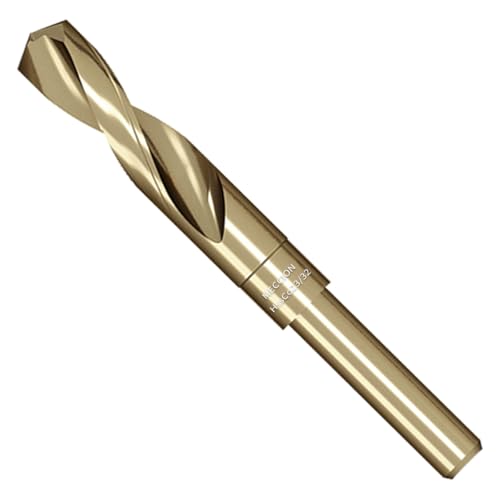
The Meccion M35 cobalt bit brings a 135° pilot point tip and a tapered web helix designed for stability in tough applications. Hardness reaches HRC 67, giving it the edge retention to tackle cast iron, stainless steel, and non-ferrous alloys. The reduced shank keeps it compatible with standard 1/2-inch chucks while the larger flute geometry clears chips rapidly under continuous cutting.
One user drilled a steel receiver adapter on an F250 using a drill press with proper RPM and lubricant, reporting good-quality steel and clean results. However, a separate review described the bit as extremely soft, chipped after two holes in 3/16-inch ferrous metal. This suggests batch-to-batch inconsistency in heat treatment, which is a risk with non-premium M35 bits at this price point.
The 135° pilot point significantly reduces walking, and the straight round shank improves concentricity. For the user who gets a properly hardened unit, the Meccion delivers performance rivaling bits costing twice as much. Pre-drilling a small pilot hole is recommended for this large diameter.
Why it’s great
- HRC 67 hardness rating for tough alloys
- 135° pilot point minimizes bit walk
- Tapered web adds stability in deep cuts
Good to know
- Inconsistent heat treatment reported by some users
- Pre-drilling required for best accuracy
5. Drill America KFD3F 23/32″ Reduced Shank Contractor Bit
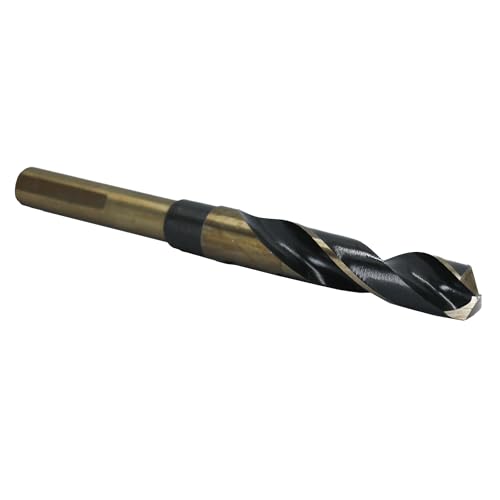
The Drill America KFD3F series brings a 135° split point to the contractor grade at a mid-range price — a geometry normally reserved for premium bits. This self-centering tip eliminates walking on aluminum, iron, and steel, which is the primary frustration at this diameter. The 3-flat 1/2-inch reduced shank provides an extra secure hold in the chuck compared to round-shank bits.
Made from M1 high-speed steel, the KFD3F balances hardness and toughness for general-purpose metal drilling. Users report excellent toughness for the price, with one noting it drills PVC without over-biting or cracking the plastic. The 3-inch flute and 6-inch overall length match standard jobber dimensions, allowing tool changes without quill adjustment.
The black-and-gold finish adds a layer of corrosion resistance and lubricity. While M1 HSS does not match M35 cobalt for high-temperature performance, for mild steel, aluminum, and plastics, this bit is a reliable daily driver that outperforms generic import bits at a similar price.
Why it’s great
- 135° split point self-centers on tough materials
- 3-flat shank prevents chuck slip
- Contractor-grade durability at a budget-friendly price
Good to know
- M1 HSS cannot sustain high heat like M35 cobalt
- Not ideal for stainless steel or hardened alloys
6. uxcell 23/32″ M35 Cobalt Jobber Twist Drill Bit

The uxcell M35 cobalt bit proves that entry-level pricing does not have to mean entry-level metallurgy. The 135° external point angle and spiral flute design provide fast, efficient drilling with effective chip removal. One user bored a clean hole in thick brass stock on a drill press with no issues, describing it as a bargain that performs exactly as advertised.
The straight shank measures 1/2-inch, which fits standard chucks, but the lack of three flats means it can slip under heavy torque more easily than a reduced-shank variant. The uncoated finish leaves the M35 cobalt exposed directly, which is fine for intermittent use but benefits from cutting oil during continuous drilling to manage heat.
For the price, the uxcell offers genuine M35 cobalt content, making it a solid choice for stainless steel, titanium, and cast iron when used with proper technique. A pilot hole is recommended for larger diameters to reduce starting torque and extend bit life.
Why it’s great
- M35 cobalt at an entry-level price point
- 135° point cuts fast and clean in brass and steel
- Spiral flute evacuates chips effectively
Good to know
- Straight shank may slip without three-flat retention
- Uncoated surface requires cutting oil for heavy use
7. HARFINGTON 23/32″ 4241 HSS Reduced Shank
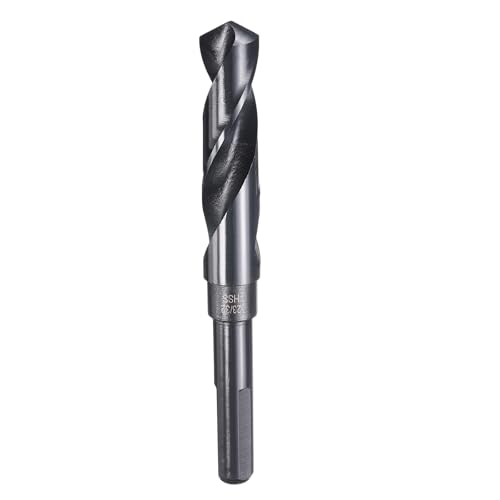
The HARFINGTON 4241 high-speed steel bit is purpose-built for soft metals, wood, plastic, iron, copper, and aluminum — exactly the materials that make up most home maintenance and DIY projects. The 118° split point provides a balance of sharpness and durability, and the nitriding black surface treatment adds wear and corrosion resistance that extends service life beyond bare HSS bits.
Users rate it highly for PVC pipe drilling, where the bit does not over-bite and crack the plastic. One user noted it cut through hardened steel easily in initial use, though another reported difficulty sharpening it after three holes in steel with cutting oil. The 4241 steel is harder than standard HSS but still falls short of cobalt for sustained high-temperature work.
The reduced shank with three flats fits standard chucks securely, and the 3-inch flute length handles moderate-depth holes. At a very accessible price point, this bit delivers excellent value for anyone who primarily drills wood, plastic, and soft metals without needing stainless steel capability.
Why it’s great
- Nitriding black finish resists corrosion and wear
- Sharp 118° split point works well on PVC and wood
- Reduced shank with three flats for secure chuck grip
Good to know
- Struggles to maintain edge in hardened steel
- Not suitable for stainless steel drilling
FAQ
Can I use a 23/32 drill bit in a standard 3/8-inch drill chuck?
Do I need a pilot hole for a 23/32-inch drill bit?
What is the difference between 118° and 135° drill point angle?
Final Thoughts: The Verdict
For most users, the best 23/32 drill bit winner is the NordWolf M35 Cobalt Stubby because its hex shank unlocks use in impact drivers, making it the most versatile option for real-world job sites and tight spaces. If you need deep hole drilling in steel on a drill press, grab the MAXTOOL Silver and Deming. And for a budget-friendly entry into M35 cobalt performance, nothing beats the uxcell M35 Cobalt Jobber.