
Our readers keep the lights on and my morning glass full of iced black tea. As an Amazon Associate, I earn from qualifying purchases.
Specs are compiled from manufacturer listings and verified buyer reviews and can change over time — please confirm the key details on the product page before buying.
Building a CNC mill, a 3D printer, or any automated rig that moves precisely? A bad motor will make you fight skipped steps, weak holding torque, and constant tuning. This guide breaks down the top 23 nema stepper motor picks so you know which one handles your actual load without stalling.
I’m Min — the founder of Gadgets Feed. These picks come from manufacturer specs and patterns in verified customer reviews, so you see real strengths and trade-offs.
Every motor here is a NEMA 23 frame (meaning the faceplate is 2.24 inches square, the standard industrial mount). But they differ hugely in length, torque, and current draw — and that is where the buying decision lives.
Quick Picks
- STEPPERONLINE High Torque Nema 23 CNC Stepper — Top Performer
- STEPPERONLINE CNC Stepper Motor Nema 23 Bipolar — Precision Pick
- Nema 23 Stepper Motor 2.8A 1.9Nm — Solid Workhorse
- CNCTOPBAOS Nema23 CNC Stepper Motor 425oz-in — High Torque Monster
- Nema23 112mm Stepper Motor 425oz-in 280Ncm 3A — Dual-Shaft Option
- iMetrx Nema 23 Stepper Motor 100mm 270oz-in 4.2A — Compact Value
- STEPPERONLINE Nema 23 CNC Stepper Motor 2.8A — Budget Champion
How To Choose A 23 NEMA Stepper Motor That Works For You
The right motor depends on three things: how much weight you need to hold still (holding torque), how much space you have in your build, and what your stepper driver can feed it. Here is how those specs translate to real-world performance.
Match Torque to Your Load So You Don’t Skip Steps
Holding torque (the force the motor uses to keep a position when power is on) is measured in ounce-inches (oz-in) or Newton-centimeters (Ncm). A light 3D printer extruder might need only 175 oz-in to stay put. But a CNC machine milling a heavy aluminum plate needs 425 oz-in or more to avoid losing steps — a phenomenon where the motor slips out of position and ruins your workpiece.
Longer Motor Equals More Power, But Check Your Space
All NEMA 23 motors share the same 2.24-inch square faceplate, but the body length varies from about 76mm to 114mm. A longer body packs more copper windings, so you get higher torque. But the longer motor also weighs more and heats up faster. Measure your mounting depth before buying a long one to avoid a fitment problem.
Match Current and Voltage to Your Driver
Every NEMA 23 motor has a rated current in amps (A) — the amount of electrical current it needs to reach full torque. You need a stepper driver (the controller that powers the motor) that can supply at least that current. If your driver maxes out lower, the motor never hits its full potential, and you will probably see skipped steps. A 4.2 A motor, for example, needs a driver like the DM542T that can handle that draw.
Quick Comparison
| Model | Best For | Holding Torque | Length | Current | Amazon |
|---|---|---|---|---|---|
| STEPPERONLINE 23HS45-4204S | High-torque CNC / Heavy loads | 425 oz-in / 3 Nm | 4.45″ (114mm) | 4.2 A | Amazon |
| STEPPERONLINE 23HS30-2804S | Precision CNC / 4th axis builds | 269 oz-in / 1.9 Nm | 3.0″ (76mm) | 2.8 A | Amazon |
| HobbyUnlimited Nema 23 76mm | CNC / Plasma table builds | 269 oz-in / 1.9 Nm | 76mm | 2.8 A | Amazon |
| CNCTOPBAOS 23HS2430 (Single) | Direct-drive steering / High torque | 425 oz-in / 280 Ncm | 112mm | 3.0 A | Amazon |
| CNCTOPBAOS 23HS2430B (Dual) | Dual-shaft projects / Encoder mounting | 425 oz-in / 280 Ncm | 112mm | 3.0 A | Amazon |
| iMetrx 23HS8430 | 3D printer extruder / Light CNC | 270 oz-in / 250 Ncm | 100mm | 4.2 A | Amazon |
| STEPPERONLINE 23HS22-2804S | Budget builds / Light loads | 175.6 oz-in / 1.24 Nm | 2.2″ (56mm) | 2.8 A | Amazon |
In‑Depth Reviews
1. STEPPERONLINE High Torque Nema 23 CNC Stepper Motor 114mm 425oz.in/3Nm

The longest NEMA 23 on this list — its 425 oz-in holding torque handles heavy CNC loads without breaking a sweat.
You get 425 oz-in of holding torque (3 Nm) from this 114mm motor. That is enough force to lock a position against a 60-pound test load on a ball screw, according to one reviewer. At 3.69 pounds, it is the heaviest motor here. You need a stepper driver that can supply its full 4.2 A rated current — the original text recommends pairing it with a STEPPERONLINE DM542T (driver unit) and a 36 V DC power supply.
Buyers report this motor can lift roughly 50 pounds across two motors on a rail system. However, it runs hot if you leave the full holding current on. One user suggests setting the driver’s standby current to 50% to manage the heat. The lead wires are thin for heavy cycling, but for hobby and light commercial machines owners mention it holds up well.
The Muscle
- 425 oz-in holding torque — the highest in this roundup
- Can achieve 1,000+ RPM with proper driver tuning
- Solid alloy steel and copper build
What to Watch
- Runs hot if holding current is left at 100%
- Wires are on the thin side for heavy-duty cycling
- At 4.45″ long, check your mounting clearance first
Reach for this if: you are building or upgrading a CNC axis that needs real torque (think milling, not just engraving).
Look elsewhere if: your project is a light 3D printer or a small desktop router — this is overkill and the heat management is more than you need.
2. STEPPERONLINE CNC Stepper Motor Nema 23 Bipolar 2.8A 269oz.in/1.9Nm

At 76mm long with 269 oz-in, this motor gives you balanced torque and precision — one buyer bought seven of them.
You get 269 oz-in (1.9 Nm) of holding torque at a rated speed of 200 RPM (revolutions per minute). Its 1.8-degree step angle (meaning it takes 200 full steps to complete one revolution) gives you fine position control even without a microstepping driver that divides each step into smaller increments. The single shaft is 6.35 mm in diameter — noticeably smaller than the 8 mm shafts on higher-torque units — so double-check your pulley or coupling bore. At 2.3 pounds, it is 1.39 pounds lighter than the CNCTOPBAOS 425 oz-in motor above.
Customers note running seven of these in a prototype that required a precise 87-degree pivot. They say the motors are “always precise and don’t miss a step.” Compared to the 269 oz-in HobbyUnlimited motor, this one has a slightly longer 3.0-inch body for the same torque, and the brand is well-known for consistent quality. It pairs naturally with STEPPERONLINE’s own drivers and a 24 V supply.
Why It Works
- Reliable 269 oz-in torque for mid-range CNC and 4th axis builds
- 200 RPM rated speed gives you a predictable torque curve
- Strong build with alloy steel and copper internals
One Trade-Off
- 6.35 mm shaft is smaller than the common 8 mm — verify your coupler
- Not as much low-speed muscle as the 425 oz-in motors for direct-drive loads
Ideal for: a CNC router’s Z-axis, a 4th-axis rotary, or any build where you want proven precision without the weight of a long motor.
Skip for: direct-drive steering or any application where you need to hold a heavy position against vibration at low speed.
3. Nema 23 Stepper Motor 2.8A 1.9Nm (269oz.in) 76mm Length with 8mm Shaft

A 76mm motor with an 8 mm shaft — you skip the adapter-hunting common with 6.35 mm shafts.
This HobbyUnlimited unit delivers the same 269 oz-in (1.9 Nm) torque as the STEPPERONLINE 23HS30-2804S, but with a wider 8 mm shaft and a slightly shorter body at 76mm. That 8 mm shaft matches the common size for many CNC pulleys and couplings. It weighs 1.03 kg (2.4 lb) — 1.46 pounds lighter than the 425 oz-in motors above. HobbyUnlimited recommends a driver with 24-50 VDC (volts DC, the electrical pressure) and at least 3.5 A current to get full torque from its 2.8 A rating.
Reviewers point out using this motor to build a plasma table (a machine that cuts metal with an electric arc). One owner says it “has worked well and holding up after months of use.” Another noted it arrived in great shape with no rust or oxidation, which can be a concern with budget motors.
What Stands Out
- 8 mm shaft fits the most common pulley bore sizes
- Proven in plasma table builds — several months of heavy use
- Light at 2.4 lb, so it won’t stress your mount
Gremlin
- Listing speed spec is confusing (likely a data entry error)
- Same torque as the STEPPERONLINE 269 oz-in, but slightly less brand consistency
Best for: anyone who wants a drop-in 8mm shaft motor for a CNC or plasma table without fiddling with shaft adapters.
If you need: a dual-shaft option or a longer motor for higher torque, look at the CNCTOPBAOS dual-shaft version instead.
4. CNCTOPBAOS Nema23 CNC Stepper Motor 425oz-in 112mm 3A 2.8N.m
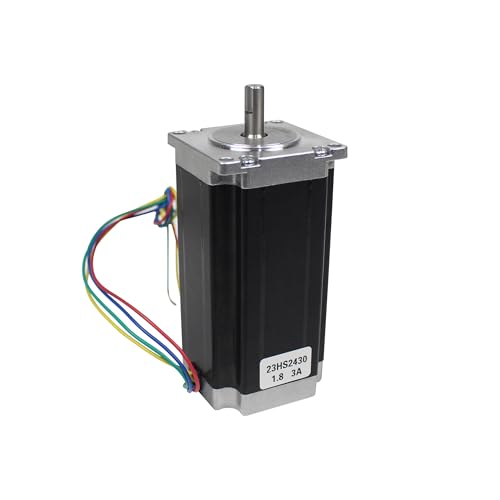
425 oz-in at just 3.0 A — this motor can steer a robot wheel through rough grass, according to buyer reports.
At 112mm long with a 425 oz-in (2.8 Nm / 280 Ncm) holding torque, at 425 oz-in versus the STEPPERONLINE 175.6 oz-in unit. The single 8 mm shaft is standard for most pulleys, and the 3.8-pound weight signals it is built for stationary machines. The frosted steel side walls give you a grippy surface if you want to clamp a heat sink. Shoppers say one reviewer used it to directly drive a 10 mm steering shaft (a metal rod that turns the wheels). An earlier NEMA 17 couldn’t turn the wheel on hardwood, but this motor “is able to steer and hold that position in very rough grass, asphalt, ect.”
Compared to the dual-shaft CNCTOPBAOS version (product 5), this single-shaft model is the same motor but without the rear shaft — pick this if you do not need to mount an encoder (a sensor that tracks the shaft’s position) or a handwheel on the back.
The Muscle
- 425 oz-in torque at just 3.0 A — efficient for the output
- 8 mm shaft matches standard pulleys and couplings
- Proven in a direct-drive steering application on rough terrain
One Thing
- At 3.8 lb and 112mm, it is long and heavy — measure your space
- Some units arrived with wires compressed under the motor in the packaging, so inspect on arrival
Grab this for: direct-drive projects, heavy CNC milling, or any application where you need the holding torque to resist external forces.
If you want: the rear shaft for an encoder, buy the dual-shaft version below instead.
5. Nema23 112mm Stepper Motor 425oz-in 280Ncm 3A Dual Shaft
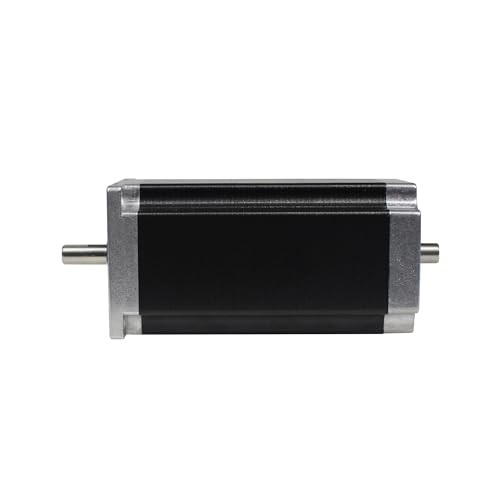
Same 425 oz-in grunt as the single-shaft, but with a rear output for encoders — the same motor that one buyer used to steer a robot through grass.
This is mechanically identical to the CNCTOPBAOS single-shaft version above — same 112mm body, same 425 oz-in (280 Ncm) holding torque at 3.0 A, same 8 mm front shaft — but it adds a second shaft on the rear face. You can use that rear shaft to mount a rotary encoder (a sensor that measures the shaft’s exact position for closed-loop control), attach a manual handwheel (a knob) for setup, or drive a secondary mechanism. At 1.71 kg (3.77 lb), compared to the HobbyUnlimited 76mm motor at 1.03 kg (2.4 lb), so it is a committed piece of hardware. Buyers report one owner used it to drive a 10 mm steering shaft on a robot, noting it could hold position in rough grass and asphalt — the same NEMA 17 upgrade story as the single-shaft version.
The trade-off: the dual shaft means you lose about 8mm of usable mounting depth on the rear if you are in a tight enclosure. The company (Changzhou Rattm Motor) is the same as the single-shaft version. Some early units showed the same packaging issue where the motor sat on its own wires.
Why Dual Shaft?
- Rear 8 mm shaft for encoders, handwheels, or secondary drives
- Full 425 oz-in torque at a reasonable 3.0 A current
- Frosted steel shell stays grippy for mounting heat sinks
Keep in Mind
- Rear shaft adds mounting depth — check your space
- Packaging may leave wires compressed; inspect on arrival
Choose this if: you are building a closed-loop stepper system, need a manual override crank, or just want a dual-shaft for flexibility.
Skip if: you only need a single shaft — the single-shaft version is the same motor for a bit less.
6. iMetrx Nema 23 Stepper Motor 100mm 270oz-in 4.2A
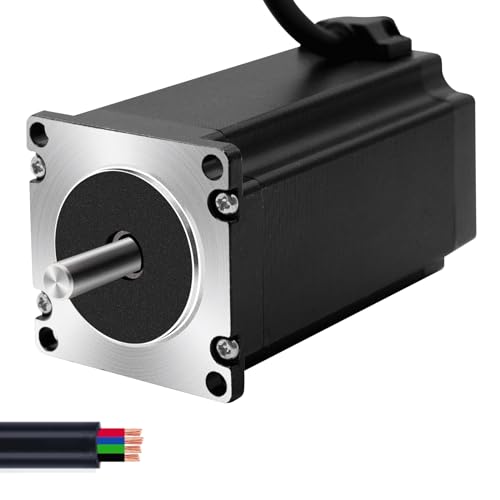
At 270 oz-in and 100mm long, this motor revived an old 3D printer’s extruder — a shorter alternative to the 112mm CNCTOPBAOS at a similar torque.
This 100mm iMetrx motor splits the difference between the short 76mm units and the long 112mm ones. Its 4.2 A rated current is high, so you need a driver that can handle that load. But that high current gives you a flatter torque curve at higher speeds (the motor maintains its force better at faster rotations). The 1.8-degree step angle is standard NEMA 23. Owners mention one owner replaced a 3+ year old extruder motor after thousands of hours and said: “Significantly improved print quality and extrusion reliability.” Another user added it as a direct-drive extruder on an Ender printer with a long reverse Bowden tube (a tube that feeds filament from a remote spool).
The listing specs are a bit messy: the product page states 270 oz-in and 250 Ncm interchangeably, and some customers note the documentation could be clearer. But for the price, reviewers point out it is a genuinely capable motor for printer upgrades and light CNC work.
Good For
- Rejuvenated a 3+ year old printer extruder — real longevity
- High 4.2 A current for better high-speed torque
- 100mm length fits where 112mm motors are too long
Heads-Up
- Spec sheet is confusing in places — verify your current needs
- 4.2 A requires a beefier driver than most budget boards
Ideal for: upgrading a 3D printer extruder or Z-axis where you want more headroom than a typical 76mm motor.
Not for: budget driver boards that max out below 3 A — you need a driver that can supply full current.
7. STEPPERONLINE Nema 23 CNC Stepper Motor 2.8A 175.6oz.in/1.24Nm

At just 2.2 inches long and 1.5 pounds, this is the most compact NEMA 23 on the list — 175.6 oz-in torque versus 425 oz-in, and 1.5 lb weight versus 3.8 lb of the CNCTOPBAOS 425 oz-in motor.
The 6.35 mm shaft is on the smaller side, and the speed is rated at 200 RPM. The STEPPERONLINE 269 oz-in motor (product 2) measures 3.0 inches long, weighs 2.3 pounds, and delivers 269 oz-in torque; this motor is 2.2 inches long, 1.5 pounds, and 175.6 oz-in torque. Shoppers say one reviewer used it to drag a large object in sand with a linear stage (a rail system that moves a load in a straight line). They called it a “very good beefy stepper motor” and recommended a high-current power supply and heat sinks to keep it cool. At 2.8 A, it needs a driver that can supply at least that — same as the bigger 269 oz-in units.
The main draw is the footprint: if your mount has minimal Z-height and you just need a reliable NEMA 23 for a light duty cycle, this motor gets the job done without eating up space.
The Pros
- Smallest NEMA 23 here at 2.2″ long — fits tight spots
- Only 1.5 lb, so mount stress is minimal
- Proven reliable in light linear-stage builds
The Limit
- 175.6 oz-in is half the torque of the 425 oz-in motors
- 6.35 mm shaft is non-standard for many CNC couplers
- Heats up under sustained load — budget for heat sinks
Best for: a compact build or a budget project where space and weight matter more than raw torque.
skip it if: you need to drive a heavy CNC axis or a direct-drive wheel — go with the 425 oz-in motors above.
Understanding the Specs
Holding Torque (oz-in / Nm)
This is the force the motor uses to lock its shaft when power is applied but the shaft is not moving. A higher number means the motor resists being pushed out of position a stronger grip. For a light 3D printer extruder, 175 oz-in works well. For a CNC machine cutting aluminum or a robot arm steering a wheel, you want 425 oz-in or more. The number is measured in ounce-inches (oz-in) or Newton-meters (Nm).
Motor Length and Current
All NEMA 23 motors share the same 2.24-inch square faceplate, but the body length varies. Longer motors (112-114mm) have more copper windings inside, so they produce more torque, but they also draw more electrical current. A short 76mm motor typically pulls 2.8 A (amps), while a 114mm unit can pull 4.2 A. Your stepper driver must be rated to handle that current — if it cannot supply enough amps, the motor will skip steps under load.
Step Angle (1.8° vs 0.9°)
All motors here use a 1.8-degree step angle. That means it takes 200 full steps for the shaft to make one complete revolution. A 0.9-degree motor (400 steps per revolution) gives you finer position control, but typically has less holding torque at the same physical size. For most CNC and 3D printer work, 1.8° is the standard. Microstepping drivers multiply resolution electronically, so you get even finer movement from the 1.8° motor.
Shaft Diameter and Type
The shaft diameter determines what pulley or coupling (the connector that links the motor to the machine’s lead screw or belt) fits it. Common sizes are 6.35 mm (1/4 inch) and 8 mm. Some budget motors use 6.35 mm, while higher-torque units typically use the stronger 8 mm. Dual-shaft motors add a second shaft on the rear, which is useful for mounting a rotary encoder (a sensor for closed-loop feedback), a manual handwheel, or a brake.
FAQ
What does NEMA 23 mean exactly?
How do I choose between a short 76mm motor and a long 112mm motor?
Can I use a 6.35 mm shaft motor with an 8 mm pulley?
What stepper driver do I need for a 4.2 A motor?
What voltage should I feed my NEMA 23 motor?
How hot should a stepper motor get during use?
What is the difference between single shaft and dual shaft?
Can I use a NEMA 23 motor on a 3D printer that originally used a NEMA 17?
Why do some NEMA 23 motors have a 1.8° step angle and others 0.9°?
Does a higher RPM rating mean a better motor?
Final Thoughts: The Verdict
The 23 nema stepper motor that fits most people is the STEPPERONLINE 23HS45-4204S because its 425 oz-in holding torque handles heavy CNC loads, and the brand is consistent. The best torque-to-current efficiency belongs to the CNCTOPBAOS 23HS2430 — 425 oz-in at just 3.0 A. And for a compact budget build that just needs a reliable NEMA 23 without the bulk, the STEPPERONLINE 23HS22-2804S is the one.
How We Picked
We do not accept paid placement. Every pick is matched to a real buyer and a real use-case; we do not hands-on test units.
Sources & Methodology
Specifications: manufacturer listings and product documentation. Review insights: verified customer reviews, as of July 2026. Pricing: not shown on this page (it changes often); check the current price via the retailer link.
As an Amazon Associate, Gadgets Feed earns from qualifying purchases. This does not affect which products we feature.