
Our readers keep the lights on and my morning glass full of iced black tea. As an Amazon Associate, I earn from qualifying purchases.
Specs are compiled from manufacturer listings and verified buyer reviews and can change over time — please confirm the key details on the product page before buying.
If you drive an electric car, the difference between a 120-volt wall outlet and a proper 240-volt home charger is the difference between adding a handful of miles overnight and waking up to a full battery every morning. This guide covers the 230 Volt Charging Station options that actually deliver that speed, with the real trade-offs on installation, smart features, and which connector works with your car.
I’m Min — the founder and writer behind Gadgets Feed. This guide is built by comparing the manufacturers’ published specifications and the patterns across verified customer reviews, so you get each pick’s real strengths and trade-offs instead of marketing spin.
Finding the right 230 volt charging station means matching amperage, connector type, and smart features to your EV and your home’s electrical setup, so you never waste money on the wrong unit.
Our Picks at a Glance

How To Choose The Best 230 Volt Charging Station
Picking a home EV charger looks simple until you realize the connector, the amperage, and the plug type all have to line up with your specific car and your home’s electrical panel. A little planning up front saves you from buying a charger that either won’t plug in or charges half as fast as it should.
Match the connector to your car
Nearly every EV sold in North America uses one of two plugs. The J1772 connector fits most non-Tesla cars like Chevrolet, Ford, Hyundai, Kia, and Volkswagen. The newer NACS plug is the Tesla standard, and it is now also appearing on some other brands. If your car uses J1772 and you buy a NACS charger, you need an adapter, and the same works in reverse. A few chargers ship with both connectors or include an adapter in the box, which is the easiest way to cover a two-car household.
Size the amperage to your breaker
Your home’s circuit breaker determines how fast you can charge. A 40-amp charger (the most common home setup) needs a 50-amp circuit breaker. A 48-amp unit pulls more power, so it usually needs a 60-amp breaker, and many of those are designed to be hardwired rather than plugged into a wall outlet. If you only have a 30-amp circuit available, look for a charger with adjustable amperage so you can dial it down to 24 amps or 16 amps and still charge safely overnight.
Decide if you want smart features
Some chargers are pure plug-and-play with no app at all — just power and a cable. Others add Wi-Fi, a phone app, scheduling, and energy tracking. If your utility charges less for electricity at night, an app that schedules off-peak charging can cut your electric bill, and several owners specifically mention using this to earn utility rebates. Ask yourself if you want to monitor charging costs from your phone, or whether a simpler, more reliable “dumb” charger fits your routine better.
Quick Comparison
| Model | Best For | Max Amperage | Connector | Cable Length | Amazon |
|---|---|---|---|---|---|
| Tesla Wall Connector★ Best Overall | Tesla owners wanting max speed | 48 A | J1772 | 24 ft | Amazon |
| NexCyber 48ABest Value | Budget-friendly app control | 48 A | J1772 | 25 ft | Amazon |
| EMPORIA J1772 48ATop Performer | Smart tracking for J1772 cars | 48 A | J1772 | 25 ft | Amazon |
| VEIPHLOX 40A | Simple no-app reliability | 40 A | J1772 | 25 ft | Amazon |
| Grizzl-E Classic | Outdoor durability on a budget | 40 A | J1772 | 24 ft | Amazon |
| ApexCharger MACH 1 | Two-car households (J1772 + Tesla) | 48 A | Dual J1772/NACS | 30 ft | Amazon |
| EVIQO NACS 40A | Tesla owners wanting plug-in ease | 40 A | NACS | 25 ft | Amazon |
| EMPORIA NACS 48A | Smart tracking for Teslas | 48 A | NACS | 24 ft | Amazon |
| Autel MaxiCharger | Flexible amperage for varied panels | 50 A | J1772 | 25 ft | Amazon |
In‑Depth Reviews
1. Tesla Wall Connector
Our pick — over 4.5★ from 1,500+ verified ratings; the strongest balance of quality and price.
The gold standard for Tesla owners, delivering up to 44 miles of range per hour at 48 amps.
For a Tesla household, this is the charger everything else gets compared to, and it earns that spot with up to 44 miles of range added per hour of charge at 48 amps. Owners describe the build quality as first-class and the installation as straightforward, with one full charge landing in under four hours. The unit is compact at just 4.3″D x 6.1″W x 13.6″H, so it tucks neatly onto a garage wall without dominating the space.
It is built for indoor or outdoor mounting, and the variable amperage lets you customize output down to 12A to match an older power supply. The Wi-Fi connection brings over-the-air firmware updates and remote access control, and the power-share feature links up to six Wall Connectors together if you ever need to charge multiple Teslas at once. Owners consistently report the app scheduling and smooth auto-charge work exactly as intended, and a second purchase is common because the first unit is still going strong.
Buyers report: “Fast charging (~44 mi/hr), solid build, clean design, app/Wi-Fi integration, smooth auto-charge.” The honest catch is the install — this needs a dedicated 60A breaker with 6AWG wire, and most owners hire an electrician for the job.
What Wins Tesla Owners Over
- Fast 44 mi/hr charging on a 48A circuit
- Sleek, durable, weatherproof design
- App scheduling with over-the-air firmware updates
- 24-ft cable with neat cable management
Fair Caveats From The Garage
- Needs a 60A breaker and 6AWG wire — plan for an electrician
- Wi-Fi connection can be slow to link up, though it works
- Premium price tag reflects the brand and fit
Reach for this if: you drive a Tesla Model S, 3, X, or Y and you want the fastest, best-integrated home charging experience available.
Look elsewhere if: you don’t drive a Tesla and you’d rather not pay for the smooth Tesla-app integration you won’t fully use.
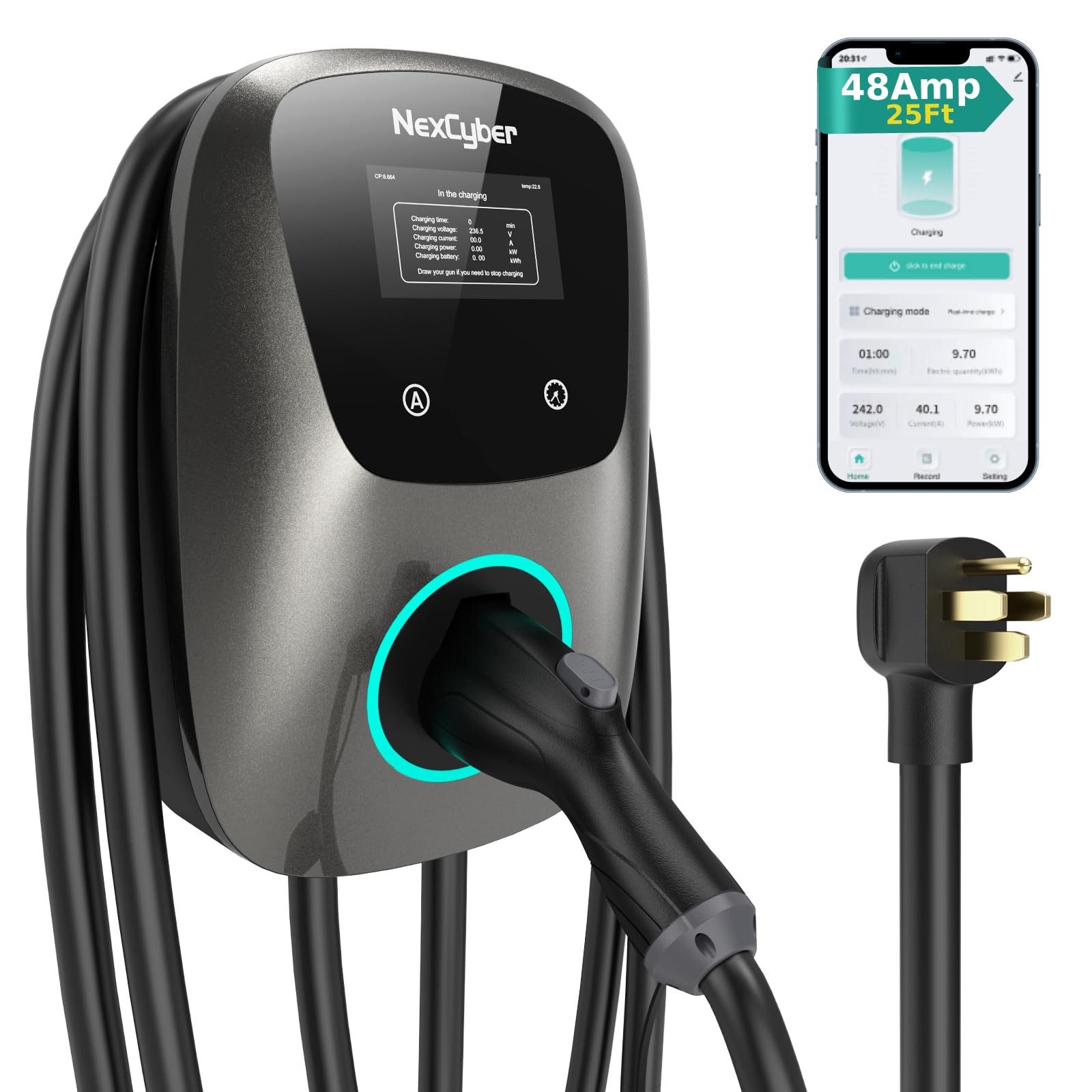
2. NexCyber 48A Level 2 EV Charger
A 48-amp workhorse with a touch screen and app, priced below the big names.
This NexCyber charger delivers up to 46 miles per hour through a hardwired connection, or up to 38 miles per hour when you use the included NEMA 14-50 plug at 40 amps. That flexibility makes it among the most versatile units here — you can start plug-and-play today and hardwire later if you want the full speed. Owners praise the ETL and FCC certification, noting the heavy-duty build and the visible display that shows amperage, charging speed, and input voltage at a glance.
You don’t need an app to use it, which is part of the appeal. The default plug-and-play mode works right from the start, and the touch buttons let you adjust amperage from 16A to 48A or set a delayed start time directly on the screen. If you do want app control, the Wi-Fi app tracks charging history, cost, and fully-charged notifications, and lets you schedule off-peak sessions. The 25-foot military-grade cable is a genuine highlight — one owner mounted the unit and found the long cord reached both sides of the car with room to spare.
Owners mention: “Pulled 40A for 6hrs, no overheating in warm garage.” The same owner replaced an overheating charger from another brand, so the steady thermal performance is meaningful. The NEMA Type 3 housing offers a degree of IP65 waterproofing, though the maker suggests avoiding direct sun or heavy rain exposure.
Why It’s A Standout Value
- 48A hardwire or 40A plug-and-play in one unit
- Visible touch screen with on-device amp adjustment
- ETL and FCC certified with a 3-year warranty
- 25-ft cable reaches across a garage
Who Should Think Twice
- App interface is functional but a bit clunky
- Tesla and newer NACS cars need a J1772 adapter, not included
- Professional install recommended for the 48A hardwire route
Pick this up if: you want near-top charging speed and app control without paying flagship prices.
skip it if: you drive a 2025+ Kia EV6 or EV9 that uses the NACS port — you’ll need an adapter to make this work.
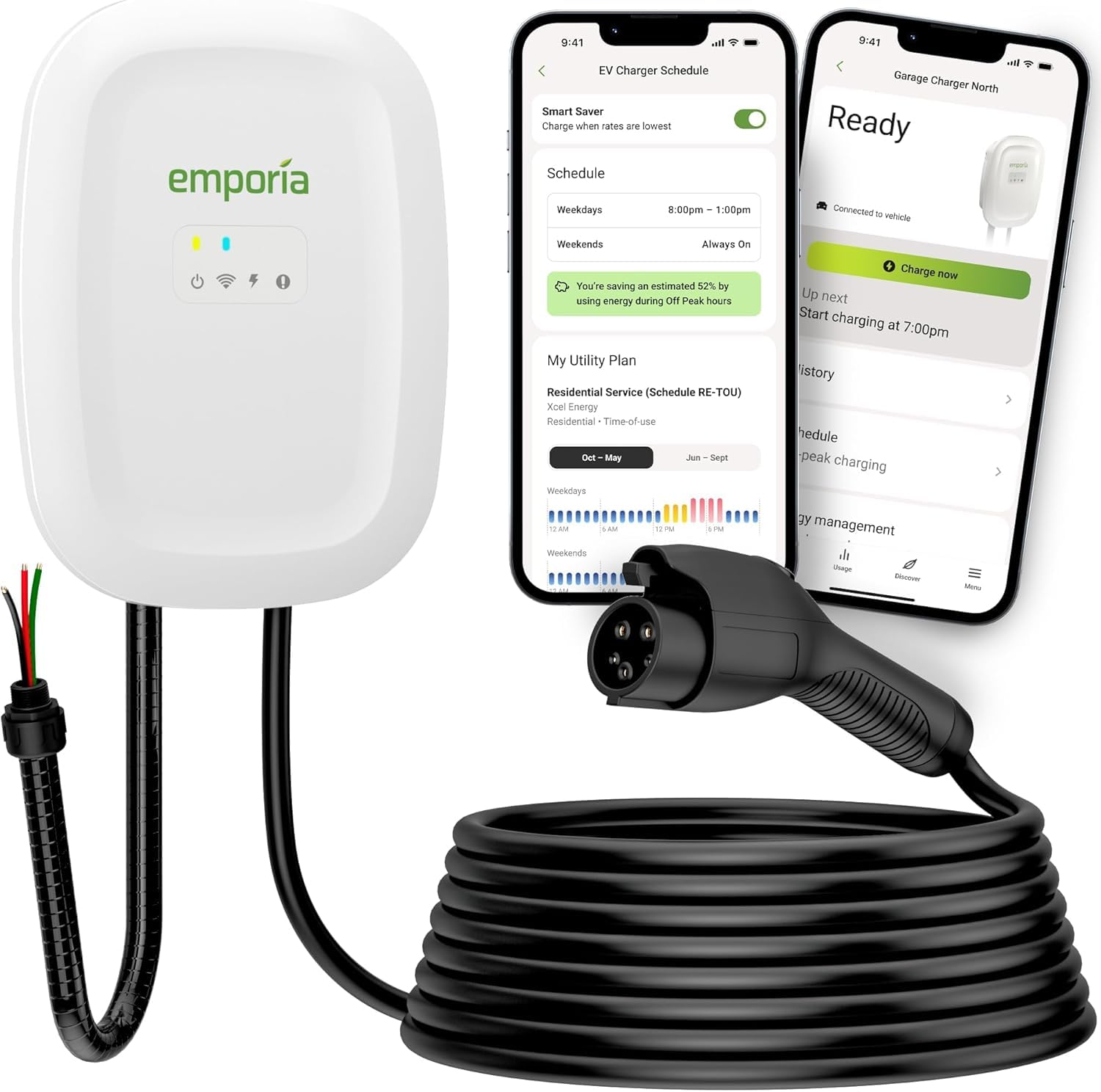
3. EMPORIA Level 2 EV Charger with J1772 Connector
A hardwired 48-amp charger with an app that shows charging costs in clear dollars and cents.
Emporia’s J1772 charger pushes up to 46 miles per hour on a hardwired 48-amp connection, which owners confirm charges an Ioniq 5 from empty in 4-5 hours and a Sportage PHEV in about an hour. The unit is UL listed and ENERGY STAR certified, meeting standards like NEC 625, SAE J1772, and UL 2594, so the safety paperwork is all in order. Owners describe the reliability as outstanding, with the charger running flawlessly night after night.
The real differentiator here is the smart charging. Over 2.4 GHz Wi-Fi, the Emporia app gives you real-time energy data, charging history, and cost per charge, all in clear dollars and cents. Owners using time-of-use utility rates say the scheduling feature is simple and effective, easily shifting charging to off-peak hours. One owner notes the app integrates cleanly with an Emporia Vue home energy monitor, so if you already track your whole-house usage, this slots right into that ecosystem.
The 25-foot cable is long enough to reach across a 2-car garage, and the hardwired install with whip is preconfigured for the full 48A. Owners do mention the plastic casing is best mounted indoors to avoid UV damage, which is a small but honest note for anyone planning an outdoor install.
Smart Charging Wins: the app is the most user-friendly of the bunch, with owners specifically calling out easy time-of-use scheduling and clear per-charge cost tracking.
One Caveat: it’s a hardwired-only unit at full 48A, so plan for a 60-amp breaker and a professional install rather than a simple plug-in.
4. EMPORIA Level 2 EV Charger with NACS Connector
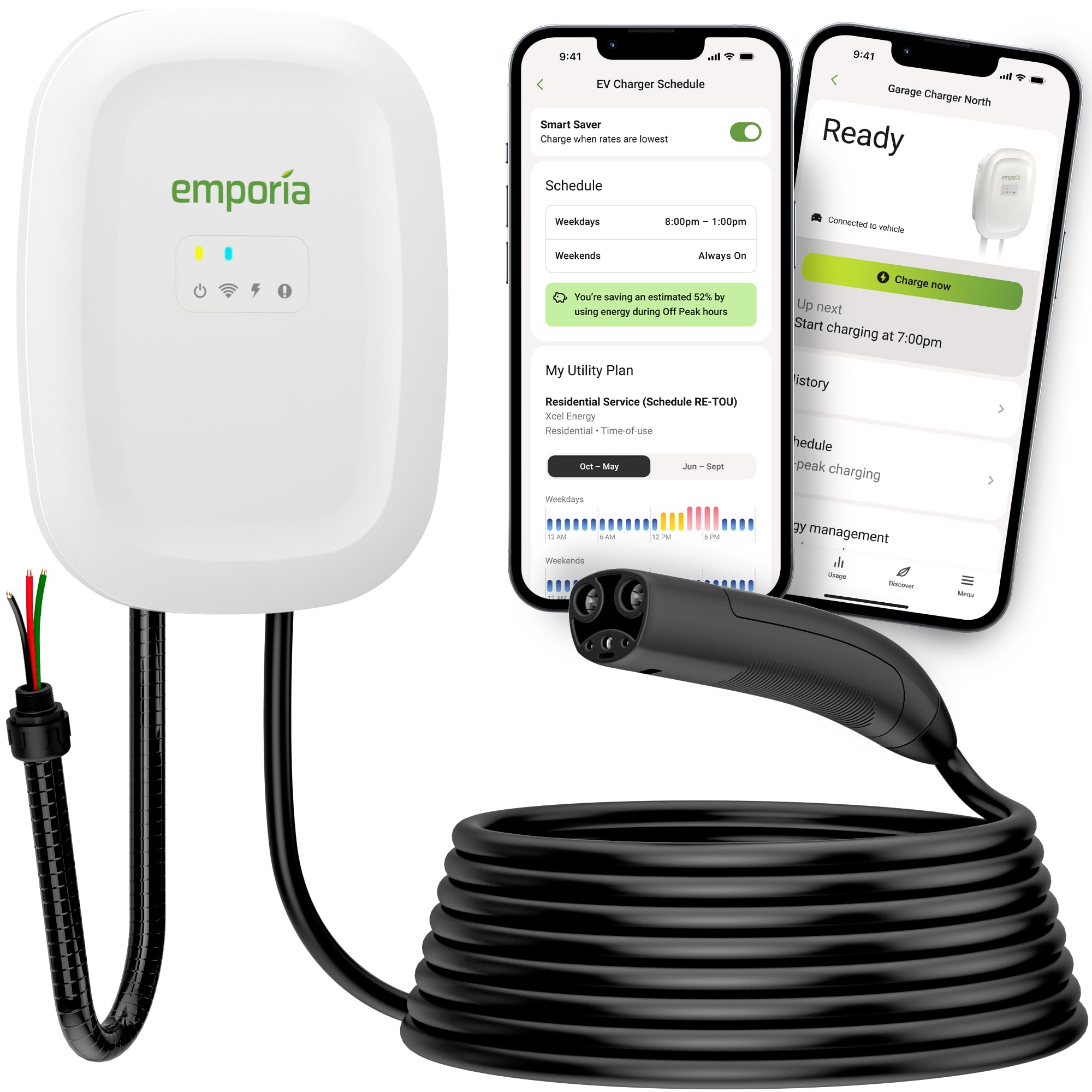
The Tesla-friendly twin of the Emporia above, with a native NACS plug and no adapter needed.
If you drive a Tesla or a newer EV with a NACS port, this Emporia skips the adapter entirely. The charger’s NACS plug connects directly, and it even has the ability to remotely pop open your Tesla’s charging port door at the press of a button, just like the factory unit. Customers note consistent charging at 11.25 to 11.5 kW, which is right at the top of what a 48-amp hardwired home charger can deliver.
It shares all the smart-charging strengths of its J1772 sibling — the app tracks usage, schedules off-peak sessions, and breaks down cost by kWh and dollar per charge. One owner notes their electrician recommended Emporia over a Tesla or Wallbox unit on value, and another mentions LADWP rebates covered the full cost. The UL listing and ENERGY STAR certification are in place, and owners consistently describe the app as good, with stable Wi-Fi and comprehensive charging data.
At 48A, this is a hardwired unit, so a 60-amp breaker is the target for full speed. Some owners note local electrical codes may limit them to 40A on a 50A breaker, which is a regional consideration worth checking before you commit. Compared to the Tesla Wall Connector at position 1, this hits the same 48A peak with a similar app experience, often at a lower price point.
Native NACS Fit: Tesla owners get the same smooth port-opening trick as the factory charger, with the app data and cost tracking that Tesla’s own unit lacks.
Plan Your Circuit: hardwired install, so confirm your local code allows the full 48A on a 60A breaker before buying.
5. ApexCharger MACH 1
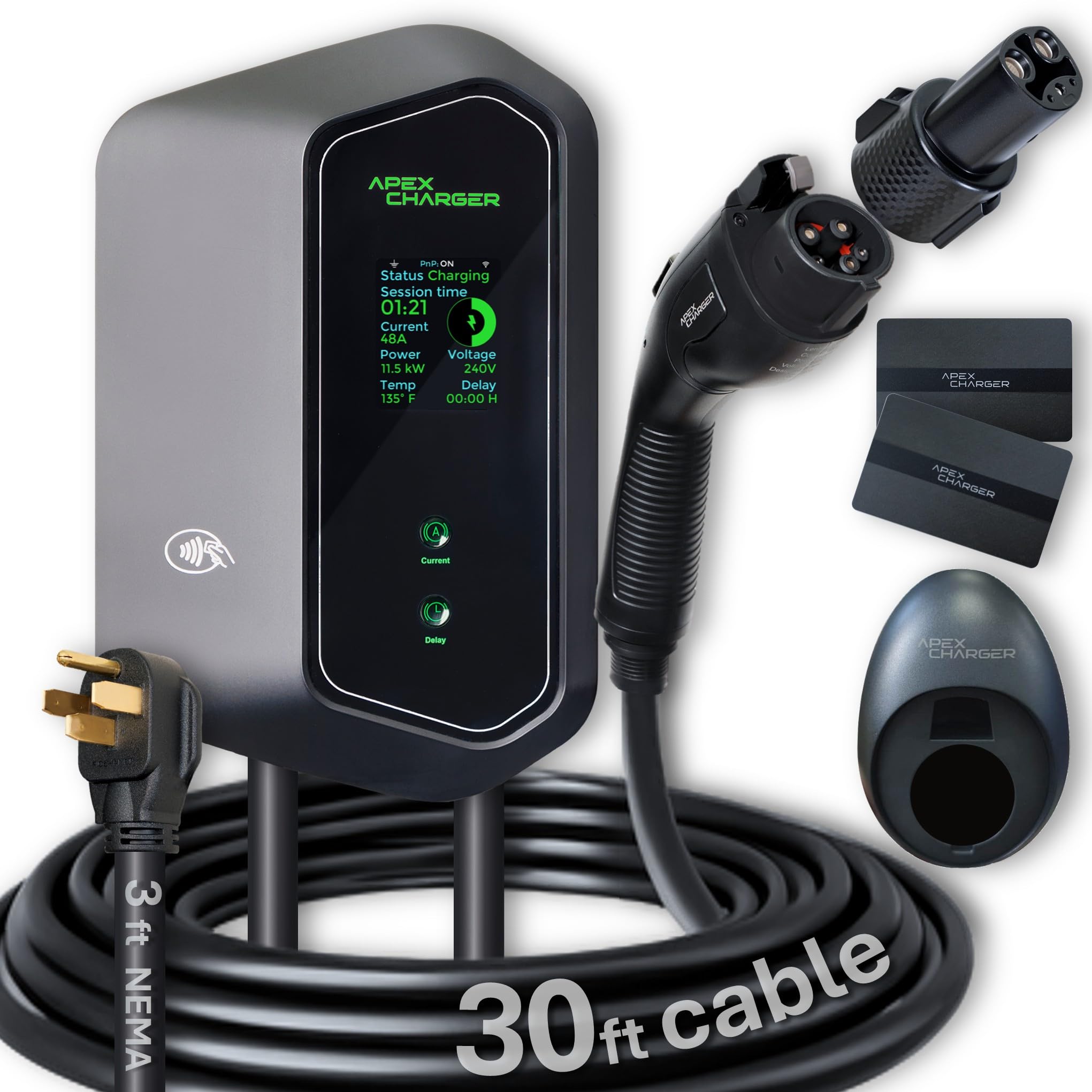
The one charger that covers every EV in America, Tesla included, straight from the start.
This is the rare charger that ships with both a J1772 connector and ApexCharger’s PRO 1 NACS adapter, so a two-car household with one Tesla and one Ioniq 5 can both charge without buying extra parts. The MACH 1 delivers up to 48A when hardwired on a 60A breaker, or 40A through its NEMA 14-50 plug, and the amperage is adjustable from 0 to 48A to match your panel. That flexibility — one owner ran it at 24A on a 30A outlet with an adapter — makes it unusually forgiving of whatever circuit you already have.
The 30-foot cable is the longest in this lineup, a genuine advantage for a long driveway or an awkward garage layout. Wi-Fi and Bluetooth are built in, along with two RFID cards for access control, a 2.4-inch LED display, and an anti-theft bolt for the mount. Owners highlight the customer support as exceptional, with one recounting how a display failure on a Sunday got an immediate callback and fix, and another whose unit was replaced under the 5-year warranty with shipping covered.
Reviewers point out it performs “even in snowy conditions,” and the outdoor-rated enclosure handles the weather. The recurring note is that connectivity can be tricky in some setups, though the support team resolves it quickly. If you want one charger that genuinely does it all, this is the most complete package here.
The All-In-One Appeal
- Both J1772 and NACS connectors included — no adapter to buy
- Longest cable here at 30 ft
- Adjustable 0-48A fits almost any breaker
- 5-year warranty with responsive support
Know Before You Buy
- Wi-Fi/app connectivity is occasionally finicky
- Full 48A requires hardwiring on a 60A breaker
- Rebate eligibility depends on your utility and local rules
Best for: mixed-vehicle households that want one wall unit to serve both a Tesla and a J1772 car without juggling adapters.
Not ideal if: you want the simplest possible no-app charger — this one has more features than you’d use.
6. EVIQO Level 2 EV Charger NACS 40A
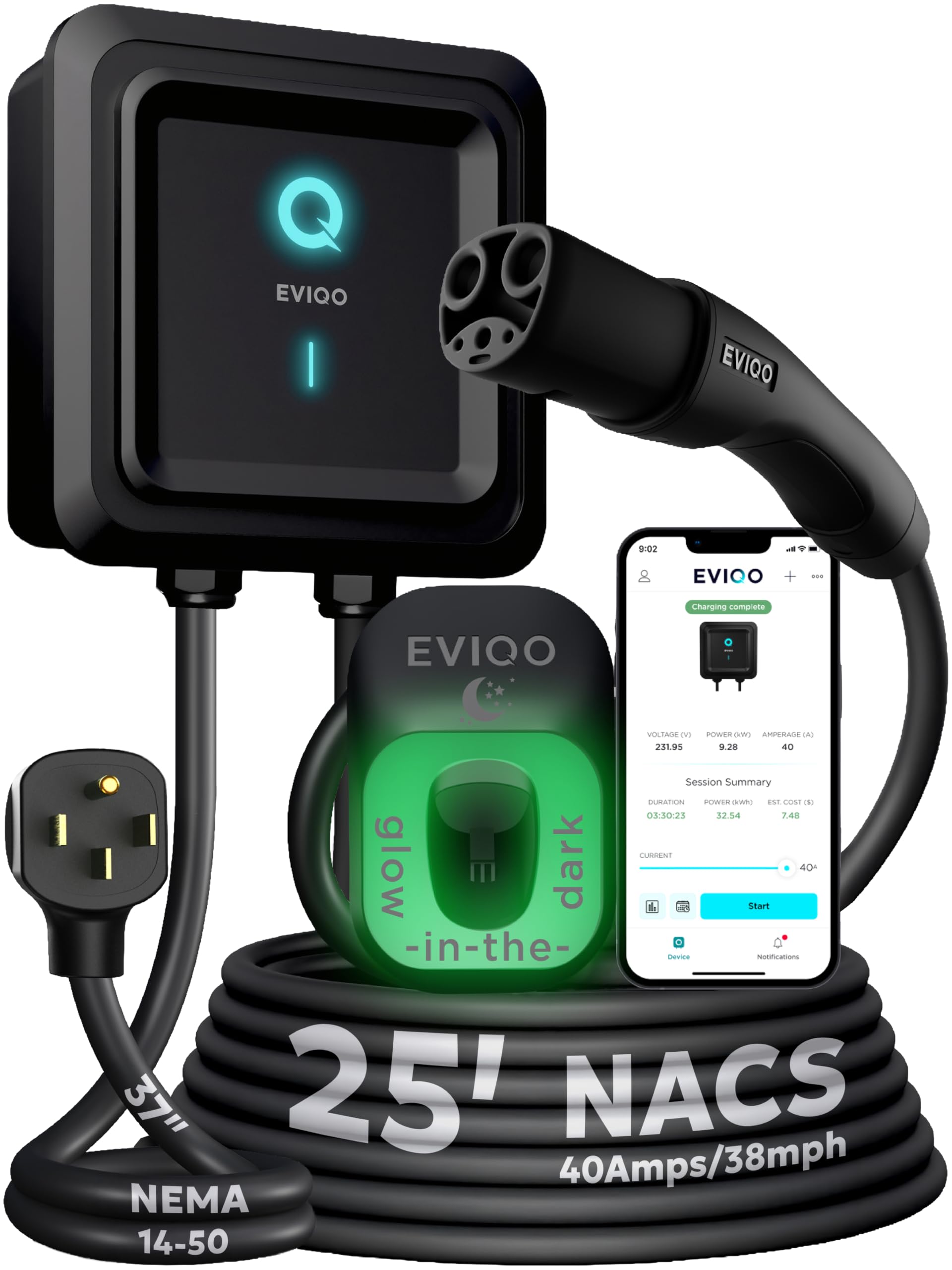
A plug-in Tesla charger with a glow-in-the-dark holster and an app that simplifies off-peak savings.
This EVIQO is built for Tesla owners who want plug-and-play simplicity without hardwiring. It draws up to 40A from a standard NEMA 14-50 outlet, which owners confirm charges a Rivian R1T overnight and fills most EVs from 20% to 100% in about 8 hours. The native NACS plug connects directly to Tesla’s port — no adapter — and the button on the plug even pops open your charge port for you.
The app is a genuine strength, letting you adjust charging speed from 6A to 40A, start or stop sessions remotely, and schedule off-peak overnight charging to cut energy costs. One owner specifically notes their power company’s off-peak rates make the scheduling feature “as simple as set the start time and forget it,” and that the charger is ENERGY STAR 2 compliant, qualifying for a utility rebate. The fully sealed IP66 / NEMA 4 housing means rain, snow, heat, and dust are all fine for outdoor mounting, and the internal steel shielding protects the electronics.
The extra-long 25-foot cable easily reaches across a garage or driveway, and the glow-in-the-dark holster makes finding the plug at night genuinely easier. Owners praise the build quality and heavy-duty cable, with one unit installed outdoors in Florida running at a consistent 40A weekly with no heat or rain issues. A side reset button restarts the charger in seconds without touching the breaker.
Plug-In Convenience: no hardwiring required, yet still a full Level 2 charger that fills most EVs overnight — the easiest install in this lineup.
Worth Knowing: it’s a 40A unit, so it tops out slightly below the 48A hardwired chargers, and it’s designed for the NACS standard.
7. Autel MaxiCharger AC Home
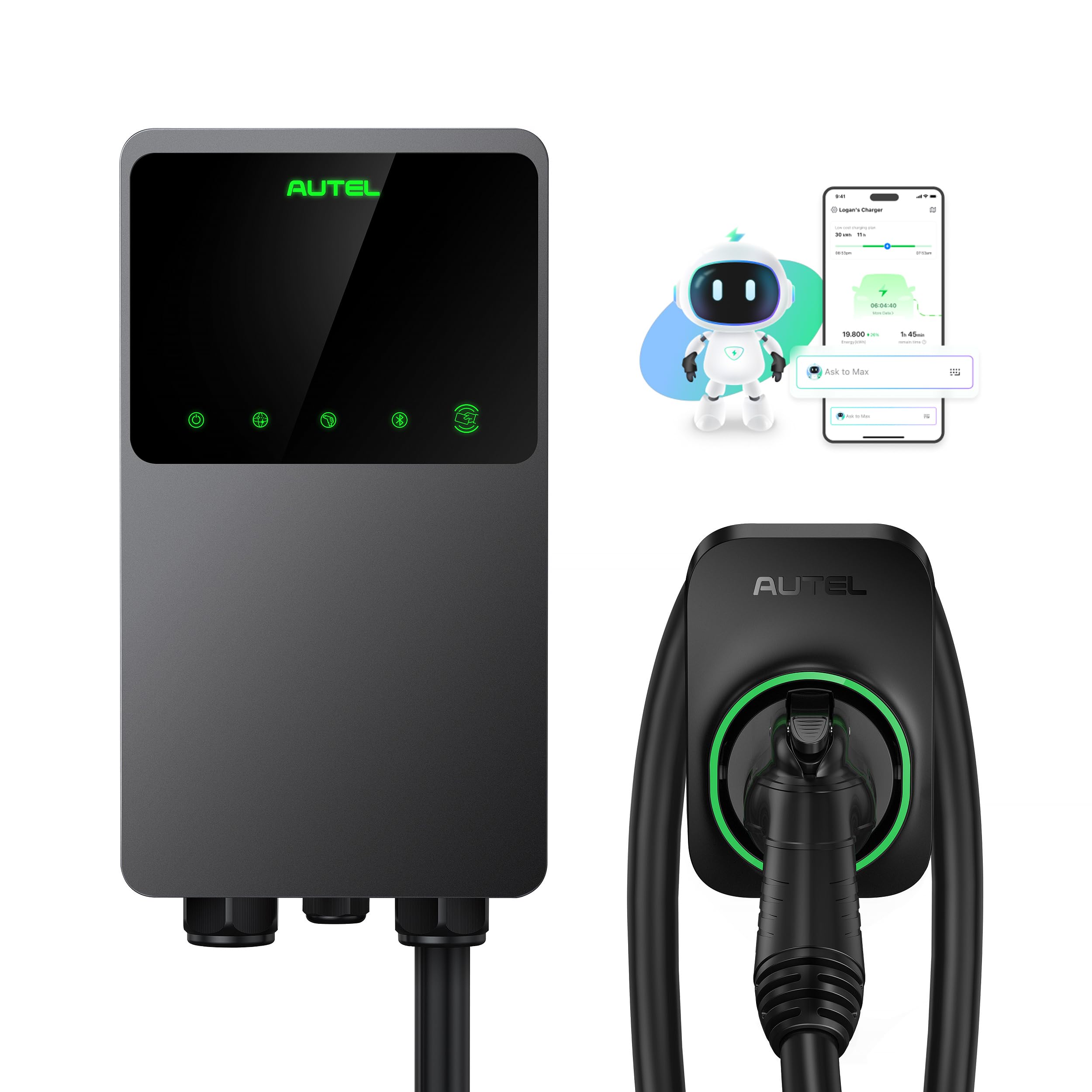
The 50-amp ceiling-setter that adds 37 miles per hour and withstands -40°C cold.
Autel’s MaxiCharger pushes past the 48A crowd with up to 50A and 12kW of output, adding 37 miles per hour of range. That headroom makes it the fastest charger in this list on paper, and owners confirm it charges a Toyota Sportage in a couple of hours and a Nissan Leaf at the same clip. The 25-foot cable stays flexible even in extreme cold — rated down to -40°C — so a frigid garage doesn’t turn the cord into a stiff rod.
It’s CSA certified with a NEMA Type 4 housing, meaning snow, rain, hail, and sleet are all handled, and it’s eligible for the Federal rebate program. The Autel Charge app manages charge times, schedules sessions while you’re away, and tune for off-peak electricity, and the adjustable amperage lets you manually set everything from 6A to 40A to match your breaker. One owner routed around a 30A circuit limitation by dialing the draw down to 32A, though that did trip a Neocharge adapter — a sign that matching amps to your actual circuit matters.
Autel has been in the automotive diagnostic space since 2004, and the 3-year warranty with around-the-clock support backs the build. Owners describe the install as easy for any electrician and praise the thick cables and solid construction. The heaviest of the lot at a substantial weight, this is a rugged, serious piece of hardware for anyone who wants maximum future-proofing.
Headroom For Days: the only unit here that hits 50A, so it’s the one to grab if you want the absolute fastest home charging and a bit of buffer for future EVs.
The Trade-Off: reliability has drawn mixed owner feedback over time, and the unit’s weight makes the wall-mount a two-person job.
8. VEIPHLOX J1772 Level 2 EV Charger 40 Amp

The no-app, no-frills 40-amp charger that just works, with a satisfying click and zero setup.
If you want a charger that does one thing and does it well, this VEIPHLOX delivers 40A and 9.6kW of power with no screen, no Wi-Fi, and no app to configure. Plug it into a NEMA 14-50 outlet and it charges, with one owner reporting their BMW went from empty to 92% in four hours. Owners describe the connector as clicking into the car with a satisfying, secure feel, and the unit as “lightweight” and easy to maneuver while still feeling sturdy.
The build is solid where it counts: a UL-certified 25-foot cable rated to 221°F, an ETL and UL approved 14-50 plug, and a sturdy IP65/NEMA 5 waterproof and dustproof housing. Over-current, over-voltage, temperature, lightning, and surge protections are all built in, along with self-monitoring and power outage recovery. The unique internal cord-holding design stores the cable and connector right in the unit, so you don’t need an extra holster and the wall stays clean.
One owner reported a unit that failed after two months, but the seller’s customer service replaced it free and promptly, with no hassle. That kind of responsiveness matters on a budget pick. The main compromise is the lack of app features — there’s no scheduling or cost tracking here, so you’re managing charging manually.
Why Keep It Simple
- True plug-and-play with no app or configuration
- IP65 weatherproof housing for indoor or outdoor use
- Integrated cord storage keeps the wall tidy
- 30-40 miles per hour — about 7-8x faster than a 110V outlet
The Simple-Life Catch
- No Wi-Fi, no scheduling, no cost tracking
- Amperage adjusted via internal switches, not a display
- Large and heavy despite being wall-mountable
Grab this if: you want dependable, fast home charging without ever opening a smartphone app.
Pass it by if: off-peak scheduling or per-charge cost tracking matters to you — you’ll want a smart charger instead.
9. Grizzl-E Classic

The “dumb” charger with a smart idea: a metal box built for the outdoors that just keeps charging.
The Grizzl-E Classic is the anti-smart-charger — no Wi-Fi, no app, just a tough metal enclosure that delivers power and lets your car handle the brains. The adjustable amperage (40A, 32A, 24A, or 16A) lets you match it to whatever breaker you have, from a 50A circuit down to a 20A one.
At 40A it delivers 28-30 miles per hour, enough to charge a Solterra to 80% overnight, as one owner noted. The installation is genuinely simple — mount the bracket, plug into a NEMA 6-50 outlet, and go — with one owner completing the whole job in about 30 minutes. It’s also easily transportable: the unit lifts off its bracket so you can move it between locations, useful for anyone with a second home or a shifting parking setup.
The trade-offs are the flip side of its simplicity. There’s no app, no scheduling, and no way to track your charging costs, and a few owners mention the lack of Wi-Fi as a downside. One owner’s unit did fail after a year, and the warranty claim required some persistence before a replacement shipped. But for sheer rugged reliability at a fair price, this metal-box classic is tough to top outdoors.
Built For The Elements: the metal IP67 enclosure is the most weather-proof design here, which is why it’s the go-to for exposed outdoor mounts.
Know The Limits: the short plug cable means mounting the frame close to your outlet, and there’s zero smart functionality to lean on.
Understanding the Specs
Amperage & Breaker Matching
Amps are the speed limit of your charger. A 40-amp charger needs a 50-amp breaker, a 48-amp unit wants a 60-amp breaker, and a 50-amp charger like the Autel sits at the top of the home range. If your panel can’t handle a big breaker, pick a charger with adjustable amperage so you can dial it down to 24A or 16A and still charge safely overnight. The trade-off is speed: fewer amps means fewer miles per hour added.
J1772 vs NACS Connectors
The connector is the physical plug that goes into your car. J1772 is the standard for most non-Tesla EVs — Chevrolet, Ford, Hyundai, Kia, Volkswagen. NACS is Tesla’s plug, now appearing on more new cars. A J1772 charger works with a Tesla only with an adapter, and a NACS charger works with a J1772 car only with an adapter. Some chargers ship with both or include an adapter to cover a two-car household without extra purchases.
Hardwired vs Plug-in
Plug-in chargers connect to a NEMA 14-50 or 6-50 outlet and install in minutes, but they’re often capped at 40A. Hardwired chargers are wired directly to the breaker panel, which open up the full 48A or 50A output for the fastest home charging. Hardwiring usually means hiring an electrician, but some owners with electrical experience do it themselves. Check your local electrical code — some regions cap even hardwired units at 40A on a 50A breaker.
Smart Features & App Control
Smart chargers connect over Wi-Fi to a phone app, where you can schedule off-peak charging, track energy use and cost per charge, and start or stop sessions remotely. If your utility charges less electricity at night, scheduling can genuinely cut your bill and may even qualify for a rebate. “Dumb” chargers skip all of that for simplicity and reliability — just plug in and charge. Decide if you want the data and control, or the zero-configuration simplicity.
FAQ
Will a 230-volt charger work with my car if I use a J1772 plug?
What’s the difference between a 40-amp and a 48-amp charger?
Can I plug a 230-volt charger into a regular wall outlet?
Is it safe to install a 230-volt charger outdoors?
Do I need an electrician to install a home EV charger?
What breaker size do I need for a 48-amp charger?
Can a 230-volt charger save me money with off-peak electricity rates?
Will this charger work with a Tesla?
How long does a full charge take with a 230-volt charger?
What’s the difference between a 230-volt charger and a Level 1 charger?
Final Thoughts: The Verdict
The crowd favorite here is the Tesla Wall Connector, holding a 4.8-star score across 1,000+ owners — it’s the fastest, cleanest, best-integrated option for any Tesla household. If you want near-identical 48A performance with a lower price tag, the Emporia J1772 is the smart pick thanks to the strongest app in the group. And if you drive a Tesla and want plug-in simplicity with genuine weatherproofing, the EVIQO NACS delivers overnight charging and off-peak scheduling without ever calling an electrician.
How We Picked
We do not accept paid placement. Every pick is matched to a real buyer and a real use-case; we do not hands-on test units.
Sources & Methodology
Specifications: manufacturer listings and product documentation. Review insights: verified customer reviews, as of August 2026. Pricing: not shown on this page (it changes often); check the current price via the retailer link.
As an Amazon Associate, Gadgets Feed earns from qualifying purchases. This does not affect which products we feature.