
Our readers keep the lights on and my morning glass full of iced black tea. As an Amazon Associate, I earn from qualifying purchases.
Specs are compiled from manufacturer listings and verified buyer reviews and can change over time — please confirm the key details on the product page before buying.
You want one lens that handles landscapes at 24mm, portraits at 105mm, and everything in between — all without swapping glass. A constant f/4 aperture means your exposure never changes as you zoom, which is critical for video and consistent shooting. The real question is which mount, how much stabilization, and what weight you can live with for the sharpest results.
I’m Min, the founder of Gadgets Feed. This guide compares official specs from the manufacturers and patterns across verified buyer reviews, so you see each lens’s real strengths and trade-offs — not just the marketing claims.
After going through the numbers and user feedback on these five models, you will know exactly which best 24-105mm lens fits your camera mount and your shooting style.
Quick Picks
- Sony FE 24-105mm f/4 G OSS Standard Zoom Lens (SEL24105G/2) — Best Overall
- Panasonic LUMIX S 24-105mm f/4 Lens, Full-Frame L Mount — Best Value L-Mount
- Canon Zoom Lens EF 24-105mm f/4L IS II USM (White Box) — Professional Grade II
- Canon EF 24-105mm f/4 L IS USM Lens (Original) — Classic Workhorse
- Sigma 24-105mm f/4 Art DG OS HSM Lens for Nikon — Nikon F-mount Value
How To Choose The Best 24-105mm Lens
The 24-105mm range is the standard zoom balance — you get true wide-angle at 24mm, a natural-looking portrait length at 105mm, and every step in between. But not all f/4 zooms deliver the same sharpness, shake reduction, or close-focus performance. Here is what to check before you buy.
Aperture: f/4 Constant vs. Variable
Every lens in this guide holds a constant f/4 aperture across the zoom range. That matters because your exposure and the amount of background blur stay the same as you zoom from wide to telephoto. That is critical for video shooters and anyone who does not want their shot to dim when they zoom in.
Image Stabilization: Your Handheld Safety Net
At 105mm, camera shake becomes visible. A lens with optical image stabilization (OIS — a system of moving lens elements that counteracts your hand movements), or in-body stabilization (IBIS — stabilization inside the camera body) lets you shoot sharp at shutter speeds several stops slower than you normally could. Check whether the lens has built-in OIS or relies on your camera body for stabilization. Some Sony and Panasonic bodies pair with lens OIS for a combined effect.
Minimum Focus Distance: The Macro Factor
A 24-105mm is not a dedicated macro lens, but a short minimum focus distance (0.3m or less) turns it into a capable close-up tool for flowers, food, or product details. The Panasonic in this list gets you to 0.3m with a 0.5x magnification — that is a real trick for a standard zoom.
Quick Comparison
| Model | Best For | Weight | Min. Focus | Stabilization | Amazon |
|---|---|---|---|---|---|
| Canon EF 24-105mm f/4 L IS USM | Budget Canon full-frame | 670g (23.6 oz) | 0.45m | 3-stop IS | $1,299.00Amazon |
| Canon 24-105mm f/4L IS II USM | Modern Canon L-series | 1.0 kg (2.2 lbs) | 0.45m | 4-stop IS | $999.00$1,449.00Amazon |
| Sigma 24-105mm f/4 Art DG OS HSM | Nikon F-mount value | — | 0.45m | Optical (OS) | $628.88$989.00Amazon |
| Panasonic LUMIX S 24-105mm f/4 | L-mount / Leica shooters | 1.18 kg (2.6 lbs) | 0.3m | OIS + 5-axis Dual I.S. 2 | $1,297.99$1,399.99Amazon |
| Sony FE 24-105mm f/4 G OSS | Sony E-mount all-round | 663g (23.4 oz) | 0.38m | Optical (OSS) | $1,398.00Amazon |
In‑Depth Reviews
1. Sony FE 24-105mm f/4 G OSS Standard Zoom Lens (SEL24105G/2)

The lens Sony E-mount shooters call their daily driver — sharper at the edges than the Panasonic L-mount at the long end.
You get a constant f/4 aperture that locks your exposure from 24mm all the way to 105mm, so you never lose light when you zoom. Sony’s Optical SteadyShot (OSS — an in-lens shake-reduction system) steadies your handheld shots, letting you keep sharper images in dim conditions. Inside, four aspherical elements and three ED (extra-low dispersion — a special glass that reduces color fringing) elements work to suppress chromatic aberration and keep detail crisp across the frame.
Buyers report it produces “outstanding image quality” and call the 24-105mm zoom range perfect for trips and hikes, with good reach for portraits and wildlife. The same reviewers flag two consistent trade-offs: at 23.4 ounces (about 1.46 lbs) it is noticeably heavier than a kit zoom, and the f/4 aperture means you will push the ISO up indoors — night shooting requires high ISO, as one owner put it.
A Nano AR Coating on the front element helps fight flare and ghosting when the sun is in the frame, and the minimum focusing distance of just 1.25 feet (0.38m) gives you a handy close-up ability for food, flowers, or product shots without swapping lenses.
What owners love
- “Sharp” all through the zoom range — buyers call the resolving power “G Master quality”
- Good daytime OSS stabilization keeps travel and daytime shots steady
- Versatile 24-105mm range covers wide, standard, and portrait lengths
What gives them pause
- 23.4 oz is “slightly bulky” for an all-day walk-around, especially on a compact body like the a7C
- f/4 maximum aperture struggles in low light — no shallow depth-of-field effect for subject isolation indoors
Who it works for: Sony E-mount shooters who want one lens for travel, daytime hikes, portraits, and video — this is the sharpest, most versatile single-lens solution in Sony’s f/4 lineup.
One honest limitation: If you regularly shoot indoors without a flash, the f/4 aperture and moderate OIS will push you to higher ISOs than a faster f/2.8 zoom would.
2. Panasonic LUMIX S 24-105mm f/4 Lens, Full-Frame L Mount

The closest you can get to a dedicated macro lens without buying one, and the only L-mount zoom with a 0.5x magnification ratio.
This Panasonic surprises L-mount shooters. It packs 16 lenses in 13 groups — including two aspherical and two ED (extra-low dispersion) elements — to suppress chromatic aberration and deliver high resolution corner to corner. The real headline is the minimum focusing distance of 0.3m (about 1 foot), which gives you a 0.5x macro magnification that no other 24-105mm on this list matches — you can fill the frame with a coin or a flower petal without switching lenses.
Owners mention the lens is “excellent stabilized zoom for Leica SL” and note that it weighs 2.6 pounds overall, while one owner calls it “the only lens you’ll ever need” for both photos and video. The catch is that it weighs 2.6 pounds overall, while the Canon EF version weighs 2.2 pounds — but the trade-off for the constant f/4, weather sealing, and macro ability is worth it, users say.
The rugged design carries dust/splash/freeze resistance, and the O.I.S. (Optical Image Stabilizer) pairs with Panasonic’s 5-axis Dual I.S. 2 to deliver a claimed 6-stop slower shutter speed advantage — a serious handheld low-light boost.
Close-up king: The 0.3m minimum focus distance and 0.5x magnification beat every other lens here for macro-style shots — you can photograph small subjects at very close distances.
Weight reality: At 2.6 pounds it is the heaviest lens in this roundup; owners say the size/weight trade-off is worth it for the constant aperture and stabilization, but do not expect a featherlight walk-around.
Reach for this if: You shoot on any L-mount body (Panasonic S-series, Leica SL/TL, Sigma fp) and want a single zoom that does macro, video, and travel — the 0.5x close-up ability and 6-stop stabilization are class-leading here.
Look elsewhere if: You need the lightest option for a compact mirrorless body — the 2.6-pound weight is noticeable over a full day hike.
3. Canon Zoom Lens EF 24-105mm f/4L IS II USM (White Box)

One full stop of stabilization better than the original — the Mark II is rated for 4 stops, versus 3 stops on the original.
Canon’s Mark II L-series standard zoom brings two big improvements. Image Stabilizer performance is rated at up to 4 stops of shake correction (one full stop better than the original’s 3 stops), so you can shoot sharp at slower shutter speeds. An Air Sphere Coating (ASC — a special anti-reflective layer) on the front element reduces flare and ghosting when shooting into bright light. The constant f/4 aperture and 10-blade circular aperture deliver “beautiful, soft backgrounds” — the 10 blades make the out-of-focus areas smoother than typical 7- or 9-blade designs.
At 2.2 pounds, this lens is lighter than the Panasonic L-mount version at 2.6 pounds, making it a more comfortable all-day companion for Canon DSLR shooters. The broad angle of view covers wide-angle through mid-telephoto, so it suits everything from group shots to head-and-shoulders portraits. Customers note the white-box packaging means you get a brand new lens without the retail box.
Stabilization leader: The 4-stop Image Stabilizer is the best shake correction among Canon EF 24-105mm lenses.
The right fit for: Canon EOS DSLR users who want the latest L-series optical performance (ASC coating, 4-stop IS, 10-blade aperture) and prefer the lighter 2.2-pound weight over the heavier L-mount alternative.
What to know: The white-box bulk packaging means no retail box — same lens, same warranty, just less packaging waste.
4. Canon EF 24-105mm f/4 L IS USM Lens (Original)

The original L-series standard zoom — 23.6 oz versus the Panasonic at 2.6 pounds, with a 3-stop IS that defined Canon full-frame kits for a decade.
This lens came in the box with countless Canon 5D-series cameras, and for good reason. It pairs a 24-105mm standard zoom range with a constant f/4 maximum aperture, a ring-type ultrasonic motor (USM — a silent, fast-focusing mechanism) system that delivers silent but quick autofocus, and full-time manual focus override so you can fine-tune without flipping a switch.
Optically, it uses one Super UD (Ultra-low Dispersion — a glass element that minimizes color fringing) and three aspherical lenses to minimize chromatic aberration and distortion. Weighing 23.6 ounces (670 grams), it is lighter than the Panasonic L-mount option and sits comfortably between the Sony and the Sigma for heft.
Enduring strengths
- Dust- and moisture-resistant construction holds up to real-world shooting conditions
- Ring-type USM autofocus is silent and snappy for both stills and video
- Weighs 23.6 oz, while the Panasonic alternative weighs 2.6 lb
Where it shows its age
- 3-stop Image Stabilizer is one stop behind the Mark II version for low-light handheld work
- Minimum focusing distance of 0.45m is further than the Panasonic’s 0.3m — you cannot get as close for macro-style shots
Best for: Budget-conscious Canon full-frame shooters who want genuine L-series build and image quality without the price tag of the Mark II — it remains a sharp, reliable standard zoom for travel and everyday use.
skip it if: You need the latest optical coatings (ASC) or the 4-stop Image Stabilizer of the newer Mark II — the original’s 3-stop IS can feel limiting in very dim light.
5. Sigma 24-105mm f/4 Art DG OS HSM Lens for Nikon
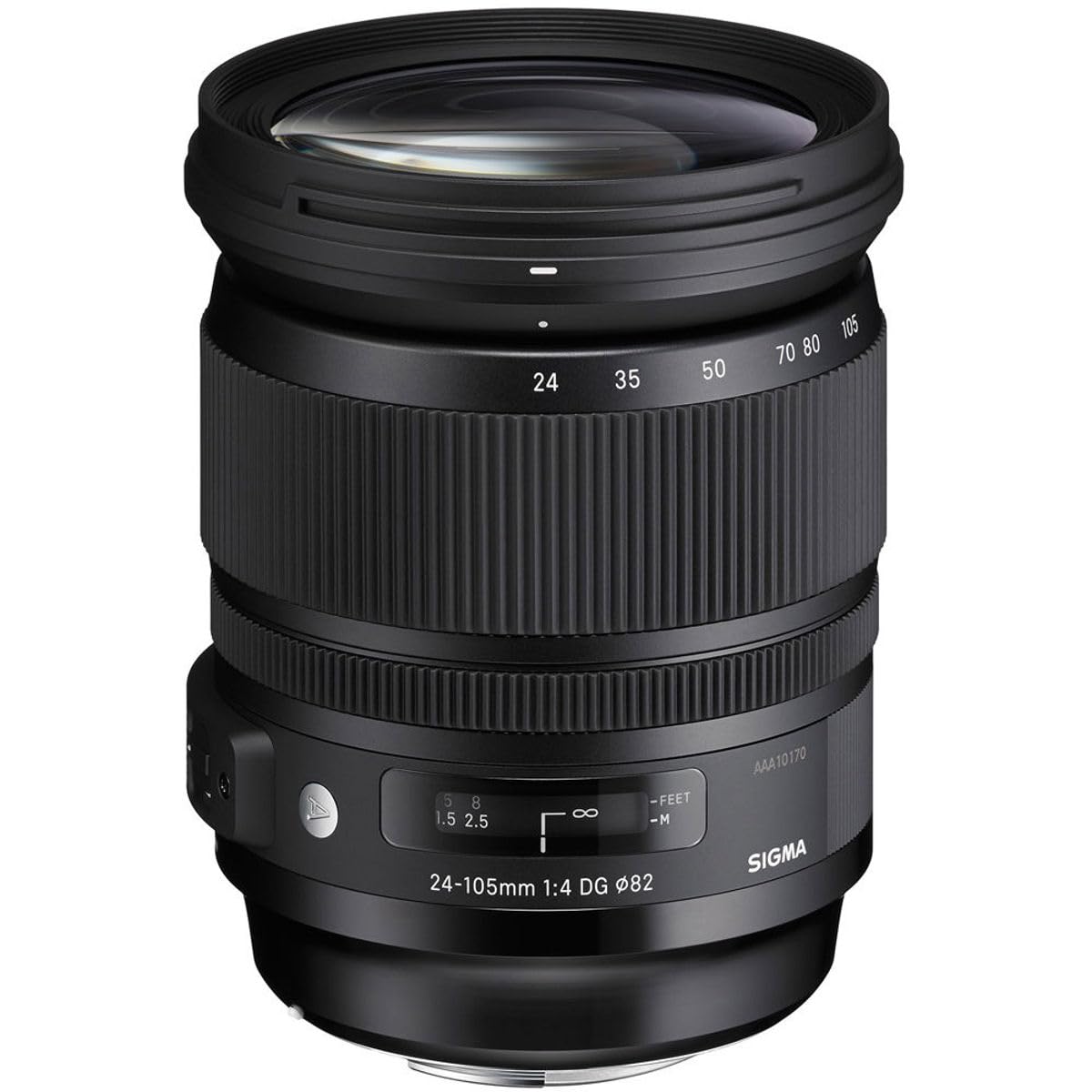
The only constant f/4 24-105mm for Nikon F-mount — an affordable Art-series lens you can also adapt to Sony E-mount later.
This Sigma is a pure mid-range value play for Nikon FX (full-frame) DSLR shooters who want a constant f/4 aperture without switching systems. It uses a ring-type ultrasonic motor (HSM — a Hyper Sonic Motor for fast, quiet autofocus), like the Canon USM lenses, and includes optical stabilization (OS) to steady your handheld shots at the telephoto end. The minimum focusing distance of 45cm (same as both Canon EF lenses) and a maximum magnification ratio of 1:4.6 give you respectable close-up ability, though not as tight as the Panasonic’s 0.5x macro.
The maker describes the lens as delivering “stable and fine image quality from wide to mid-telephoto range.” It is also MC-11 compatible, meaning it can be adapted to Sony E-mount bodies with full electronic communication if you ever switch systems. One spec to note: its fixed f/4 aperture and a good zoom ratio are kept “as high as possible” for the category, according to Sigma.
System flexibility: MC-11 compatibility means this Sigma can move to a Sony E-mount body later — a rare forward-compatibility feature for a Nikon F-mount lens.
Who it fits: Nikon FX DSLR owners who want an affordable constant-aperture standard zoom with optical stabilization and the reliable Art-series build — it is the only Nikon-mount f/4 24-105mm in this lineup.
One trade-off: At 0.45m minimum focus, it cannot match the Panasonic for close-up macro work, and the Sigma Art-series is heavier than a typical kit lens — plan for a steady carry.
Understanding the Specs
Constant f/4 Aperture
A constant f/4 aperture means the lens lets in the same amount of light whether you are zoomed out to 24mm or zoomed in to 105mm. That keeps your exposure steady during video recording and simplifies manual mode shooting — you do not have to compensate for a dimming viewfinder as you zoom.
Minimum Focus Distance
This is the closest distance between the lens and your subject where the lens can still focus. A shorter minimum focus distance (like the Panasonic’s 0.3m) lets you get physically closer to small objects — flowers, food, product details — turning a standard zoom into a pseudo-macro lens without buying a separate macro lens.
Image Stabilization (IS / OIS / OSS)
Image stabilization counteracts small hand movements during handheld shooting. Measured in “stops,” each stop of stabilization lets you shoot at a slower shutter speed while still getting sharp images. A 4-stop IS allows substantially slower handheld shutter speeds than an unstabilized shot in the same conditions.
Lens Coating (ASC / Nano AR)
Lens coatings are ultra-thin layers on the front glass that reduce reflections, flare, and ghosting when a bright light source (like the sun) is in or just outside the frame. Air Sphere Coating (Canon) and Nano AR Coating (Sony) are different technologies that achieve the same goal: cleaner, more contrasty images in backlit conditions.
FAQ
Is a 24-105mm f/4 lens good for portraits?
Will a Canon EF 24-105mm lens work on a Sony E-mount camera?
Which 24-105mm lens has the best close-up macro ability?
How much does image stabilization help on a 24-105mm lens?
Is the Canon 24-105mm f/4 L II worth the upgrade over the original?
Which 24-105mm lens is lightest for travel?
Can I use a 24-105mm lens for video?
What does “constant aperture” mean on a zoom lens?
Are 24-105mm lenses weather-sealed?
Which 24-105mm lens is best for Nikon DSLRs?
Final Thoughts: The Verdict
For most people, the best 24-105mm lens winner is the Sony FE 24-105mm f/4 G OSS because it combines class-leading sharpness, reliable optical stabilization, and a versatile zoom range in a package that Sony E-mount shooters call their daily driver. If you want close-up macro ability and the best stabilization in L-mount, grab the Panasonic LUMIX S 24-105mm f/4. And for Canon full-frame users on a budget, the standout is the original Canon EF 24-105mm f/4 L IS USM.
How We Picked
We do not accept paid placement. Every pick is matched to a real buyer and a real use-case; we do not hands-on test units.
Sources & Methodology
Specifications: manufacturer listings and product documentation. Review insights: verified customer reviews, as of July 2026. Pricing: not shown on this page (it changes often); check the current price via the retailer link.
As an Amazon Associate, Gadgets Feed earns from qualifying purchases. This does not affect which products we feature.
Product prices and availability are accurate as of the date/time indicated and are subject to change. Any price and availability information displayed on Amazon at the time of purchase will apply to the purchase of this product. As an Amazon Associate I earn from qualifying purchases.
CERTAIN CONTENT THAT APPEARS ON THIS SITE COMES FROM AMAZON. THIS CONTENT IS PROVIDED "AS IS" AND IS SUBJECT TO CHANGE OR REMOVAL AT ANY TIME.
Amazon and the Amazon logo are trademarks of Amazon.com, Inc. or its affiliates.