
Our readers keep the lights on and my morning glass full of iced black tea. As an Amazon Associate, I earn from qualifying purchases.
Specs are compiled from manufacturer listings and verified buyer reviews and can change over time — please confirm the key details on the product page before buying.
You want one lens that shoots a wide cityscape at sunrise and then zooms in on a distant mountain peak without you swapping glass. That is the idea behind a 24-200mm zoom. But the hard part is finding one that stays sharp across that whole range, stays light enough to carry all day, and fits the camera you already own. Pick the wrong one, and you get soft corners, slow autofocus, or a lens that makes your compact mirrorless body feel front-heavy.
I’m Min — the founder and writer behind Gadgets Feed. This guide is built by comparing the manufacturers’ published specifications and the patterns across verified customer reviews, so you get each pick’s real strengths and trade-offs instead of marketing spin.
Whether you are upgrading from a kit lens or building a travel kit around one do-everything piece of glass, the right 24 to 200mm lens handles portraits, landscapes, street scenes, and wildlife without ever making you stop and change your mind.
Our Picks at a Glance


How To Choose The Best 24-200mm Lens
Picking Picking the right lens for this range depends on matching it to your camera’s sensor size and your shooting style.. A Micro Four Thirds lens labeled “12-100mm” gives you the exact same 24-200mm field of view (the area the lens sees) as a full-frame Nikon Z 24-200mm — but the weight, aperture, and price are completely different. You also need to decide between a variable-aperture zoom (cheaper, lighter) and a constant f/4 (heavier, pricier, far more consistent in tricky light).
Know your mount first
Your camera’s lens mount (the physical ring that connects the lens to the body) is the only real constraint. If you shoot Nikon Z full-frame, you are looking at the NIKKOR Z 24-200mm VR. If you are in the Micro Four Thirds world (Olympus or OM SYSTEM bodies), the right lens is the M.Zuiko 12-100mm. Identify your camera mount, then choose the version that fits your budget and weather-sealing needs.
Decide on aperture: variable vs constant
A lens with a variable maximum aperture — like f/4-6.3 — lightens the load and keeps the price down. The trade-off is you lose light as you zoom in, meaning you need higher ISO (sensor sensitivity) or slower shutter speeds at 200mm to get a proper exposure, so your shots may blur or get grainy. A constant f/4 lens stays bright no matter where you are in the zoom range. That gives you consistent exposures and better low-light performance, but it adds significant weight and cost. If you shoot often in golden hour or indoors, the constant f/4 lens justifies the extra weight.
Check image stabilization
At 200mm, even slight camera shake produces blurry images. Choose a lens with built-in optical stabilization (VR for Nikon, IS for Olympus). This technology shifts an internal lens element to counteract hand shake, keeping your shot sharp. Pair that with in-body stabilization on your camera, and you can hand-hold at shutter speeds that used to demand a tripod. The OM SYSTEM 12-100mm PRO takes this further with 5-Axis Sync IS, which its owners describe as allowing handheld exposures of several seconds — This makes handheld long exposures practical for travel photography..
Quick Comparison
| Model | Best For | Focal Length | Weight | Filter Size | Amazon |
|---|---|---|---|---|---|
| Nikon NIKKOR Z 24-200mm VR★ Best Overall | Nikon Z full-frame all-rounder | 24-200mm | 1.3 lb | 67mm | Amazon |
| NIKKOR Z 24-200mm f/4-6.3 VR (Renewed)Budget Champ | Budget-friendly Nikon Z start | 24-200mm | 1.3 lb | 67mm | Amazon |
| Tamron 25-200mm F/2.8-5.6 G2 | Sony E-mount bright all-in-one | 25-200mm | 1.3 lb | 67mm | Amazon |
| OM SYSTEM 12-100mm F4.0 IS PRO | Latest OM body with IP53 sealing | 12-100mm (24-200mm eq.) | 1.2 lb | 72mm | Amazon |
| Canon RF 24-240mm F4-6.3 IS USM | Canon RF full-frame all-in-one | 24-240mm | 1.7 lb | 72mm | Amazon |
| Nikon Z5 II + 24-200mm Kit | Latest sensor & AF bundle | 24-200mm | — | 67mm | Amazon |
| Nikon Z5II Full Kit Bundle | All-in-one starter kit with accessories | 24-200mm | — | 67mm | Amazon |
In‑Depth Reviews
1. Nikon NIKKOR Z 24-200mm VR
Our pick — over 4.5★ from 450+ verified ratings; the strongest balance of quality and price.
The sharp, super-versatile super-zoom that makes a Z body feel like an entire kit.
This is the lens the crowd — over 450 owners — keeps coming back to. Sharpness tops the praise list here, and it is easy to see why: the 24-200mm range covers everything from sweeping landscapes to tight portraits, and the built-in Vibration Reduction (optical image stabilization built into the lens) keeps your handheld shots crisp at the long end. The 8.3x optical zoom leaves almost nothing unreachable, and the lens weighs just 1.3 pounds — light enough that it pairs perfectly with compact bodies like the Z5 II.
The trade-off is the variable aperture. At the wide end you get f/4, but zoom to 200mm and it closes down to f/6.3, meaning you need more light (or higher ISO) the farther you go. Buyers report that the autofocus is reliable but not the instant-lock you get from faster glass. Still, the review pages sum it up: “lightweight, well-balanced super-zoom for Z5 II.” With the ARNEO and Fluorine coatings cutting flare and fingerprints, this is the one-lens solution that actually delivers.
The Consensus
- Sharpest of the 24-200mm options, with 36 owners calling out sharpness by name
- Weighs 1.3 lb — easy to carry all day on a Z body
- VR stabilisation handles the 200mm reach without a tripod
The Caveat
- Variable f/4-6.3 aperture loses light as you zoom; not ideal for low-light interiors
- Manual focus is described as a bit tricky to get right
Best for: Nikon Z full-frame owners who want one lens for travel, portraits, and landscapes — especially if you prize sharpness over aperture speed.
Think twice if: You shoot in dim conditions often; a constant-aperture f/2.8 or f/4 lens will save you from pushing ISO too high.
2. NIKKOR Z 24-200mm f/4-6.3 VR (Renewed)
The same 24-200mm reach and VR for a fraction of the retail price.
If you are stepping into the Nikon Z system on a tighter budget, the renewed version of this lens gets you 100% of the optical formula — the same Aspherical and ED Glass elements, the same ARNEO and Fluorine coatings, the same built-in Vibration Reduction — at a noticeably lower entry point. It weighs the same 1.3 pounds and uses the same 67mm filter thread, so all your existing accessories fit. Owners mention it “works as well as a new one for a fraction of the price.”
There is a missing-lens-hood risk in the renewed channel (one buyer had to order a separate hood), and it lacks the bite of Nikon’s S-line sharpness at the pixel level — one owner noted it is “ok for your average consumer but unacceptable for a pro photographer.” The autofocus hunts occasionally, which is inline with the variable-aperture design. But for daily travel and vacation shoots, the owner pages say the results are gorgeous and the convenience of not carrying multiple lenses wins every time.
The real-world trade: You lose the new-in-box lens hood gamble, but you get the same optical stabilisation and zoom range that makes the 24-200mm VR a travel legend. If you need pro-grade edge-to-edge sharpness, look at the S-line primes; if you need one capable zoom that leaves money for a tripod or an extra battery, this is your path.
Reach for this if: You are building a Z kit on a budget and need the 24-200mm reach without paying new retail.
Look elsewhere if: You require guaranteed peak sharpness for professional printing — the S-line zooms or primes will serve you better.
3. Tamron 25-200mm F/2.8-5.6 Di III VXD G2
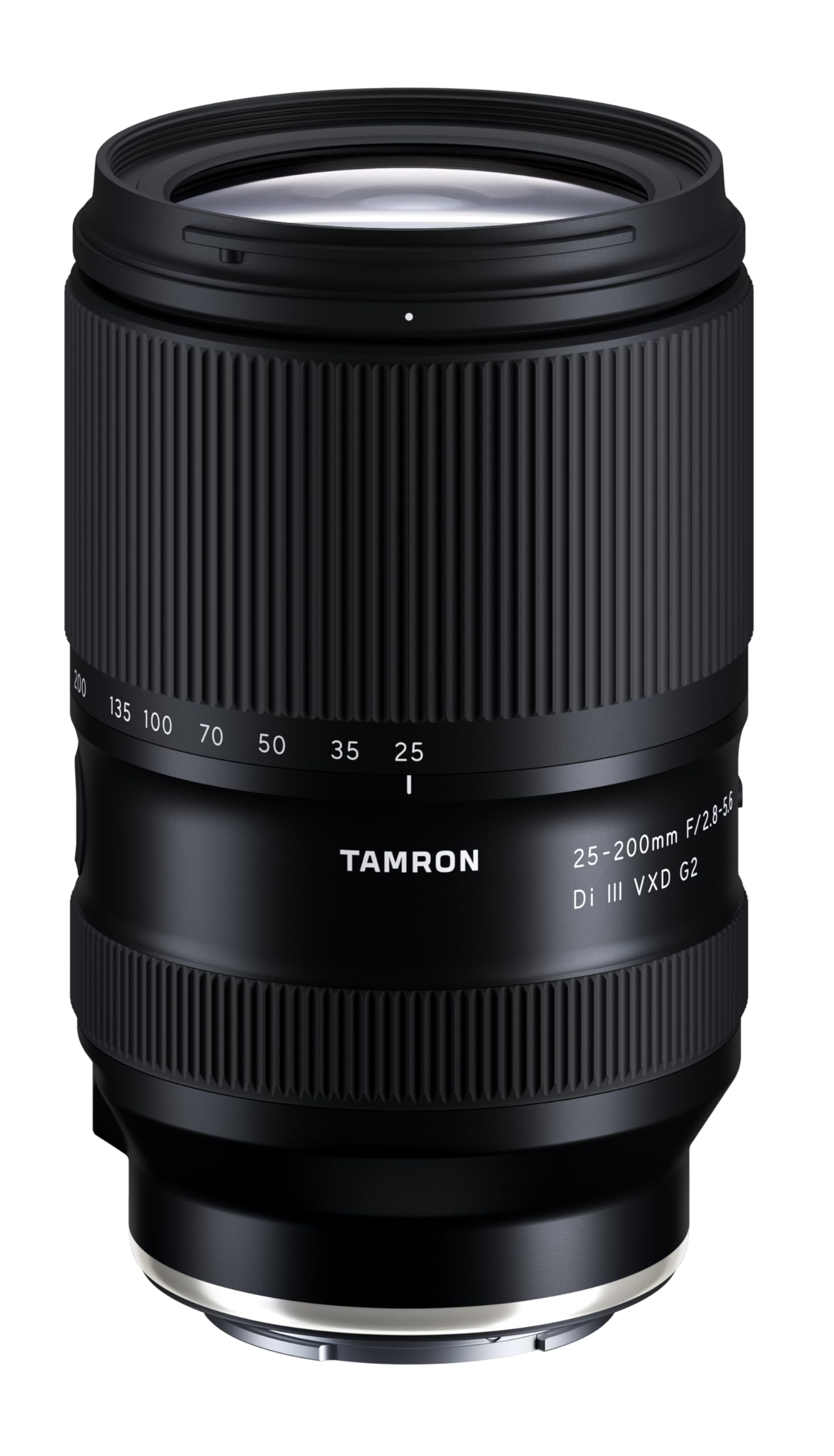
The Sony E-mount answer to this range — an 8x all-in-one that opens to f/2.8 at the wide end.
If you shoot Sony rather than Nikon, this is the closest thing to a 24-200mm in the E-mount catalogue. Tamron’s second-generation all-in-one covers 25-200mm — an 8x zoom ratio — and starts at f/2.8, a full stop and a half brighter at the wide end than the variable f/4-6.3 designs. The optical formula runs 18 elements in 14 groups with a 9-blade circular diaphragm, and Tamron’s VXD linear-motor autofocus is aimed squarely at moving subjects: the brand pitches it for sports, kids, and pets in motion.
The other headline is close focus. Minimum focus distance is 0.16m with 1:1.9 maximum magnification, which puts genuine half-macro work inside a walk-around zoom — flowers, food, product detail — without swapping glass. It weighs 1.3 lb and takes 67mm filters, the same thread as the Nikon 24-200mm, and it carries a 6-year limited USA warranty through authorised Tamron dealers. Note the lens itself has no optical stabilisation, so you are relying on your Sony body’s IBIS. Rated 4.5 stars across 21 ratings on Amazon at the time of writing.
Where It Shines
- f/2.8 at the wide end — brighter than any variable f/4-6.3 superzoom here
- 1:1.9 maximum magnification at 0.16m for half-macro close-ups
- VXD linear-motor AF built for sports, kids, and pets in motion
- 1.3 lb with a 67mm filter thread and a 6-year USA warranty
The Heft
- No optical stabilisation in the lens — you need a Sony body with IBIS
- Starts at 25mm, so it is marginally tighter than a true 24mm at the wide end
- Sony E-mount only; no Nikon Z, Canon RF, or MFT version
Best for: Sony full-frame and APS-C shooters who want one lens for the whole 25-200mm span and value a bright wide end plus close-focus ability.
Think twice if: Your Sony body has no in-body stabilisation — without IBIS there is nothing steadying the long end.
4. OM SYSTEM M.Zuiko Digital ED 12-100mm F4.0 IS PRO

The same PRO formula with an IP53 weather rating — built for the harshest travel conditions.
This is essentially the same 12-100mm f/4 PRO lens as the Olympus above, but in the OM SYSTEM branding with an IP53 weather-sealing rating (meaning dust-protected and water-jet resistant). That makes it the most rugged 24-200mm-equivalent zoom you can buy. It still delivers the same 24-200mm field of view, the same constant f/4 aperture, and the same Sync IS that lets owners hand-hold at 15-second exposures at the wide end. Performance is the most-praised aspect here, with travel-friendly close behind.
This version comes in at 1.2 pounds. Owners notice it, calling the lens “large and heavy for MFT, approaching full-frame size.” The f/4 aperture also means you are trading low-light capability for reach; at 100mm (200mm equivalent), you will need higher ISO indoors. But for a single travel zoom that covers 95% of shooting scenarios, the owner consensus is clear: it is a “perfectly fabulous lens for traveling around the world.”
Sharp all the way: Reviewers point out corner-to-corner sharpness on the OM-1 Mark II, and the close-focus capability approaches macro territory. The trade-off is 1.2 lb on a Micro Four Thirds body — but it packs IP53 weather protection and Sync IS that no other 24-200mm reach lens can match.
Reach for this if: You shoot in serious weather — dust, rain, salt spray — and need the most rugged 24-200mm-equivalent lens on the market.
Look elsewhere if: Weight is your primary concern; a variable-aperture superzoom such as the Nikon 24-200mm VR is lighter and cheaper, though it gives up the constant f/4.
5. Canon RF 24-240mm F4-6.3 IS USM

Canon’s RF take on the do-everything zoom — same 24mm start, 40mm more reach at the top.
Canon RF shooters cannot mount the Nikon Z 24-200mm, and this is the lens that fills the same slot on an EOS R body. It starts at the same 24mm wide angle and runs all the way to 240mm — a 10x range rather than 8.3x — at a matching f/4-6.3 variable aperture. Optical image stabilisation is rated up to 5 stops of shake correction, and it is the first Canon lens to bring Dynamic IS to full-frame bodies, which matters if you hand-hold video while walking.
Autofocus is Nano USM, Canon’s hybrid motor that is quick for stills and smooth and near-silent for video pulls. It weighs 1.7 lb and uses 72mm filters, so it is heavier and wider at the front than the Nikon. Canon lists compatibility with its full-frame mirrorless bodies including the EOS R, RP, R5, and R6. On Amazon it holds a 4.7-star rating from 265 ratings, the strongest review consensus of any lens in this guide.
The Combo Strength
- 24-240mm covers the full 24-200mm span and then some — a 10x range
- Optical IS rated to 5 stops, plus Dynamic IS for hand-held walking video
- Nano USM autofocus is fast for stills and quiet for video
- 4.7 stars across 265 Amazon ratings
The Weak Spot
- 1.7 lb — the heaviest all-in-one zoom on this list
- 72mm filter thread means a separate, pricier filter set from the 67mm lenses
- Canon RF mount only, and it lists as full-frame mirrorless compatible
Best for: Canon EOS R owners who want one travel lens that starts wide at 24mm and reaches past 200mm without a bag change.
Think twice if: You count grams — this is heavier than the Nikon and Tamron alternatives, and the extra 40mm costs you that weight.
6. Nikon Z5 II with Telephoto Zoom Lens (24-200mm Kit)
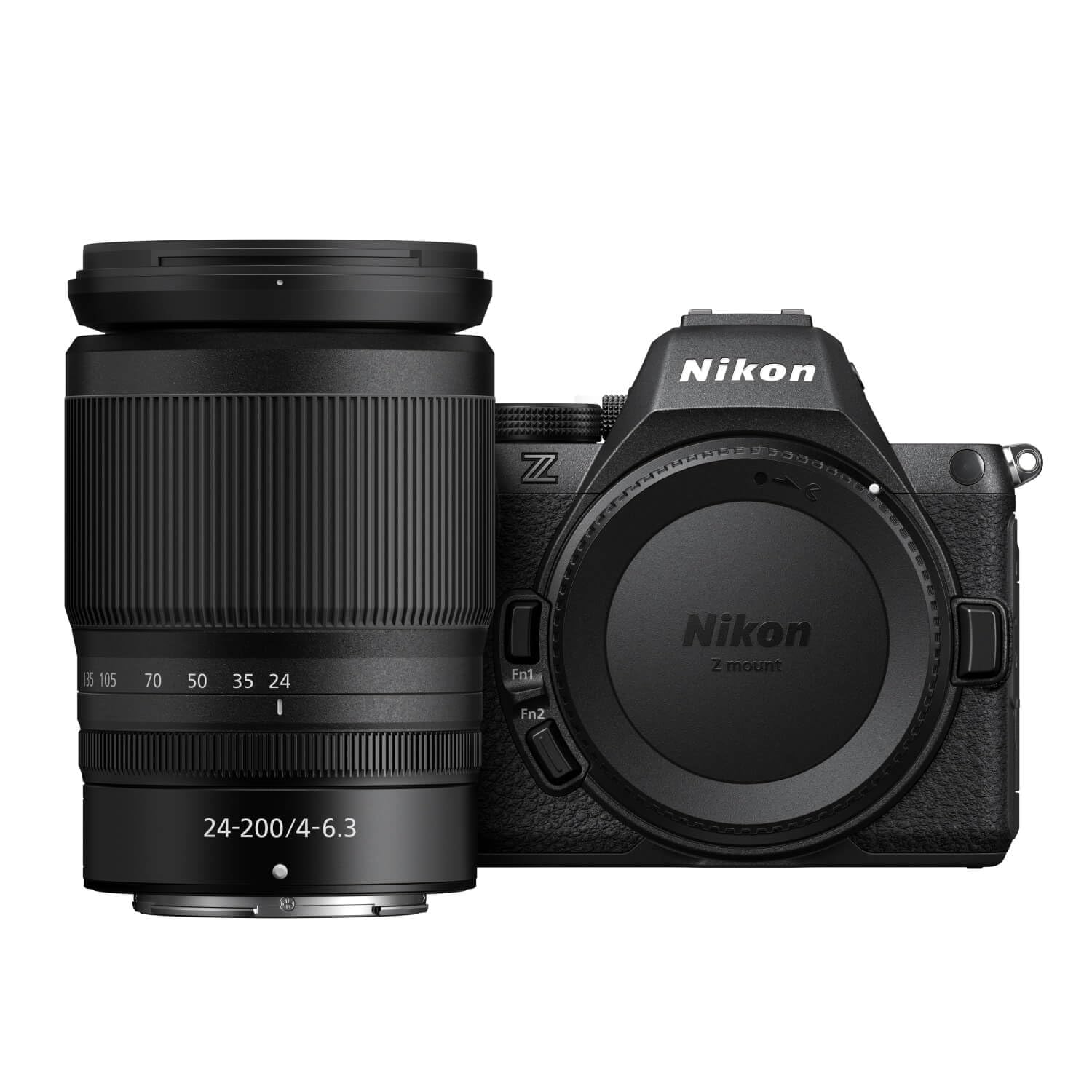
A 24.5MP BSI sensor and EXPEED 7 — speed and low-light detection that outpaces its predecessor.
The Z5 II upgrades to a 24.5MP backside-illuminated sensor (BSI-CMOS) and the EXPEED 7 processing engine, open up continuous shooting at 30 frames per second and autofocus detection down to -10 EV — meaning it can lock focus in conditions so dark you cannot see the subject with your naked eye. The kit bundles the same 24-200mm f/4-6.3 VR lens, but the body itself handles 9 subject types (people, birds, dogs, cats, cars, motorcycles, bicycles, trains, airplanes). The bright EVF hits 3000 nits, making outdoor shooting comfortable.
There is a clear split in the owner feedback. The camera itself gets high marks: “very fine and detailed images and video, convenient control layout, very fast and accurate auto focus.” But the 24-200mm kit lens gets a strong negative reaction from some — one owner says it “stinks” compared to third-party glass and plans to return the kit for the body alone. If you are buying the Z5 II for its advanced AF and speed, the 24-200mm lens is a capable travel companion but not the optical quality the body deserves. Consider it a starter lens that you upgrade later.
The split reality: Owners love the Z5 II body — the 30fps burst rate, the -10 EV AF, the 5-axis IBIS with up to 7.5 stops of shake reduction. But the 24-200mm kit lens is where the compromise lives; one owner calls it a “bad lens” and is swapping it for a Tamron 28-75mm f/2.8 G2. Buy this kit for the body, treat the lens as a get-started zoom.
Reach for this if: You want the newest Z5 II body — with its 30fps, -10EV AF, and 4K/60p N-RAW video — and need any 24-200mm lens to get started.
Look elsewhere if: You demand pro-level edge-to-edge sharpness in your kit lens; buy the body-only and pair it with an S-line or third-party zoom.
7. Nikon Z5II Full-Frame Kit with 24-200mm Lens Bundle
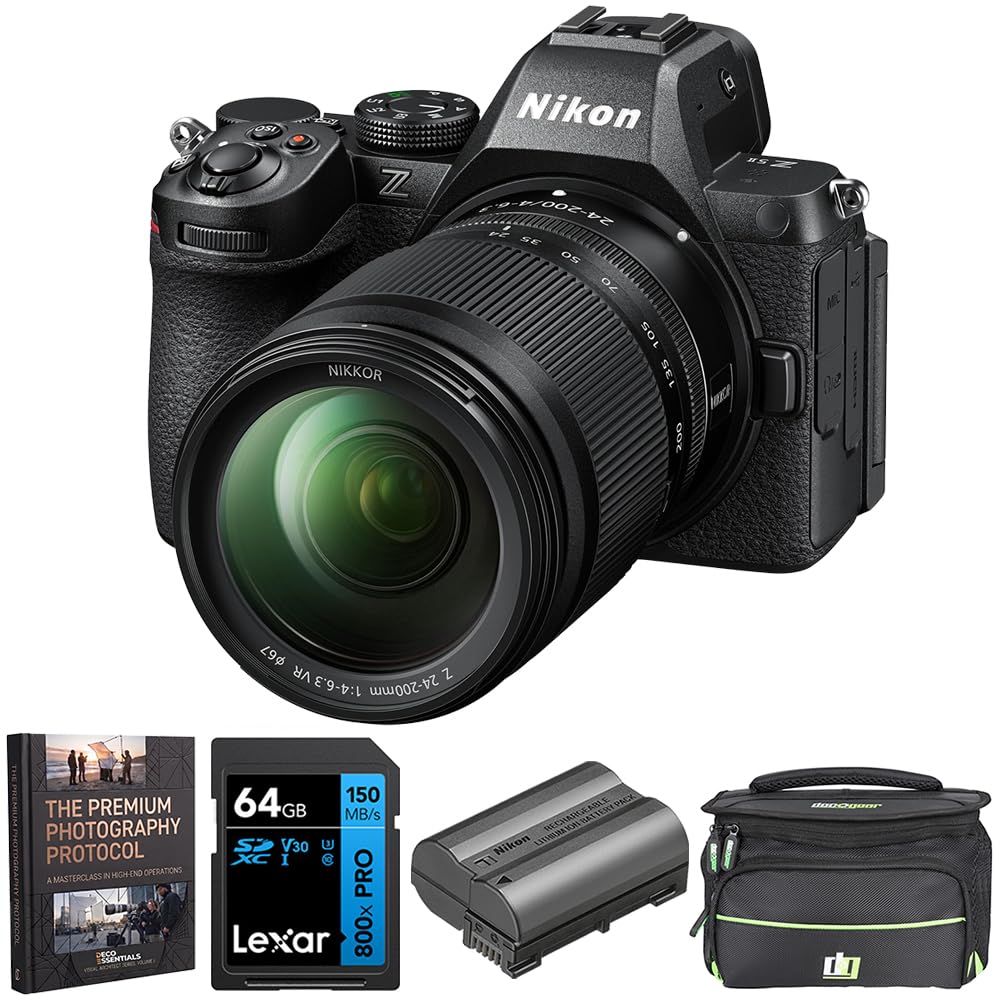
The Z5II body, the 24-200mm lens, plus a bag, extra battery, and SD card — everything you need in one box.
This bundle takes the Z5II kit and adds a Lexar 64GB SDXC memory card, a second EN-EL15 rechargeable battery, a Deco Photo camera bag, and a photography guidebook. The Z5II body itself delivers a 24.5MP FX-format sensor, EXPEED 7, 30fps continuous shooting, and 5-axis in-body stabilization. The lens is the same NIKKOR Z 24-200mm f/4-6.3 VR — a versatile walk-around zoom with optical stabilisation and weather sealing. For someone migrating from a DSLR like the D7100, the review pages say this is an “excellent upgrade: full-frame, smaller, lighter, quieter.”
The bundle accessories have a mixed reputation. One owner says the tripod in the bundle “broke immediately” — the ball head could not tighten enough, and the base snapped off under the Z5’s weight. The bag and extra battery are functional, but the tripod is best considered a temporary item. The core camera-and-lens combo, however, is what you are paying for. Owners consistently praise the image quality and autofocus performance, noting that the in-body stabilisation reduces shake by “up to 5 stops” even with unstabilized F-mount lenses (via the FTZ adapter).
Starter bundle, real camera: The Z5II and 24-200mm lens are the heart of this package — exceptional value for a full-frame travel kit. The extra battery and bag are genuine additions; the tripod is disposable. If you need everything on day one, this saves a separate accessory purchase.
Best for: DSLR upgraders who want the latest Z5II body plus every starter accessory — battery, bag, memory card — in a single purchase.
Think twice if: You already own a bag, extra batteries, or SD cards; the accessories are budget-level and you may be paying for items you do not need.
Understanding the Specs
Variable vs Constant Aperture
A lens with a variable aperture, like f/4-6.3, changes its maximum opening as you zoom. At 24mm you get f/4, which lets in a good amount of light; at 200mm it drops to f/6.3, meaning you need more light or a higher ISO setting to get the same exposure, so your shots may blur or get grainy. A constant aperture lens (like f/4 across the entire zoom range) gives you consistent exposure no matter where you are in the zoom — ideal for video shooting and low-light work, but typically heavier and more expensive.
Image Stabilisation (VR / IS)
Optical stabilisation built into the lens — called VR by Nikon, IS by Olympus — physically moves one of the internal lens elements to counteract your hand shake. It makes a huge difference at the 200mm end, where any jitter is magnified so your subject stays sharp. The OM SYSTEM 12-100mm PRO adds Sync IS, which combines the lens stabilisation with the camera’s in-body stabilisation for even longer handheld exposures — some shoppers say sharp shots at 2-4 seconds.
Weather Sealing (IP Ratings)
Weather sealing uses rubber gaskets at every joint and switch to keep dust and moisture out of the lens barrel. The OM SYSTEM 12-100mm PRO carries an IP53 rating, meaning it is dust-protected and can withstand water jets (think rain or spray). A sealed lens is worth the extra cost if you shoot in coastal spray, dusty deserts, or drizzly forests.
Filter Thread Size
The filter thread size — 67mm on the Nikon 24-200mm options, 72mm on the Micro Four Thirds PRO lenses — tells you what diameter of screw-on filter (UV, polariser, ND) the front of the lens accepts. A 67mm filter is more common and generally cheaper. If you own several lenses with different thread sizes, consider buying step-up rings so you can use one set of filters across all your glass.
FAQ
Will a 24-200mm lens work on my camera?
Is a 12-100mm lens actually a 24-200mm lens?
What does VR mean on a Nikon lens?
Is a constant f/4 lens worth the extra weight?
How long does a camera lens last?
Can I use a 24-200mm lens for portraits?
Are renewed or refurbished lenses reliable?
What is the 24-200mm range good for in real life?
Do I need a lens hood for a 24-200mm lens?
Is there a 24-200mm lens for Sony or Canon?
Final Thoughts: The Verdict
For most people, the 24 to 200mm lens winner is the Nikon NIKKOR Z 24-200mm VR because it delivers genuine sharpness across an 8.3x zoom range at a weight that does not punish your shoulder — the most-owners-satisfied choice in the full-frame camp. If you shoot Sony E-mount, the Tamron 25-200mm F/2.8-5.6 Di III VXD G2 is the all-in-one that covers the same span with an f/2.8 wide end and 1:1.9 close-focus. And for the tightest budget, the renewed-niche NIKKOR Z 24-200mm f/4-6.3 VR (Renewed) gives you the same optical formula and VR at a friendlier entry point — just bring your own lens hood.
How We Picked
We do not accept paid placement. Every pick is matched to a real buyer and a real use-case; we do not hands-on test units.
Sources & Methodology
Specifications: manufacturer listings and product documentation. Review insights: verified customer reviews, as of July 2026. Pricing: not shown on this page (it changes often); check the current price via the retailer link.
As an Amazon Associate, Gadgets Feed earns from qualifying purchases. This does not affect which products we feature.