
Our readers keep the lights on and my morning glass full of iced black tea. As an Amazon Associate, I earn from qualifying purchases.
Specs are compiled from manufacturer listings and verified buyer reviews and can change over time — please confirm the key details on the product page before buying.
Need a 24-volt lithium battery that can actually run your trolling motor all day, keep your RV powered, or handle a solar setup — without the massive weight of lead-acid? The problem is that not all 24V lithium batteries are built the same. Things like the chemistry, the BMS (the battery management system — the internal safety computer that prevents damage), and the real usable capacity vary a lot between models. This guide looks at five top options and matches each to a real use case so you can pick the one that fits your gear.
I’m Min, the founder of Gadgets Feed. This guide compares the manufacturers’ published specs and patterns from verified customer reviews. You get each pick’s real strengths and trade-offs, not marketing spin.
Here are the best 24 volt lithium battery options on the market, chosen for real-world use in trolling motors, RVs, and off-grid systems.
Quick Picks
- Elefast 24V 100Ah LiFePO4 Battery — Best Overall
- Power Queen 24V 50Ah LiFePO4 Battery with Bluetooth — Smart Choice
- LiTime 24V 50Ah Bluetooth LiFePO4 Battery — Cold-Weather King
- Dumfume 24V 100Ah LiFePO4 Battery — Budget 100Ah
- XZNY Compact 24V 100Ah LiFePO4 Battery — Compact Power
How To Choose The Best 24 Volt Lithium Battery
To pick the right 24V lithium battery, you need to match how much power you use (your amp draw) with the battery’s capacity and its protection features. Here is what matters most for a trolling motor, RV, or solar system.
Capacity (Ah) and Your Motor’s Thrust
Amp-hours (Ah) tell you how long the battery will last before you need to recharge it. A 50Ah battery might give you a half-day of fishing for a 70-100 lb thrust trolling motor, while a 100Ah battery can power through a full day with two people on board. More Ah also means more weight and a higher upfront cost, so your choice depends on how long you need to stay out.
BMS and Low-Temperature Protection
The BMS (battery management system) is the safety computer inside the battery. It prevents overcharging, over-discharging, and short circuits. If you fish in cold weather, you specifically want low-temperature protection. This feature stops the battery from charging below 32°F (0°C), which would permanently damage the lithium cells. Without it, ice fishing or winter camping can ruin the battery in one charge cycle.
Quick Comparison
On smaller screens, swipe sideways to see the full table.
| Model | Best For | Capacity (Ah) | Max Discharge Current | Weight | Amazon |
|---|---|---|---|---|---|
| Elefast 24V 100Ah | Heavy‑duty trolling/ solar | 100Ah | 100A | 42.5 lbs | $339.99Amazon |
| Power Queen 24V 50Ah | Mid‑range Bluetooth monitoring | 50Ah | 50A | 21.6 lbs | $319.99Amazon |
| LiTime 24V 50Ah | Cold‑weather fishing | 50Ah | 50A | 13.3 lbs | $349.99Amazon |
| Dumfume 24V 100Ah | Budget 100Ah for solar | 100Ah | 100A | 48.1 lbs | $357.86$383.96Amazon |
| XZNY Compact 24V 100Ah | Tight‑space installs | 100Ah | 100A | 41 lbs | $379.99Amazon |
In‑Depth Reviews
1. Elefast 24V 100Ah LiFePO4 Battery

The workhorse that keeps a pontoon boat trolling for four hours with two people aboard.
You want this battery when you need maximum run time without extra features. Its 100Ah capacity gives you 100Ah versus the Power Queen 50Ah’s 50Ah. The built-in 100A BMS (the internal safety computer) also handles a 300A inrush surge, so your motor starts smoothly under heavy load. Buyers report trolling for 4 hours with 2 people on the boat and still having plenty of charge left. Bass boat owners who replaced two 12V batteries also say it “runs all day.”
At 42.5 pounds, it is heavier than the 50Ah options. That weight buys you the energy to power a 22-foot pontoon or an RV solar bank. The A+ grade cells and the maker’s claim of 20,000+ deep cycles suggest serious longevity, but there is no Bluetooth — you cannot see the charge level on your phone, so you rely on the voltage reading. It also needs a dedicated 29.2V 20A lithium charger; a standard 12V auto-sensing charger will not work. Compared to the Dumfume 100Ah, the Elefast weighs 42.5 lbs versus the Dumfume’s 48.1 lbs at the same 100Ah capacity and 100A discharge current, but the Dumfume claims a 10-year lifespan for a slightly higher price.
One thing to know: the battery has no physical on/off switch. Like many large LiFePO4 packs, it can arrive in “sleep” mode. A quick charge with the correct 24V lithium charger (28-29V) wakes it up. If you want a simple, high-capacity pack for serious trolling or off-grid power and do not need a smartphone app, this is your battery.
What you gain
- Massive 100Ah capacity for full-day runs
- 100A BMS with 300A peak surge handles motor startup
- Replaces two 12V batteries, saving 110 lbs of boat weight
The trade-offs
- No Bluetooth — you cannot check charge from your phone
- Heavier and bulkier than 50Ah models at 42.5 lbs
- Requires a specific 24V lithium charger to wake from sleep
Reach for this if: you need the most capacity for long days on the water or a serious solar bank and you do not mind carrying 42.5 lbs.
Look elsewhere if: you want app-based battery monitoring or need a lighter pack for a kayak.
2. Power Queen 24V 50Ah LiFePO4 Battery with Bluetooth
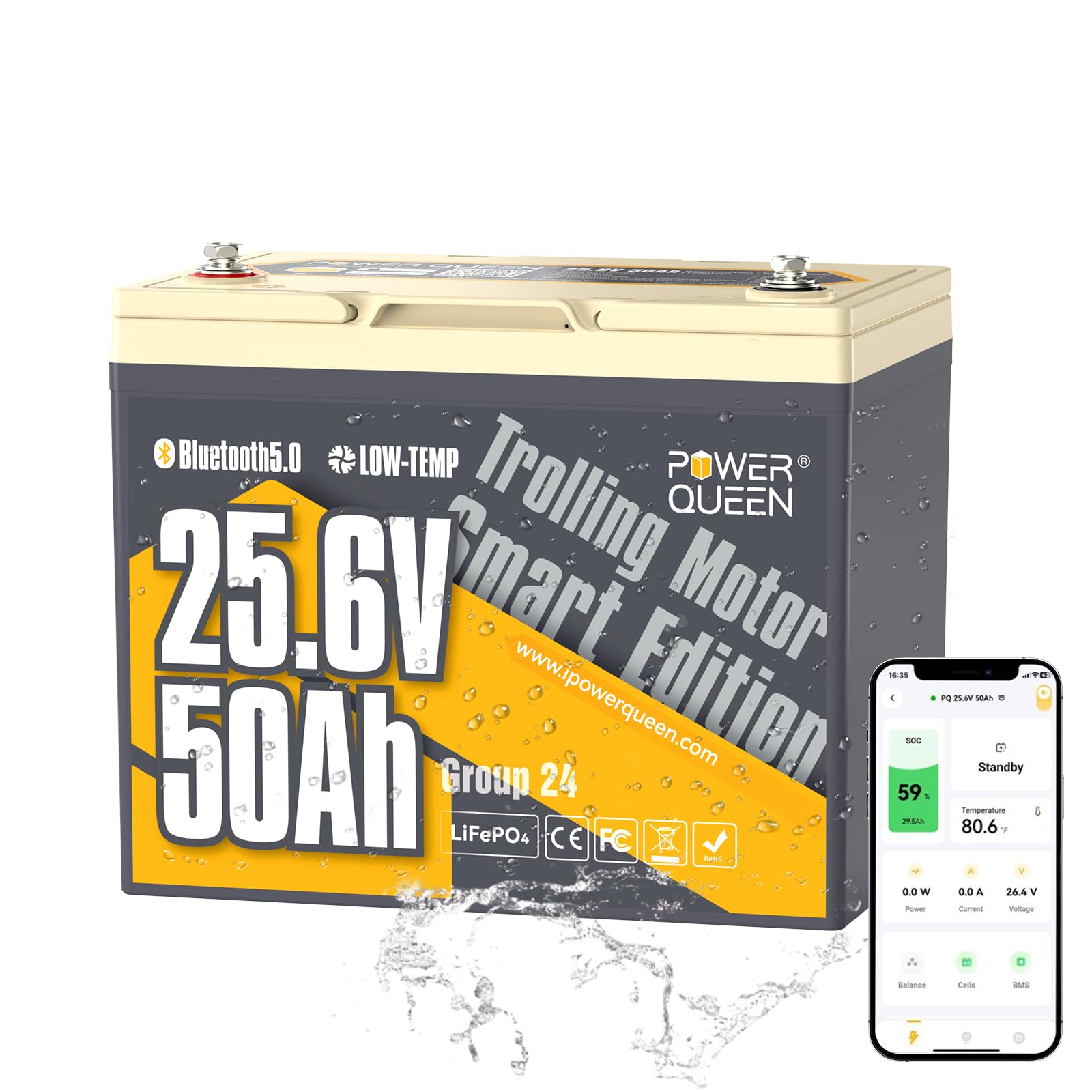
The light, smart battery that still had 82% power after four hours of hard trolling.
You get app-based monitoring at a 50Ah capacity without paying 100Ah prices. At 21.6 pounds, this is 21.6 pounds versus the Elefast 100Ah at 42.5 pounds. One reviewer noted running a Minn Kota 24V 80lb Terrova for over 4 hours of hard use and still seeing 82% power on the app. After 7 hours of fishing, the battery still had not fully drained — a real-world result that shows a 50Ah can handle serious half-day trips. The Bluetooth 5.0 app shows you the state of charge and voltage from 10 meters away. Its IP65 rating (meaning it is protected against water jets and dust) means a splash on the deck is no worry.
The downside: the BMS ships in sleep mode at zero volts. Many owners mention that a standard 12/24V auto-sensing charger will not wake it. You need a charger that delivers 25+ volts or a momentary connection to two 12V batteries in series. Once awake, it charges normally and the app works perfectly. The included ABS casing and M8 terminals make installation easy in a boat, kayak, or solar system. With a 5-year warranty and 4000+ deep cycles, this is a cost-effective way to get smart monitoring in a 24V system.
Compared to the LiTime 50Ah, the Power Queen matches its 1280Wh energy and 50A continuous discharge current but uses an IP65-rated ABS casing instead of LiTime’s Group 24 form factor. The biggest deciding factor may be the wake-up process: several buyer reviews flagged the sleep-mode issue as the main frustration, so plan ahead with a compatible charger.
Standout strengths
- Bluetooth app gives real-time SOC and voltage from 10 meters away
- At 21.6 lbs, it is easy to move and install
- IP65 water and dust resistance for marine use
What to watch
- Ships in sleep mode — needs a 25V+ charger or series jump to wake
- 50Ah may not be enough for a full day with two anglers
- No physical on/off switch, so storage sleep could be a concern
Best for: kayak or solo-boat anglers who want smartphone monitoring and can manage the wake-up process.
skip it if: you want a plug-and-play experience without any sleep-mode hassle.
3. LiTime 24V 50Ah Bluetooth LiFePO4 Battery
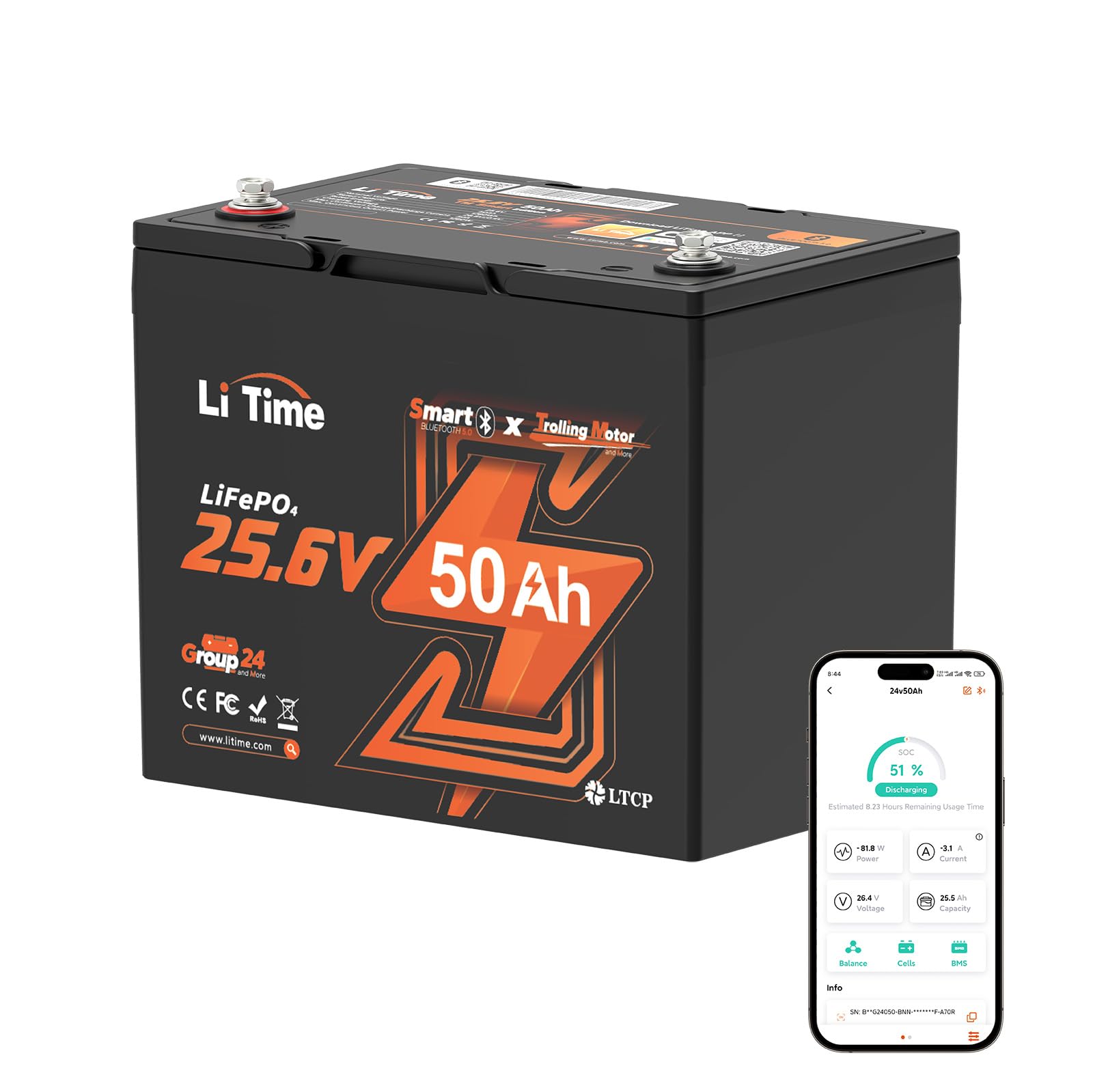
The ice-fishing specialist that automatically stops charging below freezing to protect the cells.
If you fish in cold weather, the LiTime 50Ah has the low-temperature protection you need. It stops discharging below -4°F (-20°C) and stops charging below 32°F (0°C), then resumes only when temperatures rise above 41°F (5°C). This prevents the permanent lithium damage that happens if you try to charge a frozen battery. Customers note it works great with an 80 lb thrust trolling motor on rivers, and one buyer mentioned that a single 50Ah battery easily gets through a half-day of fishing. The Bluetooth 5.0 app mirrors the Power Queen’s — you monitor the state of charge and voltage from your phone.
At just 13.3 pounds (6.05 kg), this is the lightest 50Ah battery here at 13.3 pounds versus the Power Queen at 21.6 pounds. Its Group 24 dimensions (10.24 x 6.61 x 8.27 inches) fit standard battery trays. The 4,000+ cycles at 100% DoD (depth of discharge — meaning you drain it completely each time) and 15,000 cycles at 60% DoD offer serious longevity for regular use. Customer support gets high marks: one buyer whose battery failed after a year got a prepaid overnight return label and a replacement immediately. The 5-year warranty backs it up.
The catch: like the Power Queen, this battery ships in a low-voltage state. It needs a wake-up charge from a dedicated 24V LiFePO4 charger — a 12/24V auto-sensing charger will not work. Also, the 50Ah capacity is fine for half-day trips but may fall short for full-day use with high-draw motors. If you mostly fish in warm weather, the Power Queen’s IP65 casing might be a better fit for wet conditions.
Why it stands out
- True low-temperature protection for ice fishing and cold climates
- Lightest at 13.3 lbs — easy to carry and install
- Excellent customer service with prepaid overnight replacements
Consider these
- Ships in sleep mode — needs a 24V lithium charger to wake
- 50Ah provides half-day runtime; may need a second for all-day use
- No IP65 rating, so less splash-resistant than the Power Queen
Perfect for: ice anglers and cold-weather campers who need a battery that protects itself in freezing temperatures.
Not for: anyone who expects a plug-and-play experience without a dedicated lithium charger.
4. Dumfume 24V 100Ah LiFePO4 Battery
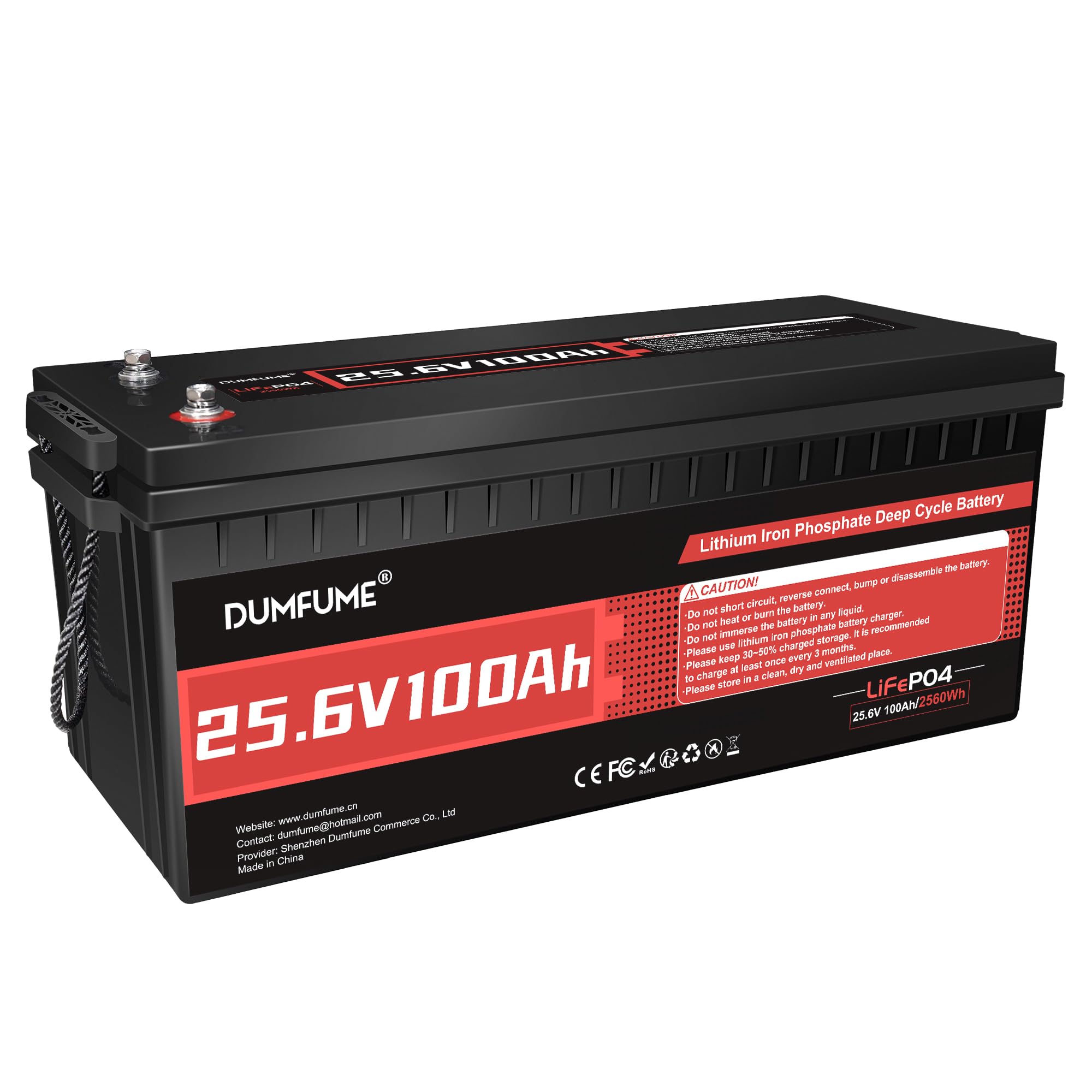
A no-frills 100Ah pack that delivers 2.56kWh of energy storage at a reasonable entry price.
You choose this battery when you need 100Ah capacity for a solar system or backup power and do not want to pay for Bluetooth or a fancy case. The Dumfume outputs a continuous 2560W, and its 100A BMS protects against overcharge, over-discharge, and short circuits. One owner reported that all four 150Ah units they bought exceeded capacity by about 7Ah. The build quality gets praise — ring terminals, foam padding, and silicone adhesive — although one unit arrived dead on arrival and was replaced quickly by the seller.
There are two big caveats. First, one review said Amazon-sourced units arrived at low voltage (12.2–12.4V) and needed a “jump” charge from another battery to wake up. Second, the warranty is only valid for direct purchases from Dumfume, not Amazon, so buying through the marketplace might leave you without support. The battery weighs 48.1 lbs and measures 20.91 x 8.11 x 8.56 inches, making it the largest and heaviest 100Ah here. Its claimed 10-year lifespan and 4000+ cycles at 100% DoD are competitive, but the odd size may need a custom enclosure.
Compared to the Elefast 100Ah, the Dumfume weighs 48.1 lbs versus 42.5 lbs and is slightly larger, with a similar 100A BMS. The Elefast claims 20,000+ deep cycles versus Dumfume’s 4,000+, but both carry a 5-year manufacturer warranty. If the price difference matters to you, the Dumfume is a solid workhorse — just make sure you can handle the sleep-mode wake-up and understand the warranty terms before buying.
What you get
- 2560W continuous output — enough for most inverters and solar setups
- Internal build quality uses ring terminals and foam padding
- 10-year lifespan with 4000+ cycles at 100% DoD
Trade-offs
- Warranty applies only to direct purchases, not Amazon orders
- Frequent sleep-mode arrivals — may need a jump to wake
- Largest and heaviest at 48.1 lbs with unusual dimensions
Grab it if: you need the raw capacity for the lowest cost, have a compatible charger ready, and buy directly from Dumfume for warranty protection.
Pass if: you want Bluetooth monitoring or cannot accommodate the large 20.9-inch length.
5. XZNY Compact 24V 100Ah LiFePO4 Battery
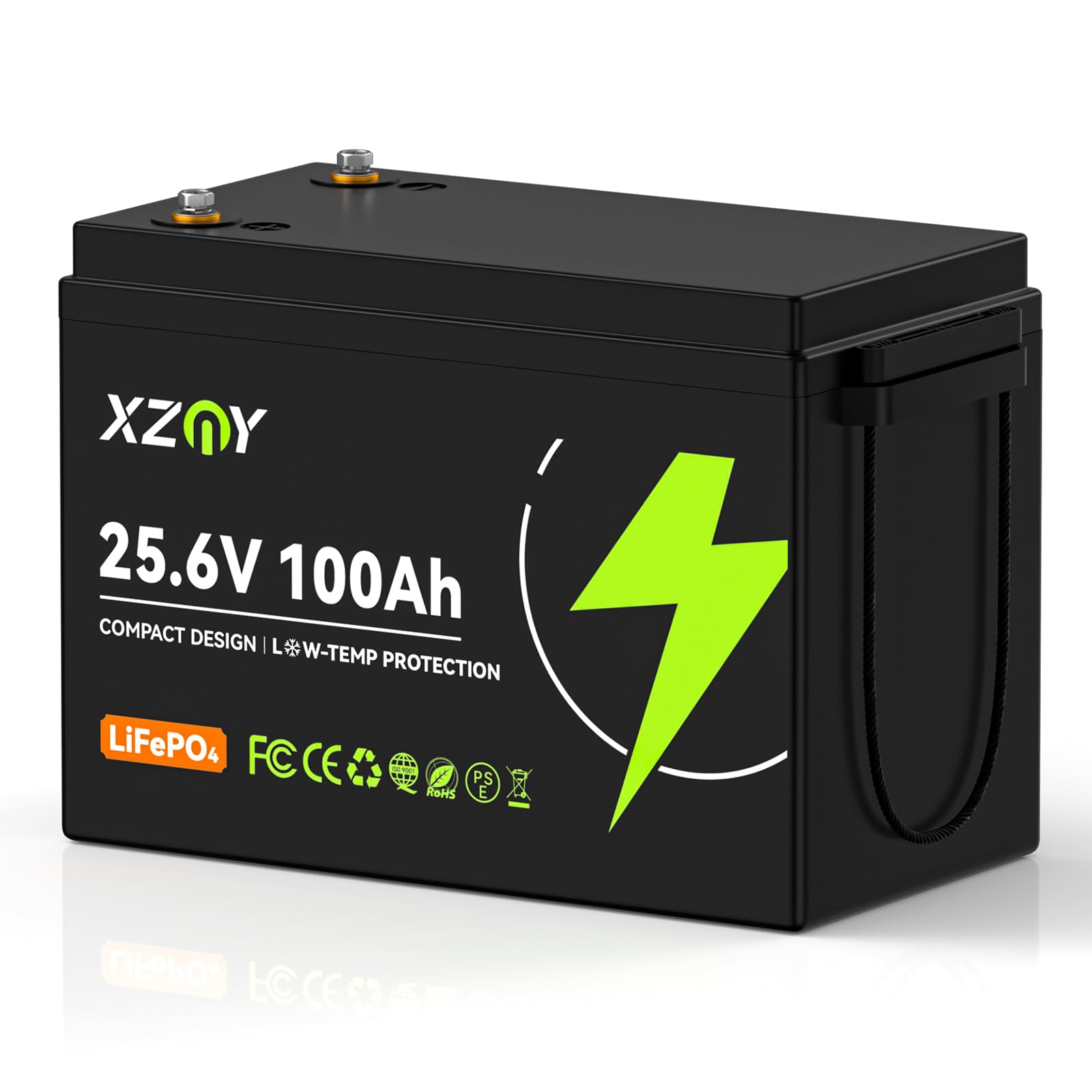
The 100Ah battery built for tight compartments.
If space is tight, the XZNY Compact is built for it. At 41 pounds and measuring 13.59 x 7.48 x 9.65 inches, it still delivers 2560W of output and a 100A continuous discharge. The 100A BMS includes low-temperature protection, and the A-grade LiFePO4 cells claim a 10-year lifespan with 5000 cycles. Buyer feedback is positive: it powers a Garmin 93sv fish finder all day and holds charge above 12V consistently. One user confirmed it delivered the full 18Ah in a load test on a smaller 12V model.
The compact size comes with one trade-off: a 3-year replacement warranty (versus 5 years on the Elefast and LiTime), meaning less long-term coverage. The seller says they will offer other options after the 3-year period. The battery can be expanded to 2S4P (connected in series and parallel) for up to 48V and 500Ah, making it scalable if your needs grow. Buyers appreciate the included manual with cutoff voltages and temperature specs, plus the well-packaged delivery with dense foam protection.
Compared to the Elefast 100Ah, the XZNY weighs 41 lbs versus 42.5 lbs and is significantly more compact. It also includes low-temperature protection, which the Elefast does not. The trade-offs are a shorter warranty and a lower claimed cycle count (5000 versus 20,000+). If you need a 100Ah battery that fits into a tight camper or boat compartment, the XZNY’s size advantage is the deciding factor.
The size advantage
- Compact 13.59 x 7.48 x 9.65 in. size fits in tight spaces
- Low-temperature protection for cold weather use
- Expands to 48V and 500Ah with series/parallel connections
What is different
- 3-year warranty vs 5-year on many competitors
- 5000 cycles vs 20,000+ on the Elefast
- No Bluetooth — you cannot monitor charge from your phone
Choose this if: you need the most capacity in the smallest footprint for a camper, boat, or off-grid setup.
pass on it if: you want app-based monitoring or a 5-year warranty for confidence.
Understanding the Specs
Amp-Hours (Ah) — The Runtime Factor
This tells you how much energy the battery can store. A 50Ah battery can deliver 50 amps for one hour, or 5 amps for 10 hours. For a trolling motor that draws 30-40 amps at full thrust, a 50Ah gives you about 1-1.5 hours of run time at full power, or much longer at lower speeds. A 100Ah gives you more stored capacity than a 50Ah battery. Check your motor’s amp draw and add 20% margin for safety.
BMS — The Safety Computer
The Battery Management System is the brain that protects the cells. It monitors voltage, current, and temperature. It shuts down the battery if something goes wrong — overcharge, over-discharge, short circuit, or extreme temperatures. A 100A BMS can deliver 100 amps continuously and handle short surges (often 300A for a few seconds). Low-temperature protection is a BMS feature that prevents charging below 32°F. You need this if you fish in winter or live in a cold climate. Without it, charging a frozen lithium battery can cause permanent damage and even create a safety risk.
FAQ
Can I use a 24V lithium battery with my 24V trolling motor?
Will a 24V lithium battery work in my RV or solar system?
How do I wake a lithium battery from sleep mode?
What is low-temperature protection and why does it matter?
How many cycles does a 24V LiFePO4 battery last?
Can I connect two 24V batteries in series or parallel?
How long does it take to charge a 50Ah vs 100Ah battery?
What size charger do I need for a 24V lithium battery?
Final Thoughts: The Verdict
If you want one dependable pick, the 24 volt lithium battery winner is the Elefast 24V 100Ah because it delivers the highest capacity, a sturdy 100A BMS, and proven real-world performance on trolling motors and RVs at a reasonable price. If you want Bluetooth monitoring and a lighter pack, go with the Power Queen 24V 50Ah. And for ice fishing or cold-weather setups where low-temperature protection is non-negotiable, the LiTime 24V 50Ah is the smart pick.
How We Picked
We do not accept paid placement, and we did not hands-on test every unit. Instead, we match each pick to a real buyer and use-case by comparing the manufacturers’ published specifications against the patterns in verified customer reviews — so you get each pick’s real strengths and trade-offs instead of marketing copy.
Sources & Methodology
Specifications: manufacturer listings and product documentation. Review insights: verified customer reviews, as of July 2026. Pricing: not shown on this page (it changes often); check the current price via the retailer link.
As an Amazon Associate, Gadgets Feed earns from qualifying purchases. This does not affect which products we feature.
Product prices and availability are accurate as of the date/time indicated and are subject to change. Any price and availability information displayed on Amazon at the time of purchase will apply to the purchase of this product. As an Amazon Associate I earn from qualifying purchases.
CERTAIN CONTENT THAT APPEARS ON THIS SITE COMES FROM AMAZON. THIS CONTENT IS PROVIDED "AS IS" AND IS SUBJECT TO CHANGE OR REMOVAL AT ANY TIME.
Amazon and the Amazon logo are trademarks of Amazon.com, Inc. or its affiliates.