
Our readers keep the lights on and my morning glass full of iced black tea. As an Amazon Associate, I earn from qualifying purchases.
Specs are compiled from manufacturer listings and verified buyer reviews and can change over time — please confirm the key details on the product page before buying.
Before you buy a portable generator, you need to know three things: how long it runs, how loud it is, and whether it safely powers your sensitive electronics. This guide answers those questions for the models that actually deliver around 2400 watts of output.
I’m Min — the founder and writer behind Gadgets Feed. This guide is built by comparing the manufacturers’ published specifications and the patterns across verified customer reviews, so you get each pick’s real strengths and trade-offs instead of marketing spin.
These picks are evaluated on quiet operation, real runtime, and clean power for storm prep and camping. Here is how to choose the best 2400 watt generator for your specific needs and budget.
Our Picks at a Glance

How To Choose The Best 2400 Watt Generator
Before you buy, know that not every generator in this class is an inverter model. Inverter generators produce cleaner power, which matters if you plan to charge a phone, run a laptop, or power a TV. Conventional models are often louder and can damage sensitive electronics with power fluctuations.
Start With Runtime, Not Just Wattage
Runtime per full tank is the key spec that determines how often you’ll refuel. A generator that runs 8 hours at a light load will have you refueling in the middle of the night during an outage. Look for a large fuel tank, measured in gallons, to stretch the time between refills.
Understand the Noise Rating
Sound is measured in decibels (dB or dBA), and the difference between 53 dB and 62 dB is significant. A unit rated at 53 dB is about as loud as a normal conversation. One rated at 62 dB is noticeably louder and may disturb neighbors at a campsite.
Quick Comparison
| Model | Best For | Running Watts | Runtime at 25% Load | Weight | Amazon |
|---|---|---|---|---|---|
| POXURIO 2450W★ Best Overall | RV use and quiet operation | 2450W | 10 hours | 43 pounds | Amazon |
| ZEGJAW 2400WBest Value | Budget home backup | 1800W | — | 39.7 pounds | Amazon |
| SIOKIUU 2500WLongest Runtime | Extended off-grid trips | 1900W | 17 hours | 39.46 pounds | Amazon |
| PowerSmart 2500W | Sensitive electronics | 1900W | 7.5 hours | 39.7 pounds | Amazon |
| POXURIO 2550W | First-pull starting | 2550W | 10 hours | — | Amazon |
| ERAYAK 2400W | Whisper-quiet campsites | 1800W | — | 42 pounds | Amazon |
| GENMAX 2200W | Jobsite tools | 1800W | 6 hours at 50% | 41.8 pounds | Amazon |
| AMERISUN 2500W | Parallel capability | 1900W | 5.5 hours at 50% | 39 pounds | Amazon |
| Pulsar 2200W | Dual fuel flexibility | 1800W (gas) | 8 hours | — | Amazon |
| Generac 2500W | National forest camping | 2200W | 8 hours | 46.6 pounds | Amazon |
In‑Depth Reviews
1. POXURIO 2450-Watt Portable Inverter Generator
Our pick — over 4.5★ from 100+ verified ratings; the strongest balance of quality and price.
The quiet RV companion that sips fuel and starts right up
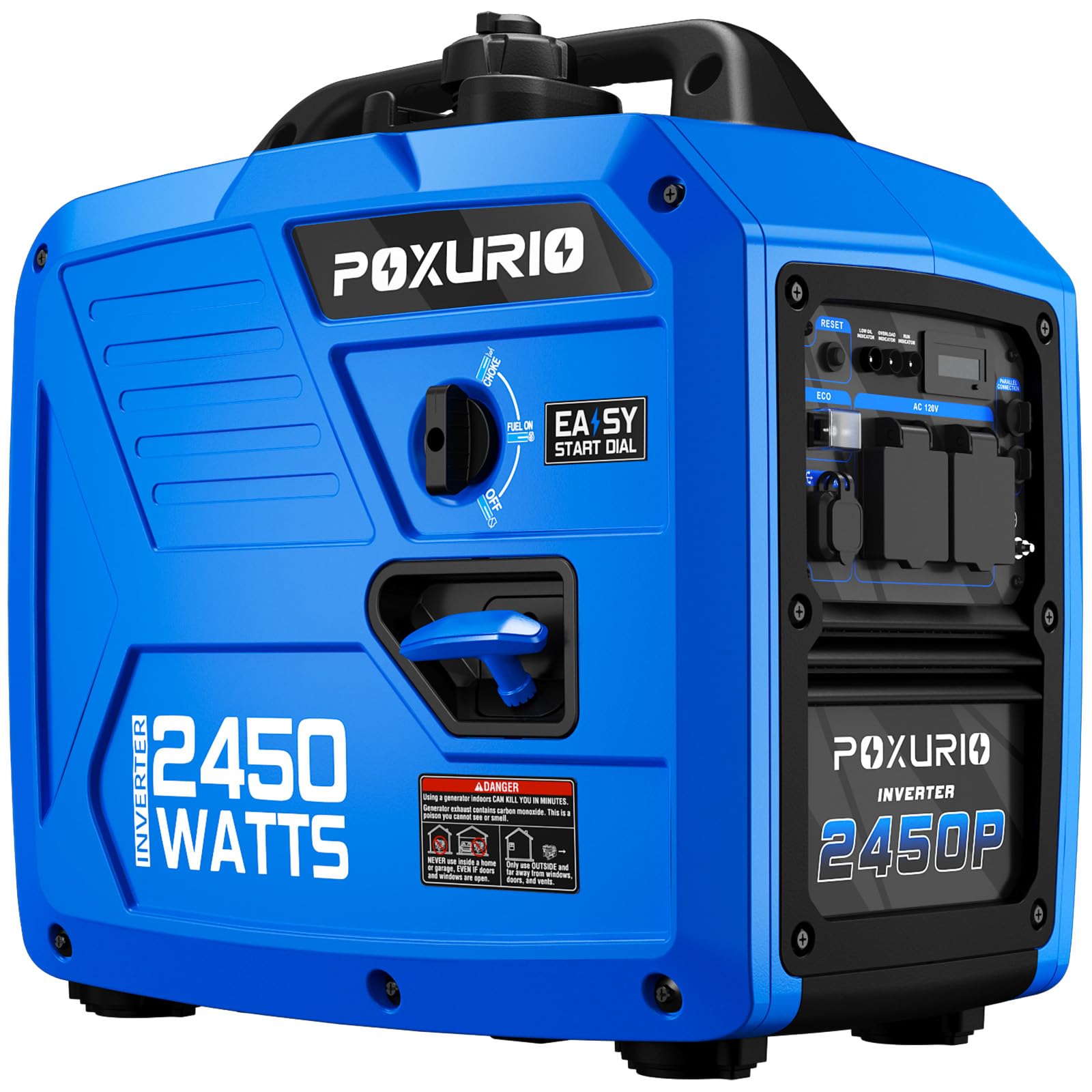
For RV owners, this POXURIO is a standout because it handles the two biggest pain points of camping power: noise and fuel stops. It produces a noise value of only 59 decibels during operation, which is quiet enough for a campground. With a 6L large capacity fuel tank, it runs up to 10 hours at 25% load, so you can sleep through the night without worrying about refueling.
What wins people over is the noise level, with over a dozen owners singling it out, and the ease of use follows close behind. The engine maxes out at 3000 watts, giving it headroom over its 2450-watt rating for starting larger appliances. Real-world testing backs this up — one owner ran it for 12 hours under light load on one tank, and another used it daily for four days straight without a hiccup.
The 43-pound weight is manageable for a unit this capable, though it’s not the lightest on this list. Unlike the SIOKIUU below, which stretches to 17 hours, this one trades a little runtime for a more proven, reliable reputation. It’s a 4-stroke engine that’s EPA compliant, so you get clean operation for sensitive gear like your RV’s air conditioner.
Why Owners Stick With It
- Super quiet at 59 dB — conversation-level volume
- Runs 10 hours at 25% load on a 6L tank
- 3000W max engine power for starting headroom
- Easy to start, smooth running, compact size
Know Before You Buy
- No user access to the carburetor for maintenance
- ECON mode can trip on voltage spikes from high-draw tools
- Cold start can be finicky without electric start
Grab it if: you want a quiet, reliable inverter that powers your RV’s AC and water heater without waking the neighbors.
Think twice if: you plan to run heavy circular saws — the ECON mode may trip on voltage spikes, so you’ll need to switch modes.
2. ZEGJAW 2400-Watt Portable Inverter Generator
The budget-friendly backup that refuses to quit during outages
When the power goes out, reliability is everything, and this ZEGJAW has proven itself in the toughest conditions. It’s powered by a 79.7cc 4-stroke OHV engine that delivers 2400 watts maximum, stabilizing at 1800 watts for normal use. During two extended power outages this winter, buyers report it ran over 12 hours straight, powering refrigerators, heaters, lights, and internet.
The defining feature here is the electric start ignition, a convenience you rarely find at this price point. It also includes a CO sensor that adds a layer of safety, plus a four-in-one digital panel showing oil, fault, running, and CO alarm indicators. The low THD (0.2%-1.2%) inverter technology keeps power clean enough for laptops, TVs, and gaming consoles.
At 62 dB at 23 feet, it’s the loudest unit on this list. And it does not boast the extended runtime of the SIOKIUU’s 17 hours, but for short-duration outages, the reliability wins the day. Fuel efficiency is a plus, with owners treating gas with stabilizer to keep the carburetor clean for months of standby.
Reliability first: The top thing owners praise is reliability, and the real-world proof — powering a fridge and heater through a two-day outage — backs that up. It’s a dependable backup that starts quickly and carries easily at just 39.7 pounds.
The honest catch: It’s a bit noisier than the 62 dB spec suggests to some ears, and there’s no fuel gauge, so you’ll need to check the tank yourself.
Reach for it if: you want an affordable, electric-start backup for home outages and small jobs.
Look elsewhere if: noise is your top concern or you need maximum runtime — this is louder and shorter-running than the premium picks.
3. SIOKIUU 2500W Portable Generator
The ultralight marathon runner that goes 17 hours without a refill
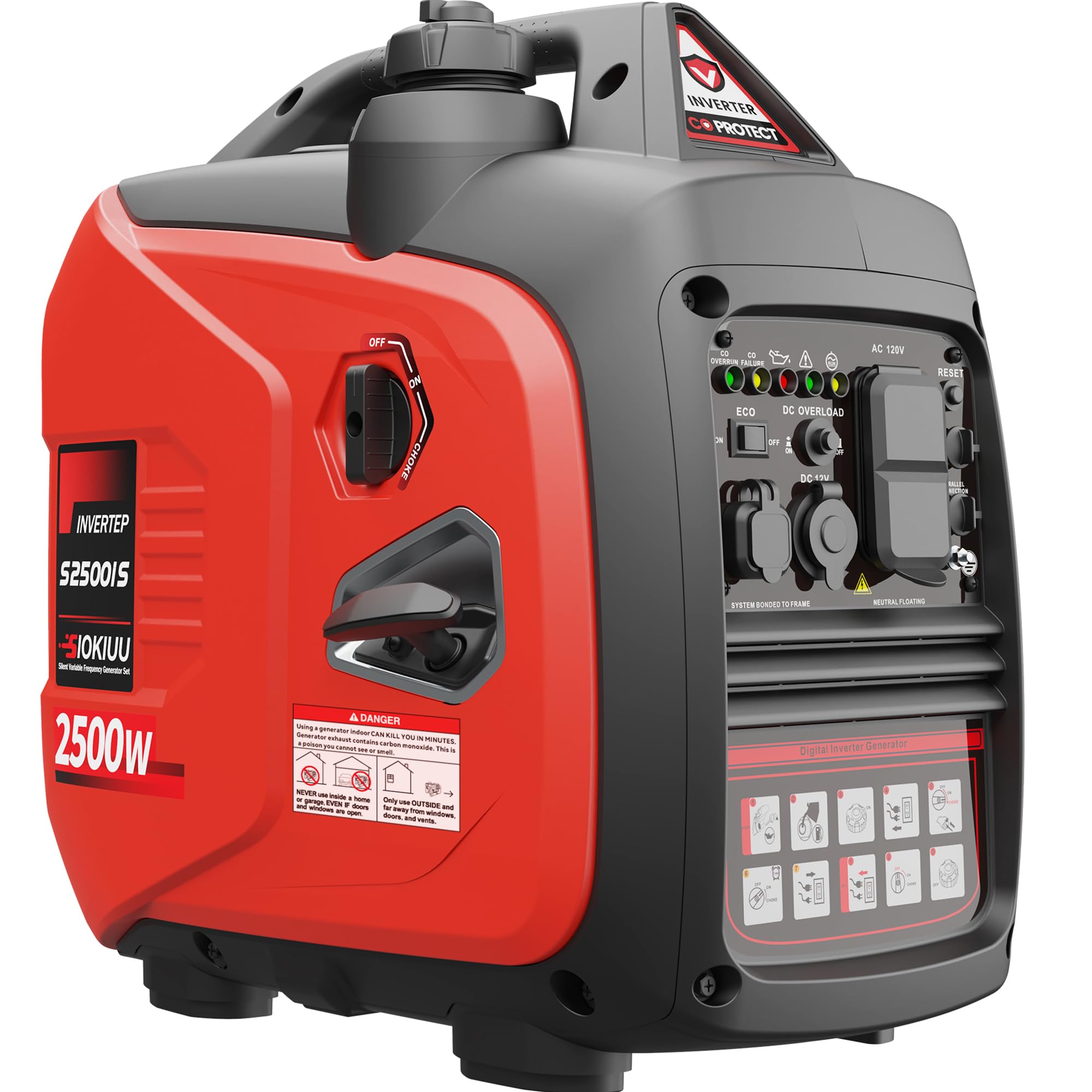
If you hate waking up at 3 a.m. to refuel, this SIOKIUU is the one to beat. It delivers up to 17 hours of operation at 25% load on a 1.06-gallon fuel tank — the longest runtime on this list and a 70% longer stretch than the POXURIO’s 10 hours. Even at 50% load, it runs 8.6 hours, which covers a full night of camping power.
At only 39.46 pounds, it’s also the featherweight champion here, tied with the AMERISUN for portability. The 80cc 4-stroke engine produces 2500 peak watts and 1900 running watts with less than 3% THD, making it safe for laptops, TVs, and camera gear. It’s ultra quiet at under 59 dBA from 23 feet away, so it won’t disturb the peace at a campsite.
You get strong value here — owners say it costs less than comparable models, and the 3-year warranty with free lifetime technical support adds confidence. But reliability feedback is mixed: some units arrive with issues, and one owner reported a CO2 sensor (a device that detects carbon dioxide and can shut off the engine) stopping the engine in high wind. Also, plan for refueling around every eight hours at full power, as owners repeatedly note.
The Long-Haul Case
- 17 hours at 25% load on a 1.06-gallon tank
- Ultra light at 39.46 pounds with sturdy handle
- Safe for sensitive electronics under 3% THD
- 3-year warranty with free lifetime tech support
The Fit Note
- Mixed reliability reports — some units have CO sensor issues
- Full power means refueling around 8 hours
- Struggles on loads it should handle with ease during surge
Best for: off-grid campers and RVers who want to minimize fuel stops and carry minimal weight.
Not for: anyone who needs guaranteed starts every time — check the unit on arrival and test the CO sensor before relying on it.
4. PowerSmart 2500 Watt Portable Inverter Generator
The dependable workhorse with a first-pull start that campers love
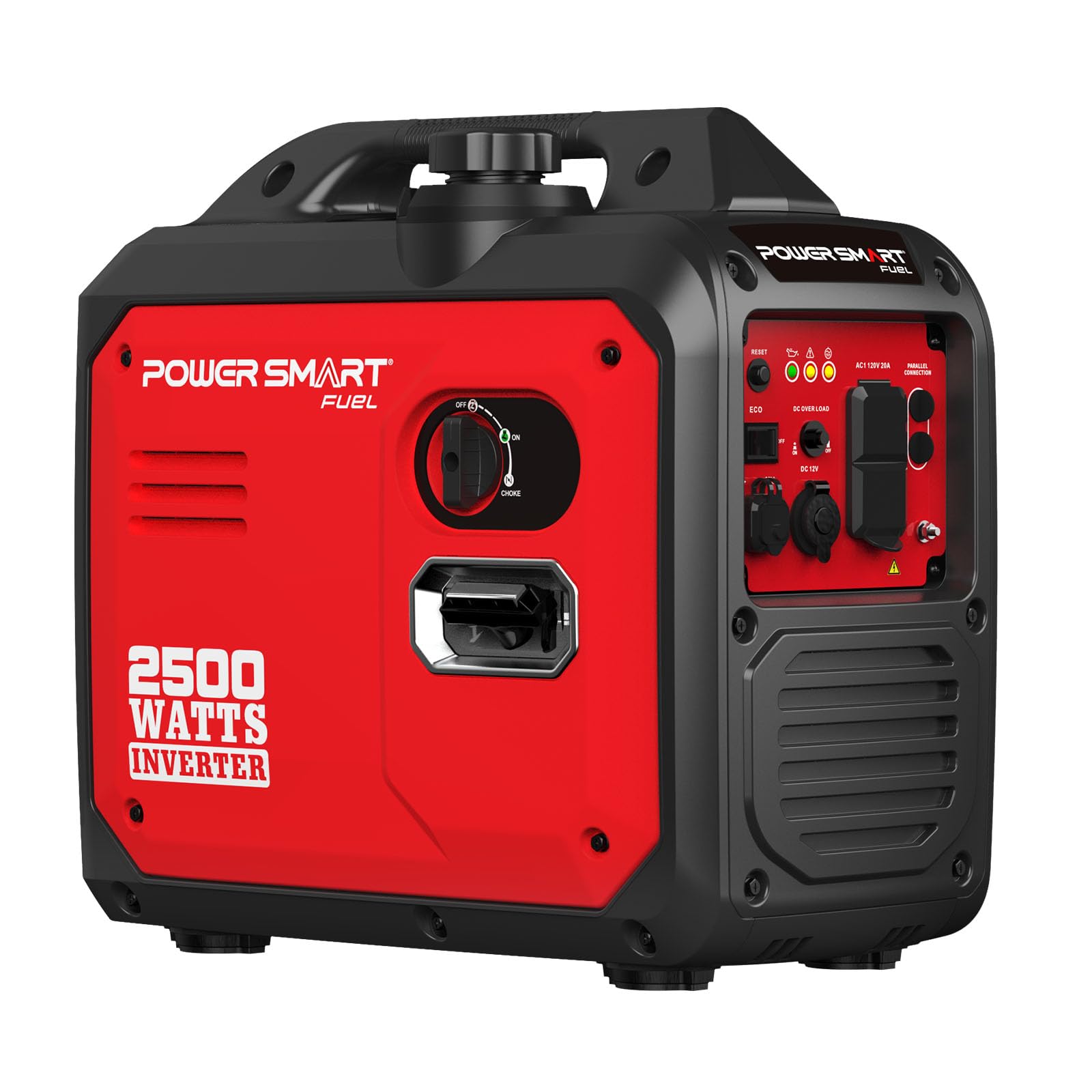
PowerSmart has built a reputation on reliability, and this 2500W model is the proof. It produces 2500W starting watts and 1900W running watts of clean power, and the 79.8cc 4-stroke engine starts easily on the first pull, thanks to the Cold Start Technology. It’s the kind of dependability that shows in the numbers — reliability is the most-praised aspect by a wide margin.
At 39.7 pounds and a compact 20.5″ x 12.8″ x 21.6″ footprint, it’s easy to move around a campsite or tuck into a vehicle. The quiet operation at 59 dBA from 23 feet means you can run it without disturbing neighbors, and owners confirm it’s surprisingly quiet for its class. The control panel is a highlight, with a 120V 20A duplex outlet, a 12V 8A DC port, and two 5V 2.1A USB ports for charging phones and tablets.
Owners have used it to charge phones, run small coffee pots, blow up air mattresses, and even power small freezers. The pure sine wave output is what makes it safe for sensitive electronics. However, one owner found the wattage rating misleading when running a heavy AC load — a good reminder to size up for demanding appliances like large air conditioners that need starting wattage spikes.
Dependability wins: The thing everyone raves about is reliability, with dozens of owners calling it dependable, quiet, and easy to use. It’s a no-drama generator for camping and home backup.
Watch the load: It’s not designed for heavy AC units — keep it to small appliances and electronics, and it will serve you for years.
Choose this one: if you want a proven, reliable inverter for camping, tailgating, and powering sensitive electronics without fuss.
skip it if: you need to run a large window AC unit — its 1900W running output will be strained.
5. POXURIO 2550-Watt Portable Inverter Generator
The quiet starter that fires up on the first pull, every time
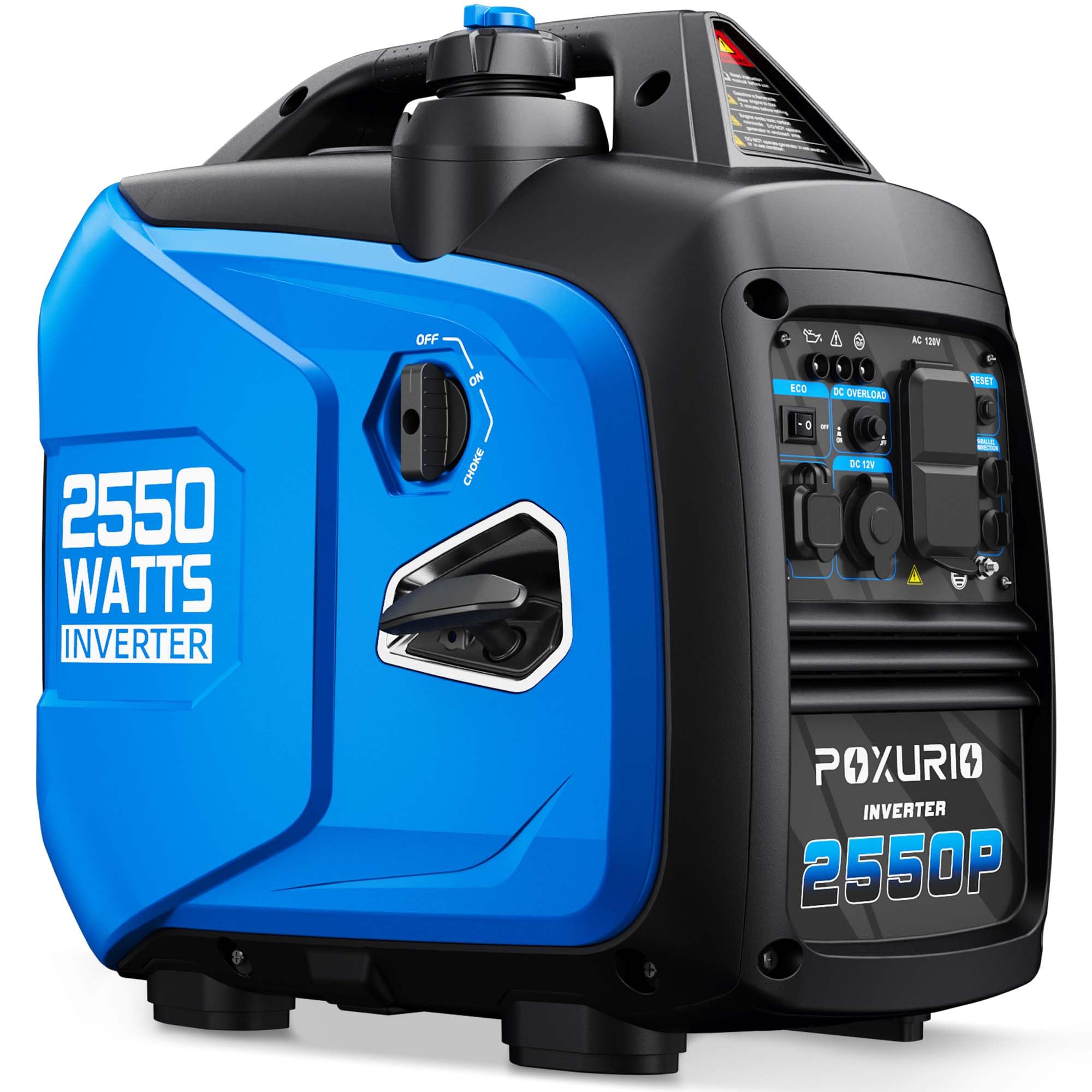
Owners consistently report this POXURIO 2550W starts on the first pull, eliminating the usual starting struggle. It offers 2550W of starting power to handle your daily electrical needs for camping, outdoor activities, or home backup. The super quiet operation at 59 decibels keeps things peaceful, even in residential areas.
The 4L large fuel tank provides up to 10 hours of running at 25% load, so a full tank covers a full night of emergency power. It’s compact and portable, designed for easy handling whether you’re heading to a campsite or dealing with a sudden outage. The engine runs on gasoline, which is convenient to store and widely available.
The noise level earns the most praise, with dozens of owners highlighting how quiet it is, and performance follows closely. One RV owner ran an AC, coffee pot, TV, and Starlink simultaneously without issue. The honest downside is the fuel tank — some owners found it runs only about 3 hours when powering an AC unit, so heavy loads will drain it quickly. The power capacity also gets mixed feedback, with some owners noting it can trip into overload mode if pushed too hard.
What Makes It Shine
- Easy start on the first pull
- Quiet operation at 59 decibels
- 10 hours of runtime at 25% load on a 4L tank
- Compact and portable for easy handling
Where It Falls Short
- Small tank — heavy loads like AC drain it in ~3 hours
- Can trip overload mode if pushed past its limits
- Manual is unclear on some maintenance steps
Pick it up: if reliable first-pull starting and quiet operation matter more to you than marathon runtime.
Pass if: you plan to run heavy AC loads for hours — you’ll be refueling sooner than you’d like.
6. ERAYAK 2400W Portable Inverter Generator

The whisper-quiet generator that rivals the big brands at a fraction of the cost
At just 52.5 dB from 7 meters, the ERAYAK 2400W is the quietest unit on this list — quieter than a normal conversation. That makes it a standout for campgrounds, RV parks, and residential areas where noise rules are strict. It produces 2400W peak and 1800W running watts of clean power with less than 1.2% THD, making it safe for laptops, CPAP machines, and mobile devices.
Reliability is the most-praised aspect in owner feedback, outnumbering all other compliments. It’s powered a table saw without issues, run tools for days on one tank, and charged phones and drills quickly. The compact 18.82″ x 11.73″ x 18.11″ dimensions and 42-pound weight make it easy to carry, and the Eco Mode dynamically adjusts engine speed to cut fuel use and noise.
Owners consistently compare it to a Honda 2000 (a popular 2000-watt generator) at a fraction of the cost, praising the digital readouts, easy start, and excellent packaging. The 3-year limited warranty with free lifetime technical support and a US support hotline adds confidence. The honest caveat: the 2400W rating is deceiving for large space heaters on high — it struggles with that kind of draw, so keep expectations realistic for big heating loads.
Premium Perks
- Ultra-quiet 52.5 dB operation — perfect for campgrounds
- Reliability is the most-praised aspect by far
- Safe for sensitive electronics with under 1.2% THD
- Compact and lightweight at 42 pounds
The Caveat
- 2400W rating struggles with large space heaters on high
- Small tank needs frequent refills for long outages
- ~50 pounds in practice, sturdier than the spec suggests
Worth the upgrade: if you want Honda-like performance and the quietest operation possible without paying Honda prices.
Reconsider if: you need to run big heating appliances — this is built for electronics, lights, and tools, not space heaters.
7. GENMAX 2200W Portable Generator

The compact power source that runs paint sprayers all day
For jobsite use, this GENMAX 2200W is a proven performer — owners have run airless paint sprayers all day without a single hiccup. It produces 2200 starting watts and 1800 running watts of clean power (less than 3% THD) from a 79.7cc 4-stroke OHV engine. The recoil start is easy, and at 41.8 pounds, it’s light and compact enough to carry for long distances.
Noise is the most-praised aspect, with the unit running as low as 58 dBA and providing up to 6 hours of runtime at 50% load on a 1-gallon tank. The ECO mode boost fuel efficiency, and owners confirm a single tank lasts about 12 hours when running a fan and lights. The CO Detect shutdown sensor adds a critical safety layer by preventing carbon monoxide buildup.
The standout feature set includes a sturdy handle, compact 18.9″ x 11.4″ x 17.3″ footprint, and a 3-year warranty with free lifetime technical support. But the reliability picture is mixed — while some units run flawlessly, a few owners mention units that won’t start after a few months, and the pull string can melt on some units under heavy load. For tent camping and light jobsite work, it’s a great value; for heavy 1800W continuous loads, be cautious.
Why It’s a Workhorse
- Runs tools like airless paint sprayers all day
- Quiet at 58 dBA — praised most by owners
- ~12-hour runtime on a tank with light loads
- 3-year warranty with free lifetime tech support
Consider This
- Mixed reliability — some units won’t start after months
- Pull string can melt under sustained heavy load
- Oil sensor can fail, bricking the unit without support
Solid for: light jobsite work and tent camping where quiet operation and portability matter most.
Not for: running heavy snow blowers or continuous 1800W loads — the overload protection will trip.
8. AMERISUN 2500-Watt Inverter Generator

The lightest parallel-ready unit that doubles your power when needed
The AMERISUN 2500W’s parallel capability lets you double output to 5000W with a second unit. Connect a second unit and you double your output to 5000 watts — a huge advantage for tailgating setups or home backup where you need more juice than a single unit provides. At just 39 pounds, it’s the lightest generator on this list, tied with the SIOKIUU, making it easy to load into a truck bed.
It produces 2500 surge watts and 1900 rated watts of clean power, running at a sound level of just 59 dB(A) at 23 feet. The runtime stretches to 5.5 hours at 50% load, which is respectable for a unit this portable. It comes with two 3-prong 120V receptacles, a 5V USB receptacle, and a 12V DC car port, giving you flexible connection options.
Build quality is the top praise, with owners calling it reliable, Honda-like, and more powerful than it looks. Safety features include CO detection, low-oil shutdown, and overload protection. The honest trade-offs: it’s not as quiet as claimed for some ears, and the CO detector can shut it down if wind blows toward the exhaust. One owner ran four sets of string lights, an Xbox, a projector, and a fan without issues, proving its real-world capability.
The Flexibility Bonus
- Parallel capable — double to 5000W with a second unit
- Ultra light at 39 pounds for easy transport
- Build quality is the most-praised aspect
- Multiple outlets: 2x 120V, 1x USB, 1x 12V DC
What to Note
- Noise is mixed — some find it louder than expected
- CO detector can trip if wind blows toward exhaust
- No fuel gauge — easy to overfill
Ideal for: campers and tailgaters who want the option to double their power later by adding a second unit.
Consider the caveat: if you’re sensitive to noise, this may run louder than the 59 dB spec suggests.
9. Pulsar 2,200W Portable Dual Fuel Inverter Generator

The dual-fuel workhorse that gives you gas or propane flexibility
The Pulsar runs on either gasoline or propane, so you can switch fuels when one is scarce or costly. On gas, it delivers 2,200 peak watts and 1,800 rated watts; on LPG, it produces 2,000 peak watts and 1,600 rated watts. That means you can keep the lights on even if your gas supply runs dry, as long as you have a propane tank handy.
The 80cc, 3Hp single-cylinder 4-stroke OHV engine runs super quiet at 60 dB with stable sine wave power safe for sensitive electronics. It’s compact with a carrying case design and a 1.18-gallon fuel tank, delivering 8 hours of runtime on a single tank of gas at half load. The dual-fuel capability is a top praise point, with owners noting it supports a 1500-watt load on propane without issue.
Performance is the most-praised aspect by far, and owners love the lightweight portability and quiet operation. It’s a favorite for recharging solar battery backups and powering truck campers. Propane starts can be tricky after storage because the diaphragm in the hose assembly tends to stick. Gasoline starts are easy in 2-3 pulls, but propane may take 20 pulls the first time. The ECO mode also runs louder at low speed, which is counterintuitive.
Why It’s Flexible
- Dual fuel — gas or propane for fuel flexibility
- 8-hour runtime on one tank of gas at half load
- Parallel capable for doubling output
- Stable sine wave safe for sensitive electronics
The Learning Curve
- Propane starting can be difficult after storage
- ECO mode is louder at low speeds
- Struggles above 1000W briefly before stabilizing
Choose this if: you want fuel flexibility for emergencies or off-grid setups where propane is easier to store than gas.
Be ready for: a learning curve with propane starts — gasoline is much easier if you don’t want the hassle.
10. Generac 2,500 Watt Gas Powered Portable Inverter Generator

The national-forest-approved pick with conversation-level 53 dB noise
If you camp in national forests or dry-fire-risk areas, this Generac is the one to grab. It comes with a USDA-qualified spark arrestor, making it approved for use in national parks and forests where other generators are banned. At 53 dB(A) at quarter load, it’s the quietest runner here alongside the ERAYAK — roughly the volume of a normal conversation, so it won’t disturb neighbors or wildlife.
It produces 2,200 running watts and 2,500 starting watts with TruePower Technology, delivering under 3% total harmonic distortion. That makes it safe for laptops, tablets, and CPAP machines. The 46.6-pound weight is hand-portable, and the Economy Mode stretches runtime to 8 hours at 25% load or 5.5 hours at 50% on a 0.95-gallon tank.
Build quality gets excellent feedback, and the CO Sense technology continuously monitors carbon monoxide and shuts down before dangerous levels build. It’s backed by a 3-year residential limited warranty and Generac’s authorized service dealer network. The honest catch: starting performance is mixed — it requires a specific pull technique (pull to compression resistance, rewind, then full pull) that takes practice. Some owners in remote areas report units failing within months with limited warranty support access.
The Premium Experience
- USDA spark arrestor — approved for national forests
- Quiet 53 dB(A) at quarter load — conversation level
- Clean power under 3% THD for sensitive electronics
- 3-year residential warranty with dealer network
The Fine Print
- Starting technique is specific — pull to resistance first
- Mixed reports on long-term durability in remote use
- Heavier at 46.6 pounds than the lightest picks
Get this for: national forest camping and premium reliability where the spark arrestor and CO Sense safety features matter most.
Practice the start: the specific pull technique takes getting used to — practice before you need it in an emergency.
Understanding the Specs
Running Watts vs. Starting Watts
Running watts is what a generator produces continuously, while starting watts is the brief surge needed to kick on appliances with motors, like refrigerators or AC units. A generator rated for 1900 running watts may need 2500 starting watts to get a motor spinning.
THD and Clean Power
Total Harmonic Distortion (THD) measures how clean the electrical sine wave is. Lower THD (under 3%) is safe for sensitive electronics like laptops, TVs, and CPAP machines. Higher THD can damage these devices over time, so look for inverter generators with low THD ratings.
FAQ
Will a 2400 watt generator run my refrigerator?
What is the difference between an inverter generator and a conventional one?
How long will a 2400 watt generator run on a full tank?
Can I run a generator in the rain?
What is the parallel capability and do I need it?
How loud is a 2400 watt inverter generator?
Is a CO sensor necessary on a generator?
Can I use a generator to power sensitive electronics like my laptop?
Final Thoughts: The Verdict
The best 2400 watt generator for most buyers is the POXURIO 2450W because it balances quiet 59 dB operation, a 3000W max engine, and a proven reliability record with strong owner satisfaction. If you want the longest runtime, the SIOKIUU 2500W stretches to 17 hours at 25% load. And for the quietest operation with premium build, the ERAYAK 2400W at 52.5 dB is the one to reach for.
How We Picked
We do not accept paid placement. Every pick is matched to a real buyer and a real use-case; we do not hands-on test units.
Sources & Methodology
Specifications: manufacturer listings and product documentation. Review insights: verified customer reviews, as of August 2026. Pricing: not shown on this page (it changes often); check the current price via the retailer link.
As an Amazon Associate, Gadgets Feed earns from qualifying purchases. This does not affect which products we feature.