
Cranking a 50-amp welder, charging an EV overnight, or running a high-HVAC compressor demands a connection that can handle the sustained draw without overheating or failing. The wrong plug can mean a loose fit, arcing, or a total replacement down the road. The NEMA configuration, amperage rating, and build materials separate a safe, long‑term connection from a fire hazard waiting to happen.
I’m Min — the co-founder and writer behind Gadgets Feed. I’ve spent many hours analyzing NEMA standards, connector ratings, and user experiences across 240V equipment to bring you a guide that focuses on the specific physical and electrical characteristics that actually matter for a reliable high‑voltage connection.
Whether you’re wiring a new workshop outlet or replacing a worn‑out dryer cord, finding the right 240v electrical plug comes down to matching your amperage, wire count, and environment to a plug built for that exact load.
How To Choose The Best 240V Electrical Plug
Selecting a 240V plug is less about brand loyalty and more about matching three hard specs: voltage, amperage, and the NEMA configuration that fits your device’s receptacle. A mismatch can cause a dangerous connection or a dead short.
NEMA Configuration: 3‑Prong vs 4‑Prong
The NEMA number tells you everything. A 6‑series plug (e.g., 6‑50P) has three prongs — two hots and a ground — and is used for welders and compressors that don’t need a neutral. A 14‑series plug (e.g., 14‑50P) has four prongs — two hots, a neutral, and a ground — and is required for EV chargers, ranges, and dryers that need the neutral for 120V components. Using a 6‑series plug in a 14‑series receptacle leaves the neutral floating, which is both unsafe and non‑compliant.
Amperage Rating and Wire Gauge
A 30‑amp plug (e.g., 6‑30P) works with 10 AWG copper wire and a 30A breaker. A 50‑amp plug (e.g., 6‑50P) requires 8 AWG or 6 AWG wire and a 50A breaker. Installing a 50A plug on a 30A circuit is a code violation — the plug won’t protect the wire from overheating. Always pair the plug amperage with the breaker and conductor size.
Build Materials and Certifications
Solid brass blades deliver the best conductivity and resist corrosion. Nylon housings are impact‑resistant and can handle the heat of high‑current draws better than cheaper thermoplastics. Look for UL or ETL listing, which means the plug has been tested for electrical safety under load — a critical difference from unbranded imports.
Quick Comparison
On smaller screens, swipe sideways to see the full table.
| Model | Category | Best For | Key Spec | Amazon |
|---|---|---|---|---|
| Leviton 931 | Premium | Compressors & welders | Interchangeable 30A/50A blades | Amazon |
| AIDA NEMA 6-30P/6-50P | Mid-Range | Workshop tools & welders | Dual 30A/50A angle plug | Amazon |
| AIDA NEMA 14-30P/14-50P | Mid-Range | EV chargers & ranges | 4-prong 30A/50A angle plug | Amazon |
| DEALTUS 2-in-1 6-50P/6-30P | Mid-Range | Portable welder setups | Extra terminal for 30A/50A swap | Amazon |
| Legrand Pass & Seymour 6-20P | Value | Small shop tools & pumps | NEMA 6-20P, 20A industrial | Amazon |
| ELEGRP LCDI NEMA 6-15P | Specialty | Window AC units | Built-in LCDI safety, 7.5ft cord | Amazon |
In‑Depth Reviews
1. Leviton 931

The Leviton 931 remains the gold standard for dual‑configuration 240V plugs. It ships with both 30‑amp (6‑30P) and flat 50‑amp (6‑50P) blades, so you can swap between a compressor and a welder without buying a second plug. The thermoplastic shell is hinged in front, making assembly straightforward — no tiny screws to lose in the workshop dust.
Solid brass blades with color‑coded terminals simplify wiring, and the hinge design clamps the cord jacket securely so the terminations aren’t yanked over time. Users report installing it on a 3‑hp cabinet saw and having the cord drop straight down without interference. It’s not rotatable once assembled, but the orientation can be set during wire‑up.
The Leviton 931 is a commercial‑grade plug that has been around for decades, and its build quality justifies the slightly higher cost over commodity options. It handles sustained 50‑amp draws without the housing softening, and the interchangeable blade system means you’re future‑proofed if you change equipment down the line.
Why it’s great
- Interchangeable 30A and 50A blades cover two common NEMA configurations in one unit.
- Hinged thermoplastic shell resists cracking from impact and everyday workshop abuse.
- Solid brass blades deliver high conductivity and resist corrosion over years of use.
Good to know
- No wiring diagram printed on the plug body — email Leviton or look up online.
- Orientation is set during assembly; cannot rotate after cord is clamped.
2. AIDA NEMA 6-30P & 6-50P

AIDA’s right‑angle plug is built for tight spaces — think behind a compressor or under a generator panel where a straight blade would stick out too far. The housing is moisture‑ and chemical‑resistant nylon, and the blades can be mounted horizontally or vertically depending on your cord approach. It accepts wire up to 4 AWG, which is thicker than you’ll need for most 50‑amp circuits.
Users note that the 30‑amp and 50‑amp blades are included with the same plug body, so you can choose which to install. The brass blades are thick and the terminals are clearly marked for hot, neutral, and ground. Some owners filed a slight angle on the ground pin to slip into a tight Leviton socket — a minor fitment nuance but worth knowing before you tighten everything down.
After a year on an 80‑gallon air compressor, users report zero loosening or heat damage. The UL listing adds a layer of safety verification that budget unlisted plugs lack. For anyone wiring a stationary high‑amp tool, this AIDA plug offers the blend of convenience and durability that makes it a top mid‑range choice.
Why it’s great
- Right‑angle design fits flush against walls and into cramped equipment compartments.
- Accepts up to 4 AWG conductors — oversized for high‑capacity 50A runs.
- Blades can be oriented horizontally or vertically for flexible cord routing.
Good to know
- The ground pin may need slight filing for perfect fit in some Leviton receptacles.
- Dual‑function blades require careful selection during installation — don’t mix amp ratings.
3. AIDA NEMA 14-30P & 14-50P

If you need a 14‑series connector for an EV charger, induction range, or generator inlet, AIDA’s 4‑prong right‑angle plug is the up‑to‑spec solution. It covers both 30‑amp (14‑30P) and 50‑amp (14‑50P) configurations with replaceable blades, and the self‑grounding clip speeds up installation. The housing is the same rugged nylon as the 6‑series version, rated for abuse and heat.
Users report using it to build a generator cable and finding the wire terminations easy to identify thanks to marked terminals. The plug accepts up to 4 AWG copper or aluminum, which is overkill for a 30A dryer but perfect for a 50A EV circuit. One electrician noted the build quality matches supply‑house brands at a lower cost, making it a solid choice for DIY cable assemblies.
The 14‑series plug has four poles — two hots, neutral, and ground — so verify your receptacle is also a 14‑50R before purchasing. The right‑angle profile keeps the cord tucked against the wall, which is especially useful for a range or dryer that sits close to the outlet box.
Why it’s great
- Dual 30A/50A blades handle both dryer and EV charger configurations in one plug.
- Self‑grounding clip simplifies installation and ensures a reliable ground path.
- Right‑angle nylon housing resists impact and keeps cables neat against walls.
Good to know
- Only compatible with 14‑series receptacles — not interchangeable with 6‑series outlets.
- Some users reported difficulty finding 14 AWG cable locally; the plug works best with 8 AWG to 4 AWG.
4. DEALTUS 2-in-1 Nema 6-50P/6-30P
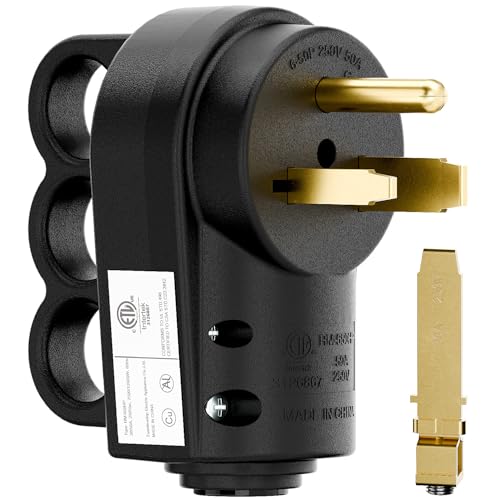
DEALTUS takes the dual‑configuration idea a step further by including a spare NEMA 6‑30P terminal in the box. That means you can build the plug as a 50‑amp 6‑50P today, and if you later need a 30‑amp 6‑30P, just swap the terminal block without buying a new plug. It’s a tidy solution for anyone with multiple 240V tools that use different plugs.
The nylon housing includes an internal cord clamp that grips the cable jacket firmly, preventing strain on the wire terminations. Users praise the built‑in handle recesses that make it easier to pull the plug out of tight receptacles — a small detail that saves frustration when the plug is in a hard‑to‑reach spot behind a welder or generator.
ETL listing provides independent safety verification, and the plug works with 10 AWG or 8 AWG 3‑conductor cables like SO, STW, or STOOW. If you’re building a portable welder cord that needs to switch between 30‑amp and 50‑amp outlets at different job sites, this DEALTUS plug is the most flexible option in this roundup.
Why it’s great
- Extra terminal included for on‑the‑fly swapping between 30A and 50A configurations.
- Internal cord clamp grips the jacket securely and prevents strain on wire connections.
- Handle recesses in the housing make insertion and removal easier in tight spots.
Good to know
- Only covers NEMA 6‑series (3‑prong) — not compatible with 4‑prong 14‑series outlets.
- Dimensions (2.8″D x 2.6″W x 3.6″H) may be larger than some tight‑space applications allow.
5. Legrand Pass & Seymour PS5466SSANCCV4 6-20P

This Legrand Pass & Seymour plug is a 20‑amp 250V connector with a straight‑blade angle design — built for smaller 240V loads like a 3‑hp table saw, a commercial pump, or a large air conditioner. It’s rated as “extra hard use” specification grade, meaning the nylon housing and brass contacts are designed to survive years of daily industrial plugging and unplugging.
The angle housing routes the cord downward, which is a major advantage for tools with top‑mounted receptacles. Users report easy two‑screw wiring with clear grounding marks, and the cord clamp holds the insulation firmly. The plug body is compact — smaller than the 50‑amp units — so it fits in tight spaces without interfering with adjacent outlets.
If you don’t need 30 or 50 amps, this 20‑amp Legrand plug is a budget‑friendly upgrade over commodity hardware‑store alternatives. The NEMA 6‑20P configuration is common for 240V power tools, and the industrial rating means it will outlast the equipment it powers.
Why it’s great
- Extra hard use industrial rating withstands frequent plugging/unplugging in workshops.
- Angled housing directs cord downward, keeping it out of the way near tool bases.
- Compact size fits in tight outlet boxes without crowding neighboring plugs.
Good to know
- NEMA 6‑20P is limited to 20A — not compatible with 30A or 50A circuits.
- Some users found the orientation non‑adjustable after final assembly.
6. ELEGRP L22615 LCDI NEMA 6-15P

The ELEGRP L22615 is a full 7.5‑foot power cord with an integrated LCDI (Leakage Current Detection Interrupter) — not just a plug head. It’s designed specifically for window and portable air conditioners that use a NEMA 6‑15P connection. The LCDI technology monitors the cord’s shield for leakage current; if it detects a break or arcing above 5mA, it trips the circuit within 0.5 seconds, preventing potential fires from aging cords.
Installation requires terminating the black (hot), white (neutral), and green (ground) wires inside the AC unit’s terminal block. The cord uses 14 AWG conductors, which is correct for 15‑amp 240V circuits. Users report the cord working perfectly as a replacement for chewed or damaged AC power cords, and the LCDI safety device adds peace of mind for units that run unattended for long hours.
The ELEGRP cord is UL certified to UL1699, meeting the safety requirement many building codes now demand for air conditioner power cords. If your AC’s original cord is damaged or missing, this is a direct drop‑in replacement with better safety features than most OEM cords provide.
Why it’s great
- Built‑in LCDI sensor trips within 0.5s upon detecting leakage current, reducing fire risk.
- Full 7.5‑foot cord with pre‑stripped leads for direct wiring to AC units.
- UL certified to UL1699 — meets modern building code requirements.
Good to know
- Designed exclusively for 15A 240V air conditioners — not for tools or EV chargers.
- Some users reported the fork terminals were narrower than expected; verify compatibility with your AC’s terminal block before installation.
FAQ
Can I use a NEMA 6-50P plug on a circuit with a 30-amp breaker?
What’s the difference between a NEMA 6-50P and a NEMA 14-50P plug?
Are right‑angle plugs better than straight plugs for 240V appliances?
Final Thoughts: The Verdict
For most users, the 240v electrical plug winner is the Leviton 931 because its interchangeable 30A and 50A blades and commercial‑grade thermoplastic shell cover the two most common 3‑prong configurations without compromise. If you need a 4‑prong plug for an EV charger or induction range, grab the AIDA NEMA 14-30P/14-50P. And for a compact, value‑priced 20‑amp connector for shop tools, nothing beats the Legrand Pass & Seymour 6-20P.