
Running 240-volt appliances away from the grid is a game of precision — a fridge compressor, a well pump, or a central AC unit demands voltage stability that most inverters simply cannot deliver. The difference between a working system and a fried control board is the quality of the sine wave and the sustained wattage capacity of your inverter.
I’m Min — the co-founder and writer behind Gadgets Feed. I’ve spent countless hours dissecting power inverter specifications, comparing continuous versus surge ratings, and analyzing real-world performance data to separate reliable 240V hardware from units that can’t handle inductive loads.
Whether you are outfitting an off-grid cabin or preparing emergency backup for your home, this guide delivers a clear verdict on the best 240v power inverter options that actually hold up under sustained loads.
How To Choose The Best 240V Power Inverter
Selecting a 240V power inverter requires a clear-eyed look at surge demands, waveform purity, and input voltage compatibility. A unit that looks great on paper may falter when a refrigerator compressor kicks on.
Assess Continuous vs. Surge Wattage
Every motor-driven appliance — well pumps, air conditioners, refrigerators — draws 3–7 times its running wattage during startup. The inverter’s surge rating must cover these peaks without triggering overload protection. A 5000W continuous inverter with 10000W surge gives you a comfortable buffer for a 2000W well pump.
Waveform Quality Matters for Sensitive Loads
Pure sine wave inverters replicate utility-grade AC power with total harmonic distortion (THD) below 3%. Modified sine wave units can cause buzzing, overheating, or failure in induction motors, variable-speed appliances, and electronics with switching power supplies. For 240V whole-house or RV applications, pure sine wave is the only safe choice.
Input Voltage and System Architecture
Standalone inverters typically accept 12V, 24V, or 48V DC from a battery bank. Higher input voltage reduces current draw and allows thinner cables — 24V and 48V systems are more efficient for 240V outputs above 3000W. Generator-based inverters produce 240V AC directly from an engine, eliminating the battery bank but requiring fuel management.
Quick Comparison
On smaller screens, swipe sideways to see the full table.
| Model | Category | Best For | Key Spec | Amazon |
|---|---|---|---|---|
| BELTTT 3000W | Inverter | Off-grid solar / RV | 6000W surge, 12V input | Amazon |
| PowerSmart 4400W | Generator | Home backup / camping | 3600W rated, 76 dB | Amazon |
| VEVOR 5000W | Inverter | Solar / heavy appliances | 10000W surge, 4 AC outlets | Amazon |
| GIANDEL 4000W | Inverter | 24V solar / RV | 7000W surge, UL458 | Amazon |
| PowerSmart PS5055C | Generator | Whole-house / RV 50A | 7000W surge, 240V output | Amazon |
| WEN DF680iX | Generator | EV Level 2 charging | 6800W surge, dual fuel | Amazon |
| Westinghouse WGen10500DFc | Generator | Heavy home backup | 13500W peak, 500cc engine | Amazon |
| AIVOLT 8000W | Generator | Quiet RV / camping | 62 dBA, 8000W peak | Amazon |
| Westinghouse iGen8200TFc | Generator | Whole-home / sensitive electronics | Tri-fuel, <3% THD | Amazon |
In‑Depth Reviews
1. BELTTT 3000W Pure Sine Wave Inverter

The BELTTT 3000W delivers a rare balance of output capacity and build quality in a compact 9.92-pound chassis. With 6000W of surge power and a conversion efficiency above 93%, this unit easily handles refrigerators, air fryers, and ice maker compressors without stalling.
The intelligent LCD displays input/output voltage, battery status, and load percentage simultaneously — remote controller with a 23-foot cable means you can monitor the inverter from inside the camper without routing through the battery compartment. Real-world testing confirms clean 120V output that sensitive electronics accept without hum or distortion.
Three built-in safety protections (undervoltage, over-temperature, short circuit) plus a 20A outlet and dual 5V USB ports round out a package that punches well above its price. Component QC can vary between units, so inspect terminal connections upon arrival.
Why it’s great
- Pure sine wave with <3% THD ensures safe operation for sensitive loads like TVs and laptops
- Remote controller with 23-ft cable enables convenient monitoring and shutoff from inside the RV
- 93%+ conversion efficiency reduces battery drain during extended off-grid use
Good to know
- Some units have arrived with corroded connection posts — inspect immediately upon delivery
- Continuous fan noise audible under light loads below 1000W
2. PowerSmart 4400W Open Frame Inverter Generator

The PowerSmart 4400W bridges the gap between budget open-frame generators and premium inverter units. Its 223cc four-stroke engine produces 3600W rated power with a 4400W surge — sufficient to run a refrigerator, freezer, lights, and electronics simultaneously during an outage.
At 68 pounds, it is light enough for one person to move, and the 1.6-gallon fuel tank delivers up to 11 hours of runtime at 25% load. The built-in CO sensor and low-oil shutdown add peace of mind for indoor-adjacent placement, though outdoor operation is always required for exhaust safety.
User reports confirm reliable starting after 55+ hours with proper maintenance, but the unit lacks a 240V outlet — only 120V. The absence of a DC cigarette port is noticeable if you plan to charge batteries directly.
Why it’s great
- Lightweight 68-pound design makes transport and storage simple for camping and home backup
- CO watchdog sensor provides automatic shutoff if carbon monoxide reaches dangerous levels
- Eco mode reduces engine speed and fuel consumption during light loads
Good to know
- No 240V output — limited to 120V appliances only
- A small percentage of units have arrived with defective control modules that prevent starting
3. VEVOR 5000W Pure Sine Wave Inverter
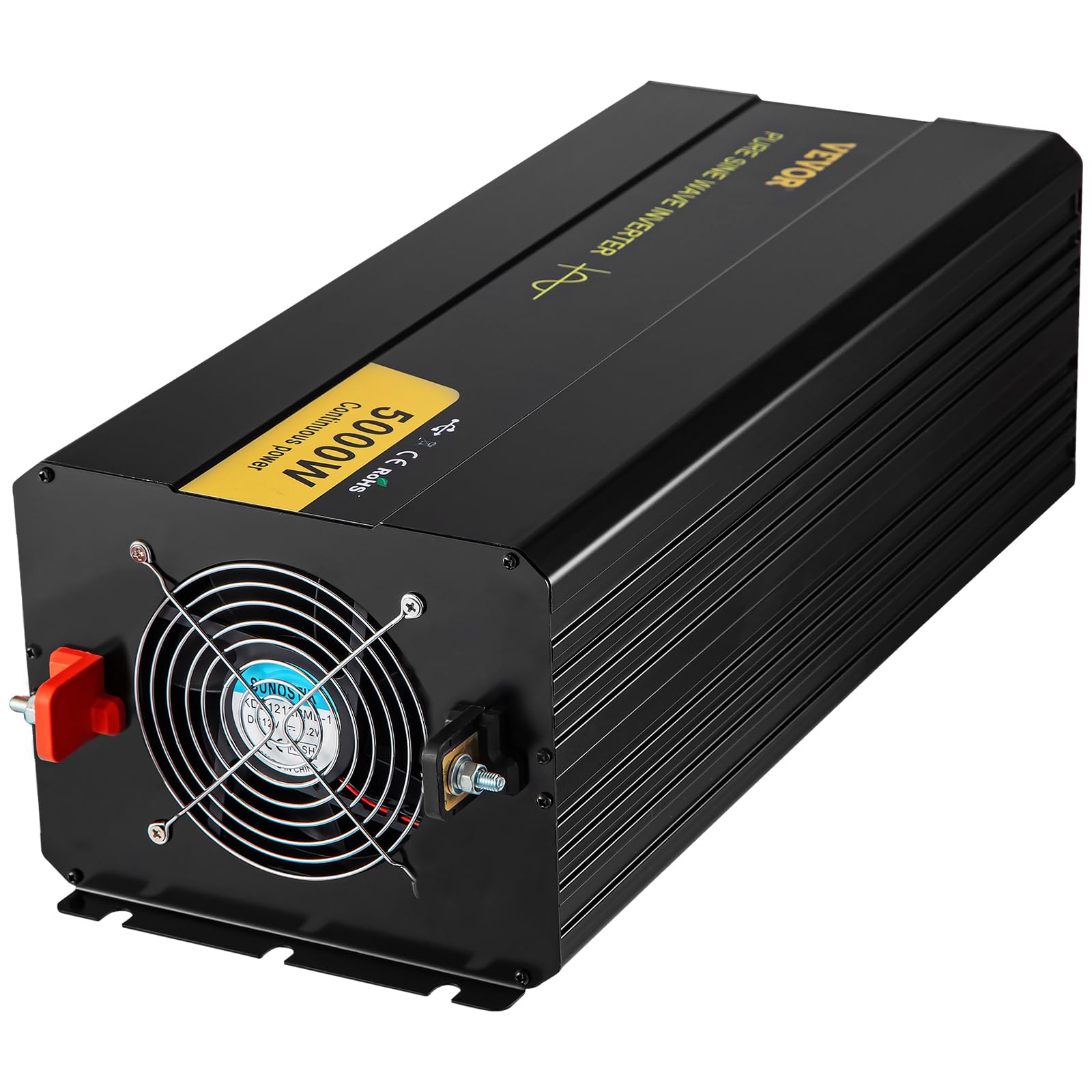
The VEVOR 5000W is built for users who need serious continuous power — it reliably runs a 13500 BTU RV air conditioner and whole-house 120V circuits via a transfer switch without voltage sag. The 10000W surge handles compressor startup draws that would trip lesser units.
Four AC outlets and a USB port provide flexibility, while the aluminum alloy shell dissipates heat effectively — the temperature-controlled fan activates at 113°F and runs quietly (20–40 dB) during normal operation. The included remote controller with 9.8-foot cable makes on/off switching convenient from inside the living space.
One nuance: the LCD display shows DC input wattage, not AC output wattage. Testing with a Kill-a-Watt meter reveals roughly 20% discrepancy due to conversion losses. Plan for 75–80% efficiency when calculating battery bank requirements.
Why it’s great
- 10000W surge capacity easily starts large motors like RV AC compressors and furnace fans
- CE, FCC, RoHS, and PSE certifications confirm compliance with international safety standards
- Aluminum alloy housing with corrosion resistance outperforms ABS-based competitors in heat dissipation
Good to know
- LCD displays DC input wattage, not actual AC output — efficiency is around 75–80% under load
- At 21 pounds, it is heavier than comparable 3000W units, requiring sturdy mounting
4. GIANDEL 4000W 24V Pure Sine Wave Inverter
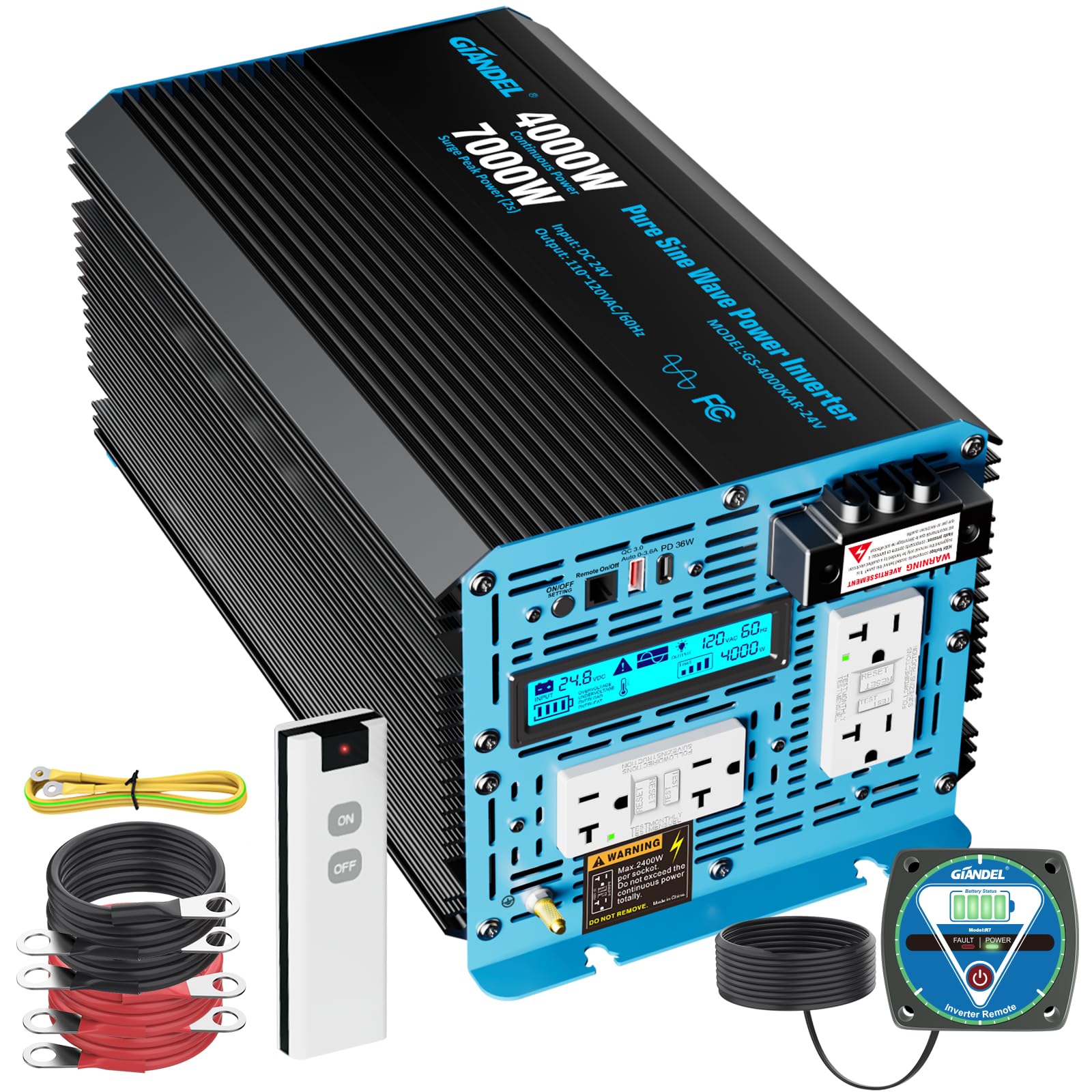
The GIANDEL 4000W is purpose-built for 24V solar and RV installations, converting DC to clean 120V AC with UL458-listed GFCI outlets. The FCC-approved design delivers 7000W of surge (for 2 seconds) and true pure sine wave output at a precise 60 Hz — critical for sensitive electronics and variable-frequency motors.
Two remotes come included: a wired 30-foot on/off remote for fixed placement and a wireless backup for convenience. The large LCD screen renders input voltage, output wattage, battery status, and protection codes clearly. An aluminum alloy housing with fireproof materials provides superior heat dissipation compared to ABS plastic shells.
Some users report a 0.3V discrepancy between the LCD reading and a multimeter — not a dealbreaker for most, but worth noting if you rely on precise voltage monitoring for solar charge coordination. The ground is bonded to neutral internally, which may require adjustment for floating-neutral off-grid setups.
Why it’s great
- UL458 listing with integrated GFCI outlets adds certified safety for RV and marine environments
- Dual remote control (wired 30-ft + wireless) offers flexible installation options
- True 60 Hz pure sine wave output runs inductive loads like microwave ovens without audible hum
Good to know
- LCD voltage reading can be off by 0.3V from actual multimeter measurement
- Ground is bonded to neutral — may need unbonding for floating-neutral solar configurations
5. PowerSmart 7000-Watt Open Frame Inverter Generator (PS5055C)
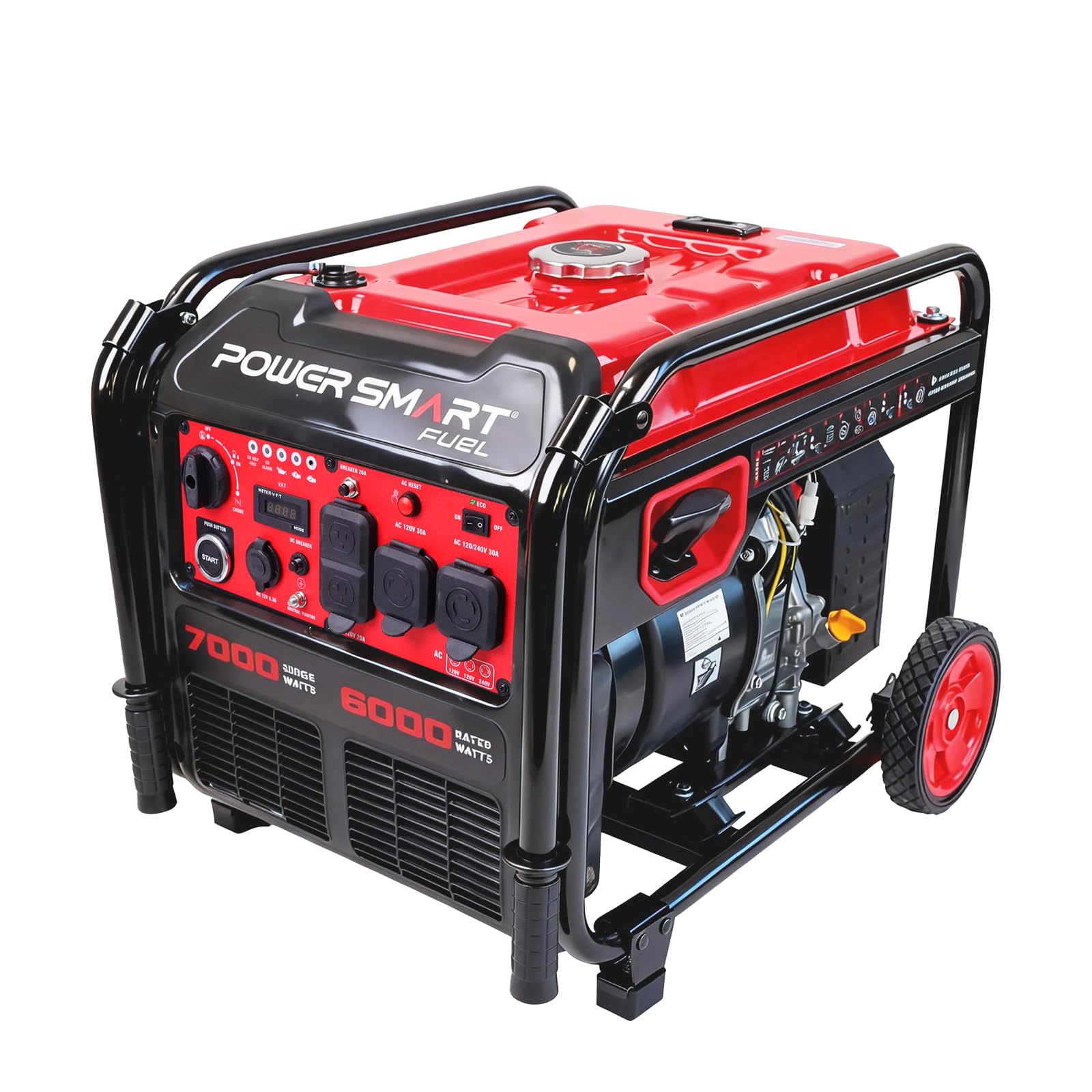
The PowerSmart PS5055C stands out with a 120/240V voltage selector switch, making it ready for transfer switch whole-house backup or 50-amp RV service. The 322cc engine produces 7000W surge and 6000W rated with less than 3% THD, safe for sensitive electronics like laptops and camera gear.
Electric push-button start with a backup recoil eliminates pull-start frustration, and the 3.2-gallon tank delivers up to 6 hours at 50% load — enough to run a refrigerator, lights, and a window AC overnight. The open-frame design improves airflow for sustained heavy loads, and the 113-pound weight is manageable with the built-in wheels.
Noise measures 70 dB(A) at 23 feet — typical for this class and not obtrusive in most neighborhoods. The metal fuel shut-off switch helps prevent carburetor clogging during storage, a common failure point in lesser generators.
Why it’s great
- 120/240V selector enables direct connection to a transfer switch for whole-house backup
- Clean sine wave with <3% THD protects phones, laptops, and other sensitive electronics
- Electric start with battery included eliminates pull-cord hassle
Good to know
- At 113 pounds, it requires a dolly or ramp for loading into a truck bed
- 6-hour runtime at 50% load is shorter than some competitors with larger fuel tanks
6. WEN 6800-Watt Dual Fuel Inverter Generator (DF680iX)

The WEN DF680iX is engineered for two critical jobs: home backup and low-power Level 2 EV charging. Its bonded-neutral 240V configuration outputs 6800W surge (5100W rated) on gasoline or 6000W surge (4500W rated) on propane — the latter running a 40-pound tank for an entire weekend.
The built-in WEN Watchdog CO sensor automatically shuts down the generator if carbon monoxide reaches dangerous levels, and the fuel shut-off lever clears the carburetor before shutdown to extend engine life. Electric start with a plug-in battery connection makes ignition simple, and the telescoping handle with onboard wheels improves portability.
Receptacles include an L14-30R 120/240V locking outlet, a TT-30R RV outlet, and two 120V standard outlets. Running propane, the unit is noticeably quieter than gasoline operation and produces smooth power that well pumps and variable-speed electronics tolerate well.
Why it’s great
- Dual-fuel flexibility — propane lasts longer in storage and extends generator lifespan
- 240V bonded-neutral output supports low-power Level 2 charging for hybrid/EV vehicles
- CO Watchdog sensor automatically shuts down the generator in dangerous CO conditions
Good to know
- Some units have experienced 240V outlet failure within two weeks of use
- Customer service response times have been inconsistent according to user reports
7. Westinghouse 13500W Dual Fuel Generator (WGen10500DFc)
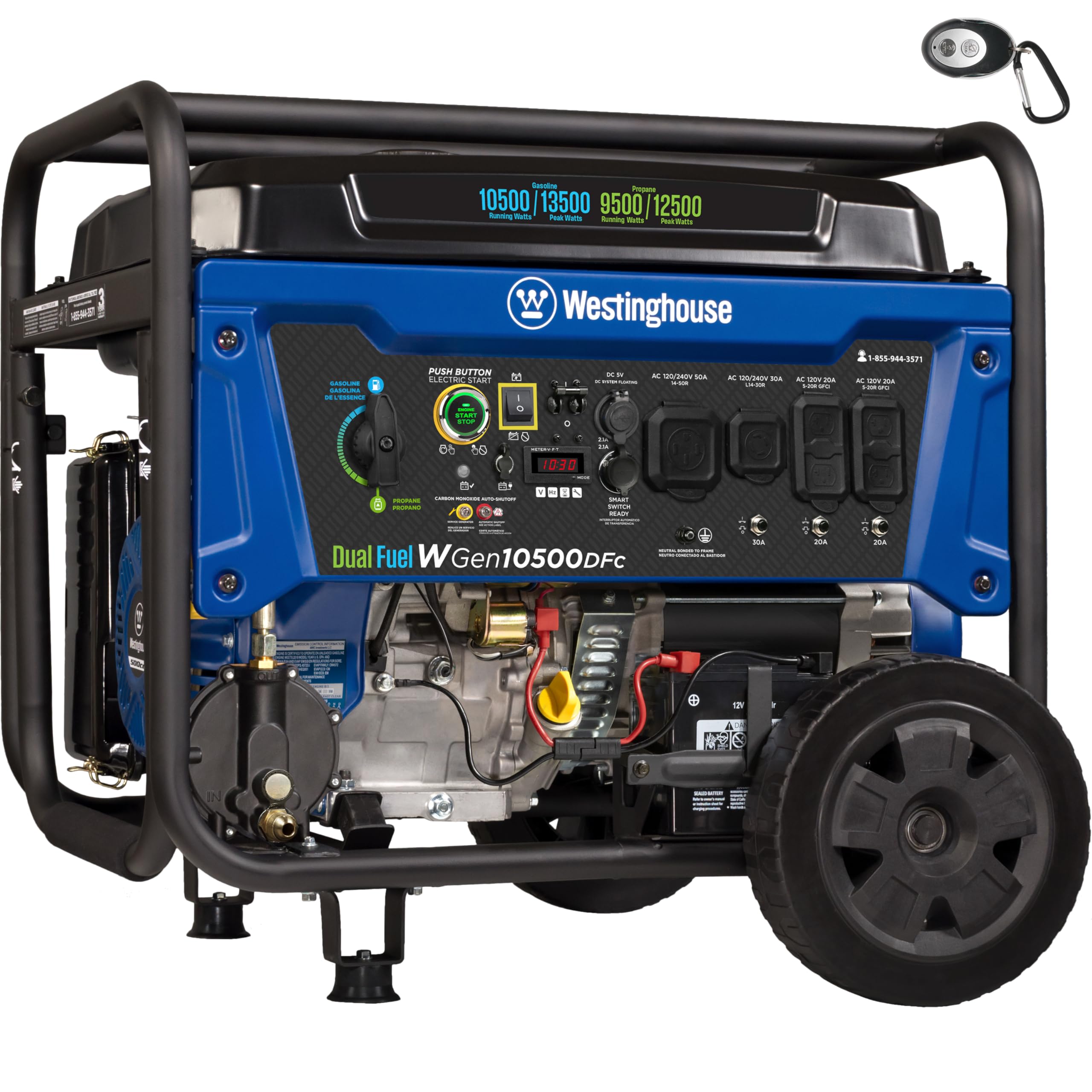
The Westinghouse WGen10500DFc delivers massive power reserves: 13500 peak watts on gasoline (10500 running) and 12500 peak on propane (9500 running). The 500cc cast-iron sleeved engine is built for longevity, and the 9.5-gallon fuel tank yields up to 19 hours of runtime at 25% load — enough to power an entire home through multi-day outages.
Remote start via included key fob is a standout feature, along with electric and recoil backup starts. The outlet panel includes a 120/240V 50A RV outlet, an L14-30R transfer-switch-ready receptacle, and two GFCI 20A household outlets — all with rubber covers for weather protection.
Multiple users report that this generator powers central air conditioning, refrigerators, well pumps, and lighting simultaneously without voltage drop. The tri-fuel capability (gasoline, propane, and natural gas with the included conversion kit) provides fuel flexibility unmatched in this class.
Why it’s great
- 13500W peak power easily handles whole-house loads including central AC and well pump
- Tri-fuel capability (gas, propane, natural gas) provides unmatched fuel source flexibility
- Remote start key fob enables convenient operation from inside the house during storms
Good to know
- At 230 pounds, it is not portable for camping — best used as a stationary home backup unit
- Assembly requires bolting on wheels and handle; expect 15–30 minutes of setup time
8. AIVOLT 8000W Dual Fuel Inverter Generator

The AIVOLT 8000W inverter generator sets a new standard for quiet operation in its power class — 62 dBA at 23 feet, significantly lower than typical open-frame units. The 322cc copper-winding engine produces 8000W peak and 6100W running watts with automatic fuel-switching between gasoline and propane.
The control panel is exceptionally well-equipped: two 120V 20A GFCI outlets, a 240V 30A twist-lock outlet, a 120V 50A industrial outlet, and a 12V DC cigarette port with dual USB adapter. The 5-in-1 LCD display monitors fuel consumption, output in watts, voltage, frequency, and runtime simultaneously.
CO Alert technology automatically shuts down the generator if carbon monoxide reaches unsafe levels. The telescopic rod and 7-inch never-flat wheels make transport easy despite the 131-pound weight. Real-world noise measurements place it around 72–73 dB at 5 feet, which is still impressively quiet for an 8000W unit.
Why it’s great
- Ultra-quiet 62 dBA operation makes it suitable for campgrounds and noise-sensitive neighborhoods
- Comprehensive outlet panel with 240V 30A and 120V 50A covers RV and home backup needs
- Automatic fuel-switching technology between gasoline and propane requires no manual adjustment
Good to know
- Customer support is based in China, which can complicate warranty claims and parts replacement
- A small number of units have failed after minimal runtime due to QC issues
9. Westinghouse iGen8200TFc Tri-Fuel Inverter Generator
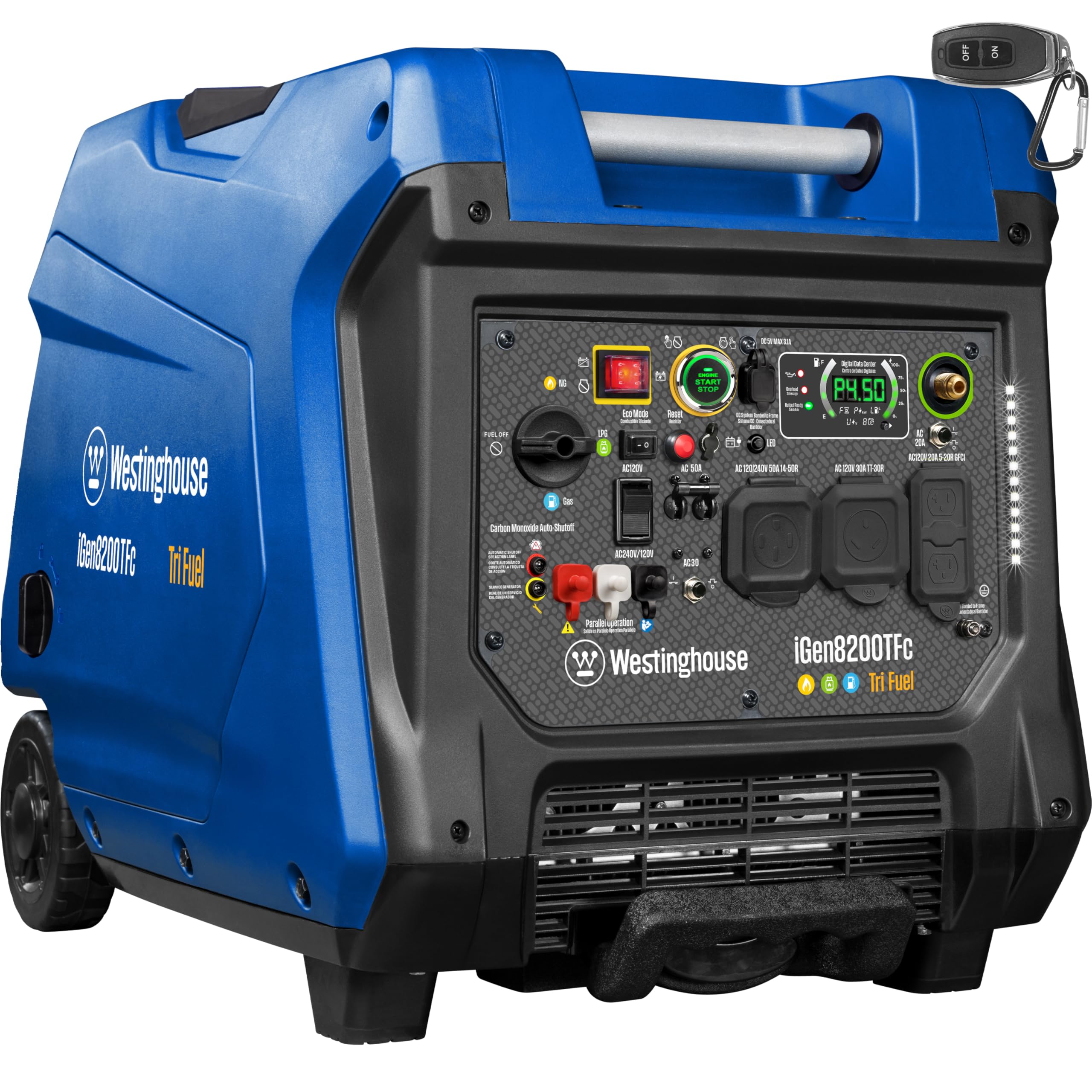
The Westinghouse iGen8200TFc is the most versatile generator on this list, offering three fuel options: gasoline (8200W peak / 6600W running), propane (7380W peak / 5940W running), and natural gas (6560W peak / 5280W running). The 298cc cast-iron sleeved engine with copper windings produces less than 3% THD, making it safe for sensitive electronics like computers, TVs, and medical devices.
Inverter technology adjusts engine speed dynamically, reducing fuel consumption and noise to approximately 60 dBA at 25% load — comparable to a normal conversation. The 3.9-gallon tank delivers up to 17 hours of runtime on gas at 25% load. Remote electric start via key fob and a backup recoil provide failsafe ignition.
The outlet panel is configured for whole-house backup: a 120/240V 50A outlet for transfer switches, a TT-30R 30A RV outlet, and a GFCI duplex 20A outlet. The tool-less access panel simplifies maintenance, and the built-in battery maintainer keeps the starting battery charged during storage.
Why it’s great
- Tri-fuel capability (gasoline, propane, natural gas) provides ultimate fuel flexibility for emergencies and long-term use
- Ultra-quiet 60 dBA operation at 25% load allows conversation-level noise during camping or night use
- Copper windings and <3% THD produce utility-grade clean power safe for all sensitive electronics
Good to know
- At 134.5 pounds, it is lighter than comparable units but still requires two people for loading
- Premium pricing places it at the high end of the 7000-8000W inverter generator segment
FAQ
Can a 240V inverter run my central air conditioner?
What gauge battery cable do I need for a 3000W 12V inverter?
Should I bond the neutral on a 240V inverter for my RV?
Final Thoughts: The Verdict
For most users, the best 240v power inverter winner is the Westinghouse iGen8200TFc because its tri-fuel versatility, ultra-quiet inverter operation, and sub-3% THD pure sine wave output cover the widest range of home backup, RV, and off-grid scenarios. If you need raw power for whole-house backup, grab the Westinghouse WGen10500DFc for its massive 13500W peak and 19-hour runtime. And for a dedicated solar or battery bank system, nothing beats the GIANDEL 4000W 24V inverter with its UL458 listing and dual remote controls.