
Our readers keep the lights on and my morning glass full of iced black tea. As an Amazon Associate, I earn from qualifying purchases.
Specs are compiled from manufacturer listings and verified buyer reviews and can change over time — please confirm the key details on the product page before buying.
When the grid drops, your 240V appliances—the well pump, the dryer, the central AC—are usually the first to go dark. A standard 120V power station can’t touch them. This guide is built around the machines that can: portable power stations with true 120V/240V dual-voltage output, so a single unit can carry your home’s heavy hitters through an outage, an off-grid setup, or an RV hookup.
I’m Min — the founder and writer behind Gadgets Feed. This guide is built by comparing the manufacturers’ published specifications and the patterns across verified customer reviews, so you get each pick’s real strengths and trade-offs instead of marketing spin.
Note that this list uses flexible matching for 240V output, meaning not every pick is the exact number you searched, but the nearest same-type size and wattage serves the same purpose. Here are the best 240V power station options to keep your 240v power station essentials running when it matters most.
Our Picks at a Glance

How To Choose The Best 240V Power Station
Choosing a 240V power station is less about picking a brand and more about matching three numbers to your home’s real needs: capacity, output, and input speed. Getting these right means the difference between powering your fridge for a day versus running your whole well pump setup for the weekend.
Capacity: The battery’s fuel tank
Capacity, measured in watt-hours (Wh), is the total energy stored. A unit like the Anker SOLIX F3800 packs 3,840Wh, which the maker says powers a family’s needs for about one day. A larger 10.8kWh unit, like the OSCAL PowerMax 6000, has nearly three times that. Think of it as the fuel tank—bigger tanks run longer, but they also weigh more and cost more.
Output: The burst of power
Output, measured in watts (W), is the maximum power the station can deliver at once. This is the number that decides whether a dryer or a 1 HP water pump will even start. The Anker SOLIX F3800 delivers a 6,000W AC output, while the PECRON E3800 LFP outputs 4,200W. A 240V well pump can draw 1,500W or more at startup, so matching output to your heaviest appliance is critical.
Chemistry and lifespan
Nearly all modern 240V stations use LiFePO4 (lithium iron phosphate) batteries—a chemistry known for long life and heat resistance. The PECRON E3800 LFP’s LiFePO4 cells hold 80% capacity after 3,500 charge cycles. The BLUETTI Apex 300 doubles that with 6,000+ cycles. That longevity makes these multi-year investments, not disposable gadgets.
Quick Comparison
| Model | Best For | Capacity | AC Output | Weight | Amazon |
|---|---|---|---|---|---|
| Anker SOLIX F3800 | Whole-Home Flexibility | 3,840Wh | 6,000W | 132.3 lbs | Amazon |
| PECRON E3800 LFP | Value + Expandability | 3,840Wh | 4,200W | 87.3 lbs | Amazon |
| BLUETTI Apex 300 | Modular Growth | 2,764.8Wh | 3,840W | 66.1 lbs | Amazon |
| PECRON F5000LFP | High-Power Home Backup | 5,120Wh | 7,200W | 123.9 lbs | Amazon |
| Anker SOLIX F3800 Plus | Fast Recharge + Adapter | 3,840Wh | 6,000W | 135.6 lbs | Amazon |
| EcoFlow DELTA Pro 3 | Silent Whole-Home Power | 4,096Wh | 4,000W | 115 lbs | Amazon |
| EcoFlow DELTA Pro 3 + 400W Panel | Solar-Ready from the start | 4,096Wh | 4,000W | 150 lbs | Amazon |
| Jackery Solar Generator 5000 Plus | Ultra-High Surge | 5,040Wh | 7,200W | 134.5 lbs | Amazon |
| Jackery HomePower 3600 Plus | Lightweight Mobility | 7,168Wh | 3,600W | 77.2 lbs | Amazon |
| OSCAL PowerMax 6000 | Massive Capacity Bundle | 10,800Wh | 6,000W | 56.2 lbs (25.5 kg) | Amazon |
In‑Depth Reviews
1. Anker SOLIX F3800 Portable Power Station, 3,840Wh
The machine that turns your outlet into a whole-home grid—dryer, well pump, and all.
The F3800 is the pick that keeps coming up in owner conversations about whole-home backup. Its defining move is the 120V/240V AC output at 6,000W, which the maker says runs everything in your home without limitation—including the dryer, often the single appliance other stations can’t touch. That’s also the number that beats the BLUETTI Apex 300’s 3,840W output by a notable margin, giving you more headroom for simultaneous heavy loads.
Capacity sits at 3,840Wh, expandable to 26.9kWh with six battery packs, or to two weeks of power if you add a second F3800 and twelve packs. There’s also a NEMA 14-50 port, so you can plug your EV charging cable in directly and charge at 6,000W without extra grounding gear—a feature buyers report using to good effect with a Rivian. The RV crowd gets the same port to feed their rig’s power inlet directly.
You get a rugged inverter that keeps working even when the sky is cloudy—owners mention it “works great powering window AC in FL, even cloudy days” with a roughly 6-hour solar charge. That means you can still harvest sunlight when conditions aren’t perfect. The recurring gripe is solar panel efficiency: one reviewer noted a 400W panel only delivered 218W in full mid-day Texas sun. So treat solar expectations realistically.
What Owners Rely On
- 6,000W dual-voltage output powers a 240V dryer and more
- NEMA 14-50 port for direct EV charging at 6,000W
- Expandable from 3,840Wh up to 26.9kWh with add-on packs
- Anker rates it for a 10-year lifespan and backs it with a 5-year warranty
Where Reality Bites
- Solar panel output often falls short of rated wattage in real sun
- At 132.3 pounds, it is 52% heavier than the PECRON E3800’s 87.3 lbs
- Charging below 50°F is limited by the battery management system
Grab it for: households that want one station to run the dryer, well pump, and window AC without pulling out a gas generator.
Think twice if: you plan to rely primarily on solar panels, since real-world sun harvest can disappoint versus the spec sheet.
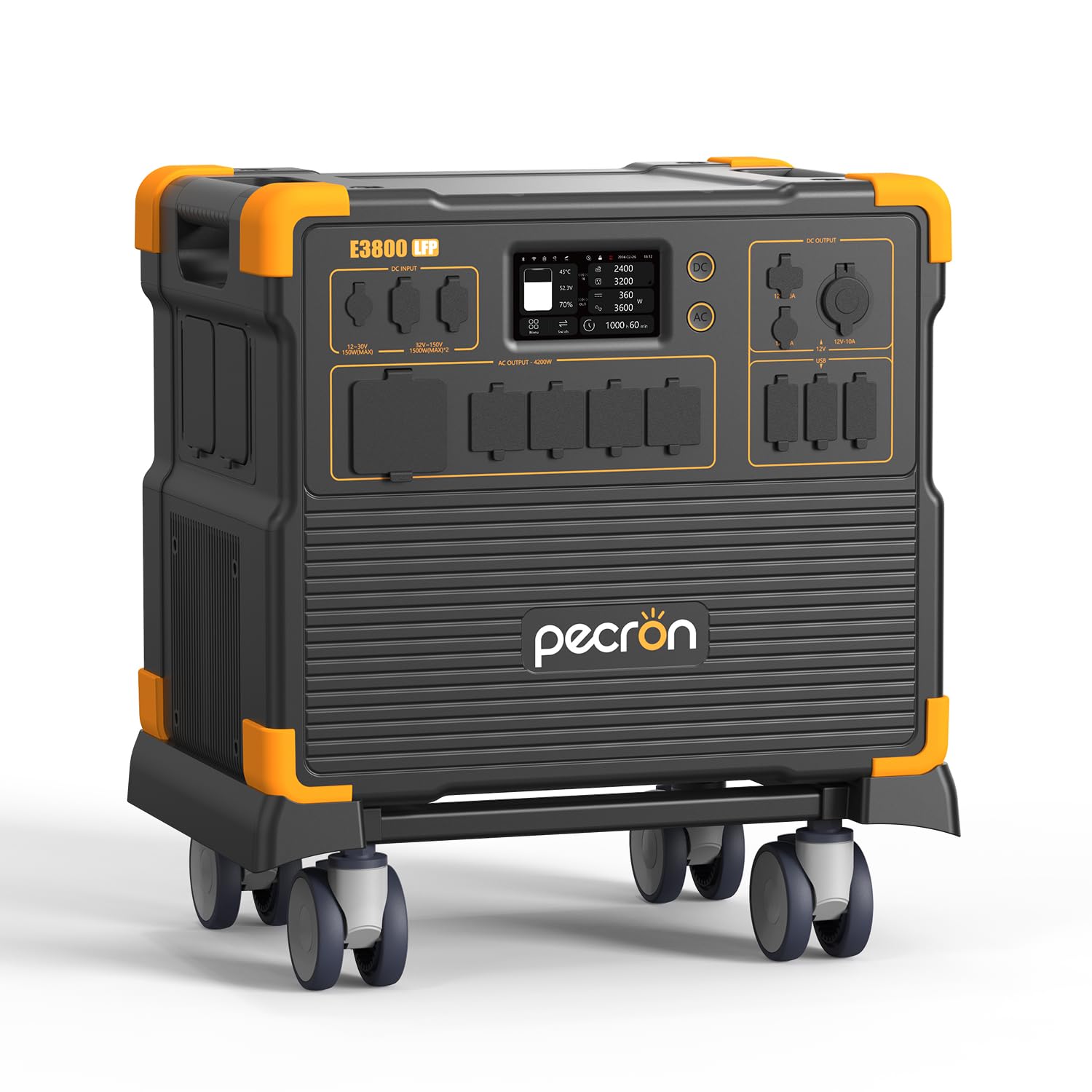
2. PECRON Portable Power Station E3800 LFP, 3840Wh
Massive 240V capacity and a full 4,200W of output at a price that resets the value bar.
The E3800 LFP matches the Anker F3800’s 3,840Wh capacity but races ahead on portability—87.3 pounds versus 132.3, a 52% weight gap that makes moving it up stairs or into an RV noticeably easier. That’s the kind of difference you feel on day one, not a spec-sheet footnote. It also expands to a staggering 53.76kWh when paired with add-on batteries, so this value pick grows into a serious backup system.
Your 240V loads are handled by four 4,200W AC outlets plus a TT30-R RV-ready port delivering pure sine wave power. That means a 1500W heater runs for over 2 hours, and a 1/2hp sump pump starts without hesitation—both verified in real owner use. The built-in UPS function switches to battery in 8-20ms during an outage, which shields computers and other sensitive electronics from the flicker that can corrupt data.
What wins people over is functionality—it’s the most-mentioned aspect, followed closely by quality. Buyers also appreciate the smart control: an LCD touchscreen shows battery level, voltage, temperature, and remaining runtime, and the WiFi/Bluetooth app lets you monitor from your phone. The honest caveat is that full 4,200W output requires unplugging from wall AC or using generator input; on a standard wall outlet, draw is limited. Heavy is the word that comes up, but that’s true of any large-capacity station.
Where It Wins
- 3,840Wh capacity at 87.3 lbs—the lightest big-capacity 240V pick here
- 14 output ports including 4x AC, USB-C 100W, and TT30-R RV outlet
- 3,500+ cycle LiFePO4 battery holds 80% capacity for 10 years
- Fast AC charging: 0-100% in 1.4 hours with the 30A cable
Know Before You Buy
- Full 4,200W output needs a generator input, not just a wall outlet
- Owners note uneven battery drain between units in some setups
- At 87.3 lbs, stairs still require a second person
Reach for this if: you want near-identical capacity to the F3800 but need something more manageable to haul between garage and RV.
Look elsewhere if: you need a single unit to run a 6,000W+ load like a large central AC without adding expansion batteries.
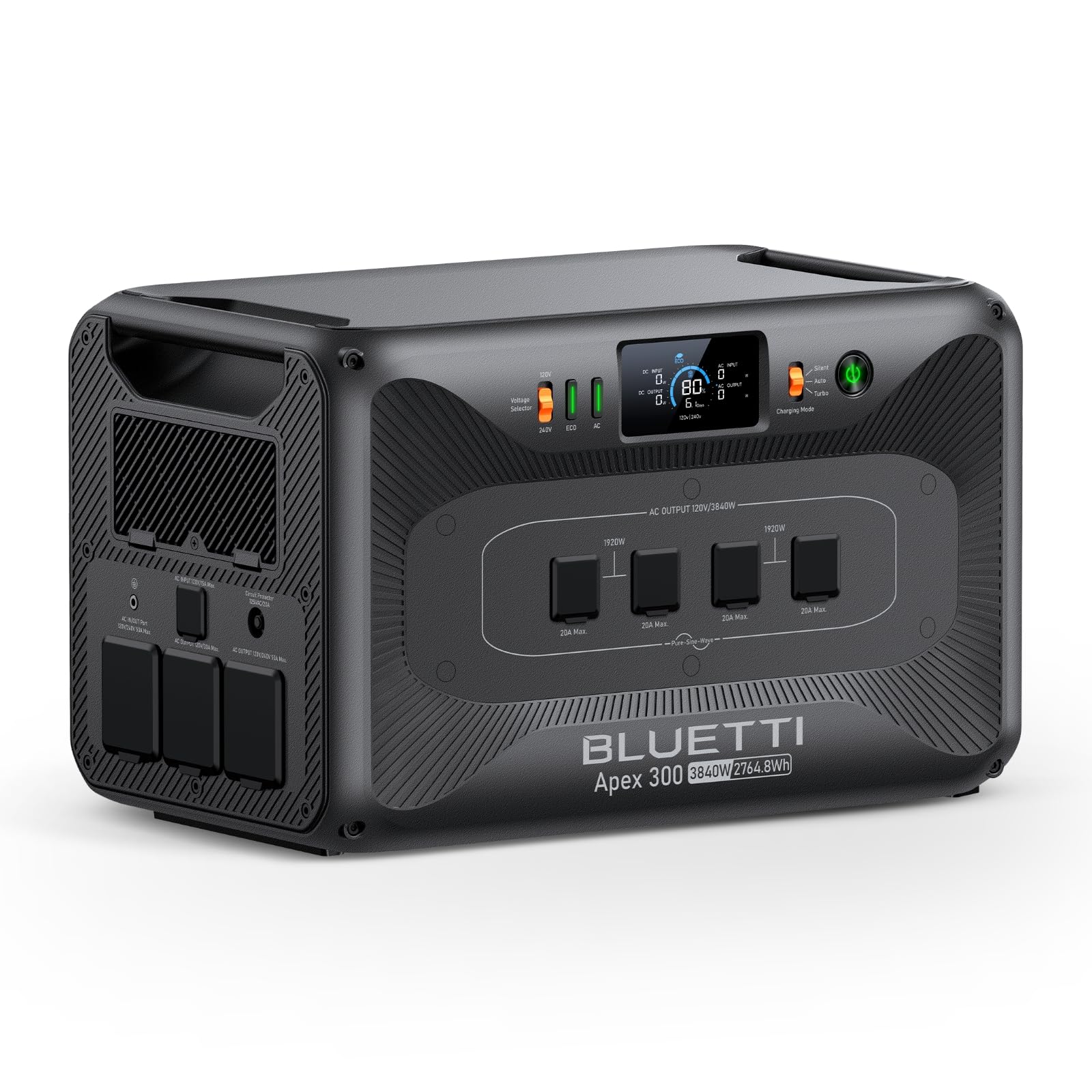
3. BLUETTI Apex 300 Portable Power Station 2764.8Wh
Start small at 2,765Wh and scale to a full home system as your needs grow.
The Apex 300 takes a different path than the monster-capacity units above: it is a “start simple, scale smart” station. At 2,764.8Wh it is the smallest capacity here, but it is also the lightest at 66.1 pounds—dramatically easier to move than the 132.3-pound Anker. The promise is that you buy only what you need today, then add B300K or B500K batteries when your power demands grow into RV trips or multi-day outages.
Output is 3,840W AC with 7,680W of lifting power, and it switches between 120V and 240V through the app or onboard controls. That 3,840W rating trails the Anker F3800’s 6,000W, so this is not the pick for running a dryer and well pump simultaneously. But for fridges, lights, and tools, customers note it excels: one owner ran a fridge and freezer through an outage, seeing roughly 14-19 hours of runtime from an 80/20 charge—about 4% drain per hour.
Performance and functionality are what owners praise most. A standout feature is that AC outlets can wake the unit and power it on—the first BLUETTI with this behavior, which matters for solar emergency setups where you want equipment to spring back to life after a discharge. It also runs at a silent 22dB under the hood. The mixed feedback centers on power consumption—idle draw around 20 watts when connected—so buyers planning long storage runs should factor that in.
Why It Stands Out
- Lightest 240V station here at 66.1 lbs—fits a wheeled cart or dolly
- Dual MPPT ports simplify solar hookup with matching panels
- 6,000+ cycles to 80% capacity, plus a 5-year warranty
- Native 240V support plus expandable storage
The Trade-Off
- Idle draw of ~20W when connected drains battery during storage
- No DC ports—owners note simpler but fewer options than rivals
- Output trails the larger Anker and PECRON units
Best for: buyers who want to start with a manageable, affordable 240V station and grow it slowly with add-on batteries.
Not for: those who need maximum raw output today—the 3,840W ceiling is well below the 6,000W-plus crowd.
4. PECRON F5000LFP Power Station, 5120Wh
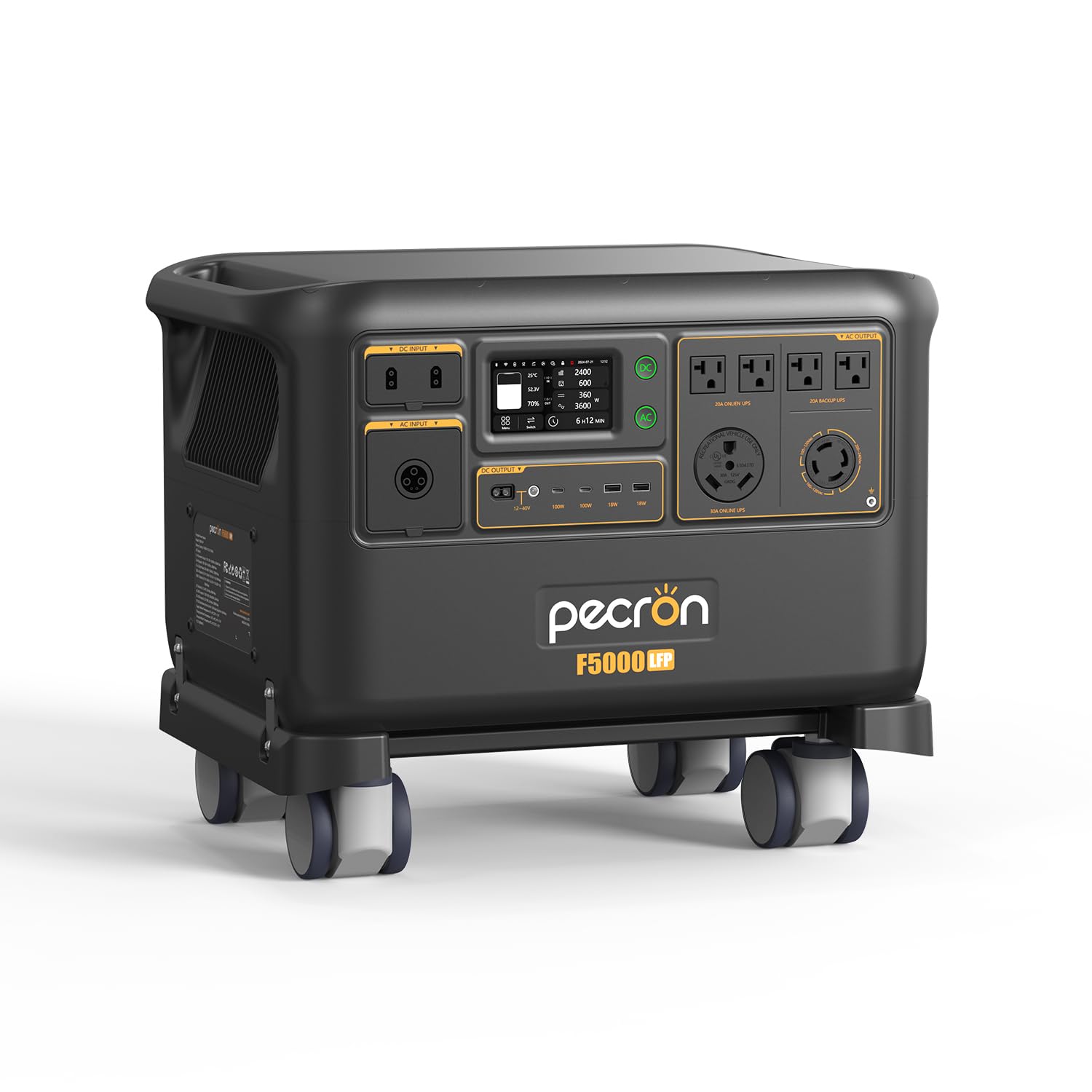
The 7,200W beast that powers a washer, dryer, and even a dishwasher from one box.
If your home’s load exceeds what the smaller 240V stations can carry, the F5000LFP is where you step up. It delivers a 7,200W output with dual 120V/240V support and 5,120Wh of capacity—enough that the maker says it can support an entire household’s essential power needs for up to three days. That capacity expands to 35.8kWh by pairing six FP5000-48V batteries, so it is built like a modular home system from day one.
Output throughput is a different league than the E3800 from the same brand: 7,200W versus 4,200W, meaning larger simultaneous loads. Reviewers point out running a washer, dryer, and dishwasher off the 240V side—work the smaller units cannot manage. It also has two 20A and one 30A 0ms online UPS outlets, so WiFi, aquariums, CPAP machines, and computers never flicker during a switchover. A 6400W solar input with two ports (25A max each) makes this a genuine solar-first candidate.
You get solid functionality and value—owners often say “Great specs, GREAT price.” But reliability is the honest caveat: a few shoppers say inverter failures or solar charge controller issues in early units, and one described a firmware lockout solved only by an OTA fix from support. The unit weighs 123.9 pounds, though the detachable wheeled cart helps. It runs at a low 30dB noise level—quiet enough for CPAP use beside your bed.
The Big Draw
- 5,120Wh capacity handles an entire household’s essentials for days
- 6,400W solar input across two ports—built for solar enthusiasts
- 0ms online UPS protects sensitive electronics from any flicker
- 12 output ports including 100W USB-C and adjustable 12-40V DC
Hesitations
- Mixed reliability feedback: some owners hit inverter or solar controller issues
- At 123.9 lbs, moving it without the wheeled cart is a two-person job
- Runs on the heavier side even with the detachable cart
Choose it for: households that want serious home backup potential—dryer, water heater, and dishwasher—plus large-scale solar charging.
Be cautious if: you need absolute bulletproof reliability from the start; a few early units required support fixes.
5. Anker SOLIX F3800 Plus Portable Power Station + 240V Generator Adapter
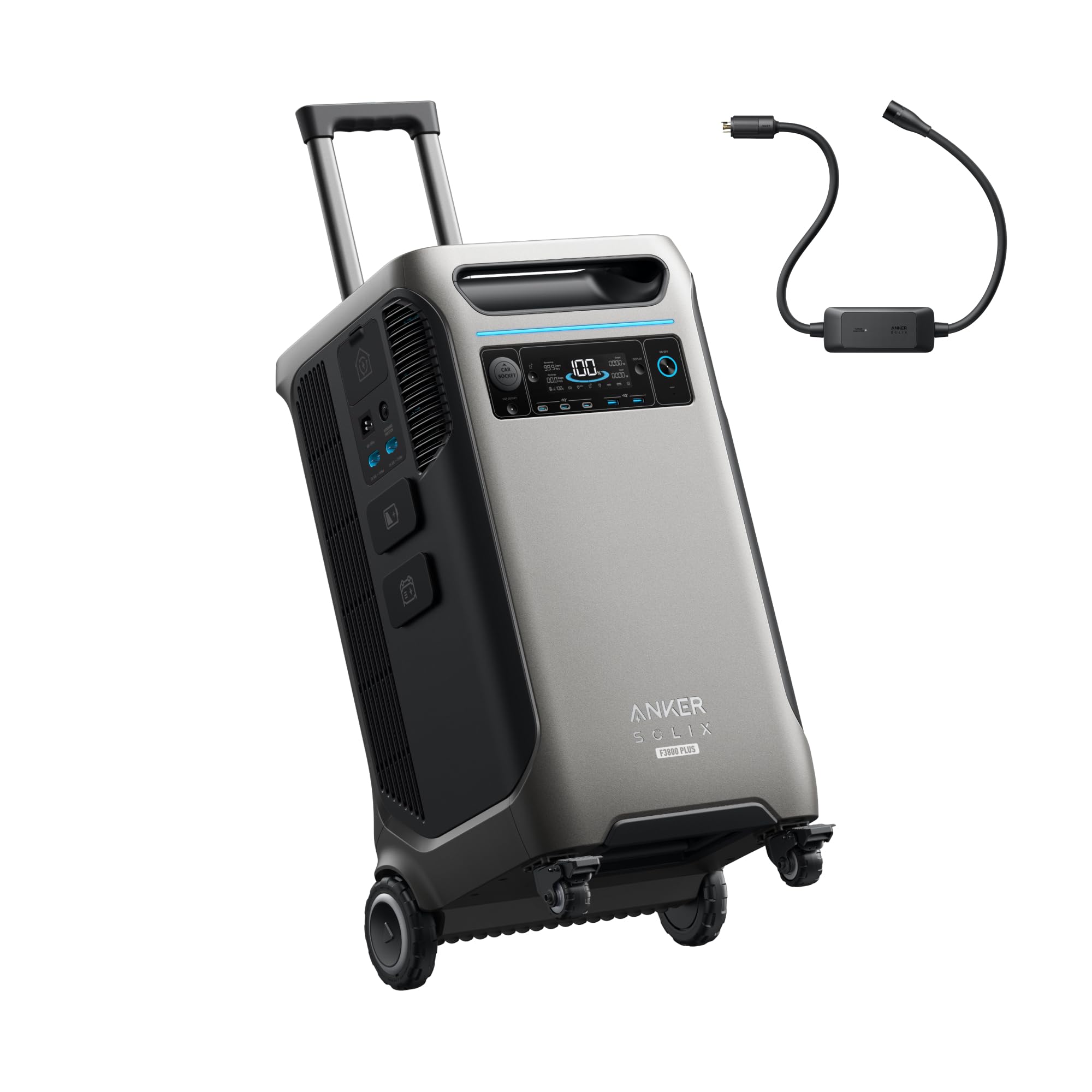
The follow-up that recharges in 63 minutes and pairs a 240V generator adapter for even faster refills.
The F3800 Plus takes the original’s formula and adds one very specific upgrade: speed. Anker claims this version gets outage-ready in just 63 minutes via solar and generator input—a number that matters when you have a storm rolling in and an empty battery. It keeps the same 6,000W output and 3.84kWh starting capacity, expandable to 26.9kWh with six batteries or 53.8kWh with twelve for weeks of power.
It ships with the 240V Generator Adapter, which is the real headline. You plug a 240V gas generator into the adapter for a 6,000W bypass, letting you recharge at high wattage without being limited to a 120V wall outlet. That makes it the pick for buyers who already own a generator and want a hybrid approach: gas to refill, battery to run quietly. The 3,200W solar input keeps a pure-sun option alive too.
Owners describe the engineering in glowing terms—”Exceptional engineering! Best in class”—and praise how the Solix app controls the whole modular system. The most realistic feedback frames it exactly as the maker intends: reliable home backup you can recharge off-peak and run during peak to save money. The one persistent complaint is post-purchase support, with conflicting information on MPPT amp draw and an AI chat pushing overpriced panels. Also note that the station and adapter ship separately, so your boxes may arrive on different days.
Speed and Power
- 63-minute recharge via solar and generator input
- 6,000W output with 120V/240V dual-voltage—runs a dryer
- Includes 240V generator adapter for high-wattage bypass charging
- Expandable to 53.8kWh for weeks of whole-home power
Speed Bumps
- Customer support is the weak spot—conflicting specs and slow responses
- Heaviest in the Anker line here at 135.6 lbs
- Needs additional units for whole-house AC or heat coverage
Pick this if: you already own a generator and want the fastest possible recharging path into a quiet battery backup.
skip it if: responsive customer support is non-negotiable for you—this is the thread owners complain about most.
6. EF ECOFLOW DELTA Pro 3 Portable Power Station, 4096Wh

The stealthy, whisper-quiet powerhouse that charges your EV and reads like a Porsche.
The DELTA Pro 3 is the premium name in this space, and its sticker reflects it. Inside a 115-pound frame sits a 4,096Wh LiFePO4 battery with 4,000W output, jumpable to 6,000W with X-Boost and scalable to 12,000W. The spec sheet says it can power a 3-ton central AC or a 1 HP water pump—that last one being exactly the kind of 240V load you’d expect to trip a cheaper station. It is expandable to 12,288Wh with extra batteries.
Three details set it apart. First, X-Quiet technology keeps it at 30dB—quiet enough that owners say you can sleep beside it. Second, the 10ms switch-over UPS protects NAS systems and servers from even a flicker. Third, EV charging: buyers report the 240V output hits 4,000W easily on a Tesla, though 120V maxes the UMC at 32A and needs a 45-minute cooldown before recharging. There’s also built-in neutral-ground bonding you can toggle in the app—a serious feature for whole-home tie-ins.
Owners are split on two things. The weight (115 lbs) is a genuine negative, though wheels help. And battery life gets mixed marks—some say it doesn’t last longer than 4 hours on heavy loads, while others insist the battery will outlast everything else in the box. The most recent feedback is warmer: owners praise the design (one calls it “stealthy like a Porsche”) and the wheels. The occasional catastrophic failure and warranty headache exists, but it is rare against a 296-review base.
Why It Commands a Premium
- 4,000W output, scalable to 12,000W for whole-home backup
- 30dB X-Quiet operation—genuinely sleeps-beside-you quiet
- 10ms UPS switch-over protects NAS, servers, and entertainment gear
- 240V EV charging at up to 4,000W with neutral-ground bonding
The Cost of Premium
- Heavy at 115 lbs—wheels help but stairs are a two-person job
- Some owners mention only 4 hours of life on heavy loads
- No 12V port, a surprise omission at this price point
Worth it for: buyers who value silence, EV charging, and NAS protection and are willing to pay for a 5-year warranty.
Reconsider if: you need maximum battery runtime on big loads—the 4-hour reports are a real pattern, not a fluke.
7. EF ECOFLOW Power Station 4096Wh DELTA Pro 3 with 400W Portable Solar Panel

The full solar kit—a 4,096Wh station plus a 400W panel—for true off-grid independence from the start.
This is the same DELTA Pro 3 as above, but the bundle changes the game. You get the 4,000W/4,096Wh station plus the 400W portable solar panel, so you can start harvesting sunlight from day one without buying panels separately. It’s the same 120V/240V output and same X-Quiet 30dB operation, plus the 10ms UPS—everything that makes the standalone unit impressive, now with solar included.
The panel itself is a real commitment: owners call it well-built but note it weighs roughly 50 lbs and is large. You’re not tossing this in a backpack; it’s a set-and-forget solar array for a shed or cabin. The station pairs with it via dual MPPT ports, and customers note running whole solar sheds—lights, mowers, tool chargers, even a mini-split—off 240V without breaking a sweat.
Ease of use is the most-praised aspect, with value and solar power close behind. One owner’s practical verdict: they vacuumed the house for fun and the battery barely dropped 2%. The recurring issue is genuine physical bulk—at 150 lbs total for station plus panel, the handle is a concern, and one owner reported it breaking instantly under the panel’s weight. Use a hand cart or two-person lift, and this is a non-issue. Reliability is the wild card—a small number of reviewers point out defective units, though EcoFlow’s customer service did replace units after documentation.
What the Bundle Buys You
- Complete solar setup—station plus 400W panel from the start
- 4,000W output with 240V support powers sheds and 5th wheels
- Runs an entire solar shed including a mini-split
- Sliding outlet covers keep dust out in workshop settings
Before You Commit
- Panel is ~50 lbs on its own—real physical bulk to manage
- Total weight of 150 lbs makes a hand cart essential
- Reliability has some mixed reports; keep documentation handy
Choose it for: anyone setting up a solar-powered shed, cabin, or large RV who wants a turnkey solution with no separate panel shopping.
Pass on it if: you don’t want the tethered weight of a bundled panel—the standalone unit gives you panel flexibility.
8. Jackery Solar Generator 5000 Plus Portable Power Station, 5040Wh
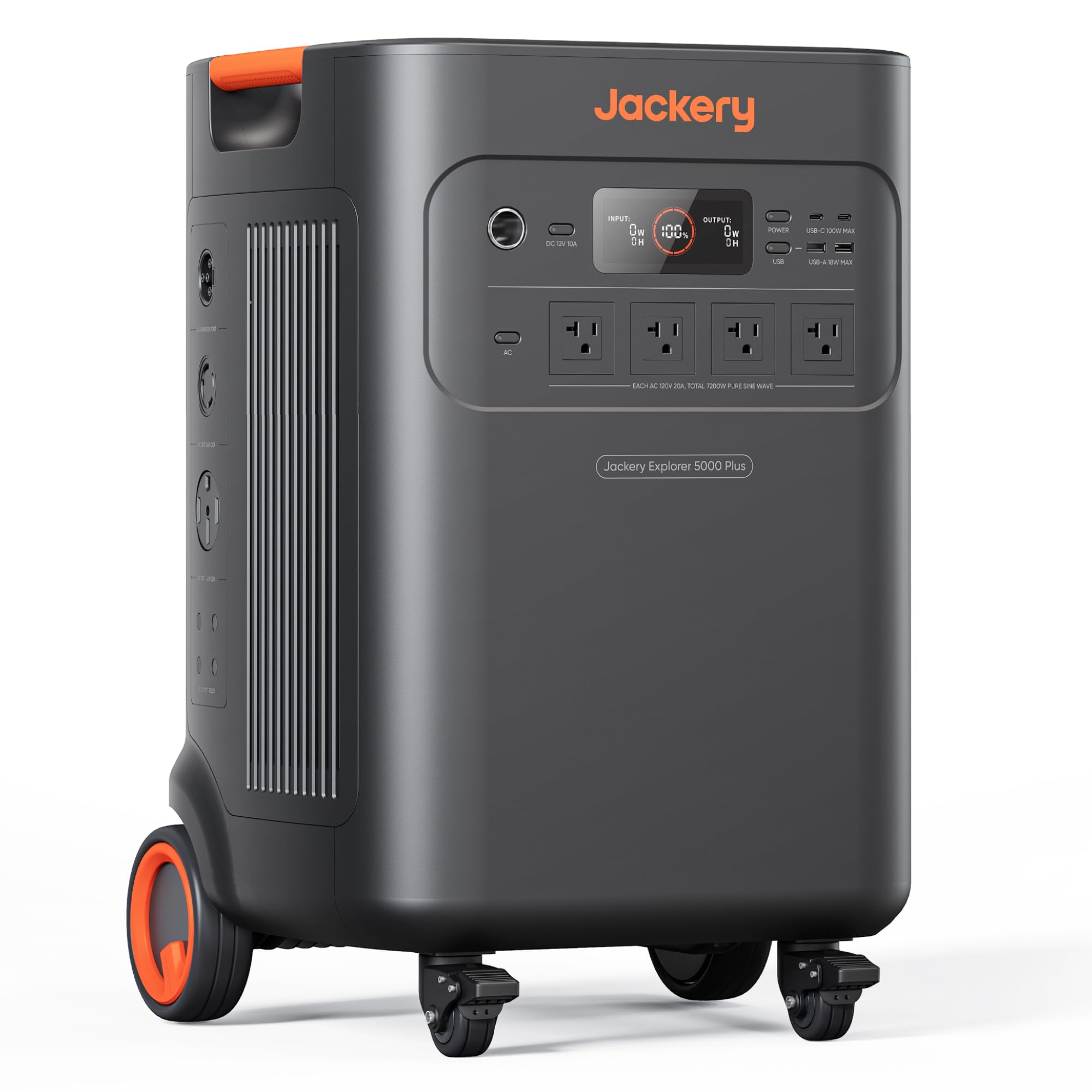
A 5,040Wh tank with a 14,400W surge that starts a 5-ton AC or a water heater instantly.
Jackery’s 5000 Plus is built for the heaviest possible home loads. It delivers 7,200W of rated power with a 14,400W surge—the surge number is what starts big motors like a 5-ton AC or a water heater, which need a massive burst before settling into steady draw. Capacity is 5,040Wh, expandable to 60kWh, and the maker says that’s enough for 13 days of home backup in an extended outage.
The whole-house story gets more interesting with the optional Jackery 60A Smart Transfer Switch, which powers up to 12 circuits at 120V or 6 circuits at 240V. That turns this portable unit into a semi-permanent home system without needing a full solar install. For solar recharging, it accepts both high- and low-voltage panels at up to 4,000W input, topping up in about 2 hours.
Power is the most-praised aspect, and the use cases are diverse—one buyer uses it to weld as a mobile welder, praising that it is quiet and needs no gas. The overall performance gets excellent marks. The honest note is battery life: owners say it holds a charge well but some report losing over 30% daily, which drains a 5,040Wh tank fast if you’re not actively using it. Treat it as a standby unit you keep topped up, not one you store at 100% for months.
The Heavyweight List
- 7,200W rated with 14,400W surge—starts 5-ton AC and water heaters
- 5,040Wh capacity expandable to 60kWh for extended outages
- Smart Transfer Switch powers 12 circuits at 120V or 6 at 240V
- Recharges in ~2 hours with up to 4,000W solar input
Watch Out For
- Battery can lose over 30% daily—needs regular top-ups in standby
- At 134.5 lbs, this is definitely a wheeled-cart machine
- Reliability is mixed; some units work flawlessly, others not always
Grab it for: homeowners with serious motor loads—5-ton AC, water heaters, welders—that need a huge surge to start.
Think twice if: you plan to store it for months between outages; the daily drain makes that impractical.
9. Jackery HomePower 3600 Plus and Extra Battery & 2x200W, 7168Wh
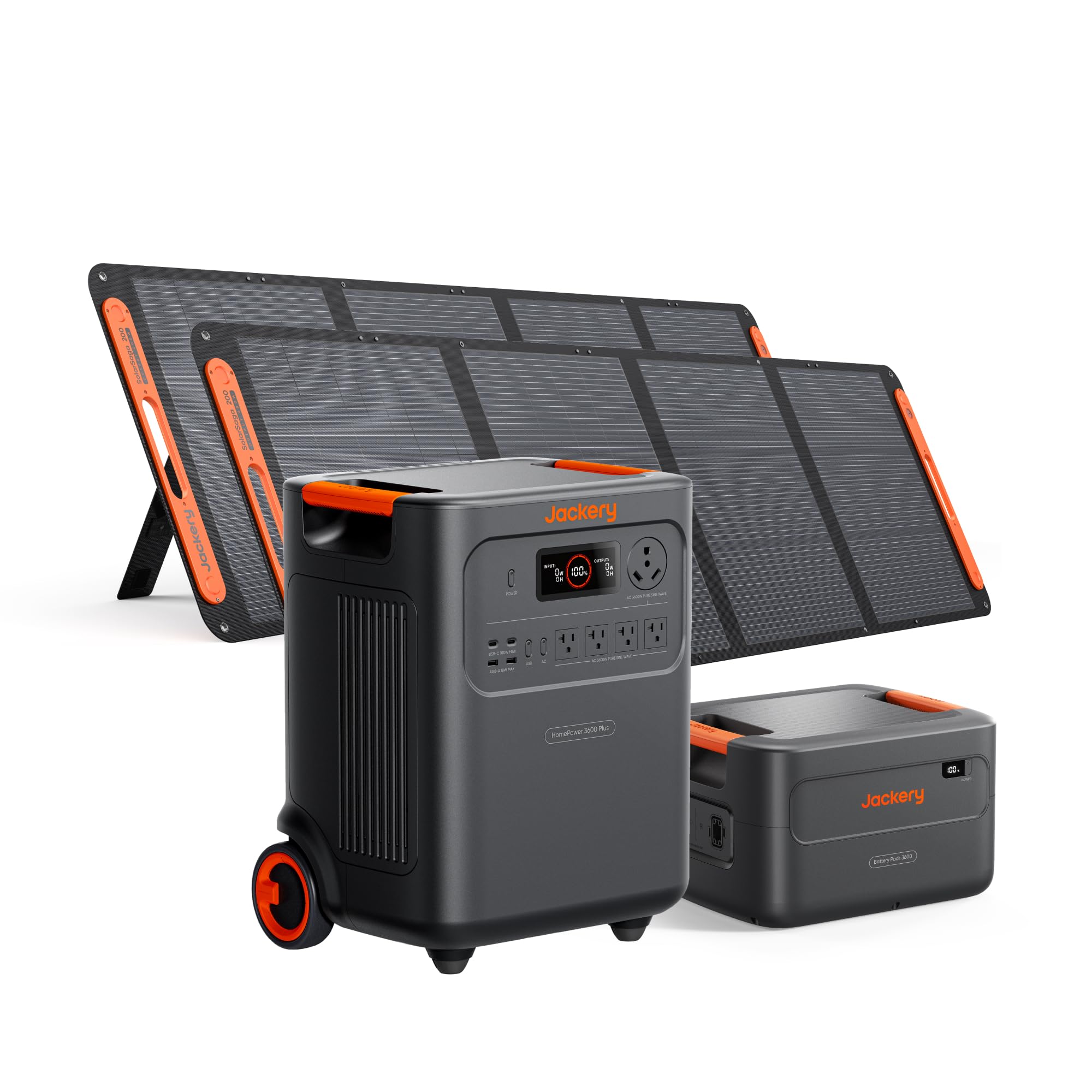
The lightest 3.6kWh LFP station—a luggage-style roller that’s 29.3% lighter than rivals.
This bundle is a real outlier: 7,168Wh of capacity in a 77.2-pound package, which the maker calls the lightest 3.6kWh LFP station on the market—34% smaller and 29.3% lighter than other models. That weight advantage is huge for anyone who isn’t a bodybuilder. The luggage-style design with wheels and a telescopic handle means you roll it from the kitchen to the garage like a suitcase, which multiple owners confirm is genuinely easy, even for seniors.
Output is 3,600W, jumpable to 7,200W in parallel mode, with dual voltage (120V & 240V in parallel). Capacity is 3,584Wh per unit, expandable to 21kWh per unit or 43kWh with multiple units—the maker says that powers a 3-person household for over 2 weeks. It charges from 0-100% in 2 hours via hybrid AC+DC, or 2.5 hours from a gas generator, making it flexible.
What owners genuinely appreciate is the safety story: high-temp resistant ceramic membrane battery cells tested at 302°F prevent thermal runaway, offering 6,000 cycles and a 10-year lifespan. The real-world anecdotes are heartwarming—one family used it to keep a TV running for an autistic child during a power outage. The caveat: this is a 30-amp system, and one buyer explicitly wished for 50-amp capability. For most homes and RVs with 30-amp service, this is a non-issue, but check your panel.
The Lightweight Advantage
- 77.2 lbs for 7,168Wh—nearly half the weight of comparable capacity
- Luggage-style design with wheels and telescopic handle
- Ceramic membrane cells tested at 302°F prevent thermal runaway
- 6,000 cycles and a 10-year lifespan
Limitations
- 30-amp service only—no 50-amp capability for larger RVs
- The 3,600W output is below the 6,000W-plus heavy hitters
- Battery drains are uneven across the included extra pack per some owners
Reach for this if: you need serious capacity but can’t handle hauling a 130-pound brick—this one rolls like luggage.
Look elsewhere if: you have a 50-amp RV or need to run multiple high-wattage 240V appliances at once.
10. OSCAL 10.8kWh Portable Power Station PowerMax 6000, 120/240V
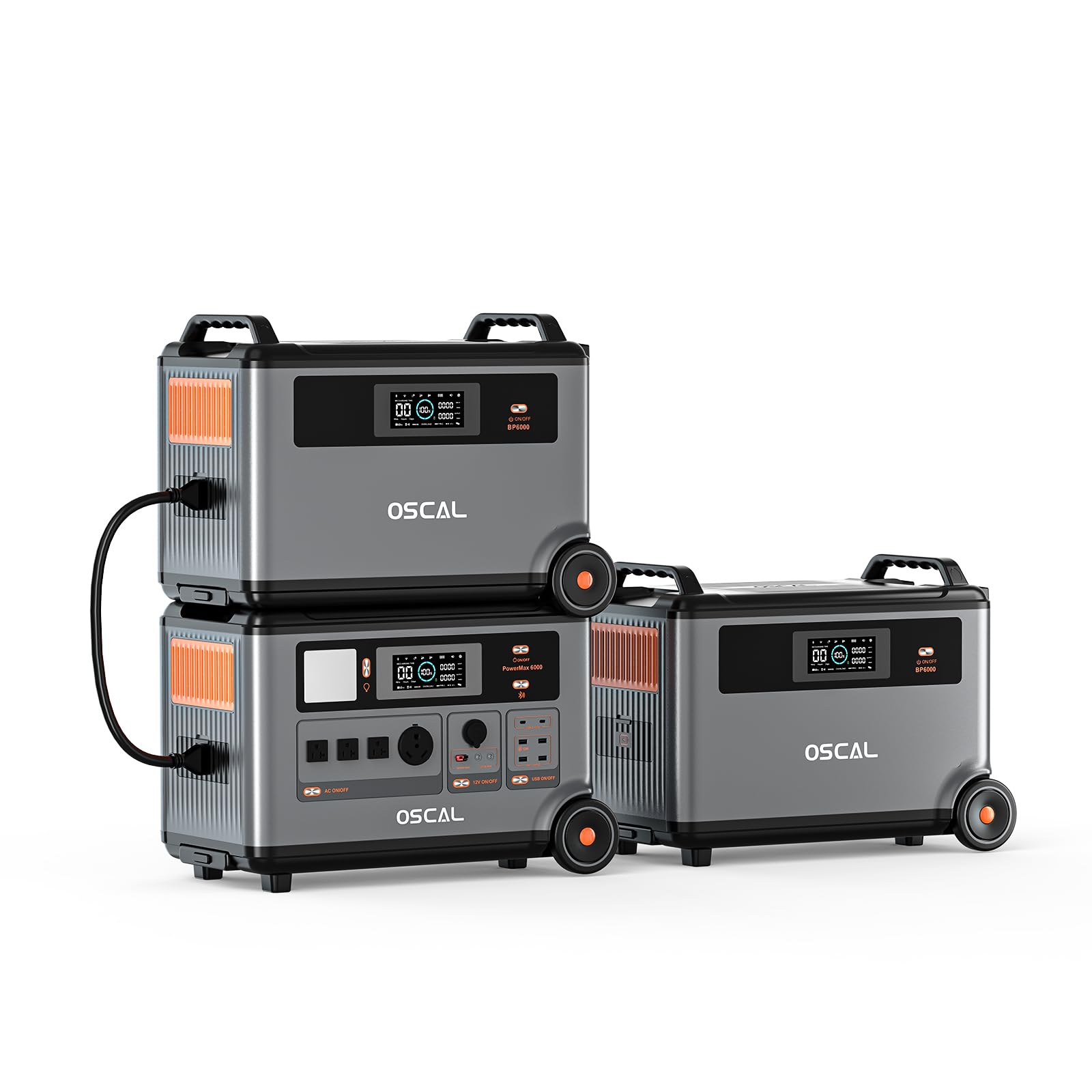
A 10.8kWh home-in-a-box with 6,000W of 120/240V split-phase output and 14 outlets.
OSCAL’s PowerMax 6000 makes every other unit here look like a starter kit. This bundle comes with the station plus two extra batteries for a total 10.8kWh capacity—roughly three times the Anker F3800’s 3,840Wh. Output is 6,000W with a 9,000W surge, over 120V/240V split-phase dual voltage. The maker’s claim is that an unplanned outage won’t interrupt any family’s charging needs, with 14 output sources across the unit.
Recharging is a standout: you get 2,200W AC input with a 2,400W solar input, delivering 0-100% in 1.44 hours on AC or 1.96 hours on the included cable. The bi-directional inverter handles both directions, which makes that speed possible. It also has a 5-8ms EPS switchover—energy protection system—which is faster than the PECRON’s 8-20ms, so your network equipment and home electronics keep running through outages smoothly.
Buyers call it well-made, and the build quality is the top-praised aspect. The unit is quiet, the display is clear, and one owner sums it up: it gives current to the entire house and works well with solar panels. The glaring negative is connectivity: multiple shoppers say you can only connect ONE solar panel at a time, even though the bundle includes three. A 3-star owner put it bluntly: “Why would you sell a power generator with 3 solar panels without a way to use three solar panels?” That limitation is real and frustrating for solar-first buyers.
The Capacity Play
- 10.8kWh total capacity with two extra batteries included
- 6,000W output with 9,000W surge over 120V/240V split-phase
- 1.44-hour full recharge via 2,200W AC input
- 5-8ms EPS switchover protects sensitive electronics
The Catch
- Only one solar panel can connect at a time—a real frustration with 3 panels included
- Heavy, though wheels help; the 25.5 kg weight is a two-person job upstairs
Choose it for: buyers who want maximum capacity from the start without buying expansion packs later—10.8kWh is a full-home tank.
Reconsider if: solar is your primary charging path; the single-panel connection limit undermines the whole bundle.
Understanding the Specs
Watt-Hours (Wh): The Fuel Tank
Capacity, measured in watt-hours, is the total energy a station can store. A 3,840Wh unit like the Anker SOLIX F3800 can run a 1,500W heater for roughly 2.5 hours, while the OSCAL’s 10,800Wh tank runs it for over 7 hours. More capacity extends outage runtime but adds pounds—a trade-off often buried in the fine print.
Watts (W): The Burst Power
Output, measured in watts, is the maximum power the station delivers at a single moment. This is what starts motors—a 1 HP water pump needs a surge before settling into steady draw. The Jackery 5000 Plus’s 14,400W surge starts a 5-ton AC, while the BLUETTI Apex 300’s 3,840W output is better suited to fridges and lights. Match output to your heaviest appliance, not your average draw.
FAQ
Can a 240V power station run my electric dryer?
How long will a 240V power station run a well pump?
What is the difference between 120V and 240V output?
How many solar panels do I need to charge a 240V power station?
Can I charge my EV with a 240V power station?
Is LiFePO4 better than other battery types?
How heavy are these power stations?
What does the UPS function do in a power station?
Final Thoughts: The Verdict
Across the board, the best 240v power station is the Anker SOLIX F3800 because it pairs a full 6,000W dual-voltage output with EV charging and a 10-year lifespan. If you want the best value and don’t mind slightly less output, grab the PECRON E3800 LFP—same capacity at 52% less weight. And for a lightweight, roll-anywhere option that still delivers serious capacity, the Jackery HomePower 3600 Plus is the one to reach for.
How We Picked
We do not accept paid placement. Every pick is matched to a real buyer and a real use-case; we do not hands-on test units.
Sources & Methodology
Specifications: manufacturer listings and product documentation. Review insights: verified customer reviews, as of August 2026. Pricing: not shown on this page (it changes often); check the current price via the retailer link.
As an Amazon Associate, Gadgets Feed earns from qualifying purchases. This does not affect which products we feature.