
Our readers keep the lights on and my morning glass full of iced black tea. As an Amazon Associate, I earn from qualifying purchases.
Specs are compiled from manufacturer listings and verified buyer reviews and can change over time — please confirm the key details on the product page before buying.
You want 240V split-phase power, and the wrong inverter means your air conditioner stumbles on startup, your well pump dies mid-cycle, or your batteries drain overnight doing nothing. The pick that handles this best is the SUNGOLDPOWER 10000W 48V — a 10,000W pure sine wave all-in-one with dual MPPT charge controllers, 200A battery charging, and a genuine 240V split-phase output.
I’m Min — the founder and writer behind Gadgets Feed. This guide is built by comparing the manufacturers’ published specifications and the patterns across verified customer reviews, so you get each pick’s real strengths and trade-offs instead of marketing spin.
Every unit here outputs true 240V split phase, so you can read the difference between continuous watts, surge ratings, and MPPT charging before you spend. This breakdown of the best 240V solar inverter pairs each unit’s real published specs with what owners actually hit in daily use.
Our Picks at a Glance


How To Choose The Best 240V Solar Inverter
A 240V solar inverter turns the DC power stored in your 48V battery bank into the split-phase AC that runs your house. Split phase means the unit produces both a 120V leg and a 240V output, so your old dryer or well pump can run like it did on the grid. Here is what actually decides whether a unit fits your setup.
Match continuous watts, not the peak number
The continuous (rated) output is what the inverter can hold all day. The peak number — often double the rated figure — only covers a few seconds of surge. A well pump or AC compressor draws a heavy spike on startup, so give yourself headroom above the continuous rating.
Check MPPT count and PV voltage ceiling
MPPT controllers pull the most power it can from your panels. Two MPPT inputs let you wire two separate strings that don’t have to match perfectly. The PV open-circuit maximum tells you how many panels you can chain in series before you risk damage.
Pick grid-tie or off-grid on purpose
A grid-tie unit with a limiter feeds only your own loads and blocks backflow to the utility. An off-grid hybrid charges batteries and runs your circuits but will not backfeed. Buying the wrong type is the most common and most expensive mistake here.
Quick Comparison
| Model | Best For | Continuous Output | Battery Voltage | MPPT Controllers | Amazon |
|---|---|---|---|---|---|
| SUNGOLDPOWER 10000W 48V (SPH10048P)★ Best Overall | Whole-home off-grid with room to surge | 10,000W | 48V DC | 2 | Amazon |
| Y&H 2000W Grid Tie (SUN-2000GTIL2-H)Best Value | Small grid-tie with no battery bank | 2,000W | 60V/72V battery option | 1 | Amazon |
| Ampinvt 5000W 24VTop Performer | Low-frequency heavy loads on 24V | 5,000W | 24V DC | — | Amazon |
| ECO-WORTHY 6KW AIO (US-L03NK6000US-1) | Mid-size home backup with touchscreen | 6,000W | 48V DC | 1 (9000W) | Amazon |
| POWLAND 12000W Hybrid | Big homes, RV parks, battery-free grid feed | 10,000W | 48V DC | 2 | Amazon |
| EcoSolLi 12000W Hybrid | High-power households with parallel scaling | 12,000W | 48V DC | 2 | Amazon |
| PROSOLI 12000W (SGR-12KW-U-PR) | Whole-house off-grid with touchscreen | 12,000W | 48V DC | 2 | Amazon |
| SUNGOLDPOWER 6500W 48V (SPH6.5K48) | Parallel expansion on a budget | 6,500W | 48V DC | 2 | Amazon |
| SUNGOLDPOWER 6500W 48V (SPH6548P1) | Off-grid homes needing clean transfer | 6,500W | 48V DC | 2 | Amazon |
| PowMr 10000W (POW-SunSmart 10KP-F) | Off-grid backup with dual MPPT | 10,000W | 48V DC | 2 | Amazon |
| ECO-WORTHY Liber 10000W | Permanent off-grid install with TOU scheduling | 10,000W | 48V DC | 2 | Amazon |
In‑Depth Reviews
1. SUNGOLDPOWER 10000W 48V Solar Inverter (SPH10048P)
Our pick — 4.5★ from 100+ verified ratings; the strongest balance of quality and price.
A 10,000W workhorse that carries a whole house without flinching on startup.
The all-in-one build bundles a 10,000W pure sine wave inverter, two MPPT solar controllers, and a 200A battery charger into a single blue box. That 10,000W rated output is what it holds continuously, with a 20,000W peak for the few seconds a compressor or pump spikes. The 48V DC input matches a standard 48V battery bank, and it outputs split-phase 120V/240V or single-phase 120V. It is the top pick here for anyone running a full house off-grid or as backup.
This inverter can run your whole home, not just one circuit, because its rated output is 10000W versus the Y&H 2000W above it in the chart — a five-times difference in the power it can hold. It is also far heavier, at 53.5 pounds against the Y&H’s 14.8 pounds, which is the trade-off for the transformers and cooling inside. Owners running this 10kW unit report it carrying the daytime load and cutting the monthly grid bill sharply.
The real sticking point is idle draw. A 48V unit like this sips battery even when nothing is running, and owners who park a 5.12kWh pack on standby report it can drain over a stretch of days. Plan your battery bank with that overnight parasitic load in mind. The other honest note: the AC input and output terminals are snug for stiff 6-gauge wire, so budget a little extra patience at the wiring stage. Reviews sit at a strong 4.5 stars across 100+ ratings.
Where it pulls ahead
- 10,000W continuous / 20,000W peak handles multiple heavy loads at once
- 200A battery charging means faster recovery on shore or PV power
- Two MPPT controllers for flexible panel string matching
- Four charging modes and four output modes let you set utility vs solar priority
- Time-slot charge/discharge for peak and off-peak tariff arbitrage
What to plan around
- Battery drain on standby is higher than some rivals — size your bank accordingly
- Terminals are tight for 6-gauge wire
- Setup demands real comfort with configuring charge parameters
Reach for this if: you are wiring a whole home, a large cabin, or a food truck that runs multiple appliances at once and needs 240V split phase with genuine surge headroom.
Look elsewhere if: you want a plug-in single-circuit setup or a grid-tie limiter with no battery bank — the 200A charger and 10kW capacity are wasted on a small load.
2. Y&H 2000W Grid Tie Inverter SUN-2000GTIL2-H
A compact grid-tie limiter that shaves peak loads — when it holds up.
This is the odd one out in the lineup: a grid-tie inverter with a power limiter, not an off-grid hybrid. It takes DC input from solar panels or a 60V/72V battery and feeds your own 240V household loads while blocking backflow to the utility. The DC input window runs 45-90V with a 49V startup, and it wants a panel array of 1000W or higher with an open-circuit voltage between 76V and 90V. Multiple units can be stacked to grow output.
Its MPPT efficiency is rated up to 99%, and owners of good units report steady power delivery and a fan quiet enough to forget in a garage. It is modest in weight at 14.8 pounds — versus the 53.5 pounds of the SUNGOLDPOWER 10000W above — which makes it easy to wall-mount. The selling point is that limiter: it supplies your loads first and holds back energy that would otherwise flow to the grid.
This is the lowest-rated pick in the roundup, and the reliability record is genuinely mixed. Some units deliver a steady output for a year or more, while others quit within a season — a run as a 48V overflow protector that produced 1600W for three months before going dead is a fair summary of the risk. Power output also lands all over the map, from 800W steady to as low as 65% efficiency depending on the unit. The wiring also wants modification for two-phase US 240V setups, and the three-terminal mains connection ships without a clear diagram. If you are handy with electronics and want a small grid-tie limiter, it can earn its place. If you want set-and-forget, look at the off-grid hybrids instead.
Why some buyers keep it: the limiter function works as designed, the fan is quiet, and stacking units lets you grow output without replacing the whole system.
Where it frays: reliability is the weak spot — a fair share of units fail inside the first year, and the seller’s suggested fix often means soldering replacement components onto the board yourself.
Worth it for: a tinkerer running a small grid-tie setup who wants the limiter feature and is comfortable with possible board-level repairs.
Think twice if: you need guaranteed uptime for critical loads — the off-grid hybrids in this list carry more consistent track records.
3. Ampinvt 5000W 24V Pure Sine Wave Inverter
A heavyweight low-frequency unit built to muscle through motor startup loads.
Low-frequency inverters carry a big transformer that delivers serious surge capacity, and this Ampinvt is exactly that breed. It is a 5,000W unit running on a 24V DC battery bank, outputting split-phase 120V/240V AC with a 15,000W peak. It also packs a battery charger and an auto-transfer switch, so it swaps between grid and battery power on its own. The built-in AVR stabilizer keeps output voltage steady, and the transfer efficiency is rated above 90%.
Where it shines is motor loads. The heavy transformer lets it start freezers, compressors, and car charging that high-frequency inverters simply choke on. Buyers report running a 2 hp deep well pump and heavy tools off it with clean 120/240V output. The 67.6-pound heft — heavy for a 5kW unit — is the physical cost of that transformer.
The catch is heat and support. At sustained output near 3800W, owners mention it can overheat within minutes unless you add airflow — one owner bolted on a server fan to solve it. Technical support is thin, and there is no paper manual, so you spend time finding setup steps like holding Enter for 10 seconds to enter programming. Battery compatibility includes SLA, AGM, GEL, Li-ion, and flooded, with an adjustable charge current from 0-35A. Reviews land at 3.6 stars over a moderate pool. For a builder who wants transformer-based surge power on a 24V bank, it delivers. For anyone expecting a guided setup, plan for some trial and error.
The transformer advantage: real surge capacity for wells, compressors, and tools that lighter high-frequency units struggle to start.
The honest trade-off: it runs hot under sustained heavy load and needs added airflow, and documentation is sparse enough that setup time is real.
A strong fit for: buyers on a 24V battery system who need to start motor-driven loads like pumps and compressors.
Skip past if: you want a 48V hybrid with app monitoring and thorough documentation from the start.
4. ECO-WORTHY 6KW Split-Phase AIO Inverter
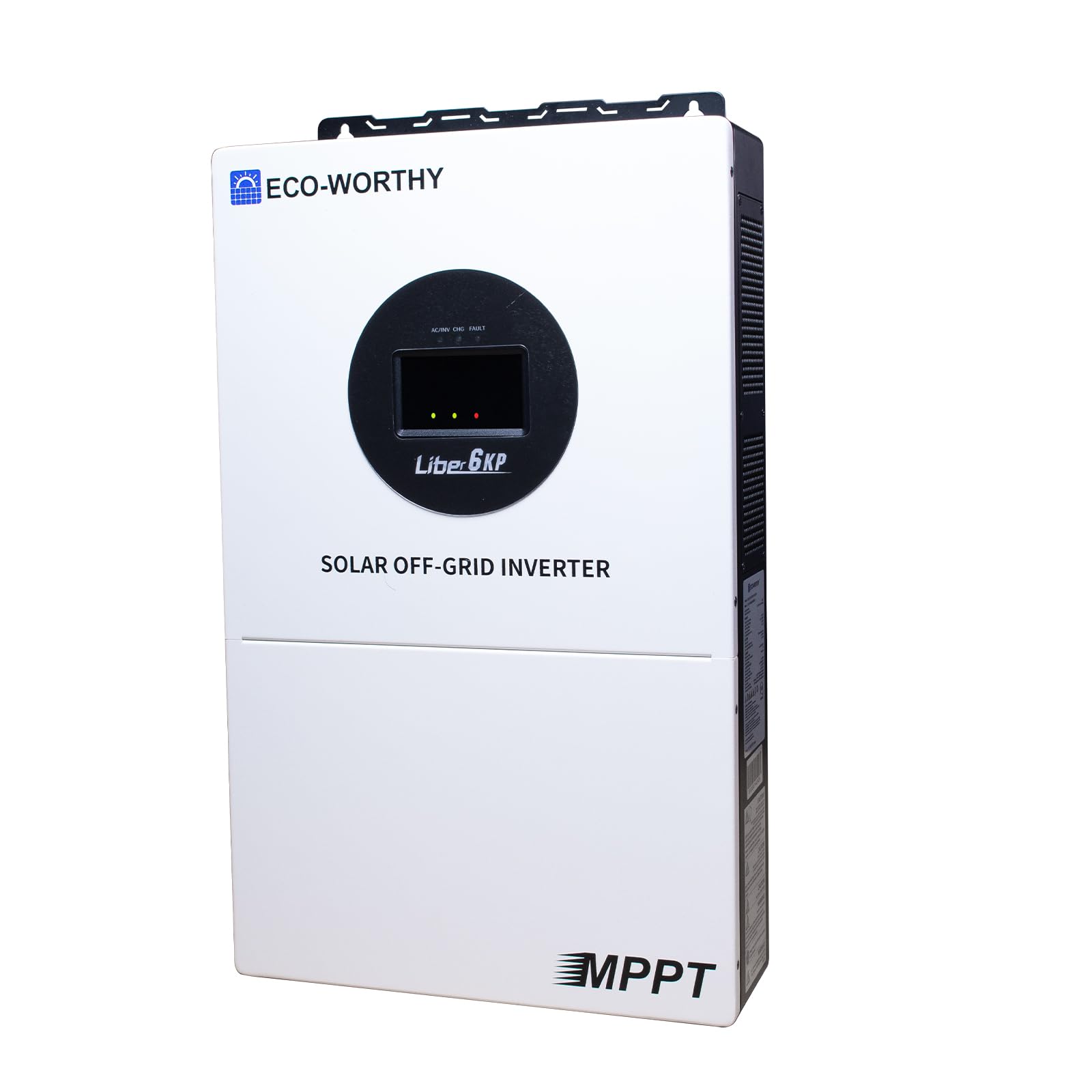
A touchscreen all-in-one that keeps 240V split-phase appliances humming off-grid.
This ECO-WORTHY unit converts 48V DC to split-phase 240V AC for running air conditioners, water heaters, and washing machines off-grid. It pairs a 6,000W inverter with a 9,000W MPPT solar charge controller. The PV ceiling is 500VDC open-circuit, the MPPT works from 125VDC to 425VDC, and it charges at up to 120A from solar or 100A from AC. A capacitive touchscreen handles setup and shows live data, and three LED indicators flash status at a glance.
The size is friendly — it fits a compact wall footprint and slips into a tight equipment corner without a huge transformer block. Owners running it daily report a steady 120/240V output, a working app once configured, and months of flawless service. Four output modes (grid priority, solar, solar-plus-battery, and battery-first) give you a lot of flexibility for a mid-size hybrid.
The friction shows up around setup and support. The instructions are thin and owners often turn to outside help to program the charge settings, and the third-party app is clunky enough that many just use the panel. Support has a reputation for slow callbacks — one buyer waited weeks for a returned message. There are also real reports of units dying young, including one that lost a phase after two days, so test yours thoroughly inside the replacement window. That is the small risk against an otherwise capable, well-featured unit.
Standout feature: the 9,000W charge controller with a 500VDC PV ceiling gives you headroom for a serious panel array, and the touchscreen makes settings changes quicker than a menu of codes.
The soft spot: documentation is thin and support is slow, so plan to lean on forums or outside guidance to get the charge parameters dialed in.
Pick this for: a mid-size off-grid home or cabin that needs 240V split phase with a clean touchscreen and real solar charging capacity.
Consider another option if: you need fast, documented support — several of the SUNGOLDPOWER models in this list have cleaner support reviews.
5. POWLAND 12000W Hybrid Solar Inverter
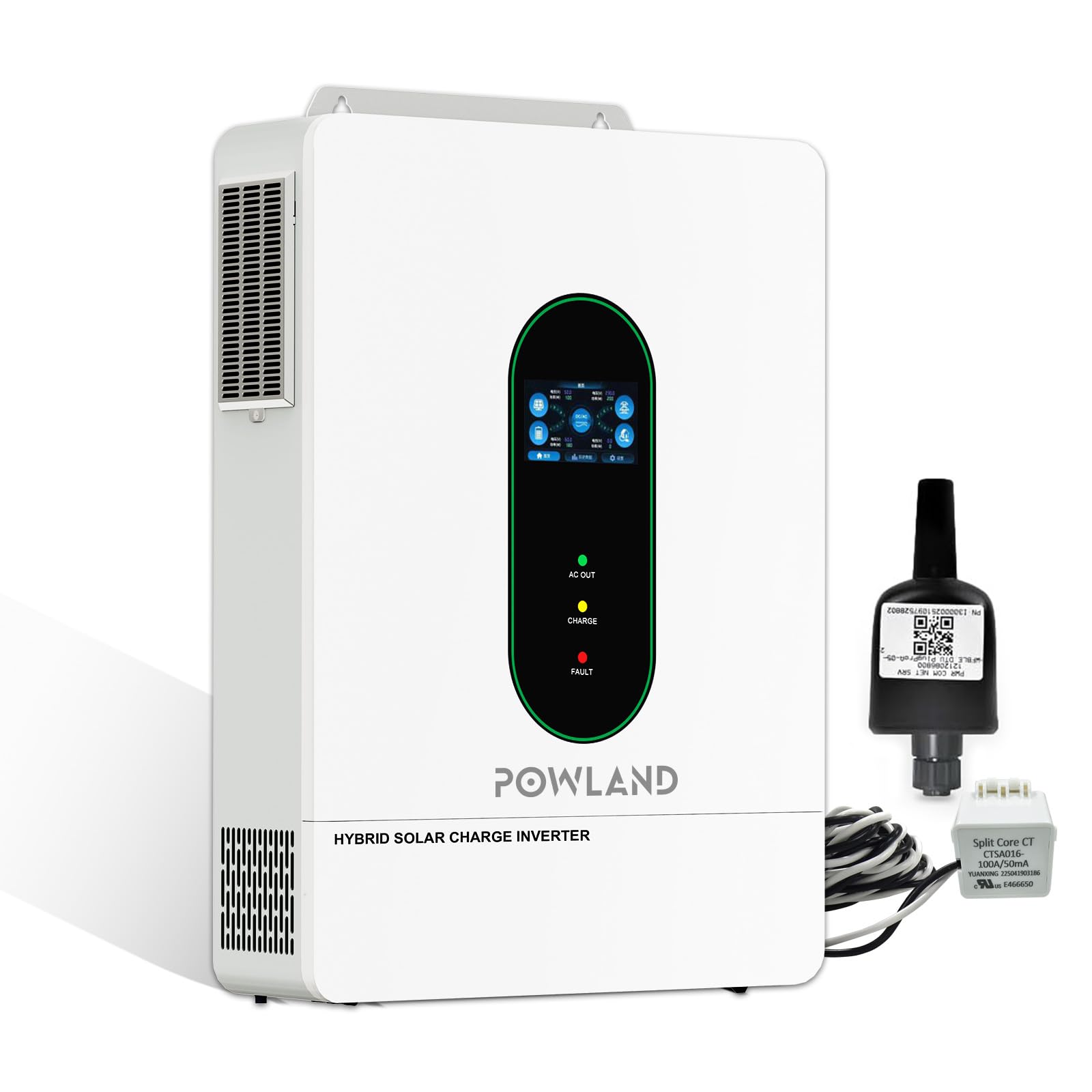
A hybrid that runs heavy loads and can scale up to six stacked units.
POWLAND’s hybrid is marketed as a 12,000W unit, and its spec sheet carries 12,000W of pure sine wave output at 120V±5%. That width matters: it is built for large homes and RV parks running central AC, fridges, and power tools together. what separates it is the battery-free design — excess solar can go straight to your home and the grid through an optional CT sensor (a current transformer that measures power flow), so you can run big solar without a battery bank.
Its MPPT controller is rated at up to 99.9% efficiency, with a 90-500VDC solar input range at up to 200A. The casing carries an IP65 weatherproof rating, so it can tolerate dust and rain. An OLED display shows real-time status, and ECO mode is claimed to cut standby draw and extend battery life by 30%. It even runs quiet — the dual-fan cooling is rated at 45dB. It supports 48V LiFePO4 and lead-acid batteries, and you can parallel up to six units for a combined 72,000W.
Fair warning: this is not a beginner’s install. Owners describe genuine difficulty getting the setup right, including a constant battery drain that cleared only after power cycling, and communication errors fixed by changing the battery protocol. The manual is limited, and support can be slow to respond. Once configured, the power is strong and stable, and owners walk away satisfied on build quality. If you are an experienced installer who wants big battery-free solar, this earns its keep. If you need hand-holding, budget extra time for the learning curve.
For the tinkerer who wants maximum solar: a battery-free path to feed heavy home loads straight from your panels, with a 200A MPPT controller and room to parallel six units.
Set expectations: the installation demands patience, and the documentation won’t hold your hand through grounding and protocol settings.
Tailored for: experienced DIYers running large off-grid or hybrid solar setups who want to skip the battery bank and feed loads directly.
Look past it if: you want a plug-and-play unit with clear instructions — the setup depth here will frustrate a first-timer.
6. EcoSolLi 12000W Hybrid Solar Inverter
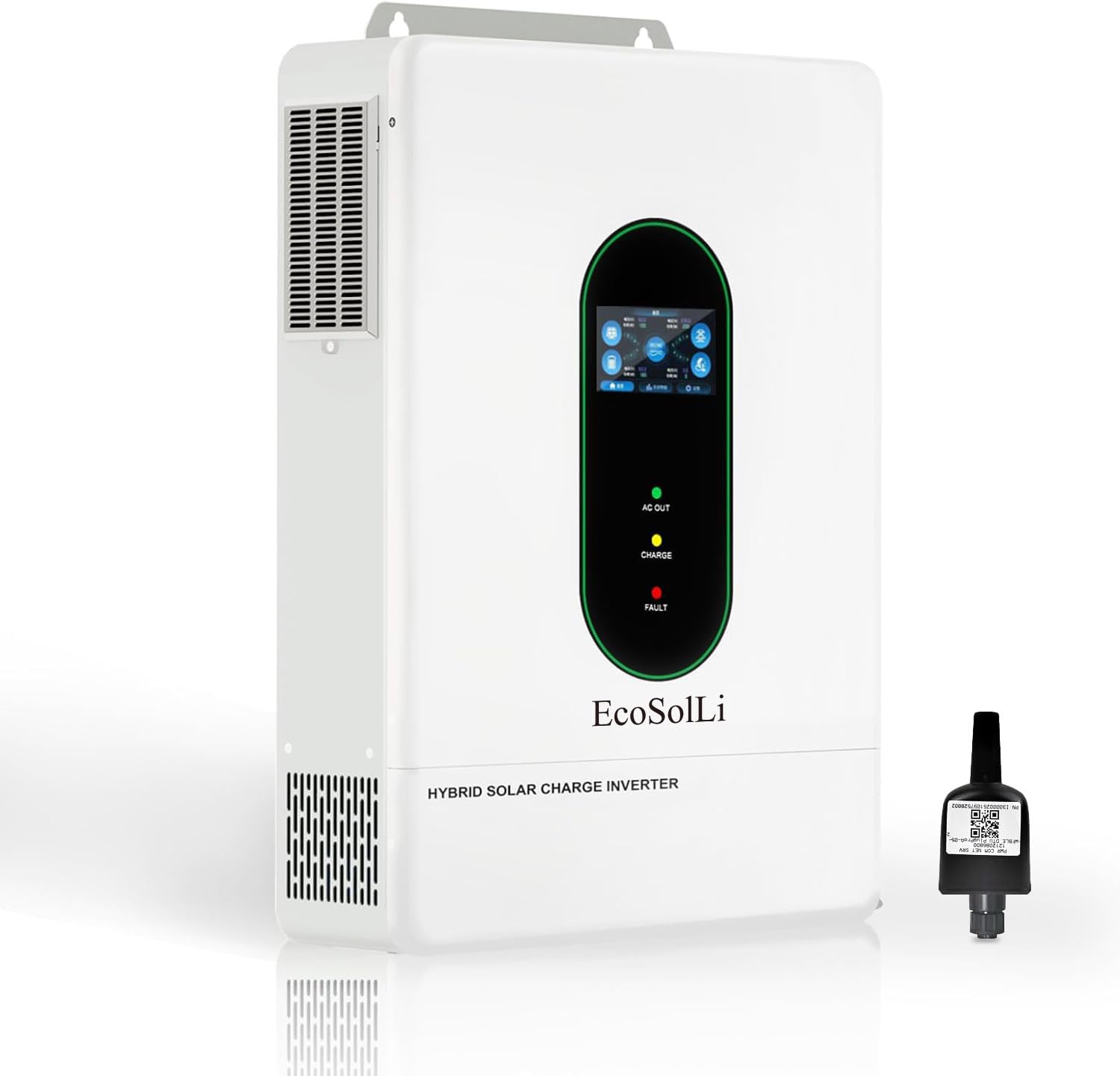
A high-power hybrid built to cold-start at high current and scale as your needs grow.
The EcoSolLi pairs a 12,000W continuous output with an 18,000VA peak, giving it plenty of margin for motor startup. Two independent MPPT controllers run at up to 99% efficiency, each accepting 22A of PV input up to a 500VDC open-circuit ceiling. It works with a 48V battery bank from 40 to 58.6Vdc, outputs split-phase 120V/240V or single-phase 120V, and supports up to six parallel units reaching a combined 72KW.
In a test with a generator and full house load, it ran an AC at 12A with a 30A surge and dipped only about 2V on compressor start. That is the kind of stability that keeps your lights from browning out. Owners describe the build as solid and well-suited to large solar systems, and the included Wi-Fi module lets you monitor from the Smart Value app. Four charging modes and four output modes give you real control over how solar, battery, and grid power flow.
The caveats are straightforward. Packaging quality has been inconsistent, the English documentation is rough, and the Wi-Fi setup has been confusing enough that buyers mention struggling to get monitoring online. Battery settings are not always clear on first pass. But the core job — delivering steady 12kW power — gets done, and the performance reviews back that up. This is a premium-class hybrid for someone building a large system and willing to work through setup quirks.
What sets it up for big systems
- 12,000W continuous with an 18,000VA peak for serious surge headroom
- Dual MPPT at 99% efficiency with a 500VDC ceiling
- Parallels up to six units for a 72KW combined output
- Steady voltage under compressor start — only about 2V dip in testing
What needs patience
- Wi-Fi setup and monitoring are fiddly on first pass
- Documentation is rough and battery settings unclear
- Packaging quality has varied
Built for: owners scaling to a large home system who need a 12kW hybrid with parallel growth to 72KW.
Better left to someone else if: you need polished setup and clear monitoring instructions from the start.
7. PROSOLI 12000W Solar Hybrid Inverter
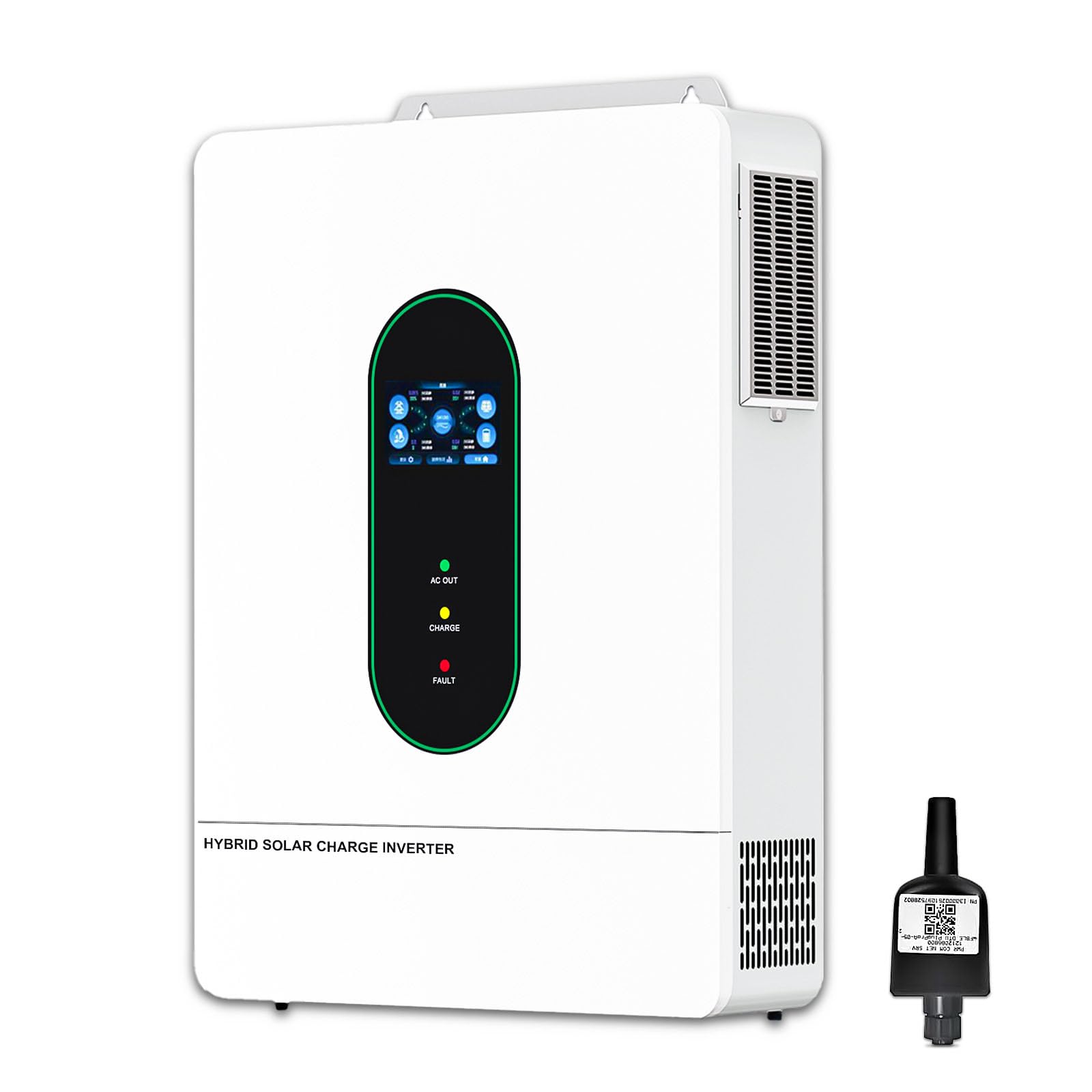
The off-grid favorite that keeps whole homes running on 120/240V with zero downtime.
PROSOLI’s 12,000W hybrid is one of the best-reviewed units here, and the reason is practical: it just works, month after month. The build handles a triple-duty role — charging a 48V bank from two MPPT controllers, running 120/240V split-phase circuits, and switching to grid automatically when a load spikes so the lights never cut out. A tap-sensitive touchscreen lets you change charging current, AC/solar priority, and load preferences right from the panel.
Owners powering off-grid homes report running five or more appliances at once for months — fridge, freezer, microwave, toaster, ice maker, coffee maker, a 4500W water heater, and shop saws on one unit, with peaks past 8400W. Its 120/240V output is clean enough that on-site electricians approve it. That combination of clean 120/240V handling and easy touchscreen control is why buyers call it the best value they found.
What can trip you up: the idle draw sits around 75W, which you will want to account for in your battery planning. Fan noise is the one recurring complaint, and a small fraction of buyers have found a unit that could not hit its advertised peak. On the balance of the reviews, though, this holds up as a genuinely reliable off-grid performer for a whole home.
What owners push it through
- Runs 120/240V circuits plus fridges, freezers, and shop tools on one unit
- Touchscreen control for charging and load priorities
- Zero-downtime switching when a load surges
- Clean output approved by an on-site electrician
Worth knowing upfront
- Idle draw around 75W on standby
- Fan noise is the most frequent gripe
- A rare unit falls short of the advertised 12K peak
Best match: a whole-house off-grid build where you want clean split-phase power, easy touchscreen control, and no downtime when the AC kicks on.
Not the one for: rooftop-only setups that need grid-tie backfeed — this is an off-grid hybrid and won’t export to the utility.
8. SUNGOLDPOWER 6500W 48V Solar Inverter (SPH6.5K48)
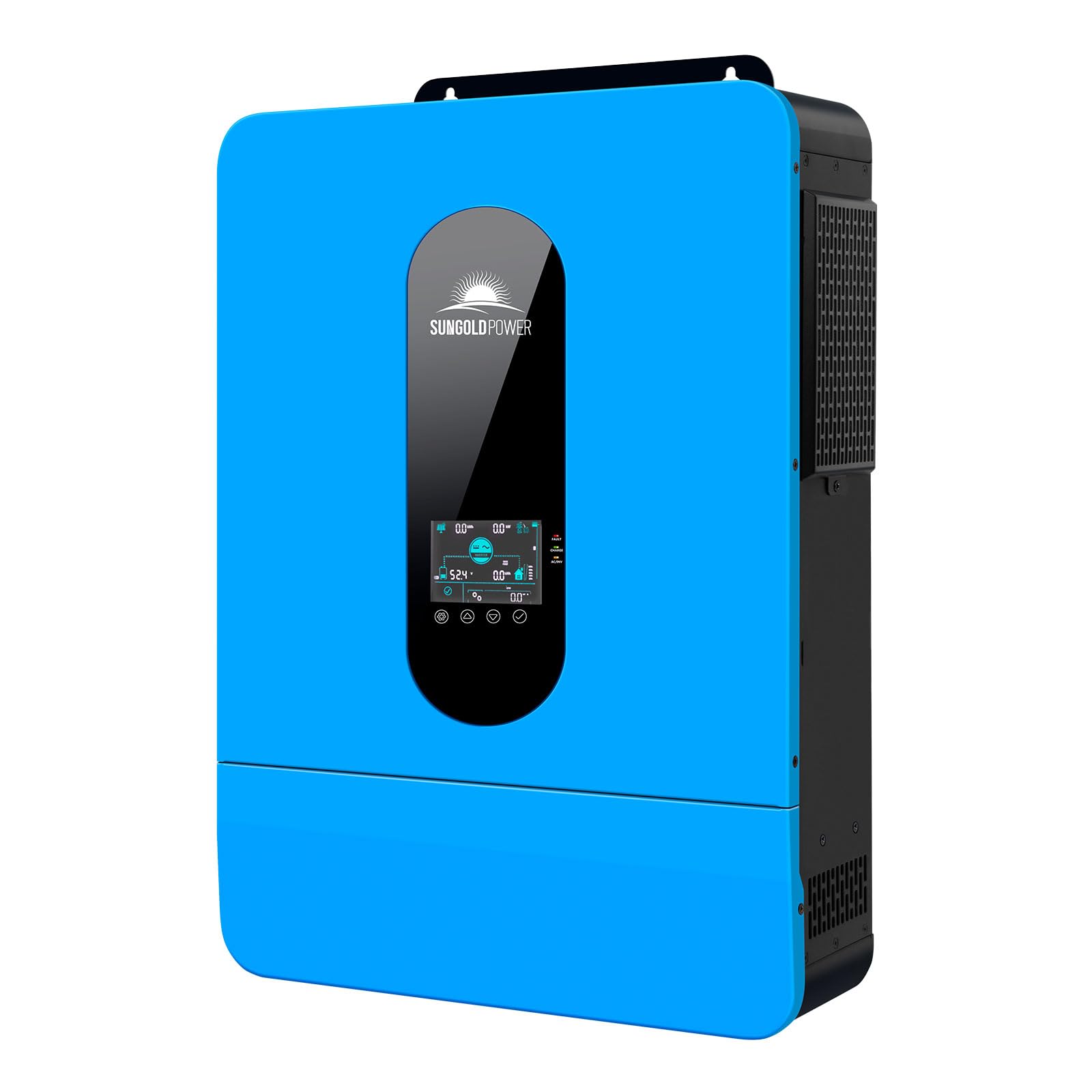
A parallel-ready hybrid that starts modest and grows as your power needs do.
This 48V unit runs 6,500W continuous with a 13,000VA peak and 140A battery charging, built around a pair of MPPT controllers that cap at 550VDC open-circuit. It outputs split-phase 120V/240V or single-phase 120V, and its party piece is scalability: you can parallel up to six units for a combined 39KW, including 208V three-phase when more than three are linked. That flexibility lets you start with one and add as you grow.
The four charging modes and four output modes mirror the bigger SUNGOLDPOWER models, so you can prioritize solar, utility, or a hybrid of both. It also sorts power by peak and off-peak tariff with its time-slot function. It carries a solid 4.8-star standing — the highest scoring unit in this list — with buyers calling it easy to install, even shipping units internationally to run homes off-grid.
Here is the honest catch: this is a smaller unit, so it does not love high-amp starting loads. Buyers who tried to run a 15k BTU AC off the 6500W found it struggled, where a 10kW version handled the job. If your biggest load is an air conditioner or a pump, size up to the 10,000W SUNGOLDPOWER instead. If your loads are moderate, though, this is an efficient, well-regarded way to get into parallel 48V solar on a tighter budget.
Strongest play: parallel scalability to 39KW with clean charging mode control, at a rating level near the top of the list.
The limitation to respect: sustained high-amp starting loads like a large AC or pump can overwhelm it — step up to a 10kW model for those.
Makes sense for: buyers who want to start modest, keep their biggest loads moderate, and expand to more units later.
Size up instead if: air conditioners or deep well pumps are your main load — you will want the 10,000W sibling.
9. SUNGOLDPOWER 6500W 48V Solar Inverter (SPH6548P1)
The split-phase hybrid that switches power sources without your TV blinking out.
Same 6,500W rated output and 13,000VA peak as its sibling above, but this version ships with a Wi-Fi module included and a 4HP loaded-motor capacity. It takes 48V DC in and puts out split-phase 120V/240V or single-phase 120V, with two MPPT controllers capping at 550VDC. It parallel-connects up to six units and carries UL1741 certification.
What buyers highlight most is functionality — specifically the transfer between utility and battery power. Unlike a lot of all-in-one inverters, it switches power sources without interrupting sensitive electronics, so your TV and computer don’t reboot when the grid drops. Combined with straightforward wiring and active support (including a US service center), it is a dependable choice for off-grid homes and small businesses. One owner in Cuba runs a household on it 24 hours a day.
The honest note here is heat. Customers note the unit runs warm under load and some have added external ventilation or a cooling duct to manage it. Fan cycling every 8-10 minutes is also noticeable enough to be distracting in a quiet room. Neither is a dealbreaker — reviews sit at a strong 4.7 stars — but if you plan to install it near a bedroom, factor in the fan rhythm and give it breathing room.
The everyday win: uninterrupted transfer between utility and battery means no reboot for the TV or computer when the grid flickers.
The one to manage: heat and fan cycling under load — give it clearance or active ventilation if it sits near living space.
Made for: off-grid homes and small shops that need split-phase power with clean transfers and included Wi-Fi monitoring.
Not ideal if: you are mounting it in a bedroom — the fan cycling every few minutes is audible.
10. PowMr 10000W Solar Inverter (POW-SunSmart 10KP-F)

A 10kW hybrid with a 10ms transfer time that barely lets your lights flicker.
This PowMr packs a 10,000W continuous output with a 20,000W surge, dual MPPT controllers at 99.9% efficiency, and a 200A MPPT controller built in. The PV input maxes at 11KW (5500 x 2) with a 500VDC ceiling, dual 22A solar inputs, and a 10ms switch time for the changeover between power sources. It runs a 48V bank, and one unit can put out 120V and 240V simultaneously through different connections.
Its battery flexibility is a genuine strength — it handles AGM, Gel, lead-acid, Lithium-ion, and LiFePO4, and supports batteryless operation. For long system life, the four charging modes (solar-only, mains-priority, solar-priority, and mixed) plus a utility-bypass output mode give you plenty of control. It is versatile enough for cabins, campers, RVs, trailers, and boats, and it parallel-connects up to six units for 60kW combined.
The practical ironies: the packaging does not include the Wi-Fi module, batteries, or cables, so factor those in as extras, and the 10ms transfer is quick but not perfectly instant. One owner who runs it off-grid simply wishes the engineers would add passive solar battery charging. That is a wish, not a flaw. For a 10kW hybrid that stays flexible across battery types and load types, this is one of the strongest options here, and the rating reflects it.
What it brings: a 20,000W surge, 10ms switch time, and dual 22A MPPT inputs with compatibility across nearly every 48V battery chemistry.
Remember to budget for: the Wi-Fi module, cables, and lugs are sold separately, so the delivered kit is just the inverter and basic hardware.
Ideal for: off-grid backup and self-use systems across cabins, RVs, and boats that want flexible battery support and expandable output.
Not the right call if: you want Wi-Fi monitoring included — that module is an added purchase here.
11. ECO-WORTHY Liber 10000W Solar Inverter
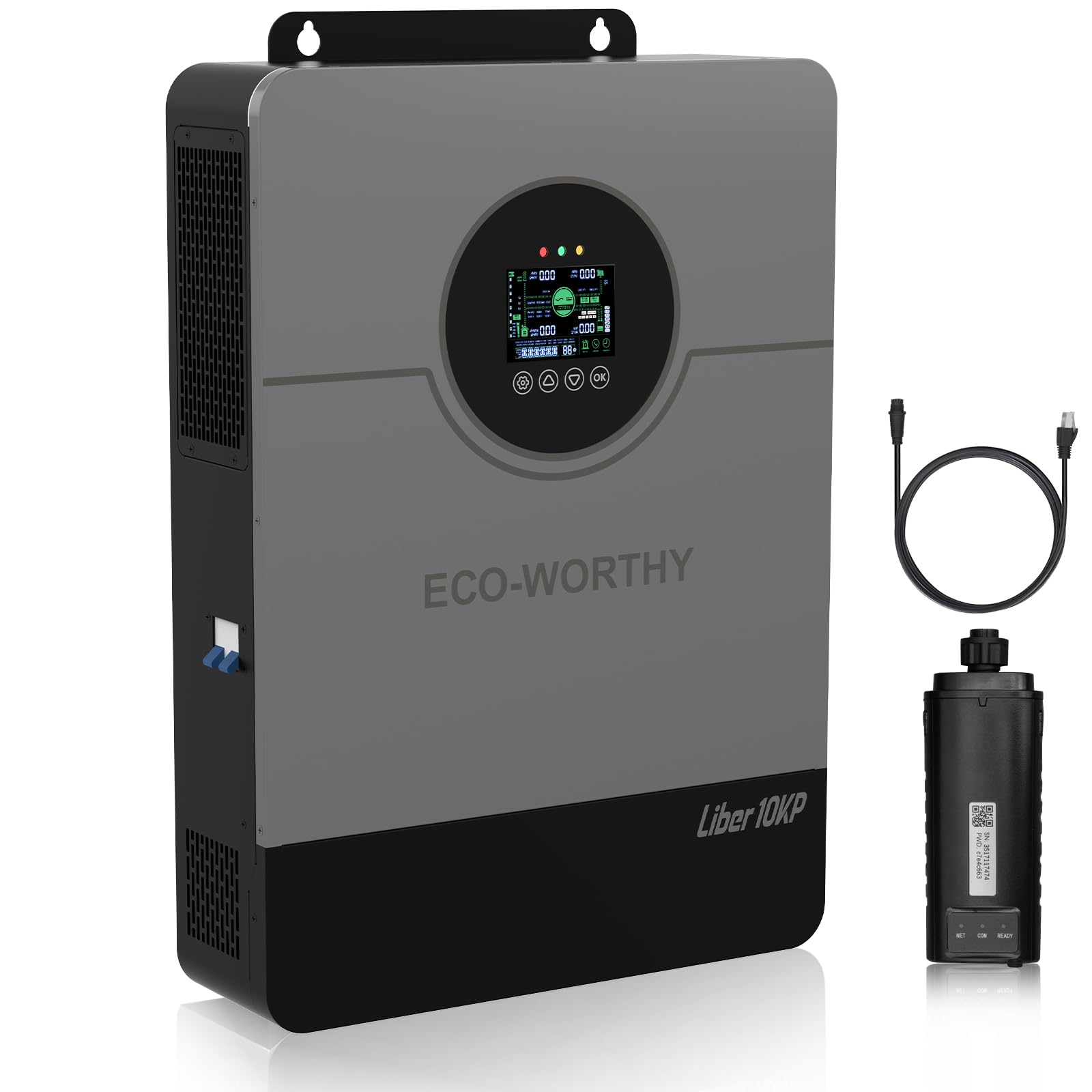
A permanent off-grid champion that schemes around peak-rate hours to stretch every watt.
The Liber 10000W is an off-grid-only hybrid — no grid-tie function — built for cabins, RVs, and backup systems. It combines a 10,000W inverter, a charger, and dual MPPT controllers feeding a 48V bank. It outputs 120V/240V split phase or 120V single phase, with a 20,000W peak, dual 5500W PV inputs for 11,000W total, and 200A max battery charging split as AC 120A, PV 200A, or hybrid 200A at 500VDC open-circuit.
The built-in Time-of-Use function is the standout — you schedule charging and discharging around peak and off-peak electricity rates to squeeze more value out of every kilowatt. It carries UL1741 certification and 14 protection functions, including short-circuit, overload, and voltage-fluctuation protection. Owners powering a whole house report running even an older dryer off it with low idle consumption, and the construction feels solid. It parallels up to six units for a 60KW combined output.
The friction points are settings and support. The manual is vague on some parameters, and setup confuses first-timers. Wi-Fi runs through an external data logger rather than built-in Bluetooth, and the app can get stuck searching. Support responses are slow — one buyer needed multiple attempts and a return before a working unit landed. All of that is worth weighing for what is otherwise a capable, well-built off-grid inverter. Note it needs a permanent install, ideally by an electrician.
Why it earns its place
- TOU scheduling to charge and discharge around peak and off-peak rates
- 200A max charging with dual 5500W PV inputs (11,000W total)
- UL1741 certified with 14 protection functions
- Parallels to six units for 60KW combined
Where setup gets rough
- Manual is vague on some settings
- Wi-Fi via external data logger; app can stall on setup
- Support is slow to respond
Suits: a permanent off-grid install where TOU scheduling and built-in series batteriesmatter more than a quick setup.
Look past it if: you need the app and Wi-Fi to work smoothly on day one.
Understanding the Specs
Continuous vs peak watts
The continuous (rated) output is the power the inverter holds all day — the number that decides whether it can run your fridge and AC at once. The peak number only covers a few seconds of startup surge, so a compressor that spikes hard still needs headroom above the continuous figure. Give your biggest motor load the space it needs.
MPPT count and PV ceiling
An MPPT controller pulls the most power it can from your panels. Two controllers let you wire two strings that don’t have to match, which helps when panels face different directions. The PV open-circuit maximum sets how many panels you can chain in series — going over it risks damage.
Split-phase vs single-phase output
Split phase delivers both 120V and 240V from one unit, so your household circuits and heavy appliances run on the same inverter. Single phase gives you 120V only. If you are running a dryer, well pump, or central AC, you want split phase.
Grid-tie vs off-grid hybrid
A grid-tie unit with a limiter feeds your own loads first and blocks backflow to the utility. An off-grid hybrid charges batteries and runs circuits but will not export power. Picking the wrong type here is the costliest mistake, so match it to how you want the system to behave.
FAQ
What does split phase 120V/240V actually mean on these inverters?
Can a 240V solar inverter backfeed my utility meter?
Do I need a battery bank for a 240V solar inverter to run?
Will one of these run central air conditioning?
How many solar panels can I connect to the MPPT controllers?
Can I parallel two inverters to get more power?
What battery voltages do these 240V inverters accept?
Is UL1741 certification important for a solar inverter?
How fast do these inverters switch between grid and battery power?
Can I install a 240V solar inverter myself?
Final Thoughts: The Verdict
For most buyers, the 240v solar inverter winner is the SUNGOLDPOWER 10000W 48V because its 10,000W continuous output, 200A charging, and dual MPPT controllers (two maximum power point trackers that squeeze the most power from your panels) carry a whole house with real surge headroom, and it holds a strong 4.5-star standing across a deep pool of owners. If you want the cleanest transfer and included Wi-Fi for an off-grid home, the SUNGOLDPOWER 6500W (SPH6548P1) is the one. And for whole-house off-grid with a touchscreen and zero-downtime switching, reach for the PROSOLI 12000W.
How We Picked
We do not accept paid placement. Every pick is matched to a real buyer and a real use-case; we do not hands-on test units.
Sources & Methodology
Specifications: manufacturer listings and product documentation. Review insights: verified customer reviews, as of September 2026. Pricing: not shown on this page (it changes often); check the current price via the retailer link.
As an Amazon Associate, Gadgets Feed earns from qualifying purchases. This does not affect which products we feature.