
Our readers keep the lights on and my morning glass full of iced black tea. As an Amazon Associate, I earn from qualifying purchases.
Specs are compiled from manufacturer listings and verified buyer reviews and can change over time — please confirm the key details on the product page before buying.
A transfer switch decides which source feeds your panel — utility or generator — and never lets both in at once. Get that wrong and you risk backfeeding the grid. This guide sorts the field by how you actually use the switch: manual lever, automatic changeover, whole-panel or a handful of circuits, and whether the enclosure is built to sit outside in the rain.
I’m Min — the founder and writer behind Gadgets Feed. This guide is built by comparing the manufacturers’ published specifications and the patterns across verified customer reviews, so you get each pick’s real strengths and trade-offs instead of marketing spin.
Most buyers land in one of two camps: a manual switch for a portable generator on a budget, or an automatic one that fires up the moment the lights drop. Below you’ll find both, ranked by the job each one does best, with the exact amp rating and wattage spelled out.
Our Picks at a Glance


How To Choose The Best 240V Transfer Switch
Before you look at a single listing, answer one question: what are you switching? A portable generator that you wheel out, plug in, and start by hand wants a manual switch. A permanently installed standby generator wants an automatic switch that senses the outage and does the work itself. Everything else — amps, wattage, enclosure rating — flows from that first choice.
Match the amps to what you actually want to run
Amps (written “A”) measure how much current the switch can pass. A 100A switch handles up to 24000W at 120/240V, which is enough to carry a whole house including 240V loads like dryers and stoves. A 50A switch tops out lower and suits a smaller panel or an RV setup; a 30A kit is built for a portable generator feeding a hand-picked set of circuits. Pick the rating that covers your loads with headroom, not the cheapest number on the page.
Manual or automatic — decide before anything else
You flip a manual switch yourself: start the generator, wait for it to settle, then throw the lever or rocker. An automatic transfer switch (ATS) runs that sequence for you — it senses the generator, waits for the output to stabilize, then transfers. Some units add a time-delay circuit (a timer that holds the load back) so the generator can run up to speed before power applies. Automatic costs more, but it removes the step where people forget and backfeed (push power backward into the grid).
Check the enclosure rating if it lives outdoors
NEMA 3R means the enclosure is built to shed rain, hail, and wind, so it can be mounted outside. An IP rating (International Protection) works the same way — a higher second digit means better protection against water. If your switch goes in a garage or beside an indoor panel, the enclosure rating matters less. If it’s going on an exterior wall, it matters a lot.
Quick Comparison
| Model | Best For | Current Rating | Control Type | Enclosure Rating | Amazon |
|---|---|---|---|---|---|
| MUJURUR 100A Double Throw Switch★ Best Overall | Whole-house manual backup on a budget | 100 A | Manual | NEMA 3R | Amazon |
| MUJURUR 100 Amp Manual Transfer SwitchTough Enclosure | Same job with added weather protection | 100 A | Manual | IP67 | Amazon |
| Nirakoka RV Automatic Transfer SwitchRV Ready | RVs, speedboats, and high-power gear | 50 A | Automatic | IP54 | Amazon |
| Eaton DT223URH-N Safety Switch | Brand-name whole-panel manual transfer | 100 A | Manual | — | Amazon |
| Furrion F50-ATS | RV changeover between shore, generator, inverter | 50 A | Automatic | UL94 Flame Retardant | Amazon |
| Reliance Controls 306A Kit | Six-circuit portable-generator hookup | 30 A | Manual | — | Amazon |
| Reliance Controls 310C Pro/Tran2 | Ten-circuit generator panel, more room to grow | 30 A | Manual | IP54 | Amazon |
| Connecticut Electric EGS1012KG2 | Large residential or small-business backup | 50 A | Manual | — | Amazon |
| Generac 100 Amp Legacy ATS | Generac standby owners wanting full automation | 100 A | Automatic | NEMA 3R | Amazon |
In‑Depth Reviews
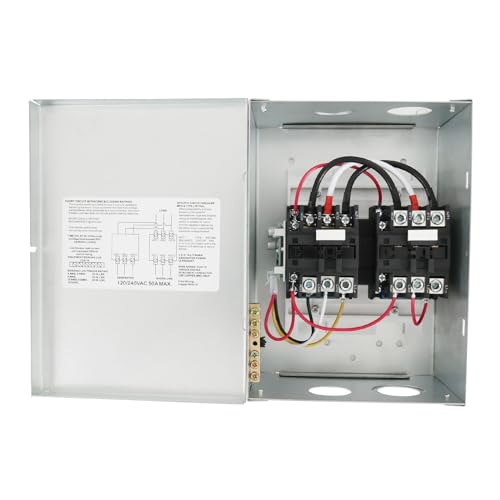
1. MUJURUR 100A Generator Transfer Switch, 24000W Double Throw, 2P
Our pick — 4.5+★ from 400+ verified ratings; the strongest balance of quality and price.
A 100-amp whole-house switch with no electronics to fail, priced like an entry-level unit.
The number that decides this pick is 100 A — a current rating that carries 24000W at 120/240V, which is enough to run a whole household including the dryer and stove. For anyone who wants to flip one lever and power the entire panel from a gas generator or solar setup, that is the whole ballgame. The move itself is a rotary lever, so there’s nothing to program and nothing to remember.
What wins people over is the build. The casing is galvanized steel with corrosion and rust resistance, and it meets NEMA 3R standards — that’s the rating that says the box can sit outdoors through rain, hail, and strong winds. Inside, there’s enough room to bend wire freely, and it takes conductors up to 3 AWG (a wire-thickness gauge where higher numbers mean thinner wire). A lock hole at the bottom stops an accidental shutdown during normal utility power, and a dedicated grounding position inside protects against stray contact.
The trade-off is that this is a manual, mechanical switch with no electronic brain — which is exactly the point, but it means you do the transfer yourself every time. It’s a fine fit for a homeowner with basic electrical expertise and a portable generator, though the maker recommends a licensed electrician for most installs, and backs the unit with a 10-year warranty. The MUJURUR 100A carries 24000W through a manual double-throw lever and sits in a NEMA 3R steel box, so a whole home stays powered without a circuit board to fail.
Where it earns its keep
- 100 A at 24000W covers dryers and stoves, not just lights
- Galvanized steel in a NEMA 3R enclosure handles outdoor weather
- No electronic parts to fall foul of moisture or dust
- Lock hole guards against accidental shutdown while on utility power
Worth knowing first
- Fully manual — you throw the lever on every outage
- Installing it safely calls for an electrician
Fits best: a whole-house panel, a portable generator, and a buyer who wants the switch decided by steel and levers rather than software.
Think twice if: you want the transfer to happen on its own — this one waits for your hand.
2. MUJURUR 100 Amp Manual Transfer Switch, 24000W, 120/240V
The same 100-amp muscle as our top pick, wrapped in a higher water-protection rating.
Pick this one over the MUJURUR above if water is your worry. Both run 100 A and 24000W at 120/240V, both flip with a rotary lever, and both use aluminum connections with zero electronic parts. The difference you will feel is the enclosure. This one is rated IP67 — IP is the International Protection scale for dust and water, and a 67 rating means it is built to shrug off more water exposure than the NEMA 3R steel box on the pick above (NEMA 3R is a US outdoor rating for rain, sleet and snow).
Buyers report quality as the standout trait on this listing, and it matches the spec sheet: a galvanized-steel body that resists corrosion and rust, plus enough internal room to bend conductors up to 3 AWG (a wire thickness gauge where lower numbers mean thicker wire). The lock hole at the base stops accidental cut-offs while you are on utility power, and a grounding spot inside adds safety. A 24-hour technical support line and a 10-year warranty round out the package.
The honest catch: this switch is not UL listed, and that comes up in buyer feedback. If your inspector or local code specifically wants that mark, plan around it; for a straightforward manual install it’s a cosmetic-versus-code question, not a performance one. With a 100 A rating, 24000W capacity, and an IP67 enclosure, the MUJURUR 100 Amp manual switch is the pick when moisture protection outranks certification paperwork.
Where the value sits: You get the full 24000W and 100 A of a whole-house manual switch, plus a tougher IP67 enclosure than most in this bracket, and a 10-year warranty behind it.
The one wrinkle: No UL listing — check what your local code and inspector require before you commit to this over a certified alternative.
Reach for this if: the switch lives somewhere wet and you want maximum moisture protection at a hundred amps.
Look elsewhere if: a UL mark is a hard requirement from your inspector.
3. Nirakoka RV Automatic Transfer Switch, 240VAC 50A
A hands-off changeover box built for RVs, speedboats, and gear that needs emergency power fast.
Where the manual picks ask you to flip a lever, this one does the thinking. Once generator AC is sensed, a timer runs, and the switch moves over to generator power after a 20-45 second delay — the wait is deliberate, giving the generator time to reach full speed before load hits it. The green LED lights when generator power is present, so you can see at a glance what source is live.
At 50 A, this one suits an RV or speedboat setup rather than a full house panel. The safety design is the standout: built-in mechanical interlocks (physical blockers) plus control circuits keep two separate 120/240 volt AC sources from ever reaching the AC distribution board at the same time — the backfeed scenario you want to avoid. Contacts are copper, brass, and silver, and it comes pre-wired to shift automatically from shore power to generator or inverter when activated.
What the reviews circle back to is simple reliability — it works, and it works better than the original model it replaces for many rig owners. The wire run is a quick-connect type, and the IP54 rating means it tolerates dust and splashing but isn’t built for total submersion. The Nirakoka ATS switches an RV between shore and generator power automatically at 50 A, with a 20-45 second delay that protects the generator before load lands.
Why rig owners like it
- Fully automatic changeover between shore, generator, and inverter power
- 20-45 second time delay lets the generator spin up before load applies
- Dual interlocks stop two sources from feeding the board at once
- Green LED confirms live generator power
Know before you buy
- 50 A — not sized for a whole-house panel
- IP54 handles splashes but not submersion
Built for: RV and boat owners who want the changeover to happen on its own.
Pass if: you’re wiring a home panel and need 100 A of headroom.
4. Eaton 100 Amp 120/240V 24,000W Double-Throw Safety Switch DT223URH-N

The brand-name general-duty switch electricians reach for when a panel needs a clean double-throw manual transfer.
This is the simplest spec sheet in the lineup — 100 A, 120/240 volt, 24,000 watt, non-fused, general-duty, double-throw — and that’s the appeal. As a double-throw switch, it routes power to one source or the other and cannot feed both, which is the whole point of the hardware. It’s built in alloy steel and comes in at 11.5 pounds, a solid chunk of metal rather than a thin tin box.
The double-throw design draws a lot of the praise on this listing, and a third ground bus inside earns a specific nod from owners who need somewhere to land their ground conductors. Suitability for generator transfer is clearly the reason most people land here, and setup is described as easy. There’s also a real value story: for a name-brand safety switch, the price-to-build ratio keeps coming up as fair.
The one place opinions split is physical size — some find the enclosure bigger than expected for the wall space they had planned. Measure your mounting spot before ordering. Otherwise, this is the conservative, well-known pick for a manual transfer at a hundred amps. The Eaton DT223URH-N does one job — a 100 A, 24,000W double-throw manual transfer — in an alloy-steel body that electricians recognize on sight.
What it’s really good at: A no-nonsense double-throw switch at 100 A and 24,000W, with a third ground bus inside and a steel body that feels like it will outlast the house.
Watch the footprint: It’s a substantial enclosure, so confirm your wall space before you commit — and it’s manual, so the lever is still your job.
Suits you if: you want a familiar, electrician-approved name on a manual whole-panel transfer.
Skip if: you’re tight on mounting space or want automation.
5. Furrion F50-ATS 50 Amp RV Automatic Transfer Switch

An RV changeover box engineered to survive the constant vibration of life on the road.
Under the hood, this 50 A automatic switch does what an ATS should: it changes between two separate 125/250 volt AC sources — generator, shore power cord, or inverter — without your input. A mechanical interlock between contactors guarantees both can’t close in parallel, which is how it avoids overvoltage on the output line. Once generator AC hits the Input 2 terminals, a 20-30 second timer runs before the transfer, so the generator is up to speed first.
The build is where Furrion puts its money. VibrationSmart and ClimateSmart are the brand’s own names for the vibration and temperature resilience built into this unit, aimed squarely at the constant shake of an RV. Solid brass terminals improve conductivity and cut heat, and they’re nickel plated to resist corrosion. The casing is UL 94 flame-retardant plastic, and the switch is certified to UL1008 — a standard specific to transfer switches.
Installation is what most buyers highlight, and several are replacing a TODD automatic switch with this one. The honest friction point is noise: this unit can develop a low hum and has been known to chatter when switching. That’s a known characteristic of contactor-based ATS boxes rather than a one-off defect, but worth knowing if the compartment sits right next to where you sleep. The Furrion F50-ATS is a UL1008-certified 50 A automatic switch built with vibration and temperature resilience for RV duty.
The engineering case: Interlocked contactors, brass terminals, a flame-retardant enclosure, and a 20-30 second delay all add up to a genuinely safety-first 50 A automatic switch.
The noise caveat: Expect a possible low hum and some chatter at the moment of switching — normal for the genre, but audible in a tight RV bay.
Best matched to: an RV or marine setup where vibration and temperature swings are the daily reality.
Reconsider if: a quiet switch is a must — contactor noise is part of this design.
6. Reliance Controls 30 Amp 240V 6-Circuit Generator Power Transfer Kit
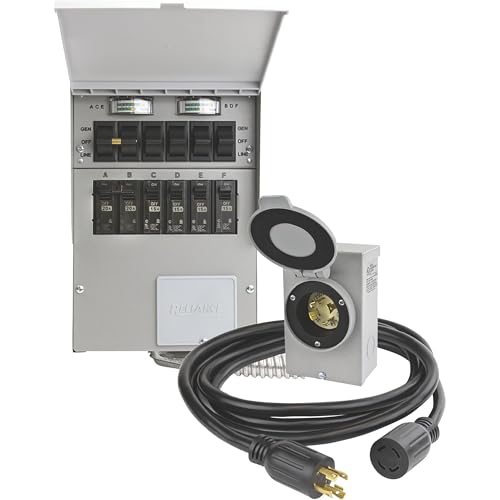
A complete circuit-by-circuit kit for a portable generator, pre-wired and ready for your panel.
If you’re powering a chosen set of circuits rather than the whole house, this is the shape the job takes. It’s a 30 A, 240 volt, 2-space 6-circuit surface-mount kit that installs adjacent to your existing load center. It handles up to 6 single-pole circuits, or one 2-pole plus 4 single-pole, and it accommodates generators up to 7500W continuous output.
What makes it attractive for a first-time generator owner is that it’s completely pre-wired and contains all the components needed to safely power those circuits during an outage. Installation is the thing buyers talk about most — clear instructions, straightforward wiring, and no hunting for missing pieces because it ships with everything to connect to the panel. Switching between generator and line power is described as clean.
Note it’s a manual kit — this is circuit-level management, not a whole-panel transfer — and its 30 A rating caps what you can run at once. For a homeowner who wants to keep the fridge, a few lights, and the furnace going without rewiring the entire panel, that trade is exactly right. The Reliance Controls kit pre-wires six circuits at 30 A and 240 volt for a portable generator up to 7500W continuous, so you back up the essentials without touching the main panel.
What makes it easy
- Completely pre-wired — no loose ends to sort out
- Ships with everything needed to connect to the panel
- Six circuits cover the fridge, lights, and furnace
- Surface-mounts beside your existing load center
Set expectations
- 30 A and 6 circuits only — not a whole-house solution
- Manual switching, circuit by circuit
Pick this for: a portable generator and a plan to back up the essentials only.
Not for: a whole-panel backup or a generator pushing past 7500W continuous.
7. Reliance Controls 310C Pro/Tran2 30-Amp 10-Circuit Manual Transfer Switch

Ten circuits of manual generator management — four more than the kit below it, for a panel with more to protect.
Ten circuits is the reason to buy this over the 6-circuit Reliance kit in this guide. Both are 30 A and both feed generators rated up to 7,500 running watts at 120/240V, so the extra four slots keep more of your panel live during an outage. It is a manual switch, so you decide when to move between sources, and it uses flexible conduit connector entry with normally-open contacts (contacts that stay open until you switch them).
What the reviews praise is how naturally it goes in — installation and straightforward operation both land as the top themes, and functionality keeps coming up alongside stories of it doing its job through real outages. Construction is solid and the design is well thought out, all of which explains why the value read holds up for a switch at this level.
One trade-off surfaces repeatedly: the wire length. Several owners wish the pigtails ran about a foot longer, so factor in whether your panel position gives you that slack or whether you’ll need to extend. Otherwise this is the most circuit capacity you get in a Reliance manual switch here. The Reliance 310C Pro/Tran2 manages 10 circuits at 30 A for generators up to 7,500 running watts, giving you four more live slots than the 6-circuit kit.
What it does well: 10 circuits at 30 A and 7,500 running watts, straightforward manual operation, and construction that holds up through real outages.
The wire-length note: The pigtails can come up short for some panel layouts — a foot more would help, so check your run before install.
Right for: a bigger panel where the extra four circuit slots pay for themselves.
Check first: your wire run — short pigtails can force an extension on some installs.
8. Connecticut Electric Series 2 Backup Power Manual Transfer Switch Kit, 50 Amp, 10 Circuits
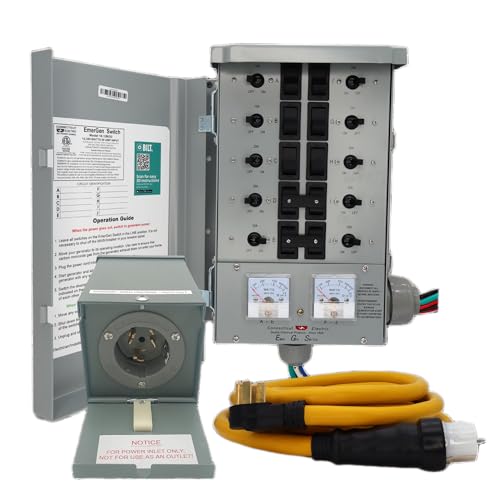
A 50-amp, ten-circuit kit that arrives with the inlet box and cord so nothing’s missing on install day.
Most kits leave you to buy the inlet and cord separately. This one doesn’t — it ships with a professional-grade 50 Amp Power Inlet Box (CS6375) with a weather-resistant cover and a 25-foot connecting cord. That’s the practical difference: a portable generator can sit up to 25 feet away and still feed the panel, no extra shopping trip required.
It spreads 12,500 watts across 10 separate circuits at 50 A, so critical loads like well pumps and HVAC systems stay backed up while standard household circuits still fit. It includes specialized switching for 240-volt applications. The double-throw rocker switches (switches that can only connect one source at a time) are designed to eliminate backfeeding entirely, protecting both utility workers and your generator. It is fully ETL certified to UL safety standards (ETL is a US safety-testing lab; UL is the safety standard it tests against).
This suits a larger home or a small business with real power demands, and the construction and completeness are what owners respond to most. It’s manual, so you’re still the one throwing the switch, and the inlet box adds a hole through the wall to plan. For anyone who wants a one-box solution that handles 240V equipment, that’s a fair trade. The Connecticut Electric kit runs 50 A and 12,500 watt across 10 circuits, and ships with the 50A inlet box and 25-foot cord so the outdoor hookup is covered.
Why the kit earns its place
- Ships with the 50A inlet box and 25-foot cord
- 12,500W over 10 circuits with dedicated 240V switching
- Double-throw rockers eliminate backfeeding
- ETL certified to UL standards
Plan around this
- Manual switching — not automatic
- Inlet box means cutting through an exterior wall
Ideal if: you want the inlet, the cord, and the switch in one box for a larger home or shop.
Look elsewhere if: you want automatic changeover — this one needs your hand on the rocker.
9. Generac 100 Amp Legacy Automatic Generator Transfer Switch, SE Rated

The switch that starts your generator and moves the whole panel for you the moment the grid drops.
This is the fully automatic end of the spectrum: it senses an outage, starts your compatible Generac standby generator, and transfers your entire panel without anyone touching a lever — the exact contrast with every manual switch in this guide. Open-transition switching (a break-before-make design) mechanically isolates utility and generator power so both cannot connect at once, protecting line workers and your wiring.
At 100 A it carries up to 24000 watts across your full 120V and 240V panel, including 240V loads like well pumps and dryers. There’s a built-in Smart AC Module that sequences up to four air conditioning or heating loads without extra hardware, and optional Smart Management Modules add more circuit control later. The enclosure is powder-coated aluminum rated NEMA 3R, so it handles outdoor weather on an exterior wall or in a garage.
Two things a buyer must clear first. It’s engineered specifically for Generac home standby generators with Evolution or Nexus controls — not portable units from other brands — so confirm your generator’s controller before ordering. And because it’s service-entrance rated, it functions as your main service disconnect, which means a licensed electrician and a permit are part of the deal. It ships with the switch enclosure, contactor, Smart AC Module, and manual, backed by a 5-year limited warranty; the inlet and cord are sold separately. The Generac 100 Amp Legacy ATS starts your Generac standby generator and transfers your entire panel automatically at 100 A and 24000 watts, in a NEMA 3R aluminum enclosure.
The automatic advantage: Outage-sensing startup, open-transition isolation, a Smart AC Module for up to four HVAC loads, and 100 A across the full panel — full hands-off backup.
The compatibility gate: Generac Evolution or Nexus controls only, service-entrance install, and the inlet and cord sold separately — get your generator confirmed first.
Made for: a Generac standby owner who wants the whole house back up without lifting a finger.
Wrong fit if: you run a portable generator from another brand — this switch won’t talk to it.
Understanding the Specs
Amps, Volts, and Watts: How They Connect
Amps (A) measure current flow, volts measure electrical pressure, and watts measure actual power delivered. A switch rated 100 A at 120/240V can carry up to 24000W, which is enough for a whole household including 240V appliances like dryers and stoves. A 30 A or 50 A switch caps out lower and suits smaller panels or circuit-selected backup. Size the rating to the total load you plan to run, not just the biggest single appliance.
Manual vs. Automatic Transfer
A manual switch is a lever or rocker you throw yourself — you start the generator, wait for it to settle, then transfer. An automatic transfer switch (ATS) senses the generator, waits for a time-delay (often 20-45 seconds) so the generator reaches speed, then moves the load for you. Manual suits portable generators and tighter budgets; automatic suits permanently installed standby units and anyone who wants the sequence handled without a second thought.
Enclosure Ratings: NEMA 3R and IP
NEMA 3R is the North American rating for an enclosure built to shed rain, hail, and wind — it’s what lets a switch mount on an exterior wall. IP (International Protection) uses two digits: the first for dust, the second for water. A higher second digit means better water resistance, so an IP67 unit tolerates more exposure than an IP54 one. Indoor installs in a garage or beside a panel don’t lean on these ratings as heavily.
Why Double-Throw and Interlocks Matter
A double-throw switch physically moves between two sources and cannot feed both at once. Automatic units use mechanical interlocks and control circuits to guarantee the same thing. That’s the safety core of any transfer switch: if utility and generator power met on the same conductor, you’d backfeed the grid and endanger line workers and your own equipment. Always confirm the switch does this by design.
FAQ
Will a 240V transfer switch work with a 120V generator?
What is the difference between manual and automatic transfer switches?
How many circuits can a 30-amp transfer kit actually back up?
Can I install a transfer switch myself or do I need an electrician?
What does NEMA 3R mean on a transfer switch enclosure?
Why does an automatic transfer switch have a time delay?
Is a 50-amp transfer switch enough to run an air conditioner?
Does the Generac Legacy ATS work with a non-Generac portable generator?
Do transfer switch kits include the cord and inlet box?
What happens if I skip a transfer switch and plug the generator straight into the panel?
Final Thoughts: The Verdict
For most people setting up a manual whole-house transfer, the MUJURUR 100A Double Throw Switch is the pick to beat — it carries 100 A and 24000W for dryers and stoves, lives in a NEMA 3R galvanized-steel box outdoors, and keeps working without an electronic part to fail. If moisture is your chief worry, the MUJURUR 100 Amp Manual Transfer Switch adds an IP67 enclosure for a tougher water rating. And for a Generac standby owner who wants the whole panel back up the moment the grid drops, the Generac 100 Amp Legacy ATS does the whole sequence hands-free at 100 A and 24000 watts. Whichever direction you go, lock in your amp rating first and the switch type second — that order narrows the field fast.
How We Picked
We do not accept paid placement. Every pick is matched to a real buyer and a real use-case; we do not hands-on test units.
Sources & Methodology
Specifications: manufacturer listings and product documentation. Review insights: verified customer reviews, as of November 2026. Pricing: not shown on this page (it changes often); check the current price via the retailer link.
As an Amazon Associate, Gadgets Feed earns from qualifying purchases. This does not affect which products we feature.