
Stripped fasteners, broken knuckles, and that sinking feeling when a bolt refuses to budge are the real cost of a subpar 24mm socket. Whether you’re wrestling a crank bolt on an LS swap or freeing a seized oxygen sensor, the single most important decision you make is which 24mm piece of steel spins at the end of your breaker bar.
I’m Min — the co-founder and writer behind Gadgets Feed. After hundreds of hours analyzing torque specifications, steel alloy compositions, and real-world user reports across the automotive internet, I’ve narrowed down which 24mm sensor sockets actually survive high-torque impact use and which ones crack under pressure.
This guide breaks down seven of the most compelling options available today, from specialty harmonic balancer sockets to universal impact swivels and complete O2 sensor kits, so you can confidently choose the best 24mm sensor socket for your specific wrenching needs.
How To Choose The Best 24mm Sensor Socket
A 24mm sensor socket isn’t just a hunk of metal with a square hole. The wrong alloy, the wrong geometry, or the wrong depth can turn a five-minute job into an afternoon of swearing. Here are the critical specs that separate a tool you’ll pass down from one you’ll throw away.
Steel Alloy: Chrome Molybdenum vs. Chrome Vanadium
Chrome molybdenum steel (CR-MO) absorbs more torsional shock before fracturing, making it the premium choice for impact-rated sockets that regularly handle high-torque pneumatic guns. Chrome vanadium (CR-V) is harder and more brittle — fine for hand-tool use but prone to cracking under the hammer blows of an impact wrench. For a 24mm sensor socket that will see impact driver duty, prioritize CR-MO construction.
Point Geometry: 6-Point vs. 12-Point
A six-point socket contacts the fastener across broad, flat surfaces, distributing torque evenly and minimizing rounded-off bolt heads. Twelve-point sockets engage every 30 degrees of rotation, useful for tight swivel positions but more likely to strip a stubborn fastener. For crank bolts and suspension fasteners where failure isn’t an option, six-point is the safer bet.
Depth and Counter-Weighting
Deep sockets provide the extra reach needed for studded sensors and recessed crank bolts, but a standard deep-well socket lacks the rotational mass to break loose a torqued-to-yield fastener. Specialty counter-weighted harmonic balancer sockets pack three times the momentum of standard impact sockets — essential for those 200+ ft-lb crank bolts without locking the flywheel.
Quick Comparison
On smaller screens, swipe sideways to see the full table.
| Model | Category | Best For | Key Spec | Amazon |
|---|---|---|---|---|
| Sunluway 77070 | Specialty Impact | GM LS crank bolt removal | Counter-weighted 40CR alloy steel | Amazon |
| Capri Tools Universal | Swivel Impact | Angled fasteners in tight spaces | CR-MO steel, 30° swivel | Amazon |
| Sunex 267224 | Premium Impact | High-torque impact gun use | CR-MO alloy, 12-point deep | Amazon |
| Lisle 12100 | O2 Sensor | O2 sensor removal with wire harness | Cutaway slot for wire clearance | Amazon |
| ARES 70318 Kit | Specialty Kit | Full O2 sensor & injector suite | 10 pieces, CR-V steel, case | Amazon |
| FOCMKEAS Deep Impact | Budget Deep | Deep reach on a budget | CR-V steel, 6-inch length | Amazon |
| Mayouko 11-Piece Set | Budget Set | Building a socket collection | 11 deep sockets, blow-molded case | Amazon |
In‑Depth Reviews
1. Sunluway 77070 24mm Crank Bolt Socket
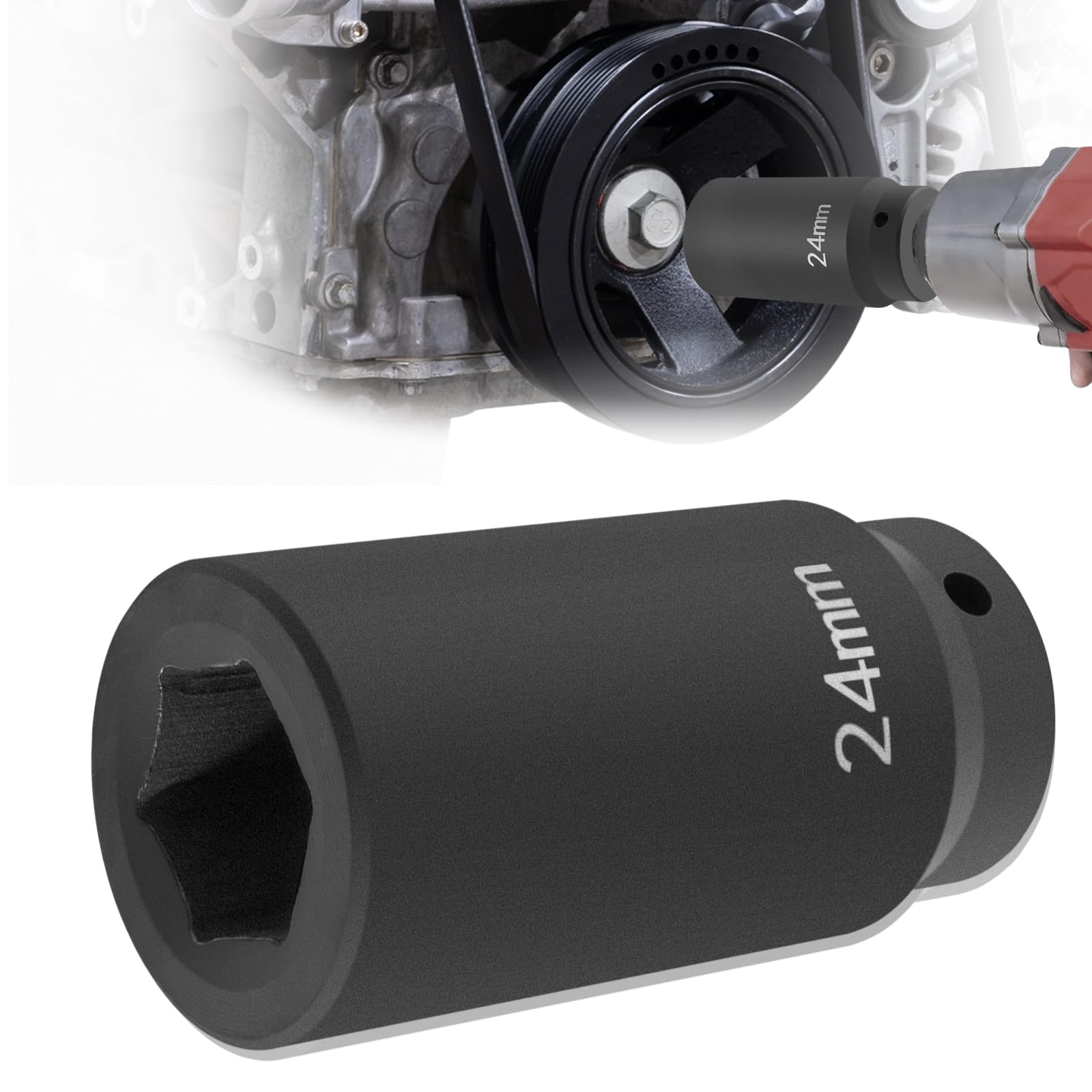
This socket was engineered for one specific, brutal job: breaking loose the harmonic balancer bolt on GM LS engines. Its deep counter-weighted design packs roughly three times the momentum of a standard shallow impact socket, so the rotational mass, not just the impact gun’s torque, does the work. Multiple users report cracking 200+ ft-lb crank bolts on Honda Odysseys and 5.3L LS engines in under two seconds with a standard air impact.
The six-point contact pattern grips the bolt head across flat surfaces, reducing the chance of rounding a stubborn crank fastener that’s been torqued to yield. Constructed from heat-treated 40CR alloy steel with a 1/2-inch square drive, this socket is built for repeated high-stress use. Owners describe it as “solid built” and note they’d buy it again specifically because it feels indestructible.
Its weight exceeds one pound, which is noticeable on the scale but negligible when you’re saving five minutes of flywheel locking and breaker-bar wrestling. The only catch is that this is a specialty tool — you won’t use it for lug nuts or suspension bolts. But if you own a modern GM, Honda, or Toyota with a tight crank bolt, this socket pays for itself the first time it saves your knuckles.
Why it’s great
- Counter-weighted design multiplies impact torque effectively
- Six-point geometry prevents fastener rounding on high-torque bolts
- Heat-treated 40CR alloy steel withstands repeated impact abuse
Good to know
- Specialized for crank bolts — not a general-purpose socket
- Significantly heavier than standard deep impact sockets
2. Capri Tools 24 mm Universal Impact Socket

The universal swivel design on this Capri Tools socket solves one of the most infuriating problems in automotive work: reaching fasteners that sit at an awkward angle behind suspension arms or exhaust components. With a 30-degree working angle and full 360-degree rotation, this socket transfers torque to fasteners that a straight socket simply cannot engage without knuckle-scraping extensions.
Capri Tools uses premium chrome molybdenum steel treated with their proprietary heat-tempering process, then coated with manganese phosphate — the same corrosion-resistant finish specified by military and aerospace applications. This is not a budget black-oxide coating that rusts after one wet-weekend job. The six-point WaveDrive design grips the flat sides of the fastener, reducing rounding compared to traditional hex sockets.
Multiple fleet mechanics who work on patrol cars and heavy equipment report this socket has survived dozens of wheel bearings and suspension jobs on a Milwaukee M18 mid-torque impact without failure. The only trade-off is the universal joint introduces a tiny amount of wobble at the fastener — acceptable for impact work but not ideal for final hand-torquing. At this price point, the swivel CR-MO construction is exceptional value.
Why it’s great
- 30-degree swivel reaches fasteners straight sockets cannot access
- Chrome molybdenum steel with manganese phosphate coating resists corrosion
- WaveDrive design reduces fastener rounding under impact load
Good to know
- Universal joint introduces slight play in the socket
- Not ideal for final torque applications requiring absolute rigidity
3. Sunex 267224 1/2-Inch Drive 24-mm 12-Point Deep Impact Socket
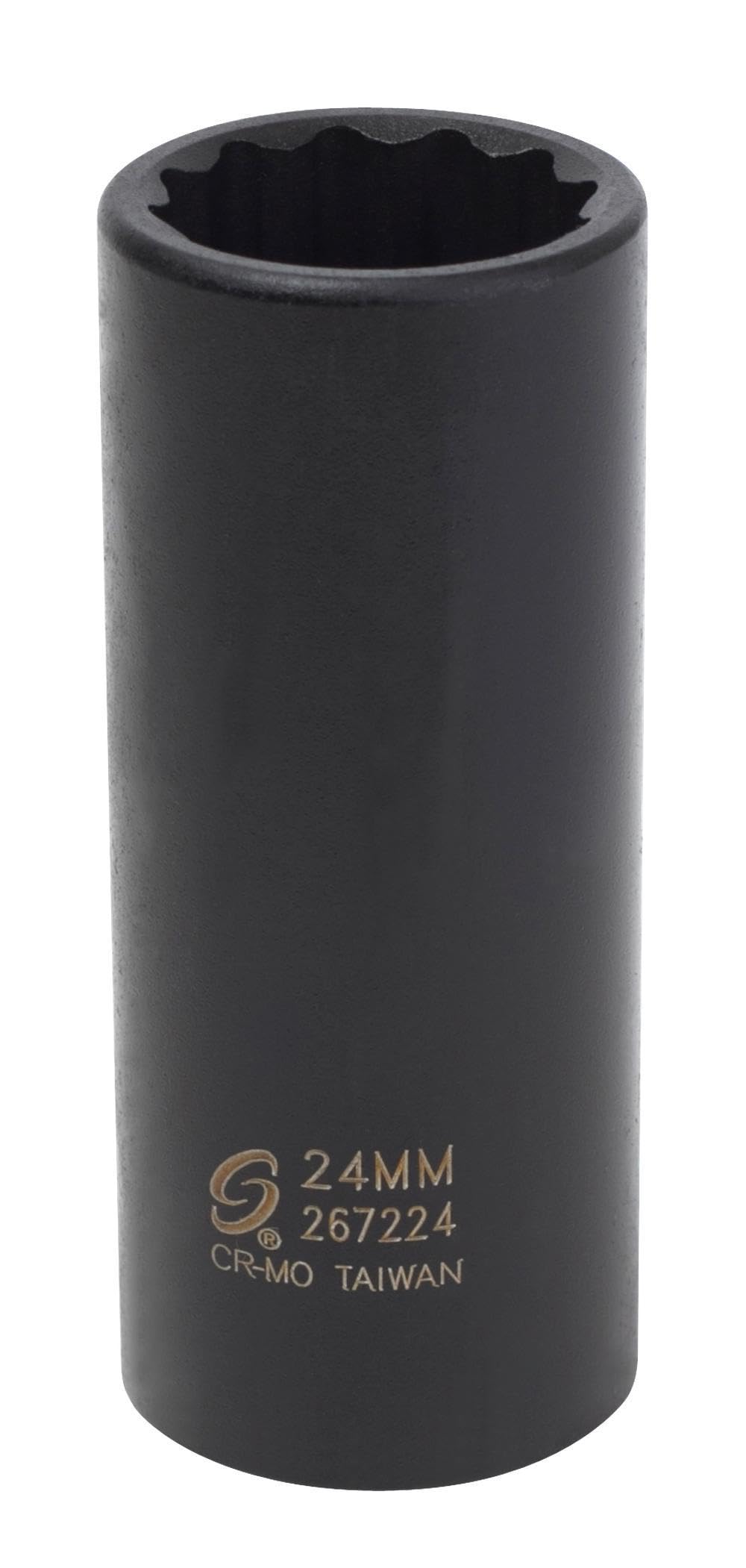
The Sunex name carries weight in professional automotive circles, and this 24mm deep impact socket justifies the reputation. Constructed from chrome molybdenum alloy steel, it’s designed specifically to survive the hammering of pneumatic impact wrenches on high-torque applications like axle bolts and suspension fasteners. VW GTI and Audi owners specifically praise this socket for fitting the tight axle bolt tolerances of German engineering.
The 12-point geometry allows socket engagement every 30 degrees, which is genuinely useful when working in cramped wheel wells where you cannot rotate the socket a full 60 degrees. The black phosphate finish provides solid corrosion resistance, and the laser-etched markings remain legible even in low-light garage conditions — a small but appreciated detail when you’re fumbling under a car. Sunex backs this with a lifetime warranty that has no exclusions.
Frequent “ugga-dugga” testimonials from real users confirm this socket handles repeated VW axle bolt removals without cracking or deforming. The 12-point design is theoretically more prone to rounding than a 6-point, but Sunex’s precision machining keeps the engagement tight enough that this is rarely a real-world problem. If you need a deep 24mm for impact work and want brand-backed durability assurance, this is the socket to buy.
Why it’s great
- Chrome molybdenum steel survives repeated impact gun abuse
- 12-point engagement works well in tight rotation spaces
- Lifetime warranty with no exclusions provides long-term value
Good to know
- 12-point geometry slightly more prone to rounding than 6-point
- Deep length may not fit in some confined engine bay areas
4. Lisle 12100 Oxygen Sensor Socket

The Lisle 12100 solves a very specific O2 sensor problem: how do you remove a sensor without crushing its wire harness? The cutaway slot running the length of the socket provides clearance for the O2 sensor wires, letting you spin the socket freely without pre-threading wires through the top. This heat-treated alloy steel socket works with both a 3/8-inch square drive ratchet and a 1-inch wrench, giving you two torque application methods.
Real-world users confirm this socket is heavy-duty enough to break loose corroded O2 sensors on Toyotas and Chevrolets without deforming. The 7/8-inch size corresponds to the standard 22mm hex found on most oxygen sensors, and the adequate depth covers the full sensor body. Mechanic reviews note it maintains square alignment under high torque from an impact ratchet, unlike cheaper stamped-steel alternatives that twist.
The only practical limitation is wall thickness — if your O2 sensor sits behind a heat shield, this socket may be too thick to fit. Some users report needing to remove the heat shield entirely before the socket engages. For accessible O2 sensors, this socket is stouter than the Tekton equivalent and justifies its reputation as the go-to DIY choice for sensor replacement.
Why it’s great
- Cutaway slot provides wire harness clearance during rotation
- Heat-treated alloy steel resists deformation on corroded sensors
- Dual-drive compatibility with ratchet and open-end wrench
Good to know
- Thick walls may not fit behind factory heat shields
- Single-purpose tool with limited versatility outside O2 work
5. ARES 70318 10-Piece Oxygen Sensor Kit
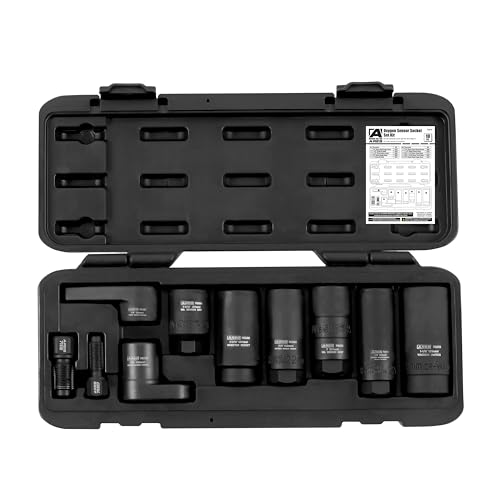
If you work on multiple vehicles or deal with emissions and fuel system diagnostics regularly, the ARES 70318 kit eliminates the frustration of digging through a drawer for the right specialty socket. This set includes 29mm and 22mm vacuum switch sockets, 27mm injector and oil sender sockets, heated and deep offset O2 sensor sockets, plus M12 and M18 rethread tools — covering nearly everything you’ll encounter on modern gasoline engines.
All tools are forged from chrome vanadium steel with a manganese phosphate coating, the same corrosion-resistant finish used on military-grade tools. The offset O2 sensor wrench is a lifesaver for sensors positioned at the back of the engine bay where straight sockets cannot engage. Real users report this kit removed a stuck O2 sensor that two professional shops had given up on, avoiding an exhaust manifold replacement.
The molded storage case keeps each socket organized and prevents loss — a genuine advantage when you’re under a car and need the 22mm offset immediately. The trade-off is that this kit uses CR-V rather than the more impact-tolerant CR-MO steel found in single-socket premium options. For hand-tool and occasional impact ratchet use, this is adequate, but don’t subject these to repeated high-torque pneumatic abuse.
Why it’s great
- Comprehensive 10-piece set covers nearly all sensor and injector sizes
- Offset O2 wrench reaches sensors straight sockets cannot
- Organized case keeps specialty tools from getting lost
Good to know
- CR-V steel less impact-durable than CR-MO counterparts
- Some tools may be redundant if you mostly work one vehicle platform
6. FOCMKEAS 1/2 Inch Drive 24mm Deep Impact Socket
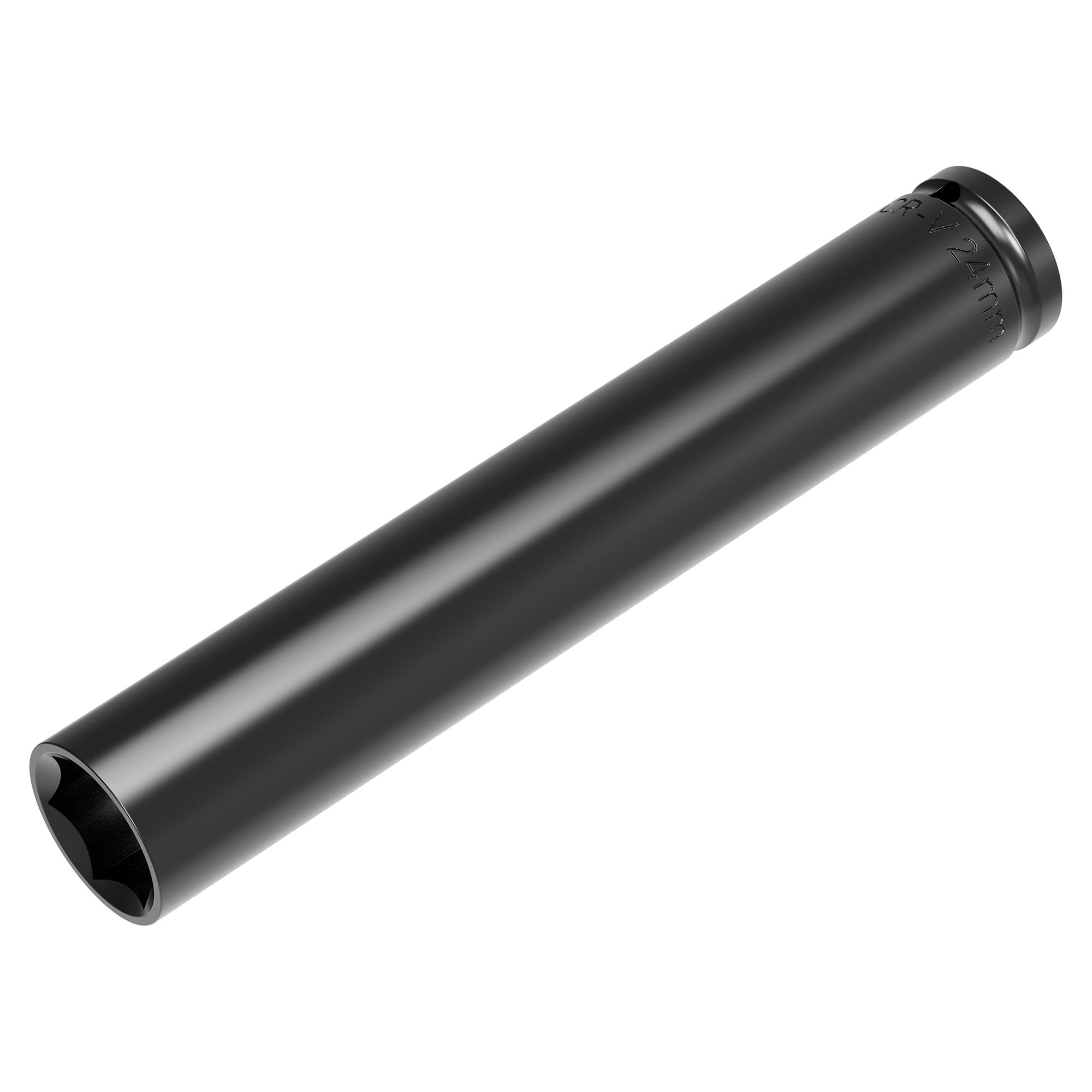
At just over six inches in total length, this FOCMKEAS deep impact socket provides the reach needed for applications like trailer nut systems, oil pressure sensors behind engine blocks, and harmonic balancer bolts that sit recessed in the crankshaft pulley. The heat-treated chrome vanadium steel construction with electrophoresis finish provides solid corrosion resistance and sufficient strength for impact driver use on non-industrial applications.
The radius corner design is a genuine engineering touch for this price tier — it places force on the flat walls of the fastener rather than the corners, reducing wear on both the socket and the bolt head. The pinhole base adds an extra layer of security by allowing a locking pin when you’re really leaning into a stubborn bolt. Users specifically mention it fitting the oil pressure sensor on a 2001 Chevy Suburban 5.3L perfectly without needing an extension.
The limitation here is material — chrome vanadium is harder but more brittle than chrome molybdenum, meaning this socket is best for moderate-torque impact work rather than the sustained hammering of a 1,200 ft-lb pneumatic gun. For the DIY home mechanic using a compact impact driver or hand ratchet, this represents excellent value for a single deep 24mm socket.
Why it’s great
- Six-inch length reaches recessed fasteners and deep studs
- Radius corner design reduces fastener rounding
- Pinhole base allows locking pin for high-torque applications
Good to know
- CR-V steel is less impact-durable than premium CR-MO alloys
- Single-piece purchase — no included case or storage
7. Mayouko 1/2″ Drive Deep Metric Impact Socket Set (11-Piece)

The set includes every interval you regularly encounter on European and Asian automotive fasteners: 10, 11, 12, 13, 14, 16, 17, 19, 21, 22, and the critical 24mm.
Construction is chrome vanadium steel with a black phosphate finish and a six-point high-torque design that meets ANSI and DIN performance standards. The blow-molded carrying case keeps the set organized and portable — a genuine advantage when you’re moving between job sites or storing in a truck toolbox. Customer reviews consistently note the quality exceeds what the price implies, with multiple buyers using these sockets as gifts for mechanically inclined family members.
The primary consideration is that this is CR-V steel, which means these are best suited for hand-tool and moderate-impact use. The 24mm socket in this set will handle lug nuts, suspension bolts, and engine accessories, but sustained high-torque impact gun work will wear the drive square faster than a premium CR-MO socket. For the home mechanic who needs a full metric deep socket range, this is the most cost-effective entry point available.
Why it’s great
- Eleven-piece set covers 10mm through 24mm in deep impact
- Blow-molded case keeps sockets organized and portable
- Six-point design meets ANSI and DIN performance standards
Good to know
- CR-V steel not suited for sustained high-torque impact abuse
- Case is functional but not as rugged as professional tool storage
FAQ
Can I use a standard 24mm socket on an impact gun?
What is the difference between 6-point and 12-point 24mm sockets?
When do I need a deep 24mm socket instead of a standard one?
Final Thoughts: The Verdict
For most users, the best 24mm sensor socket winner is the Sunluway 77070 because it combines counter-weighted momentum with six-point grip for the hardest job you’ll face: breaking loose a torqued-to-yield crank bolt. If you need a swivel socket for reaching awkward fasteners behind suspension components, grab the Capri Tools Universal. And for complete emissions-system coverage with all the specialty cutaway and offset designs you need, nothing beats the ARES 70318 kit.