
A 24mm wide angle lens sits right at the edge of ultra-wide territory, offering a field of view that pulls in expansive landscapes, tight interiors, and dramatic environmental portraits without the extreme distortion of wider glass. It’s the focal length that forces you to compose carefully — every element in the frame matters because there’s no zoom to crop out distractions.
I’m Min — the co-founder and writer behind Gadgets Feed. I’ve spent hundreds of hours analyzing MTF charts, autofocus performance metrics, and real-world sample galleries to understand exactly how each 24mm prime and zoom handles chromatic aberration, corner sharpness, and flare resistance.
Whether you’re shooting astrophotography under a dark sky or documenting city streets at night, this guide breaks down the sharpest, fastest, and most reliable options to help you find the perfect 24mm wide angle lens for your camera system and budget.
How To Choose The Best 24mm Wide Angle Lens
Selecting a 24mm lens isn’t just about the focal length — you’re deciding between a prime’s sharpness and a zoom’s versatility, a fast aperture for astro or a compact build for travel. The right choice depends on your camera’s mount and the light you’ll be shooting in.
Fast Glass Matters at 24mm
Aperture is the single most important spec for a 24mm lens. An f/1.4 or f/1.8 prime lets in 2-4x more light than a typical f/4 zoom, which makes the difference between a usable handheld shot indoors and a blurry mess. Astrophotographers should prioritize f/1.4 lenses to capture the Milky Way with shorter shutter speeds and lower ISO noise.
Corner Sharpness and Distortion Control
Wide-angle lenses inherently struggle with corner softness and barrel distortion. Look for designs with aspherical elements and ultra-low dispersion glass — these correct coma (star trailing near edges) and chromatic aberration that shows up as purple fringing on high-contrast edges. Lenses like the Sony FE 24mm F1.4 GM use XA (extreme aspherical) elements to maintain resolution edge-to-edge.
Build Quality and Weather Sealing
If you shoot outdoors, moisture-resistant construction and fluorine coatings protect against dust and rain. Metal mounts last longer than plastic, and manual aperture rings on lenses like the Viltrox 24mm F1.8 give video shooters tactile exposure control without touching the camera body.
Quick Comparison
On smaller screens, swipe sideways to see the full table.
| Model | Category | Best For | Key Spec | Amazon |
|---|---|---|---|---|
| Sony FE 24mm F1.4 GM | Premium | Astro & Professional Work | F1.4, XA elements, 445g | Amazon |
| Sigma 24mm F1.4 Art DG DN | Premium | Event & Low Light | F1.4, Super Multilayer Coating | Amazon |
| Canon RF 24mm F1.8 Macro IS STM | Mid-Range | Video & Close-up Work | F1.8, 0.5x macro, 268g | Amazon |
| Nikon 24mm f/1.8G ED | Mid-Range | DLSR Landscape | F1.8, F-mount, 590g | Amazon |
| Nikon 24-120mm f/4G ED VR | Mid-Range | Travel Versatility | F4, 5x zoom, VR II | Amazon |
| Viltrox 24mm F1.8 | Value | Nikon Z Budget Prime | F1.8, STM motor, 370g | Amazon |
| Tamron 24mm F/2.8 Di III OSD | Value | Compact Everyday Use | F2.8, 1:2 macro, 215g | Amazon |
| Sigma 14-24mm F2.8 DG DN Art | Premium | Real Estate & Ultra-Wide | F2.8, 14-24mm, HSM motor | Amazon |
| Sigma 28-70mm F2.8 DG DN | Mid-Range | Standard Zoom Alternative | F2.8, 28-70mm, 470g | Amazon |
In‑Depth Reviews
1. Sony FE 24mm F1.4 GM

The Sony FE 24mm F1.4 GM sits at the pinnacle of wide-angle prime design, weighing just 445 grams while delivering class-leading resolution from f/1.4 through f/11. Its two XA (extreme aspherical) elements suppress sagittal flare and coma, making it the go-to lens for astrophotographers who need pinpoint star rendering at the edges of a 42MP sensor.
Autofocus is instantaneous and silent thanks to the DDSSM (Direct Drive SSM) motor, and the lens features a focus hold button and aperture ring with a click/de-click switch for video. Real-world owners consistently report that it replaces the need for a 16-35mm zoom in many scenarios, citing the f/1.4 speed advantage as the deciding factor for low-light event work.
The G Master coating system minimizes ghosting even with direct light sources in the frame, and the physical build includes dust and moisture sealing. At this price point, you’re paying for the sharpest 24mm on the Sony E-mount ecosystem — and the results justify the investment for working professionals and serious enthusiasts alike.
Why it’s great
- Extraordinary sharpness wide open at f/1.4
- Compact and lightweight for a fast prime
- Excellent coma correction for astrophotography
Good to know
- Premium price compared to f/1.8 alternatives
- No optical image stabilization on lens itself
2. Sigma 24mm F1.4 Art DG DN

The Sigma 24mm F1.4 Art DG DN brings the legendary Art series optical formula to mirrorless cameras, using a 14-element construction with two FLD (F Low Dispersion) and one SLD (Special Low Dispersion) element to control chromatic aberration across the frame. The f/1.4 maximum aperture captures 1.3 stops more light than f/1.8 lenses, giving it a real advantage for interior real estate and nighttime cityscapes.
Owners praise its fast and reliable autofocus on Sony A7 series bodies, with accurate eye-tracking for environmental portraits. The manual aperture ring with de-click option is a welcome feature for video shooters who need silent exposure ramping, and the dust- and splash-proof construction holds up to outdoor conditions.
Corner sharpness at f/1.4 is excellent but not quite at the Sony GM level — the difference is most visible on 61MP sensors. Still, for the substantial savings compared to the G Master, this lens delivers 95% of the performance and is the smart choice for shooters who need f/1.4 without stretching to the flagship price.
Why it’s great
- Brilliant value for f/1.4 performance
- Strong chromatic aberration correction
- Manual aperture ring with de-click
Good to know
- Slightly heavier than Sony GM equivalent
- Corner sharpness trails the GM
3. Canon RF 24mm F1.8 Macro IS STM

The Canon RF 24mm F1.8 Macro IS STM is a unique hybrid that combines a wide-angle prime with 0.5x macro magnification and optical image stabilization rated at 5.5 stops. The minimum focus distance drops to just 0.14 meters, letting you capture extreme close-ups of flowers, food, or product details that no other 24mm prime can match.
Paired with an EOS R series body, Coordinated IS pushes stabilization to 6.5 stops, making this lens exceptionally capable for handheld video and gimbal work. The STM motor keeps autofocus smooth and quiet during recording, though some users note a slight focus noise in silent environments. At 268 grams, it’s one of the lightest 24mm options available.
The UD glass element and Super Spectra Coating effectively suppress flare and ghosting, and the f/1.8 aperture provides decent low-light reach. It’s not the sharpest wide open in the corners, but for a lens that also functions as a macro and a stabilized video lens, the versatility is unmatched within the Canon RF system.
Why it’s great
- 0.5x macro capability in a 24mm lens
- 5.5-stop optical image stabilization
- Ultra-light at 268 grams
Good to know
- Corner sharpness softens wide open
- STM motor can be audible in quiet scenes
4. Nikon 24mm f/1.8G ED
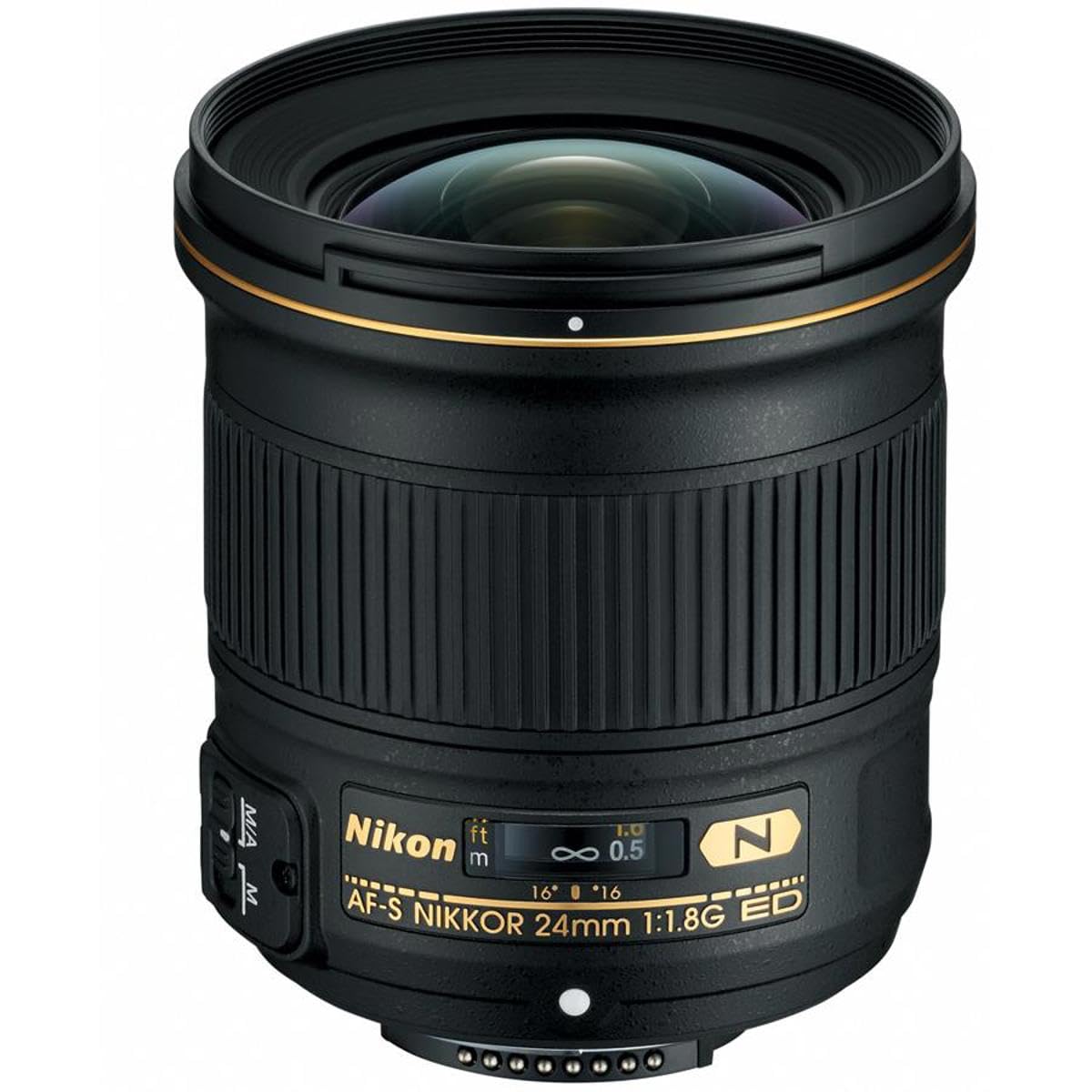
The Nikon AF-S FX NIKKOR 24mm f/1.8G ED is a full-frame F-mount prime designed to extract peak performance from Nikon’s high-resolution DSLRs like the D850 and D810. Its two ED elements and two aspherical elements correct sagittal flare and spherical aberration, producing clean sunstars at narrower apertures and natural-looking bokeh at f/1.8.
Landscape and architecture photographers appreciate the minimal barrel distortion, and the 0.23m minimum focus distance allows creative close-ups that exaggerate perspective. The Silent Wave Motor (SWM) delivers fast, accurate autofocus, though some owners report copy-to-copy variation in focus accuracy at f/1.8 that requires AF fine-tuning.
At 590 grams, it’s heavier than mirrorless-native 24mm f/1.8 lenses, but the metal mount and rubber gasket provide durability against the elements. It’s a solid investment for Nikon DSLR users who want an f/1.8 prime that matches the resolving power of modern sensors without stepping to the f/1.4 tier.
Why it’s great
- Sharp across the frame when stopped down
- Beautiful sunstar rendering
- Robust F-mount build quality
Good to know
- AF consistency varies between copies
- Heavier than mirrorless alternatives
5. Nikon 24-120mm f/4G ED VR

The Nikon 24-120mm f/4G ED VR is a 5x standard zoom that covers the versatile 24mm wide end all the way to 120mm telephoto, making it a single-lens solution for travel and event photography. The constant f/4 aperture keeps exposure consistent throughout the zoom range, and VR II provides up to 4 stops of shake correction for handheld shooting in dim interiors.
At 24mm, barrel distortion is present but easily correctable in Lightroom, and Nano Crystal Coat minimizes flare when shooting into the sun. The 24-120mm range eliminates lens changes during a wedding shoot or day trip — owners report relying on it for 85% of their shots due to the sheer convenience of the zoom.
The trade-off is a maximum aperture of f/4, which means you’ll need to raise ISO in low light compared to an f/1.8 or f/2.8 lens. It’s also heavier than a prime at 710 grams. For photographers who value flexibility over absolute low-light performance, this remains a workhorse zoom that starts at a true 24mm.
Why it’s great
- Versatile 24-120mm range covers wide to telephoto
- VR II stabilization effective for handheld shooting
- Constant f/4 aperture throughout zoom
Good to know
- F/4 aperture limits low-light performance
- Noticeable barrel distortion at 24mm
6. Viltrox 24mm F1.8

The Viltrox 24mm F1.8 brings fast-aperture wide-angle capability to Nikon Z-mount shooters without the investment required for the Nikkor Z 24mm f/1.8 S. Its 11-element design with two aspherical and three ED lenses controls chromatic aberration and coma effectively, producing sharp images across the frame when stopped down to f/2.8.
The STM stepping motor enables smooth and quiet autofocus for both stills and video, and the lens includes a manual aperture ring that can be switched between automatic and manual control — a feature usually reserved for lenses costing twice as much. A Type-C port allows firmware updates to address future camera compatibility, extending the lens’s lifespan.
Build quality is solid with a metal barrel and mount, though some users report the included lens hood can scratch the focus ring when reversed. Autofocus is reliable for static subjects and slow movement, but it struggles with fast action like pets in the backyard. For portrait, landscape, and video work on a Z-mount body, this lens delivers outstanding value.
Why it’s great
- Excellent sharpness for the price point
- STM motor provides quiet AF for video
- Firmware upgradeable via USB-C
Good to know
- Autofocus not ideal for fast action
- Manual aperture ring can be bumped accidentally
7. Tamron 24mm F/2.8 Di III OSD

At just 215 grams and 2.5 inches long, the Tamron 24mm F/2.8 Di III OSD is the smallest and lightest lens in this roundup, designed specifically for full-frame or APS-C Sony E-mount cameras. Despite its featherweight build, it offers a 1:2 maximum magnification ratio, making it a capable semi-macro lens for detail shots of food, flowers, or textures.
The minimum object distance of 4.7 inches lets you fill the frame with small subjects while still showing background context, creating distinctive wide-angle macro compositions. Fluorine coating on the front element repels water and dirt, and moisture-resistant construction adds durability for outdoor shooting. Autofocus is driven by an OSD (Optimized Silent Drive) motor that keeps noise minimal during stills, though it’s audible in video recording.
Image quality punches above expectations for a budget-friendly lens — center sharpness is excellent, contrast is good, and chromatic aberration is well-contained. The trade-off is the f/2.8 maximum aperture, which limits low-light performance compared to f/1.8 and f/1.4 alternatives. Some users report the lens mount requires excessive force to attach, so handle with care during installation.
Why it’s great
- Extremely compact and lightweight for travel
- 1:2 macro magnification at 4.7 inches
- Solid center sharpness and contrast
Good to know
- Tight f/2.8 aperture limits low light
- Autofocus motor audible during video
8. Sigma 14-24mm F2.8 DG DN Art

The Sigma 14-24mm F2.8 DG DN Art is an ultra-wide-angle zoom that goes well beyond the 24mm focal length, reaching 14mm for expansive interior shots and dramatic landscapes. The constant f/2.8 aperture is invaluable for real estate photographers who need to capture dim bathrooms and closets without raising ISO, and the Hyper Sonic Motor provides fast, accurate autofocus even on high-pixel-count bodies like the Sony A1.
Image quality at 14mm is sharp in the center even wide open, though corner sharpness improves noticeably when stopped down to f/5.6. Owners using this lens for architectural work note that barrel distortion is significant at the wide end and requires post-processing correction. The bulbous front element prevents the use of screw-on filters, necessitating a costly drop-in filter system for ND or polarizer use.
Dust- and splash-proof construction makes it suitable for outdoor and coastal photography, and the included rear filter slot adds versatility. This lens is a specialist tool for shooters who need the 14mm ultra-wide perspective frequently — for those who primarily shoot at 24mm, a prime offers better sharpness and a lighter load.
Why it’s great
- 14mm ultra-wide capability for real estate
- Constant f/2.8 across zoom range
- Dust- and splash-proof construction
Good to know
- Bulbous front element prevents screw-on filters
- Noticeable barrel distortion at 14mm
9. Sigma 28-70mm F2.8 DG DN

The Sigma 28-70mm F2.8 DG DN is a standard zoom that starts at 28mm rather than 24mm, but it earns its place here as a lightweight alternative to the Sony 24-70mm GM. At 470 grams and with a 67mm filter thread that matches other Sigma primes, it’s a compact travel companion that covers portrait-length to mild wide-angle without the bulk of a traditional f/2.8 zoom.
Image quality is impressive for the price — center sharpness rivals the Sony GM at equivalent apertures, and colors are pleasing straight out of camera. Some corner softness appears at 70mm wide open, and chromatic aberration is present at the extremes but cleans up easily in post-processing. The Nano Porous Coating effectively controls flare and ghosting in backlit situations.
Owners consistently report that this lens replaced their Sony 24-70mm GM due to the combination of lighter weight, lower cost, and comparable real-world results. For those who don’t absolutely need the 24mm wide end, the savings can fund a dedicated fast prime like the 24mm F1.4 GM for low-light and astro work — creating a versatile two-lens kit.
Why it’s great
- Excellent value compared to Sony GM equivalent
- Lightweight at 470 grams for f/2.8 zoom
- Matches 67mm filter thread with Sigma primes
Good to know
- Starts at 28mm, not true 24mm wide
- Corner sharpness softens at 70mm wide open
FAQ
Is a 24mm lens good for astrophotography?
Should I get a 24mm prime or a 24-70mm zoom?
Does a 24mm lens work on APS-C cameras?
What’s the difference between f/1.8 and f/1.4 at 24mm?
Can I use a 24mm lens for portraits?
Final Thoughts: The Verdict
For most users, the best 24mm wide angle lens overall is the Sony FE 24mm F1.4 GM because it combines the fastest aperture with the sharpest optics in the lightest possible package for full-frame mirrorless. If you want a versatile hybrid that also doubles as a macro lens with built-in stabilization, grab the Canon RF 24mm F1.8 Macro IS STM. And for Nikon Z-mount shooters on a budget, nothing beats the Viltrox 24mm F1.8 for delivering f/1.8 performance and metal build quality at a value-oriented price point.