
Our readers keep the lights on and my morning glass full of iced black tea. As an Amazon Associate, I earn from qualifying purchases.
Specs are compiled from manufacturer listings and verified buyer reviews and can change over time — please confirm the key details on the product page before buying.
Setting the right amount of twist on a critical bolt is the difference between a joint that holds and a part that cracks, warps, or snaps. On a car or truck, you are often torquing lug nuts, axle retainers, or suspension bolts. A 250 ft-lb torque wrench lets you stop guessing and follow the spec exactly. The market is full of options ranging from simple click-style tools to digital units with multiple readouts, so narrowing the choice depends on accuracy, ease of use, and how the wrench feels in your hands.
I’m Min — the founder and writer behind Gadgets Feed. This guide is built by comparing the manufacturers’ published specifications and the patterns across verified customer reviews, so you get each pick’s real strengths and trade-offs instead of marketing spin.
For the occasional weekend job or daily professional use, the best 250 ft-lb torque wrench balances dependable accuracy with a comfortable handle and clear torque markings so you can work with confidence every time.
Quick Picks
- GEARWRENCH 1/2″ Drive Micrometer Torque Wrench – 85066 — Professional Grade
- TEKTON 1/2 Inch Drive 72-Tooth Split Beam Torque Wrench – TRQ62203 — Smart Design
- CRAFTSMAN Digital Torque Wrench, 1/2-Inch, 50-250 FT-LB – CMMT99436 — Digital Versatility
- CDI 1/2 Inch Drive Adjustable Click Torque Wrench, 30-250 Ft Lbs – 2503MFRMH — Industrial Strength
- BULLTOOLS 1/2-inch Drive Click Torque Wrench, 25-250 ft.lb — Best Value
- LEXIVON 1/2-Inch Drive Click Torque Wrench, 25-250 Ft-Lb – LX-184 — Locking Collar Pick
- Puibers 1/2 Drive Torque Wrench, 30-250 FT.LB — Budget Champion
How To Choose The Best 250 Ft-Lb Torque Wrench
A 250 ft-lb torque wrench is a specialized tool. Buying the wrong one means either inaccurate fastening or a tool that feels clumsy on the job. Focus on these three factors to match a wrench to your actual work.
Accuracy and Calibration
Look for the accuracy percentage stated by the manufacturer, usually ±3% or ±4%. A lower number means you get closer to the exact torque you set, which is critical for engine internals and structural bolts. Every wrench worth buying ships with a calibration certificate that traces back to a known standard, confirming it met its claim before leaving the factory.
Adjustment Mechanism and Locking
Micrometer-style wrenches use a rotating handle to dial in torque, and the setting can drift if the lock ring is not engaged during use. Split-beam designs use a thumbscrew for setting and lock the value with a flip-up cover, so you never lose the setting when you set the wrench down. Consider how often you will change torque values and if you need a mechanism that holds rock-solid during repeated cycles.
Length, Ratchet Teeth, and Handle Feel
Longer wrenches provide better leverage at 250 ft-lb, but they can be too long for tight engine bays. Ratchet tooth count, such as 72-tooth versus 90-tooth, determines how much swing arc you need to advance the fastener — a higher tooth count works in tighter spaces. The grip material and knurling affect control when you are pulling hard, so look for non-slip, comfortable handles that stay grippy even with oily hands.
Quick Comparison
On smaller screens, swipe sideways to see the full table.
| Model | Best For | Accuracy | Length | Ratchet Teeth | Amazon |
|---|---|---|---|---|---|
| Puibers 1/2″ Drive | Budget-friendly beginner | ±3% | — | 72-tooth | $35.83$49.99Limited time dealAmazon |
| BULLTOOLS 1/2″ Drive | Mid-range all-rounder | ±3% | 24.8 Inches | 90-tooth | $59.99Amazon |
| LEXIVON LX-184 | Value pick with locking collar | ±4% | 24.84 Inches | — | $69.97Amazon |
| GEARWRENCH 85066 | High-torque leverage | ±3% | 26.75 Inches | — | $149.00Amazon |
| TEKTON TRQ62203 | Split-beam convenience | ±4% | 22.8 Inches | 72-tooth | $150.00Amazon |
| CRAFTSMAN CMMT99436 | Digital readout versatility | — | 29.64 Inches | — | $163.07Amazon |
| CDI 2503MFRMH | Professional-grade precision | ±4% CW ±6% CCW | 24.4 Inches | — | $185.73Amazon |
In‑Depth Reviews
1. GEARWRENCH 1/2″ Drive Micrometer Torque Wrench – 85066

The long-handled powerhouse that gives you major leverage at the top end of the torque range.
The GEARWRENCH 85066 stretches to 26.75 inches, making it the longest standard click-style wrench here. That 2-inch advantage over the BULLTOOLS (24.8 inches) means you apply less muscle force to reach 250 ft-lb, which is a real relief when you are torquing axle nuts or suspension bolts. It covers 30-250 ft-lb with a rated accuracy of ±3% CW (clockwise) between 20% and 100% of its range, so you get consistent results on both mid-range and high-end fasteners. Buyers report that they have used this tool daily for a decade and that the engraved numbers on the micrometer barrel will not fade over time like painted markings do.
The pull adjustment collar lets you make quick torque setting changes without fumbling with a separate lock ring, and the teardrop ratchet head helps you reach fasteners in tight spots. The knurled handle stays grippy even when your hands are wet or oily, which matters when you are pulling hard. The only compromise is the head thickness — some users note it is on the thicker side, so pros working in extremely confined engine bays might prefer a slimmer design.
The lever cam ratchet gives you smooth directional switching, and the included carry case keeps the calibration certificate and wrench protected. If you regularly tighten above 200 ft-lb, the extra length of the GEARWRENCH gives it a real edge over shorter wrenches without making the tool feel flimsy.
Reasons to Grab It
- Longest handle at 26.75 inches for maximum leverage on high-torque bolts
- Rated ±3% accuracy with engraved, fade-proof torque markings
- Pull adjustment collar for fast, intuitive setting changes
- Buyers confirm reliable performance even after a decade of daily use
Considerations
- Ratchet head is thick, which can limit access in very tight spaces
- Some users prefer a rotating lock ring over the slip collar design
The go-to for high-torque work: you regularly torque bolts above 200 ft-lb and want the leverage advantage of a 26.75-inch handle without sacrificing ±3% accuracy.
Look elsewhere if: you often work in cramped engine bays where a thick ratchet head simply will not fit.
2. TEKTON 1/2 Inch Drive 72-Tooth Split Beam Torque Wrench – TRQ62203

A split-beam design that never needs returning to zero after each use.
Unlike the GEARWRENCH click-style wrench, the TEKTON TRQ62203 uses a split-beam mechanism so you can store it at any torque setting without damaging the internal spring. That means you set it once, use it for the job, and toss it in the drawer without having to rotate the handle back to the lowest value — a small daily convenience that adds up fast. It covers 40-250 ft-lb with ±4% accuracy throughout the entire range, and each wrench ships with a serialized calibration certificate that meets the ASME B107.300-2010 standard (an industry standard for torque tools). A smooth-turning thumbscrew makes setting a precise torque value quick, and the flip-up cover locks the setting in place during use so you never accidentally bump the value mid-tightening.
The 72-tooth ratchet always felt smooth in the reviewers’ hands, and the non-ratcheting head has a straightforward mechanism that is less prone to wear than more complex designs. The wrench weighs only 3.7 pounds, notably lighter than many 250 ft-lb models, which reduces fatigue during a full day of work. Owners mention that the tool survived three years of heavy shop abuse — including being dropped and even run over — while maintaining consistent accuracy.
The scale on the body allows quick conversion from foot-pounds to newton-meters (Nm), so you can follow any spec sheet without mental math. The only trade-off is the slightly shorter 22.8-inch handle, which requires a bit more arm force at the very top of the torque range compared to the GEARWRENCH above.
Standout Features
- Split beam design does not require resetting after use, saving time and wear
- Flip-up cover locks the torque setting so it never drifts during work
- Weighs only 3.7 pounds for less fatigue during extended sessions
- Buyers confirm consistent accuracy after years of heavy shop abuse
Keep in Mind
- Shorter 22.8-inch handle means more arm effort at the 250 ft-lb limit
- Accuracy is ±4%, which is a step behind the ±3% wrenches in this list
Choose this for convenience: you value a split-beam wrench that can be stored at any setting and you want a lightweight, durable tool for everyday shop work.
skip it if: you need the maximum leverage of a 26-inch-plus handle to reach 250 ft-lb with less effort.
3. CRAFTSMAN Digital Torque Wrench, 1/2-Inch, 50-250 FT-LB – CMMT99436

A digital screen that saves you from squinting at tiny etched marks in dim light.
The CRAFTSMAN CMMT99436 replaces the traditional micrometer scale with an LED (light-emitting diode) backlit screen, so you read the exact torque value even in a dark garage or under a vehicle. It converts between foot-pounds, inch-pounds, and newton-meters at the touch of a button, which is handy when you work on both domestic and imported vehicles with different spec formats. This is a ratcheting wrench that covers 50-250 ft-lb, and it meets or exceeds ASME specifications for reliability. Customers note that the beeping alert system is helpful for confirming when you have reached the set torque, though some wish the display could be viewed remotely from a different angle.
At 29.64 inches, it is the longest wrench in this roundup, offering tremendous leverage for high-torque applications like axle nuts that require well over 100 ft-lb. The ergonomic handle with a sure-grip surface keeps your hand comfortable during sustained pulls. The durable clear case protects the digital internals and makes the wrench easy to spot in a crowded toolbox.
The main learning curve comes from the torque setting menu — buyers recommend reading the manual first to avoid confusion. The number of ratchet teeth is not stated in the specs, and users suspect it has fewer than 72 teeth, which means you may need a wider swing arc in tight spaces. If you prefer a purely mechanical tool with no batteries to manage, a click-style wrench might be a better fit.
What Works Well
- LED backlit screen provides a clear readout in low-light conditions
- Instant unit conversion between ft-lb, in-lb, and Nm
- Longest handle at 29.64 inches for maximum leverage on stubborn bolts
- Beeping alert confirms when set torque is reached
What to Watch
- Setting the torque value requires reading the manual first; not fully intuitive
- Unknown ratchet tooth count means a wider swing arc may be needed
- Battery-powered; a dead battery means no torque reading until you replace it
Best suited for: the mechanic who prefers a bright digital display, works with multiple unit systems, and needs the longest handle available for high-torque jobs.
Not ideal for: someone who wants a simple analog tool with no batteries, menus, or buttons to manage.
4. CDI 1/2 Inch Drive Adjustable Click Torque Wrench, 30-250 Ft Lbs – 2503MFRMH
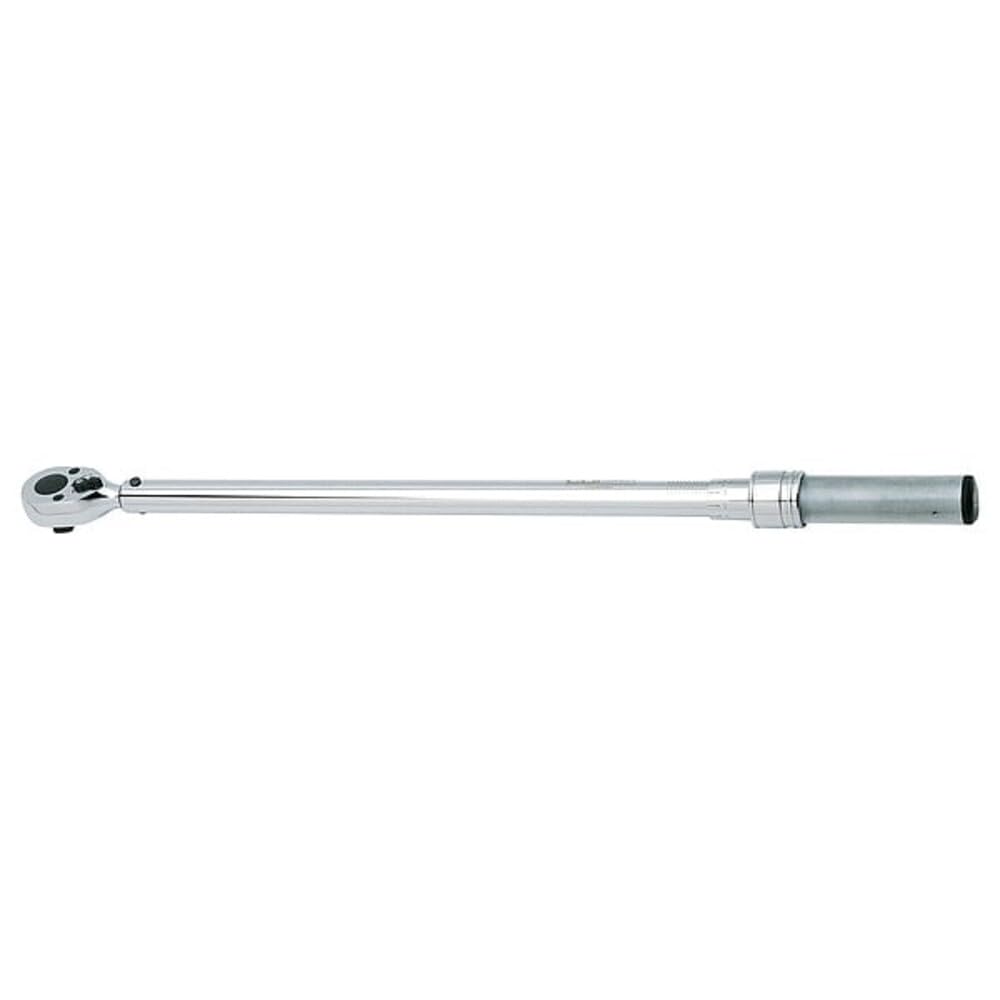
A professional-grade click wrench made in the USA, backed by the same company that produces Snap-on torque tools.
The CDI 2503MFRMH covers 30-250 ft-lb and 47-332 Nm with a rated accuracy of ±4% CW and ±6% CCW (counterclockwise) of the indicated value from 20% to 100% of full scale. It covers 30-250 ft-lb and 47-332 Nm with a rated accuracy of ±4% CW and ±6% CCW (counterclockwise) of the indicated value from 20% to 100% of full scale. Every wrench is individually serialized with a matching certificate of calibration that is traceable to N.I.S.T. (National Institute of Standards and Technology), giving you a documented pedigree that professional shops often require. Reviewers point out that the solid, audible click at the set torque is satisfyingly crisp, and the long handle provides the leverage needed for heavy jobs like torquing axle nuts to 217 ft-lb.
The quick-release button on the ratchet head provides solid socket retention and easy removal, while the laser-marked dual scales are precise and easy to read. The handle is lightly knurled for a tough, non-slip grip that stays secure even when pulling hard at the top of the range. The spring-loaded pull-down lock ring keeps the setting secure during use, but you must remember to reset the wrench to the lowest setting (around 30 ft-lb) after each use to preserve the internal spring’s calibration.
The blow-molded case provides rugged protection when the wrench is not in use. Some users note that the scale markings can be hard to read in bright sunlight, and the 24.4-inch length, while solid, is shorter than the GEARWRENCH and CRAFTSMAN options. If you want a precision torque wrench with a made-in-USA stamp and a calibration certificate that satisfies industrial quality assurance, this is among the most trustworthy picks available.
Why It Stands Out
- Manufactured in the USA with N.I.S.T.-traceable calibration certificate
- Crisp, audible click that users trust for critical high-torque fasteners
- Quick-release socket button for fast swaps and secure retention
- Knurled metal handle provides a confident grip even with oily hands
Drawbacks
- Must reset to lowest setting after each use to protect the internal spring
- Scale markings are hard to read in very bright sunlight
Reach for this if: you need a professional-grade, US-made torque wrench with documented N.I.S.T. traceability for industrial or aviation work.
Look elsewhere if: you do not want to remember to reset the tool to its lowest setting every time you finish using it.
5. BULLTOOLS 1/2-inch Drive Click Torque Wrench, 25-250 ft.lb

A 90-tooth ratchet designed for tighter access than a 72-tooth head.
The BULLTOOLS 1/2-inch drive wrench uses a 90-tooth ratchet, while the Puibers uses a 72-tooth ratchet, which can be a real benefit when you are working in crowded suspension areas or behind wheels. It spans 25-250 ft.lb / 33.75-337.5 Nm with an industrial-grade accuracy of ±3% and ships with a formal calibration certificate. The manufacturer says the wrench head is made from hardened chromium-molybdenum alloy (a type of steel stronger than the more common chromium-vanadium), while the handle uses an aluminum-titanium alloy that resists corrosion and stays comfortable to grip.
Shoppers say that the black-on-gray 15 ft-lb markings are excellent, but the gray-on-blue 1 ft-lb markings have poor contrast and are hard to read in dim conditions. Some note that at 24.8 inches, the length feels insufficient for reaching 250 ft-lb without extreme force, and the adjustment gets stiffer as you dial toward the upper end. For torque values under 150 ft-lb, the same brand makes a 10-160 ft-lb model that buyers report offers a better feel and includes adapters in the case.
The laser-etched dual-range scale is designed to resist wear over time, and the quick-release button on the ratchet head makes socket swaps fast. The pull-down lock knob automatically snaps back to lock your setting. If you frequently work in the 80-150 ft-lb range and want a tool that can also handle occasional 250 ft-lb tasks, this is a strong mid-range pick that beats the Puibers on ratchet refinement.
Strengths
- 90-tooth ratchet head requires only a 3-degree swing arc, great for tight spaces
- ±3% accuracy with a formal calibration certificate included
- Manufacturer states head is made from stronger chromium-molybdenum alloy
- Aluminum-titanium handle resists rust and feels comfortable in the hand
Weaknesses
- 1 ft-lb markings suffer from poor gray-on-blue contrast for readability
- 24.8-inch length requires significant arm effort at the 250 ft-lb max
- Adjustment stiffness increases noticeably at the upper torque ranges
Grab this for: the 90-tooth ratchet that makes a real difference in tight spaces, paired with ±3% accuracy at a competitive mid-range price.
Pass if: you primarily work above 200 ft-lb and want a longer handle for better leverage without straining.
6. LEXIVON 1/2-Inch Drive Click Torque Wrench, 25-250 Ft-Lb – LX-184

A locking collar design that many buyers prefer over the twist-knob mechanism on cheaper wrenches.
The LEXIVON LX-184 ships pre-calibrated to ±4% accuracy and ready to use with a calibration certificate that has a traceable serial number. The reinforced ratchet gear head is built from hardened, heat-treated chrome vanadium alloy steel, and the brand’s unique Electro-Black finish treatment provides rust and corrosion protection so the wrench still looks good even after months in a damp toolbox. The dual-range scale features highlighted yellow print, which makes the markings visible even in low-light conditions — a practical advantage over wrenches with plain black-on-metal scales. Owners mention that the locking collar design is a major upgrade over the simpler twist-knob lock, as it holds the setting more securely during use. One reviewer noted that the 1/4-inch drive 20-200 in-lb version of this wrench was well worth the money, speaking to the brand’s overall build quality.
The reversible ratchet head drives in both directions and measures torque in a clockwise direction. At 6.4 pounds, it is one of the heavier wrenches in this lineup, but that heft contributes to a solid, durable feel. The included storage case adds protection and makes it easy to keep the calibration certificate with the tool. The main trade-off is the ±4% accuracy rating, versus ±3% on the Puibers and BULLTOOLS wrenches above. For casual automotive work and routine lug nut torquing, that difference rarely matters — but for engine-building precision, a ±3% tool would be the safer choice.
The 24.84-inch length is average for this class, providing decent leverage without being unwieldy. The click mechanism is somewhat subtle at lighter settings, so you need to pay attention to the audible and tactile feedback. For the price, the LEXIVON feels well-made and includes thoughtful touches like the corrosion-resistant finish and easy-to-read scale, making it a solid value for the home mechanic who does not need the highest tier of accuracy.
What You Get
- Locking collar holds torque settings more securely than twist-knob designs
- Yellow-highlighted dual-range scale improves readability in low light
- Electro-Black finish resists rust and corrosion for long-term durability
- Calibration certificate with a traceable serial number included
Trade-offs
- ±4% accuracy is less precise than the ±3% wrenches in this list
- Click feedback is subtle at lower torque settings and can be missed
- Heavier than many competitors at 6.4 pounds
Choose this if: you want a sturdy, corrosion-resistant wrench with a locking collar that keeps your settings secure and a bright scale you can actually read in the dark.
Pass if: you require the tightest ±3% accuracy for precision engine work and are comfortable with a simpler lock mechanism.
7. Puibers 1/2 Drive Torque Wrench, 30-250 FT.LB
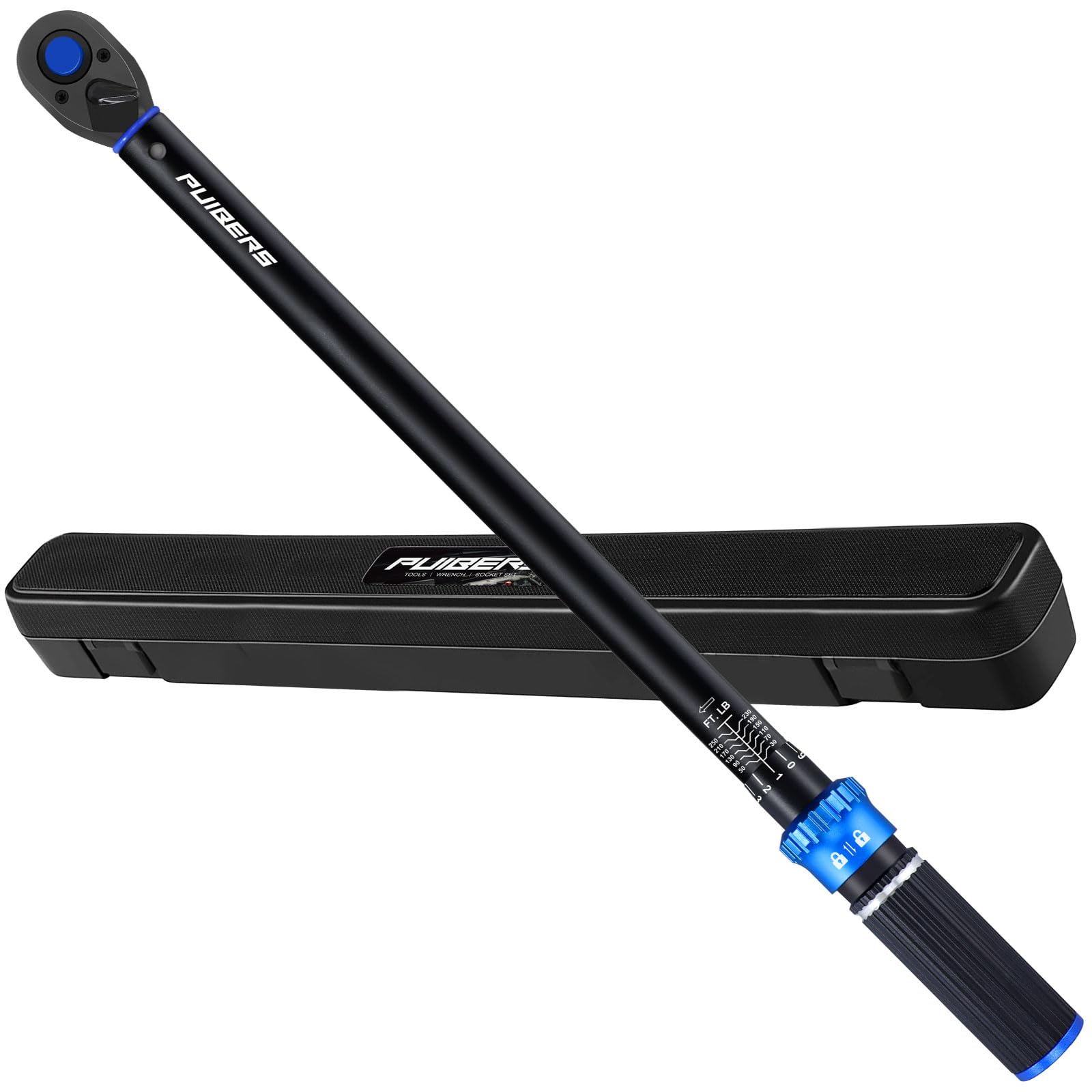
An entry-level click wrench that hits ±3% accuracy at a surprisingly low entry point.
The Puibers 1/2 drive torque wrench offers a ±3% accuracy rating and a torque range of 30-250 FT.LB / 40.7-339 Nm, while the BULLTOOLS starts at 25 ft-lb — meaning the Puibers does not go quite as low for very light fasteners, but it covers everything from standard lug nuts up to heavy truck bolts. Each wrench undergoes comprehensive accuracy calibration according to the consistency test method and ships with an individual calibration certificate. The 72-tooth quick-release ratchet allows for easy socket insertion and removal, and the lever adjusts for both clockwise and counterclockwise operation. Customers note that the tool is durable, reliable, and easy to adjust, with one reviewer noting that the sliding lock mechanism prevents the setting from drifting during use.
The handle features a non-slip striped design for improved grip, and the dual scales are non-reflective to maintain readability under all lighting conditions. The body is made from chrome vanadium steel, which gives it a solid feel without being overly heavy. The included hard case keeps the wrench and calibration certificate organized. The operation is simple: pull down the lock button and hold it until the desired torque is set, release it to lock the value, and listen for the audible click when the preset torque is reached. The handle also delivers a tactile vibration to confirm you have hit the target.
The most notable compromise is the 72-tooth ratchet, while the BULLTOOLS uses a 90-tooth ratchet — a difference you may feel in tighter spots. Assorted reviews mention different drive sizes, which suggests the product listing can be confusing for first-time buyers. If you are on a tight budget and need a 250 ft-lb range with verified ±3% accuracy, the Puibers delivers the core performance at a price that leaves room in your tool fund for quality sockets.
What It Does Well
- Surprisingly tight ±3% accuracy for a budget-friendly price point
- Individual calibration certificate confirms tested performance
- Non-slip striped handle and non-reflective dual scales improve usability
- Included hard case protects the tool and keeps the certificate organized
What It Skimps On
- 72-tooth ratchet requires a wider swing arc than higher-tooth-count competitors
- Product listing can be confusing due to mixed drive-size reviews
- Starts at 30 ft-lb, so it does not cover the lowest-torque fasteners
Grab this if: you are a budget-conscious home mechanic who wants a verified ±3% calibration without spending on premium materials or high tooth counts.
Not the pick if: you need a fine-tooth ratchet for tight-access work or you regularly torque below 30 ft-lb.
Understanding the Specs
Accuracy Percentage
The accuracy rating, such as ±3% or ±4%, tells you how close the actual torque applied will be to the value you set on the wrench. A ±3% wrench delivers the most precise results, which matters for critical engine and suspension fasteners where over-tightening can strip threads or cause cracks. Every serious torque wrench ships with a calibration certificate that traces back to a national standard, confirming that the tool met its rated accuracy before it left the factory. A lower percentage margin means more confidence on high-stakes bolts.
Click vs. Split-Beam Mechanism
Click-style wrenches use an internal spring that compresses as you turn the handle; when the set torque is reached, the mechanism slips and produces an audible click. You must reset a click wrench to its lowest setting after each use to prevent the spring from fatiguing. Split-beam wrenches use a different internal geometry that does not rely on spring tension for storage, so you can leave them set at any value without damaging the mechanism. The split beam is faster to adjust and more convenient for frequent users, but the click style remains the most common and affordable choice.
Ratchet Tooth Count
The number of ratchet teeth affects how finely the ratchet engages as you advance the socket. In this guide, some models use a 72-tooth ratchet while others use a 90-tooth ratchet, which can help in tighter spaces. This matters most when you are working in confined engine bays, behind brake calipers, or anywhere you cannot swing the handle freely. Sacrificing tooth count for cost is a reasonable trade-off if you mainly work on open areas like wheels and suspension arms.
Length and Leverage
The length of the torque wrench directly affects how much physical force you need to apply at the handle to reach 250 ft-lb. Longer wrenches, such as the GEARWRENCH at 26.75 inches, give you more leverage and require less arm strength, reducing fatigue during a long job. However, a longer handle can be awkward to maneuver in tight spaces, so you may need to trade off between leverage and access depending on where you typically work.
FAQ
Do I really need to reset a click torque wrench to the lowest setting after each use?
What is the difference between foot-pounds and newton-meters on a torque wrench?
Can I use a 250 ft-lb torque wrench for smaller bolts like 20 ft-lb?
Is a ±3% torque wrench worth paying more for than a ±4% one?
Why do some torque wrenches have a 90-tooth ratchet while others have 72 teeth?
Can a digital torque wrench be used in the rain or wet conditions?
What is the difference between a micrometer and a split-beam torque wrench?
Does a longer torque wrench always mean better accuracy?
How often should I get my torque wrench recalibrated?
Can I use a torque wrench to loosen bolts?
Final Thoughts: The Verdict
If you want one dependable pick, the 250 ft-lb torque wrench winner is the GEARWRENCH 85066 because the 26.75-inch handle provides the leverage you want at the top of the torque range, backed by ±3% accuracy and a decade of reliable feedback from owners. If you want the convenience of a split-beam design that never needs resetting, grab the TEKTON TRQ62203. And for the best balance of premium ratchet feel and mid-range pricing, the BULLTOOLS 1/2-inch Drive with its 90-tooth head delivers a noticeably tighter swing arc that makes a difference in tight engine compartments.
How We Picked
We do not accept paid placement, and we did not hands-on test every unit. Instead, we match each pick to a real buyer and use-case by comparing the manufacturers’ published specifications against the patterns in verified customer reviews — so you get each pick’s real strengths and trade-offs instead of marketing copy.
Sources & Methodology
Specifications: manufacturer listings and product documentation. Review insights: verified customer reviews, as of July 2026. Pricing: not shown on this page (it changes often); check the current price via the retailer link.
As an Amazon Associate, Gadgets Feed earns from qualifying purchases. This does not affect which products we feature.
Product prices and availability are accurate as of the date/time indicated and are subject to change. Any price and availability information displayed on Amazon at the time of purchase will apply to the purchase of this product. As an Amazon Associate I earn from qualifying purchases.
CERTAIN CONTENT THAT APPEARS ON THIS SITE COMES FROM AMAZON. THIS CONTENT IS PROVIDED "AS IS" AND IS SUBJECT TO CHANGE OR REMOVAL AT ANY TIME.
Amazon and the Amazon logo are trademarks of Amazon.com, Inc. or its affiliates.