
The transition from LCD to OLED in the monitor space is the single most impactful visual upgrade you can make for gaming. A 2560×1440 resolution at 144Hz hits the sweet spot between sharpness and frame rate, but it took OLED to make every frame look genuinely three-dimensional. The near-infinite contrast eliminates the gray haze you didn’t realize you were tolerating, and the sub-millisecond pixel response kills motion blur at its source.
I’m Min — the co-founder and writer behind Gadgets Feed. I’ve spent hundreds of hours cross-referencing panel specifications, analyzing real-world brightness measurements, and tracking firmware issues across the latest generation of OLED gaming monitors to understand which models justify their premium over LCD alternatives.
This guide breaks down the most compelling monitors in the category, from fast 27-inch panels to ultrawide productivity beasts. If you’re serious about image quality and responsive gameplay, finding the right 2560×1440 144hz oled monitor is the best investment for your setup.
How To Choose The Best 2560×1440 144Hz OLED Monitor
Choosing an OLED monitor requires understanding trade-offs that simply don’t exist with IPS or VA panels. Burn-in mitigation, panel type, and subpixel layout directly affect your long-term satisfaction. Here are the three critical factors to evaluate.
WOLED vs QD-OLED: Panel Architecture Matters
WOLED panels use a white OLED core with color filters, producing superior black levels but slightly lower color volume in bright highlights. QD-OLED uses blue OLEDs with quantum dot layers, delivering higher peak color brightness and a wider color gamut. The trade-off is that QD-OLED can show a subtle purple tint under direct ambient light. For a mixed-use room with windows, a matte WOLED like the LG 27GX700A handles reflections better. For a controlled lighting setup, QD-OLED gives you more vibrant HDR highlights.
Burn-In Prevention and Warranty Coverage
Every modern OLED monitor includes pixel shifting, logo detection, and automatic brightness limiting to prevent permanent image retention. What separates good from great is the warranty. The MSI MPG 322URX comes with a 3-year burn-in warranty. Samsung’s Odyssey G9 also includes a 3-year warranty on the panel. Models without explicit burn-in coverage may still offer pixel refresh cycles, but you assume more risk if you leave static elements on screen for hours daily.
Refresh Rate vs Resolution Trade-off at This Size
At 27 inches, 1440p offers a pixel density of 108 PPI, which is sharp enough for text while being far easier to drive than 4K. A 144Hz ceiling paired with OLED’s 0.03ms response time produces motion clarity that even 240Hz LCDs struggle to match. The LG 27GX700A pushes to 280Hz, but the jump from 144Hz to 240Hz is perceptually smaller than the jump from LCD to OLED at any refresh rate—so don’t overpay for extra Hz if the core panel quality is solid.
Quick Comparison
On smaller screens, swipe sideways to see the full table.
| Model | Category | Best For | Key Spec | Amazon |
|---|---|---|---|---|
| LG 27GX700A-B | 27″ WOLED | Competitive FPS / Bright room | 280Hz / 0.03ms / 1500 nits peak | Amazon |
| Samsung Odyssey OLED G9 | 49″ QD-OLED | Immersive ultrawide gaming | 144Hz / 5120×1440 / 1800R curve | Amazon |
| Deco Gear 49″ QD-OLED | 49″ QD-OLED | Productivity + gaming hybrid | 240Hz / 90W USB-C / Built-in KVM | Amazon |
| MSI MPG 322URX | 32″ QD-OLED | Single-monitor 4K+HDR hybrid | 240Hz / DP 2.1a / 3yr burn-in warranty | Amazon |
| Alienware AW3225QF | 32″ QD-OLED | Dolby Vision / Console gaming | 240Hz / 4K UHD / 0.03ms | Amazon |
| Samsung OLED M9 (M90SF) | 32″ QD-OLED | Smart TV + monitor hybrid | 165Hz / Built-in Gaming Hub / 4K | Amazon |
| Philips Evnia 49M2C8900L | 49″ QD-OLED | Multitasking / Dual-PC setup | 144Hz / 90W USB-C / KVM | Amazon |
| Samsung Odyssey Neo G9 | 57″ Mini-LED | Extreme ultrawide productivity | 240Hz / Dual 4K / DP 2.1 | Amazon |
| LG 32GX850A-B | 32″ WOLED | Glossy 4K gaming / Mac users | 165Hz / Dual Mode 330Hz / Glossy | Amazon |
In‑Depth Reviews
1. LG 27GX700A-B 27″ Ultragear QHD OLED
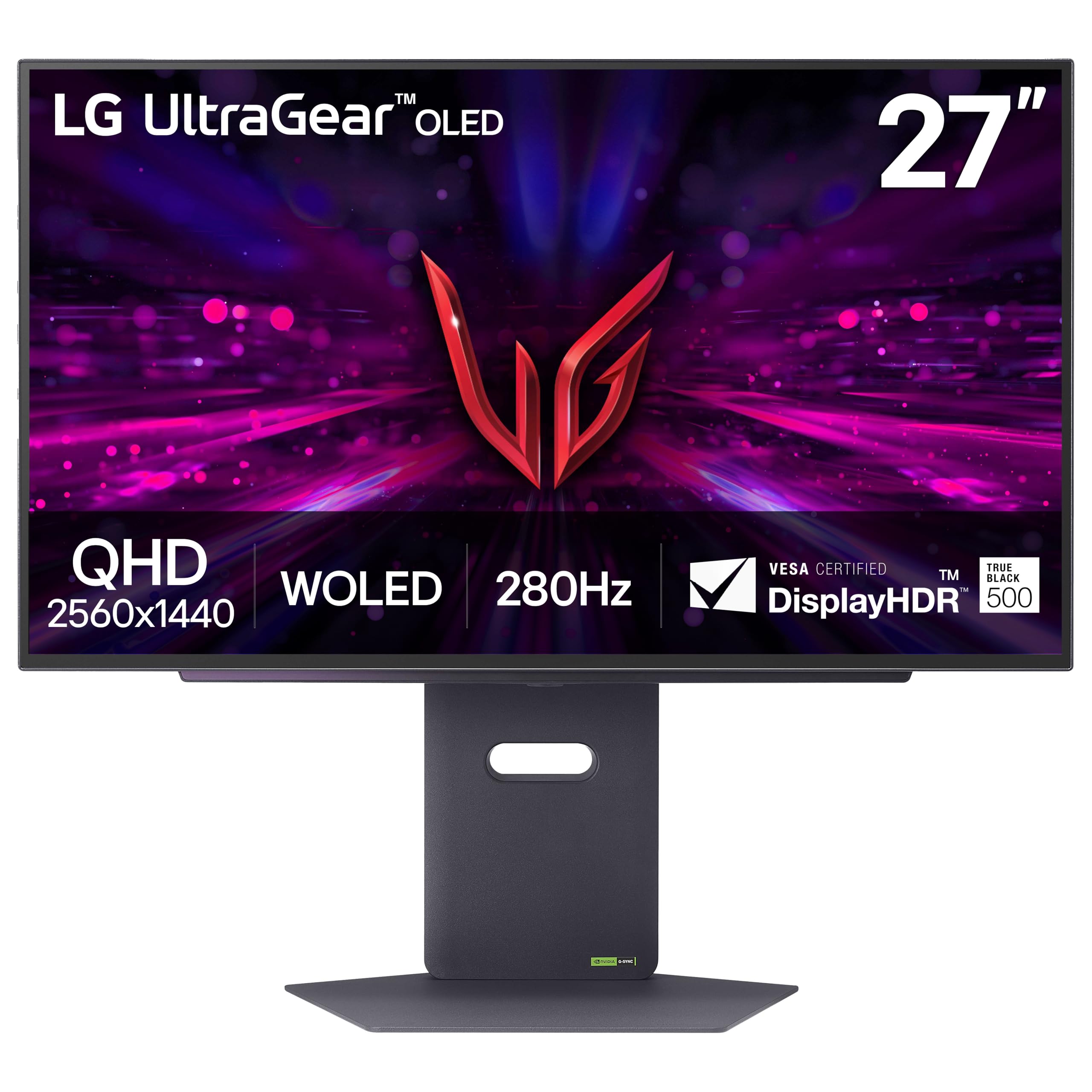
The LG 27GX700A-B represents the best fusion of brightness and speed in the 27-inch OLED class. Its 4th Gen WOLED panel with Primary RGB Tandem technology reaches up to 1500 nits peak, making it one of the few OLED monitors that competes with Mini-LED in bright-room visibility. The 280Hz refresh rate and 0.03ms response time eliminate any perceptible motion blur, and the VESA DisplayHDR TrueBlack 500 certification ensures deep blacks in dark scenes without crushing shadow detail.
The matte coating handles reflections better than glossy QD-OLED panels, making this a strong choice for rooms with windows or overhead lighting. UL verification for Perfect Black and Perfect Color means the factory calibration is reliable out of the box. The slim bezel design and height-adjustable stand make it easy to integrate into multi-monitor setups, and the RGB backlighting at the rear adds a clean accent without being distracting.
Some users report horizontal banding on static gray screens, though LG’s auto pixel refresh cycle typically resolved this after a few uses. The monitor’s 4-pole audio jack with DTS Headphone:X provides decent spatial audio for headset users. For a pure 1440p gaming experience at this size, the LG 27GX700A delivers an extremely competitive price-to-performance ratio.
Why it’s great
- Highest peak brightness among 27″ WOLED monitors
- 280Hz paired with 0.03ms response for elite motion clarity
- Matte coating reduces reflections in bright rooms
Good to know
- Some units exhibit temporary horizontal banding on static screens
- RGB backlight is fixed color, not dynamic
2. MSI MPG 322URX QD-OLED 32″

The MSI MPG 322URX is the most well-rounded premium OLED monitor for those who want 4K sharpness without sacrificing high refresh rate. Its 32-inch 3rd Gen QD-OLED panel delivers a Delta E≤2 color accuracy right from the factory, making it usable for color-sensitive work alongside gaming. The 240Hz refresh rate is supported natively via DisplayPort 2.1a, which provides 80Gbps bandwidth for uncompressed 4K at 240Hz with full 10-bit color depth.
The glossy coating enhances contrast and color vibrancy in controlled lighting, and the VESA DisplayHDR True Black 400 certification keeps blacks deep even during bright HDR scenes. MSI’s OLED Care 2.0 includes pixel shift, logo detection, and taskbar detection to actively reduce burn-in risk. The 3-year burn-in warranty gives you a safety net that many competitors still lack at this price point.
The built-in speakers are basic but functional for casual use, and the hybrid inputs (HDMI 2.1, DP 2.1a, USB-C) cover all modern GPUs and consoles. The primary complaint is that the glossy screen shows fingerprints easily and can scratch during cleaning. For a single-monitor setup covering gaming, creative work, and media consumption, the MPG 322URX is hard to beat.
Why it’s great
- DisplayPort 2.1a enables uncompressed 4K at 240Hz
- Factory Delta E≤2 accuracy for color work
- 3-year burn-in warranty included
Good to know
- Glossy coating scratches more easily than matte
- Requires a powerful GPU to drive 4K at high frame rates
3. LG 32GX850A-B 32″ UltraGear
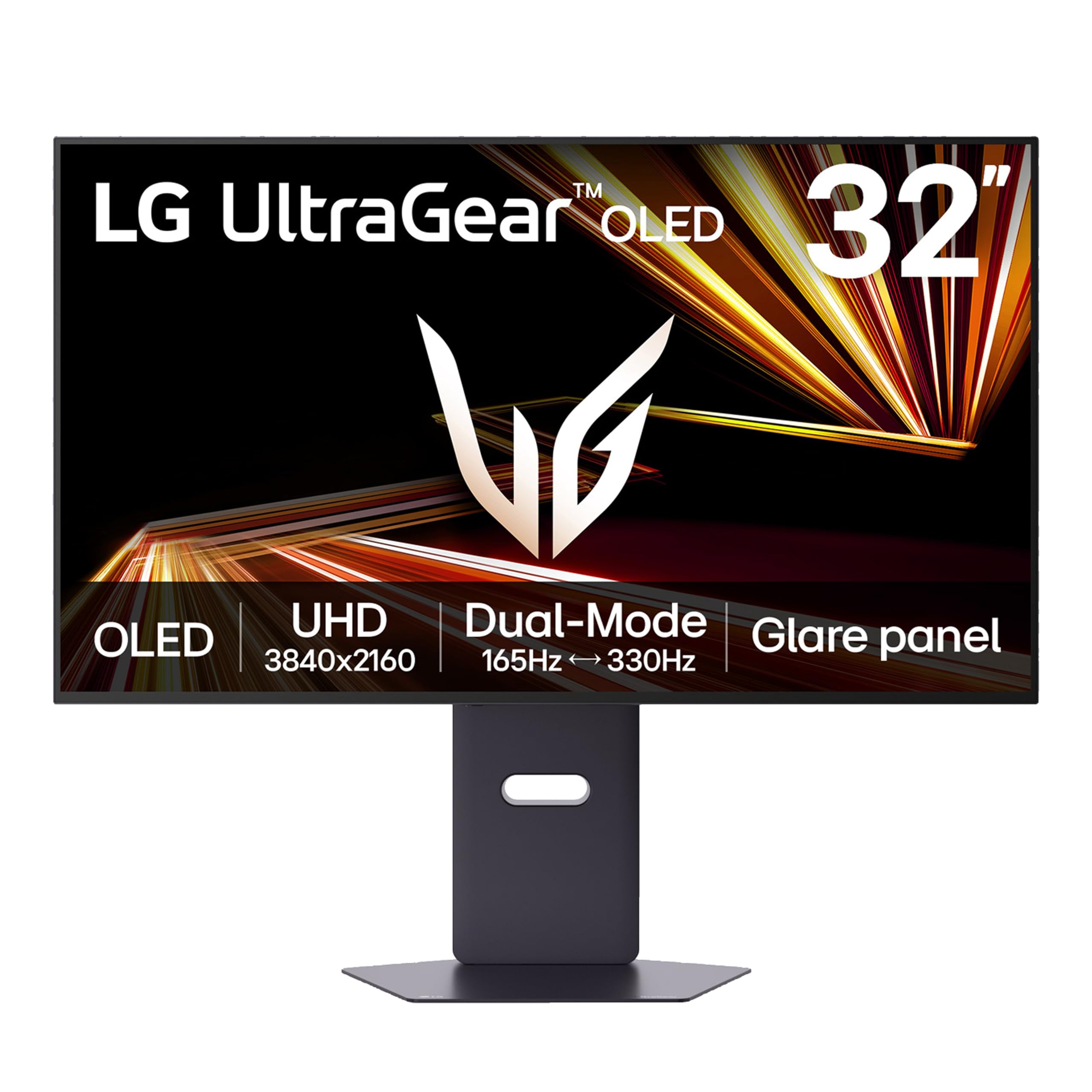
The LG 32GX850A-B offers a compelling value proposition by bringing a glossy WOLED panel to a 32-inch 4K format with a dual-mode feature. At its standard 4K resolution, you get 165Hz, but you can hot-switch to 1080p at 330Hz for competitive shooters where raw frame rate matters more than resolution. This dual-mode works seamlessly via a dedicated hotkey, effectively giving you two monitors in one.
The glossy coating on this model enhances perceived color vibrancy and contrast compared to the matte-finished LG 27GX700A, but it does reflect ambient light. The Micro Lens Array+ technology improves typical brightness to 275 nits, which is a noticeable step up from earlier WOLED generations. UL certifications for Flicker-Free, Anti-Glare, and Low Blue Light make extended sessions easier on the eyes.
The stand offers full height, tilt, swivel, and pivot adjustments, and the metal border adds a premium tactile feel. Text clarity is typical for WOLED—fine for general use but not as sharp as high-PPI LCD for reading. The lack of a built-in KVM or USB-C power delivery means you likely need a separate dock for a clean desk setup.
Why it’s great
- Dual-mode (4K@165Hz or 1080p@330Hz) via hotkey
- Glossy panel with improved WOLED brightness
- Full ergonomic stand with metal construction
Good to know
- No USB-C power delivery or KVM
- Reflections visible in bright rooms
4. Samsung 49″ Odyssey OLED G9 (G91SD)

The Samsung Odyssey OLED G9 (G91SD) brings QD-OLED to the ultrawide format with a 49-inch 32:9 panel at 5120×1440 resolution. This is effectively two 27-inch 1440p monitors fused into one seamless display with no bezels. The 1800R curvature wraps the screen around your peripheral vision, making it highly immersive for racing sims, flight sims, and open-world RPGs.
The QD-OLED panel delivers infinite contrast and vibrant quantum dot color, covering 99% DCI-P3. Samsung’s Thermal Modulation System actively manages brightness to prevent overheating, and the Logo & Taskbar Detection automatically dims static elements to reduce burn-in. The 144Hz refresh rate with 0.03ms response time ensures smooth motion even during fast panning shots. G-Sync compatibility and FreeSync Premium Pro eliminate tearing without added input lag.
The ergonomic stand supports height, tilt, and swivel, and the monitor weighs about 22 pounds—manageable with a desk arm. Samsung offers a 3-year warranty, though some users have reported reliability issues with the panel failing within the first few months. The Picture-in-Picture feature is genuinely useful for console+PC setups, letting you game on one source while browsing on the other. For pure immersion, this ultrawide is unmatched in its price tier.
Why it’s great
- Seamless 32:9 gaming with no bezels
- QD-OLED color volume and contrast
- 3-year warranty with burn-in protection features
Good to know
- Only one DisplayPort input
- Customer service experience varies significantly
5. Alienware AW3225QF 32″ QD-OLED
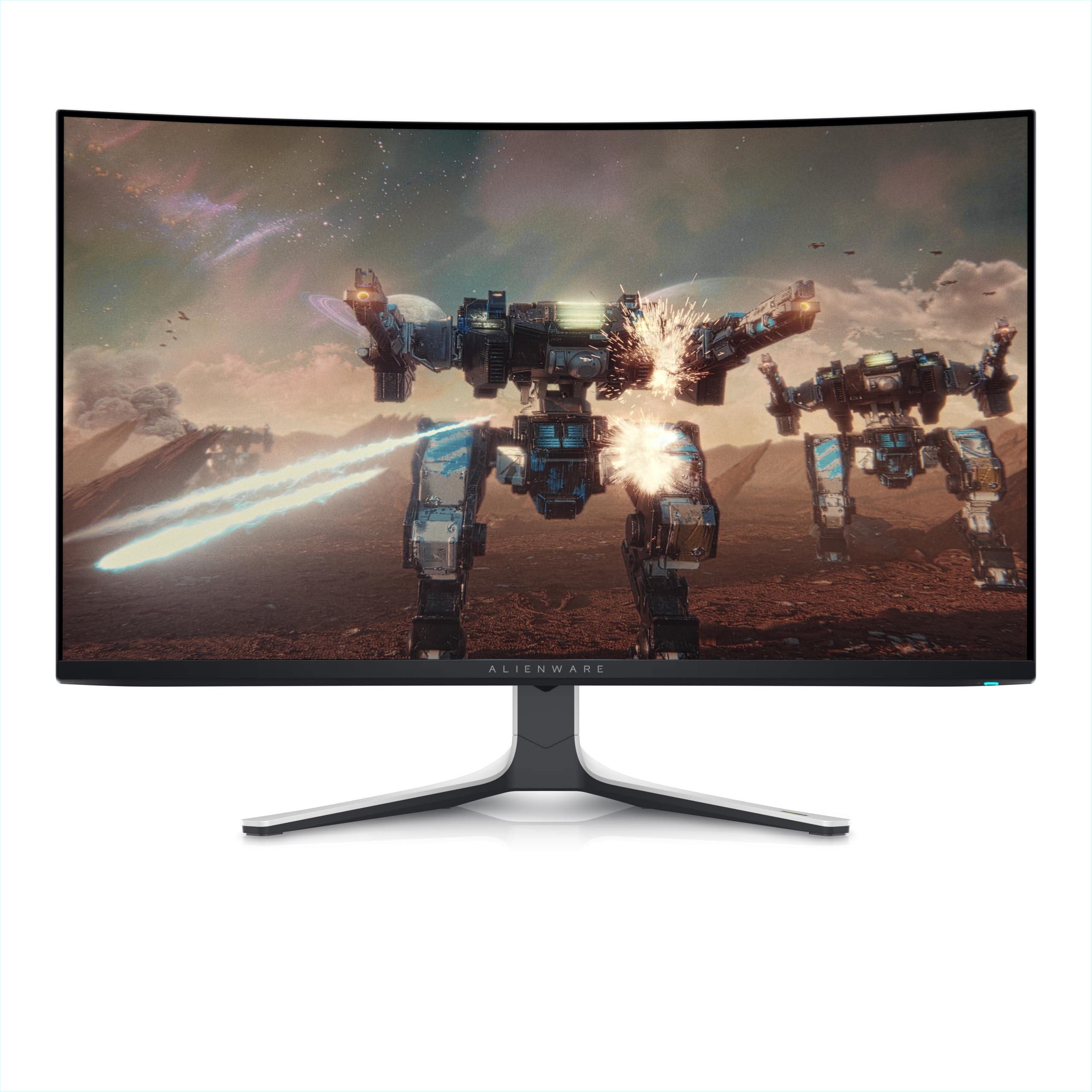
The Alienware AW3225QF is one of the few OLED monitors that supports Dolby Vision, making it a standout choice for HDR movie lovers and console gamers. The 32-inch QD-OLED panel delivers 4K UHD resolution at 240Hz with a 0.03ms response time, and the 12-bit color processing (via FRC) produces smooth gradients without banding. The design matches Alienware’s Legend 2.0 aesthetic with a white rear shell and customizable RGB lighting.
The glossy coating on this panel emphasizes color saturation and deep blacks better than matte alternatives, but it requires a controlled lighting environment to avoid reflections. The monitor includes a height-adjustable stand with a small footprint, and the build quality feels solid with minimal flex. The OSD includes AlienFX lighting control and a full suite of gaming features including Dark Stabilizer and crosshair overlays.
A notable limitation is the lack of HDMI 2.1 bandwidth for simultaneous 4K at 240Hz on console—it caps at 4K 120Hz over HDMI. The 1ms response time rating is conservative; real-world performance matches 0.03ms OLED standards. For mixed PC and Xbox Series X use, the Dolby Vision support gives this monitor a unique advantage that few competitors offer.
Why it’s great
- Dolby Vision HDR for movies and console games
- 12-bit color processing for smooth gradients
- Solid build quality with compact stand base
Good to know
- HDMI limited to 4K 120Hz on console
- Glossy panel requires low ambient light
6. Deco Gear 49″ QD-OLED Ultrawide
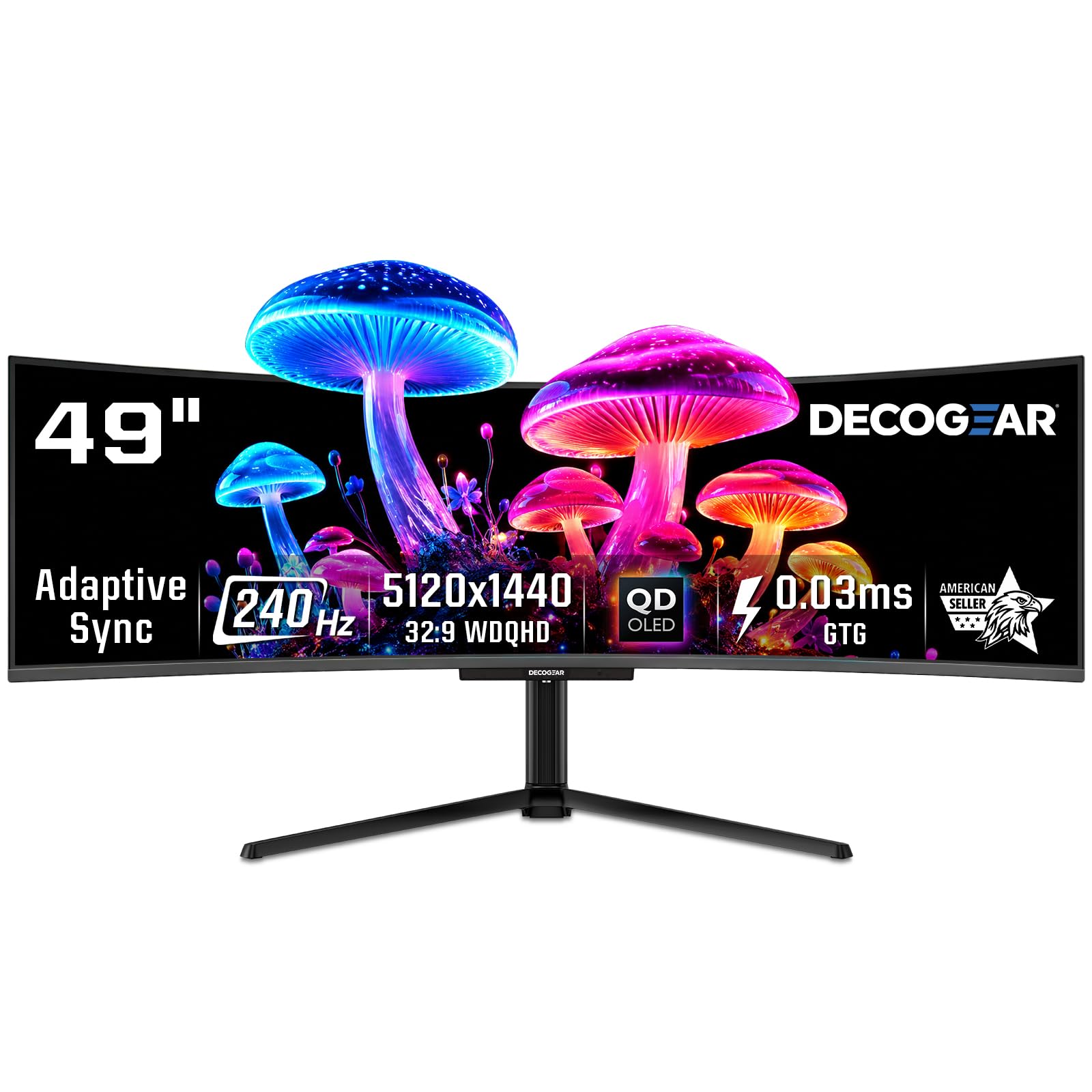
The Deco Gear 49″ QD-OLED is a dark horse that delivers strong specs at a compelling price point. Its 5120×1440 resolution with a 240Hz refresh rate and 0.03ms response time matches the performance of more expensive Samsung and Philips ultrawides. The QD-OLED panel produces the same deep blacks and 1.07 billion color depth expected from the technology, and the 1500000:1 contrast ratio ensures excellent dynamic range in both SDR and HDR10 content.
What sets this monitor apart is the connectivity package. The USB-C port delivers 90W power delivery, allowing you to charge a gaming laptop or MacBook through a single cable while running full 240Hz. The built-in KVM switch lets you toggle between two connected devices with one keyboard and mouse setup. PIP/PBP support works well for split-screen multitasking between a PC and a console.
The RGB lighting on the rear is customizable but the stand base is large, requiring a desk depth of at least 28 inches. Build quality feels adequate but not premium—the plastic housing shows fingerprints easily. Some early users reported faulty power cables that needed replacement. For the money, this is the best KVM-equipped ultrawide OLED available.
Why it’s great
- 90W USB-C with built-in KVM for dual-PC setups
- 240Hz refresh rate at ultrawide resolution
- Strong value for QD-OLED specs
Good to know
- Stand base is large—measure your desk
- Some units have cosmetic QC issues
7. Samsung 32″ OLED M9 (M90SF)
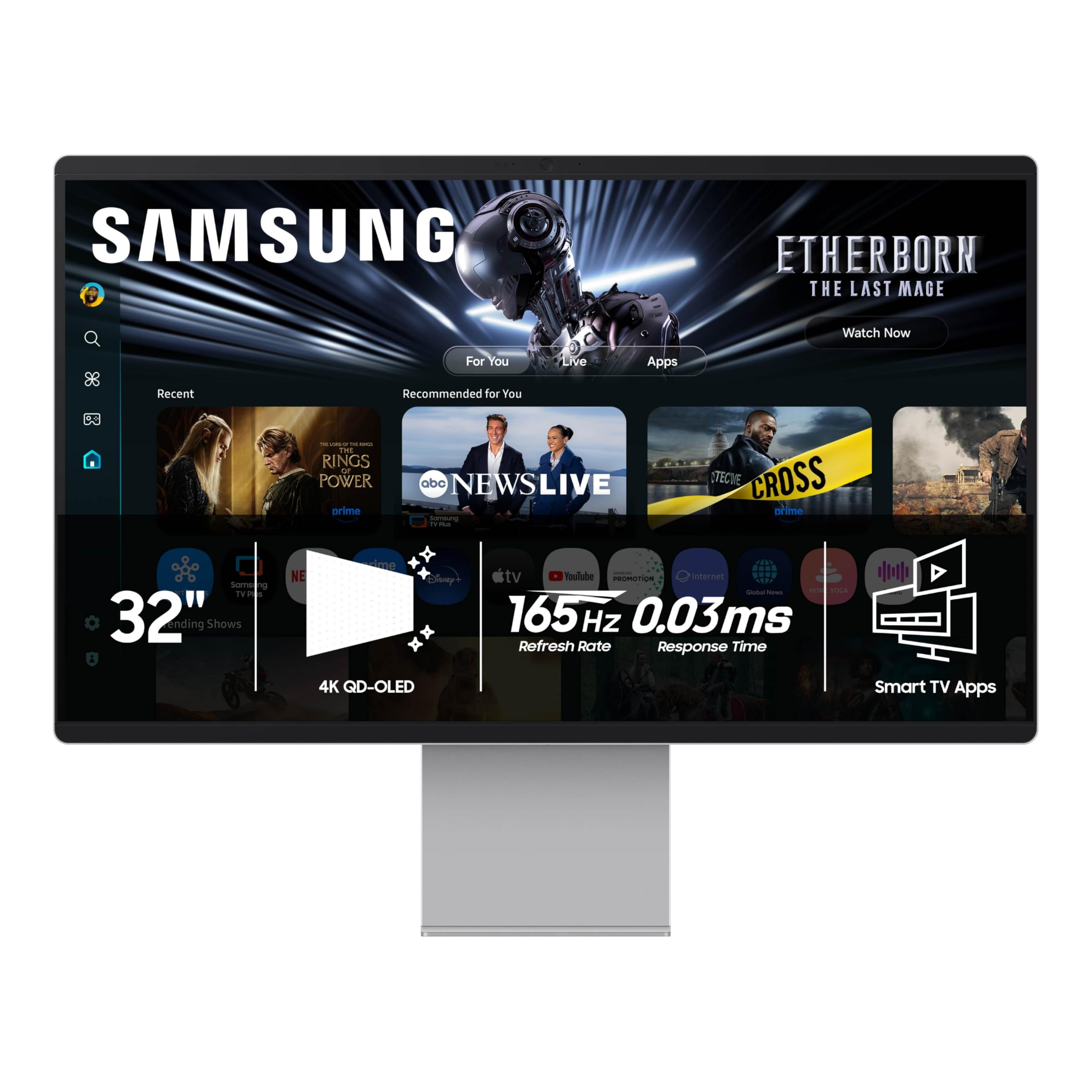
The Samsung OLED M9 (M90SF) is a unique hybrid that functions as a 4K QD-OLED monitor and a Samsung Smart TV. The built-in Tizen OS gives you direct access to Samsung Gaming Hub, Netflix, YouTube, and Samsung TV Plus without connecting a PC or console. The 165Hz refresh rate with 0.03ms response time keeps it competitive for gaming, and the 4K resolution ensures sharp text and image quality for productivity.
The QD-OLED panel delivers vivid color and deep blacks, though at 250 nits typical brightness, it’s less suited for bright rooms than LG’s WOLED panels. The Thermal Modulation System and Logo Detection help prevent burn-in during long static-content sessions. The USB-C port supports up to 65W charging, and Wi-Fi and Bluetooth 5 connectivity are built in.
The smart OS setup requires a Samsung account, and the interface can feel sluggish compared to a dedicated streaming device. The chassis is plastic with a metallic finish, not actual metal. The auto-source detection is unreliable with USB-C connections, often requiring manual input switching. For users who want a combined monitor and TV in one desk footprint, the M9 works well—but it’s a niche fit.
Why it’s great
- Built-in smart TV and Gaming Hub—no PC required
- 4K QD-OLED with solid gaming performance
- USB-C 65W charging
Good to know
- Smart OS requires Samsung account
- Plastic chassis despite premium price
8. Philips Evnia 49M2C8900L QD-OLED
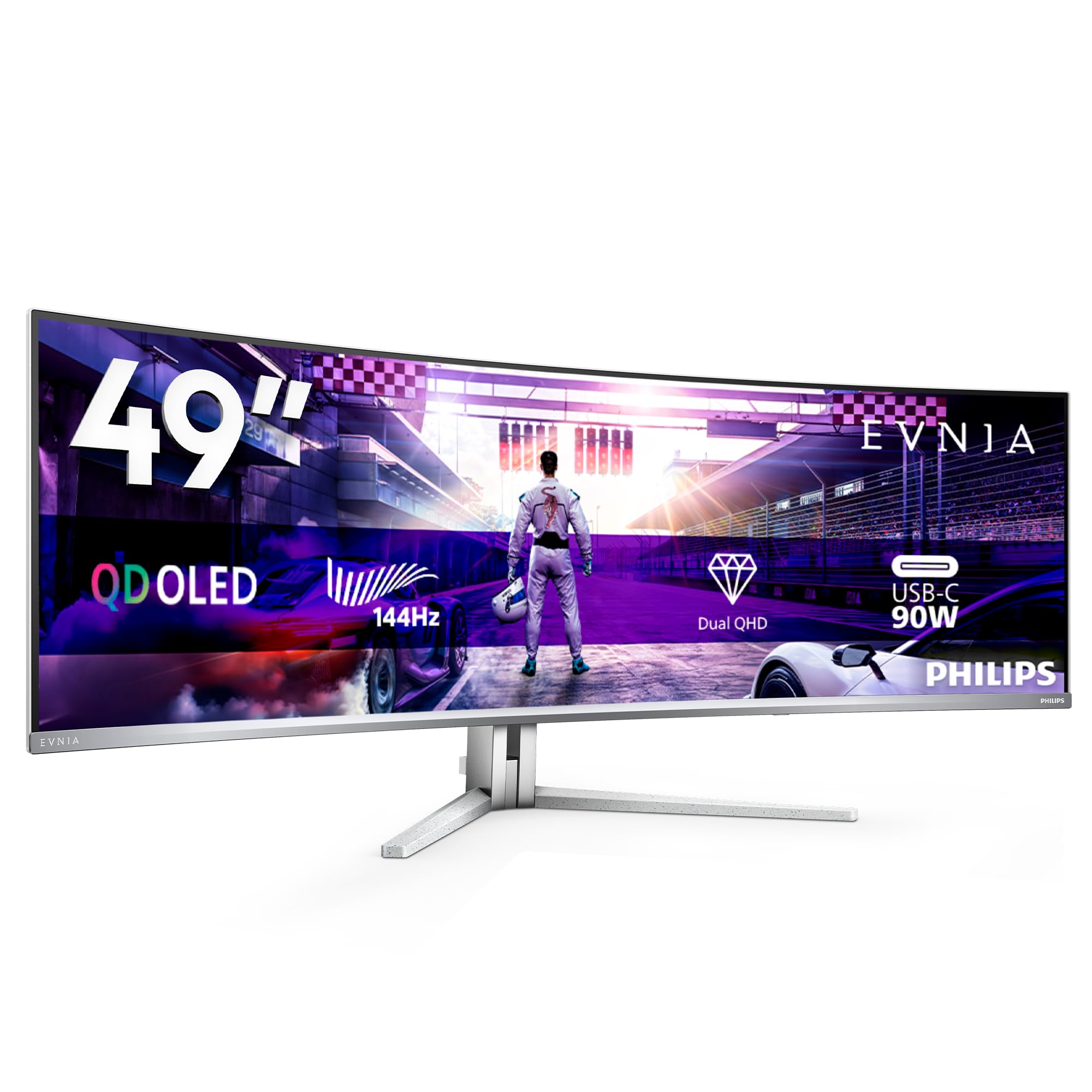
The Philips Evnia 49M2C8900L is built for users who need a productivity powerhouse that also games exceptionally well. The 49-inch QD-OLED panel in a 32:9 aspect ratio matches the resolution of two 27-inch QHD monitors, but the built-in KVM and PIP/PBP features let you control two PCs from one keyboard and mouse. The USB-C port delivers 90W charging, making it ideal for a MacBook Pro or high-end gaming laptop as a single-cable docking station.
The 144Hz refresh rate with 0.03ms GtG response is smooth enough for competitive gaming, and the QD-OLED HDR performance with VESA DisplayHDR True Black 400 delivers stunning highlights and pure blacks. The 1800R curve wraps the 49-inch surface naturally, reducing eye strain when scanning across the wide desktop. The anti-glare matte coating handles overhead lighting well without sacrificing too much contrast.
The Ambiglow lighting system projects colors onto the wall behind the monitor, but it’s less sophisticated than Philips’ TV Ambilight implementations. The 7.5W speakers are surprisingly good for a monitor, capable of filling a small room. The 16-hour automatic pixel refresh reminder can be disruptive. For dual-PC workflows, this is the most feature-complete ultrawide on the market.
Why it’s great
- Full KVM and PIP/PBP for dual-PC operation
- 90W USB-C with single-cable laptop charging
- Matte coating with effective anti-glare
Good to know
- Frequent pixel refresh notifications can be intrusive
- Power cable is shorter than ideal
9. Samsung 57″ Odyssey Neo G9 (G95NC)

The Samsung Odyssey Neo G9 is not an OLED monitor, but it uses Quantum Mini-LED technology to achieve OLED-like black levels with significantly higher peak brightness. Its 57-inch Dual 4K resolution (7680×2160) delivers the pixel density of two 4K monitors side by side, making it the most productive ultrawide desktop available. The 240Hz refresh rate with 1ms GtG response time ensures motion stays smooth at this extreme resolution.
The 1000R curvature is tighter than most ultrawides, wrapping aggressively around your field of view. The 2392 local dimming zones with Quantum Matrix Technology produce minimal haloing around bright objects against black backgrounds. The DisplayPort 2.1 input provides enough bandwidth for 7680×2160 at 240Hz with 10-bit color, but only DisplayPort 2.1 GPUs (RX 7000 series or RTX 50 series) can fully utilize this bandwidth. The VESA DisplayHDR 1000 certification ensures excellent HDR performance with very high brightness levels.
The build feels somewhat hollow for a monitor at this price, with plastic panels that don’t match the premium expectation. The single DisplayPort 2.1 input is a limitation, and wake-from-sleep issues persist across firmware versions. The massive size requires a desk at least 36 inches deep to comfortably view the entire panel. For productivity users who want to replace three separate monitors with one seamless display, this is the ultimate solution.
Why it’s great
- Dual 4K resolution replaces three monitors seamlessly
- 240Hz via DP 2.1 for uncompressed performance
- Very high peak brightness for HDR
Good to know
- Not OLED—uses Mini-LED with local dimming
- Firmware wake-from-sleep issues
FAQ
Is a 2560×1440 resolution sharp enough on a 32-inch OLED monitor?
Can I use an OLED monitor for work without causing burn-in?
Why does my OLED monitor flicker with G-Sync enabled during loading screens?
Final Thoughts: The Verdict
For most users, the 2560×1440 144hz oled monitor winner is the LG 27GX700A-B because it combines the highest peak brightness in its class with a versatile 27-inch size, proper matte coating, and a refresh rate that exceeds the 144Hz baseline with headroom. If you want ultrawide immersion for sim racing and RPGs, grab the Samsung Odyssey OLED G9. And for a dual-purpose gaming and productivity monitor with a 3-year burn-in warranty, nothing beats the MSI MPG 322URX.