
Our readers keep the lights on and my morning glass full of iced black tea. As an Amazon Associate, I earn from qualifying purchases.
Specs are compiled from manufacturer listings and verified buyer reviews and can change over time — please confirm the key details on the product page before buying.
You can finally tackle that stained driveway, grimy siding, or mossy patio in a single afternoon with a pressure washer rated at 2600 PSI or higher. The key choice is between an electric unit that starts instantly with no fumes, or a gas engine that gives you raw, untethered power. This guide covers machines at 2600 PSI and above, so you get enough cleaning force to strip grime, mildew, and baked-on dirt without feeling like you bought a toy.
I’m Min — the founder and writer behind Gadgets Feed. This guide is built by comparing the manufacturers’ published specifications and the patterns across verified customer reviews, so you get each pick’s real strengths and trade-offs instead of marketing spin.
You will learn which cleaning jobs need gas power and where a quieter electric model wins, plus the specs that truly matter when choosing your 2600 psi pressure washer.
Our Picks at a Glance

How To Choose The Best 2600 PSI Pressure Washer
Before you click buy, you need to settle one big question: do you want to plug into an outlet or pour in gasoline? Electric models start instantly, run quietly, and need almost no maintenance, but you are always tethered to a power cord. Gas models roam anywhere and deliver higher flow, but they demand oil changes, fuel stabilization, and a bit more patience on a cold morning. Everything else — nozzles, hose length, wheel size — follows from that first decision.
PSI vs GPM: Why Flow Rate Is the Hidden Hero
PSI (pounds per square inch) is the force of the water jet — the number that strips paint and blasts mud. GPM (gallons per minute) is the volume of water moving through the nozzle, and it is what actually sweeps the loosened dirt off the surface. A machine with huge pressure but low flow will etch the grime but leave it sitting there; a balanced machine cleans faster because the water carries the mess away. Serious buyers check both numbers together rather than chasing a single big figure.
Pump & Motor: What Keeps It Running
Electric washers use either a brushed or a brushless induction motor. The brushless type runs quieter, lasts longer, and sips less electricity — worth the small premium if you wash more than a car a month. On the pump side, an axial cam pump is the common, affordable choice for home use, while a triplex pump (found on pro-grade gas units) handles continuous heavy work far better. If you are planning multi-hour driveway marathons, that pump upgrade matters more than any other spec on the sheet.
Quick Comparison
| Model | Best For | Max PSI | Max GPM | Power Source | Amazon |
|---|---|---|---|---|---|
| Westinghouse WPX2700e★ Best Overall | All-around home value | 2700 | 1.76 | Electric | Amazon |
| A-iPower E2800-FMBest Value | Compact maneuverability | 2800 | 1.7 | Electric | Amazon |
| PowerSmart DB1002Quiet Power Pick | Brushless quiet power | 3000 | 1.2 | Electric | Amazon |
| BILT HARD 3500 PSI | Budget gas muscle | 3500 | 2.6 | Gas | Amazon |
| Ezasin EAPW01 | Gas power, easy start | 3500 | 2.3 | Gas | Amazon |
| VEVOR 3400 PSI | High flow, low price | 3400 | 2.6 | Gas | Amazon |
| Mutaomay MTPW01 | Reliable gas starts | 3500 | 2.3 | Gas | Amazon |
| Greenworks GPW3002A | Electric gas-equivalent power | 3000 | 2.0 | Electric | Amazon |
| DeWalt DXPW3300-S | Premium residential gas | 3300 | 2.4 | Gas | Amazon |
| EGO HPW3200 | Cordless battery freedom | 3200 | 2.0 | Battery | Amazon |
| Simpson PS3228 | Pro-grade gas longevity | 3500 | 2.5 | Gas | Amazon |
In‑Depth Reviews
1. Westinghouse WPX2700e
Our pick — over 4.5★ from 500+ verified ratings; the strongest balance of quality and price.
This 2700 PSI electric washer delivers gas-level cleaning power without the maintenance.
When your driveway looks like a crime scene, the Westinghouse is the machine owners reach for. It delivers 2700 max PSI and 1.76 max GPM of flow, and buyers report it powers through baked-on red Georgia clay and strips paint off a cement patio — jobs you would normally expect to need a gas engine. That capability comes from a high-performance 13A induction motor (the type that runs cooler and longer than a cheap brushed unit) driving a maintenance-free axial cam pump.
Setup takes about 10 to 15 minutes, and the tool-free removable handle makes it easier to cart around. The built-in.42 gallon soap tank pairs with 5 quick-connect nozzles (0°, 15°, 25°, turbo, and soap), so you can switch from a pinpoint jet for stubborn grime to a wide soap spray for a car wash without uncoupling anything. The 25-foot abrasion-resistant hose keeps you moving, and 10-inch never-flat wheels roll over rough ground without airing up. Quality is the most-praised aspect here by a wide margin, and owners repeatedly call the build solid and the value hard to argue with.
The honest trade-off: like any electric unit, you are anchored to a 35-foot power cord, so a long, winding driveway means extension-cord planning. Also, a few owners note the wider spray can splinter softwood if you linger — keep the nozzle moving on decking. For the mix of power, build, and price, this is the pick most households should start with.
Owners’ verdict: The recurring praise centers on quality and assembly — both among the most-mentioned positives — with owners calling it a high-quality machine that is easy to put together and use, and one noting it outperforms a 20-year-old gas model.
The one caveat: A few found the yellow nozzle can splinter wood if you hold it still too long, so treat it as a moving-target tool.
Reach for this if: you want one electric washer that handles cars, fences, driveways, and patio furniture without drama, and you value a brand with a 3-year limited warranty and nationwide support.
Look elsewhere if: your property is so large that hauling extension cords all day would ruin the fun — a gas unit with a 300-inch hose might serve you better.
2. A-iPower E2800-FM
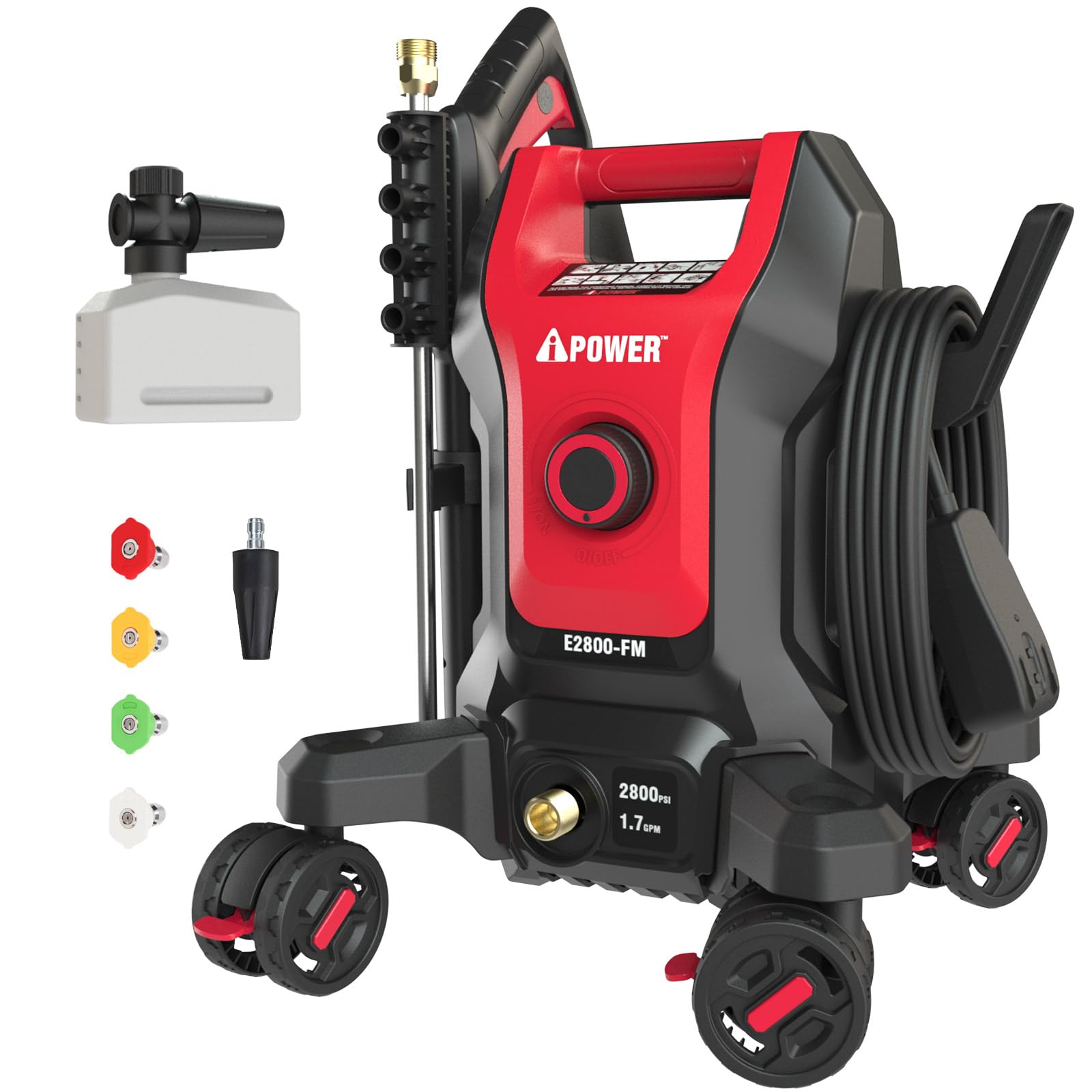
This 18.2-pound electric washer rolls on 360° casters and delivers 2800 PSI of cleaning force.
This little red unit keeps surprising people with its compact size. The A-iPower delivers 2800 max PSI at initial discharge and 2000 rated PSI, with a max 1.7 GPM for soap dispensing and 1.2 rated GPM of flow. But the headline is the footprint: at just 18.2 pounds and 12.4″ x 11″ x 19.6″, it is dramatically more compact than the 35-pound, 19″ x 18.5″ x 37.5″ Westinghouse above — roughly a 53% smaller footprint — so it tucks into a garage corner or closet without becoming furniture.
The 4 quick-lock wheels give true 360° steering, and the low center of gravity is engineered to resist tipping. Owners describe rolling it up and down sidewalks and driveways with ease, and one buyer — an older woman — says it gets vinyl siding clean in a single pass. That kind of feedback explains why performance is the most-praised aspect here. The TSS system (a feature that auto-stops the pump when the trigger is released) saves energy and protects both pump and motor, which means longer life between the occasional deep clean.
The catch is in the value-tier reality: durability gets some mixed feedback, so this is best treated as a capable home tool rather than a commercial-grade machine. Also, the short stature — about 19.6 inches tall — drew a note from someone who wished it were a bit taller. For small-to-mid-size yards and light commercial touches, the portability-to-power ratio is tough to beat at this end of the price range.
What wins people over
- Compact, 18.2-pound body with 360° steering wheels makes it genuinely easy to move and store
- Performance is the most-praised trait — owners say it cleans siding, patios, and rugs in one pass
- 25-foot pressure hose plus 35-foot power cord covers a typical yard without frequent relocation
Worth knowing before you buy
- Durability is a mixed note — several units earned praise, but a recurring theme suggests careful storage extends life
- Low-profile design means a shorter reach; some owners wanted more height
This one suits: renters and homeowners who want real cleaning power but lack shed space for a hulking machine.
Think twice if: you plan to run it for hours every weekend — a heavier-duty electric or gas unit will weather that schedule better.
3. PowerSmart DB1002
The brushless electric that out-silences the garage and still flexes 3000 PSI.
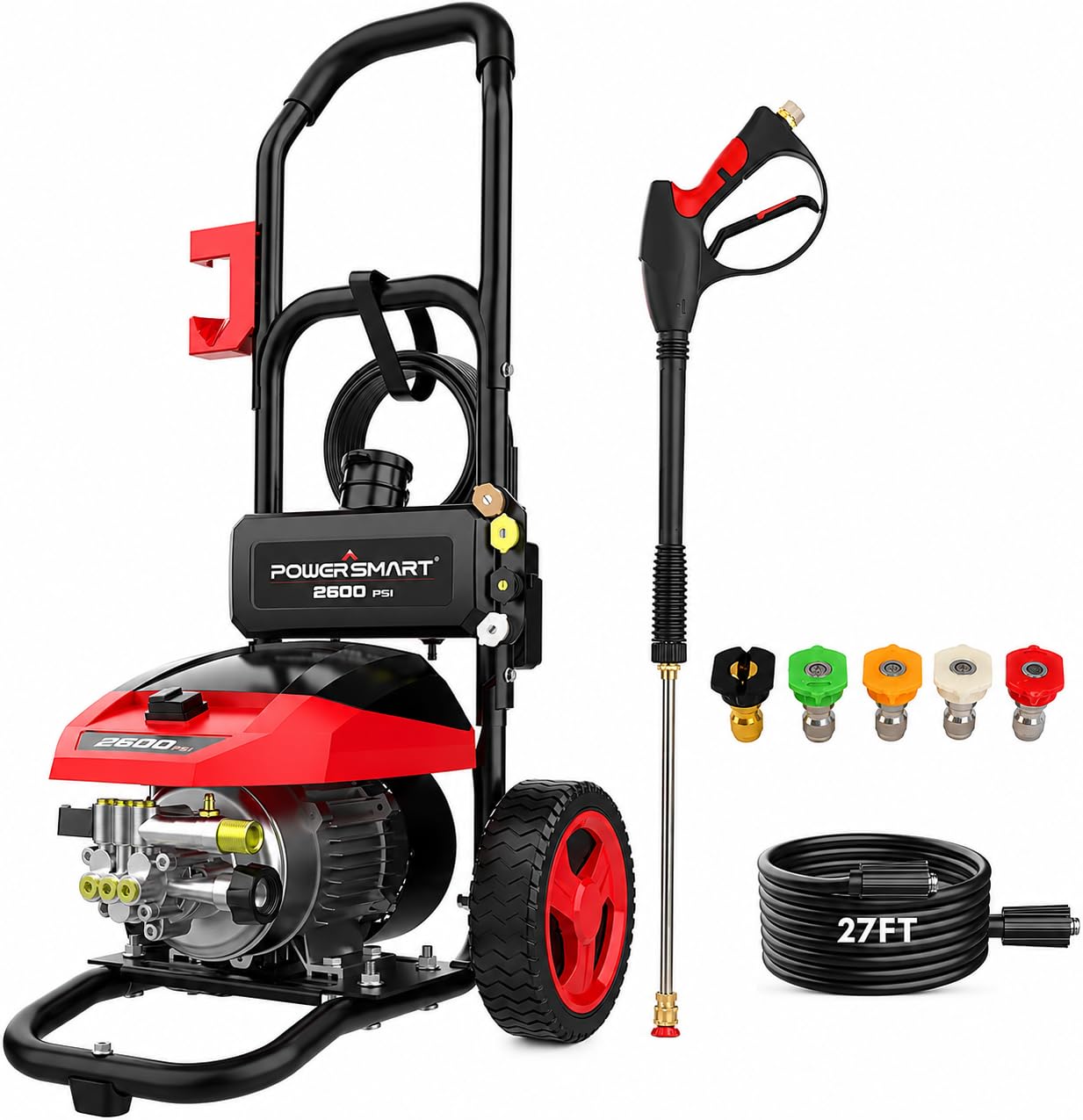
If noise bothers you as much as grime, this is the electric washer to watch. The PowerSmart runs a 14-amp brushless induction motor — the technology that delivers quieter operation, longer life, and better energy efficiency than traditional brushed motors. It delivers up to 3000 PSI max and 1.2 GPM of flow, which puts it right in the wheelhouse for siding, driveways, decks, and vehicles. The flow figure is modest, so 1.2 GPM means rinsing takes a little more patience than a high-flow gas unit, but the pressure does the heavy lifting.
Assembly is quick enough that owners say it is ready in about ten minutes. The 5 quick-connect nozzles (0°, 15°, 25°, 40°, and soap) cover everything from spot cleaning to wide rinsing to detergent application. Rolling it across lawns and gravel is handled by large 8-inch wheels, and the built-in soap tank makes sudsing up a fence or a car straightforward. Quality is the most-praised aspect by a solid margin, with power and easy assembly also getting repeated shout-outs.
Be honest about the durability picture: the overall feedback is mixed, with most units praised as well-built and a smaller set reporting units that stopped after a single use. That is the risk profile of a value-tier electric. Also, the soap dispenser drew a practical note — owners say it works well but lacks a shutoff valve, so it keeps running until it empties. Treat it as a clean-and-store machine for light-to-mid duty, not a rental-grade workhorse.
Why it earns a spot: A 3000 PSI electric with a brushless motor at a budget-friendly price is a rare combo, and owners confirm it tears through car washing, deck cleaning, and driveway grime admirably for the money.
The honest note: The soap dispenser runs until empty — plan to shut the machine off between soap passes.
Best for: homeowners who wash the car and deck on weekends and want the low-maintenance, low-noise life of a brushless electric.
Not for: those who need maximum rinse speed — the 1.2 GPM flow is the price you pay for that quiet motor.
4. BILT HARD 3500 PSI
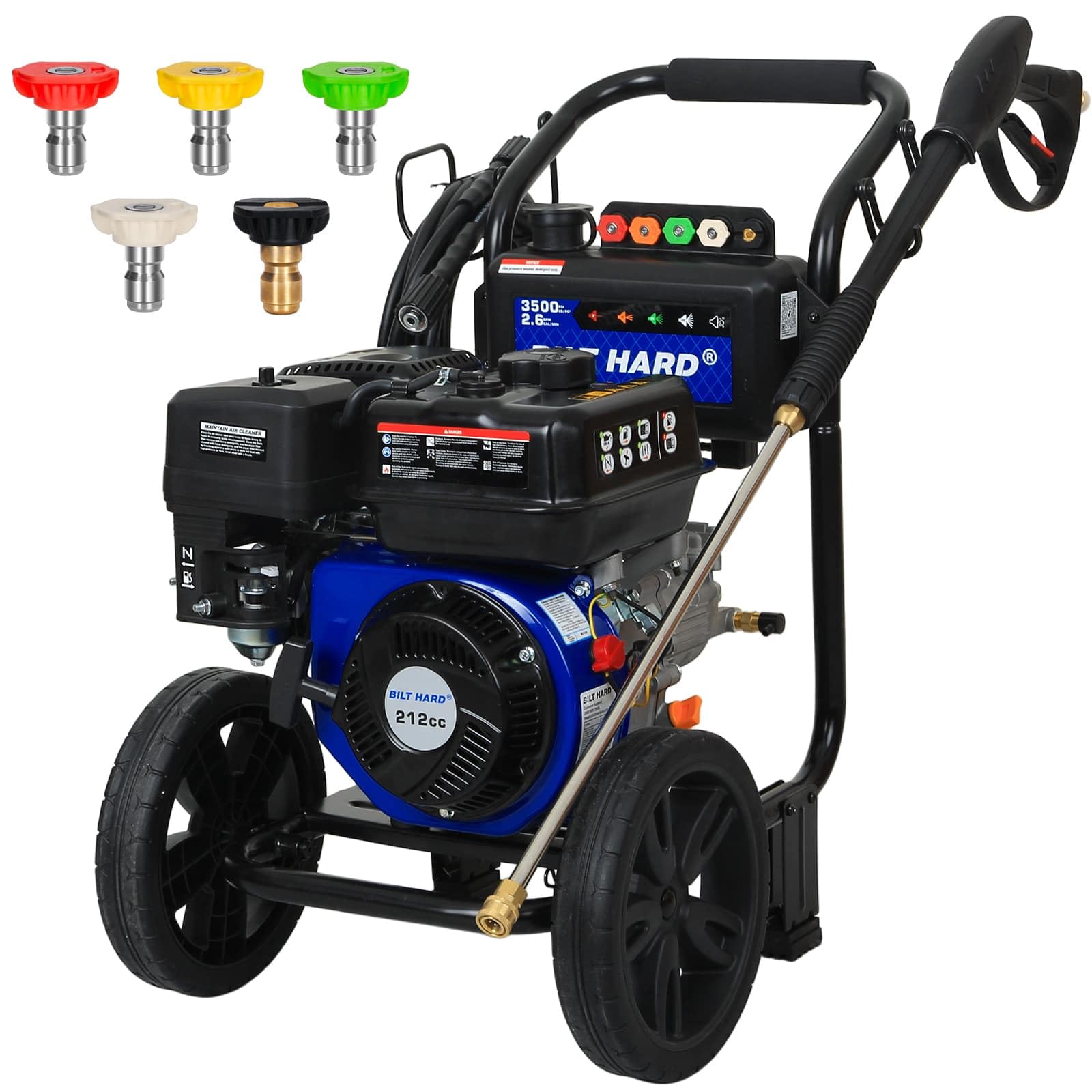
This 3500 PSI gas washer delivers 2.6 GPM flow at a budget price.
This is your entry door into gas-powered cleaning without the premium price tag. The BILT HARD runs a 212cc 4-cycle OHV engine with a 70×55 bore/stroke, delivering up to 3500 PSI and 2.6 GPM — that flow figure is the standout, because 2.6 GPM is what actually blasts algae off landscaping and sweeps a driveway clean fast. The maintenance-free axial cam pump keeps things simple, and the 3/8-inch x 30-foot steel braided hose (the spec sheet lists a 25-foot hose too) resists kinks and abrasion while reducing surface marking.
Portability is handled by 10-inch never-flat wheels and a soft-grip non-slip handle, so it rolls across gravel, pavement, and grass without a struggle. The 0.63-gallon fuel tank pairs with an integrated 1-gallon soap tank, meaning you can power through an entire driveway, patio, or barn without refueling mid-job. Owners mention the high-pressure nozzles remove algae easily and that it is good value for the price, with performance and ease of use leading the positive feedback.
The trade-offs are the classic gas-washer ones: you take on oil changes, fuel stabilization, and a louder workday. One owner noted the hose kinks easily, and another had a handle arrive slightly bent (easily straightened). If you want gas power and are willing to handle the maintenance, this delivers serious cleaning force for the money.
The strong points
- 2.6 GPM flow makes short work of algae, grime, and large flat surfaces
- 10-inch never-flat wheels and soap tank simplify big jobs
- Owners call it easy to assemble with great working pressures
The trade-offs
- Gas engine means oil, fuel, and noise maintenance
- A few customers note the hose kinking easily
Choose this for: big driveways and barns where portability and high flow beat convenience.
skip it if: you are not ready to handle gas-engine upkeep — an electric unit will serve you without the maintenance.
5. Ezasin EAPW01
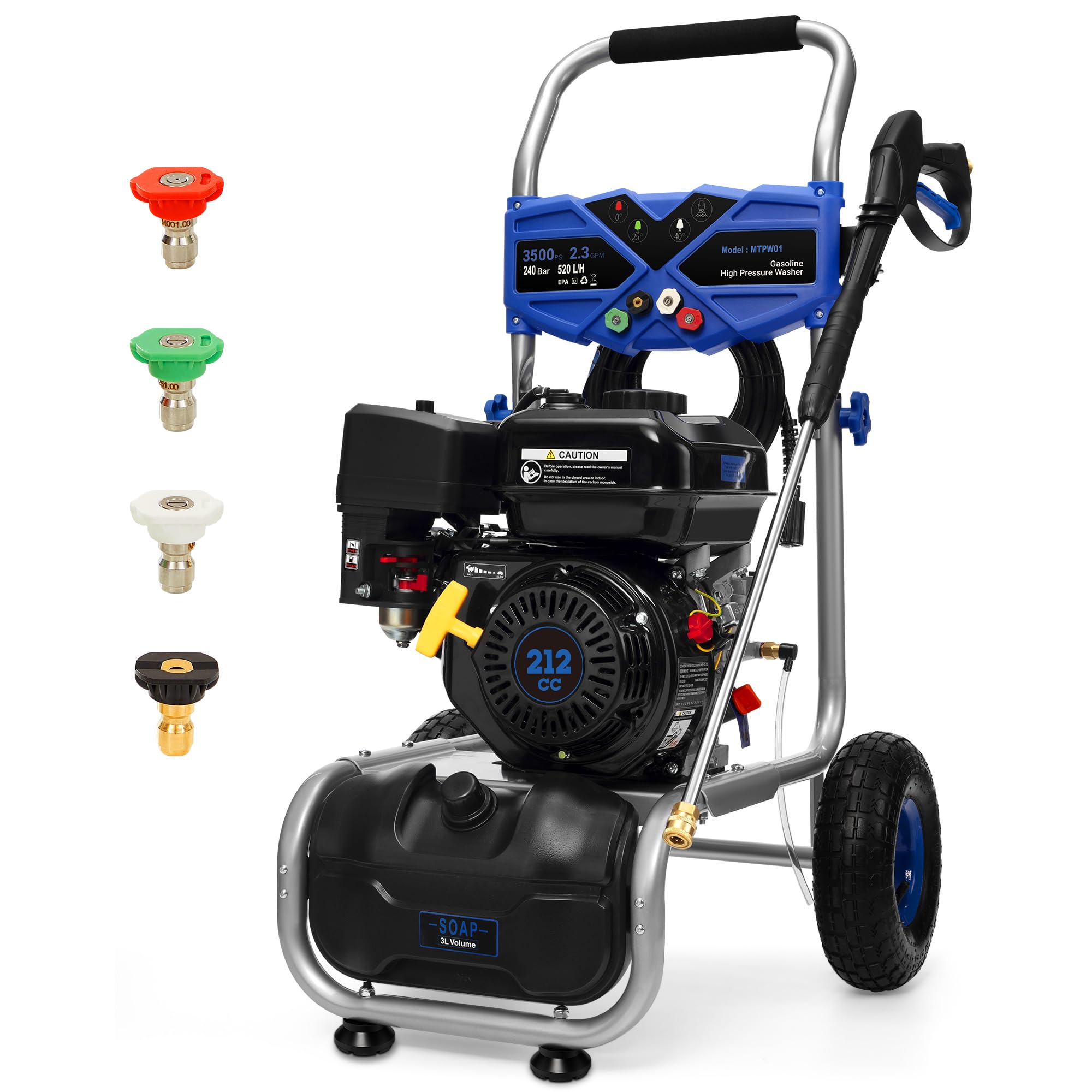
This 3500 PSI gas washer starts on the first pull and cleans with 2.3 GPM flow.
Most gas-washer frustrations start at the pull cord — this one skips that drama. The Ezasin runs a heavy-duty 7HP 4-stroke OHV gasoline engine with 212cc displacement and recoil start, and buyers consistently report it starts right up on the first or second pull. It delivers 3500 PSI and 2.3 GPM through a long-lasting axial cam pump with minimal maintenance, and the numbers back up the reputation: starting time is among the most-praised aspects, right behind overall performance.
The design shows some thoughtful touches. The 10-inch tires roll over gardens with stability, dual front rubber pads add balance and protect against collisions and vibration, and the 25-foot high-pressure hose extends your working radius so you move the machine less. It comes with 4 quick-connect nozzles (0°, 25°, 40°, and soap) ranging from high-impact jets to soft dispersion — enough range for decks, cars, house exteriors, furniture, and prepping a surface for paint. The blue body sits on a frame that handles a 63-pound overall weight with a solid feel.
Some real-world quirks deserve honesty. The manual has a couple of errors — it references a non-existent oil valve — and a thermal switch can prevent starting in 90°F+ sun until it cools down, which tripped up a few owners on hot afternoons. The tip-over sensor is reportedly a bit too sensitive, and the long-gun bracket is fragile. But the praise is loud: it cleans mold well, strips old paint, and owners say it is excellent value if it holds up with proper care.
Owners’ take: Performance leads the praise, with starting time close behind — the combination of first-pull starts and 3500 PSI power is what earns the strong reviews.
Watch for: the thermal shutdown in extreme heat and a manual with a few inaccuracies — read the quick-start guide, not the novel.
This fits: homeowners who want dependable gas starts for decks, driveways, and house exteriors without paying a premium.
Not ideal if: you live in a hot climate and wash in direct midday sun — let it cool before starting.
6. VEVOR 3400 PSI
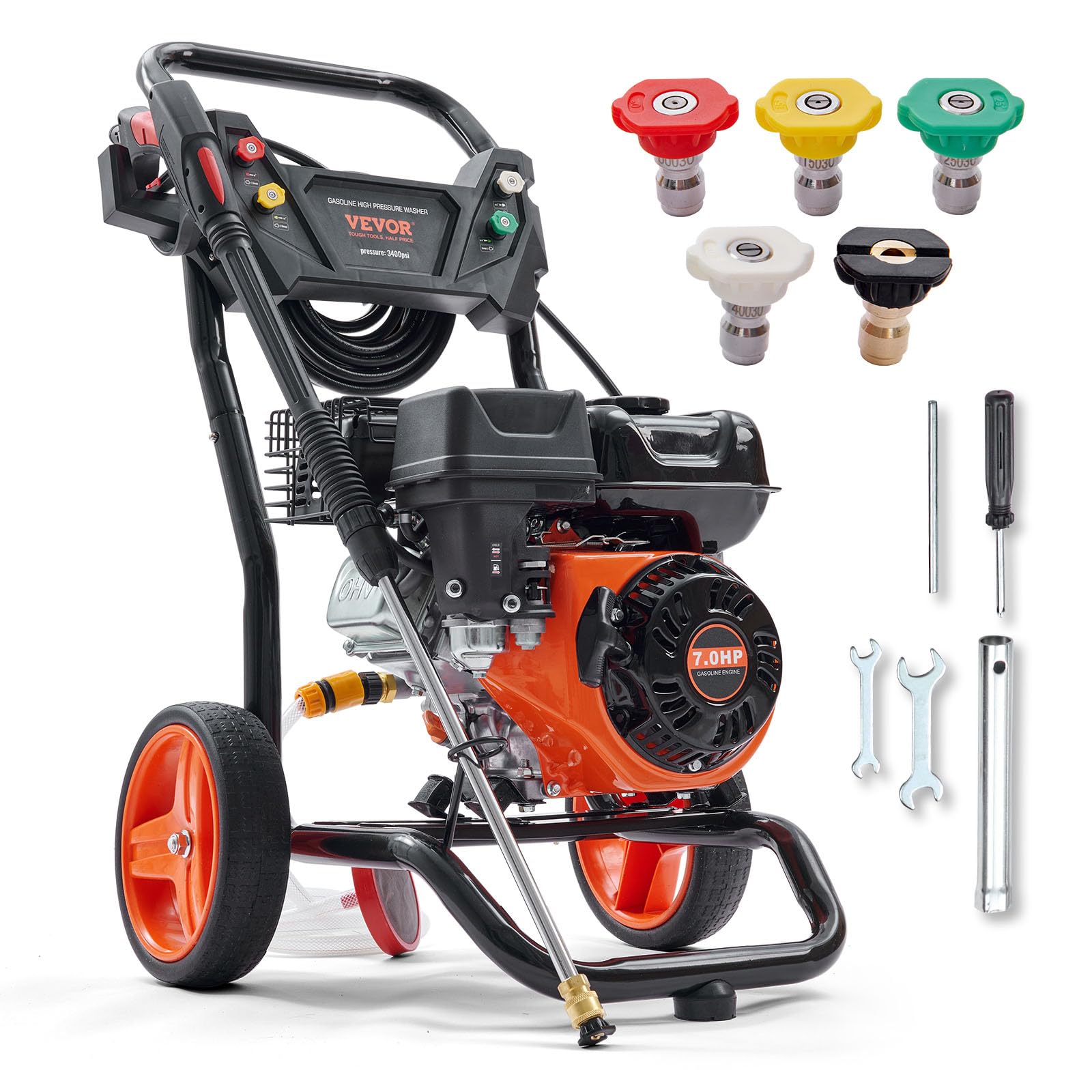
This 3400 PSI gas washer delivers 2.6 GPM flow at a budget price.
If flow rate is your religion, this VEVOR preaches it. The gas-powered unit delivers 3400 PSI and a hefty 2.6 GPM through an aluminum pump, and owners flat-out say it beats electric units without a doubt — one calls it powerful, reliable, and great for tough cleaning jobs. The 4-spoke engine holds 0.8 gallons of gasoline, giving you solid run time before a refill, and the 26-foot water hose resists abrasion and high pressure so you can cover ground without babying the line.
The accessories are genuinely complete. You get 5 quick-connect metal spray nozzles (0°, 15°, 25°, 40°, and soap) ranging from high-impact jets to gentle sprays, plus a spray gun that connects quickly. Everything stores on the machine, which is a small but meaningful detail — no more digging through a shed for the nozzle you need. Reviewers point out it strips paint easily, works well with a surface cleaner, and is great for home and light commercial use.
The durability story is the honest split: many owners say they would buy it again, but a real subset reports failures after about 6 uses, and one unit started leaking oil after sitting unused. The pump is aluminum rather than the copper some competitors tout, which matters if you plan heavy commercial work. For a homeowner who wants serious flow and is gentle with the machine, this is a strong budget gas choice.
What stands out
- 2.6 GPM flow for fast, thorough rinsing on large surfaces
- 5 metal quick-connect nozzles and on-board storage
- Owners say it starts in one pull most of the time
What to weigh
- Durability is a genuine mixed bag — treat it gently and store it properly
- Some small parts feel cheap; a few shoppers say flimsy motor mounts
Reach for it if: you want maximum cleaning speed per dollar on driveways, sheds, and fences.
Choose differently if: you need a machine that survives heavy, regular use — the durability feedback points to a lighter-duty role.
7. Mutaomay MTPW01
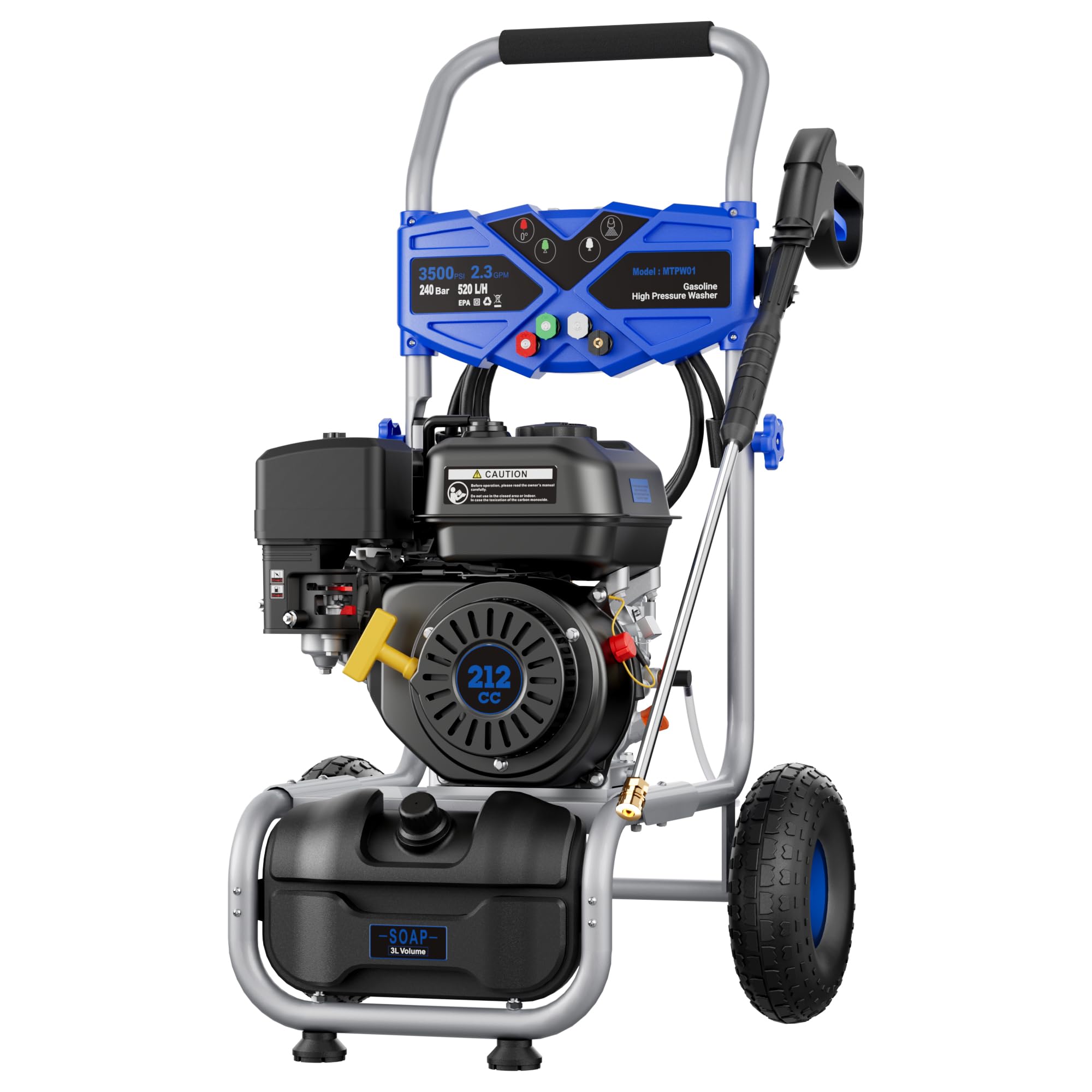
This 3500 PSI gas washer starts on the first pull and cleans with 2.3 GPM flow.
Starting reliability is the story here. The Mutaomay runs a 7HP 4-stroke OHV 209CC engine with recoil start, and starting time is the second most-praised aspect in its reviews — buyers report it fires up on the first pull, every time. It delivers 3500 PSI and 2.3 GPM through a durable axial cam pump, and the marketing claim of being stronger than standard 3200 PSI models is backed by owners who say it strips thick moss, deep-set oil stains, and old peeling paint in seconds.
The wraparound package is what makes it feel premium. A rugged steel frame with corrosion-resistant coating, 10-inch pneumatic tires that roll smoothly over dirt and grass, and a 25-foot high-pressure hose so you move less and clean more. It includes 4 quick-connect nozzles (0°, 25°, 40°, and soap) — from a pinpoint 0° jet for deep stains to a gentle 40° spray for vehicles and delicate surfaces. Assembly is simple with clear instructions, and several owners proved it works with a 50-foot hose from an older washer, which is a nice compatibility bonus.
The durability record is the honest caveat. While many owners praise the build and say “time will tell,” a subset reports units that won’t stay running past 5 minutes. Also, the 25-foot hose drew a complaint from an owner who wished it were 35 feet. For the price, the first-pull starts and cleaning force make it a compelling mid-range gas option.
Owners’ consensus: Performance leads the praise, with starting time close behind — buyers consistently report first-pull starts and strong 3500 PSI cleaning.
The honest note: A few units struggled with reliability; the brand’s support response drew one stinging review, so buy from a seller with good returns.
Best for: homeowners who hate fighting a pull cord and want dependable gas starts for siding, driveways, and post-storm cleanup.
Think twice if: you need guaranteed long-term reliability — the durability feedback is genuinely mixed.
8. Greenworks GPW3002A

This 3000 PSI electric washer delivers 2.0 GPM flow, rivaling gas performance.
The bold claim here is that electric can match gas, and the Greenworks backs it up. Its powerful 14 Amp TruBrushless motor generates 3000 PSI and 2.0 GPM — and the spec sheet notes Cleaning Units of 3300 C.U. — with all pressure and flow claims independently lab-verified, so the numbers on the box are the numbers you get. Owners who measured it at the nozzle found real-world PSI figures in the 2,500 to 3,200 range depending on the tip, which is remarkable for a plug-in unit.
The JETFLOW technology delivers up to 50% more flow to reach higher areas and power-rinse quickly, and the rugged metal gun pairs with a 25-foot Uberflex kink-resistant hose. You get 15°, 25°, and 40° tips plus soap and turbo nozzles — the turbo is repeatedly singled out as excellent. The brushless motor runs quiet and cool enough that owners mention no overheating even after hours of continuous use on a single 15A circuit, which is the kind of reliability that makes electric appealing.
The honest cost of that power: it draws heavily from your outlet. Owners recommend a dedicated circuit and at least a 12-gauge extension cord, with some reporting lights flickering on shared lines. It is also not quite as fast as a high-flow gas unit for large flat surfaces. But for someone who wants gas-like cleaning without oil, fuel, or noise, this is arguably the best electric value on the list.
The big wins
- Lab-verified 3000 PSI and 2.0 GPM at a price far below pro gas units
- Quiet brushless motor that runs for hours without overheating
- Turbo nozzle and metal gun feel genuinely premium
The costs
- Needs a dedicated outlet and heavy-gauge cord — 10 AWG tripped a GFCI in testing
- Rinsing is slower than a 2.5+ GPM gas unit on big driveways
Choose this for: gas-level cleaning power with electric convenience — perfect for car, motorcycle, and patio work.
pass on it if: your only outlet is a shared garage circuit; this machine demands serious power draw.
9. DeWalt DXPW3300-S
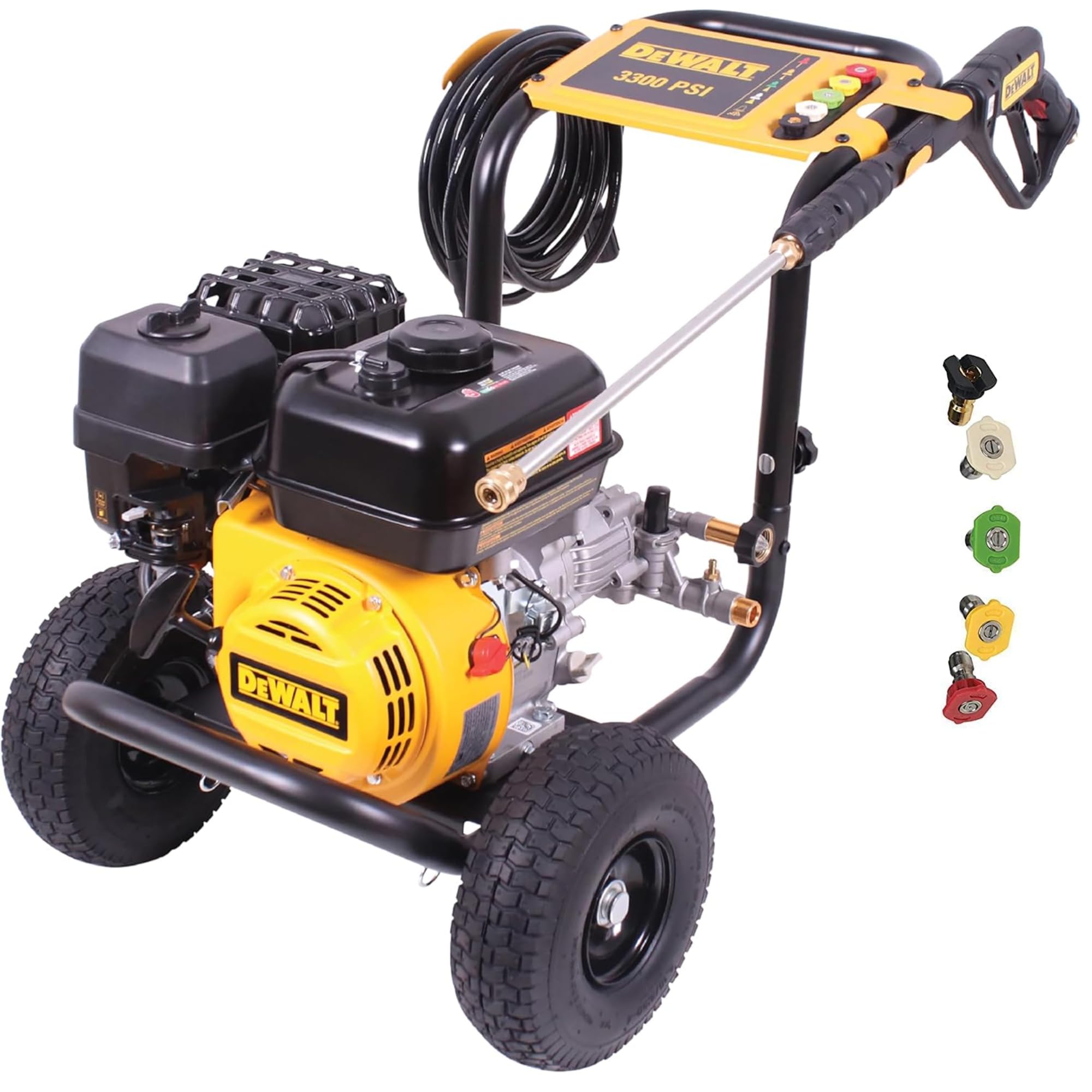
This 3300 PSI gas washer starts on the first pull and cleans with 2.4 GPM flow.
When you see the yellow and black, expectations run high — and this one mostly delivers. The DeWalt runs a 208cc engine that owners describe as starting on the first pull consistently, even after sitting for a month. It delivers 3300 PSI at 2.4 GPM through an OEM Technologies axial cam pump, and the welded steel frame with powder-coated finish adds the durability you expect from the brand. A thermal relief valve prevents overheating, which extends the pump’s life during long sessions.
Portability is genuinely thoughtful. Premium 10-inch pneumatic tires roll smoothly over uneven terrain, and the compact design at 41″ x 21″ x 24″ is easy to transport. The 25-foot abrasion-resistant hose, 5 quick-connect nozzles (0°, 15°, 25°, 40°, soap), ergonomic spray gun, and 16-inch steel wand cover every task from stripping paint to gentle car washing. Customers note it removes baked-on mud from an exhaust down to bare metal — and warn to use the tips with caution because it is that strong.
The reliability story is the honest split. Many owners call it well-built and powerful, but a genuine subset reports units that won’t start or run at all, with one failing on the second use. That mixed functionality feedback is real. The warranty structure helps — 5-year frame, 3-year pump, 2-year engine — and the brand’s service network is a genuine advantage over no-name imports. For a residential machine with proven brand backing, the DeWalt earns its premium.
Owners’ verdict: Quality is the most-praised aspect by a wide margin, with pressure close behind — the power is exceptional and the starts are reliable for most buyers.
The honest caveat: A meaningful number of units arrive with starting or running problems; buy from a seller with solid returns in case you get a lemon.
This is for: buyers who trust the DeWalt name and want a powerful residential gas washer with a real warranty and service network.
Not the pick if: you are on a tight budget — the premium price buys the brand and warranty more than extra cleaning power.
10. EGO HPW3200

The battery-powered pioneer that gives gas a run for its money — until the batteries fade.
This is the future of pressure washing, and it mostly lives up to the hype. The EGO combines the power of any two 56V ARC Lithium batteries to deliver up to 3200 PSI at 1.2 GPM, and up to 2.0 GPM max. Peak Power Technology lets you select ECO, High, and Turbo modes, and a wand-integrated display shows battery charge wirelessly — you always know how much juice you have left. Owners call the performance better than plug-in electric and only slightly below gas, which is remarkable for a cordless unit.
The portability is the whole point. No cord, no gas — plug a garden hose in, or draw from any fresh water source using the included siphon hose, and you can clean anywhere from remote job sites to a neighbor’s driveway. The telescopic handle pulls out for transport and collapses for compact storage. Accessories are generous: flexible high-pressure hose, siphon hose, quick-connect gun and wand, stainless steel wand, foam cannon, filter, plus 15°, 25°, 40°, turbo, and rinse nozzles. It works with all EGO 56V ARC Lithium batteries and carries a 5-year tool warranty.
The battery life is the honest trade-off, and it is the most-discussed aspect in the reviews. On two 6Ah batteries, you get roughly 40 minutes on High, 15-20 minutes in Turbo, and about 60 minutes in ECO — and Turbo “crushes batteries,” as one owner bluntly put it. The 1.2 GPM flow also means rinsing is slower than a gas unit. If you have a yard full of EGO tools and batteries already, this is a no-brainer; if you are starting from scratch, factor in the cost of extra batteries.
Why it’s a breakthrough
- True cordless freedom with up to 3200 PSI — no gas, no cord, no fumes
- Wand-integrated display shows battery status wirelessly across ECO, High, and Turbo modes
- Works with all EGO 56V ARC Lithium batteries and carries a 5-year warranty
The honest limitations
- Battery life is the top discussion — Turbo empties a pair of 6Ah batteries in 15-20 minutes
- 1.2 GPM flow makes rinsing slower than a 2.5+ GPM gas unit
- Premium price, plus extra batteries if you are not already in the EGO ecosystem
This is for: EGO platform owners and anyone who wants drag-anywhere cleaning power without cords or fuel.
Think carefully if: you need to wash for hours at a stretch — the battery drain makes long driveway marathons a two-charger operation.
11. Simpson PS3228
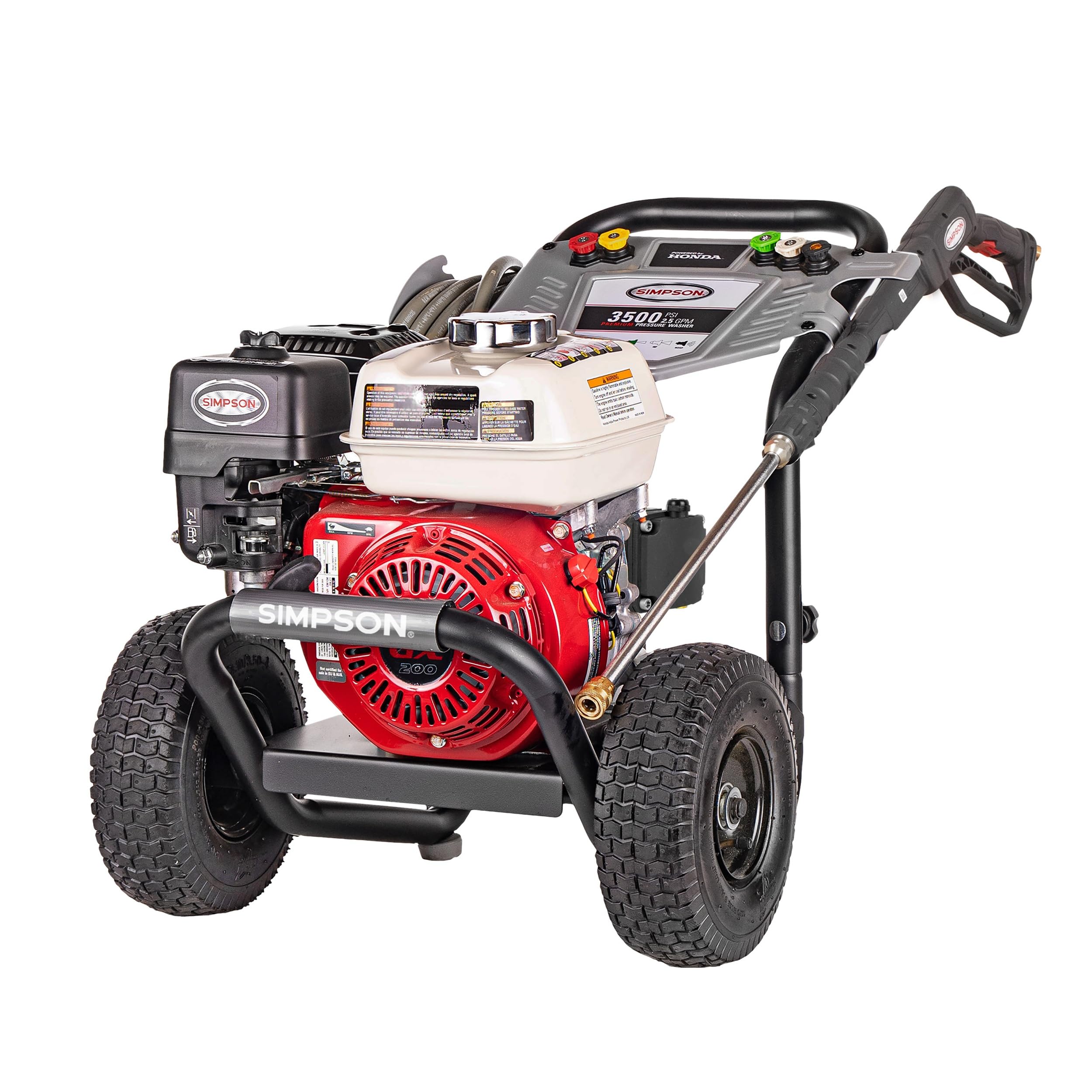
The Honda-engine workhorse professionals reach for when it has to last.
If there is one machine on this list built to be the last pressure washer you buy, it is the Simpson. The headline is the premium Honda GX200 engine — the gold standard for small-engine reliability — which starts easily and includes low-oil shutdown to protect itself from abuse. It delivers 3300 PSI (listed at 3500 max in the title specs) at 2.5 GPM through an AAA triplex pump with an integrated unloader and thermal relief to prevent overheating. That triplex pump is the real upgrade: it is the pro-grade design that handles continuous heavy work far better than the axial cam pumps on cheaper units.
The build quality is evident everywhere. The Simpson Morflex series 25-foot high-pressure hose resists kinks and abrasion, and its non-marring polyurethane jacket protects finished surfaces from scuffs. The welded steel frame with powder-coated finish resists corrosion, and 10-inch premium pneumatic tires roll smoothly over gravel, grass, and curbs. It comes with five quick-connect tips (0°, 15°, 25°, 40°, and soap) plus a rear-load M22 gun and 16-inch spray wand. Owners describe it as well-built, reliable, and ready to go within minutes — one calls it “UNREAL” for the money.
The honest downsides are physical: at 74 pounds, it is heavy to move, and owners note it is loud and vibrates at idle. One owner wishes the handle stayed put better, and another notes it ships with 16oz of oil when the engine needs 20oz — a small extra purchase before first start. But the durability reputation is exactly why contractors choose this: a Honda engine with a triplex pump is the combination that keeps working for years.
The professional edge
- Honda GX200 engine with low-oil shutdown — the most reliable small engine made
- AAA triplex pump with thermal relief designed for long service life
- Morflex hose with non-marring jacket protects finished surfaces
The physical trade-offs
- 74 pounds — heavy to move, loud, and it vibrates at idle
- Ships with 16oz oil but needs 20oz, so budget for an extra bottle
- The handle can wobble, and the wand holder doesn’t always secure the wand with the hose attached
Reach for this if: you want pro-grade longevity and are willing to pay for the Honda engine and triplex pump.
Look elsewhere if: you need something light to haul — the 74-pound weight is the price of that durability.
Understanding the Specs
PSI — The Force of the Jet
PSI (pounds per square inch) measures how hard the water hits the surface. Higher PSI strips paint, blasts mud, and etches concrete; lower PSI is gentler on cars and wood. For this category, 2600 PSI is the floor for serious cleaning, and the units here range up to 3500 PSI. Keep in mind the “max PSI” figure is measured at initial discharge — rated PSI is what you get during continuous use, so a machine rated at 2000 PSI still cleans well but slower than its max suggests.
GPM — The Volume That Rinses
GPM (gallons per minute) is the flow of water through the nozzle. It is what actually sweeps loosened dirt off the surface. A high-PSI, low-GPM washer etches grime but leaves it sitting there; a balanced machine cleans faster because the water carries the mess away. For driveways and large flat areas, look for 2.0 GPM and up. The VEVOR and BILT HARD units at 2.6 GPM will rinse a driveway noticeably faster than a 1.2 GPM electric.
Pump Types — Axial Cam vs. Triplex
The pump is the heart of any pressure washer. An axial cam pump is the common, affordable choice for home use — it is compact, light, and fine for weekend jobs, but it wears faster under heavy use. A triplex pump, found on pro-grade gas units like the Simpson, uses three plungers for smoother, more durable operation that handles continuous work far better. If you plan multi-hour driveway marathons, the pump upgrade matters more than any other spec.
Nozzles — The Right Angle for Every Job
Nozzles are color-coded by spray angle, and the angle controls both coverage and intensity. A 0° nozzle is a pinpoint jet that strips paint and digs into grime — use it with caution. A 25° or 40° nozzle spreads the spray for general rinsing and gentle cleaning. A soap or detergent nozzle applies suds at low pressure. A turbo nozzle rotates the jet for a concentrated, oscillating blast that is great for tough stains. Every unit here includes a set, but the mix varies — count the nozzles before you choose.
Electric vs. Gas vs. Battery — The Power Source Decision
Electric units plug into a standard outlet, start instantly, run quietly, and need almost no maintenance, but they are tethered to a power cord. Gas units roam anywhere and deliver higher flow — most gas models here push 2.3 to 2.6 GPM — but demand oil changes, fuel stabilization, and more patience on a cold morning. Battery units like the EGO offer true cordless freedom but trade away runtime. Match the power source to your property size and how often you’ll actually wash.
Hose Length & Wheels — Reach and Mobility
Hose length determines how far you can clean without moving the machine. A 25-foot hose (the standard here) covers most residential jobs; the VEVOR’s 26-foot hose and the BILT HARD’s 30-foot steel braided option add a bit more reach. Wheel size matters for terrain — 8-inch wheels handle lawns and gravel, while 10-inch pneumatic tires roll over curbs and rough ground far more smoothly. Pair a long hose with big wheels and you can clean a whole driveway without repositioning.
FAQ
Is 2600 PSI enough for cleaning a concrete driveway?
What’s the difference between max PSI and rated PSI?
Which is better for home use, gas or electric?
How long does a pressure washer pump last?
Can I use a pressure washer to clean my car?
What size extension cord do I need for an electric pressure washer?
How long does the EGO battery pressure washer run on a charge?
Why does my gas pressure washer start then shut off?
What detergent can I use in the soap tank?
Which pressure washer should I buy for a large driveway?
Final Thoughts: The Verdict
For most households, the 2600 psi pressure washer winner is the Westinghouse WPX2700e because it delivers 2700 PSI with a 13A induction motor, a 5-nozzle set, and a soap tank at a price that undercuts most gas units. If you want gas-level flow and portability without the engine upkeep, the Greenworks GPW3002A is the electric to grab. And for the pro-grade, buy-it-for-years option, the Simpson PS3228 with its Honda GX200 engine and triplex pump is the one contractors reach for. Match your pick to the size of your property — electric for convenience, gas for raw cleaning speed.
How We Picked
We do not accept paid placement. Every pick is matched to a real buyer and a real use-case; we do not hands-on test units.
Sources & Methodology
Specifications: manufacturer listings and product documentation. Review insights: verified customer reviews, as of August 2026. Pricing: not shown on this page (it changes often); check the current price via the retailer link.
As an Amazon Associate, Gadgets Feed earns from qualifying purchases. This does not affect which products we feature.