
The jump to a 27-inch 4K gaming monitor means committing to a pixel density of roughly 163 to 166 PPI — a spec that makes text look razor-sharp and game worlds feel dense with detail. But the real challenge isn’t the resolution; it’s maintaining high frame rates without tearing, choosing between the blazing contrast of OLED versus the burn-in-free reliability of IPS, and deciding whether a dual-mode panel (switching to 1080p for extreme refresh rates) is a feature you’ll actually use or a marketing gimmick you’ll pay for.
I’m Min — the co-founder and writer behind Gadgets Feed. I’ve spent countless hours analyzing refresh rate ladders, response time claims, color gamut coverage, and adaptive sync implementations across dozens of 27-inch 4K models to sort the genuine performers from the spec-sheet heroes.
Whether you prioritize motion clarity for competitive shooters or vibrant HDR for single-player immersion, this guide cuts through the noise to help you find the best 27 inch 4k gaming monitor that matches your actual hardware and budget.
How To Choose The Best 27 Inch 4K Gaming Monitor
A 4K gaming monitor at 27 inches is a sweet spot — dense enough to eliminate the need for scaling on desktop use, but not so large that you lose peripheral vision in competitive titles. The key decisions come down to panel technology, refresh rate versus your GPU’s capability, and whether you need the flexibility of a dual-mode or a premium OLED.
Panel Technology: IPS, OLED, or QD-OLED
IPS panels dominate the mid-range because they offer solid color accuracy, wide viewing angles, and zero burn-in risk. The trade-off is mediocre contrast (around 1000:1) and less impressive HDR. OLED and QD-OLED panels deliver infinite contrast, true blacks, and sub-0.1ms response times, but they carry a premium price and potential burn-in over years of static desktop use. Newer models like those from MSI and ASUS include OLED Care features and heatsinks to mitigate this, but it remains a consideration if you plan to use the monitor 50/50 for work and gaming.
Refresh Rate and Your GPU
4K at 144Hz requires a powerful GPU — an RTX 4080 or RX 7900 XT is the minimum for high settings in modern titles. A 240Hz 4K panel is overkill unless you own an RTX 4090 or the upcoming 5090, or you play esports titles that can actually hit those frame rates at 4K. Dual-mode monitors that switch to 1080p at 360Hz offer a practical compromise: crisp 4K for single-player and a blistering high-refresh 1080p mode for competitive shooters. The key spec to check is whether the switch is native or upscaled — native switching (like the LG and ASUS dual-mode panels) avoids blur from interpolation.
Connectivity That Matches the Specs
To run a 4K monitor at 180Hz or 240Hz without compression artifacts, you need HDMI 2.1 (48Gbps) or DisplayPort 2.1a (80Gbps). Many monitors still ship with DP 1.4, which forces Display Stream Compression at higher refresh rates — visually lossless in gaming but potentially problematic for color-critical work. USB-C with 90W+ Power Delivery is a valuable bonus for laptop users, letting you charge your machine and drive the display with a single cable.
Quick Comparison
On smaller screens, swipe sideways to see the full table.
| Model | Category | Best For | Key Spec | Amazon |
|---|---|---|---|---|
| INNOCN GA27W1Q | OLED | Best Value OLED | 240Hz / 0.03ms / QD-OLED | Amazon |
| ASUS ROG Swift PG27UCDM | QD-OLED | Premium All-Rounder | 240Hz / DP 2.1a / 90W PD | Amazon |
| MSI MPG 272URX | QD-OLED | Mac & PC Hybrid | 240Hz / 98W USB-C / KVM | Amazon |
| Samsung Odyssey G8 G81SF | QD-OLED | Glare-Free Gaming | 240Hz / DisplayHDR True Black 400 | Amazon |
| LG 27G810A-B (Ultragear) | IPS | Best Overall Value | 180Hz (4K) / 360Hz (FHD) Dual Mode | Amazon |
| ASUS ROG Strix XG27UCG | IPS | Budget Dual-Mode | 160Hz (4K) / 320Hz (FHD) / USB-C | Amazon |
| Samsung Odyssey G7 G70D | IPS | Smart Features | 144Hz / FreeSync Premium Pro / Gaming Hub | Amazon |
| Alienware AW2725QF | IPS | Color-Accurate Dual-Mode | 180Hz (4K) / 360Hz (FHD) / Delta E <2 | Amazon |
In‑Depth Reviews
1. INNOCN 27″ OLED GA27W1Q
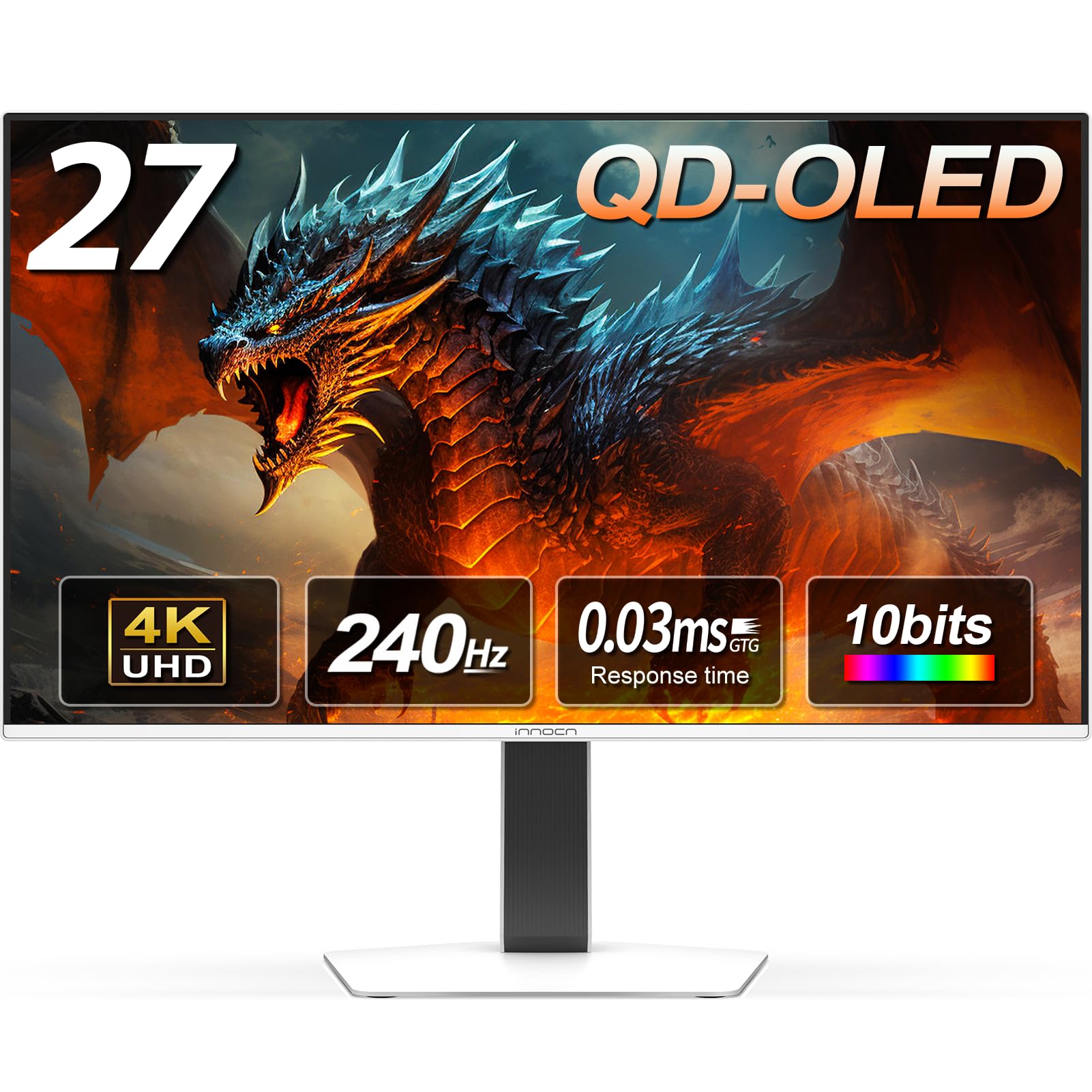
At 240Hz with native 4K resolution, it offers the same elite motion clarity and inky blacks as monitors from Samsung or ASUS, making it the entry point to true OLED gaming without compromising on the core panel specifications.
Connectivity is generous for its price tier: two HDMI 2.1 ports plus two DisplayPort inputs, though it lacks USB-C with Power Delivery, which matters if you frequently dock a laptop. The build quality is a step down — some owners report a flimsy housing and an external power brick with short cables — but the panel itself competes with flagships. The included stand offers full height, tilt, swivel, and pivot adjustment, plus LED ambient lighting that adds some visual flair.
Where this monitor stumbles is in the OSD experience and documentation. The menu presets are poorly labeled and there’s no printed guide explaining the HDR modes (Normal = HDR1000, Highlights = True Black 400, based on user discovery). The built-in speakers are weak, but most gamers will use a headset anyway. If you can tolerate the budget chassis and DIY calibration, this is the most cost-effective path to 4K OLED gaming today.
Why it’s great
- True QD-OLED with 240Hz for hundreds less than competitors
- Excellent contrast and color out of the box
- Full ergonomic stand with height/swivel/pivot
Good to know
- Build quality is cheap vs. ASUS or MSI OLEDs
- No USB-C port for laptop charging
- OSD presets are confusing without online research
2. ASUS ROG Swift PG27UCDM

The PG27UCDM is ASUS’s flagship 27-inch QD-OLED, and it earns its premium status with the full feature set: DisplayPort 2.1a UHBR20 with 80Gbps bandwidth (no compression required at 4K 240Hz), USB-C with 90W Power Delivery, and Dolby Vision support. The 4th-gen QD-OLED panel includes ASUS OLED Care Pro with a Neo Proximity Sensor that auto-dims the screen when you walk away, directly addressing burn-in anxiety.
Color performance is reference-grade: 99% DCI-P3, true 10-bit color, Delta E < 2 out of the box. The 0.03ms response time is beyond what any human can perceive, and the 240Hz refresh rate pairs perfectly with an RTX 4090 or 5090. The custom heatsink design helps sustain brightness without fan noise, and the package includes both DP 2.1 and HDMI 2.1 cables, a VESA mount kit, and even a microfiber cloth — rare attention to unboxing detail.
Downsides are minor but real at this price point. The triangular QD-OLED subpixel layout can make Windows text look slightly soft (less noticeable at 166 PPI than on larger OLEDs), the OSD menu is unintuitive, and there are no built-in speakers. The port orientation faces downward, making cable management tricky on tight desks. For pure gaming performance and future-proof connectivity, this is the most complete package available.
Why it’s great
- DP 2.1a UHBR20 — full bandwidth without compression
- Neo Proximity Sensor for automatic burn-in protection
- Dolby Vision + Delta E <2 out of the box
Good to know
- Triangular subpixel layout softens Windows text slightly
- No built-in speakers at a + price
- Downward-facing ports make desktop cable routing harder
3. MSI MPG 272URX QD-OLED

The MSI MPG 272URX competes directly with the ASUS PG27UCDM but carves a unique niche for hybrid workstation-gaming setups. Its USB-C port delivers 98W Power Delivery — enough to charge a 16-inch MacBook Pro or high-end gaming laptop — and the built-in KVM switch lets you share a single keyboard and mouse between a PC and a laptop. The QD-OLED panel is the same class as the competition: 240Hz, 0.03ms, 1.07 billion colors, and VESA DisplayHDR True Black 400.
MSI’s OLED Care 2.0 includes a graphene heatsink for passive cooling (fanless design), and the Smart Crosshair AI feature adds a practical edge for FPS players. The 166 PPI density keeps text crisp, and owners report no fringing issues even on macOS. The bundle includes a DisplayPort 2.1a cable and HDMI 2.1 cable, and the stand provides full four-way adjustment. At roughly the same price as the ASUS, it’s a direct alternative with the bonus of the KVM and higher USB-C power delivery.
The main drawback is the same as any QD-OLED at 27 inches: potential burn-in over years of static UI elements, though MSI’s care features mitigate this. A small portion of users have reported bubbles under the screen laminate, requiring RMA — but MSI’s warranty process covers this. The connectivity is comprehensive, though there’s only one USB-C port and the DP 2.1a is a single input, limiting multi-monitor 4K 240Hz setups.
Why it’s great
- 98W USB-C with KVM — ideal for laptop + PC workflows
- Graphene heatsink for silent, fanless operation
- Excellent text clarity at 166 PPI, no subpixel fringing issues
Good to know
- Price is premium — same tier as ASUS and Samsung OLEDs
- Rare reports of screen bubbles under the laminate
- Single DisplayPort 2.1a input limits advanced multi-monitor setups
4. Samsung Odyssey G8 G81SF (QD-OLED)
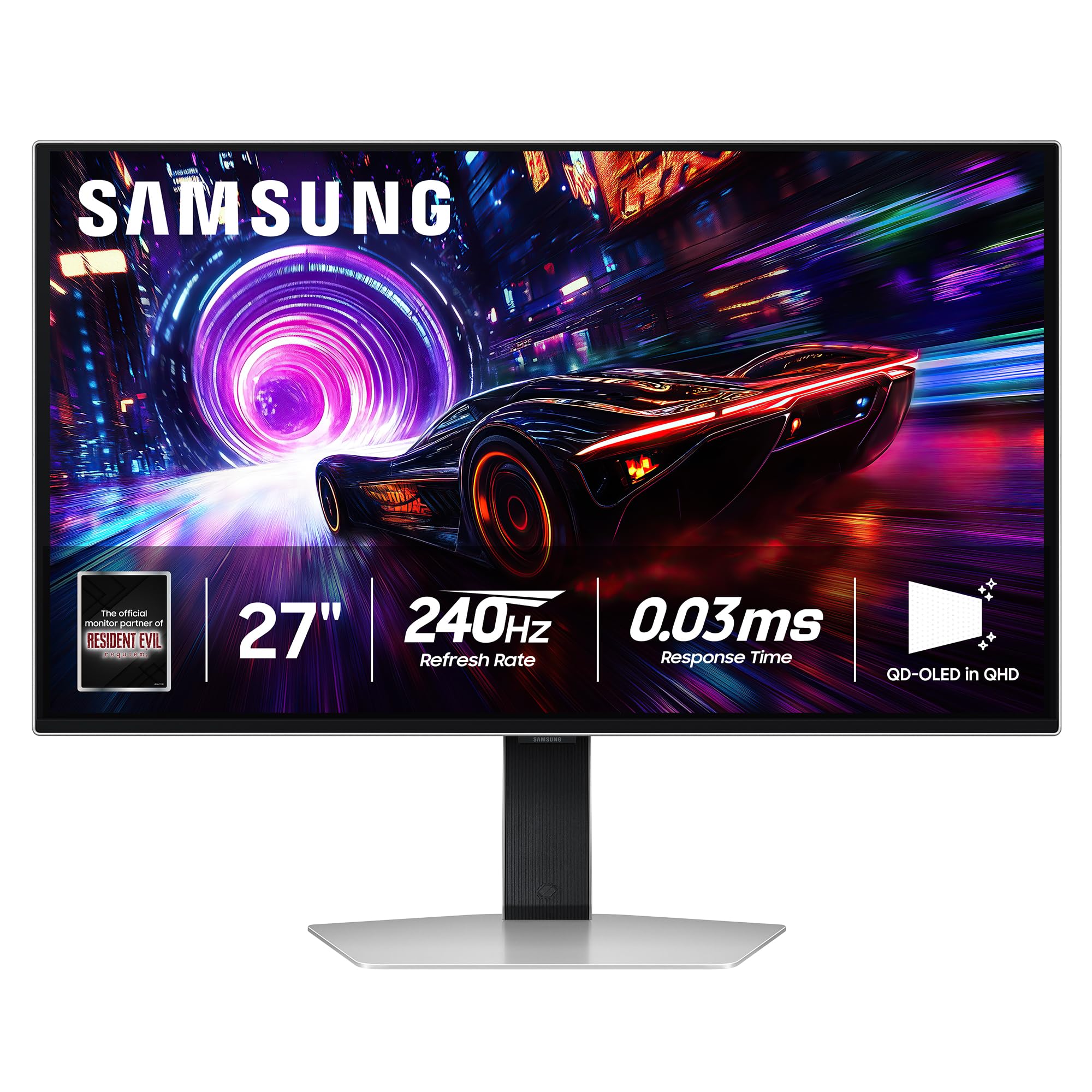
Samsung’s G8 G81SF brings fourth-gen QD-OLED to the Odyssey lineup with a unique Glare-Free coating that reduces reflections by 54% compared to conventional anti-glare films. This makes it the best option for bright rooms or setups with windows behind the monitor — the screen maintains its deep blacks and rich colors even in direct ambient light, where standard glossy OLEDs wash out. The 240Hz refresh rate and 0.03ms response time are identical to the premium OLED competition.
The Samsung-specific features extend to the Dynamic Cooling System, which uses a pulsating heat pipe to dissipate heat faster than graphite sheets, reducing burn-in risk over extended sessions. The Thermal Modulation System and auto-dimming for static logos and taskbars add another layer of protection. The ergonomic stand is fully adjustable, and the 166 PPI density ensures sharp text for productivity use between gaming sessions.
The G81SF ships with DisplayPort and HDMI 2.1 cables, but it lacks USB-C entirely — a meaningful omission for anyone hoping to use a single cable with a laptop. The on-screen menu is controlled via a finicky mini-joystick, and warranty paperwork has been reported as one year despite Samsung advertising three. The anti-glare coating, while excellent for light control, is the most matte of any QD-OLED and may appear slightly grainy to users accustomed to glossy screens.
Why it’s great
- Glare-Free coating works brilliantly in bright rooms
- Pulsating heat pipe cooling for long-term durability
- True Black 400 HDR with infinite contrast
Good to know
- No USB-C — requires separate cables for laptop users
- Very matte coating may look slightly grainy to some
- Warranty duration confusion: one year vs. advertised three
5. LG 27G810A-B Ultragear
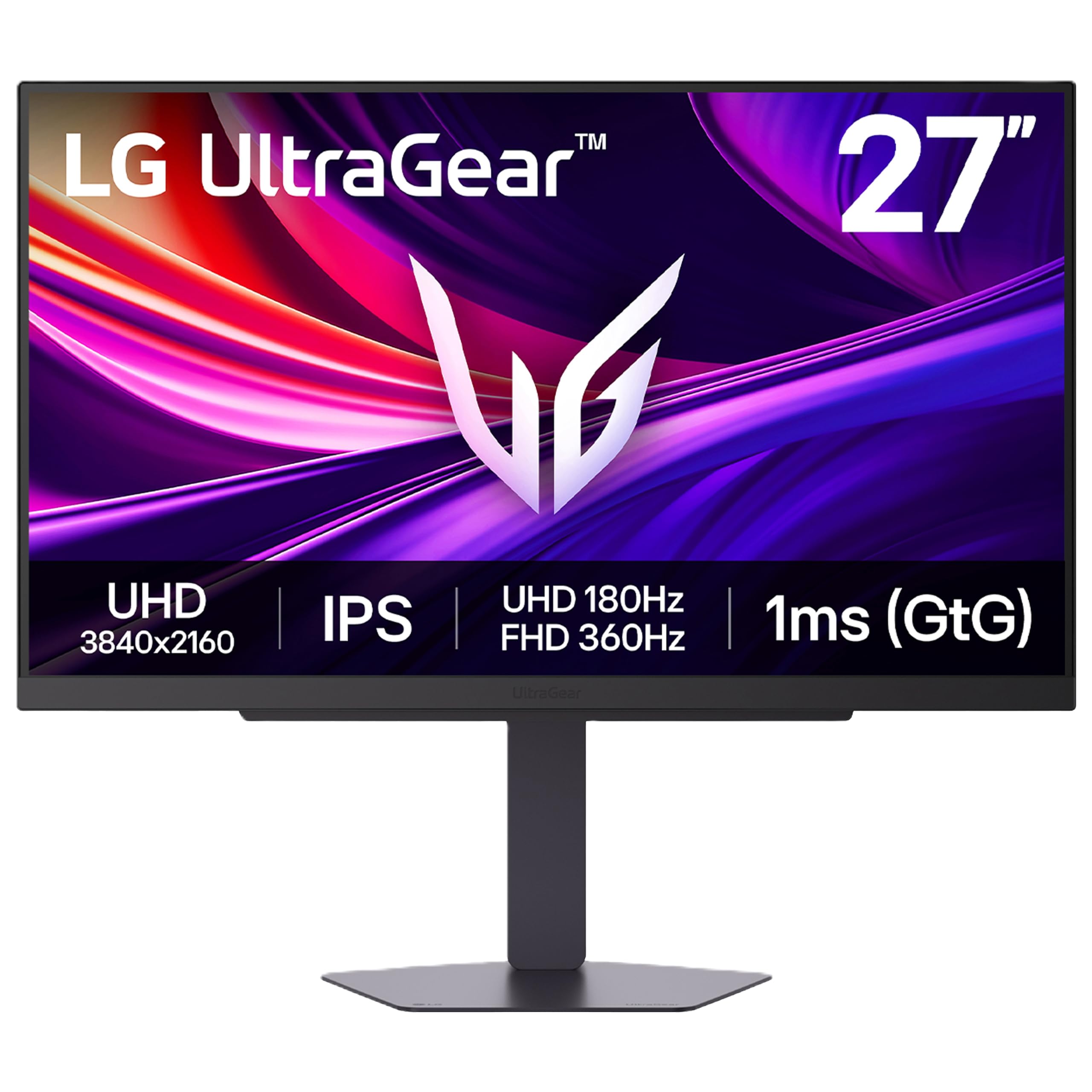
The LG 27G810A-B is the most compelling mid-range pick for gamers who want both 4K detail and esports-level responsiveness without spending OLED money. Its IPS panel delivers 180Hz at native 4K UHD and a dedicated Full HD mode at 360Hz — both native resolutions, not interpolation. The 1ms GtG response time is competitive with the fastest IPS panels, and the 95% DCI-P3 coverage surpasses many older OLEDs in color vibrancy.
G-Sync and FreeSync Premium compatibility ensure tear-free gameplay across both NVIDIA and AMD GPUs, and LG includes the DisplayPort cable and an HDMI 2.1 cable in the box. The Dynamic Action Sync and Black Stabilizer features reduce input lag and improve visibility in dark scenes. The stand is fully adjustable (height, swivel, tilt, pivot), and the 4-pole headphone jack with DTS HP:X delivers spatial audio through a single connection.
The trade-off for this price is the inherent contrast limitation of IPS — 1000:1 means blacks look gray in dark rooms, and DisplayHDR 400 is the entry-level HDR tier, offering limited impact in bright highlights. Some units have a noticeable fan noise in silent environments, and the height adjustment range is slightly limited compared to premium stands. For under , the value proposition is unmatched: you get dual-mode performance, solid color, and a full ergonomic stand.
Why it’s great
- Native dual mode — 4K 180Hz or FHD 360Hz, no upscaling blur
- Excellent IPS colors at 95% DCI-P3 for the price
- Ergonomic stand with full adjustability included
Good to know
- IPS contrast — blacks appear gray in dark scenes
- DisplayHDR 400 is minimal HDR performance
- Some units have audible fan noise in quiet rooms
6. ASUS ROG Strix XG27UCG

The ASUS ROG Strix XG27UCG is a direct competitor to the LG 27G810A-B, offering a similar dual-mode IPS experience with slightly lower maximum refresh rates: 4K at 160Hz and Full HD at 320Hz. Its Fast IPS panel achieves a 1ms GtG response time and includes ASUS’s Extreme Low Motion Blur Sync (ELMB SYNC) technology, which can operate simultaneously with variable refresh rate — rare in this price class and effective at eliminating ghosting.
The 95% DCI-P3 gamut delivers vibrant colors, and the 130% sRGB coverage makes it viable for content creation alongside gaming. The stand offers full ergonomic adjustment (height, swivel, pivot, tilt), and the built-in power supply eliminates the need for an external brick. Connectivity includes DisplayPort, HDMI, and USB-C, though the USB-C is data-only and does not support Power Delivery or video input in all configurations.
The main limitation is the 160Hz ceiling in 4K — you’ll need a very fast GPU to notice the difference between 160Hz and 180Hz, but it’s worth noting. The HDR performance is functional rather than impressive (the LG and ASUS are equivalent in this regard at this price tier), and the ELMB SYNC technology introduces slight brightness reduction in the fastest modes. For the price, it’s a well-rounded entry into 4K gaming with a practical dual-mode fallback for esports.
Why it’s great
- ELMB SYNC works with VRR for tear-free blur reduction
- Fast IPS with 1ms response and vibrant DCI-P3 colors
- Ergonomic stand with full adjustability included
Good to know
- 4K capped at 160Hz — slightly behind LG’s 180Hz
- USB-C is data-only, no video or charging
- HDR is functional but not transformative
7. Samsung Odyssey G7 G70D
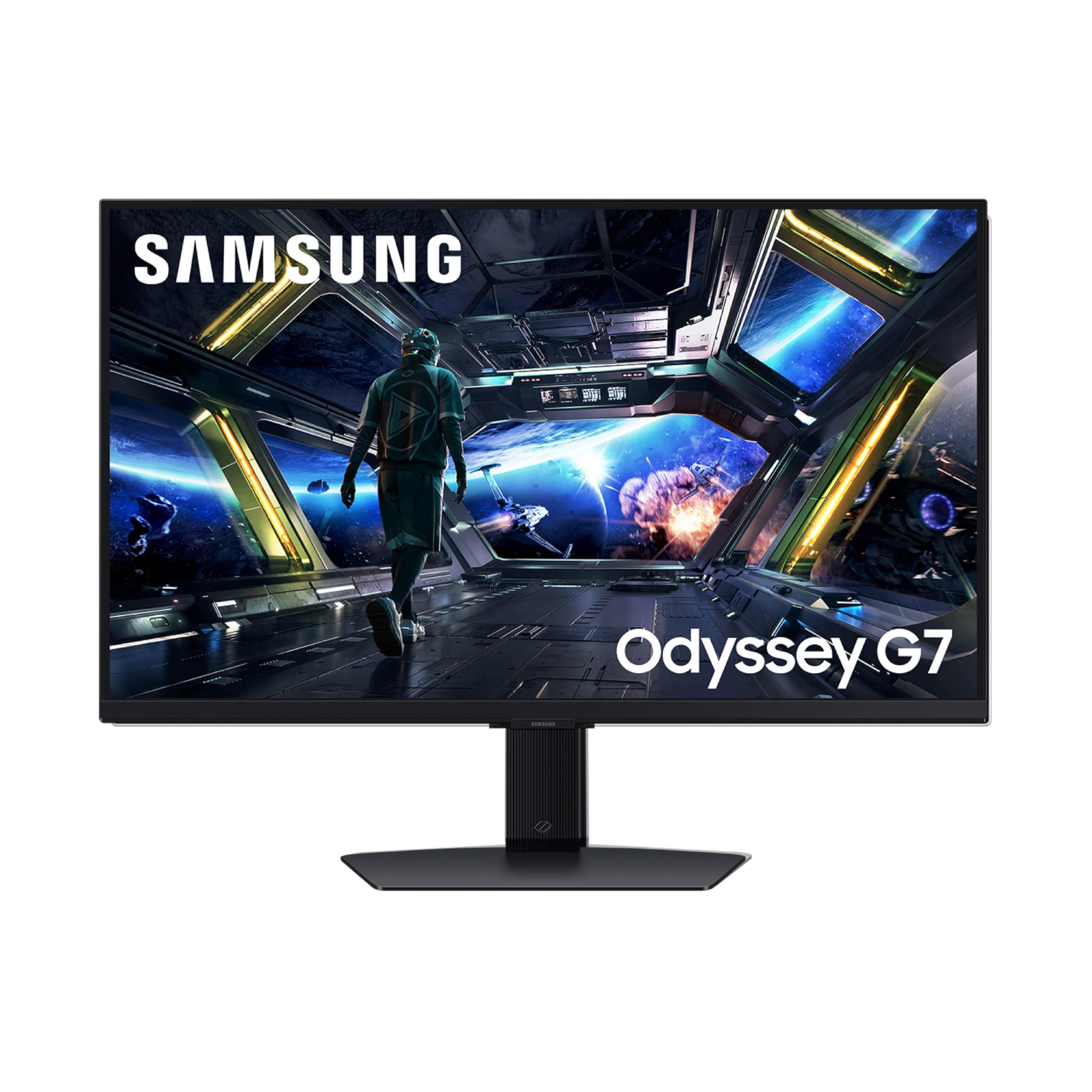
The Samsung Odyssey G7 G70D is a 4K 144Hz Fast IPS monitor that differentiates itself through the integrated Samsung Gaming Hub — a smart TV platform that provides instant access to Xbox Cloud Gaming, NVIDIA GeForce NOW, and streaming apps without needing a PC. The NQM AI Processor upscales lower-resolution content to near 4K for both gaming and streaming services.
The 144Hz refresh rate paired with FreeSync Premium Pro and G-Sync compatibility delivers smooth gameplay for most modern titles at 4K, though it lacks the dual-mode flexibility of the LG or ASUS options. The 99% DCI-P3 color gamut and DisplayHDR 400 ensure solid color performance and decent contrast for a Fast IPS panel. The built-in speakers and remote control add convenience, and the included stand offers full ergonomic adjustment with height, swivel, and tilt.
The smart platform is a double-edged sword. Some users report forced updates and persistent ads in the interface, and the monitor runs noticeably warm during extended use. There’s no USB-C port, and the single HDMI 2.1 input limits connectivity for multi-console setups. The 144Hz refresh rate is now entry-level for 4K gaming — adequate for most GPUs but missing the headroom that 160-240Hz monitors provide — and the 4K AI upscaling can introduce slight artifacting in fast motion.
Why it’s great
- Built-in Gaming Hub — no PC needed for streaming and cloud gaming
- AI upscaling improves lower-res content to near 4K
- FreeSync Premium Pro + G-Sync compatibility
Good to know
- Smart TV interface includes ads and forced updates
- No USB-C port — limits single-cable laptop setups
- 144Hz refresh rate is now entry-level for 4K gaming
8. Alienware AW2725QF

The Alienware AW2725QF delivers the same dual-mode IPS formula as the LG and ASUS: native 4K at 180Hz and native FHD at 360Hz, with a 0.5ms GtG response time in standard mode (0.5ms extreme). Where it differentiates itself is in color accuracy — Delta E < 2 calibration out of the box, combined with 95% DCI-P3 coverage and Dolby Vision support, making it the most color-reliable dual-mode monitor in its price bracket.
The build quality matches the premium Alienware aesthetic: a sturdy stand with full ergonomic adjustment, a clean dark chassis, and a rear ring LED that matches the brand’s design language. The OSD includes the fast switching between 4K and FHD modes, and the monitor integrates well with Xbox Series X in 4K mode. Connectivity covers HDMI 2.1 and DisplayPort, though there’s no USB-C.
The most serious concern reported by multiple buyers is a recurring black screen flickering issue — the monitor losing signal for several seconds at random intervals. Some units appear to require a manufacturer firmware update (A02) that isn’t available for user download. This appears to be a hardware defect rather than a universal flaw, but it’s a risk factor at this price point. For those who get a working unit, the color accuracy and dual-mode performance are excellent — but the gamble on signal stability is real.
Why it’s great
- Factory-calibrated Delta E <2 for color-critical work
- Dual-mode with native 4K 180Hz and FHD 360Hz
- Dolby Vision support and premium build aesthetics
Good to know
- Black screen flickering issue reported on some units — hardware defect risk
- No USB-C port for single-cable laptop setups
- Firmware updates not user-downloadable — requires RMA
FAQ
Is 27 inches too small for 4K gaming?
Can my GPU handle a 4K 240Hz monitor?
What is the dual-mode feature on gaming monitors?
What is the difference between G-Sync and FreeSync?
Is OLED worth the extra cost for gaming?
Final Thoughts: The Verdict
For most users, the best 27 inch 4k gaming monitor is the LG 27G810A-B Ultragear because it delivers a native dual-mode IPS panel — 4K at 180Hz and FHD at 360Hz — at a price that leaves room for a GPU upgrade. If you want true OLED contrast and 240Hz performance, the ASUS ROG Swift PG27UCDM offers the most complete package with DP 2.1a and Dolby Vision. And for a budget-friendly OLED entry, the INNOCN GA27W1Q delivers genuine QD-OLED quality at a price that redefines the value tier.