
A 27-inch curved gaming monitor is where immersive peripheral vision meets a practical desk footprint. The subtle wrap of a 1000R or 1500R panel pulls your eyes into the action without the neck strain of a massive flat screen, making it the sweet spot for competitive and story-driven titles alike. The challenge is balancing refresh rate, panel technology, and color accuracy against a budget that often demands compromise.
I’m Min — the co-founder and writer behind Gadgets Feed. I’ve spent countless hours parsing spec sheets, analyzing real-world response times, and comparing contrast ratios across OLED, IPS, and VA panels to separate genuine performance from marketing noise in this crowded category.
After dissecting dozens of models across multiple price tiers, I’ve built this guide to help you confidently pick the best 27 inch curved gaming monitor that matches your specific gaming priorities and hardware setup.
How To Choose The Best 27 Inch Curved Gaming Monitor
Selecting a curved gaming monitor requires understanding how the curve interacts with resolution, refresh rate, and panel technology. A 27-inch screen benefits most from a 1000R curvature because it matches the natural focal range of human eyesight, reducing side-to-side head movement during long sessions. The wrong combination of specs can leave you with blurry motion, washed-out blacks, or a screen that feels too small for the resolution.
Panel Technology: OLED vs IPS vs VA
OLED panels deliver infinite contrast and per-pixel lighting that makes dark scenes in games like *Elden Ring* or *Alan Wake 2* truly immersive, with response times as low as 0.03ms GtG. IPS panels offer higher peak brightness and wider viewing angles but suffer from IPS glow in dark rooms. VA panels provide the best native contrast ratio outside of OLED (typically 2500:1 to 3000:1) and are the most common panel type for curved monitors at budget and mid-range price points.
Refresh Rate and Adaptive Sync
A 240Hz refresh rate is the current practical ceiling for most GPUs at 1440p, offering a frame window of 4.16ms that eliminates motion blur in fast-paced shooters. Higher refresh rates (360Hz, 480Hz, 500Hz) only benefit players with hardware capable of sustaining those frame rates. AMD FreeSync Premium Pro and NVIDIA G-Sync Compatible reduce tearing without adding input lag — ensure your chosen monitor explicitly lists compatibility with your GPU brand.
Resolution and Pixel Density
1440p QHD at 27 inches yields roughly 109 PPI, which strikes the ideal balance between sharp text rendering and GPU load. 4K at the same size pushes 163 PPI but requires a significantly more powerful graphics card to maintain high frame rates. Full HD 1080p should be avoided at 27 inches because the low 81 PPI makes individual pixels visible and text appear fuzzy.
Quick Comparison
On smaller screens, swipe sideways to see the full table.
| Model | Category | Best For | Key Spec | Amazon |
|---|---|---|---|---|
| ASUS ROG Strix XG27AQDPG | Premium | Elite competitive FPS | 500Hz / 0.03ms QD-OLED | Amazon |
| Sony INZONE M10S | Premium | Pro-level 480Hz gaming | 480Hz / 0.03ms OLED | Amazon |
| MSI MPG 271QRX QD-OLED | Premium | High-refresh OLED with KVM | 360Hz / 0.03ms QD-OLED | Amazon |
| ASUS ROG Strix XG27AQDMG | Premium | Glossy WOLED for vibrant colors | 240Hz / 0.03ms WOLED | Amazon |
| AOC Agon PRO AG276QZD2 | Mid-Range | QD-OLED at a reasonable price | 240Hz / 0.03ms QD-OLED | Amazon |
| Samsung Odyssey G65B | Mid-Range | Immersive 1000R curve + HDR600 | 240Hz / 1ms VA / HDR600 | Amazon |
| Samsung Odyssey OLED G5 | Mid-Range | Entry-level QD-OLED experience | 180Hz / 0.03ms QD-OLED | Amazon |
| LG 27GR83Q-B Ultragear | Mid-Range | Fast IPS for competitive play | 240Hz / 1ms IPS / DP 1.4 | Amazon |
| Dell S2725QS 4K | Budget | Productivity + light gaming | 120Hz / 4K IPS | Amazon |
In‑Depth Reviews
1. ASUS ROG Strix XG27AQDPG QD-OLED

The ASUS ROG Strix XG27AQDPG sets a new ceiling for competitive gaming with its native 500Hz refresh rate on a QD-OLED panel. The 0.03ms GtG response time eliminates perceptible motion blur, making it ideal for esports titles where tracking targets during fast flicks matters. The OLED Care Pro system with a Neo proximity sensor automatically dims the screen when you step away, reducing burn-in risk during long sessions.
VESA DisplayHDR 500 True Black compliance and 99% DCI-P3 coverage produce rich contrast and accurate colors, though peak sustained brightness is lower than premium IPS panels. The anti-flicker OLED 2.0 algorithm cuts flicker by 20% compared to earlier gen panels, which reduces eye strain during extended play. The stand offers tilt adjustment but lacks height and swivel, so a monitor arm is a worthwhile addition.
At this performance level, you need a high-end GPU to push 500 frames per second at 1440p. The DP 1.4 and HDMI 2.1 inputs handle the bandwidth, but G-SYNC compatibility ensures smooth frame delivery even when your GPU fluctuates below the refresh ceiling.
Why it’s great
- 500Hz native refresh rate with 0.03ms response time
- QD-OLED panel delivers true blacks and vibrant HDR colors
- OLED Care Pro with proximity sensor for burn-in protection
Good to know
- Limited ergonomic adjustments on the stand
- Requires a top-tier GPU to fully utilize 500Hz
2. Sony INZONE M10S

Sony’s INZONE M10S is co-developed with the Fnatic esports team, and its tournament-ready features reflect that partnership. The 480Hz OLED panel delivers 0.03ms response times, and the included FPS Pro and FPS Pro+ modes boost contrast in dark corners to reveal hidden enemies. The low-profile 4mm-thin stand frees up desk space, and the 24.5-inch dual screen mode lets you switch to a smaller viewport for competitive play.
A custom passive heatsink handles cooling without a fan, which keeps the monitor silent during intense sessions. The OLED care suite includes pixel refresh, static image detection, and a screen saver to prevent burn-in. Connectivity includes DisplayPort 2.1 (UHBR10) and two HDMI 2.1 ports, giving you full bandwidth for 1440p at 480Hz without compression.
The contrast ratio of 1,500,000:1 produces stunning black levels, but the peak brightness of 275 nits is modest compared to premium IPS panels. The 3-year OLED limited warranty with burn-in coverage provides peace of mind for long-term ownership, though the price demands a serious commitment to competitive gaming.
Why it’s great
- 480Hz refresh rate with dedicated FPS Pro modes
- Ultra-thin base maximizes desk space
- Fan-less passive cooling with custom heatsink
Good to know
- Peak brightness is lower than premium IPS alternatives
- Price is high for all but the most dedicated players
3. MSI MPG 271QRX QD-OLED

The MSI MPG 271QRX delivers a 360Hz refresh rate on a next-gen QD-OLED panel with a 0.03ms response time, placing it squarely in the high-performance tier for competitive and immersive gaming. The QD Premium Color calibration ensures Delta E ≤ 2 out of the box, so you get accurate colors without manual tweaking. VESA DisplayHDR True Black 400 certification provides excellent contrast in HDR content, with deep blacks and bright highlights.
A built-in KVM switch lets you control two devices — such as a desktop PC and a work laptop — using a single set of keyboard and mouse, a rare and useful feature for multi-device setups. The console mode with HDMI 2.1 at full 48 Gbps bandwidth supports 4K at 120Hz for PS5 and Xbox Series X. MSI OLED Care 2.0 uses pixel shift and panel refresh to reduce burn-in risk.
The stand offers height, tilt, and swivel adjustments, giving you flexibility in desk placement. The Gaming Intelligence App allows per-game profile customization through software. The 360Hz refresh rate is a step above 240Hz and noticeable in fast-paced titles, though the difference diminishes in slower games.
Why it’s great
- 360Hz QD-OLED with factory delta E ≤ 2 accuracy
- Integrated KVM switch for multi-device workflows
- HDMI 2.1 at full 48 Gbps for console gaming
Good to know
- Brightness limited to 250 nits sustained
- High price point targets enthusiasts only
4. ASUS ROG Strix XG27AQDMG

The ASUS ROG Strix XG27AQDMG stands out with its third-generation glossy WOLED panel, which enhances perceived contrast and color saturation compared to matte OLEDs. The 240Hz refresh rate and 0.03ms response time deliver smooth motion, while the custom heatsink and advanced airflow design reduce burn-in risk without a fan. ROG-exclusive anti-flicker technology minimizes flicker during refresh rate fluctuations, a common issue with VRR.
The uniform brightness setting keeps luminance consistent across the screen, which is helpful for productivity work. 99% DCI-P3 coverage provides vibrant, accurate colors for both gaming and content creation. The stand offers height, tilt, and swivel adjustments, and the monitor includes two USB 3.2 Gen 1 Type-A ports for peripheral connectivity.
The glossy finish reflects ambient light more than matte alternatives, so consider your room’s lighting before purchasing. The 3-year warranty with burn-in coverage makes this a safer OLED investment. The lack of built-in speakers means you’ll need external audio.
Why it’s great
- Glossy WOLED panel for superior color pop and contrast
- Custom heatsink for passive cooling and burn-in protection
- Anti-flicker technology reduces VRR flicker
Good to know
- Glossy finish reflects overhead lighting
- No built-in speakers included
5. AOC Agon PRO AG276QZD2

The AOC Agon PRO AG276QZD2 delivers QD-OLED performance at a price that undercuts most premium competitors. The 240Hz refresh rate and 0.03ms GtG response time provide motion clarity that rivals monitors costing significantly more. The 1.5 million-to-1 contrast ratio ensures deep blacks and vibrant colors, and the 136.7% sRGB coverage makes it suitable for HDR gaming and creative work.
Built-in speakers, while mediocre in quality, eliminate the need for external audio in a pinch, which is a rare addition on an OLED monitor. The included calibration report confirms factory color accuracy, and the AOC G Menu software allows per-game profile adjustments. The stand is height-adjustable and provides tilt and swivel, though the base feels slightly wobbly when the desk is bumped.
The default color saturation can seem oversaturated out of the box, requiring a few minutes of OSD adjustment to tone it down for accurate sRGB work. Text fringing on QD-OLED panels is slightly noticeable, so this monitor is best as a primary gaming display rather than a primary productivity monitor.
Why it’s great
- QD-OLED at a mid-range price point
- Built-in speakers for convenience
- Factory calibration report included
Good to know
- Stand feels slightly wobbly
- QD-OLED text fringing may bother productivity users
6. Samsung Odyssey G65B

The Samsung Odyssey G65B combines a 1000R curve with a VA panel to deliver the most physically immersive experience on this list. The aggressive curve matches the human eye’s natural field of view, pulling you into the game without distortion. The 240Hz refresh rate and 1ms GtG response time keep motion smooth, while DisplayHDR 600 certification provides brighter highlights and deeper blacks than standard HDR400 monitors.
AMD FreeSync Premium Pro ensures tear-free gameplay with low frame rate compensation for dips below the refresh rate. The Samsung Gaming Hub is built-in, letting you stream games from Xbox Game Pass and other services without a PC — useful for casual gaming or watching content. The VA panel’s 2500:1 native contrast ratio produces deeper blacks than IPS, though it still can’t match OLED in dark room performance.
The smart features can be intrusive: undismissable pop-ups and countdown screens interrupt gameplay, and the interface has a frustrating auto-input switching system. The stand offers height, tilt, and swivel adjustments, and the remote control makes navigation easier once you disable the unwanted notifications.
Why it’s great
- Aggressive 1000R curve for maximum immersion
- DisplayHDR 600 with 2500:1 contrast ratio
- Built-in Gaming Hub streams without a PC
Good to know
- Smart features interfere with the gaming experience
- VA panel has narrower viewing angles than IPS or OLED
7. Samsung Odyssey OLED G5

The Samsung Odyssey OLED G5 is the most affordable entry point into true QD-OLED gaming. The 180Hz refresh rate and 0.03ms GtG response time deliver the core benefits of OLED — instant pixel response and infinite contrast — at a price that undercuts higher-tier OLEDs. The Glare Free matte coating keeps reflections manageable in bright rooms, though it slightly diffuses the punchy blacks that glossy OLEDs show.
The Pantone-validated screen reproduces over 2100 colors accurately, and HDR10 support provides brighter highlights and nuanced shadows. OLED Safeguard uses a thermal modulation system to keep the panel cool and prevent burn-in. Auto Source Switch+ automatically detects active devices and switches inputs, which is handy for multi-device setups.
Input connectivity is limited to one HDMI and one DisplayPort, so you can’t connect multiple gaming consoles simultaneously. The stand offers only tilt adjustment, so you’ll likely want a VESA arm for ergonomic positioning. The peak brightness of roughly 280 nits is modest, and HDR impact is noticeably lower than premium OLEDs.
Why it’s great
- Entry-level QD-OLED with true blacks and fast response
- Pantone-validated color accuracy
- OLED Safeguard thermal system reduces burn-in risk
Good to know
- Only one HDMI and one DisplayPort input
- Stand is tilt-only with no height adjustment
8. LG 27GR83Q-B Ultragear
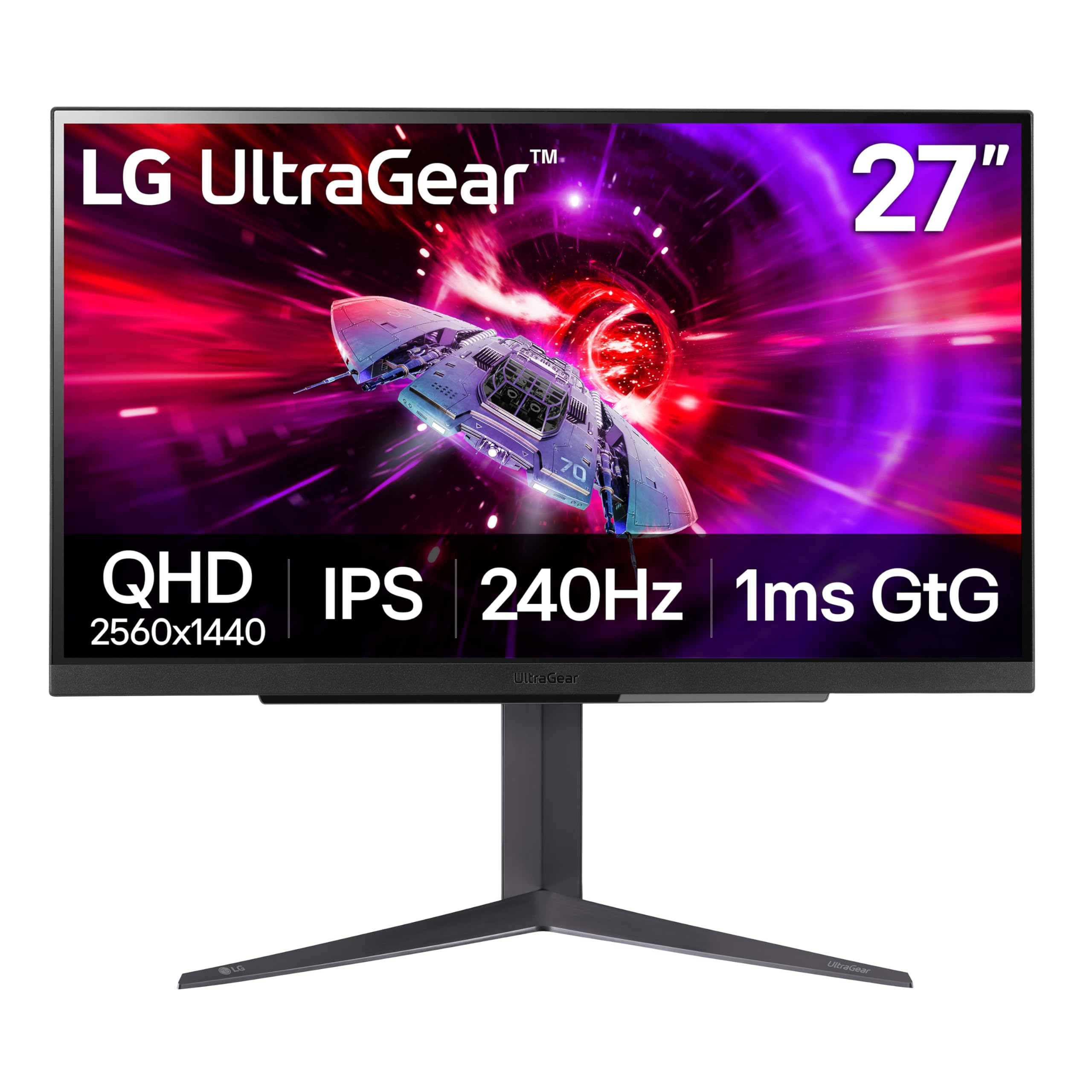
The LG 27GR83Q-B Ultragear is a high-performance IPS monitor that doesn’t need OLED level investment. The 240Hz refresh rate and 1ms GtG response time at 1440p make it a strong contender for competitive gaming, and the HDMI 2.1 port supports full bandwidth 4K 120Hz from consoles. Both DisplayPort and HDMI 2.1 can drive the full 240Hz refresh rate, which is not always the case in this price tier.
NVIDIA G-Sync Compatible certification ensures tear-free gameplay with GeForce GPUs, and AMD FreeSync Premium provides a similar experience for Radeon users. The DCI-P3 95% coverage produces vibrant colors, though the 1000:1 contrast ratio is typical for IPS and shows grayish blacks in dark rooms. The 4-pole headphone jack with DTS Headphone:X provides spatial audio over a single cable.
The stand is fully adjustable with height, tilt, swivel, and pivot, making it easy to find the perfect viewing angle. Some users report inconsistent quality control with stuck or dead pixels, so inspect the panel closely after arrival. The 400-nit peak brightness is enough for most rooms but won’t deliver the same HDR punch as OLED or high-end VA panels.
Why it’s great
- Full 240Hz over HDMI 2.1 and DisplayPort
- G-Sync Compatible and FreeSync Premium support
- Fully adjustable stand with height, tilt, swivel, pivot
Good to know
- IPS contrast ratio shows grayish blacks in dark scenes
- Quality control issues with dead pixels reported
9. Dell S2725QS 4K

The Dell S2725QS 4K is not a curved monitor, but it offers a 4K resolution at 120Hz with an IPS panel, making it a budget-friendly option for gamers who prioritize pixel density over curvature. The 3840 x 2160 resolution at 27 inches provides 163 PPI, delivering exceptionally sharp text and detailed visuals for productivity and slower-paced games. The 120Hz refresh rate and 0.03ms response time are sufficient for casual gaming, though competitive players will want higher refresh rates.
AMD FreeSync Premium ensures smooth, tear-free motion, and the 99% sRGB coverage delivers accurate colors for photo editing and design work. The improved ComfortView Plus reduces blue light emissions to ≤35%, making extended work sessions more comfortable. The integrated speakers produce better audio than typical monitor speakers, with deeper frequency response and more decibel range than previous Dell monitors.
The 1500:1 contrast ratio is slightly above average for IPS, helping with dark scene visibility. The stand offers full ergonomic adjustments including height, pivot, swivel, and tilt. Ghosting is noticeable in fast-paced games, and the matte coating creates a slight graininess on light backgrounds, which may bother some users.
Why it’s great
- 4K resolution with 163 PPI for sharp visuals
- 120Hz refresh rate with FreeSync Premium
- Integrated speakers with improved audio quality
Good to know
- 120Hz is not enough for competitive gaming
- Not a curved panel — flat IPS design
FAQ
Is a 27-inch screen too small for a 1000R curvature?
Can I use a 1440p gaming monitor for 4K console gaming?
Will a curved monitor cause distortion in productivity work?
Final Thoughts: The Verdict
For most users, the best 27 inch curved gaming monitor winner is the ASUS ROG Strix XG27AQDPG because its 500Hz QD-OLED panel delivers unmatched motion clarity and vibrant HDR for both competitive and story-driven gaming. If you want a true 1000R immersive curve with HDR600, grab the Samsung Odyssey G65B. And for the best value in OLED gaming, nothing beats the AOC Agon PRO AG276QZD2.