
If you are looking for a 2835 LED strip, you already know the standard 30 LEDs-per-meter strips leave dark gaps that ruin a clean look. The SMD 2835 chip (a surface-mounted diode that measures 2.8mm by 3.5mm) is smaller and more efficient than older chips, which means manufacturers can pack them tighter — creating a continuous wall of light instead of a spotty dotted line. The question is which density, voltage, and waterproof rating actually fit your project without wasting money.
I’m Min — the co-founder and writer behind Gadgets Feed. This guide is built by comparing the manufacturers’ published specifications and the patterns across verified customer reviews, so you get each pick’s real strengths and trade-offs instead of marketing spin.
The six options below span 16.4-foot to 82-foot lengths, 12V and 24V systems, and everything from basic indoor tape to fully outdoor-rated silicone tubes. Here is the honest breakdown of what matters when choosing the 2835 led strip that actually fits your room or project.
How To Choose The Best 2835 LED Strip
The SMD 2835 chip is a workhorse: it produces high brightness (up to 18 lumens per LED, in some models) while running cooler than older 5050 chips (which measure 5.0mm by 5.0mm). But a 2835 strip is only as good as how it is packaged — the strip’s density, voltage, waterproofing, and included accessories decide whether it solves your lighting problem or becomes a frustration. Here is what to check.
LED Density Per Meter (The “Dotless” Factor)
The single biggest visual difference between a cheap LED strip and a good one is whether you see individual dots of light on your wall or a continuous smooth beam. At 120 LEDs per meter, the light is already much more even than the old 30- or 60-LED strips. At 240 LEDs per meter, the light appears nearly seamless, especially if you place the strip inside an aluminum channel with a frosted cover. At 480 LEDs per meter (the double-row design), you get a solid bar of light that looks like a neon tube — no dots at all, even when viewed from inches away.
Voltage Choice: 12V vs 24V
12V strips are everywhere and easy to work with — you can power them from a common 12V power supply and cut them between every 3 LEDs in some models. The catch is voltage drop (the gradual loss of power over distance): over a 16-foot run, the far end can be noticeably dimmer than the start. 24V strips handle longer runs much better because the higher voltage pushes current farther with less loss. For runs over 10 feet, 24V is almost always the smarter choice. For short under-cabinet sections under 5 feet, 12V is simpler and cheaper.
Waterproof Rating: IP20 vs IP67
IP20 means no waterproofing — the strip has a thin layer of conformal coating (a protective resin) but is fully exposed. It is fine inside a dry kitchen cabinet or behind a TV. IP67 means the strip is sealed inside a clear silicone tube, making it safe for rain, splashes, and outdoor patios. The downside of IP67 is that the silicone jacket traps heat, so the strip runs warmer and may have slightly lower brightness at the far end of long runs. If your project is indoors, IP20 is cleaner and runs cooler. If it touches rain or a wet counter, go IP67.
Color Temperature and Dimmability
Color temperature (measured in Kelvin, or K) sets the mood. 2700K-3000K is warm yellow like an old incandescent bulb — good for bedrooms and cozy corners. 4000K is neutral white — good for kitchens and workspaces. 6000K-6500K is daylight white — crisp, slightly bluish, and best for task lighting. Some strips are tunable (3000K to 6500K) so you can change the mood with a remote. Dimmability is often built into the controller; but if a strip says “dimmable” in the specs, make sure you are buying a compatible dimmer, not assuming the strip itself handles dimming by default.
Quick Comparison
On smaller screens, swipe sideways to see the full table.
| Model | Category | Best For | Key Spec | Amazon |
|---|---|---|---|---|
| Ustarus 82ft | Tunable / Indoor | Large rooms needing adjustable warmth | 82ft, 24V, 3000K-6500K, 3000 LEDs, remote | Amazon |
| ALITOVE 32.8ft | Outdoor / IP67 | Rain-exposed decks and patios | 32.8ft, 24V, 6200K, IP67, 1200 LEDs | Amazon |
| 12V Tesfish 16.4ft | High Density / Indoor | Dotless under-cabinet or cove lighting | 16.4ft, 12V, 6000K, IP20, 240 LEDs/M | Amazon |
| 24V Tesfish 16.4ft | Long-Run / Indoor | Aluminum channel installations needing voltage stability | 16.4ft, 24V, 6000K, IP20, 240 LEDs/M | Amazon |
| LEDENET 16.4ft | Double Row / Outdoor | Maximum brightness in trailers or toolboxes | 16.4ft, 12V, 6500K, IP67, 2400 LEDs | Amazon |
| Lepro 16.4ft | Budget / Indoor | First-time under-cabinet or vanity installs | 16.4ft, 12V, 6000K, 300 LEDs, dimmer included | Amazon |
In‑Depth Reviews
1. Ustarus 82ft 24V Dimmable 3000K-6000K
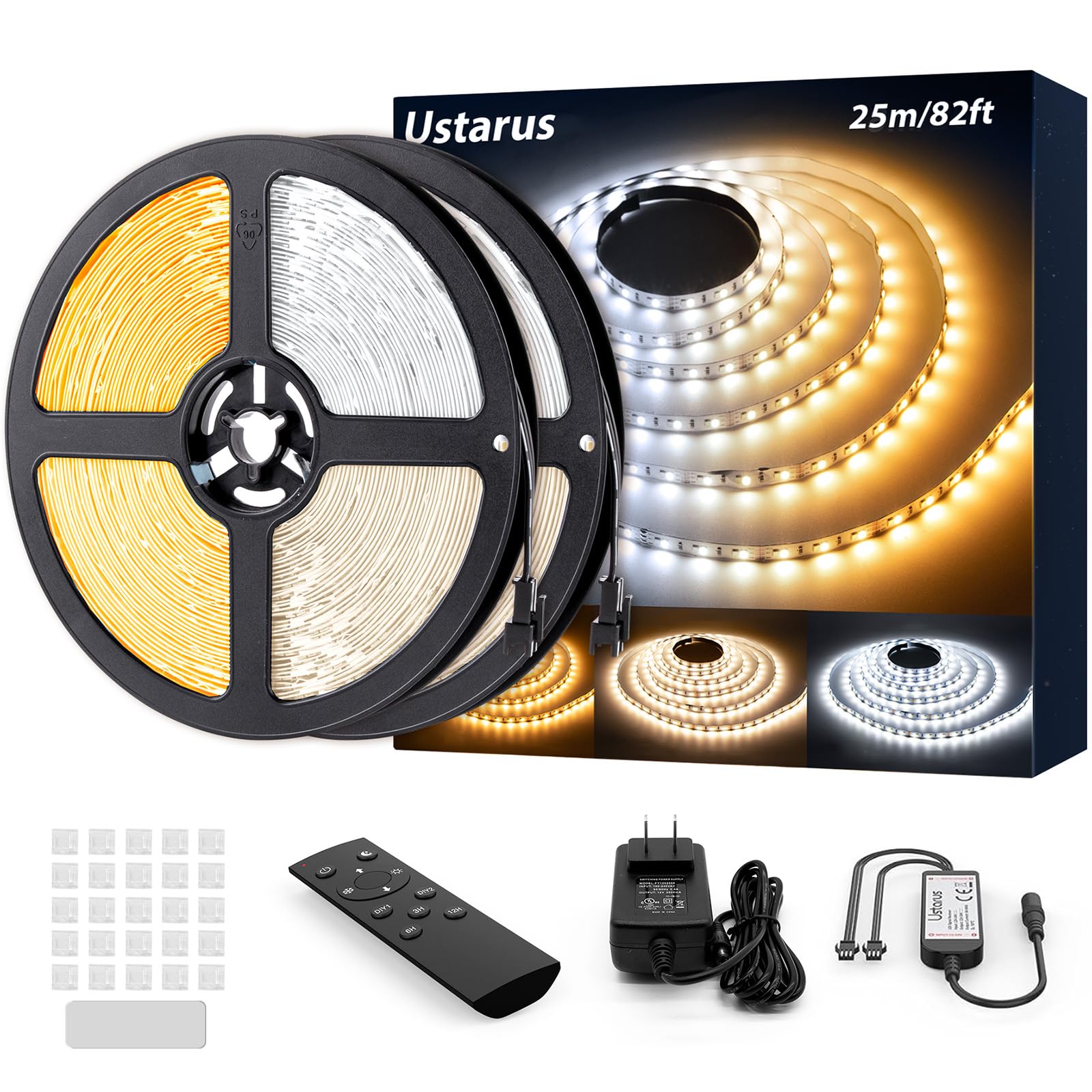
The 82-foot continuous run on 24V without voltage drop makes this the top pick for anyone lighting a large indoor perimeter or long counter in one go. The 3000 LEDs split across two 41-foot reels, and the RF remote works up to 50 feet through walls, offering 10 color temperature levels from 3000K to 6500K plus 8 brightness levels. Buyers report the LEDs lasted 4 years with daily use, and one reviewer noted it “remembers its previous setting” when toggled on a switched outlet.
The honest limit is that the included remote is reported by reviewers to intermittently lose connection with the receiver, even with fresh batteries and close range. The Ustarus is ETL and FCC certified for safety, and the 24V system stays cool to the touch. If you need a single strip to cover a large area with adjustable white light, this is the one.
skip it if your project is outdoors — it is IP20 indoor only. For a long, dimmable white strip that holds up over years, this is the clear top pick.
Why it’s great
- 82ft continuous length with 24V power — no voltage drop over the full run
- Tunable white from 3000K (warm) to 6500K (daylight) with 10 levels
- RF remote works up to 15 meters through walls
Good to know
- Remote is reported to intermittently lose connection
- Indoor use only (not waterproof)
- Two 41ft reels need to be linked; connectors are not included
2. ALITOVE 32.8ft 24V Waterproof IP67 1200 LEDs

The ALITOVE beats the Ustarus on sheer weather toughness — it is rated IP67, meaning the LEDs are sealed inside a clear PVC tube that survives rainstorms without a problem. But it gives up the Ustarus’s tunable white feature (this strip is fixed at 6200K daylight white) and its 32.8-foot length is less than half of the Ustarus’s 82 feet. Where the Ustarus shines for whole-room perimeter lighting, the ALITOVE is built for outdoor decks, patios, and areas exposed to weather.
At 120 LEDs per meter (1200 total on the 32.8ft strip), the light from the ALITOVE is bright enough that owners mention dimming it to 30% with a PWM power supply (pulse-width modulation, which rapidly cycles power on and off to reduce brightness) for most uses. One buyer mentioned these strips are “still working after 2 years in Texas weather,” proving the IP67 silicone tube holds up against heat, rain, and humidity. The 24V input helps the strip maintain stable brightness across its full length better than 12V alternatives.
A real-world catch is that the PVC jacket traps heat, and one reviewer measured a voltage drop from 19.3V at the input to 16.5V at the far end — about 50% brightness loss — especially if you power from one end only. The adhesive tape is sold separately, so you need mounting clips (included) or your own tape. If your project is outdoors or in a wet environment and you need bright, cool light, choose the ALITOVE over the Ustarus. pass on it if you want a warm, cozy glow instead of daylight white.
Where it shines
- IP67 waterproof rating — survives rain, dust, and hose-down cleaning
- 24V system handles long runs with less voltage drop than 12V
- 120 LEDs per meter produces even, dotless light
Worth noting
- PVC jacket traps heat; power from both ends for long runs
- Adhesive tape not included — use mounting clips
- Fixed 6200K daylight white — cannot be warmed up
3. 12V Tesfish 16.4ft 240 LEDs/M 1200 LEDs

Imagine you are installing LED strips under kitchen cabinets and you want a clean, continuous glow with zero visible dots — not a string of bright spots. This 12V Tesfish strip at 240 LEDs per meter (1200 total on the 16.4ft length) delivers exactly that dotless look. One buyer confirmed they achieved “excellent dotless light via diffuser tube, true neon replacement,” and another reviewer who installed it inside a white opal aluminum profile said “no se aprecia distancia entre leds” (you cannot see gaps between LEDs).
The density is what sets this apart from the Lepro’s 300-LED strip below: at 240 LEDs per meter versus the Lepro’s roughly 60 LEDs per meter, the Tesfish produces over 4 times more LEDs in the same space — which translates to a wall of continuous light rather than a dotted line. The strip runs on 12V (so you can use common power supplies) and draws 72 watts total at full brightness. It cuts between every 3 LEDs, giving you fine control over length adjustments.
The trade-off is that this strip does not include a power adapter or dimmer — you must buy those separately. And because it is 12V, runs longer than about 5 feet may show some brightness drop at the far end (much less of an issue with the 24V Tesfish version below). For short under-cabinet or cove lighting where dotless appearance is your top priority, this is the best value. it’s not for you if your run exceeds 6 feet — the 24V Tesfish handles voltage drop better.
What stands out
- 240 LEDs per meter — virtually seamless, dotless light
- Cuttable every 3 LEDs for precise length adjustment
- 12000 lumens total output — genuinely bright for task lighting
The trade-offs
- Power supply and dimmer not included
- 12V voltage drop may dim the far end on longer runs
- Runs hot at full brightness; must be unrolled for heat dissipation
4. 24V Tesfish 16.4ft 240 LEDs/M 1200 LEDs

The single number that matters most in this category is the voltage: at 24V, this Tesfish strip maintains consistent brightness along the full 16.4 feet far better than the 12V Tesfish version. The same 240 LEDs per meter and 12000 lumen output, but with the voltage stability that matters if you are installing it in an aluminum channel with a frosted cover (a common setup for professional-looking under-cabinet lighting).
One limitation is that you must supply your own 24V power adapter and dimmer — neither is included. But it also means you can choose a higher-quality dimmer or smart controller (customers note using this strip with Alexa and percentage-based controls successfully). One reviewer who installed it in aluminum recessed strips noted “no visible light points” and said it is “still working perfectly after months; repurchased for another location.”
At the same 16.4-foot length and 240 LEDs per meter density as the 12V version, the 24V system is the smarter choice if your run is longer than 6-8 feet, because you will not see the dim tail-end that 12V strips often suffer. It costs slightly more, but the voltage stability is worth it for projects where brightness uniformity across the full strip matters. For buyers who need a reliable, uniform glow in an aluminum channel, this beats the 12V Tesfish.
The upsides
- 24V power maintains consistent brightness across the full 16.4ft
- 240 LEDs per meter produces smooth, dotless light in channels
- Well-reviewed for compatibility with smart dimmers and Alexa
Keep in mind
- Power adapter and dimmer not included
- IP20 indoor only — not for wet locations
- Cut marks every 6 LEDs (less precise than the 12V version’s 3-LED cuts)
5. LEDENET 16.4ft Double Row 2835 2400 LEDs IP67

What you actually get at this lower price is a 16.4ft reel of double-row 2835 LEDs (2400 total) that packs 480 LEDs per meter — double the density of standard 240-LED-per-meter strips — producing roughly 144 watts of raw light output. The IP67 silicone sleeve protects against dust and splashes, but because the double-row design is heavy, there is no adhesive on the back; you install it with the included fixing clips.
For comparison, this strip puts out over twice the wattage of the ALITOVE IP67 strip (144W vs 70W) in half the length. Buyers confirm it is “blown away” bright for a 20-foot enclosed trailer, and one reviewer used it on an ICON toolbox hutch and said it is “much brighter than Lowe’s motion-sensor strip costing twice as much.” The obvious drawback is that this strip runs very hot (144W of power generates significant heat), and the 12V system means you need a beefy power supply rated for at least 150W; no power supply or dimmer is included.
If you are building a storage area, a workshop, or a vehicle interior where maximum light output is the goal, the LEDENET is the most cost-effective way to get it. Skip it for general room lighting — the brightness is overwhelming in a living space. This is the exact budget buyer it is perfect for: someone who wants the most raw lumens per dollar for a utility space, not a living room.
Why we’d pick it
- Double-row 480 LEDs per meter — the most dense and brightest option here
- IP67 waterproof for outdoor, trailer, and workshop use
- Reviewers point out it outperforms premium-brand strips at a lower cost
A few caveats
- No adhesive tape provided — requires clips or custom mounting
- Runs hot; needs adequate ventilation and a 150W+ power supply
- No power supply or dimmer included
6. Lepro 16.4ft Dimmable 300 LEDs 2835

This Lepro is perfect for the first-time buyer who just wants bright under-cabinet lighting in a kitchen or mirror vanity without spending extra on accessories. At this entry-level price, what you actually get is a complete ready-to-install kit: a 16.4-foot strip of 300 LEDs, a 12V power adapter, and a dimmer — everything in the box. No hunting for a separate power supply. The strip uses strong 3M VHB adhesive (Very High Bond, an industrial-strength tape) that buyers confirm is “very sticky” and holds well on smooth, clean surfaces. One buyer described it as “very bright under-counter light” that connects easily to a Sonoff smart switch for voice control.
What you give up is density. At roughly 60 LEDs per meter, the Lepro produces about a quarter of the LEDs per meter compared to the Tesfish 240-LED strips. On a bare wall, you will see the individual dots of light — it will not look like the seamless neon-tube effect the high-density strips achieve. This matters most if you are installing it in an open visible location without a diffuser channel. The strip is also 12V, so voltage drop will be noticeable if you run it at full length.
If you need the dotless look or are installing in a visible spot like a cove ceiling, skip this and go for one of the 240-LEDs-per-meter options above. But for a simple, budget-friendly task light that works out of the box, the Lepro delivers.
Strong points
- Complete kit with power adapter and dimmer included — no extras to buy
- Strong 3M VHB adhesive holds firmly on clean surfaces
- Very bright for its class; works with smart switches
Before you buy
- Only 60 LEDs per meter — visible dots on bare surfaces
- 12V voltage drop dims the far end on full-length runs
- Indoor use only; not waterproof
Understanding the Specs
LED Chip Type: 2835 SMD
The “2835” number refers to the physical size of the LED chip: 2.8mm by 3.5mm. It is smaller and flatter than the older 5050 chip, which means manufacturers can pack more LEDs per meter without the strip getting bulky. A 2835 chip delivers about 18 lumens per LED at a cooler operating temperature than 3528 chips (3.5mm by 2.8mm), which gives you higher brightness for the same power draw. If you see a strip labeled only as “LED strip” without specifying the chip size, you cannot assume the brightness or density — the 2835 designation is what guarantees the efficiency and compact size that make 240-LED-per-meter strips possible.
Voltage Drop and Power Injection
When you run electricity through a thin copper trace on a flexible strip, the voltage drops as it travels further from the power source. On a 12V strip, that drop is noticeable after about 5 meters — the far end can be 30-50% dimmer than the start. A 24V strip cuts that drop by half because the higher starting voltage gives more headroom. The practical fix for long runs is “power injection” — feeding power to both ends of the strip (or at the middle) so the full length stays evenly bright. Most 24V strips also use thicker copper traces, which further reduces the voltage sag. If your project exceeds 10 feet, prioritize 24V or plan to inject power at multiple points.
FAQ
Can I use a 2835 LED strip outdoors?
What power supply do I need for a 2835 strip?
How do I cut and reconnect a 2835 LED strip?
What color temperature should I pick for a kitchen versus a bedroom?
Final Thoughts: The Verdict
For the majority of shoppers, the 2835 led strip winner is the Ustarus 82ft because it combines a very long 82-foot run, 24V power for stable brightness, and tunable white from warm 3000K to daylight 6500K — all in one box with a remote. If you need weatherproof outdoor lighting, grab the ALITOVE 32.8ft IP67. And for the most seamless dotless under-cabinet light at a lower cost, the 12V Tesfish 16.4ft with 240 LEDs per meter gives you the density you need.