
Our readers keep the lights on and my morning glass full of iced black tea. As an Amazon Associate, I earn from qualifying purchases.
Specs are compiled from manufacturer listings and verified buyer reviews and can change over time — please confirm the key details on the product page before buying.
Finding a true 2HP electric motor for your air compressor or table saw can feel like walking through a spec-sheet minefield. The good news is that for most home shops, a replacement motor is a straightforward swap—if you know the three numbers that matter: the frame size, the RPM, and the shaft diameter. This guide cuts through the jargon to show you which picks actually bolt up and run, and which ones need a bit of extra work.
I’m Min — the founder and writer behind Gadgets Feed. This guide is built by comparing the manufacturers’ published specifications and the patterns across verified customer reviews, so you get each pick’s real strengths and trade-offs instead of marketing spin.
Read on for the straight story on frame sizes, RPM ratings, and wiring gotchas that make or break a successful motor swap. This is your shortcut to picking the right 2hp electric motor for the job.
Our Picks at a Glance


How To Choose The Best 2HP Electric Motor
Buying a replacement motor is a matching game, not a horsepower arms race. Before you look at torque curves, you need to confirm the physical dimensions of the motor you’re replacing. A motor that’s too powerful for your pump but has the wrong frame won’t fit at all.
Frame Size and Mounting
The frame size, like 56 or 56C, is the standardized measurement of the motor’s mounting holes and shaft height. If your equipment uses a NEMA 56 frame, a 56C frame motor has the same bolt pattern but adds a C-face flange for direct coupling, which can be crucial for pumps. Always match the frame exactly, or you’ll be drilling new holes and fabricating adapter plates.
RPM and Duty Cycle
Speed is critical because your equipment is designed to run at a specific speed. Compressors and pumps often use 3450 RPM motors, while some larger machines, like certain grinders, need a slower 1725 RPM. Running a 3450 RPM motor where a 1725 RPM belongs will ruin your tool’s performance. Also check for “continuous duty” (S1) rating—this means the motor can run indefinitely without overheating, which is the standard you want for shop tools.
Shaft, Voltage, and Phase
Before ordering, measure the old shaft’s diameter (often 5/8″ or 7/8″) and length to ensure your existing pulley or coupling slides on. Next, confirm your power supply: most home shops run 120V or 240V single-phase, while factories use 230V/460V three-phase. A motor is only useful if its voltage matches your wall outlet. Finally, check the rotation direction (CW or CCW) to ensure the motor spins your machine the right way.
Quick Comparison
| Model | Best For | RPM | Frame Size | Shaft Diameter | Amazon |
|---|---|---|---|---|---|
| EDGE INDUSTRIAL EMZ 56S34D2M★ Best Overall | Direct compressor swap | 3450 | 56 | 5/8″ | Amazon |
| VEVOR 1HP SY-1HP-2PBudget Champion | Budget table saws | 3450 | 56C | 5/8″ | Amazon |
| EMZ EM-02Versatile Performer | Versatile replacements | 3450 | 56 | 5/8″ | Amazon |
| Cuilvu Farm Duty 1/2HP | Compact farm equipment | 1750 | 56 | 5/8″ | Amazon |
| VEVOR 2HP SY-2HP-4P | Woodworking tools | 1725 | 143/5T | 7/8″ | Amazon |
| Cuilvu 2HP Three Phase | Industrial & VFD setups | 3450 | 56C | 5/8″ | Amazon |
| Cuilvu 2HP Single Phase | High-torque shop tools | 3450 | 56C | 5/8″ | Amazon |
| Century USQ1202 | Pool pump replacement | 3450 | 48Y | — | Amazon |
| Century UST1202 | Hayward pump swaps | 3450 | Round Flange | — | Amazon |
| Century B381 | Legacy compressor rebuilds | 3450 | M56 | 5/8″ | Amazon |
In‑Depth Reviews
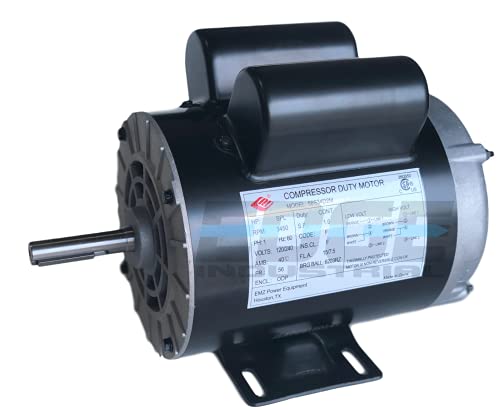
1. EDGE INDUSTRIAL EMZ Compressor Duty Motor
Our pick — over 4★ from 300+ verified ratings; the strongest balance of quality and price.
The drop-in champion for air compressors, matching the original’s specs bolt-for-bolt.
If your compressor motor gave up, this EDGE INDUSTRIAL motor is the pragmatic fix. It is a 3450 RPM, 56 frame motor with a 5/8″ shaft that you can wire for 120V or 240V operation (drawing 15 FLA at 120V and 7.5 FLA at 240V). Buyers report “All specs on this motor were the same as the original motor,” which is the highest praise a replacement part can earn because it means reusing the old pulley and mounting holes.
The “SPL” in the name means it’s designed for compressor duty—it has capacitor start and capacitor run for continuous operation, so it won’t bog down when the tank fills against pressure. The open drip-proof (ODP) housing means it’s built for dry indoor spaces, so keep it out of the rain. Installation is the headline here; the wiring is straightforward, and the bolt pattern lines up with standard craftsman-style horizontal compressor tanks.
At 29 pounds, it’s a solid hunk of alloy steel that doesn’t feel flimsy. There are some mixed notes on long-term durability, with a few owners reporting failures, but the overwhelming consensus is that it’s a powerful, easy DIY repair at a fraction of the cost of a new compressor unit.
What Wins Owners Over
- Build quality is the top praise, with 37 buyers highlighting it as a solid, well-made unit.
- Installation is a breeze for DIYers, earning 20 mentions for its easy, direct-fit nature.
- Handles the load, with buyers noting it copes with 20amp, 120V circuits under load without tripping.
Reality Check
- Some owners question whether it’s truly 2HP, as A few owners measured real-world output slightly below the rated 2HP..
- A handful of units have failed prematurely, so there’s a slight lottery element on durability.
- It’s not suited for 208V incoming power, so check your shop’s voltage tap.
Best for: Anyone replacing a dead motor on a standard home air compressor who wants a verified, same-spec bolt-in swap.
Think twice if: You need a motor for a wet or outdoor location—this needs a dry indoor environment to live a long life.
2. VEVOR 1HP Electric Motor
A bargain 1HP that often feels as strong as a 2HP in real-world shop use.
Here’s the honest caveat: this VEVOR is rated at 1HP, not 2HP, but it earns a spot on your shortlist for the incredible value it delivers. Owners mention it “runs great on my 10″ table saw,” and One owner even called it a beast at 1.5HP..
The standout feature is the dual rotation direction (CW/CCW). You can switch the spin direction to match your machinery, which simplifies wiring and makes it more versatile than a fixed-rotation motor. It’s tested to CSA standards and has a heavy-duty rolled steel shell, plus overload protection with manual reset for safety. Performance is the most-cited positive attribute, with 19 buyers praising how it powers everything from table saws to boat lifts.
The main physical drawback is the electrical box knockouts—several owners found them not factory-punched and had to drill them out with a hole saw. For a budget-friendly motor that breathes new life into an old saw, that’s a minor annoyance.
Smart money: If your tool only needs 1HP, this 3450 RPM motor delivers performance that punches above its rating, and the reversible rotation adds real flexibility.
The catch: Budget for a bit of metalwork—the wiring knockouts often need drilling to feed your cables through.
3. EMZ EM-02 SPL Motor
You get a 2 HP motor that runs quietly and is built in Canada—a rare find for the price.
For a home shop, this EMZ motor delivers dependable power right from the start. It’s a 2 HP SPL motor (a special-purpose motor rated for specific tools, not general use) spinning at 3450 RPM, with a 56 frame (a standard NEMA mounting size) and a 5/8″ keyed shaft. Compared to the EDGE motor, this one weighs 30 pounds and arrived in packaging one buyer called “the very best packing I have ever seen, bar none.” It’s made in Canada, not an import, and it bolts directly onto tablesaw motor mounts. One buyer calculated the real output at 2.20 to 2.30 HP, so you get more than the rated 2 HP.
It’s a non-reversible CCW motor, so make sure your equipment spins that direction. The open drip-proof design means it’s for dry, indoor use. Performance and value are the top-mentioned positives, with 27 and 22 buyers respectively highlighting how well it runs for the money, especially on Puma air compressors and table saws. One owner noted it’s quieter than the old motor it replaced.
Because it’s an SPL motor, it’s specifically for compressor or continuous-duty applications, and it’s a great choice for a 72″ x 2″ belt grinder. The 2 1/16″ shaft length gives your pulley plenty of purchase.
Built different: The fit and finish here gets rave reviews, and the performance is genuine—this is a real 2HP with muscle to spare.
Check before you buy: It is strictly CCW rotation, so it won’t work on machines that need a clockwise spin.
4. Cuilvu 1/2HP Farm Duty Motor

The quiet, enclosed 1/2HP fix for drill presses and light farm gear.
This Cuilvu is a 0.5 HP motor running at 1750 RPM—half the speed of the 3450 RPM motors on this list. That lower speed makes it ideal for applications like drill presses where torque matters more than raw RPM. It has a 56 frame and a 5/8″ shaft with a 1.88″ length, making it a direct equivalent for many older machines. It’s a “farm duty” motor, which means it uses a TEFC (Totally Enclosed Fan Cooled) enclosure rated IP-55, so dust and dirt stay out of the windings.
Quiet operation is the standout trait. Customers note it runs “super quiet” on a drill press, thanks to a rolled steel shell. It has an S1 continuous working rating (meaning it’s safe to run for long periods without overheating), so you can leave it on for extended jobs. Owners call it a great value, but a couple hit a snag: the shaft comes with a plastic shipping cover that you must remove before mounting your pulley. One buyer initially thought the shaft was 7/8″ instead of the actual 5/8″, so double-check before you start.
It’s compact enough to fit tight spaces, though one reviewer noted the housing is a bit large for the power. If you’re upgrading an old drill press or need a reliable motor for a small conveyor, this is a solid pick.
Easy going: This is the motor that slips in where you need quiet, reliable, low-speed power for bench tools.
Watch the shaft: Remove the plastic dust cover before measuring—the real shaft is 5/8″, and skipping that step leads to ordering the wrong pulley.
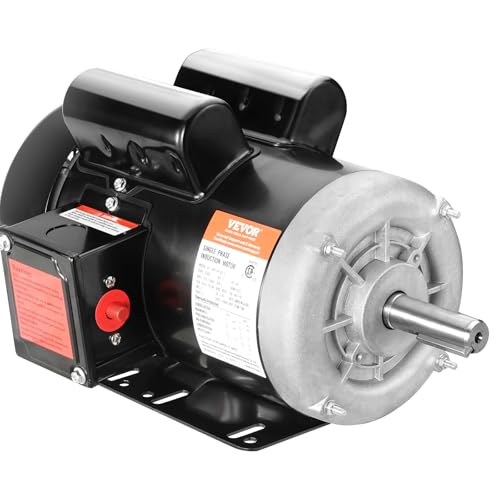
5. VEVOR 2HP Electric Motor
A hefty 2HP torque monster built for the toughest woodworking machines.
This VEVOR is a different animal from the 1HP budget pick above—it’s a true 2HP motor with a 143/5T frame and a 7/8″ keyed shaft. Instead of the fast 3450 RPM, it runs at a torquier 1725 RPM, which is perfect for heavy-duty table saws and machinery that needs grunt over speed. Weighing in at 44.1 pounds, it’s a substantial piece of copper and steel, and buyers have used it to replace 50-year-old Craftsman table saw motors with great success.
Like the 1HP version, it offers reversible CW/CCW rotation and has a rolled steel shell with overload protection. Quality is the top praised attribute with 28 mentions. However, the wiring is the recurring hurdle: the instructions are confusing, and reviewers point out the motor arrives pre-wired for 230V, not 120V. The knockout holes on the electrical box are also notoriously hard to remove—some owners had to use a mill or hole saw to open them.
It’s larger than a typical 3/4hp motor, so you may need to remove a fan housing for it to fit in tight spaces. This is a great deal on a powerful motor, but it demands a patient DIYer comfortable with wiring diagrams.
The Muscle
- Quality construction that owners say matches or beats older American motors.
- Reversible rotation adds versatility for different machine setups.
- The 1725 RPM speed is ideal for ripping hardwoods on cabinet saws.
The Grief
- Wiring instructions are tough to follow, especially since it ships pre-wired for 230V.
- Removing the knockouts for your conduit can feel like a blacksmithing project.
- It’s physically large, so check your machine’s motor bay for clearance.
Reach for this if: You have a heavy woodworking machine that needs a high-torque, slow-speed motor and you’re comfortable with electrical work.
Look elsewhere if: You want a simple swap—the setup here requires real mechanical and electrical aptitude.
6. Cuilvu 2HP Three Phase Motor

The VFD-ready industrial motor that powers belt grinders and lathes with silky smoothness.
This Cuilvu is a three-phase motor, which is a totally different world from the single-phase motors above. It requires 230V/460V three-phase power, which you won’t find in a standard home garage—but if you have a Variable Frequency Drive (VFD) to convert single-phase power, this is a star performer. It’s a 2HP, 3450 RPM motor with a 56C frame and 5/8″ shaft, and the TEFC (Totally Enclosed Fan Cooled) enclosure keeps dust out of the windings.
Buyers are using this on homemade 2×72 belt grinders and lathes with speed controllers, and they’re thrilled. One owner says it “runs smooth, plenty of power, and holds up under daily use,” praising its reliability. The wiring is easy, with a good instruction sheet. The mixed note is noise level—some call it quiet, while one buyer found the cooling fan slightly warped, creating a noticeable hum. It’s a solid unit that doesn’t overheat even on long jobs.
This is the crowd-pleaser for shops that have already invested in a VFD setup, offering smooth speed control that a single-phase motor can’t match.
Machine upgrade: If you’re building or upgrading a serious grinder, this motor paired with a VFD gives you variable speed and constant torque.
Not for standard outlets: You absolutely need a three-phase supply or a VFD—this will not run on a regular 120V wall plug.
7. Cuilvu 2HP Single Phase Motor

The 2HP single-phase upgrade that resurrects old table saws without tripping breakers.
This Cuilvu is the single-phase sibling to the three-phase motor above, and it’s the one that solves a very specific problem for woodworkers. It’s a 2HP motor running at 3450 RPM on standard 115V or 230V household current. It draws 18.2A on 115V or 9.1A on 230V, and it’s a TEFC (Totally Enclosed Fan Cooled) unit with a 56C frame and 5/8″ shaft. The key benefit is power without nuisance tripping; buyers use it to replace 1HP motors that were kicking breakers under load.
It’s a direct fit on many older saws, including a Rockwell Delta and an ancient Craftsman. One buyer notes it “fits right on my saw and runs like new.” It’s also reversible (CW/CCW). However, reliability has a mixed reputation: The most-discussed issue is bearings failing after about 8 months of use., so it’s not the motor for daily pro-shop abuse. Also, at 15.9 kg (about 35 pounds), it’s a hefty unit.
For a home hobbyist resurrecting a classic saw, the instant power boost is worth it. But if you run a professional shop, the long-term durability questions warrant caution.
Breaker breaker: The higher amperage rating on 115V means you can run a 2HP motor on a standard circuit where a weaker motor was failing.
Watch the wear: The reliability score is dragged down by early bearing failures—expect this to be a serviceable, not eternal, component.
8. Century USQ1202 Pool Motor

An American-made 2HP workhorse that shrugs off years of pool-pump duty.
This motor is all about reliability for pool pumps. The Century USQ1202 is a 2HP, 3450 RPM motor with a 48Y frame and a square flange mounting, built specifically to replace the motors on Sta-Rite and Pentair pumps. It’s made in the USA from cast iron, running on 230V with a max draw of 10.4 amps. Reliability is the most-praised attribute, with 61 buyers reporting years of smooth service—One owner’s unit ran for 7 years before needing a swap..
It’s very DIY-friendly; owners find it a perfect replacement and easy to install. The recurring complaint is noise, with a polarized split: many find it quiet, while a significant minority report a loud whine. Durability is the biggest asterisk, with 32 buyers flagging failures—some within the first year, with bearings typically failing around the 2.5-year mark.. This is the “loud motor” lottery of the pool world.
Still, at over 400 ratings, the majority of owners are happy with the value and performance, especially compared to paying a pool company to do it.
DIY saver: Swapping this in yourself can save hundreds versus a pro install, and it pairs perfectly with Sta-Rite pump bodies.
Volume warning: There’s a real chance you get a whiney one—set your expectations that noise can be hit or miss.
9. Century UST1202 Pool Motor

The round-flange legend that purrs like a kitten and outlasts cheaper rivals.
This is the round-flange version of the Century pool motor, designed for Hayward pumps. It’s a 2HP motor with a 10.4 amp draw on 230V, and it’s a direct swap for A.O. Smith motors (Century acquired A.O. Smith). Buyers specifically call out how quiet it is, with one owner noting it “purrs like a kitten!!” and another reporting it outlasted two Emerson/US Motors replacements in a row.
It’s an easy 30-minute replacement for most Hayward pumps and feels high-quality, with a stainless steel exterior resisting corrosion. The main downside is that the bearings can fail if water gets past the seal, and One owner reported smoke and power surges after just over a year of use.. Despite that occasional failure, the overwhelming consensus is that this is a durable, high-quality motor that justifies its premium price compared to no-name alternatives.
If you want the smoothest, quietest, and most reliable pool motor swap, this is the one to beat.
Quiet achiever: Expect a whisper-quiet, smooth-running motor that handles the daily grind of pool circulation with ease.
Protect the seal: The stainless shell resists rust, but a compromised shaft seal can let moisture in and shorten its life.
10. Century B381 Compressor Motor

The premium century-old design that brings 1970s compressors roaring back to life.
If you have a vintage compressor you can’t bear to part with, this is the motor for you. The Century B381 is a 2 HP SPL motor running at 3450 RPM, drawing 15.0/7.5 amps on 115/230V. It uses a flat rigid base mount with an M56 frame and a 5/8″ diameter shaft that’s 1 7/8″ long. It’s built with open drip-proof ball bearings and has a service factor of 1.0.
This motor is a direct upgrade for decades-old machines. One owner replaced a 40+ year-old motor and said the compressor “works like new at less than half cost of a new unit,” and It’s noticeably quieter than the old motor it replaced.. Installation is straightforward: it comes wired for 110V from the box, and switching to 220V is a “simple terminal switch,” per one buyer. Note that rotation is non-reversible CCW (counterclockwise only), so it’s a strict drop-in for standard compressors—not for setups needing reverse.
The catch is reliability of the restart button, with one buyer reporting a failure and a frustrating refund process. For most, though, this is a premium, durable rebuild candidate.
Anniversary gift: This is the definitive fix for keeping a classic compressor running for another few decades.
Check the button: The thermal reset button has failed for a few owners—it’s a simple part but an annoyance if yours goes out.
Understanding the Specs
Frame Size & Mount
The frame size (56, 56C, 48Y) defines the universal bolt pattern and shaft height so different brands can interchange. A 56 frame is the most common for home shop tools. A 56C frame has the same base but adds a “C-face” flange for direct, rigid coupling to pumps and gearboxes. Matching this is non-negotiable—a 56 motor won’t bolt to a 48Y mount without adapters.
Enclosure Type
OPD (Open Drip Proof) motors have vents that allow airflow but should stay in dry, indoor spaces—a stray hose spray could hit the windings. TEFC (Totally Enclosed Fan Cooled) motors seal the internal parts against dust and light moisture, making them the safer choice for farm and woodworking environments where debris flies around. For a pool pump, you’ll be looking at the specific flange type instead.
FAQ
What does the “SPL” rating mean on a 2HP electric motor?
What is the difference between a 56 frame and a 56C frame motor?
Will a 3450 RPM and a 1725 RPM motor work on the same machine?
Can I wire a 2HP motor to a standard 120V household outlet?
What is a TEFC enclosure and why should I care?
How do I know if my motor needs a 5/8-inch or 7/8-inch shaft?
What does “single phase” and “three phase” mean electrically?
Can I reverse the rotation direction of my motor?
Final Thoughts: The Verdict
For the majority of shoppers, the 2hp electric motor winner is the EDGE INDUSTRIAL EMZ Compressor Duty because it nails the three most important checks—frame, RPM, and shaft—and it’s a verified bolt-in for the most common compressor swap. If you want a reversible motor for a specific machine setup, the VEVOR 2HP is a powerful torquier option. And for resurrecting a classic table saw on a budget, the VEVOR 1HP delivers surprising punch for the price.
How We Picked
We do not accept paid placement. Every pick is matched to a real buyer and a real use-case; we do not hands-on test units.
Sources & Methodology
Specifications: manufacturer listings and product documentation. Review insights: verified customer reviews, as of August 2026. Pricing: not shown on this page (it changes often); check the current price via the retailer link.
As an Amazon Associate, Gadgets Feed earns from qualifying purchases. This does not affect which products we feature.