
The used studio monitor market is where smart studio builds happen — but it is also where worn-out drivers, blown tweeters, and deceptive listings hide in plain sight. Unlike consumer speakers that flatter your music, proper near-field monitors are designed to reveal every flaw in a mix, and a compromised second-hand unit will lie to you about your low end, your stereo image, and your transient detail. Buying blindly here means paying someone else to dispose of their damaged gear.
I’m Min — the co-founder and writer behind Gadgets Feed. I’ve spent hundreds of hours cross-referencing factory spec sheets, analyzing batch-level production changes in popular monitor lines, and mapping the failure patterns buyers of used gear encounter most often — from surround rot in rubber woofers to degraded ferrofluid in silk dome tweeters.
This guide cuts through the noise of impulse-used listings to help you identify monitors that still deliver truthful, uncolored playback. These are the best 2nd hand studio monitors for building a reliable, budget-conscious monitoring chain that won’t sabotage your mix decisions.
How To Choose The Best 2nd Hand Studio Monitors
The used monitor market is a minefield of cosmetic-only condition reports. A scuff-free cabinet can hide a woofer that has lost half its compliance, or a tweeter running on degraded ferrofluid that sounds harsh and spitty. Focus on three pillars: driver health, amplifier noise floor, and the bass reflex port’s integrity.
Driver Health and Surround Condition
The rubber or foam surround around the woofer cone is the first part to fail. Press gently around the cone — if the surround feels sticky, cracked, or has lost its spring-back, the low end will be loose and uncontrolled. On used passive radiators, check for dents in the cone material itself; a pushed-in dust cap can often be popped out, but a creased cone is permanently compromised.
Amplifier Noise and Hiss Floor
Every powered monitor has a self-noise floor, but on aging units, electrolytic capacitors in the power supply can drift, introducing a constant hiss or a 60 Hz hum that becomes audible in quiet passages. Power the monitor on with no input signal and place your ear six inches from the tweeter. A faint hiss is normal; a buzzing or crackling sound suggests failing PSU caps or a damaged amp module, both expensive to fix on a used monitor.
Frequency Response and Room Integration
The whole point of a studio monitor is to give you a flat, uncolored reference. Used units may have shifted response due to aged crossover capacitors — listen for a mid-range that sounds nasal or a treble that feels rolled off compared to a known reference. Check the rear panel: high-frequency trim and low-frequency cut switches let you compensate for room placement, but they cannot fix a damaged driver. Always request a serial number photo and look up the production year — rubber surrounds on some early 2010s models are known to develop porosity after a decade.
Quick Comparison
On smaller screens, swipe sideways to see the full table.
| Model | Category | Best For | Key Spec | Amazon |
|---|---|---|---|---|
| Yamaha HS5 (Pair) | Premium | Critical mixing & mastering | 45W LF + 25W HF bi-amp, 54Hz–30kHz | Amazon |
| JBL 305P MkII (Pair) | Premium | Wide sweet spot imaging | Image Control Waveguide, dual 41W Class-D | Amazon |
| ADAM Audio T5V (Single) | Premium | High-frequency detail retrieval | U-ART folded ribbon tweeter, 5” woofer | Amazon |
| PreSonus Eris E4.5 BT | Mid-Range | Desktop production & multimedia | 4.5” woven composite woofer, Bluetooth 5.0 | Amazon |
| Pioneer DJ DM-40D (White) | Mid-Range | DJ monitoring & beat matching | DSP 2-way mode, Class-D amp 96kHz sampling | Amazon |
| Edifier MR3 (Pair) | Mid-Range | Hi-Res monitoring & casual listening | 52Hz–40kHz, 18Wx2 RMS, Bluetooth 5.4 | Amazon |
| Audio-Technica AT-SP3X | Mid-Range | Compact turntable & streaming setup | Bluetooth multipoint, 76mm full-range driver | Amazon |
| Edifier R1280T | Budget | Entry-level vinyl monitoring | 13mm silk dome tweeter, 4” woofer, 42W RMS | Amazon |
| Micca PB42X (Pair) | Budget | Ultra-budget desktop near-field | Woven carbon fiber woofer, 15Wx2 Class-D | Amazon |
In‑Depth Reviews
1. Yamaha HS5 (Pair)

The Yamaha HS5 is the de facto standard for used monitor buyers who demand truthful, uncolored playback. Its 5-inch white-cone woofer and 1-inch dome tweeter are powered by a 70W bi-amp system (45W LF plus 25W HF) with a frequency response spanning 54 Hz to 30 kHz. In the used market, these hold value because the amplifier section uses robust electrolytic caps that rarely drift, and the sealed cabinet design reduces the risk of port noise or debris ingress in the bass reflex tube.
On used pairs, listen for the signature Yamaha mid-range clarity — the crossovers are set to ensure zero phase shift at the critical 2 kHz region where vocals and snare transients live. The XLR and TRS inputs accept balanced signals natively, so you can plug directly into any audio interface without adapters. A well-maintained HS5 pair from 2018 or later will still deliver a flat ±1.5 dB response down to 70 Hz, which is remarkable for a 5-inch monitor at this tier.
Inspect the rear panel for the room control switches (HIGH TRIM and ROOM CONTROL) — make sure the potentiometers are clean and don’t crackle when turned. The HS5’s bass reflex port is front-firing, so wall placement is less punishing than rear-port designs, making it a flexible choice for cramped studio corners. For mixing and mastering where tonal accuracy is non-negotiable, this is the safest used bet.
Why it’s great
- Industry-standard flat response for mix translation
- Bi-amped design with separate LF/HF amplification
- Front-firing port reduces wall-proximity coloration
Good to know
- No Bluetooth or wireless connectivity
- Bass roll-off below 70 Hz; subwoofer recommended for EDM
2. JBL 305P MkII (Pair)

The JBL 305P MkII brings JBL’s professional cinema sound heritage into a compact 5-inch near-field monitor. Its patented Image Control Waveguide shapes the high-frequency dispersion to create a wide, deep sweet spot that remains stable even when you move your head side to side — a critical advantage during long mixing sessions where ear fatigue from a narrow sweet spot is a real risk. The dual 41-watt Class-D amplifiers deliver clean headroom with a Slip Stream port that extends bass response without chuffing noise.
When inspecting a used pair, pay close attention to the waveguide’s surface — any dents or scratches will scatter the high frequencies unpredictably. The rear panel features Boundary EQ and HF Trim switches that compensate for desk or wall placement without affecting the monitor’s intrinsic tonal balance. The 5-inch woofer uses a woven composite cone that resists humidity-driven compliance shifts better than paper cones, which is a common failure mode in older used speakers stored in damp basements.
Reviews consistently note that the MkII generation fixed the hiss floor issues that plagued the original LSR305 series — the self-noise is now rated at 0 dBu, practically inaudible at listening position. The MDF cabinet is internally braced to reduce panel resonance, and the XLR/TRS combo jacks accept balanced signals from any interface. For producers who value stereo imaging and low-end punch in a compact foot-print, this is a premium used choice.
Why it’s great
- Wide sweet spot thanks to waveguide technology
- Low self-noise floor; suitable for quiet listening
- Boundary EQ and HF trim for room adaptation
Good to know
- Requires balanced cables (TRS or XLR) for best performance
- No Bluetooth input; wired-only connectivity
3. ADAM Audio T5V (Single)
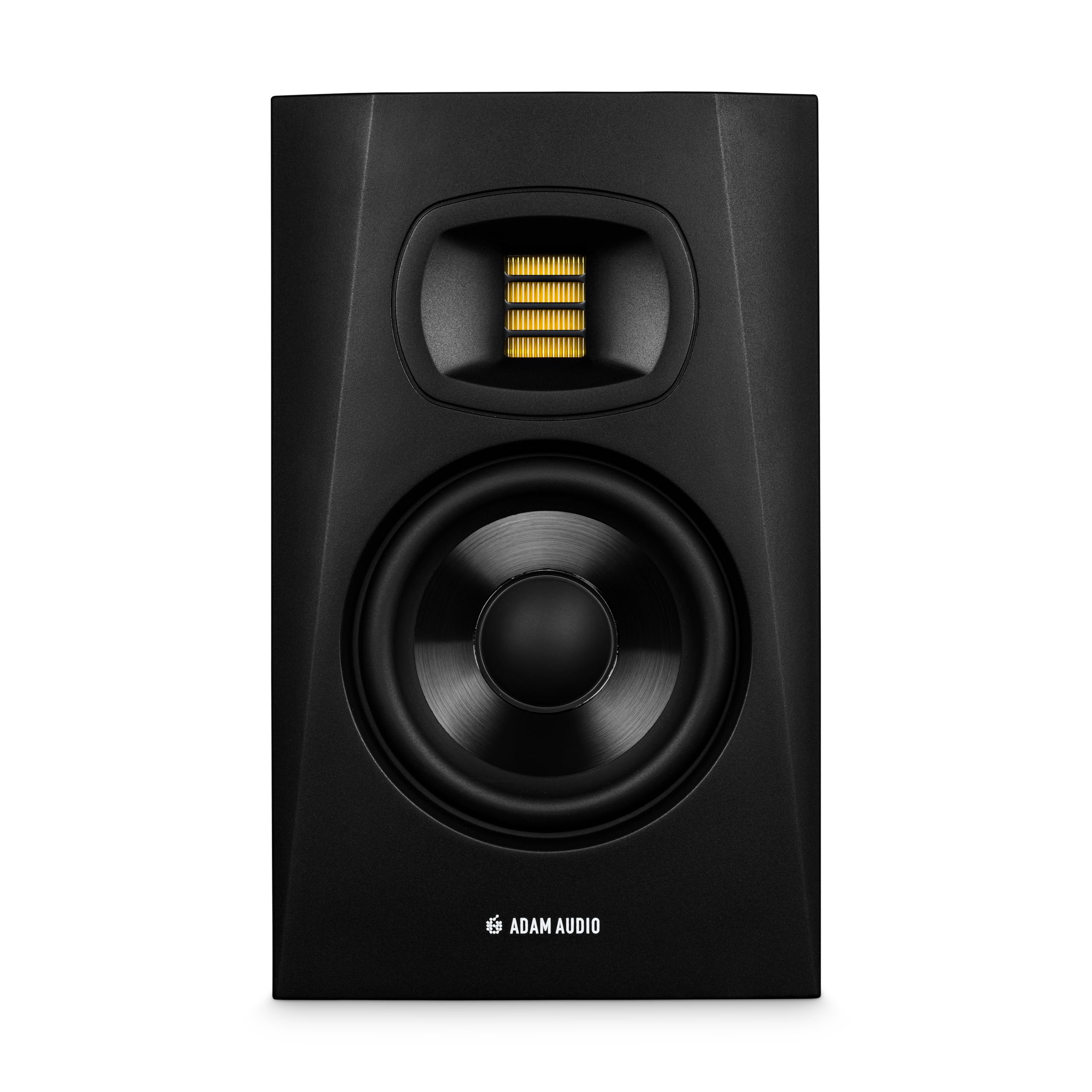
The ADAM Audio T5V stands apart from every other monitor in this guide because of its U-ART folded ribbon tweeter — a design that accelerates air through pleated folds to produce a transient response far faster than any dome tweeter. The result is an unnerving level of high-frequency detail that reveals sibilance, reverb tails, and subtle harmonic distortion that dome tweeters simply smear over. The 5-inch woofer works with a rear-firing bass reflex port tuned to 50 Hz, giving you usable low-end extension for a monitor this size.
In the used market, the U-ART tweeter is extremely durable — no ferrofluid to dry out, no dome to dent. The main failure point to check is the rear-firing port: make sure the cabinet has at least six inches of clearance behind it, or the bass will sound one-note and boomy. The DSP-based high-shelf and low-shelf filters on the rear panel allow ±2 dB adjustment, but these are clean digital corrections, not the crude analog EQ pots found on budget monitors that add noise at extreme settings.
Bear in mind that the T5V is sold as a single monitor, so a used pair purchase requires two separate listings — verify serial numbers are within a reasonable range (< 500 apart) to ensure matching driver tolerances. The XLR input only (no TRS) means you need a balanced source with XLR outputs or a quality adapter. For producers who need to hear every last nuance in their high-frequency content, this is the most revealing used monitor in the premium tier.
Why it’s great
- U-ART ribbon tweeter delivers unmatched high-frequency detail
- DSP room EQ filters; no analog noise added
- Durable tweeter design; no ferrofluid degradation
Good to know
- Sold as single unit; must buy two for stereo
- XLR input only — no TRS or RCA compatibility
4. PreSonus Eris E4.5 BT

The PreSonus Eris E4.5 BT bridges the gap between a true studio monitor and a multimedia speaker, offering a 4.5-inch woven composite woofer and a 1-inch silk dome tweeter powered by 50W (25W per side) Class AB amplification. The woven composite cone provides a faster decay than paper cones, which translates to tighter bass and clearer mid-range transient detail. Bluetooth 5.0 allows you to A/B your mix against a wireless reference without leaving the listening position, which is a huge workflow advantage for producers who check mixes on consumer devices.
In the used market, the acoustic tuning controls on the rear panel (high and low frequency trim) allow ±6 dB adjustment to compensate for room modes, but be cautious — if the previous owner cranked the low-frequency trim to +6 dB for a boomy sound, the 4.5-inch woofer may have been driven beyond its linear excursion range, causing voice coil rubbing. Listen for a scratching sound when playing a 60 Hz sine wave. The front panel headphone jack and stereo aux input are convenient for private monitoring and smartphone referencing, but the headphone output has a slightly higher noise floor than dedicated headphone amps.
Reviews highlight that while the E4.5 BT excels at detailed near-field clarity, it loses fullness when trying to fill a large room — this is expected for a 4.5-inch driver. The bundled Studio One Prime software adds worth of production tools, but verify the software license has not been redeemed by the previous seller. For a used desk monitor that doubles as a production tool and casual listener, this is the most feature-packed mid-range option.
Why it’s great
- Bluetooth 5.0 for wireless mixing reference
- Acoustic tuning controls for room correction
- Comes with Studio One Prime music production suite
Good to know
- 4.5” driver limits low-end extension in large rooms
- Headphone output has moderate noise floor
5. Pioneer DJ DM-40D (White)

The Pioneer DJ DM-40D is uniquely designed for the dual role of DJ monitoring and production, with a physical switch that toggles between DJ and Production DSP modes. In DJ mode, the DSP emphasizes punch and transient attack for beat matching, while production mode flattens the response for mixing decisions. The 4-inch woofer and DECO convex diffuser tweeter use a time-aligned baffle to ensure the acoustic centers of both drivers align at the listening position, which improves phase coherence and stereo imaging accuracy.
When checking a used DM-40D, the critical inspection point is the DSP mode switch — it should click firmly with no looseness, and both modes should sound distinctly different when toggled mid-playback. The front-panel headphone socket is a godsend for cueing during DJ practice, but it only outputs a summed mono signal, not stereo. The rear RCA and mini-jack inputs are straightforward, and the 96 kHz sampling DSP engine keeps the AD/DA conversion clean even after years of use.
Reviews note that the DM-40D’s bass is punchy and impressive for a 4-inch driver, but the treble can feel slightly emphasized in production mode, with a dip in the upper mids around 2–4 kHz that can leave vocals and guitars sounding a bit recessed. This is a deliberate voicing for DJs who need to hear beat transients clearly, but it makes the DM-40D less suitable as a pure mixing monitor for critical vocal work. For a used monitor that excels in the DJ booth and doubles as a respectable production tool, this is a specialized pick.
Why it’s great
- Dual DSP modes for DJing and production
- Time-aligned drivers for coherent stereo image
- Front-panel headphone output for cueing
Good to know
- Upper-mid dip can make vocals sound recessed
- Headphone output is mono summed, not stereo
6. Edifier MR3 (Pair)

The Edifier MR3 is a Hi-Res Audio certified monitor that delivers a flat frequency response from 52 Hz to 40 kHz, with 18W x 2 RMS output and a peak SPL of 92.5 dB. The 3.5-inch mid-low driver and 1-inch tweeter are housed in an MDF cabinet that reduces panel resonance, and the rear panel features balanced TRS inputs alongside RCA and AUX — a rare connectivity suite at this price tier. Bluetooth 5.4 with multi-point allows you to switch between a computer and phone without re-pairing, which is a workflow advantage for A/B referencing.
A used pair of MR3s should be checked for Bluetooth pairing button wear — the button is on the back of the main speaker and can become unresponsive after heavy use. The front-panel volume knob and headphone output are built on an Alps-type potentiometer that is rated for 10,000 rotations, so feel for any scratchiness when turning. The EDIFIER ConneX app offers Music, Monitor, and Custom sound modes with parametric EQ, but verify the app connects to the used unit — some older firmware revisions have Bluetooth pairing quirks.
Reviews consistently praise the MR3 for its clean, neutral sound with zero hiss at idle — a strong indicator of a well-shielded amplifier section. The MDF cabinet weighs enough to resist resonance at moderate volumes, and the detachable power cable uses a standard C7 figure-8 connector, which is easy to replace if lost. For a used monitor that supports both studio-grade balanced inputs and convenient Bluetooth, this is the most versatile mid-range option.
Why it’s great
- Hi-Res Audio certified up to 40kHz
- Balanced TRS, RCA, and AUX inputs plus Bluetooth 5.4
- App-based parametric EQ for room tuning
Good to know
- 3.5” woofer limits low-end extension without subwoofer
- Bluetooth pairing button on rear can wear out
7. Audio-Technica AT-SP3X

The Audio-Technica AT-SP3X is a compact bookshelf speaker that leans toward living-room friendly design while still offering the clarity necessary for entry-level monitoring. Its 76 mm full-range driver is tuned for a bass-boosted curve that makes vinyl and streaming content sound impressive, but this voicing is not flat enough for critical mixing or mastering. The Bluetooth multipoint function lets you connect to two devices simultaneously — ideal for switching between a turntable and a phone without re-pairing.
The dual RCA jacks on the rear panel are simple and reliable, but there is no balanced input option, so ground loops can be an issue in complex studio setups. The included international AC adapter is a nice bonus for traveling musicians, but verify the adapter’s barrel connector is not loose — a common wear point.
Reviews highlight that the AT-SP3X gets remarkably loud for its size, with a bass presence that feels heavy on certain tracks — this is the bass boost circuit at work, not a flat monitor response. For producers who need to check how their mix sounds on a “fun” consumer system without leaving the desk, the AT-SP3X serves as a secondary reference pair. For primary mixing, stick to monitors with flatter response curves.
Why it’s great
- Bluetooth multipoint for dual-device connectivity
- Compact size fits small desks and bookshelves
- Bass-boosted tuning sounds impressive with vinyl
Good to know
- Not flat enough for critical mixing or mastering
- No balanced inputs; RCA only
8. Edifier R1280T

The Edifier R1280T is an entry-level powered bookshelf speaker that uses a 13 mm silk dome tweeter and a 4-inch full-range woofer to deliver 42W RMS of natural sound reproduction. Its classic wood-effect MDF cabinet and dual AUX inputs make it a flexible choice for connecting a turntable and a computer simultaneously, with a remote control for volume adjustment — a rarity at this price tier. The side panel bass and treble knobs allow ±6 dB EQ adjustment, which can compensate for placement near walls.
On the used market, the R1280T’s main weakness is its bass extension — the 4-inch woofer rolls off steeply below 80 Hz, and there is no subwoofer output to add a dedicated sub. The amplifier section uses a simple Class AB design that can exhibit a slight hum if the power supply capacitors are aging; listen for a 60 Hz buzz when no signal is playing. The wood-effect vinyl finish can peel if exposed to humidity, so inspect the cabinet corners for lifting edges.
Reviews consistently note that the R1280T is easy to set up and produces clear mids and crisp highs that outshine similarly priced plastic speakers. The remote control operates via IR and requires line-of-sight, so the sensor on the front panel must be unobstructed. For a used pair under that can serve as reference speakers for entry-level vinyl playback or casual desktop monitoring, the R1280T delivers reliable value without the risk of a blown driver that heavier use might cause on more expensive used monitors.
Why it’s great
- Dual AUX inputs for simultaneous device connection
- Remote control for volume convenience
- Side panel bass and treble EQ for room adaptation
Good to know
- No subwoofer output; limited low-end extension
- Wood-effect vinyl can peel in humid environments
9. Micca PB42X (Pair)

The Micca PB42X is a compact active near-field monitor that punches far above its size class thanks to a balanced woven carbon fiber woofer and a high-performance silk dome tweeter. The carbon fiber cone is exceptionally stiff for its mass, which means the woofer can track fast transients without cone breakup, resulting in surprisingly clean mid-bass and punchy kick drum reproduction. The ported enclosure is tuned for extended bass response with low port noise, and the built-in Class-D amplifier delivers 15W x 2 of clean power.
In the used market, the PB42X’s key inspection point is the 4-inch woofer surround — while the carbon fiber cone itself is nearly indestructible, the rubber surround is glued to a plastic frame that can develop hairline cracks if the monitor was stored in a hot car. The rear panel has a simple RCA input with a built-in volume knob — no balanced inputs, no subwoofer output. The front panel features a 3.5mm headphone jack and a power LED, both of which should function without flickering.
Reviews consistently praise the PB42X for its vocal clarity and neutral mid-range, with many users noting that it outperforms the more expensive Audioengine A2+ in terms of transient response. The bass rolls off gracefully around 80 Hz, so a subwoofer is recommended for electronic music production. The included RCA cable, speaker wire, and adhesive rubber feet make setup straightforward. For a used pair under that delivers studio-quality clarity in a compact desk footprint, this is the ultimate budget champion.
Why it’s great
- Woven carbon fiber woofer for tight, clean bass
- Excellent vocal clarity and neutral mid-range
- Compact size fits small desks without sacrificing sound
Good to know
- No balanced inputs; RCA only
- Bass rolls off below 80 Hz; subwoofer recommended
FAQ
How can I test the driver condition of a used studio monitor without playing it loud?
What is the maximum age I should consider for buying 2nd hand studio monitors?
Should I avoid monitors with scratched woofer cones or dented tweeter domes?
Final Thoughts: The Verdict
For most users, the best 2nd hand studio monitors winner is the Yamaha HS5 (Pair) because its bi-amped design, robust amplifier section, and industry-standard flat response minimize the risks of buying used — these monitors hold their spec tolerance for over a decade when properly stored. If you need wide sweet spot imaging and low self-noise, grab the JBL 305P MkII (Pair). And for budget-conscious producers who want vocal clarity and transient snap at a steal, nothing beats the Micca PB42X (Pair).